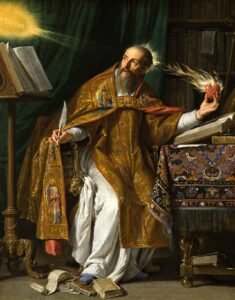
Augustine of Hippo
A professor of rhetoric at Milan, baptized at Easter 387 after reading a verse of Paul in a garden.
The record
- Born
- November 13, 354, Thagaste, Roman Africa
- Converted
- Milan, late summer 386
- Baptized
- Easter 387, at Milan
- Became
- Bishop of Hippo Regius, c. 395
- Died
- August 28, 430, Hippo
- As a witness
- In the library →
Augustine wrote the Confessions at Hippo about A.D. 397, some ten years after the events it records. In the late summer of 386 he was thirty-one, a professor of rhetoric at Milan, and unbaptized. The account is his own, in E. B. Pusey’s translation of 1838. The scene is a garden at Milan; his friend Alypius was sitting near him.
But when a deep consideration had from the secret bottom of my soul drawn together and heaped up all my misery in the sight of my heart; there arose a mighty storm, bringing a mighty shower of tears. Which that I might pour forth wholly, in its natural expressions, I rose from Alypius: solitude was suggested to me as fitter for the business of weeping; so I retired so far that even his presence could not be a burden to me. … I cast myself down I know not how, under a certain fig-tree, giving full vent to my tears; and the floods of mine eyes gushed out an acceptable sacrifice to Thee. And, not indeed in these words, yet to this purpose, spake I much unto Thee: and Thou, O Lord, how long? how long, Lord, wilt Thou be angry for ever? Remember not our former iniquities, for I felt that I was held by them. I sent up these sorrowful words: How long, how long, “tomorrow, and tomorrow?” Why not now? why not is there this hour an end to my uncleanness?Augustine, Confessions VIII.12 (tr. E. B. Pusey, 1838)
The narrative continues without a break:
So was I speaking and weeping in the most bitter contrition of my heart, when, lo! I heard from a neighbouring house a voice, as of boy or girl, I know not, chanting, and oft repeating, “Take up and read; Take up and read.” Instantly, my countenance altered, I began to think most intently whether children were wont in any kind of play to sing such words: nor could I remember ever to have heard the like. So checking the torrent of my tears, I arose; interpreting it to be no other than a command from God to open the book, and read the first chapter I should find. For I had heard of Antony, that coming in during the reading of the Gospel, he received the admonition, as if what was being read was spoken to him: Go, sell all that thou hast, and give to the poor, and thou shalt have treasure in heaven, and come and follow me: and by such oracle he was forthwith converted unto Thee. Eagerly then I returned to the place where Alypius was sitting; for there had I laid the volume of the Apostle when I arose thence. I seized, opened, and in silence read that section on which my eyes first fell: Not in rioting and drunkenness, not in chambering and wantonness, not in strife and envying; but put ye on the Lord Jesus Christ, and make not provision for the flesh, in concupiscence. No further would I read; nor needed I: for instantly at the end of this sentence, by a light as it were of serenity infused into my heart, all the darkness of doubt vanished away.Augustine, Confessions VIII.12 (tr. E. B. Pusey, 1838)
Augustine marked the place and showed the passage to Alypius, who read on past the verse where Augustine had stopped, applied the words that followed to himself, and joined him. The two then went indoors to Augustine’s mother, Monica.
Thence we go in to my mother; we tell her; she rejoiceth: we relate in order how it took place; she leaps for joy, and triumpheth, and blesseth Thee, Who are able to do above that which we ask or think; for she perceived that Thou hadst given her more for me, than she was wont to beg by her pitiful and most sorrowful groanings. For thou convertedst me unto Thyself, so that I sought neither wife, nor any hope of this world, standing in that rule of faith, where Thou hadst showed me unto her in a vision, so many years before. And Thou didst convert her mourning into joy, much more plentiful than she had desired, and in a much more precious and purer way than she erst required, by having grandchildren of my body.Augustine, Confessions VIII.12 (tr. E. B. Pusey, 1838)
At the close of the vintage vacation Augustine gave up his chair of rhetoric and wrote to Ambrose, the bishop of Milan.
The vintage-vacation ended, I gave notice to the Milanese to provide their scholars with another master to sell words to them; for that I had both made choice to serve Thee, and through my difficulty of breathing and pain in my chest was not equal to the Professorship. And by letters I signified to Thy Prelate, the holy man Ambrose, my former errors and present desires…Augustine, Confessions IX (tr. E. B. Pusey, 1838)
Augustine was baptized at Milan at Easter, 387, together with Alypius and with his son Adeodatus, then in his sixteenth year.
Him we joined with us, our contemporary in grace, to be brought up in Thy discipline: and we were baptised, and anxiety for our past life vanished from us.Augustine, Confessions IX (tr. E. B. Pusey, 1838)
Monica died at Ostia later that year, as they waited to sail for Africa. Augustine was ordained priest at Hippo Regius in 391 and became its bishop about 395.