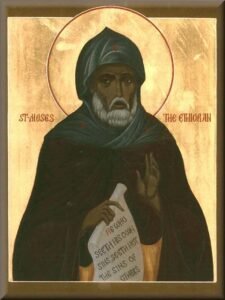
Moses the Black
An Ethiopian robber-chief who became a desert monk and died a martyr.
The record
- Born
- c. 330 (traditional), Egypt
- Converted
- left banditry for the monastic life at Scete
- Became
- a monk and priest, renowned for humility
- Died
- c. 405, at Scete, killed in a raid on the monastery
- Feast
- August 28
Moses the Black — also called Moses the Ethiopian — began as a slave, dismissed by his master for theft and violence, and became the leader of a band of robbers in Egypt. Palladius, who gathered the desert stories a generation later, does not spare him:
A certain Moses — this was his name — an Ethiopian by race and black, was house-servant to a government official. His own master drove him out because of his immorality and brigandage. For he was said to go even the length of murder.Palladius, The Lausiac History, tr. W. K. Lowther Clarke (1918)
Then he gave himself up to the monastic life in the desert of Scete. The old life did not let go easily; once, robbers set upon his cell, not knowing who lived there. He overpowered all four:
He tied them all together and, putting them on his back like a truss of straw, brought them to the church of the brethren, saying: Since I am not allowed to hurt anyone, what do you bid me do with these?Palladius, The Lausiac History, tr. Lowther Clarke (1918)
He became known for a humility that refused to judge anyone. The Sayings of the Fathers tell of the day the monks summoned him to sit in judgment on a brother’s fault:
he took a basket with a hole in it and filled it with sand, and carried it upon his shoulders… my sins which are running down behind me and I cannot see them, and I, even I, have come this day to judge shortcomings… which are not mine.Abba Moses, in E. A. Wallis Budge, The Paradise of the Holy Fathers (1907)
He became a monk and, in time, a priest at Scete; Palladius records that he died there at seventy-five, with seventy disciples. The Sayings preserve the manner of it. When word came that barbarians were descending on the monastery, Moses would not flee or fight:
Behold, this day have the barbarians come to Scete; rise up and flee.Abba Moses, in Budge, The Paradise of the Holy Fathers (1907)
Those who take the sword shall perish by the sword.Abba Moses (quoting Matthew 26:52), in Budge, The Paradise of the Holy Fathers (1907)
Moses was killed with six companions in the raid. A brother hidden among the palm leaves said afterward that he saw “seven crowns come down and place themselves on the heads of those who had been slain.”