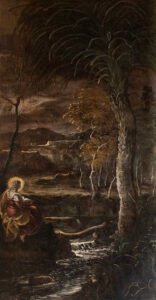
Mary of Egypt
Turned back from the church door, she lived 47 years in the desert.
The record
- Born
- c. 344 (traditional), Egypt
- Converted
- at the church door in Jerusalem, on the feast of the Exaltation of the Cross
- Became
- a desert hermit beyond the Jordan for about 47 years
- Died
- c. 421 (traditional); found by the monk Zosimas
- Feast
- April 1; the fifth Sunday of Great Lent (Byzantine)
Mary of Egypt is a figure of Christian tradition, her dates uncertain and placed by the old accounts in the fifth century. As a young woman she left home for Alexandria and lived many years in dissolute life. She joined a company of pilgrims sailing to Jerusalem for the feast of the Exaltation of the Cross. In her own account, given long afterward, she came with the crowd to the church door and could go no further:
…found myself withheld from entering the place by some secret but invisible force. This happening to me three or four times, I retired into a corner of the court and began to consider with myself what this might proceed from; and seriously reflecting that my criminal life might be the cause, I melted into tears.Mary of Egypt, in Alban Butler, The Lives of the Saints (1866 edition)
Above her she saw a picture of the Mother of God, and prayed before it. Then she went back to the door:
I besought her that I might be suffered to enter the church doors to behold the sacred wood of my redemption… I went up with ease into the very middle of it, and had the comfort to venerate the precious wood of the glorious cross.Mary of Egypt, in Butler, The Lives of the Saints (1866)
After she had prayed, she reported hearing a voice:
If thou goest beyond the Jordan, thou shalt there find rest and comfort.the voice Mary of Egypt reported, in Butler, The Lives of the Saints (1866)
She bought three loaves, and at daybreak she crossed the river and vanished into the wilderness:
Next morning… I passed the Jordan; and from that time I have carefully shunned the meeting of any human creature.Mary of Egypt, in Butler, The Lives of the Saints (1866)
Many years later the monk Zosimas came upon her deep in the desert and asked how long she had lived there:
It is… as near as I can judge, forty-seven years.Mary of Egypt, in Butler, The Lives of the Saints (1866)
Her story, told in the Life attributed to St. Sophronius of Jerusalem, made her one of the most beloved of the penitent saints in East and West. The Roman Martyrology keeps her on 1 April; the Byzantine churches commemorate her on the fifth Sunday of Great Lent.