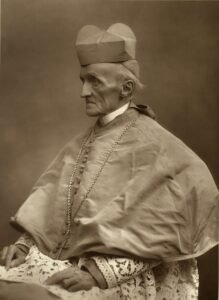
Henry Edward Manning
Archdeacon of Chichester who left the Church of England after the Gorham Judgment.
The record
- Born
- July 15, 1808, Totteridge, Hertfordshire
- Converted
- received into the Catholic Church, April 6, 1851, London
- Became
- Archbishop of Westminster (1865); cardinal (1875)
- Died
- January 14, 1892, London
Henry Edward Manning was Archdeacon of Chichester, a celebrated preacher, and a friend of William Gladstone — ordained an Anglican priest in 1832 and made an archdeacon in 1840. He was, by the middle of the century, one of the most prominent clergymen in the Church of England.
In March 1850 the Judicial Committee of the Privy Council — a civil court — handed down the Gorham Judgment. The Bishop of Exeter had refused to install a clergyman who denied that baptism conferred spiritual regeneration; the clergyman appealed to the Crown’s court, and the court ordered him installed. A secular tribunal had settled a question of doctrine. Within the year Manning resigned his archdeaconry and his benefice and left the Church of England.
Years afterward, in an autobiographical note, he set down the day of his reception into the Catholic Church:
On 6th April 1851, Passion Sunday, Hope and I went to Father Brownbill in Hill Street and were received. I, before High Mass, and he after it.Cardinal Manning, autobiographical note, in E. S. Purcell, Life of Cardinal Manning (1896)
“So ended one life,” he wrote. He expected the step to cost him his career and to end in obscurity:
I fully believed that I should never do more than become a priest; about which I never doubted, nor ever wavered. But I looked forward to live and die in a priest’s life, out of sight.Cardinal Manning, autobiographical note, in Purcell, Life of Cardinal Manning (1896)
It did not end in obscurity. Manning was ordained a Catholic priest ten weeks after his reception. In 1865 he was appointed Archbishop of Westminster, and in 1875 Pope Pius IX created him a cardinal. In 1889 he acted as a mediator in the London Dock Strike, helping to bring the great labour dispute to a settlement. He died in London on 14 January 1892.