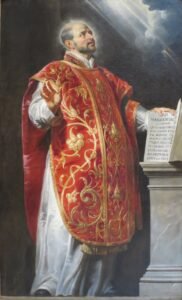
Ignatius of Loyola
Wounded at Pamplona in 1521; converted while reading a Life of Christ and lives of the saints.
The record
- Born
- 1491, Loyola, Basque Country
- Wounded
- siege of Pamplona, 1521
- Converted
- during his recovery at Loyola
- Became
- founder of the Society of Jesus (approved 1540)
- Died
- July 31, 1556, Rome
The story of Ignatius of Loyola’s conversion survives in the Autobiography he dictated late in life, in which he refers to himself in the third person as “the pilgrim.” The translation is J. F. X. O’Conor’s, published in 1900. He was a Basque nobleman and soldier. It begins with the wound that ended his military career, at the French siege of Pamplona in 1521.
Ignatius stood fighting bravely until a cannon ball of the enemy broke one of his legs and seriously injured the other. When he fell, the citadel was surrendered.Autobiography of St Ignatius (tr. J. F. X. O’Conor, 1900)
He was carried home to the castle of Loyola to recover. He asked for romances of chivalry to pass the time; there were none in the house.
They gave him, instead, “The Life of Christ,” by Rudolph, the Carthusian, and another book called the “Flowers of the Saints,” both in Spanish. By frequent reading of these books he began to get some love for spiritual things.Autobiography of St Ignatius (tr. J. F. X. O’Conor, 1900)
The reading set two kinds of ambition against each other in him — the worldly life he had led, and the lives of the saints he was now reading.
“St. Dominic did this; I, too, will do it.” “St. Francis did this; therefore I will do it.” These heroic resolutions remained for a time, and then other vain and worldly thoughts followed. This succession of thoughts occupied him for a long while, those about God alternating with those about the world.Autobiography of St Ignatius (tr. J. F. X. O’Conor, 1900)
He noticed that the two kinds of thought left him differently — and, by his own account, this was the beginning of what he would later teach as the discernment of spirits.
When he thought of worldly things it gave him great pleasure, but afterward he found himself dry and sad. But when he thought of journeying to Jerusalem, and of living only on herbs, and practising austerities, he found pleasure not only while thinking of them, but also when he had ceased. … He learned by experience that one train of thought left him sad, the other joyful. This was his first reasoning on spiritual matters.Autobiography of St Ignatius (tr. J. F. X. O’Conor, 1900)
On recovering, Ignatius laid up his sword at the shrine of Montserrat and withdrew to Manresa, where he began the notes that became the Spiritual Exercises. He later founded the Society of Jesus, approved in 1540. He was born at Loyola in 1491 and died at Rome in 1556.