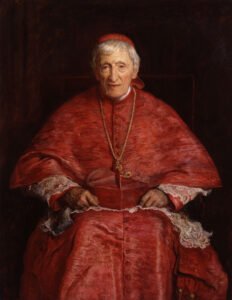
John Henry Newman
Leader of the Oxford Movement; received into the Catholic Church in 1845. His Apologia is the source.
The record
- Born
- February 21, 1801, London
- Received
- into the Catholic Church, October 9, 1845, Littlemore
- By
- Bl. Dominic Barberi, Passionist
- Became
- cardinal, 1879; canonized 2019
- Died
- August 11, 1890, Birmingham
John Henry Newman was the intellectual leader of the Oxford Movement in the Church of England. He told the story of his religious development in the Apologia Pro Vita Sua, published in 1864. A turning point came in 1839, while he was studying the history of the fifth-century Monophysite controversy and a friend pointed him to a sentence of St Augustine quoted in a review.
He repeated these words again and again, and, when he was gone, they kept ringing in my ears. “Securus judicat orbis terrarum;” they were words which went beyond the occasion of the Donatists: they applied to that of the Monophysites.J. H. Newman, Apologia Pro Vita Sua (1864)
For a mere sentence, the words of St. Augustine, struck me with a power which I never had felt from any words before. To take a familiar instance, they were like the “Turn again Whittington” of the chime; or, to take a more serious one, they were like the “Tolle, lege,–Tolle, lege,” of the child, which converted St. Augustine himself. “Securus judicat orbis terrarum!” By those great words of the ancient Father, interpreting and summing up the long and varied course of ecclesiastical history, the theory of the Via Media was absolutely pulverized.J. H. Newman, Apologia Pro Vita Sua (1864)
Newman withdrew to Littlemore and, after several more years, resigned his position in the Church of England. He was received into the Catholic Church by the Passionist Father Dominic Barberi at Littlemore on 9 October 1845. Writing of the years since, he described the effect of the step.
I was not conscious to myself, on my conversion, of any change, intellectual or moral, wrought in my mind. I was not conscious of firmer faith in the fundamental truths of Revelation, or of more self-command; I had not more fervour; but it was like coming into port after a rough sea; and my happiness on that score remains to this day without interruption.J. H. Newman, Apologia Pro Vita Sua (1864)
Newman was made a cardinal in 1879. He was born in London in 1801 and died at Birmingham in 1890; he was canonized in 2019.