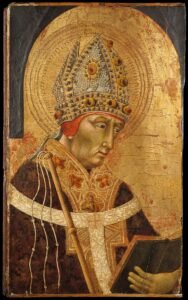
Ambrose of Milan · A.D. 339–397 A.D. 390
“Lastly, though to others it is commanded, Let down your nets, to Peter alone it is said, Launch out into the deep, i. e. into deep researches. What is so deep, as the knowledge of the Son of God!”
Ambrose of Milan · A.D. 339–397 A.D. 390
“Perhaps you will say, "I see something else, how is it that you assert that I receive the Body of Christ?" And this is the point which remains for us to prove. And what evidence shall we make use of? Let us prove that this is not what nature made, but what the blessing consecrated, and the power of blessing is greater than that of nature, because by blessing nature itself is changed.”
Ambrose of Milan · A.D. 339–397 A.D. 397
“(in Luc. c. iii.) He therefore names specially two authors of His birth—one who received the promise concerning the kindreds of the people, the other who obtained the oracle concerning the generation of Christ; and though he is later in order of succession is yet first named, inasmuch as it is greater to have received the promise concerning Christ than concerning the Church, which is through Christ; for greater is He who saves than that which is saved.”
Ambrose of Milan · A.D. 339–397 A.D. 397
“(in Luc. cap. 3. lib. iii. n. 7, 8.) For Abraham was the first who deserved the witness of faith; He believed God, and it was accounted to him for righteousness. It behoved therefore that he should be set forth as the first in the line of descent, who was the first to deserve the promise of the restoration of the Church, In thee shall all the nations of the earth be blessed. And it is again brought to a period in David, for that Jesus should be called his Son; hence to him is preserved the privilege, that from him should come the beginning of the Lord’s genealogy.”
Ambrose of Milan · A.D. 339–397 A.D. 397
“(in Luc. c. 3.) But Luke has avoided the mention of these, that he might set forth the series of the priestly race immaculate. But the plan of St. Matthew did not exclude the righteousness of natural reason; for when he wrote in his Gospel, that He who should take on Him the sins of all, was born in the flesh, was subject to wrongs and pain, he did not think it any detraction from His holiness that He did not refuse the further humiliation of a sinful parentage. Nor, again, would it shame the Church to be gathered from among sinners, when the Lord Himself was born of sinners; and, lastly, that the benefits of redemption might have their beginning with His own forefathers: and that none might imagine that a stain in their blood was any hindrance to virtue, nor again any pride themselves insolently on nobility of birth.”
Ambrose of Milan · A.D. 339–397 A.D. 397
“(ubi sup.) Observe that Matthew does not name both without a meaning; for though the object of his writing only required the mention of Phares, yet in the twins a mystery is signified; namely, the double life of the nations, one by the Law, the other by Faith.”
Ambrose of Milan · A.D. 339–397 A.D. 397
“(ubi sup.) But how did Ruth who was an alien marry a man that was a Jew? and wherefore in Christ’s genealogy did His Evangelist so much as mention a union, which in the eye of the law was bastard? Thus the Saviour’s birth of a parentage not admitted by the law appears to us monstrous, until we attend to that declaration of the Apostle, The Law was not given for the righteous, but for the unrighteous. (1 Tim. 1:9.) For this woman who was an alien, a Moabitess, a nation with whom the Mosaic Law forbad all intermarriage, and shut them totally out of the Church, how did she enter into the Church, unless that she were holy and unstained in her life above the Law? Therefore she was exempt from this restriction of the Law, and deserved to be numbered in the Lord’s lineage, chosen from the kindred of her mind, not of her body. To us she is a great example, for that in her was prefigured the entrance into the Lord’s Church of all of us who are gathered out of the Gentiles.”
Ambrose of Milan · A.D. 339–397 A.D. 397
“(ubi sup.) But the holy David is the more excellent in this, that he confessed himself to be but man, and neglected not to wash out with the tears of repentance the sin of which he had been guilty, in so taking away Urias’ wife. Herein shewing us that none ought to trust in his own strength, for we have a mighty adversary whom we cannot overcome without God’s aid. And you will commonly observe very heavy sins befalling to the share of illustrious men, that they may not from their other excellent virtues be thought more than men, but that you may see that as men they yield to temptation.”
Ambrose of Milan · A.D. 339–397 A.D. 397
“(In Luc. cap. 2.) That there were two kings of the name of Joakim, is clear from the Book of Kings. And Joakim slept with his fathers, and Joachin his son reigned, in his stead. (2 Kings 24:6.) This son is the same whom Jeremiah calls Jeconias. And rightly did St. Matthew purpose to differ from the Prophet, because he sought to shew therein the great abundance of the Lord’s mercies. For the Lord did not seek among men nobility of race, but suitably chose to be born of captives and of sinners, as He came to preach remission of sin to the captives. The Evangelist therefore did not conceal either of these; but rather shewed them both, inasmuch as both were called Jeconias.”
Ambrose of Milan · A.D. 339–397 A.D. 397
“Of whom Jeremiah speaks. Write this man dethroned; for there shall not spring of his seed one sitting on the throne of David. (Jer. 22:30.) How is this said of the Prophet, that none of the seed of Jeconias should reign? For if Christ reigned, and Christ was of the seed of Jeconiah, then has the Prophet spoken falsely. But it is not there declared that there shall be none of the seed of Jeconiah, and so Christ is of his seed; and that Christ did reign, is not in contradiction to the prophecy; for He did not reign with worldly honours, as He said, My kingdom is not of this world. (John 18:36.)”
Ambrose of Milan · A.D. 339–397 A.D. 397
“(in Luc. c. 3.) Let us not think this is to be overlooked, that though there were seventeen Kings of Judæa between David and Jeconiah, Matthew only recounts fourteen. We must observe that there might be many more successions to the throne than generations of men; for some may live longer and beget children later; or might be altogether without seed; thence the number of Kings and of generations would not coincide.”
Ambrose of Milan · A.D. 339–397 A.D. 397
“(ubi sup.) Again, from Jeconiah to Joseph are computed twelve generations; yet he afterwards calls these also fourteen. But if you look attentively, you will be able to discover the method by which fourteen are reckoned here. Twelve are reckoned including Joseph, and Christ is the thirteenth; and history declares that there were two Joakims, that is two Jeconiahs, father and son. The Evangelist has not passed over either of these, but has named them both. Thus, adding the younger Jeconiah, fourteen generations are computed.”
Ambrose of Milan · A.D. 339–397 A.D. 397
“(De Spir. Sanct. ii. 5.) That which is of any thing is either of the substance or the power of that thing; of the substance, as the Son who is of the Father; of the power, as all things are of God, even as Mary was with child of the Holy Spirit.”
Ambrose of Milan · A.D. 339–397 A.D. 397
“(in Luc. ii. 5.) St. Matthew has beautifully taught how a righteous man ought to act, who has detected his wife’s disgrace; so as at once to keep himself guiltless of her blood, and yet pure from her defilements; therefore it is he says, Being a just man. Thus is preserved throughout in Joseph the gracious character of a righteous man, that his testimony may be the more approved; for, the tongue of the just speaketh the judgment of truth.”
Ambrose of Milan · A.D. 339–397 A.D. 397
“(in Luc. ii. 1.) But as no one puts away what he has not received; in that he was minded to put her away, he admits to have received her.”
Ambrose of Milan · A.D. 339–397 A.D. 397
“In this word appeared is conveyed the power of Him that did appear, allowing Himself to be seen where and how He pleases.”
Ambrose of Milan · A.D. 339–397 A.D. 397
“(in Luc. ii. 5.) Be not troubled that he calls her his wife; for she is not herein robbed of her virginity, but her wedlock is witnessed to, and the celebration of her marriage is declared.”
Ambrose of Milan · A.D. 339–397 A.D. 397
“(in Luc. iii. 41.) It is said, that some Idumæan robbers coming to Ascalon, brought with them among other prisoners Antipatera. He was instructed in the law and customs of the Jews, and acquired the friendship of Hyrcanus, king of Judæa, who sent him as his deputy to Pompey. He succeeded so well in the object of his mission, that he laid claim to a share of the throne. He was put to death, but his son Herod was under Antony appointed king of Judæa, by a decree of the Senate; so it is clear that Herod sought the throne of Judæa without any connection or claim of birth.”
Ambrose of Milan · A.D. 339–397 A.D. 397
“(in Luc. ii. 45.) The star is the way, and the way is Christ; and according to the mystery of the incarnation, Christ is a star. He is a blazing and a morning-star. Thus where Herod is, the star is not seen; where Christ is, there it is again seen, and points out the way.”
Ambrose of Milan · A.D. 339–397 A.D. 397
“(Ambrosiaster. Serm. x. 5.) Scripture tells of many wonders wrought at various times in this river; as that, among others, in the Psalms, Jordan, was driven backwards; (Ps. 114:3.) before the water was driven back, now sins are turned back in its current; as Elijah divided the waters of old, so Christ the Lord wrought in the same Jordan the separation of sin.”
Ambrose of Milan · A.D. 339–397 A.D. 397
“(Ambrosiaster. Serm. xii. 1.) Also like a wise master inculcating His doctrines as much by His own practice, as by word of mouth, He did that which He commanded all His disciples to do.”
Ambrose of Milan · A.D. 339–397 A.D. 397
“(Ambrosiaster. Serm. xii. 4.) For, as we have said, when the Saviour was washed, then the water was cleansed for our baptism, that a laver might be ministered to the people who were to come. Moreover, it behoved that in Christ’s baptism should be signified those things which the faithful obtain by baptism.”
Ambrose of Milan · A.D. 339–397 A.D. 397
“(Ambrosiaster. Serm. x. 1.) And no wonder that the mystery of the Trinity is not wanting to the Lord’s laver, when even our laver contains the sacrament of the Trinity. The Lord willed to shew in His own case what He was after to ordain for men.”
Ambrose of Milan · A.D. 339–397 A.D. 397
“(in Luc. c. iv. 3.) He begins with that which had once been the means of his victory, the palate; If thou be the Son of God, command that these stones become loaves. What means such a beginning as this, but that he knew that the Son of God was to come, yet believed not that He was come on account of His fleshly infirmity. His speech is in part that of an enquirer, in part that of a tempter; he professes to believe Him God, he strives to deceive Him as man.”
Ambrose of Milan · A.D. 339–397 A.D. 397
“But as Satan transfigures himself into an Angel of light, and spreads a snare for the faithful, even from the divine Scriptures, so now he uses its texts, not to instruct but to receive.”
Ambrose of Milan · A.D. 339–397 A.D. 397
“(in Luc. c. iv. 11.) Ambition has its dangers at home; that it may govern, it is first others’ slave; it bows in flattery that it may rule in honour; and while it would be exalted, it is made to stoop.”
Ambrose of Milan · A.D. 339–397 A.D. 397
“(De Officiis i. 16.) In the eye of Heaven blessedness begins there where misery begins in human estimation.”
Ambrose of Milan · A.D. 339–397 A.D. 397
“(in Luc. c. v. 20.) When I have learned contentment in poverty, the next lesson is to govern my heart and temper. For what good is it to me to be without worldly things, unless I have besides a meek spirit? It suitably follows therefore, Blessed are the meek.”
Ambrose of Milan · A.D. 339–397 A.D. 397
“(ubi sup.) Soften therefore your temper that you be not angry, at least that you be angry, and sin not. It is a noble thing to govern passion by reason; nor is it a less virtue to check anger, than to be entirely without anger, since one is esteemed the sign of a weak, the other of a strong, mind.”
Ambrose of Milan · A.D. 339–397 A.D. 397
“(ubi sup.) When yon have done thus much, attained both poverty and meekness, remember that you are a sinner, mourn your sins, as He proceeds, Blessed are they that mourn. And it is suitable that the third blessing should be of those that mourn for sin, for it is the Trinity that forgives sin.”
Ambrose of Milan · A.D. 339–397 A.D. 397
“(ubi sup.) As soon as I have wept for my sins, I begin to hunger and thirst after righteousness. He who is afflicted with any sore disease, hath no hunger.”
Ambrose of Milan · A.D. 339–397 A.D. 397
“(in Luc. vi. 22.) The merciful loses the benefit of his mercy, unless he shews it from a pure heart; for if he seeks to have whereof to boast, he loses the fruit of his deeds; the next that follows therefore is, Blessed are the pure in heart.”
Ambrose of Milan · A.D. 339–397 A.D. 397
“(ubi sup.) When you have made your inward parts clean from every spot of sin, that dissentions and contentious may not proceed from your temper, begin peace within yourself, that so you may extend it to others.”
Ambrose of Milan · A.D. 339–397 A.D. 397
“(in Luc. vi. 23.) Otherwise; the first kingdom of heaven was promised to the Saints, in deliverance from the body; the second, that after the resurrection they should be with Christ. For after your resurrection you shall begin to possess the earth delivered from death, and in that possession shall find comfort. Pleasure follows comfort, and Divine mercy pleasure. But on whom God has mercy, him He calls, and he whom He calls, beholds Him that called him. He who beholds God is adopted into the rights of divine birth, and then at length as the son of God is delighted with the riches of the heavenly kingdom. The first then begins, the last is perfected.”
Ambrose of Milan · A.D. 339–397 A.D. 397
“(non occ.) And therefore let none shut up his faith within the measure of the Law, but have recourse to the Church in which the grace of the sevenfold Spirit shines forth.”
Ambrose of Milan · A.D. 339–397 A.D. 397
“(in Luc. 8. 30.) The two dæmoniacs are also a type of the Gentile world; for Noah having three sons, Shem, Ham, and Japhet, Shem’s posterity alone was taken into the inheritance of God, while from the other two sprang the nations of the Gentiles.”
Ambrose of Milan · A.D. 339–397 A.D. 397
“(in Luc. 8. 52.) For by the ancient custom minstrels were engaged to make lamentation for the dead.”
Ambrose of Milan · A.D. 339–397 A.D. 397
“(in Luc. 6.) He was not chosen among the Apostles unwittingly; for that truth is great, which cannot be harmed even by having an adversary in one of its own ministers.”
Ambrose of Milan · A.D. 339–397 A.D. 397
“(in Luc. 9:5.) The Apostles are not to choose carelessly the house into which they enter, that they may have no cause for changing their lodging; the same caution is not enforced upon the entertainer, lest in choosing his guests, his hospitality should be diminished. When ye enter a house, salute it, saying, Peace be to this house.”
Ambrose of Milan · A.D. 339–397 A.D. 397
“(in Luc. 7. 19.) Some understand it thus; That it was a great thing that John should be so far a prophet, as to acknowledge Christ, and to preach remission of sin; but that like a pious prophet, he could not think that He whom he had believed to be He that should come, was to suffer death; he doubted therefore though not in faith, yet in love. So Peter also doubted, saying, This be far from thee, Lord; this shall not be unto thee. (Mat. 16:22.)”
Ambrose of Milan · A.D. 339–397 A.D. 397
“And perhaps the two disciples sent are the two people; those of the Jews, and those of the Gentiles who believed.”
Ambrose of Milan · A.D. 339–397 A.D. 397
“(in Luc. 8:21.) Nor does He overthrow the duty of filial submission, which is conveyed in the command, Honour thy father and thy mother, (Ex. 20:12.) but shews that He owes more to the mysteries and relationship of His Father, than of His mother; as it follows, And stretching out his hand to his disciples, he said, Behold my mother and my brethren.”
Ambrose of Milan · A.D. 339–397 A.D. 397
“(in Luc. 7, 37.) It is possible therefore that they were different persons, and so all appearance of contradiction between the Evangelists is removed. Or it is possible that it was the same woman at two different times and two different stages of desert; first while yet a sinner, afterwards more advanced.”
Ambrose of Milan · A.D. 339–397 A.D. 397
“(de Sacr. vi. 1.)d; And that we might not be shocked by the sight of blood, while it at the same time wrought the price of our redemption.”
Ambrose of Milan · A.D. 339–397 A.D. 397
“(de Sacr. iv. 3.) Hence learn that the Christian mysteries were before the Jewish. Melchisedech offered bread and wine, being in all things like the Son of God, (Ps. 110:4.) to Whom it is said, Thou art a Priest for ever after the order of Melchisedech; and of Whom it is here said, Jesus took bread. (John 12:24.)”
Ambrose of Milan · A.D. 339–397 A.D. 397
“(de Sacr. iv. 4.) This bread before the sacramentary words, is the bread in common use; after consecration it is made of bread Christ’s flesh. And what are the words, or whose are the phrases of consecration, save those of the Lord Jesus? For if His word had power to make those things begin to be which were not, how much rather will it not be efficacious to cause them to remain what they are, while they are at the same time changed into somewhat else? For if the heavenly word has been effectual in other matters, is it ineffectual in heavenly sacraments? Therefore of the bread is made the Body of Christ, and the wine is made blood by the consecration of the heavenly word.f Dost thou enquire after the manner? Learn. The course of nature is, that a man is not born but of man and woman, but by God’s will Christ was born of the Holy Spirit and a Virgin.”
Ambrose of Milan · A.D. 339–397 A.D. 397
“(de Sacr. iv. 5.) Before consecration, it is bread; after Christ’s words, This is my body, have been pronounced, it is Christ’s Body.”
Ambrose of Milan · A.D. 339–397 A.D. 397
“(de Sacr. v. 1.) If Melchisedech offered bread and wine, what means this mixing of water? Hear the reason. Moses struck the rock, and the rock gave forth abundance of water, but that rock was Christ. Also one of the soldiers with his spear pierced Christ’s side, and out of His side flowed water and blood, the water to cleanse, the blood to redeem.m”
Ambrose of Milan · A.D. 339–397 A.D. 397
“(ill. Luc. 22:43.) He is sorrowful, yet not Himself, but His soul; not His Wisdom, not His divine Substance, but His soul, for He took upon Him my soul, and my body.”
Ambrose of Milan · A.D. 339–397 A.D. 397
“(in Luc. 22, 57.) I had rather that Peter deny, than that the Lord be made out false.”
Ambrose of Milan · A.D. 339–397 A.D. 397
“(in Luc. 6:73) The good Lord indeed whilst He requires diligence, gives strength; nor will He dismiss them fasting, lest they faint by the way, that is, either in the course of this life, or before they have reached the fountainhead head of life, that is, the Father, and have learnt that Christ is of the Father, lest haply, after receiving that He is born of a virgin, they begin to esteem His virtue not that of God, but of a man. Therefore the Lord Jesus divides the food, and His will indeed is to give to all, to deny none; He is the Dispenser of all things, but if thou refusest to stretch forth thy hand to receive the food, thou wilt faint by the way, nor canst thou find fault with Him, who pities and divides.”
Ambrose of Milan · A.D. 339–397 A.D. 397
“(in Luc. 9, 6) Or else, they found it bound before the door, because whosoever is not in Christ is without, in the way; but he who is in Christ, is not without. He has added in the way, or in a place where two ways meet, where there is no certain possession for any man, nor stall, nor food, nor stable; miserable is his service, whose rights are unfixed; for he who has not the one Master, has many. Strangers bind him that they may possess him, Christ looses him in order to keep him, for He knows that gifts are stronger ties than bonds.”
Ambrose of Milan · A.D. 339–397 A.D. 397
“(Expos. Ev. Luc. l. i. c. i.) For as many among the Jewish people prophesied by inspiration of the Spirit of God, but others were false prophets rather than prophets, so now also have many attempted to write Gospels which the good moneychanger refuses to pass. One gospel is mentioned which the twelve Apostles are said to have written; another Basilides presumed to write; and another is said to have been by Matthias.”
Ambrose of Milan · A.D. 339–397 A.D. 397
“Now they who have attempted to set forth these things in order have laboured by themselves, and have not succeeded in what they attempted. For without the assistance of man come the gifts and the grace of God, which, when it is infused, is wont so to flow, that the genius of the writer is not exhausted, but ever abounding. He well says therefore, Of things which have been fully accomplished among us, or which abound among us. For that which abounds is lacking to none, and no one doubts about that which is fulfilled, since the accomplishment builds up our faith, and the end manifests it.”
Ambrose of Milan · A.D. 339–397 A.D. 397
“This expression is used, not that we should suppose the ministry of the word to consist rather in seeing than hearing, but that, because by the word was meant not a word that can be spoken by the mouth, but one of real existence, we may understand that to have been not a common, but a Heavenly Word, to which the Apostles ministered.”
Ambrose of Milan · A.D. 339–397 A.D. 397
“Now not only did they see the Lord in the body, but also in the Word. For they saw the Word, who with Moses and Elias saw the glory of the Word. Others did not see it, who could only see the body.”
Ambrose of Milan · A.D. 339–397 A.D. 397
“When he says, It seemed good to me, he does not deny that it seemed good to God: for it is God who predisposes the wills of men. Now no one has doubted that this book of the Gospel is more full of details than the others; by these words then he claims to himself, not any thing that is false, but the truth; and therefore he says, “It seemed good to me, having investigated every thing, to write.” Not to write every thing, but from a review of every thing; “for if all the things which Jesus did were written, I do not think the world itself could contain them.” (John 21:25.) But purposely has Luke passed by things that were written by others, in order that each book of the Gospel might be distinguished by certain mysteries and miracles peculiar to itself.”
Ambrose of Milan · A.D. 339–397 A.D. 397
“Divine Scripture teaches us with respect to those whom we commemorate, that not only the characters of the men themselves, but of their parents also, ought to be praised, that they might be distinguished by an inheritance, as it were, handed down to them of unspotted purity. Now not only from his parents, but also from his ancestors, St. John derives his illustrious descent, a descent not exalted by secular power, but venerable from its sanctity. Complete then is that praise which comprehends birth, character, office, actions, and judgments.
The office was that of the Priesthood, as it is said, A certain Priest of the name of Zacharias.”
Ambrose of Milan · A.D. 339–397 A.D. 397
“His birth is implied in the mention made of his ancestors. Of the course of Abia, i. e. of high rank among the noblest families.”
Ambrose of Milan · A.D. 339–397 A.D. 397
“Here their whole character is comprehended in their justice, but it is well said before God, for a man by affecting a popular good-will might seem just to me, but not be just before God, if that justice instead of springing from simpleness of heart, was a mere pretence carried on by flattery. Perfect then is the praise, “that a man is just before God;” for he only is perfect who is approved by Him who cannot be deceived. St. Luke comprehends the action in the commandment, the doing justice in the justification. Hence it follows, walking in all the commandments and justifications of the Lord. For when we obey the command of heaven we walk in the commandments of the Lord, when we observe justice we seem to possess the justification of the Lord. But to be “blameless” we must “provide things honest, not only before God, but also before men”; (Prov. 3:4.) there is no blame when both motive and action are alike good, but a too austere righteousness often provokes censure. A righteous act may also be done unrighteously, as when a man out of ostentation gives largely to the poor, which is not without just cause of blame. It follows, And they had no son, because Elisabeth was barren.”
Ambrose of Milan · A.D. 339–397 A.D. 397
“Zacharias seems here to be designated High Priest, because into the second tabernacle went the High Priest alone once every year, not without blood, which he offered for himself and the sins of the people. (Heb. 9:7.)”
Ambrose of Milan · A.D. 339–397 A.D. 397
“This then is that High Priest who is still sought by lot, for as yet the true High Priest is unknown; for he who is chosen by lot is not obtained by man’s judgment. That High Priest therefore was sought for, and another typified, the true High Priest for ever, who not by the blood of victims, but by His own blood, was to reconcile God the Father to mankind. Then indeed there were changes in the Priesthood, now it is unchangeable.”
Ambrose of Milan · A.D. 339–397 A.D. 397
“It is well said that there appeared an angel to Zacharias, who suddenly beheld him; and this is the expression especially used by Divine Scripture with respect to angels or God, that what cannot be seen beforehand may be said to appear. For things which are the objects of our senses are not seen as He is seen, Who is seen only as He will, and Whose nature is not to be seen.”
Ambrose of Milan · A.D. 339–397 A.D. 397
“It was not without good reason that the angel appeared in the temple, for the coming of the true High Priest was now announced, and the Heavenly Sacrifice was preparing at which angels were to minister. For one cannot doubt that an angel stands by where Christ is sacrificed. But he appeared at the right hand of the altar of incense, because he brought down the token of Divine mercy. For the Lord is on my right hand, so that I should not be moved. (Ps. 16:8.)”
Ambrose of Milan · A.D. 339–397 A.D. 397
“Or, as follows; Divine mercy is ever full and overflowing, not narrowed to a single gift, but pouring in an abundant store of blessings; as in this case, where first the fruit of his prayer is promised; and next, that his barren wife shall bear a child, whose name is announced as follows; And thou shalt call his name John.”
Ambrose of Milan · A.D. 339–397 A.D. 397
“But a saint is not only the blessing of his parents, but also the salvation of many; as it follows, And many shall rejoice at his birth. Parents are reminded here to rejoice at the birth of saints, and to give thanks. For it is no slight gift of God to vouchsafe unto us children, to be the transmitters of our race, to be the heirs of succession.”
Ambrose of Milan · A.D. 339–397 A.D. 397
“Next to his becoming the rejoicing of many, the greatness of his virtue is prophesied; as it is said, For he shall be great in the sight of the Lord. The greatness signified is not of the body, but of the soul. Greatness in the sight of the Lord is greatness of soul, greatness of virtue.”
Ambrose of Milan · A.D. 339–397 A.D. 397
“He extended not the boundaries of an empire, nor brought back in triumph the spoils of war, (but, what is far greater,) preaching in the desert he overcame by his great virtue the delights of the world, and the lusts of the flesh. Hence it follows; And he shall drink no wine nor strong drink.”
Ambrose of Milan · A.D. 339–397 A.D. 397
“On whomsoever the Holy Spirit is poured, in him there is fulness of great virtue; as in St. John, who before he was born, when yet in his mother’s womb, bore witness to the grace of the Spirit which he had received, when leaping in the womb of his parent he hailed the glad tidings of the coming of the Lord. There is one spirit of this life, another of grace. The former has its beginning at birth, its end at death; the latter is not tied down to times and seasons, is not quenched by death, is not shut out of the womb.”
Ambrose of Milan · A.D. 339–397 A.D. 397
“But we need no testimony that St. John turned the hearts of many, for to this point we have the express witness of both prophetic and and evangelical Scriptures. For the voice of one crying in the wilderness, Prepare ye the way of the Lord, and make His paths straight; and his baptisms thronged by the people, declare the rapid progress of conversion. For the forerunner of Christ preached, not himself, but the Lord; and therefore it follows, And he shall go before Him. It was well said, that he shall go before Him, who both in birth and in death was His forerunner.”
Ambrose of Milan · A.D. 339–397 A.D. 397
“For never is the spirit without power, nor power without the spirit. And therefore it is said, in the spirit and power; because holy Elijah had great power and grace. Power, so that he turned back the false hearts of the people to faith; power of abstinence, and patience, and the spirit of prophecy. Elijah was in the wilderness, in the wilderness also was John. The one sought not the favour of king Ahab; the other despised that of Herod. The one divided Jordan; the other brought men to the Saving waters; John, the forerunner of our Lord’s first coming; Elijah of His latter.”
Ambrose of Milan · A.D. 339–397 A.D. 397
“But a nod is a certain action of the body, without speech endeavouring to declare the will, yet not expressing it.”
Ambrose of Milan · A.D. 339–397 A.D. 397
“What reason then for concealment, except shame? For there are certain allowed times in wedlock, when it is becoming to attend to the begetting of children; while the years thrive, while there is hope of child-bearing. But when in good time old age has come on, and the period of life is more fitted for governing children, than begetting them, it is a shame to bear about the signs of pregnancy, however lawful. It is a shame to be laden with the burden of another age, and for the womb to swell with the fruit of not one’s own time of life. It was a shame then to her on account of her age; and hence we may understand the reason why they did not at this time come together, for surely she who blushed not at their coming together in their old age, would not blush at her child-bearing; and yet she blushes at the parental burden, while she yet is unconscious of the religious mystery. But she who hid herself because she had conceived a son, began to glory that she carried in her womb a prophet.”
Ambrose of Milan · A.D. 339–397 A.D. 397
“And though she might blush at the time of her child-bearing, on the other hand she rejoiced that she was free from reproach, saying, Thus hath the Lord dealt with me.”
Ambrose of Milan · A.D. 339–397 A.D. 397
“For it is a shame among women not to receive that reward of marriage, which is the only cause of their being married.”
Ambrose of Milan · A.D. 339–397 A.D. 397
“But in one man the voice of the people was put to silence, because in one man the whole people was addressing God. For the word of God has come over to us, and in us is not silent. He is dumb who understands not the Law; for why should you think the man who knows not a sound, to be more dumb than him who knows not a mystery. The Jewish people are like to one beckoning, who cannot make his actions intelligible.”
Ambrose of Milan · A.D. 339–397 A.D. 397
“Scripture has rightly mentioned that she was espoused, as well as a virgin, a virgin, that she might appear free from all connexion with man; espoused, that she might not be branded with the disgrace of sullied virginity, whose swelling womb seemed to bear evident marks of her corruption. But the Lord had rather that men should cast a doubt upon His birth than upon His mother’s purity. He knew how tender is a virgin’s modesty, and how easily assailed the reputation of her chastity, nor did He think the credit of His birth was to be built up by His mother’s wrongs. It follows therefore, that the holy Mary’s virginity was of as untainted purity as it was also of unblemished reputation. Nor ought there, by an erroneous opinion, to be left the shadow of an excuse to living virgins, that the mother of our Lord even seemed to be evil spoken of. But what could be imputed to the Jews, or to Herod, if they should seem to have persecuted an adulterous offspring? And how could He Himself say, I came not to abolish the law, but to fulfil it, (Matt. 5:18.) if He should seem to have had his beginning from a violation of the law, for the issue of an unmarried person is condemned by the law? (Deut. 23:17.) Not to add that also greater credit is given to the words of Mary, and the cause of falsehood removed? For it might seem that unmarried becoming pregnant, she had wished to shade her guilt by a lie; but an espoused person has no reason for lying, since to women child-birth is the reward of wedlock, the grace of the marriage bed. Again, the virginity of Mary was meant to baffle the prince of the world, who, when he perceived her espoused to a man, could cast no suspicion on her offspring.”
Ambrose of Milan · A.D. 339–397 A.D. 397
“But still more has it baffled the princes of the world, for the malice of devils soon detects even hidden things, while they who are occupied in worldly vanities, can not know the things of God. But moreover, a more powerful witness of her purity is adduced, her husband, who might both have been indignant at the injury, and revenged the dishonour, if he also had not acknowledged the mystery; of whom it is added, Whose name was Joseph, of the house of David.”
Ambrose of Milan · A.D. 339–397 A.D. 397
“Mark the virgin by her manner of life. Alone in an inner chamber, unseen by the eyes of men, discovered only by an angel; as it is said, And the angel came in unto her. That she might not be dishonoured by any ignoble address, she is saluted by an angel.”
Ambrose of Milan · A.D. 339–397 A.D. 397
“But mark the Virgin by her bashfulness, for she was afraid, as it follows; And when she heard, she was troubled, It is the habit of virgins to tremble, and to be ever afraid at the presence of man, and to be shy when he addresses her. Learn, O virgin, to avoid light talking. Mary feared even the salutation of an angel.”
Ambrose of Milan · A.D. 339–397 A.D. 397
“She wondered also at the new form of blessing, unheard of before, reserved for Mary alone.”
Ambrose of Milan · A.D. 339–397 A.D. 397
“But all are not as Mary, that when they conceive the word of the Holy Spirit, they bring forth; for some put forth the word prematurely, others have Christ in the womb, but not yet formed.”
Ambrose of Milan · A.D. 339–397 A.D. 397
“It was said also of John, that he shall be great, but of him indeed as of a great man, of Christ, as of the great God. For abundantly is poured forth the power of God; widely the greatness of the heavenly substance extended, neither confined by place, nor grasped by thought; neither determined by calculation, nor altered by age.”
Ambrose of Milan · A.D. 339–397 A.D. 397
“It was Mary’s part neither to refuse belief in the Angel, nor too hastily take unto herself the divine message. How subdued her answer is, compared with the words of the Priest. Then said Mary to the Angel, How shall this be? She says, How shall this be? He answers, Whereby shall I know this? He refuses to believe that which he says he does not know, and seeks as it were still further authority for belief. She avows herself willing to do that which she doubts not will be done, but how, she is anxious to know. Mary had read, Behold, she shall conceive and bear a son. (Is. 7:14.) She believed therefore that it should be, but how it was to take place she had never read, for even to so great a prophet this had not been revealed. So great a mystery was not to be divulged by the mouth of man, but of an Angel.”
Ambrose of Milan · A.D. 339–397 A.D. 397
“Behold now the humility, the devotion of the virgin. For it follows, But Mary said, Behold the handmaid of the Lord. She calls herself His handmaid, who is chosen to be His mother, so far was she from being exalted by the sudden promise. At the same time also by calling herself handmaid, she claimed to herself in no other way the prerogative of such great grace than that she might do what was commanded her. For about to bring forth One meek and lowly, she was bound herself to shew forth lowliness. As it follows, Be it unto me according to thy word. You have her submission, you see her wish. Behold the handmaid of the Lord, signifies the readiness of duty. Be it unto me according to thy word, the conception of the wish.”
Ambrose of Milan · A.D. 339–397 A.D. 397
“The Angel, when he announced the hidden mysteries to the Virgin, that he might build up her faith by an example, related to her the conception of a barren woman. When Mary heard it, it was not that she disbelieved the oracle, or was uncertain about the messenger, or doubtful of the example, but rejoicing in the fulfilment of her wish, and consicentious in the observance of her duty, she gladly went forth into the hill country. For what could Mary now, filled with God, (plena Deo) but ascend into the higher parts with haste!”
Ambrose of Milan · A.D. 339–397 A.D. 397
“The grace of the Holy Spirit knows not of slow workings. Learn, ye virgins, not to loiter in the streets, nor mix in public talk.”
Ambrose of Milan · A.D. 339–397 A.D. 397
“But soon the blessed fruits of Mary’s coming and our Lord’s presence are made evident. For it follows, And it came to pass, that when Elisabeth heard the salutation of Mary, the babe leaped in her womb. Mark the distinction and propriety of each word. Elisabeth first heard the word, but John first experienced the grace. She heard by the order of nature, he leaped by reason of the mystery. She perceived the coming of Mary, he the coming of the Lord.”
Ambrose of Milan · A.D. 339–397 A.D. 397
“She who had hid herself because she conceived a son, began to glory that she carried in her womb a prophet, and she who had before blushed, now gives her blessing; as it follows, And she spake out with a loud voice, Blessed art thou among women. With a loud voice she exclaimed when she perceived the Lord’s coming, for she believed it to be a holy birth. But she says, Blessed art thou among women. For none was ever partaker of such grace or could be, since of the one Divine seed, there is one only parent.”
Ambrose of Milan · A.D. 339–397 A.D. 397
“She says it not ignorantly, for she knew it was by the grace and operation of the Holy Spirit that the mother of the prophet should be saluted by the mother of his Lord, to the advancement and growth of her own pledge; but being aware that this was of no human deserving, but a gift of Divine grace, she therefore says, Whence is this to me, that is, By what right of mine, by what that I have done, for what good deeds?”
Ambrose of Milan · A.D. 339–397 A.D. 397
“You see that Mary doubted not but believed, and therefore the fruit of faith followed.”
Ambrose of Milan · A.D. 339–397 A.D. 397
“But happy are ye also who have heard and believed, for whatever soul hath believed, both conceives and brings forth the word of God, and knows His works.”
Ambrose of Milan · A.D. 339–397 A.D. 397
“As evil came into the world by a woman, so also is good introduced by women; and so it seems not without meaning, that both Elisabeth prophesies before John, and Mary before the birth of the Lord. But it follows, that as Mary was the greater person, so she uttered the fuller prophecy.”
Ambrose of Milan · A.D. 339–397 A.D. 397
“The soul of Mary therefore magnifies the Lord, and her spirit rejoiced in God, because with soul and spirit devoted to the Father and the Son, she worships with a pious affection the one God from whom are all things. But let every one have the spirit of Mary, so that he may rejoice in the Lord. If according to the flesh there is one mother of Christ, yet, according to faith, Christ is the fruit of all. For every soul receives the word of God if only he be unspotted and free from sin, and preserves it with unsullied purity.”
Ambrose of Milan · A.D. 339–397 A.D. 397
“Mary abode with Elisabeth until she had accomplished the time of her bringing forth; as it is said, And Mary abode, &c.”
Ambrose of Milan · A.D. 339–397 A.D. 397
“Now it was not only for the sake of friendship that she abode so long, but for the increase also of so great a prophet. For if at her first coming the child had so far advanced, that at the salutation of Mary he leaped in the womb, and his mother was filled with the Holy Spirit, how much must we suppose the presence of the Virgin Mary to have added during the experience of so long a time? Rightly then is she represented as having shewn kindness to Elisabeth, and preserved the mystical number.”
Ambrose of Milan · A.D. 339–397 A.D. 397
“If you carefully observe, you will find that the word signifying fulness is no where used except at the birth of the righteous. Hence it is said, Now Elisabeth’s full time came. For the life of the righteous hath fulness, but the days of the wicked are empty.”
Ambrose of Milan · A.D. 339–397 A.D. 397
“For the bringing forth of saints causes the rejoicing of many; it is a common blessing; for justice is a public virtue, and therefore at the birth of a just man a sign of his future life is sent beforehand, and the grace of the virtue which is to follow is represented, being foreshadowed by the rejoicing of the neighbours.”
Ambrose of Milan · A.D. 339–397 A.D. 397
“The holy Evangelist has especially remarked, that many thought the child should be called after his father Zacharias, in order that we might understand, not that any name of his kinsfolk was displeasing to his mother, but that the same word had been communicated to her by the Holy Spirit, which had been foretold by the Angel to Zacharias. And in truth, being dumb, Zacharias was unable to mention his son’s name to his wife, but Elisabeth obtained by prophecy what she had not learnt from her husband. Hence it follows, And she answered, &c. Marvel not that the woman pronounced the name which she had never heard, seeing the Holy Spirit who imparted it to the Angel revealed it to her; nor could she be ignorant of the forerunner of the Lord, who had prophesied of Christ. And it well follows, And they said unto her, &c. that you might consider that the name belongs not to the family, but to the Prophet. Zacharias also is questioned, and signs made to him, as it follows, And they made signs to the father, &c. But since unbelief had so bereft him of utterance and hearing, that he could not use his voice, he spoke by his hand-writing, as it follows, And he asked for a writing table, and wrote, saying, His name is John; that is, we give no name to him who has received his name from God.”
Ambrose of Milan · A.D. 339–397 A.D. 397
“Rightly also, from that moment was his tongue loosed, for that which unbelief had bound, faith set free. Let us then also believe, in order that our tongue, which has been bound by the chains of unbelief, may be loosed by the voice of reason. Let us write mysteries by the Spirit if we wish to speak. Let us write the forerunner of Christ, not on tables of stone, but on the fleshly tablets of the heart. For he who names John, prophesies Christ. For it follows, And he spake, giving thanks.”
Ambrose of Milan · A.D. 339–397 A.D. 397
“God in His mercy and readiness to pardon our sins, not only restores to us what He has taken away, but grants us favours even beyond our expectations. Let no one then distrust Him, let no one from consciousness of past sins despair of the Divine blessing. God knoweth how to change His sentence, if thou hast known how to correct thy sin, seeing he that was long silent prophesies; as it is said, And Zacharias was filled with the Holy Spirit.”
Ambrose of Milan · A.D. 339–397 A.D. 397
“In prophesying of the Lord he rightly addresses the prophet, shewing that prophecy also is a gift of the Lord, in order that he might not, while enumerating public benefits, seem to be so ungrateful as to be silent of his own. Hence it is said, And thou, child, shalt be called the Prophet of the Highest.”
Ambrose of Milan · A.D. 339–397 A.D. 397
“Now perhaps some may think it an absurd extravagance of the mind to address a child of eight days old. But if we keep our eyes fixed upon higher things, we surely can understand that the son might hear the voice of his father, who before he was born heard the salutation of Mary. The Prophet knew that there were certain organs of hearing in a Prophet which were unclosed by the Spirit of God, not by the growth of the body. He possessed the faculty of understanding who was moved by the feeling of exultation.”
Ambrose of Milan · A.D. 339–397 A.D. 397
“Mark also, in how few words Elisabeth prophesies, in how many Zacharias, and yet each spoke filled with the Holy Spirit; but this discipline is preserved, that women may study rather to learn what are the Divine commands than to teach them.”
Ambrose of Milan · A.D. 339–397 A.D. 397
“And rightly is the time noted during which the prophet was in the womb, in order that the presence of Mary might not be passed over, while they are silent about the time of his childhood, because being strengthened in the womb by the presence of the Mother of the Lord, he knew not the struggles of childhood.”
Ambrose of Milan · A.D. 339–397 A.D. 397
“He has rightly added the name of the governor, to mark the course of time. For if the names of the Consuls are affixed to the tables of prices, how much more ought the time to be noted down, of that event which was the redemption of all men?”
Ambrose of Milan · A.D. 339–397 A.D. 397
“There is described a secular registration, implied a spiritual, to be laid before the King not of earth but of Heaven; a registering of faith: a census of souls. For the old census of the Synagogue was abolished, a new census of the Church was preparing. And to decide that the census was not of Augustus, but of Christ, the whole world is ordered to be registered. For who could demand the registration of the whole world but He who had dominion over it, for the earth is not of Augustus, but the earth is the Lord’s? (Ps. 24:1.)”
Ambrose of Milan · A.D. 339–397 A.D. 397
“This was then the first public enrolment of souls to the Lord, to Whom all enrol themselves not at the voice of the crier, but of the Prophet, who says, O clap your hands, all ye people. (Ps. 47:1.) But in order that men might know that it was an enrolment of righteousness, there came up to it Joseph and Mary, the just man and the virgin. He who was to be guardian of the Word and she who was to bring it forth.”
Ambrose of Milan · A.D. 339–397 A.D. 397
“St. Luke has briefly explained the manner, time, and also the place in which Christ was born in the flesh; the manner, that is, in which the espoused has conceived, a virgin has born offspring.”
Ambrose of Milan · A.D. 339–397 A.D. 397
“On thy account then am I weak, in Himself is He strong. On thy account am I poor, in Himself is He rich. Consider not what thou seest, but acknowledge that thou art redeemed. I owe more, O Lord Jesus, to Thy sufferings that I am redeemed, than to Thy works that I am created. It were no advantage to be born, had it not advantaged me to be redeemed also.”
Ambrose of Milan · A.D. 339–397 A.D. 397
“Observe with what care God builds up our faith. An Angel teaches Mary; an Angel teaches Joseph; an Angel the shepherds also, of whom it is said, And there were in the same country shepherds abiding in the field.”
Ambrose of Milan · A.D. 339–397 A.D. 397
“How remarkably Scripture weighs the import of each word. For when we behold the flesh of the Lord, we behold the Word, which is the Son. Let not this seem to you a slight example of faith, because of the humble character of the shepherds. For simplicity is sought for, not pride. It follows, And they came in haste. For no one indolently seeks after Christ.”
Ambrose of Milan · A.D. 339–397 A.D. 397
“Esteem not the words of the shepherds as mean and despicable. For from the shepherds Mary increases her faith, as it follows: Mary kept all these sayings, and pondered them in her heart. Let us learn the chastity of the sacred Virgin in all things, who no less chaste in her words than in her body, gathered up in her heart the materials of faith.”
Ambrose of Milan · A.D. 339–397 A.D. 397
“Who is this Child, but He of whom it was said, Unto us a child is born, unto us a son is given? (Is. 9:6, Gal. 4:5.) For He was made under the law, that He might redeem them who were under the law.”
Ambrose of Milan · A.D. 339–397 A.D. 397
“For no union with man disclosed the secrets of the virgin’s womb, but the Holy Spirit infused the immaculate seed into an inviolate womb. He then who sanctified another womb in order that a prophet should be born, He it is who has opened the womb of His own mother, that the Immaculate should come forth. By the words opening the womb, he speaks of birth after the usual manner, not that the sacred abode of the virgin’s womb, which our Lord in entering sanctified, should now be thought by His proceeding forth from it to be deprived of its virginity.”
Ambrose of Milan · A.D. 339–397 A.D. 397
“For among those that are born of a woman, the Lord Jesus alone is in every thing holy, who in the newness of His immaculate birth experienced not the contagion of earthly defilement, but by His Heavenly Majesty dispelled it. For if we follow the letter, how can every male be holy, since it is undoubted that many have been most wicked? But He is holy whom in the figure of a future mystery the pious ordinances of the divine law prefigured, because He alone was to open the hidden womb of the holy virgin Church for the begetting of nations.”
Ambrose of Milan · A.D. 339–397 A.D. 397
“Not only did Angels and Prophets, the shepherds and his parents, bear witness to the birth of the Lord, but the old men and the righteous. As it is said, And, behold, there was a man in Jerusalem whose name was Simeon, and he was a just man, and one who feared God. For scarcely is righteousness preserved without fear, I mean not that fear which dreads the loss of worldly goods, (which perfect love casteth out,) (1 John 4:18) but that holy fear of the Lord which abideth for ever, (Ps. 19:9.) by which the righteous man, the more ardent his love to God, is so much the more careful not to offend Him.”
Ambrose of Milan · A.D. 339–397 A.D. 397
“Well is he called righteous who sought not his own good, but the good of his nation, as it follows, Waiting for the consolation of Israel.”
Ambrose of Milan · A.D. 339–397 A.D. 397
“He desired indeed to be loosed from the chains of bodily infirmity, but he waits to see the promise, for he knew, Happy are those eyes which shall see it. (Job 6.)”
Ambrose of Milan · A.D. 339–397 A.D. 397
“Observe then that this just man, confined as it were in the prison house of his earthly frame, is longing to be loosed, that he may again be with Christ. (Phil. 1:23.) But whoso would be cleansed, let him come into the temple;—into Jerusalem: let him wait for the Lord’s Christ, let him receive in his hands the word of God, and embrace it as it were with the arms of his faith. Then let him depart that he might not see death who has seen life.”
Ambrose of Milan · A.D. 339–397 A.D. 397
“Behold what abundant grace is extended to all men by the birth of the Lord, and how prophecy is withheld from the unbelievers, not from the righteous. Simeon also prophesies that Christ Jesus has come for the fall and rising again of many.”
Ambrose of Milan · A.D. 339–397 A.D. 397
“That is, to distinguish the merits of the just and the unjust, and according to the quality of our deeds, as a true and just Judge, to decree punishment or rewards.”
Ambrose of Milan · A.D. 339–397 A.D. 397
“Or it shews the wisdom of Mary, that she was not ignorant of the heavenly Majesty. For the word of God is living and strong, and sharper than the sharpest sword. (Heb. 4:12.)”
Ambrose of Milan · A.D. 339–397 A.D. 397
“Simeon had prophesied, a woman united in marriage had prophesied, a virgin had prophesied, it was meet also that a widow should prophesy, that there might lack no sex or condition of life, and therefore it is said, And there was one Anna a prophetess.”
Ambrose of Milan · A.D. 339–397 A.D. 397
“Now Anna, both from the duties of her widowhood and her manner of life, is found to be such that she is thought worthy to announce the Redeemer of the world. As it follows, She was of a great age, and had lived with her husband, &c.”
Ambrose of Milan · A.D. 339–397 A.D. 397
“Or the twelfth year was the commencement of our Lord’s disputation with the doctors, for this was the number of the Evangelists necessary to preach the faith.”
Ambrose of Milan · A.D. 339–397 A.D. 397
“After three days He is found in the temple, that it might be for a sign, that after three days of victorious suffering, He who was believed to be dead should rise again, and manifest Himself to our faith, seated in heaven with divine glory.”
Ambrose of Milan · A.D. 339–397 A.D. 397
“There are two generations in Christ, one from His Father, the other from His mother; the Father’s more divine, the mother’s that which has come down for our use and advantage.”
Ambrose of Milan · A.D. 339–397 A.D. 397
“And can you wonder if He who is subject to His mother, also submits to His Father? Surely that subjection is a mark not of weakness but of filial duty. Let then the heretic so raise his head as to assert that He who is sent has need of other help; yet why should He need human help, in obeying His mother’s authority? He was obedient to a handmaid, He was obedient to His pretended father, and do you wonder whether He obeyed God? Or is it a mark of duty to obey man, of weakness to obey God?”
Ambrose of Milan · A.D. 339–397 A.D. 397
“The Son of God being about to gather together the Church, commences His work in His servant. And so it is well said, The word of the Lord came to John, that the Church should begin not from man, but from the Word. But Luke, in order to declare that John was a prophet, rightly used these few words, The word of the Lord came to him. He adds nothing else, for they need not their own judgment who are filled with the Word of God. By saying this one thing, he has therefore declared all. But Matthew and Mark desired to shew him to be a prophet, by his raiment, his girdle, and his food.”
Ambrose of Milan · A.D. 339–397 A.D. 397
“Again, the wilderness is the Church itself, for the barren has more children than she who has an husband. The word of the Lord came, that the earth which was before barren might bring forth fruit unto us.”
Ambrose of Milan · A.D. 339–397 A.D. 397
“The Word came, and the voice followed. For the Word first works inward, then follows the office of the voice, as it is said, And he went into all the country about Jordan.”
Ambrose of Milan · A.D. 339–397 A.D. 397
“And therefore many say that St. John is a type of the Law, because the Law could denounce sin, but could not pardon it.”
Ambrose of Milan · A.D. 339–397 A.D. 397
“John the forerunner of the Word is rightly called the voice, because the voice being inferior precedes, the Word, which is more excellent, follows.”
Ambrose of Milan · A.D. 339–397 A.D. 397
“We see these men through the compassion of God, inspired with prudence to seek repentance of their crimes, dreading with wise devotion the terror of the judgment to come. Or perhaps, according to the precept, Be ye wise as serpents, (Matt. 10:16.) they are shewn to have a natural prudence, who perceive what is coming, and earnestly desire help, though they still forsake not what is hurtful.”
Ambrose of Milan · A.D. 339–397 A.D. 397
“But although God can alter and change the most diverse natures, yet in my mind a mystery is of more avail than a miracle. For what else than stones were they who bowed down to stones, like indeed to them who made them. It is prophesied therefore that faith shall be poured into the stony hearts of the Gentiles, and through faith the oracles promise that Abraham shall have sons. But that you may know who are the men compared to stones, he has also compared men to trees, adding, For now the axe is laid to the root of the tree. This change of figure was made, that by means of comparison might be understood to have now commenced a more kindly growth of manhood.”
Ambrose of Milan · A.D. 339–397 A.D. 397
“Let him then that is able bring forth fruit unto grace, him who ought, unto repentance. The Lord is at hand seeking for His fruit, who shall cherish the fruitful, but rebuke the barren.”
Ambrose of Milan · A.D. 339–397 A.D. 397
“For other commands of duty have reference only to individuals, mercy has a common application. It is therefore a common commandment to all, to contribute to him that has not. Mercy is the fulness of virtues, yet in mercy itself a proportion is observed to meet the capacities of man’s condition, in that each individual is not to deprive himself of all, but what he has to share it with the poor.”
Ambrose of Milan · A.D. 339–397 A.D. 397
“Teaching thereby that wages were affixed to military duty, lest men seeking for gain should go about as robbers.”
Ambrose of Milan · A.D. 339–397 A.D. 397
“Now what could be more absurd than that he who was fancied to be in another should not be believed in his own person? He whom they thought to have come by a woman, is not believed to have come by a virgin; while in fact the sign of the Divine coming was placed in the childbearing of a virgin, not of a woman.”
Ambrose of Milan · A.D. 339–397 A.D. 397
“Or: John saw into the secrets of the heart; but let us remember by whose grace, for it is of the gift of God to reveal things to man, not of the virtue of man, which is assisted by the Divine blessing, rather than capable of perceiving by any natural power of its own. But quickly answering them, he proved that he was not the Christ, for his works were by visible operations. For as man is compounded of two natures, i. e. soul and body, the visible mystery is made holy by the visible, the invisible by the invisible; for by water the body is washed, by the Spirit the soul is cleansed of its stains. It is permitted to us also in the very water to have the sanctifying influence of the Deity breathed upon us. And therefore there was one baptism of repentance, another of grace. The latter was by both water and Spirit, the former by one only; the work of man is to bring forth repentance for his sin, it is the gift of God to pour in the grace of His mystery. Devoid therefore of all envy of Christ’s greatness, he declared not by word but by work that he was not the Christ. Hence it follows, There cometh after me one mightier than I. In those words, mightier than I, he makes no comparison, for there can be none between the Son of God and man, but because there are many mighty, no one is mightier but Christ. So far indeed was he from making comparison, that he adds, Whose shoes latchet I am not worthy to unloose.”
Ambrose of Milan · A.D. 339–397 A.D. 397
“By the words, Whose shoes I am not worthy to bear, he shews that the grace of preaching the Gospel was conferred upon the Apostles, who were shod for the Gospel. (Eph. 6:15.) He seems however to say it, because John frequently represented the Jewish people.”
Ambrose of Milan · A.D. 339–397 A.D. 397
“By the sign of a fan then the Lord is declared to possess the power of discerning merits, since when the corn is winnowed in the threshing floor, the full cars are separated from the empty by the trial of the wind blowing them. Hence it follows, And he shall gather the wheat into his barn. By this comparison, the Lord shews that on the day of judgment He will discern the solid merits and fruits of virtue from the unfruitful lightness of empty boasting and vain deeds, about to place the men of more perfect righteousness in His heavenly mansion. For that is indeed the more perfect fruit which was thought worthy to be like to Him who fell as a grain of wheat, that He might bring forth fruit in abundance. (John 12:24.)”
Ambrose of Milan · A.D. 339–397 A.D. 397
“In a matter which has been related by others, Luke has rightly given us only a summary, and has left more to be understood than expressed in the fact, that our Lord was baptized by John. As it is said, Now when all were baptized, it came to pass. Our Lord was baptized not that He might be cleansed by the waters but to cleanse them, that being purified by the flesh of Christ who knew no sin, they might possess the power of baptism.”
Ambrose of Milan · A.D. 339–397 A.D. 397
“But the cause of our Lord’s baptism He Himself declares when He says, Thus it becomes us to fulfil all righteousness. But what is righteousness, except that what you would have another do to you, you should first begin yourself, and so by your example encourage others? Let none then avoid the laver of grace, since Christ avoided not the laver of repentance.”
Ambrose of Milan · A.D. 339–397 A.D. 397
“Now the Spirit rightly shewed Himself in the form of a dove, for He is not seen in His divine substance. Let us consider the mystery why like a dove? Because the grace of baptism requires innocence, that we should be innocent as doves. The grace of baptism requires peace, which under the emblem of an olive branch the dove once brought to that ark which alone escaped the deluge.”
Ambrose of Milan · A.D. 339–397 A.D. 397
“We have seen the Spirit, but in a bodily shape, and the Father whom we cannot see we may hear. He is invisible because He is the Father, the Son also is invisible in His divinity, but He wished to manifest Himself in the body. And because the Father did not take the body, He wished therefore to prove to us that He was present in the Son, by saying, Thou art my Son.”
Ambrose of Milan · A.D. 339–397 A.D. 397
“Rightly as was supposed, since in reality He was not, but was supposed to be so, because Mary who was espoused to Joseph was His mother. But we might doubt why the descent of Joseph is described rather than that of Mary, (seeing that Mary brought forth Christ of the Holy Spirit, while Joseph seemed to be out of the line of our Lord’s descent,) were we not informed of the custom of the Holy Scripture, which always seeks the origin of the husband, and especially in this case, since in Joseph’s descent we also find that of Mary. For Joseph being a just man took a wife really from his own tribe and country, and so at the time of the taxing Joseph went up from the family and country of David to be taxed with Mary his wife. She who gives in the returns from the same family and country, shews herself to be of that family and country. Hence He goes on in the descent of Joseph, and adds, Who was the son of Eli. But let us consider the fact, that St. Matthew makes Jacob, who was the father of Joseph, to be son of Nathan, but Luke says that Joseph (to whom Mary was espoused) was the son of Eli. How then could there be two fathers, (namely, Eli and Jacob,) to one man.”
Ambrose of Milan · A.D. 339–397 A.D. 397
“For it is related that Matthas, who was descended from Salomon, begat Jacob as his son, and died leaving his wife living, whom Melchi took unto him as wife, and from her Eli was born. Again, Eli, when his brother Jacob died without children, was joined to his brother’s wife, and begot a son Joseph, who according to law is called the son of Jacob, since Eli raised up seed to his deceased brother, according to the order of the ancient law. (Deut. 25:5.)”
Ambrose of Milan · A.D. 339–397 A.D. 397
“Luke rightly thought, seeing that he could not embrace more of the sons of Jacob, lest he should seem to be wandering from the line of descent in a superfluous course, that the ancient names of the Patriarchs though occurring in others far later, Joseph, Judah, Simeon, and Levi, should not be omitted. For we recognise in these four kinds of virtue; in Judah, the mystery of our Lord’s Passion prophesied by figure; in Joseph, an example of chastity going before; in Simeon, the punishment of injured modesty; in Levi, the priestly office. Hence it follows, Who was the son of Melchi, i. e. “my King.” Who was the son of Janna, i. e. “a right hand.” Who was the son ofJoseph, i. e. “growing up;” but this was a different Joseph. Who was the son of Mattathias, i. e. “the gift of God,” or “sometimes.” Who was the son of Amos, i. e. “loading, or he loaded.” Who was the son of Naum, i. e. “help me.” Who was the son of Matthat, i. e. “desire.” Who was the son of Mattathias, as above. Who was the son of Simei, i. e. “obedient.” Who was the son ofJoseph, i. e. “increase.” Who was the son of Judah, i. e. “confessing.” Joanna, “the Lord, his grace,” or “the gracious Lord.” Resa, “merciful.” Zorobabel, “chief or master of Babylon.” Salathiel, “God my petition.” Neri, “my lanthern.” Melchi, “my kingdom.” Addi, “strong or violent.” Cosam, “divining.” Her, “watching, or watch, or of skins.” Who was the son of Jesus, i. e. “Saviour.” Eliezer, i. e. “God my helper.” Joarim, i. e. “God exalting, or, is exalting.” Matthat, as above. Levi, as above. Simeon, i. e. “He has heard the sadness, or the sign.” Juda, as above. Joseph, as above. Jonah, a dove, or wailing. Eliachim, i. e. “the resurrection of God.” Melchi, i. e. “his king.” Menan, i. e. “my bowels.” Mattathias, i. e. “gift.” Nathan, i. e. “He gave, or, of giving.””
Ambrose of Milan · A.D. 339–397 A.D. 397
“But by Nathan we perceive expressed the dignity of Prophecy, that as Christ Jesus alone fulfilled all things, in each of His ancestors different kinds of virtue might precede Him. It follows, Who was the son of David.”
Ambrose of Milan · A.D. 339–397 A.D. 397
“The mention of just Noah ought not to be omitted among our Lord’s generations, that as our Lord was born the builder of His Church, He might seem to have sent Noah beforehand, the author of His race, who had before founded the Church under the type of an ark. Who was the son of Lamech.”
Ambrose of Milan · A.D. 339–397 A.D. 397
“His years are numbered beyond the deluge, that since Christ is the only one whose life experiences no age, in His ancestors also He might seem to have felt not the deluge. Who was the son of Enoch. And here is a manifest declaration of our Lord’s piety and divinity, since our Lord neither experienced death, and returned to heaven, the founder of whose race was taken up into heaven. Whence it is plain that Christ could not die, but was willing that His death should profit us. And Enoch indeed was taken, that his heart might not change by wickedness, but the Lord, whom the wickedness of the world could not change, returned to that place whence He had come by the greatness of His own nature.”
Ambrose of Milan · A.D. 339–397 A.D. 397
“What could better agree than that the holy generation should commence from the Son of God, and be carried up even to the Son of God; and that he who was created should precede in a figure, in order that he who was born might follow in substance, so that he who was made after the image of God might go before, for whose sake the image of God was to descend. For Luke thought that the origin of Christ should be referred to God, because God is the true progenitor of Christ, or the Father according to the true birth, or the Author of the mystical gift according to baptism and regeneration, and therefore he did not from the first begin to describe His generation, but not till after he had unfolded His baptism, that both by nature and by grace, he might declare Him to be the Son of God. But what more evident sign of His divine generation than that when about to speak of it St. Luke introduces first the Father, saying, Thou art my beloved Son?”
Ambrose of Milan · A.D. 339–397 A.D. 397
“Nor do the Evangelists seem so to differ who have followed the old order, nor can you wonder if from Abraham down to Christ there are more successions according to Luke, fewer according to Matthew, since you must admit the line to have been traced through different persons. But it might be that some men have passed a very long life, but the men of the next generation have died at an early age, since we see how many old men live to see their grandchildren, while others depart as soon as they have sons born to them.”
Ambrose of Milan · A.D. 339–397 A.D. 397
“He was led therefore into the wilderness, to the intent that He might provoke the devil, for if the one had not contended, the other it seems had not conquered. In a mystery, it was to deliver that Adam from exile who was cast out of Paradise into the wilderness. By way of example, it was to shew us that the devil envies us, whenever we strive after better things; and that then we must use caution, lest the weakness of our minds should lose us the grace of the mystery. Hence it follows: And he was tempted of the devil.”
Ambrose of Milan · A.D. 339–397 A.D. 397
“There are three things which united together conduce to the salvation of man; The Sacrament, The Wilderness, Fasting. No one who has not rightly contended receives a crown, but no one is admitted to the contest of virtue, except first being washed from the stains of all his sins, he is consecrated with the gift of heavenly grace.”
Ambrose of Milan · A.D. 339–397 A.D. 397
“But mark the mystical number of days. For you remember that for forty days the waters of the deep were poured forth, and by sanctifying a fast of that number of days, He brings before us the returning mercies of a calmer sky. By a fast of so many days also, Moses earned for himself the understanding of the law. Our fathers being for so many years settled in the wilderness, obtained the food of Angels.”
Ambrose of Milan · A.D. 339–397 A.D. 397
“There are three especial weapons which we are taught the devil is wont to arm himself with, that he may wound the soul of man. One is of the appetite, another of boasting, the third ambition. He began with that wherewith he had already conquered, namely, Adam. Let us then beware of the appetite, let us beware of luxury, for it is a weapon of the devil. But what mean his words, If thou art the Son of God, unless he had known that the Son would come, but supposed Him not to have come from the weakness of His body. He first endeavours to find Him out, then to tempt Him. He professes to trust Him as God, then tries to deceive Him as man.”
Ambrose of Milan · A.D. 339–397 A.D. 397
“You see then what kind of arms He uses to defend man against the assaults of spiritual wickedness, and the allurements of the appetite. He does not exert His power as God, (for how had that profited me,) but as man He summons to Himself a common aid, that while intent upon the food of divine reading He may neglect the hunger of the body, and gain the nourishment of the word. For he who seeks after the word cannot feel the want of earthly bread; for divine things doubtless make up for the loss of human. At the same time by saying, Man lives not by bread alone, He shews that man was tempted, that is, our flesh which He assumed, not His own divinity.”
Ambrose of Milan · A.D. 339–397 A.D. 397
“Truly in a moment of time, the kingdoms of this world are described. For here it is not so much the rapid glance of sight which is signified as is declared the frailty of mortal power. For in a moment all this passes by, and oftentimes the glory of this world has vanished before it has arrived. It follows, And he said unto him, I will give thee all this power.”
Ambrose of Milan · A.D. 339–397 A.D. 397
“For it is elsewhere said, that all power is from God. (Rom. 13:1.) Therefore from God’s hands comes the disposal of power, the lust of power is from the evil one; power is not itself evil, but he who evilly uses it. What then; is it good to exercise power, to desire honour? Good if it is bestowed upon us, not if it is seized. We must distinguish however in this good itself. There is one good use of the world, another of perfect virtue. It is good to seek God; it is a good thing that the desire of becoming acquainted with God should be hindered by no worldly business. But if he who seeks God, is from the weakness of the flesh, and the narrowness of his mind, often tempted, how much more is he exposed who seeks the world? We are taught then to despise ambition, because it is subject to the power of the devil. But honour abroad is followed by danger at home, and in order to rule others a man is first their servant, and prostrates himself in obedience that he may be rewarded with honours, and the higher he aspires the lower he bends with feigned humility; whence he adds, If thou will fall down and worship me.”
Ambrose of Milan · A.D. 339–397 A.D. 397
“The next weapon he uses is that of boasting, which always causes the offender to fall down; for they who love to boast of the glory of their virtue descend from the stand and vantage ground of their good deeds. Hence it is said, And he led him to Jerusalem.”
Ambrose of Milan · A.D. 339–397 A.D. 397
“It is the fate of boasting, that while a man thinks he is climbing higher, he is by his pretension to lofty deeds brought low. Hence it follows, And he said unto him, If thou art the Son of God, throw thyself down.”
Ambrose of Milan · A.D. 339–397 A.D. 397
“That is truly the devil’s language, which seeks to cast down the soul of man from the high ground of its good deeds, while he shews at the same time both his weakness and malice, for he can injure no one that does not first cast himself down. For he who forsaking heavenly things pursues earthly, rushes as it were wilfully down the self-sought precipice of a falling life. As soon then as the devil perceived his dart blunted, he who had subdued all men to his own power, began to think he had to deal with more than man. But Satan transforms himself into an angel of light, and often from the Holy Scriptures weaves his mesh for the faithful: hence it follows, It is written, He shall give, &c.”
Ambrose of Milan · A.D. 339–397 A.D. 397
“Let not the heretic entrap thee by bringing examples from the Scriptures. The devil makes use of the testimony of the Scriptures not to teach but to deceive.”
Ambrose of Milan · A.D. 339–397 A.D. 397
“But the Lord, to prevent the thought that those things which had been prophesied of Him were fulfilled according to the devil’s will, and not by the authority of His own divine power, again so foils his cunning, that he who had alleged the testimony of Scripture, should by Scripture himself be overthrown. Hence it follows, And Jesus answering said, It is said, Thou shalt not tempt the Lord thy God.”
Ambrose of Milan · A.D. 339–397 A.D. 397
“He would not have said that all the temptation was ended, had there not been in the three temptations which have been described the materials for every crime; for the causes of temptations are the causes of desire, namely, the delight of the flesh, the pomp of vain-glory, greediness of power.”
Ambrose of Milan · A.D. 339–397 A.D. 397
“You see then that the devil is not obstinate on the field, is wont to give way to true virtue; and if he ceases not to hate, he yet dreads to advance, for so he escapes a more frequent defeat. As soon then as he heard the name of God, he retired (it is said) for a season, for afterwards he comes not to tempt, but to fight openly.”
Ambrose of Milan · A.D. 339–397 A.D. 397
“The Lord in every thing so humbled Himself to obedience, that He did not despise even the office of a reader, as it follows, And he rose up to read, and there was delivered unto him the book, &c. He received the book indeed, that He might shew Himself to be the same who spoke in the Prophets, and that He might stop the blasphemies of the wicked, who say that there is one God of the Old Testament, another of the New; or who say that Christ had His beginning from a virgin. For how did He begin from a virgin, who spoke before that virgin was?”
Ambrose of Milan · A.D. 339–397 A.D. 397
“You see the Trinity coeternal and perfect. The Scripture speaks of Jesus as perfect God and perfect man. It speaks of the Father, and the Holy Spirit, who was shewn to be a cooperator, when in a bodily form as a dove He descended upon Christ.”
Ambrose of Milan · A.D. 339–397 A.D. 397
“Or, He is anointed all over with spiritual oil, and heavenly virtue, that He might enrich the poverty of man’s condition with the everlasting treasure of His resurrection.”
Ambrose of Milan · A.D. 339–397 A.D. 397
“Or, by the acceptable year of the Lord, he means this day extended through endless ages, which knows of no return to a world of labour, and grants to men everlasting reward and rest. It follows, And he closed the book, and he gave it again.”
Ambrose of Milan · A.D. 339–397 A.D. 397
“But the Saviour purposely excuses Himself for not working miracles in His own country, that no one might suppose that love of country is a thing to be lightly esteemed by us. For it follows, But he says, Verily I say unto you, that no prophet is accepted in his own country.”
Ambrose of Milan · A.D. 339–397 A.D. 397
“But this is given for an example, that in vain can you expect the aid of Divine mercy, if you grudge to others the fruits of their virtue. The Lord despises the envious, and withdraws the miracles of His power from them that are jealous of His divine blessings in others. For our Lord’s Incarnation is an evidence of His divinity, and His invisible things are proved to us by those which are visible. See then what evils envy produces. For envy a country is deemed unworthy of the works of its citizen, which was worthy of the conception of the Son of God.”
Ambrose of Milan · A.D. 339–397 A.D. 397
“By a very apt comparison the arrogance of envious citizens is put to shame, and our Lord’s conduct shewn to agree with the ancient Scriptures. For it follows, But I tell you of a truth, many widows were in Israel in the days of Elias: not that the days were his, but that he performed his works in them.”
Ambrose of Milan · A.D. 339–397 A.D. 397
“But he says in a mystery, “In the days of Elias,” because Elias brought the day to them who saw in his works the light of spiritual grace, and so the heaven was opened to them that beheld the divine mystery, but was shut when there was famine, because there was no fruitfulness in acknowledging God. But in that widow to whom Elias was sent was prefigured a type of the Church.”
Ambrose of Milan · A.D. 339–397 A.D. 397
“Now in a mystery the people pollute the Church, that another people might succeed, gathered together from foreigners, leprous indeed at first before it is baptized in the mystical stream, but which after the sacrament of baptism, washed from the stains of body and soul, begins to be a virgin without spot or wrinkle.”
Ambrose of Milan · A.D. 339–397 A.D. 397
“It can not be wondered at that they lost their salvation who cast the Saviour out of their city. But the Lord who taught His Apostles by the example of Himself to be all things to all men, neither repels the willing, nor chooses the unwilling; neither struggles against those who cast Him out, nor refuses to hear those who supplicate Him. But that conduct was the result of no slight enmity, which, forgetful of the feelings of fellow citizens, converts the causes of love into the bitterest hatred. For when the Lord Himself was extending His blessings among the people, they began to inflict injuries upon Him, as it follows, And they led him unto the brow of the hill, that they might cast him down.”
Ambrose of Milan · A.D. 339–397 A.D. 397
“At the same time we must understand that this bodily endurance was not necessary, but voluntary. When He wills, He is taken, when He wills, He escapes. For how could He be held by a few who was not held by a whole people? But He would not have the impiety to be the deed of the many, in order that by a few indeed He might be afflicted, but might die for the whole world. Moreover, He had still rather heal the Jews than destroy them, that by the fruitless issue of their rage they might be dissuaded from wishing what they could not accomplish.”
Ambrose of Milan · A.D. 339–397 A.D. 397
“Neither indignation at their treatment, nor displeasure at their wickedness, caused our Lord to abandon Judæa, but unmindful of His injuries, and remembering mercy, at one time by teaching, at another by healing, He softens the hearts of this unbelieving people, as it is said, And he went down to Capernaum.”
Ambrose of Milan · A.D. 339–397 A.D. 397
“The work of divine healing commenced on the sabbath, signifying thereby that he began anew where the old creation ceased, in order that He might declare at the very beginning that the Son of God was not under the Law, but above the Law. Rightly also He began on the sabbath, that He might shew Himself the Creator, who interweaves His works one within another, and follows up that which He had before begun; just as a builder determining to reconstruct a house, begins to pull down the old one, not from the foundation, but from the top, so as to apply his hand first to that part, where he had before left off. Holy men may through the word of God deliver from evil spirits, but to bid the dead rise again, is the work of Divine power alone.”
Ambrose of Milan · A.D. 339–397 A.D. 397
“It ought not to shock any one that the devil is mentioned in this book as the first to have spoken the name of Jesus of Nazareth. For Christ received not from him that name which an Angel brought down from heaven to the Virgin. The devil is of such effrontery, that he is the first to use a thing among men and bring it as something new to them, that he may strike people with terror at his power. Hence it follows: For I know thee who thou art, the Holy One of God.”
Ambrose of Milan · A.D. 339–397 A.D. 397
“In a mystery, the man in the synagogue with the unclean spirit is the Jewish people, which being fast bound in the wiles of the devil, defiled its vaunted cleanliness of body by the pollution of the heart. And truly it had an unclean spirit, because it had lost the Holy Spirit. For the devil entered whence Christ had gone out.”
Ambrose of Milan · A.D. 339–397 A.D. 397
“Luke having first introduced a man delivered from an evil spirit, goes on to relate the healing of a woman. For our Lord had come to heal each sex, and he ought first to be healed who was first created. Hence it is said, And he arose out of the synagogue, and entered into Simon’s house.”
Ambrose of Milan · A.D. 339–397 A.D. 397
“But if we weigh these things with deeper thoughts, we shall consider the health of the mind as well as the body; that the mind which was assailed by the wiles of the devil may be released first. Eve was not a hungered before the serpent beguiled her, and therefore against the author of evil himself ought the medicine of salvation first to operate. Perhaps also in that woman as in a type our flesh languished under the various fevers of crimes, nor should I say that the fever of love was less than that of bodily heat.”
Ambrose of Milan · A.D. 339–397 A.D. 397
“When the Lord had performed many and various kinds of cures, the multitude began to heed neither time nor place in their desire to be healed. The evening came, they followed; a lake is before them, they still press on; as it is said, And it came to pass, as the people pressed upon him.”
Ambrose of Milan · A.D. 339–397 A.D. 397
“Now in a mystery, the ship of Peter, according to Matthew, is beaten about by the waves, (Matt. 8:24.) according to Luke, is filled with fishes, in order that you might understand the Church at first wavering, at last abounding. The ship is not shaken which holds Peter; that is which holds Judas. In each was Peter; but he who trusts in his own merits is disquieted by another’s. Let us beware then of a traitor, lest through one we should many of us be tossed about. Trouble is found there where faith is weak, safety here where love is perfect. Lastly, though to others it is commanded, Let down your nets, to Peter alone it is said, Launch out into the deep, i. e. into deep researches. What is so deep, as the knowledge of the Son of God! But what are the nets of the Apostles which are ordered to be let down, but the interweaving of words and certain folds, as it were, of speech, and intricacies of argument, which never let those escape whom they have once caught. And rightly are nets the Apostolical instruments for fishing, which kill not the fish that are caught, but keep them safe, and bring up those that are tossing about in the waves from the depths below to the regions above. But he says, Master, we have toiled the whole night and have caught nothing; for this is not the work of human eloquence but the gift of divine calling. But they who had before caught nothing, at the word of the Lord inclosed a great multitude of fishes.”
Ambrose of Milan · A.D. 339–397 A.D. 397
“But the other ship is Judæa, out of which James and John are chosen. These then came from the synagogue to the ship of Peter in the Church, that they might fill both ships. For at the name of Jesus every knee shall bow, whether Jew or Greek.”
Ambrose of Milan · A.D. 339–397 A.D. 397
“We may understand also by the other ship another Church, since from one Church several are derived.”
Ambrose of Milan · A.D. 339–397 A.D. 397
“Say thou also, Depart from me, for I am a sinful man, O Lord, that God may answer, Fear not. Confess thy sin, and the Lord will pardon thee. See how good the Lord is, who gives so much to men, that they have the power of making alive. As it follows, From henceforth thou shalt catch men.”
Ambrose of Milan · A.D. 339–397 A.D. 397
“But mystically, those whom Peter takes by his word, he claims not as his own booty or his own gift. Depart, he says, from me, O Lord. Fear not then also to ascribe what is thy own to the Lord, for what was His He has given to us.”
Ambrose of Milan · A.D. 339–397 A.D. 397
“The fourth miracle after Jesus came to Capernaum was the healing of a leprous man. But since He illumined the fourth day with the sun, and made it more glorious than the rest, we ought to think this work more glorious than those that went before; of which it is said, And it came to pass, when he was in a certain city, behold a man full of leprosy. Rightly no definite place is mentioned where the leprous man was healed, to signify that not one people of any particular city, but all nations were healed.”
Ambrose of Milan · A.D. 339–397 A.D. 397
“In falling upon his face he marked his humility and modesty, for every one should blush at the stains of his life, but his reverence kept not back his confession, he shews his wound, and asks for a remedy, saying, If thou wilt, thou canst make me clean. Of the will of the Lord he doubted, not from distrust of His mercy, but checked by the consciousness of his own unworthiness. But the confession is one full of devotion and faith, placing all power in the will of the Lord.”
Ambrose of Milan · A.D. 339–397 A.D. 397
“He heals in the same manner in which He had been entreated to heal, as it follows, And Jesus put forth his hand, and touched him, &c. The law forbids to touch the leprous man, but He who is the Lord of the law submits not to the law, but makes the law; He did not touch because without touching He was unable to make him clean, but to shew that he was neither subject to the law, nor feared the contagion as man; for He could not be contaminated Who delivered others from the pollution. On the other hand, He touched also, that the leprosy might be expelled by the touch of the Lord, which was wont to contaminate him that touched.”
Ambrose of Milan · A.D. 339–397 A.D. 397
“In the words which follow, I will, be thou clean, you have the will, you have also the result of His mercy.”
Ambrose of Milan · A.D. 339–397 A.D. 397
“He says then, I will, for Photinus, He commands, for Arius, He touches, for Manichæus. But there is nothing intervening between God’s work and His command, that we may see in the inclination of the healer the power of the work. Hence it follows, And immediately the leprosy departed from him. But lest leprosy should become rife among us, let each avoid boasting after the example of our Lord’s humility. For it follows, And he commanded him that he should tell it to no one, that in truth he might teach us that our good deeds are not to be made public, but to be rather concealed, that we should abstain not only from gaining money, but even favour. Or perhaps the cause of His commanding silence was that He thought those to be preferred, who had rather believed of their own accord than from the hope of benefit.”
Ambrose of Milan · A.D. 339–397 A.D. 397
“And that the Priest also should know that not by the order of the law, but by the grace of God above the law, he was cured. And since a sacrifice is commanded by the regulation of Moses, the Lord shews that He does not abrogate the law, but fulfil it. As it follows, And offer for thy cleansing according as Moses commanded.”
Ambrose of Milan · A.D. 339–397 A.D. 397
“Or because the law is spiritual He seems to have commanded a spiritual sacrifice. Hence he said, As Moses commanded. Lastly, he adds, for a testimony unto them. The heretics understand this erroneously, saying, that it was meant as a reproach to the law. But how would he order an offering for cleansing, according to Moses’ commandments, if he meant this against the law?”
Ambrose of Milan · A.D. 339–397 A.D. 397
“But if the word is the healing of leprosy, the contempt of the word is the leprosy of the mind.”
Ambrose of Milan · A.D. 339–397 A.D. 397
“Mighty is the Lord who pardons one man for the good deed of another, and while he approves of the one, forgives the other his sins. Why, O man, with thee does not thy fellowman prevail, when with God a servant has both the liberty to intercede in thy behalf, and the power of obtaining what he asks? If thou despairest of the pardon of heavy sins, bring the prayers of others, bring the Church to pray for thee, and at sight of this the Lord may pardon what otherwise He might deny to thee.”
Ambrose of Milan · A.D. 339–397 A.D. 397
“From the Pharisees themselves therefore the Son of God receives testimony. For it is both more powerful evidence when men confess unwillingly, and a more fatal error when they who deny are left to the consequence of their own assertions. Hence it follows, Who can forgive sins, but God only? Great is the madness of an unbelieving people, who though they have confessed that it is of God alone to forgive sins, believe not God when He forgives sins.”
Ambrose of Milan · A.D. 339–397 A.D. 397
“The Lord wishing to save sinners shews Himself to be God, by His knowledge of the secret thoughts; as it follows, But that ye may know.”
Ambrose of Milan · A.D. 339–397 A.D. 397
“Nor is there any delay, health is present; there is but one moment both of words, and healing. Hence it follows, And immediately he rose. From this fact it is evident, that the Son of man has power on earth to forgive sins; He said this both for Himself and us. For He as God made man, as the Lord of the law, forgives sins; we also have been chosen to receive from Him the same marvellous grace. For it was said to the disciples, Whose sins ye remit, they are remitted unto them. (John 20:23.) But how does He not Himself forgive sins, Who has given to others the power of doing so? But the kings and princes of the earth when they acquit homicides, release them from their present punishment, but cannot expiate their crimes.”
Ambrose of Milan · A.D. 339–397 A.D. 397
“They behold him rising up, still disbelieving, and marvel at his departing; as it follows, And they were all amazed.”
Ambrose of Milan · A.D. 339–397 A.D. 397
“But they had rather fear the miracles of divine working, than believe them. As it follows, And they were filled with fear. But if they had believed they had not surely feared, but loved; for perfect love casteth out fear. But this was no careless or trifling cure of the paralytic, since our Lord is said to have prayed first, not for the petition’s sake, but for an example.”
Ambrose of Milan · A.D. 339–397 A.D. 397
“Now let every sick person have those that will pray for his salvation, by whom the loosened joints of our life and halting steps may be renewed by the remedy of the heavenly word. Let there be then certain monitors of the soul, to raise the mind of man, though grown dull through the weakness of the external body, to higher things, by the aid of which being able again easily to raise and humble itself, it may be placed before Jesus worthy to be presented in the Lord’s sight. For the Lord beholdeth the humble.”
Ambrose of Milan · A.D. 339–397 A.D. 397
“But the Lord, pointing out the full hope of resurrection, pardons the sins of the soul, sets aside the weakness of the flesh. For this is the curing of the whole man. Although then it is a great thing to forgive the sins of men, it is yet much more divine to give resurrection to the bodies, since indeed God is the resurrection. But the bed which is ordered to be taken up is nothing else but the human body.”
Ambrose of Milan · A.D. 339–397 A.D. 397
“Or it may reseek its own home, i. e. return to Paradise, for that is its true home, which first received man, and was lost not fairly, but by treachery. Rightly then is the soul restored thither, since He has come Who will undo the treacherous knot, and reestablish righteousness.”
Ambrose of Milan · A.D. 339–397 A.D. 397
“For by His eating with sinners, He prevents not us also from going to a banquet with the Gentiles.”
Ambrose of Milan · A.D. 339–397 A.D. 397
“This was the voice of the Devil. This was the first word the Serpent uttered to Eve, Yea hath God said, Ye shall not eat. (Gen. 3:1) So they diffuse the poison of their father.”
Ambrose of Milan · A.D. 339–397 A.D. 397
“But how does God love righteousness, and David has never seen the righteous man forsaken, if the righteous are excluded, the sinner called; unless you understand that He meant by the righteous those who boast of the law, (Ps. 11:7, Ps. 37:25.) and seek not the grace of the Gospel. Now no one is justified by the law, but redeemed by grace. He therefore calls not those who call themselves righteous, for the claimers to righteousness are not called to grace. For if grace is from repentance, surely he who despises repentance renounces grace.”
Ambrose of Milan · A.D. 339–397 A.D. 397
“But He calls those sinners, who considering their guilt, and feeling that they cannot be justified by the law, submit themselves by repentance to the grace of Christ.”
Ambrose of Milan · A.D. 339–397 A.D. 397
“But he who receives Christ into his inner chamber, is fed with the greatest delights of overflowing pleasures. The Lord therefore willingly enters, and reposes in his affection; but again the envy of the treacherous is kindled, and the form of their future punishment is prefigured; for while all the faithful are feasting in the kingdom of heaven, the faithless will be cast out hungry. Or, by this is denoted the envy of the Jews, who are afflicted at the salvation of the Gentiles.”
Ambrose of Milan · A.D. 339–397 A.D. 397
“At the same time also is shewn the difference between those who are zealous for the law and those who are for grace, that they who follow the law shall suffer eternal hunger of soul, while they who have received the word into the inmost soul, refreshed with abundance of heavenly meat and drink, can neither hunger nor thirst. And so they who fasted in soul murmured.”
Ambrose of Milan · A.D. 339–397 A.D. 397
“Or, That fast is not given up whereby the flesh is mortified, and the desires of the body chastened. (For this fast commends us to God.) But we cannot fast who have Christ, and banquet on the flesh and blood of Christ.”
Ambrose of Milan · A.D. 339–397 A.D. 397
“But when are those days, in which Christ shall be taken away from us, since He has said, I will be with you alway, even unto the end of the world? But no one can take Christ away from you, unless you take yourself away from Him.”
Ambrose of Milan · A.D. 339–397 A.D. 397
“Lastly, it is spoken of the fast of the soul, as the context shews, for it follows, But he said, No man putteth a piece of a new garment upon an old. He calleth fasting an old garment, which the Apostle thought should be taken off, saying, Put off the old man with his deeds. (Col. 3:9.) In the same manner we have a series of precepts not to mix up the actions of the old and new man.”
Ambrose of Milan · A.D. 339–397 A.D. 397
“The weakness of man’s condition is exposed when our bodies arc compared to the skins of dead animals.”
Ambrose of Milan · A.D. 339–397 A.D. 397
“Not only in the form of expression, but in His very practice and mode of action, did the Lord begin to absolve man from the observance of the old law. Hence it is said, And it came to pass that he went through the corn fields, &c.”
Ambrose of Milan · A.D. 339–397 A.D. 397
“But the Lord proves the defenders of the law to be ignorant of what belongs to the law, bringing the example of David; as it follows, And Jesus answering said to them, Have ye not read so much as this, &c.”
Ambrose of Milan · A.D. 339–397 A.D. 397
“But herein is a great mystery. For the field is the whole world, the corn is the abundant harvest of the saints in the seed of the human race, the ears of corn are the fruits of the Church, which the Apostles shaking off by their works fed upon, nourishing themselves with our increase, and by their mighty miracles, as it were out of the bodily husks, plucking forth the fruits of the mind to the light of faith.”
Ambrose of Milan · A.D. 339–397 A.D. 397
“Now the Jews thought this unlawful on the Sabbath, but Christ by the gift of new grace represented hereby the rest of the law, the work of grace. Wonderfully has He called it the second-first sabbath, not the first-second, because that was loosed from the law which was first, and this is made first which was ordained second. It is therefore called the second sabbath according to number, the first according to the grace of the work. For that sabbath is better where there is no penalty, than that where there is a penalty prescribed. Or this perhaps was first in the foreknowledge of wisdom, and second in the sanction of the ordinance. Now in David escaping with his companions, there was a foreshadowing of Christ in the law, who with His Apostles escaped the prince of the world. But how was it that the Observer and Defender of the law Himself both eat the bread, and gave it to those that were with Him, which no one was allowed to eat but the priests, except that He might shew by that figure that the priests’ bread was to come over to the use of the people, or that we ought to imitate the priests’ life, or that all the children of the Church are priests, for we are anointed into a holy priesthood, offering ourselves a spiritual sacrifice to God. (1 Pet. 2:5.) But if the sabbath was made for men, and the benefit of men required that a man when hungry (having been long without the fruits of the earth) should forsake the abstinence of the old fast, the law is surely not broken but fulfilled.”
Ambrose of Milan · A.D. 339–397 A.D. 397
“The Lord now proceeds to another work. For He who had determined to make the whole man safe, was able to cure each member. Hence it is said, And it came to pass also on another sabbath, that he entered into the synagogue and taught.”
Ambrose of Milan · A.D. 339–397 A.D. 397
“But the law by things present prefigured the form of things future, among which surely the days of rest to come are to be not from good works but from evil. For although secular works may be given up, yet it is no idle act of a good work to rest in the praise of God.”
Ambrose of Milan · A.D. 339–397 A.D. 397
“You have heard then the words of Him who says, Stretch forth thy hand. That is a frequent and common cure, and thou that thinkest thy hand is whole, beware lest it be contracted by avarice or sacrilege. Stretch it forth oftener to help thy neighbour, to protect the widow, to save from injury him whom you see the victim of unjust attack; stretch it forth to the poor man who beseeches thee; stretch it forth to the Lord, to ask pardon of thy sins; as the hand is stretched forth so is it healed. (1 Kings 13:5, 6.)”
Ambrose of Milan · A.D. 339–397 A.D. 397
“Let not thy ears be open to deceit, that thou shouldest think that the Son of God prays from want of strength, that He may obtain what He could not perform; for being Himself the Author of power, the Master of obedience, He leads us by His own example to the precepts of virtue.”
Ambrose of Milan · A.D. 339–397 A.D. 397
“Every where also He prays alone, for human wishes comprehend not the wisdom of God; and no one can be a partaker of the secrets of Christ. But not every one who prays ascends a mountain, he only who prays advancing from earthly things to higher, who is not anxious for the riches or honours of the world. All whose minds are raised above the world ascend the mountain. In the Gospel therefore you will find, that the disciples alone ascend the mountain with the Lord. But thou, O Christian, hast now the character given, the form prescribed which thou shouldest imitate; as it follows, And he continued all night in prayer to God. For what oughtest thou to do for thy salvation, when Christ continues all night in prayer for thee?”
Ambrose of Milan · A.D. 339–397 A.D. 397
“But what does it become thee to do when thou wouldest commence any work of piety, when Christ, about to send out His disciples, first prayed? for it follows, And when it was day, he called his disciples, &c. whom truly He destined to be the means of spreading the salvation of man through the world. Turn thy eyes also to the heavenly council. Not the wise men, not the rich, not the noble, but He chose to send out fishermen and publicans, that they might not seem to turn men to their grace by riches or by the influence of power and rank, and that the force of truth, not the graces of oratory, might prevail.”
Ambrose of Milan · A.D. 339–397 A.D. 397
“But observe all things carefully, how He both ascends with His Apostles and descends to the multitude; for how could the multitude see Christ but in a lowly place. It follows him not to the lofty places, it ascends not the heights. Lastly, when He descends, He finds the sick, for in the high places there can be no sick.”
Ambrose of Milan · A.D. 339–397 A.D. 397
“But being about to utter His divine oracles, He begins to rise higher; although He stood in a low place, yet as it is said, He lifted up his eyes. What is lifting up the eyes, but to disclose a more hidden light?”
Ambrose of Milan · A.D. 339–397 A.D. 397
“Now Luke mentions only four blessings, but Matthew eight; but in those eight are contained these four, and in these four those eight. For the one has embraced as it were the four cardinal virtues, the other has revealed in those eight the mystical number. For as the eighth 1 is the accomplishment of our hope, so is the eighth also the completion of the virtues. But each Evangelist has placed the blessings of poverty first, for it is the first in order, and the purest, as it were, of the virtues; for he who has despised the world shall reap an eternal reward. Now can any one obtain the reward of the heavenly kingdom who, overcome by the desires of the world, has no power of escape from them? Hence it follows, He said, Blessed are the poor.”
Ambrose of Milan · A.D. 339–397 A.D. 397
“For the Jews persecuted the prophets even to death.”
Ambrose of Milan · A.D. 339–397 A.D. 397
“In that He says, Blessed are the poor, thou hast temperance; which abstains from sin, tramples upon the world, seeks not vain delights. In Blessed are they that hunger, thou hast righteousness; for he who hungers suffers together with the hungry, and by suffering together with him gives to him, by giving becomes righteous, and his righteousness abideth for ever. In Blessed are they that weep now (Ps. 112:9.), thou hast prudence; which is to weep for the things of time, and to seek those which are eternal. In Blessed are ye when men hate you, thou hast fortitude; not that which deserves hatred for crime, but which suffers persecution for faith. For so thou wilt attain to the crown of suffering, if thou slightest the favour of men, and seekest that which is from God.
Temperance therefore brings with it a pure heart; righteousness, mercy; prudence, peace; fortitude, meekness. The virtues are so joined and linked to one another, that he who has one seems to have many; and the Saints have each one especial virtue, but the more abundant virtue has the richer reward. What hospitality in Abraham, what humility, but because he excelled in faith, he gained the preeminence above all others. To every one there are many rewards because many incentives to virtue, but that which is most abundant in a good action, has the most exceeding reward.”
Ambrose of Milan · A.D. 339–397 A.D. 397
“But although in the abundance of wealth many are the allurements to crime, yet many also are the incitements to virtue. Although virtue requires no support, and the offering of the poor man is more commendable than the liberality of the rich, still it is not those who possess riches, but those who know not how to use them, that are condemned by the authority of the heavenly sentence. For as that poor man is more praiseworthy who gives without grudging, so is the rich man more guilty, who ought to return thanks for what he has received, and not to hide without using it the sum which was given him for the common good. It is not therefore the money, but the heart of the possessor which is in fault. And though there be no heavier punishment than to be preserving with anxious fear what is to serve for the advantage of successors, yet since the covetous desires are fed by a certain pleasure of amassing, they who have had their consolation in the present life, have lost an eternal reward. We may here however understand by the rich man the Jewish people, or the heretics, or at least the Pharisees, who, rejoicing in an abundance of words, and a kind of hereditary pride of eloquence, have overstepped the simplicity of true faith, and gained to themselves useless treasures.”
Ambrose of Milan · A.D. 339–397 A.D. 397
“And mark, that Matthew by rewards called the people to virtue and faith, but Luke also frightened them from their sins and iniquities by the denunciation of future punishment.”
Ambrose of Milan · A.D. 339–397 A.D. 397
“Having proceeded in the enumeration of many heavenly actions, He not unwisely comes to this place last, that He might teach the people confirmed by the divine miracles to march onward in the footsteps of virtue beyond the path of the law. Lastly, among the three greatest, (hope, faith, and charity,) the greatest is charity, which is commanded in these words, Love your enemies.”
Ambrose of Milan · A.D. 339–397 A.D. 397
“Now philosophy seems to divide justice into three parts; one towards God, which is called piety; another towards our parents, or the rest of mankind; a third to the dead, that the proper rites may be performed. But the Lord Jesus passing beyond the oracle of the law, and the heights of prophecy, extended the duties of piety to those also who have injured us, adding, But love your enemies.”
Ambrose of Milan · A.D. 339–397 A.D. 397
“How great the reward of mercy which is received into the privilege of divine adoption! For it follows, And ye shall be the sons of the Highest (Ps. 82:6.). Follow then mercy, that ye may obtain grace. Widely spread is the mercy of God; He pours His rain upon the unthankful, the fruitful earth refuses not its increase to the evil. Hence it follows, For he is kind to the unthankful, and to the evil.”
Ambrose of Milan · A.D. 339–397 A.D. 397
“The Lord added, that we must not readily judge others, lest when conscious of guilt thyself, thou shouldest be compelled to pass sentence upon another.”
Ambrose of Milan · A.D. 339–397 A.D. 397
“On the thorns of this world the fig cannot be found, which as being better in its second fruit, is well fitted to be a similitude of the resurrection. Either because, as you read, The fig trees have put forth their green figs, (Cant. 2:13.) that is, the unripe and worthless fruit came first in the Synagogue. Or because our life is imperfect in the flesh, perfect in the resurrection, and therefore we ought to cast far from us worldly cares, which eat into the mind and scorch up the soul, that by diligent culture we may obtain the perfect fruits. This therefore has reference to the world and the resurrection, the next to the soul and the body, as it follows, Nor of a bramble bush gather they grapes. Either because no one living in sin obtains fruit to his soul, which like the grape nearest the ground is rotten, on the higher branches becomes ripe. Or because no one can escape the condemnations of the flesh, but he whom Christ has redeemed, Who as a grape hung on the tree.”
Ambrose of Milan · A.D. 339–397 A.D. 397
“Or, He teaches that the obedience to heavenly precepts is the foundation of all virtue, by means of which this our house can be moved neither by the torrent of pleasures, nor by the violence of spiritual wickedness, neither by the storms of this world, nor by the cloudy disputations of heretics; hence it follows, But the flood came, &c.”
Ambrose of Milan · A.D. 339–397 A.D. 397
“But having finished His teaching, He rightly instructs them to follow the example of His precepts. For straightway the servant of a Gentile centurion is presented to the Lord to be healed. Now the Evangelist, when he said that the servant was about to die, did not err, because he would have died had he not been healed by Christ.”
Ambrose of Milan · A.D. 339–397 A.D. 397
“Which certainly He did not do, because He was unable to heal when absent, but that He might set them an example of imitating His humility. He would not go to the son of the nobleman, lest He should seem thereby to have respected his riches; He went immediately here, that He might not seem to have despised the low estate of a centurion’s servant. But the centurion laying aside his military pride puts on humility, being both willing to believe and eager to honour; as it follows, And when he was not far off, he sent unto him, saying, Trouble not, thyself: for I am not worthy, &c. For by the power not of man, but of God, he supposed that health was given to man. The Jews indeed alleged his worthiness; but he confessed himself unworthy not only of the benefit, but even of receiving the Lord under his roof, For I am not worthy that thou shouldest enter under my roof.”
Ambrose of Milan · A.D. 339–397 A.D. 397
“But Luke well says, that friends were sent by the centurion to meet our Lord, lest by his own coming he might seem both to embarrass our Lord, and to have called for a requital of good offices. Hence it follows, Wherefore neither thought I myself worthy to come unto thee, but say in a word, and my servant shall be healed.”
Ambrose of Milan · A.D. 339–397 A.D. 397
“And indeed if you read it thus, “In none in Israel have I found so great faith,” the meaning is simple and easy. But if according to the Greek, “Not even in Israel have I found so great faith,” faith of this kind is preferred even to that of the more elect, and those that see God.”
Ambrose of Milan · A.D. 339–397 A.D. 397
“The faith of the master is proved, and the health of the servant established, as it follows, And they that were sent returning to the house, found the servant whole that had been sick. It is possible then that the good deed of a master may advantage his servants, not only through the merit of faith, but the practice of discipline.”
Ambrose of Milan · A.D. 339–397 A.D. 397
“Mystically, by the centurion’s servant is signified that the Gentile people who were enthralled by the chain of worldly bondage, and diseased with deadly passions, are to be healed by the mercy of the Lord.”
Ambrose of Milan · A.D. 339–397 A.D. 397
“But the centurion wished not to trouble Jesus, for Whom the Jewish people crucified, the Gentiles desire to keep inviolate from injury, and (as touching a mystery) he saw that Christ was not yet able to pierce the hearts of the Gentiles.”
Ambrose of Milan · A.D. 339–397 A.D. 397
“For this widow surrounded by a great multitude of people seems to be more than the woman who was thought worthy by her tears to obtain the resurrection of her only son, because the Church recalls the younger people from the funeral procession to life by the contemplation of her tears, who is forbid to weep for him to whom resurrection was promised.”
Ambrose of Milan · A.D. 339–397 A.D. 397
“This dead man was borne on the bier by the four material elements to the grave, but there was a hope of his rising again because he was borne on wood, which though before it did not benefit us, yet after Christ had touched it, began to profit unto life, that it might be a sign that salvation was to be extended to the people by the wood of the cross. For we lie lifeless on the bier when either the fire of immoderate desire bursts forth, or the cold moisture breaks out, and through the sluggish state of our earthly body the vigour of our minds waxes dull.”
Ambrose of Milan · A.D. 339–397 A.D. 397
“If then thy sin is so heavy that by thy penitential tears thou canst not thyself wash it out, let the mother Church weep for thee, the multitude standing by; soon shalt thou rise from the dead and begin to speak the words of life; they all shall fear, (for by the example of one all are corrected;) they shall also praise God who has given us such great remedies for escaping death.”
Ambrose of Milan · A.D. 339–397 A.D. 397
“But how could it come to pass, that Him of whom he said, Behold him who taketh away the sins of the world, he should still not believe to be the Son of God? For either it is presumption to attribute to Christ a divine action ignorantly, or it is unbelief to have doubted concerning the Son of God. But some suppose of John himself that he was indeed so great a prophet as to acknowledge Christ, but still as not a doubting, but pious, prophet disbelieved that He would die, whom he believed was about to come. Not therefore in his faith but in his piety, he doubted; as Peter also, when he said, Be it far from thee, Lord; this shall not be unto thee. (Mat 16:22.)”
Ambrose of Milan · A.D. 339–397 A.D. 397
“An ample testimony surely by which the Prophet might recognise the Lord. For of the, Lord Himself it was prophesied, that the Lord giveth food to the hungry, raiseth up them that are bowed down, looseth the prisoners, openeth the eyes of the blind, and that he who doeth these things shall reign for ever. (Ps. 146:7–10.) Such then are not the tokens of human, but divine power. But these are found seldom or not at all before the Gospel. Tobias alone received sight, and this was the cure of an Angel, not of a man. (Tob. 11.) Elias raised the dead, but he prayed and wept, our Lord commanded. (1 Kings 17) Elisha caused the cleansing of a leper: yet then the cause was not so much in the authority of the command as in the figure of the mystery. (2 Kings 5.)”
Ambrose of Milan · A.D. 339–397 A.D. 397
“But still these are but slight examples of the testimony to the Lord. The full assurance of faith is the cross of the Lord, His death and burial. Hence He adds, And blessed is he who shall not be offended in me. For the cross may cause offence, even to the elect. But there is no greater testimony than this of a divine person. For there is nothing which seems to be more surpassing the nature of man than that one should offer Himself for the whole world.”
Ambrose of Milan · A.D. 339–397 A.D. 397
“But we have before said, that mystically John was the type of the Law, which was the forerunner of Christ. John then sends his disciples to Christ, that they might obtain the filling up of their knowledge, for Christ is the fulfilling of the Law. And perhaps those disciples are the two nations, of whom the one of the Jews believed, the other of the Gentiles believed because they heard. They wished then to see, because blessed are the eyes that see. But when they shall have come to the Gospel, and found that the blind receive their sight, the lame walk, then shall they say, “We have seen with our eyes,” for we seem to ourselves to see Him whom we read of. Or perhaps through the instrumentality (operatrice) of a certain part of our Body a we all seem to have traced out the course of our Lord’s passion; for faith comes through the few to the many. The Law then announces that Christ will come, the writings of the Gospel prove that He has come.”
Ambrose of Milan · A.D. 339–397 A.D. 397
“Not unmeaningly then is the character of John praised there, who preferred the way of righteousness to the love of life, and swerved not through fear of death. For this world seems to be compared to a desert, into which, as yet barren and uncultivated, the Lord says we must not so enter as to regard men puffed up with a fleshly mind, and devoid of inward virtue, and vaunting themselves in the heights of frail worldly glory, as a kind of example and model for our imitation. And such being exposed to the storms of this world, and tossed to and fro by a restless life, are rightly compared to a reed.”
Ambrose of Milan · A.D. 339–397 A.D. 397
“And although very many become effeminate by the use of softer garments, yet here other garments seem to be meant, namely, our mortal bodies, by which our souls are clothed. Again, luxurious acts and habits are soft garments, but those whose languid limbs are wasted away in luxuries are shut out of the kingdom of heaven, whom the rulers of this world and of darkness have taken captive. For these are the kings who exercise tyranny over those who are their fellows in their own works.”
Ambrose of Milan · A.D. 339–397 A.D. 397
“Indeed, greater than a prophet (or more than a prophet) was he in whom the prophets terminate; for many desired to see Him whom he saw, whom he baptized.”
Ambrose of Milan · A.D. 339–397 A.D. 397
“But he prepared the way of the Lord not only in the order of birth according to the flesh, and as the messenger of faith, but also as the forerunner of His glorious passion. Hence it follows, Who shall prepare thy way before thee.”
Ambrose of Milan · A.D. 339–397 A.D. 397
“But if Christ also is a prophet, how is this man greater than all. But it is said, among those born of woman, not of a virgin. For He was greater than those, whose equal he might be in way of birth, as it follows, For I say unto you, of those that are born of woman, there is not a greater prophet than John the Baptist.”
Ambrose of Milan · A.D. 339–397 A.D. 397
“Lastly, so impossible is it that there should be any comparison between John and the Son of God, that he is counted even below the angels; as it follows, But he that is least in the kingdom of God, is greater than he.”
Ambrose of Milan · A.D. 339–397 A.D. 397
“For He is of another nature, which bears not comparison with human kind. For there can be no comparing of God with men.”
Ambrose of Milan · A.D. 339–397 A.D. 397
“God is justified by baptism, wherein men justify themselves confessing their sins. For he that sins and confesses his sin unto God, justifies God, submitting himself to Him who overcometh, and hoping for grace from Him; God therefore is justified by baptism, in which there is confession and pardon of sin.”
Ambrose of Milan · A.D. 339–397 A.D. 397
“Let us not then despise (as the Pharisees did) the counsel of God, which is in the baptism of John, that is, the counsel which the Angel of great counsel searches out. (Is. 9:6. LXX.) No one despises the counsel of man. Who then shall reject the counsel of God?”
Ambrose of Milan · A.D. 339–397 A.D. 397
“But the prophets sung, repeating in spiritual strains their oracles of the common salvation; they wept, soothing with mournful dirges the hard hearts of the Jews. The songs were not sung in the market-place, nor in the streets, but in Jerusalem. For that is the Lord’s forum, in which the laws of His heavenly precepts are framed.”
Ambrose of Milan · A.D. 339–397 A.D. 397
“The Son of God is wisdom, by nature, not by growth, which is justified by baptism, when it is not rejected through obstinacy, but through righteousness is acknowledged the gift of God. Herein then is the justification of God, if he seems to transfer His gifts not to the unworthy and guilty, but to those who are through baptism holy and just.”
Ambrose of Milan · A.D. 339–397 A.D. 397
“He well says, of all, for justice is reserved for all, that the faithful may be taken up, the unbelievers cast out.”
Ambrose of Milan · A.D. 339–397 A.D. 397
“Now in this place many seem to be perplexed with the question, whether the Evangelists do not appear to have differed concerning the faith.”
Ambrose of Milan · A.D. 339–397 A.D. 397
“Matthew has introduced this woman as pouring ointment upon the head of Christ, and was therefore unwilling to call her a sinner, for the sinner, according to Luke, poured ointment upon the feet of Christ. She cannot then be the same, lest the Evangelists should seem to be at variance with one another. The difficulty may be also solved by the difference of merit and of time, so that the former woman may have been yet a sinner, the latter now more perfect.”
Ambrose of Milan · A.D. 339–397 A.D. 397
“Or, the leper, is the prince of this world; the house of Simon the leper, is the earth. The Lord therefore descended from the higher parts to this earth; for this woman could not have been healed, who bears the figure of a soul or the Church, had not Christ come upon earth. But rightly does she receive the figure of a sinner, for Christ also took the form of a sinner. If then thou makest thy soul approach in faith to God, it not with foul and shameful sins, but piously obeying the word of God, and in the confidence of unspotted purity, ascends to the very head of Christ. But the head of Christ is God. (1 Cor. 11:3.) But let him who holds not the head of Christ, hold the feet, the sinner at the feet, the just at the head; nevertheless she also who sinned, has ointment.”
Ambrose of Milan · A.D. 339–397 A.D. 397
“Bring thou also repentance after sin. Wherever thou hearest the name of Christ, speed thither; into whatever house thou knowest that Jesus has entered, thither hasten; when thou findest wisdom, when thou findest justice sitting in any inner chamber, run to its feet, that is, seek even the lowest part of wisdom; confess thy sins with tears. Perhaps Christ washed not His own feet, that we might wash them with our tears. Blessed tears, which can not only wash away our own sin, but also water the footsteps of the heavenly Word, that His goings may abound in us. Blessed tears, in which there is not only the redemption of sinners, but the refreshing of the righteous.”
Ambrose of Milan · A.D. 339–397 A.D. 397
“Throw about thy hair, scatter before Him all the graces of thy body. The hair is not to be despised which can wash the feet of Christ.”
Ambrose of Milan · A.D. 339–397 A.D. 397
“But she is of no slight merit of whom it is said, From the time that she entered has not ceased to kiss my feet, so that she knew not to speak aught but wisdom, to love aught but justice, to touch aught but chastity, to kiss aught but modesty.”
Ambrose of Milan · A.D. 339–397 A.D. 397
“Blessed is he even who can anoint with oil the feet of Christ, but more blessed is he who anoints with ointment, for the essence of many flowers blended into one, scatters the sweets of various odours. And perhaps no other than the Church alone can bring that ointment which has innumerable flowers of different perfumes, and therefore no one can love so much as she who loves in many individuals. But in the Pharisee’s house, that is, in the house of the Law and the Prophets, not the Pharisee, but the Church is justified. For the Pharisee believed not, the Church believed. The Law has no mystery by which secret faults are cleansed, and therefore that which is wanting in the Law is made up in the Gospel. But the two debtors are the two nations who are responsible for payment to the usurer of the heavenly treasury. But we do not owe to this usurer material money, but the balance of our good deeds, the coin of our virtues, the merits of which are estimated by the weight of sorrow, the stamp of righteousness, the sound of confession. But that denarius is of no slight value on which the image of the king is found. Woe to me if I shall not have what I received. Or because there is hardly any one who can pay the whole debt to the usurer, woe to me if I shall not seek the debt to be forgiven me. But what nation is it that owes most, if not we to whom most is lent? To them were entrusted the oracles of God, to us is entrusted the Virgin’s offspring, Immanuel, i. e. God with us, the cross of our Lord, His death, His resurrection. It cannot then be doubted that he owes most who receives most. Among men he perhaps offends most who is most in debt. By the mercy of the Lord the case is reversed, so that he loves most who owes most, if so be that he obtains grace. And therefore since there is nothing which we can worthily return to the Lord, woe be to me also if I shall not have loved. Let us then offer our love for the debt, for he loves most to whom most is given.”
Ambrose of Milan · A.D. 339–397 A.D. 397
“The moral teacher who gives himself an example to others, when about to enjoin upon others, that he who has not left father and mother, is not worthy of the Son of God, first submits Himself to this precept, not that He denies the claims of filial piety, (for it is His own sentence, He that knoweth not his father and mother shall die the death,) but because He knows that He is more bound to obey His Father’s mysteries than the feelings of His mother. Nor however are His parents harshly rejected, but the bonds of the mind are shewn to be more sacred than those of the body. Therefore in this place He does not disown His mother, (as some heretics say, eagerly catching at His speech,) since she is also acknowledged from the cross; but the law of heavenly ordinances is preferred to earthly affection.”
Ambrose of Milan · A.D. 339–397 A.D. 397
“In a mystical sense he ought not to stand without, who was seeking Christ. Hence also that saying, Come unto him, and be enlightened (Ps. 34:6. Vulg.). For if they stand without, not even parents themselves are acknowledged; and perhaps for our example they are not. How are we acknowledged by Him if we stand without? That meaning also is not unreasonable, because by the figure of parents He points to the Jews of whom Christ was born, (Rom. 9:5.) and thought the Church to be preferred to the synagogue.”
Ambrose of Milan · A.D. 339–397 A.D. 397
“We are told above, moreover, that He passed the night in prayer. How then does He here fall asleep in a storm? The security of power is expressed, that while all were afraid, He alone lay fearless; but He lay asleep in the body, while in the mind he was in the mystery of divinity. For nothing happens without the Word.”
Ambrose of Milan · A.D. 339–397 A.D. 397
“Our Lord therefore, who knew that He came upon earth for a divine mystery, having left His kinsfolk, went up into the ship.”
Ambrose of Milan · A.D. 339–397 A.D. 397
“You must remember that no one can pass from the course of this life without temptations, for temptation is the trial of faith. We are therefore subject to the storms of spiritual wickedness, but as watchful sailors we must awake the Pilot, who does not obey but commands the winds, who although He now no longer sleeps in the sleep of His own body, yet let us beware, lest through the sleep of our bodies He is to us asleep and at rest. But they are rightly reproved who feared, when Christ was present; since he surely who clings to Him can in no wise perish.”
Ambrose of Milan · A.D. 339–397 A.D. 397
“But the devils could not endure the clearness of the light of heaven, as those who have weak eyes can not bear the sun’s rays.”
Ambrose of Milan · A.D. 339–397 A.D. 397
“Now although the number of those healed by Christ is different in Luke and Matthew, yet the mystery is one and the same. For as he who had a devil is the figure of the Gentile people, the two also in like manner take the figure of the Gentiles. For whereas Noah begat three sons, Shem, Ham, and Japhet; the family of Shem only was called to the possession of God, and from the other two the people of different nations were descended. He (as Luke says) had devils long time, inasmuch as the Gentile people was vexed from the deluge down to our Lord’s coming. But he was naked, because the Gentiles lost the garment of their nature and virtue.”
Ambrose of Milan · A.D. 339–397 A.D. 397
“Or what are the bodies of the unbelieving but kinds of tombs in which the word of God abides not?”
Ambrose of Milan · A.D. 339–397 A.D. 397
“They are carried violently down, for they are reclaimed not by the contemplation of any good deed, but thrust as from a higher place to a lower, along the downward path of iniquity, they perish amidst the waves of this world, shut out from the approach of air. For they who are carried to and fro by the rapid tide of pleasure cannot receive the communication of the Spirit; we see then that man himself is the author of his own misery. For unless a man lived like the swine, the devil would never have received power over him, or received it, not to destroy but to prove him. And perhaps the devil, who after the coming of our Lord can no longer steal away the good, seeks not the destruction of all men, but only the wanton, as the robber lies in wait not for armed men, but the unarmed. When those who kept the herd saw this they fled. For neither the teachers of philosophy nor the chief of the synagogue can bring a cure to perishing mankind. It is Christ alone who takes away the sins of the people.”
Ambrose of Milan · A.D. 339–397 A.D. 397
“Or there seems to have been a kind of synagogue in the city of the Gerasenes who besought our Lord to depart, because they were seized with great fear. For the weak mind receives not the word of God, nor can it endure the burden of wisdom. And therefore He no longer troubled them, but ascends from the lower parts to the higher, from the Synagogue to the Church, and returned across the lake. For no one passes from the Church to the Synagogue without endangering his salvation. But whoever desires to pass from the Synagogue to the Church, let him take up his cross, that he may avoid the danger.”
Ambrose of Milan · A.D. 339–397 A.D. 397
“But when about to raise the dead, in order to bring faith to the ruler of the synagogue, He first cured the issue of blood. So also a temporal resurrection is celebrated at the Passion of our Lord, that the other might be believed to be eternal. But as he went, the people thronged him.”
Ambrose of Milan · A.D. 339–397 A.D. 397
“Now mystically Christ had left the synagogue in Gerasa, and Him whom His own received not we strangers receive.”
Ambrose of Milan · A.D. 339–397 A.D. 397
“But whom do we suppose the chief of the synagogue to be, but the Law, from consideration of which our Lord had not entirely abandoned the synagogue.”
Ambrose of Milan · A.D. 339–397 A.D. 397
“But while the Word of God hastens to this daughter of the ruler that He might save the children of Israel, the holy Church collected from among the Gentiles which was perishing by its falling away into gross crimes, seized first by faith the health prepared for others.”
Ambrose of Milan · A.D. 339–397 A.D. 397
“But what means it that this daughter of the ruler was dying at twelve years, and the woman was afflicted with the issue of blood for twelve years, but that it might be understood that as long as the Synagogue flourished the Church was weak. For almost in the same age of the world, the Synagogue began to grow up among the patriarchs, and idolatry to pollute the Gentile nation.”
Ambrose of Milan · A.D. 339–397 A.D. 397
“But as she had spent all her substance upon physicians, so the Gentile nations had lost all the gifts of nature.”
Ambrose of Milan · A.D. 339–397 A.D. 397
“Now hearing that the people of the Jews were sick, she begins to hope for the remedy of their salvation; she knew that the time was arrived when a Physician should come from heaven, she rose to meet Him, more ready from faith, more backward from modesty. For this is the part of modesty and faith to acknowledge weakness, not to despair of pardon. From modesty then she touched the hem of His garment; in faith she came, in piety believed, in wisdom knew herself to be healed; so the holy people of the Gentiles which believed God, blushed at its sins so as to desert them, offered its faith in believing, shewed its devotion in asking, put on wisdom in itself feeling its own cure, assumed boldness to confess that it had forestalled what was not its own. Now Christ is touched behind, as it is written, Thou shall walk after the Lord thy God (Deut. 13:4.)”
Ambrose of Milan · A.D. 339–397 A.D. 397
“For they believe not who throng Him; they believe who touch. By faith Christ is touched, by faith He is seen. Lastly, to express the faith of her who touched Him, He says, I know that virtue is gone out of me, which is a more palpable sign, that the Divine Nature is not confined within the possibility of man’s condition, and the compass of the human body, but eternal virtue overflows beyond the bounds of our mediocrity. For the Gentile people is not released by man’s aid, but the gathering of nations is the gift of God, which even by its little faith turns to itself the everlasting mercy. For if we think what our faith is, and understand how great the Son of God is, we see that in comparison of Him we touch only the hem, we cannot reach the upper parts of the garment. If then we also wish to be cured, let us touch by faith the hem of Christ. But he who has touched Him is not hidden. Happy the man who has touched the extreme part of the Word. For who can comprehend the whole?”
Ambrose of Milan · A.D. 339–397 A.D. 397
“But still also were the servants of the ruler incredulous with regard to the resurrection, which Jesus had foretold in the Law, fulfilled in the Gospel; therefore say they, Do not trouble him; (Ps. 16.) as if it were impossible for Him to raise the dead.”
Ambrose of Milan · A.D. 339–397 A.D. 397
“Therefore having entered into the house, He called a few to be judges of the coming resurrection: for the resurrection was not soon believed by the many. What then was the cause of this great difference? In a former case the widow’s son is raised up before all, here a few only are set apart to judge. But I think that herein the mercy of the Lord is shewn, since the widowed mother of an only son suffered no delay. There is also the token of wisdom, that in the widow’s son we should see the Church quick in believing; in the ruler of the synagogue’s daughter, the Jews about indeed to believe, but out of a great many only a few. Lastly, when our Lord says, She is not dead, but sleepeth, they laughed Him to scorn. For whoever believes not, laughs. Let them therefore mourn their dead who think they are dead. Where there is a belief of the resurrection, the notion is not of death but of rest.”
Ambrose of Milan · A.D. 339–397 A.D. 397
“Now the Lord taking hold of the hand of the maid, cured her. Blessed is he whom wisdom takes by the hand, that she may bring him into her secret places, and command to be given him to eat. For the bread of heaven is the word of God. Hence comes also that wisdom which has filled its altars with the food of the body and blood of God. Come, she says, eat my bread, and drink the wine which I have mixed for you. (Prov. 9:5.)”
Ambrose of Milan · A.D. 339–397 A.D. 397
“Of what kind then he ought to be who preaches the Gospel of the kingdom of God is marked out by these Gospel precepts; that is, he must not require the supports of secular aid; and clinging wholly to faith, he must believe that the less he requires those things, the more they will be supplied to him.”
Ambrose of Milan · A.D. 339–397 A.D. 397
“To those also who wish it, this place admits of being explained, so as to seem only to represent a spiritual temper of mind, which appears to have cast off as it were a certain covering of the body; not only rejecting power and despising wealth, but renouncing also the delights of the flesh itself.”
Ambrose of Milan · A.D. 339–397 A.D. 397
“He pronounces it to be foreign to the character of a preacher of the heavenly kingdom to run from house to house and change the rights of inviolable hospitality; but as the grace of hospitality is supposed to be offered, so also if they are not received the dust must be shaken off, and they are commanded to depart from the city; as it follows, And whosoever will not receive you when ye go out of that city, shake off the very dust from your feet for a testimony, &c.”
Ambrose of Milan · A.D. 339–397 A.D. 397
“Or it is a great return of hospitality which is here taught, i. e. that we should not only wish peace to our hosts, but also if any faults of earthly infirmity obscure them, they should be removed by receiving the footsteps of apostolical preaching.”
Ambrose of Milan · A.D. 339–397 A.D. 397
“It is clear that the multitude were filled not by a scanty meal, but by a constant and increasing supply of food. You might see in an incomprehensible manner amid the hands of those who distributed, the particles multiplying which they broke not; the fragments too, untouched by the fingers of the breakers, spontaneously mounting up.”
Ambrose of Milan · A.D. 339–397 A.D. 397
“After that she who received the type of the Church was cured of the issue of blood, and that the Apostles were appointed to preach the Gospel of the kingdom of God, the nourishment of heavenly grace is imparted. But mark to whom it is imparted. Not to the indolent, not to those in a city, of rank in the synagogue, or in high secular office, but to those who seek Christ in the desert.”
Ambrose of Milan · A.D. 339–397 A.D. 397
“But they who are not proud are themselves received by Christ, and the Word of God speaks with them, not about worldly things, but of the kingdom of God. And if any have ulcers of bodily passions, to these He willingly affords His cure. But every where the order of the mystery is preserved, that first through the remission of sins the wounds should be healed, but afterwards the nourishment of the heavenly table should plentifully abound.”
Ambrose of Milan · A.D. 339–397 A.D. 397
“Although the multitude is not as yet fed with stronger food. For first, as milk, there are five loaves; secondly, seven; thirdly, the Body of Christ is the stronger food. But if any one fears to seek food, let him leave every thing that belongs to him, and listen to the word of God. But whoever begins to hear the word of God begins to hunger, the Apostles begin to see him hungering. And if they who eat, as yet know not what they eat, Christ knows; He knows that they cat not this world’s food, but the food of Christ. For they did not as yet know that the food of a believing people was not to be bought and sold. Christ knew that we are rather to be bought with a ransom, but His banquet to be without price.”
Ambrose of Milan · A.D. 339–397 A.D. 397
“But here the bread which Jesus brake is mystically indeed the word of God, and discourse concorning Christ, which when it is divided is increased. For from these few words, He ministered abundant nourishment to the people. He gave us words like loaves, which while they are tasted by our mouth are doubled.”
Ambrose of Milan · A.D. 339–397 A.D. 397
“; Not without meaning are the fragments which remained over and above what the multitudes had eaten, collected by the disciples, since those things which are divine you may more easily find among the elect than among the people. Blessed is he who can collect those which remain over and above even to the learned. But for what reason did Christ fill twelve baskets, except that He might solve that word concerning the Jewish people, His hands served in the basket? (Ps. 81:6.) that is, the people who before collected mud for the pots, now through the cross of Christ gather up the nourishment of the heavenly life. Nor is this the office of few, but all. For by the twelve baskets, as if of each of the tribes, the foundation of the faith is spread abroad.”
Ambrose of Milan · A.D. 339–397 A.D. 397
“But it is no trifling opinion of the multitude which the disciples mention, when it is added, But they answering said, John the Baptist, (whom they knew to be beheaded;) but some say, Elias, (whom they thought would come,) but others say that one of the old Prophets is risen again. But to make this enquiry belongs to a different kind of wisdom from ours, for if it were enough for the Apostle Paul to know nothing but Christ Jesus, and Him crucified, what more can I desire to know than Christ? (1 Cor. 2:2.)”
Ambrose of Milan · A.D. 339–397 A.D. 397
“In this one name there is the expression both of His divinity and incarnation, and the belief of His passion. He has therefore comprehended every thing, having expressed both the nature and the name wherein is all virtue. (summa virtutum)”
Ambrose of Milan · A.D. 339–397 A.D. 397
“But our Lord Jesus Christ was at first unwilling to be preached, lest an uproar should arise; as it follows, And he straitly charged them, and commanded them to tell no man any thing. For many reasons He commands His disciples to be silent; to deceive the prince of this world, to reject boasting, to teach humility. Christ then would not boast and dost thou boast who art of ignoble birth? Likewise He did it to prevent rude and as yet imperfect disciples from being oppressed with the wonder of this awful announcement. They are then forbid to preach Him as the Son of God, that they might afterwards preach Him crucified.”
Ambrose of Milan · A.D. 339–397 A.D. 397
“Perhaps because the Lord knew that the disciples would believe even the difficult mystery of the Passion and Resurrection, He wished to be Himself the proclaimer of His own Passion and Resurrection.”
Ambrose of Milan · A.D. 339–397 A.D. 397
“Now our Lord while He ever raises us to look to the future reward of virtue, and teaches us how good it is to despise worldly things, so also He supports the weakness of the human mind by a present recompense. For it is a hard thing to take up the cross, and expose your life to danger and your body to death; to give up what you are, when you wish to be what you are not; and even the loftiest virtue seldom exchanges things present for future. The good Master then, lest any man should be broken down by despair or weariness, straightway promises that He will be seen by the faithful, in these words, But I say unto you, There are some standing here who shall not taste of death till they see the kingdom of God.”
Ambrose of Milan · A.D. 339–397 A.D. 397
“If then we also wish not to fear death, let us stand where Christ is. For they only cannot taste death who are able to stand with Christ, wherein we may consider from the nature of the very word, that they will not experience even the slightest perception of death, who are thought worthy to obtain union with Christ. At least let us suppose that the death of the body is tasted by touch, the life of the soul preserved by possession; for here not the death of the body, but of the soul, is denied.”
Ambrose of Milan · A.D. 339–397 A.D. 397
“Or, Peter went up, who received the keys of the kingdom of heaven; John, to whom was committed our Lord’s mother; James, who first suffered martyrdom. (Acts 12:1.)”
Ambrose of Milan · A.D. 339–397 A.D. 397
“Now in a mystical manner, after the words above said, is exhibited the transfiguration of Christ, since he who hears the words of Christ, and believes, shall see the glory of His resurrection. For, on the eighth day the resurrection took place. Hence also several Psalms are written, ‘for the eighth,’ (pro octava.) or perhaps it was that He might make manifest what He had said, that he who for the word of God shall lose his own life, shall save it, seeing that He will make good His promises at the resurrection.”
Ambrose of Milan · A.D. 339–397 A.D. 397
“But Matthew and Mark have related that He took them with Him after six days, of which we may say after 6000 years, (for a thousand years in the Lord’s sight are as one day;) but more than 6000 years are reckoned. We had rather then take the six days symbolically, that in six days the works of the world were completed, that by the time we may understand the works, by the works the world. And so the times of the world being finished, the resurrection to come is declared; or because, He who has ascended above the world, and has passed beyond the moments of this life, is waiting, seated as it were on a high place, for the everlasting fruit of the resurrection.”
Ambrose of Milan · A.D. 339–397 A.D. 397
“I should think that in the three who are taken up into the mountain, was contained in a mystery the human race, because from the three sons of Noah sprung the whole race of man; I did not perceive that they were chosen out. Three then are chosen to ascend the mountain, because none can see the glory of the resurrection, but they who have preserved the mystery of the Trinity with inviolable purity of faith.”
Ambrose of Milan · A.D. 339–397 A.D. 397
“Or else, according to your capacity is the word either lessened or increased to you, and unless you ascend the summit of a higher wisdom, you behold not what glory there is in the word of God. Now the garments of the Word, are the discourses of the Scriptures, and certain clothings of the Divine mind; and as His raiment shone white, so in the eyes of your understanding, the sense of the divine words becomes clear. Hence after Moses, Elias; that is, the Law and the Prophets in the Word. For neither can the Law exist without the Word, nor the Prophet, unless he prophesied of the Son of God.”
Ambrose of Milan · A.D. 339–397 A.D. 397
“For the incomprehensible brightness of the Divine nature oppresses our bodily senses. For if the sight of the body is unable to contain the sun’s ray when opposite to the eyes which behold it, how can the corruption of our fleshly members endure the glory of God? And perhaps they were oppressed with sleep, that after their rest they might behold the sight of the resurrection. Therefore when they were awake they saw His glory. For no one, except he is watching, sees the glory of Christ. Peter was delighted, and as the allurements of this world enticed him not, was carried away by the glory of the resurrection. Hence it follows, And it came to pass as they departed, &c.”
Ambrose of Milan · A.D. 339–397 A.D. 397
“But Peter distinguished not only by earnest feeling, but also by devout deeds, wishing like a zealous workman to build three tabernacles, offers the service of their united labour; for it follows, Let us make three tabernacles, one for thee, &c.”
Ambrose of Milan · A.D. 339–397 A.D. 397
“Nor does the condition of man in this corruptible body allow of making a tabernacle to God, whether in the soul or in the body, or in any other place; and although he knew not what he said, yet a service was offered which not by any deliberate forwardness, but its premature devotion, receives in abundance the fruits of piety. For his ignorance was part of his condition, his offer of devotion.”
Ambrose of Milan · A.D. 339–397 A.D. 397
“For it is the overshadowing of the divine Spirit which does not darken, but reveals secret things to the hearts of men.”
Ambrose of Milan · A.D. 339–397 A.D. 397
“Now observe, that the cloud was not black from the darkness of condensed air, and such as to overcast the sky with a horrible gloom, but a shining cloud, from which we were not moistened with rain, but as the voice of Almighty God came forth the dew of faith was shed upon the hearts of men. For it follows, And there came a voice out of the cloud, saying, This is my beloved Son: hear ye him. Elias was not His Son. Moses was not. But this is the Son whom you see alone.”
Ambrose of Milan · A.D. 339–397 A.D. 397
“They then departed, when our Lord’s manifestation had begun. There are three seen at the beginning, one at the end; for faith being made perfect, they are one. Therefore are they also received into the body of Christ, because we also shall be one in Christ Jesus; or perhaps, because the Law and the Prophets came out from the Word.”
Ambrose of Milan · A.D. 339–397 A.D. 397
“For he who receives the followers of Christ, receives Christ; and he who receives the image of God, receives God; but because we cannot see the image of God, it has been made present to us by the incarnation of the Word, that the divine nature which is above us, may be reconciled to us.”
Ambrose of Milan · A.D. 339–397 A.D. 397
“For John loving much, and therefore much beloved, thinks that they should be excluded from the privilege who did not practise obedience.”
Ambrose of Milan · A.D. 339–397 A.D. 397
“Now John is not blamed, because he did this from love, but he is taught to know the difference between the strong and the weak. And therefore our Lord though He rewards the stronger, yet does not exclude the weak; as it follows, And Jesus said unto him, Forbid him not, for he that is not against you is for you. True, O Lord. For both Joseph and Nicodemus, through fear Thy secret disciples, when the time came, did not refuse their offices. But still since Thou saidst elsewhere, He that is not with me is against me, and he that gathereth not with me scattereth, (Luke 11:23.) explain unto us lest the two seem contrary to one another. And it seems to me, if any one considers the Searcher of hearts, he cannot doubt that every man’s action is distinguished by the motive of his heart.”
Ambrose of Milan · A.D. 339–397 A.D. 397
“Now why does He in this place say that they are not to be hindered, who by the imposition of hands can subdue the unclean spirits, when according to Matthew, He says to these, I never knew you? (Matt. 7:23.) But we ought to perceive that there is no difference of opinion, but that the decision is this, that not only the official works but works of virtue are required in a priest, and that the name of Christ is so great, that even to the unholy it serves to give defence, but not grace. Let no one then claim to himself the grace of cleansing a man, because in him the power of the eternal Name has worked. For not by thy merits, but by his own hatred, the devil is conquered.”
Ambrose of Milan · A.D. 339–397 A.D. 397
“Mark that He was unwilling to be received by those who He knew had not turned to Him with a simple heart. For if He had wished, He might have made them devout, who were undevout. But God calls those whom He thinks worthy, and whom He wills He makes religious. But why they did not receive Him the Evangelist mentions, saying, Because his face was as if he would go to Jerusalem.”
Ambrose of Milan · A.D. 339–397 A.D. 397
“For they knew both that when Phineas had slain the idolaters it was counted to him for righteousness; (Numb. 25:8, Ps. 107:31) and that at the prayer of Elijah fire came down from heaven, that the injuries of the prophet might be avenged. (2 Kings 1:10, 12.)”
Ambrose of Milan · A.D. 339–397 A.D. 397
“But let him be avenged who fears. He who fears not, seeks not vengeance. At the same time the merits of the Prophets are likewise shewn to have been in the Apostles, seeing that they claim to themselves the right of obtaining the same power of which the Prophet was thought worthy; and fitly do they claim that at their command fire should come down from heaven, for they were the sons of thunder.”
Ambrose of Milan · A.D. 339–397 A.D. 397
“But the Lord is not moved against them, that He might shew that perfect virtue has no feeling of revenge, nor is there any anger where there is fulness of love. For weakness must not be thrust out, but assisted. Let indignation be far from the religious, let the high-souled have no desire of vengeance. Hence it follows, But he turned and rebuked them, and said, Ye know not what manner of spirit ye are of.”
Ambrose of Milan · A.D. 339–397 A.D. 397
“For we must not always punish the offender, since mercy sometimes does more good, leading thee to patience, the sinner to repentance. Lastly, those Samaritans believed the sooner, who were in this place saved from fire.”
Ambrose of Milan · A.D. 339–397 A.D. 397
“Or, He compares foxes to heretics, because they are indeed a wily animal, and, ever intent upon fraud, commit their robberies by stealth. They let nothing be safe, nothing be at rest, nothing secure, for they hunt their prey into the very abodes of men. The fox again, an animal full of craft, makes no hole for itself, yet likes to lie always concealed in a hole. So the heretics, who know not how to construct a house for themselves, circumscribe and deceive others. This animal is never tamed, nor is it of use to man. Hence the Apostle, A heretic after the first and second admonition reject. (Tit. 3:10.) But the birds of the air, which are frequently brought in to represent spiritual wickedness, build as it were their nests in the breasts of the wicked, and as long as deceit reigns over the affections, the divine principle has no opportunity to take possession. But when a man has proved his heart to be innocent, upon him Christ leans in some measure the weight of His greatness, for by a more abundant shedding of grace He is planted in the breasts of good men. So then it does not seem reasonable that we should think him faithful and simple, who is rejected by the judgment of the Lord, notwithstanding that he promised the service of unwearied attendance; but our Lord cares not for this kind of service, but only purity of affection, nor is his attendance accepted whose sense of duty is not proved. For the hospitality of faith should be given with circumspection, lest while opening the interior of our house to the unbelieving, through our imprudent credulity we fall a snare to the treachery of others. Therefore that you may be aware that God despises not attendance upon him but deceit, He who rejected the deceitful man chose the innocent. For it follows, And he said unto another, Follow me. But He says this to him, whose father He knew to be dead. Hence it follows, But he said, Lord, suffer me first to go and bury my father.”
Ambrose of Milan · A.D. 339–397 A.D. 397
“But the Lord calls those upon whom He has compassion. Hence it follows, And Jesus said, Let the dead bury their dead. Since we have received as a religious duty the burial of the human body, how is it thus that the burial even of a father’s dead body is forbidden, unless you are to understand that human things are to be postponed to divine? It is a good employment, but the hindrance is greater, for he who divides his pursuits, draws down his affections; he who divides his care, delays his advances. We must first set about the things which are most important. For the Apostles also, that they might not be occupied in the office of distributing alms, ordained ministers for the poor.”
Ambrose of Milan · A.D. 339–397 A.D. 397
“The performance of a father’s burial is not then prohibited, but the observance of religious duty is preferred to the ties of relationship. The one is left to those in like condition, the other is commanded to those who are left. But how can the dead bury the dead? unless you here understand a twofold death, one a natural death, the other the death of sin. (Rom. 9:11.) There is also a third death, by which we die unto sin, live unto God.”
Ambrose of Milan · A.D. 339–397 A.D. 397
“Or because the throat of the ungodly is an open sepulchre, their memory is ordered to be forgotten whose services die together with their bodies. Nor is the son recalled from his duty to his father, but the faithful is separated from the communion of the unbelieving; there is no prohibition of duty, but a mystery of religion, that is, that we should have no fellowship with the dead Gentiles.”
Ambrose of Milan · A.D. 339–397 A.D. 397
“Now these animals are at variance among themselves, so that the one is devoured by the other, the lambs by the wolves; but the good Shepherd has no fear of wolves for His flock. And therefore the disciples are appointed not to make prey, but to impart grace. For the watchfulness of the good Shepherd causes the wolves to attempt nothing against the lambs; He sends them as lambs amid wolves that that prophecy might be fulfilled, The wolf and the lamb shall feed together. (Isaiah 65:25.)”
Ambrose of Milan · A.D. 339–397 A.D. 397
“Or the heretics are compared to wolves. For wolves are beasts who lay in wait near the sheep folds, and prowl about the shepherds’ cottages. They dare not enter the abodes of men, they pry out sleeping dogs, absent or slothful shepherds; they seize the sheep by the throat, that they may quickly strangle them; ravenous beasts, with bodies so stiff that they cannot easily turn themselves, but are carried along by their own impetus, and so are often deceived. If they are the first to see a man, it is said, they by a certain natural impulse, tear out his voice; but if a man first sees them, they quake with fear. In like manner the heretics lurk about Christ’s sheep folds, howl near the cottages at night time. For night is the time for the treacherous who obscure the light of Christ with the mists of false interpretation. The inns of Christ, however, they dare not enter, and therefore are not healed, as he was in an inn who fell among thieves. They look out for the shepherds’ absence, for they can not attack the sheep when the shepherds are by. Owing also to the inflexibility of a hard and obstinate mind, they seldom if ever turn from their error, while Christ the true interpreter of Scripture mocks them, so that they vent forth their violence in vain, and are not able to hurt; and if they overtake any one by the subtle trickery of their disputations, they make him dumb. For he is dumb who confesses not the word of God with the glory which belongs to it. Beware then lest the heretic deprive you of your voice, and lest you detect him not first. For he is creeping on while his treachery is disguised. But if you have discovered his unholy desires, you can not fear the loss of a holy voice. They attack the throat, they wound the vitals while they seek the soul. If also you hear any one called a priest, and you know his robberies, outwardly he is a sheep, inwardly a wolf, who is longing to gratify his rage with the insatiable cruelty of human murder.”
Ambrose of Milan · A.D. 339–397 A.D. 397
“Our Lord did not then forbid these things because the exercise of benevolence was displeasing to Him, but because the motive of following after devotedness was more pleasing.”
Ambrose of Milan · A.D. 339–397 A.D. 397
“Our Lord also would have nothing human in us. For Moses is bid to loose off the human and earthly shoe when he was sent to deliver the people. (Exod. 3:5) But if any one is perplexed why in Egypt we are ordered to eat the lamb with shoes on, (Exod. 12:11.) but the Apostles are appointed to preach the Gospel without shoes: he must consider, that one in Egypt ought still to beware of the serpent’s bite, for there were many poisonous creatures in Egypt. And he who celebrates the Passover in figure may be exposed to the wound, but the minister of truth fears no poison.”
Ambrose of Milan · A.D. 339–397 A.D. 397
“That in truth we should convey the message of peace, and that our very first entrance be attended with the blessing of peace.”
Ambrose of Milan · A.D. 339–397 A.D. 397
“Another virtue is added, that we should not go about easily, changing from house to house. For it follows, Go not from house to house; that is, that we should preserve a consistency in our love towards our hosts, nor lightly loose any bond of friendship.”
Ambrose of Milan · A.D. 339–397 A.D. 397
“He next teaches them to shake off the dust from their feet when the men of a city have refused to entertain them, saying, Into whatsoever city ye enter, and they receive you not, shake off the dust.”
Ambrose of Milan · A.D. 339–397 A.D. 397
“Our Lord warns us that they will meet with a heavier punishment who have refused to follow the Gospel than those who have chosen to break the law; saying, Woe unto thee, Chorazin! woe unto thee, Bethsaida!”
Ambrose of Milan · A.D. 339–397 A.D. 397
“Lastly, he unveils the heavenly mystery by which it pleased God to reveal His grace, rather to the little ones than the wise of the world. Hence it follows, That thou hast hid these things from the wise and prudent.”
Ambrose of Milan · A.D. 339–397 A.D. 397
“Or by a babe we should here understand one who knew nothing of exalting himself, and of boasting in proud words of the excellence of his wisdom, as the Pharisees often do.”
Ambrose of Milan · A.D. 339–397 A.D. 397
“Or, when you read all things, you acknowledge the Almighty, not the Son lower than the Father; when you read delivered, you confess the Son, to whom by the nature of one substance all things rightly belong, not conferred as a gift by grace.”
Ambrose of Milan · A.D. 339–397 A.D. 397
“But that you may know that as the Son revealed the Father to whom He will, the Father also reveals the Son to whom He will, hear our Lord’s words, Blessed art thou, Simon Barjona, for flesh and blood have not revealed it to thee, but my Father which is in heaven.”
Ambrose of Milan · A.D. 339–397 A.D. 397
“For he was one of those who think themselves skilled in the law, and who keep the letter of the law, while they know nothing of its spirit. From a part of the law itself our Lord proves them to be ignorant of the law, shewing that at the very first the law preached the Father and the Son, and announced the sacraments of the Lord’s Incarnation; for it follows, And he answering said, Thou shall love the Lord thy God with all thy heart, and with all thy soul, and with all thy strength, and with all thy mind.”
Ambrose of Milan · A.D. 339–397 A.D. 397
“He answered that he knew not his neighbour, because he believed not on Christ, and he who knows not Christ knows not the law, for being ignorant of the truth, how can he know the law which makes known the truth?”
Ambrose of Milan · A.D. 339–397 A.D. 397
“But who are those robbers but the Angels of night and darkness, among whom he had not fallen, unless by deviating from the divine command he had placed himself in their way.”
Ambrose of Milan · A.D. 339–397 A.D. 397
“Or they stripped us of the garments which we have received of spiritual grace, and so are wont to inflict wounds. For if we keep the unspotted garments we have put on, we can not feel the wounds of robbers.”
Ambrose of Milan · A.D. 339–397 A.D. 397
“Now this Samaritan was also coming down. For who is he that ascended upon into heaven, but he who came down from heaven, even the Son of Man who is in heaven (John 3:13.).”
Ambrose of Milan · A.D. 339–397 A.D. 397
“Now when He came He was made very near to us by His taking upon Himself our infirmities, He became a neighbour by bestowing compassion. Hence it follows, And when he saw him he was moved with compassion.”
Ambrose of Milan · A.D. 339–397 A.D. 397
“Or, He binds up our wounds by a stricter commandment, as by oil he soothes by the remission of sin, as by wine he pricks to the heart by the denunciation of judgment.”
Ambrose of Milan · A.D. 339–397 A.D. 397
“Or, He places us on His beast in that He bears our sins, and is afflicted for us, (Isai. 53:4, LXX) for man hath been made like to the beasts, (Ps. 49:12) therefore He placed us on His beast, that we might not be as horse and mule, (Ps. 32:9.) in order that by taking upon Him our body, He might abolish the weakness of our flesh.”
Ambrose of Milan · A.D. 339–397 A.D. 397
“But as the Samaritan had not time to stay longer on the earth, he must needs return to the place whence he descended, as it follows, And on the morrow he took out two pence, &c. (Ps. 118:24.) What is that morrow, but perchance the day of our Lord’s resurrection? of which it was said, This is the day the Lord hath made. But the two pence are the two covenants, which bear stamped on them the image of the eternal King, by the price of which our wounds are healed.”
Ambrose of Milan · A.D. 339–397 A.D. 397
“Blessed then is that inn-keeper who is able to cure the wounds of another; blessed is he to whom Jesus says, Whatsoever thou hast spent more, when I come again I will repay thee. But when wilt thou return, O Lord, save on the Judgment day? For though Thou art ever every where, and though standing in the midst of us, art not perceived by us, yet the time will be in which all flesh shall behold Thee coming again. Thou wilt then restore what Thou owest to the blessed, whose debtor Thou art. Would that we were confident debtors, that we could pay what we had received!”
Ambrose of Milan · A.D. 339–397 A.D. 397
“For relationship does not make a neighbour, but compassion, for compassion is according to nature. For nothing is so natural as to assist one who shares our nature.”
Ambrose of Milan · A.D. 339–397 A.D. 397
“May you then like Mary be influenced by the desire of wisdom. For this is the greater, this the more perfect work. Nor let the care of ministering to others turn thy mind from the knowledge of the heavenly word, nor reprove or think indolent those whom thou seest seeking after wisdom.”
Ambrose of Milan · A.D. 339–397 A.D. 397
“Who is a greater friend to us, than He who delivered up His body for us? Now we have here another kind of command given us, that at all times, not only in the day, but at night, prayers should be offered up. For it follows, And shall go into him at midnight. (Ps. 119:62.) As David did when he said, At midnight I will rise and give thanks unto thee. For he had no fear of awakening them from sleep, whom he knew to be ever watching. For if David who was occupied also in the necessary affairs of a kingdom was so holy, that seven times in the day he gave praise to God, (Ps. 119:164.) what ought we to do, who ought so much the more to pray, as we more frequently sin, through the weakness of our mind and body? But if thou lovest the Lord thy God, thou wilt be able to gain favour, not only for thyself, but others. For it follows, And say unto him, Friend, lend me three loaves, &c.”
Ambrose of Milan · A.D. 339–397 A.D. 397
“This is the door which Paul also requests may be opened to him, beseeching to be assisted not only by his own prayers, but those also of the people, that a door of utterance may be opened to him to speak the mystery of Christ. (Col. 4:3.) And perhaps that is the door which John saw open, and it was said to him, Come up hither, and, I will shew thee things which must be hereafter. (Rev. 4:1.)”
Ambrose of Milan · A.D. 339–397 A.D. 397
“Now he who promises any thing ought to convey a hope of the thing promised, that obedience may follow commands, faith, promises. And therefore he adds, For every one that asketh receiveth.”
Ambrose of Milan · A.D. 339–397 A.D. 397
“The argument then persuading to frequent prayer, is the hope of obtaining what we pray for. The ground of persuasion was first in the command, afterwards it is contained in that example which He sets forth, adding, If a son shall ask bread of any of you, will he give him a stone? &c.”
Ambrose of Milan · A.D. 339–397 A.D. 397
“Herein also He shews His own kingdom to be undivided and everlasting. Those then who possess no hope in Christ, but think that He casts out devils through the chief of the devils, their kingdom, He says, is not everlasting. This also has reference to the Jewish people. For how can the kingdom of the Jews be everlasting, when by the people of the law Jesus is denied, who is promised by the law? Thus in part does the faith of the Jewish people impugn itself; the glory of the wicked is divided, by division is destroyed. And therefore the kingdom of the Church shall remain for ever, because its faith is undivided in one body.”
Ambrose of Milan · A.D. 339–397 A.D. 397
“Nor would you think in the compacting together of our limbs any division of power to be made, for there can be no division in an undivided thing. And therefore the appellation of finger must be referred to the form of unity, not to the distinction of power.”
Ambrose of Milan · A.D. 339–397 A.D. 397
“At the same time He shews that it is a regal power which the Holy Spirit possesses, in whom is the kingdom of God, and that we in whom the Spirit dwells are a royal house.”
Ambrose of Milan · A.D. 339–397 A.D. 397
“The comparison then is between one man and the whole Jewish people, from whom through the Law the unclean spirit had been cast out. But because in the Gentiles, whose hearts were first barren, but afterwards in baptism moistened with the dew of the Spirit, the devil could find no rest because of their faith in Christ, (for to the unclean spirits Christ is a flaming fire,) he then returned to the Jewish people. Hence it follows, And finding none, he saith, I will return to my house whence I came.”
Ambrose of Milan · A.D. 339–397 A.D. 397
“For Israel being adorned with a mere outward and superficial beauty, remains inwardly the more polluted in her heart. For she never quenched or allayed her fires in the water of the sacred fountain, and rightly did the unclean spirit return to her, bringing with him seven other spirits more wicked than himself. Hence it follows, And he goeth and taketh with him seven other spirits more wicked than himself, and they enter in and dwell there. Seeing that in truth she has sacrilegiously profaned the seven weeks of the Law, (i. e. from Easter to Pentecost,) and the mystery of the eighth day. Therefore as upon us is multiplied the seven-fold gifts of the Spirit, so upon them falls the whole accumulated attack of the unclean spirits. For the number seven is frequently taken to mean the whole.”
Ambrose of Milan · A.D. 339–397 A.D. 397
“That you may know that the people of the Synagogue are treated with dishonour, while the blessedness of the Church is increased. But as Jonas was a sign to the Ninevites, so also will the Son of man be to the Jews. Hence it is added, They seek a sign; and there shall no sign be given them but the sign of Jonas the prophet.”
Ambrose of Milan · A.D. 339–397 A.D. 397
“Now as the sign of Jonas is a type of our Lord’s passion, so also is it a testimony of the grievous sins which the Jews have committed. We may remark at once both the mighty voice of warning, and the declaration of mercy. For by the example of the Ninevites both a punishment is denounced, and a remedy promised. Hence even the Jews ought not to despair of pardon, if they will but practise repentance.”
Ambrose of Milan · A.D. 339–397 A.D. 397
“Herein also while condemning the Jewish people, He strongly expresses the mystery of the Church, which in the queen of the South, through the desire of obtaining wisdom, is gathered together from the uttermost parts of the whole earth, to hear the words of the Peacemaking Solomon; a queen plainly whose kingdom is undivided, rising up from different and distant nations into one body.”
Ambrose of Milan · A.D. 339–397 A.D. 397
“Now in a mystery, the Church consists of two things, either ignorance of sin, which has reference mainly to the queen of the South, or ceasing to sin, which relates indeed to the repentant Ninevites. For repentance blots out the offence, wisdom guards against it.”
Ambrose of Milan · A.D. 339–397 A.D. 397
“Either faith is the light, as it is written, Thy word, O Lord, is a lantern to my feet. (Ps. 119:105.) For the word of God is our faith. But a lantern cannot shine except it has received its quality from something else. Hence also the powers of our mind and senses are enlightened, that the piece of money which had been lost may be found. Let no one then place faith under the law, for the law is bound by certain limits, grace is unlimited; the law obscures, grace makes clear.”
Ambrose of Milan · A.D. 339–397 A.D. 397
“Now mark that our bodies are signified by the mention of earthly and fragile things, which when let fall a short distance are broken to pieces, and those things which the mind meditates within, it easily expresses through the senses and actions of the body, just as those things which the cup contains within make a glitter without. Hence also hereafter, by the word cup doubtless the passion of the body is spoken of. You perceive then, that not the outside of the cup and platter defiles us, but the inner parts. For he said, But your inward part is full of ravening and wickedness.”
Ambrose of Milan · A.D. 339–397 A.D. 397
“Now our Lord as a good Master taught us how we ought to purify our bodies from defilement, saying, But rather give alms of such things as ye have over: and, behold, all things are clean unto you. You see what the remedies are; almsgiving cleanseth us, the word of God cleanseth us, according to that which is written, Now ye are clean through the word which I have spoken unto you. (John 15:3.)”
Ambrose of Milan · A.D. 339–397 A.D. 397
“The whole then of this beautiful discourse is directed to this end, that while it invites us to the study of simplicity, it should condemn the luxury and worldliness of the Jews. And yet even they are promised the abolition of their sins if they will follow mercy.”
Ambrose of Milan · A.D. 339–397 A.D. 397
“Or judgment, because they do not bring to examination every thing that they do; charity, because they love not God with their heart. But that He might not make us zealous of the faith, to the neglect of good works, He sums up the perfection of a good man in a few words, these ought ye to have done, and not to leave the other undone.”
Ambrose of Milan · A.D. 339–397 A.D. 397
“He reproves also the arrogance of the boasting Jews in seeking the preeminence: for it follows, Woe unto you, Pharisees, for ye love the uppermost seats in the synagogues, &c.”
Ambrose of Milan · A.D. 339–397 A.D. 397
“And like graves which appear not, they deceive by their outside beauty, and by their look impose upon the passers by; as it follows, And the men that walk over them are not aware of them; so much that in truth, though they give outward promise of what is beautiful, inwardly they enclose all manner of pollution.”
Ambrose of Milan · A.D. 339–397 A.D. 397
“This is a good answer to the foolish superstition of the Jews, who in building the tombs of the prophets condemned the deeds of their fathers, but by rivalling their fathers’ wickedness, throw back the sentence upon themselves. For not the building but the imitation of their deeds is looked upon as a crime. Therefore He adds, Truly ye bear witness that ye allow, &c.”
Ambrose of Milan · A.D. 339–397 A.D. 397
“The wisdom of God is Christ. The words indeed in Matthew are, Behold I send unto you prophets and wise men.”
Ambrose of Milan · A.D. 339–397 A.D. 397
“Those also are even now condemned under the name of Jews, and made subject to future punishment, who, while usurping to themselves the teaching of divine knowledge, both hinder others, and do not themselves acknowledge that which they profess.”
Ambrose of Milan · A.D. 339–397 A.D. 397
“Our Lord has introduced a most forcible argument for preserving simplicity, and being zealous for the faith, that we should not after the manner of faithless Jews put one thing in practice, while in words we pretend another, namely, that at the last day the hidden thoughts accusing or else excusing one another, shall be seen to reveal the secrets of our mind. Whence it is added, There is nothing hid which shall not be revealed.”
Ambrose of Milan · A.D. 339–397 A.D. 397
“Since unbelief springs from two causes, either from a deeply-seated malice or a sudden fear; lest any one from terror should be compelled to deny the God whom he acknowledges in his heart, He well adds, And I say unto you my friends, Be not afraid of them that kill the body, &c.”
Ambrose of Milan · A.D. 339–397 A.D. 397
“He tells us also, that that death is not terrible for which at a far more costly rate of interest immortality is to be purchased.”
Ambrose of Milan · A.D. 339–397 A.D. 397
“For our natural death is not the end of punishment: and therefore He concludes that death is the cessation of bodily punishment, but the punishment of the soul is everlasting. And God alone is to be feared, to whose power nature prescribes not, but is herself subject; adding, Yea, I say unto you, Fear him.”
Ambrose of Milan · A.D. 339–397 A.D. 397
“Our Lord then had instilled the virtue of simplicity, had awakened a courageous spirit. Their faith alone was wavering, and well did He strengthen it by adding with respect to things of less value, Are not five sparrows sold for two farthings? and not one of them is forgotten before God. As if He said, If God forgets not the sparrows, how can He man?”
Ambrose of Milan · A.D. 339–397 A.D. 397
“But perhaps some one will say, How is it that the Apostle says, Does the Lord care for oxen? (1 Cor. 9:9.) whereas an ox is of more value than a sparrow; but to care for is one thing, to have knowledge another.”
Ambrose of Milan · A.D. 339–397 A.D. 397
“Or else; A good sparrow is one which nature has furnished with the power of flying; for nature has given us the grace of flying, pleasure has taken it away, which loads with meats the soul of the wicked, and moulds it towards the nature of a fleshly mass. The five senses of the body then, if they seek the food of earthly alloy, cannot fly back to the fruits of higher actions. A bad sparrow therefore is one which has lost its habit of flying through the fault of earthly grovelling; such are those sparrows which are sold for two farthings, namely, at the price of worldly luxury. For the enemy sets up his, as it were, captive slaves, at the very lowest price. But the Lord, being the fit judge of His own work, has redeemed at a great price us, His noble servants, whom He hath made in His own image.”
Ambrose of Milan · A.D. 339–397 A.D. 397
“Lastly, the numbering of the hairs is not to be taken with reference to the act of reckoning, but to the capability of knowing. Yet they are well said to be numbered, because those things which we wish to preserve we number.”
Ambrose of Milan · A.D. 339–397 A.D. 397
“If then such is the majesty of God, that a single sparrow or the number of our hair is not beside His knowledge, how unworthy is it to suppose that the Lord is either ignorant of the hearts of the faithful, or despises them so as to account them of less value. Hence He proceeds to conclude, Fear not then, ye are of more value than many sparrows.”
Ambrose of Milan · A.D. 339–397 A.D. 397
“He has also well introduced faith, stimulating us to its confession, and to faith itself He has placed virtue as a foundation. For as faith is the incentive to fortitude, so is fortitude the strong support of faith.”
Ambrose of Milan · A.D. 339–397 A.D. 397
“Truly by the Son of Man we understand Christ, Who by the Holy Spirit was born of a virgin, seeing that His only parent on earth is the Virgin. What then, is the Holy Spirit greater than Christ, that they who sin against Christ should obtain pardon, while they who offend against the Holy Spirit are not thought worthy to obtain it? But where there is unity of power there is no question of comparison.”
Ambrose of Milan · A.D. 339–397 A.D. 397
“Thus it is thought by some that we should believe both the Son and the Holy Spirit to be the same Christ, preserving the distinction of Persons with the unity of the substance, since Christ both God and man is one Spirit, as it is written, The Spirit before our face, Christ the Lord; (Lam. 4:20.) the same Spirit is holy, for both the Father is holy, and the Son holy, and the Spirit holy. If then Christ is each, what difference is there except we know that it is not lawful for us to deny the divinay of Christ?”
Ambrose of Milan · A.D. 339–397 A.D. 397
“The whole of the former passage is given to prepare us for undergoing suffering for confessing the Lord, or for contempt of death, or for the hope of reward, or for denunciation of the punishment that will await him to whom pardon will never be granted. And since covetousness is generally wont to try virtue, for destroying this also, a precept and example is added, as it is said, And one of the company said to him, Speak to my brother, that he divide the inheritance with me.”
Ambrose of Milan · A.D. 339–397 A.D. 397
“Well then does He avoid earthly things who had descended for the sake of divine things, and deigns not to be a judge of strifes and arbiter of laws, having the judgment of the quick and dead and the recompensing of works. You should consider then, not what you seek, but from whom you ask it; and you should not eagerly suppose that the greater are to be disturbed by the less. Therefore is this brother deservedly disappointed who desired to occupy the steward of heavenly things with corruptible, seeing that between brothers no judge should intervene, but natural affection should be the umpire to divide the patrimony, although immortality not riches should be the patrimony which men should wait for.”
Ambrose of Milan · A.D. 339–397 A.D. 397
“For in vain he amasses wealth who knows not how to use it. Neither are these things ours which we cannot take away with us. Virtue alone is the companion of the dead, mercy alone follows us, which gains for the dead an everlasting habitation.”
Ambrose of Milan · A.D. 339–397 A.D. 397
“Now nothing is more likely to produce conviction in believers that God can give us all things, than the fact, that the ethereal spirit perpetuates the vital union of the soul and body in close fellowship, without our exertion, and the healthgiving use of food does not fail until the last day of death has arrived. Since then the soul is clothed with the body as with a garment, and the body is kept alive by the vigour of the soul, it is absurd to suppose that a supply of food will be wanting to us, who are in possession of the everlasting substance of life.”
Ambrose of Milan · A.D. 339–397 A.D. 397
“: But it is a great thing to follow up this example in faith. For to the birds of the air who have no labour of tilling, no produce from the fruitfulness of crops, Divine Providence grants an unfailing sustenance. It is true then that the cause of our poverty seems to be covetousness. For they have for this reason a toilless and abundant use of food, because they think not of claiming to themselves by any special right fruits given for common food. We have lost what things were common by claiming them as our own. For neither is any thing a man’s own, where nothing is perpetual, nor is supply certain when the end is uncertain.”
Ambrose of Milan · A.D. 339–397 A.D. 397
“Nor does it seem of light moment, that a flower is either compared to man, or even almost more than to man is preferred to Solomon, to make us conceive the glory expressed, from the brightness of the colour to be that of the heavenly angels; who are truly the flowers of the other world, since by their brightness the world is adorned, and they breathe forth the pure odour of sanctification, who shackled by no cares, employed in no toilsome task, cherish the grace of the Divine bounty towards them, and the gifts of their heavenly nature. Therefore well also is Solomon hero described to be clothed in his own glory, and in another place to he veiled, because the frailty of his bodily nature be clothed as it were by the powers of his mind to the glory of his works. But the Angels, whose diviner nature remains free from bodily injury, are rightly preferred, although he be the greatest man. We should not however despair of God’s mercy to us, to whom by the grace of His resurrection He promises the likeness of angels.”
Ambrose of Milan · A.D. 339–397 A.D. 397
“But He goes on to shew, that neither at the present time, nor hereafter, will grace be lacking to the faithful, if only they who desire heavenly things seek not earthly; for it is unworthy for men to care for meats, who fight for a kingdom. The king knoweth wherewithal he shall support and clothe his own family. Therefore it follows, But seek ye first the kingdom of God, and all these things shall be added unto you.”
Ambrose of Milan · A.D. 339–397 A.D. 397
“Or else, the form of the first command is a general one adapted to all, but the following example seems to be proposed to the stewards, that is, the priests; and therefore it follows, And the Lord said, Who then is that faithful and wise steward, whom his Lord shall make ruler over his household, to give, them their portion of meat in due season?”
Ambrose of Milan · A.D. 339–397 A.D. 397
“To stewards, that is, to Priests, the preceding words seem to have been addressed, that they may thereby know that hereafter a heavier punishment awaits them, if, intent upon the world’s pleasures, they have neglected the charge of their Lord’s household, and the people entrusted to their care. But as it profiteth little to be recalled from error by the fear of punishment, and far greater is the privilege of charity and love, our Lord therefore kindles in men the desire of acquiring the divine nature, saying, I came to send fire on earth, not indeed that He is the Consumer of good men, but the Author of good will, who purifies the golden vessels of the Lord’s house, but burns up the straw and stubble.”
Ambrose of Milan · A.D. 339–397 A.D. 397
“But so great was our Lord’s condescension, that He tells us He has a desire of inspiring us with devotion, of accomplishing perfection in us, and of hastening His passion for us; as it follows, And how am I straitened till it be accomplished?”
Ambrose of Milan · A.D. 339–397 A.D. 397
“Though the connexion would seem to be of six persons, father and son, mother and daughter, mother in law and daughter in law, yet are they five, for the mother and the mother in law may be taken as the same, since she who is the mother of the son, is the mother in law of his wife.”
Ambrose of Milan · A.D. 339–397 A.D. 397
“Now in a mystical sense the one house is one man, but by two we often mean the soul and the body. But if two things meet together, each one has its part; there is one which obeys, another which rules. But there are three conditions of the soul, one concerned with reason, another with desire, the third with anger. Two then are divided against three, and three against two. For by the coming of Christ, man who was material became rational. We were carnal and earthly, God sent His Spirit into our hearts, and we became spiritual children. (Gal. 4:6.) We may also say, that in the house there are five others, that is, smell, touch, taste, sight, and hearing. If then with respect to those things which we hear or see, separating the sense of sight and hearing, we shut out the worthless pleasures of the body which we take in by our taste, touch, and smell, we divide two against three, because the mind is not carried away by the allurements of vice. Or if we understand the five bodily senses, already are the vices and sins of the body divided among themselves. The flesh and the soul may also seem separated from the smell, touch, and taste of pleasure, for while the stronger sex of reason is impelled, as it were, to manly affections, the flesh strives to keep the reason more effeminate. Out of these then there spring up the motions of different desires, but when the soul returns to itself it renounces the degenerate offspring. The flesh also bewails that it is fastened down by its desires (which it has borne to itself,) as by the thorns of the world. But pleasure is a kind of daughter in law of the body and soul, and is wedded to the motions of foul desire. As long then as there remained in one house the vices conspiring together with one consent, there seemed to be no division; but when Christ sent fire upon the earth which should burn out the offences of the heart, or the sword which should pierce the very secrets of the heart, then the flesh and the soul renewed by the mysteries of regeneration cast off the bond of connection with their offspring. So that parents are divided against their children, while the intemperate man gets rid of his intemperate desires, and the soul has no more fellowship with crime. Children also are divided against parents when men having become regenerate renounce their old vices, and younger pleasure flies from the rule of piety, as from the discipline of a strict house.”
Ambrose of Milan · A.D. 339–397 A.D. 397
“Or our adversary is the devil, who lays his baits for sin, that he may have those his partners in punishment who were his accomplices in crime; our adversary is also every vicious practice. Lastly, our adversary is an evil conscience, which affects us both in this world, and will accuse and betray us in the next. Let us then give heed, while we are in this life’s course, that we may be delivered from every bad act as from an evil enemy. Nay, while we are going with our adversary to the magistrate, as we are in the way, we should condemn our fault. But who is the magistrate, but He in whose hands is all power? But the Magistrate delivers the guilty to the Judge, that is, to Him, to whom He gives the power over the quick and dead, namely, Jesus Christ, through Whom the secrets are made manifest, and the punishment of wicked works awarded. He delivers to the officer, and the officer casts into prison, for He says, Bind him hand and foot, and cast him into outer darkness. (Matt. 22:12.) And he shews that His officers are the angels, of whom he says, The angels shall come forth, and sever the wicked from among the just, and shall cast them into the furnace of fire; (Matt. 13:49.) but it is added, I tell thee, thou shalt not depart thence till thou hast paid the very last mite. For as they who pay money on interest do not get rid of the debt of interest before that the amount of the whole principal is paid even up to the least sum in every kind of payment, so by the compensation of love and the other acts, or by each particular kind of satisfaction the punishment of sin is cancelled.”
Ambrose of Milan · A.D. 339–397 A.D. 397
“In those whose blood Pilate mingled with the sacrifices, there seems to be a certain mystical type, which concerns all who by the compulsion of the Devil offer not a pure sacrifice, whose prayer is for a sin, (Ps. 109:7.) as it was written of Judas, who when he was amongst the sacrifices devised the betrayal of our Lord’s blood.”
Ambrose of Milan · A.D. 339–397 A.D. 397
“There was a vineyard of the Lord of hosts, which He gave for a spoil to the Gentiles. And the comparison of the fig tree to the synagogue is well chosen, because as that tree abounds with wide and spreading foliage, and deceives the hopes of its possessor with the vain expectation of promised fruit, so also in the synagogue, while its teachers are unfruitful in good works, yet magnify themselves with words as with abundant leaves, the empty shadow of the law stretches far and wide. This tree also is the only one which puts forth fruit in place of flowers. And the fruit falls, that other fruit may succeed; yet some few of the former remain, and do not fall. For the first people of the synagogue fell off as a useless fruit, in order that out of the fruitfulness of the old religion might arise the new people of the Church; yet they who were the first out of Israel whom a branch of a stronger nature bore, under the shadow of the law and the cross, in the bosom of both, stained with a double juice after the example of a ripening fig, surpassed all others in the grace of most excellent fruits; to whom it is said, You shall sit upon twelve thrones. Some however think the fig tree to be a figure not of the synagogue, but of wickedness and treachery; yet these differ in nothing from what has gone before, except that they choose the genus instead of the species.”
Ambrose of Milan · A.D. 339–397 A.D. 397
“But our Lord sought, not because He was ignorant that the fig tree had no fruit, but that He might shew in a figure that the synagogue ought by this time to have fruit. Lastly, from what follows, He teaches that He Himself came not before the time who came after three years. For so it is said, Then said he to the dresser of the vineyard, Behold, these three years I come seeking fruit on this fig tree, and find none. He came to Abraham, He came to Moses, He came to Mary, that is, He came in the seal of the covenant, He came in the law, He came in the body. We recognise His coming by His gifts; at one time purification, at another sanctification, at another justification. Circumcision purified, the law sanctified, grace justified. The Jewish people then could not be purified because they had not the circumcision of the heart, but of the body; nor be sanctified, because ignorant of the meaning of the law, they followed carnal things rather than spiritual; nor justified, because not working repentance for their offences, they knew nothing of grace. Rightly then was there no fruit found in the synagogue, and consequently it is ordered to be cut down; for it follows, Cut it down, why cumbereth it the ground? But the merciful dresser, perhaps meaning him on whom the Church is founded, foreseeing that another would be sent to the Gentiles, but he himself to them who were of the circumcision, piously intercedes that it may not be cut off; trusting to his calling, that the Jewish people also might be saved through the Church. Hence it follows, And he answering said unto him, Lord, let it alone this year also. He soon perceived hardness of heart and pride to be the causes of the barrenness of the Jews. He knew therefore how to discipline, who knew how to censure faults. Therefore adds He, till I shall dig about it. He promises that the hardness of their hearts shall be dug about by the Apostles’ spades, lest a heap of earth cover up and obscure the root of wisdom. And He adds, and dung it, that is, by the grace of humility, by which even the fig is thought to become fruitful toward the Gospel of Christ. Hence He adds, And if it bear fruit, well, that is, it shall be well, but if not, then after that thou shall cut it down.”
Ambrose of Milan · A.D. 339–397 A.D. 397
“He soon explained that He had been speaking of the synagogue, shewing, that He truly came to it, who preached in it, as it is said, And he was teaching in one of the synagogues.”
Ambrose of Milan · A.D. 339–397 A.D. 397
“Lastly, God rested from the works of the world not from holy works, for His working is constant and everlasting; as the Son says, My Father worketh until now, and I work; (John 5:17.) that after the likeness of God our worldly, not our religious, works should cease. Accordingly our Lord pointedly answered him, as it follows, Thou hypocrite, doth not each one of you on the sabbath-day loose his ox or his ass? &c.”
Ambrose of Milan · A.D. 339–397 A.D. 397
“Or the fig tree represents the synagogue; afterwards in the infirm woman there follows as it were a figure of the Church, which having fulfilled the measure of the law and the resurrection, and now raised up on high in that eternal resting place, can no more experience the frailty of our weak inclinations. Nor could this woman be healed except she had fulfilled the law and grace. For in ten sentences is contained the perfection of the law, and in the number eight the fulness of the resurrection.”
Ambrose of Milan · A.D. 339–397 A.D. 397
“Now this miracle is a sign of the coming sabbath, when every one who has fulfilled the law and grace, shall by the mercy of God put off the toils of this weak body. But why did He not mention any more animals, save to shew that the time would come when the Jewish and Gentile nations should quench their bodily thirst, and this world’s heat in the fulness of the fountain of the Lord, and so through the calling forth of two nations, the Church should be saved.”
Ambrose of Milan · A.D. 339–397 A.D. 397
“In another place, a grain of mustard seed is introduced where it is compared to faith. If then the mustard seed is the kingdom of God, and faith is as the grain of mustard seed; faith is truly the kingdom of heaven, which is within us. (Luke 17:21.) A grain of mustard seed is indeed a mean and trifling thing, but as soon as it is crushed, it pours forth its power. And faith at first seems simple, but when it is buffeted by adversity, pours forth the grace of its virtue. The martyrs are grains of mustard seed. They have about them the sweet odour of faith, but it is hidden. Persecution comes; they are smitten by the sword; and to the farthest boundaries of the whole world they have scattered the seeds of their martyrdom. The Lord Himself also is a grain of mustard seed; He wished to be bruised that we might see that we are a sweet savour of Christ. (2 Cor. 2:15.) He wishes to be sown as a grain of mustard seed, which when a man takes he puts it into his garden. For Christ was taken and buried in a garden, where also He rose again and became a tree, as it follows, And it waxed into a great tree. For our Lord is a grain when He is buried in the earth, a tree when He is lifted up into the heaven. He is also a tree overshadowing the world, as it follows, And the fowls of the air rested in his branches; that is, the heavenly powers and they whoever (for their spiritual deeds) have been thought worthy to fly forth. Peter is a branch, Paul is a branch, into whose arms, by certain hidden ways of disputation, we who were a far off now fly, having taken up the wings of the virtues. Sow then Christ in thy garden; a garden is truly a place full of flowers, wherein the grace of thy work may blossom, and the manifold odour of thy different virtues be breathed forth. Wherever is the fruit of the seed, there is Christ.”
Ambrose of Milan · A.D. 339–397 A.D. 397
“Many think Christ is the leaven, for leaven which is made from meal, excels its kind in strength, not in appearance. So also Christ (according to the Fathers) shone forth above others equal in body, but unapproachable in excellence. The Holy Church therefore represents the type of the woman, of whom it is added, Which a woman, took and hid in three measures (sata) of meal, till the whole was leavened.”
Ambrose of Milan · A.D. 339–397 A.D. 397
“But we are the meal of the woman which hide the Lord Jesus in the secrets of our hearts, until the heat of heavenly wisdom penetrates our innermost recesses. And since He says it was hid in three measures, it seems fitting that we should believe the Son of God to have been hid in the Law, veiled in the Prophets, manifested in the preaching of the Gospel. Here however I am invited to proceed farther, because our Lord Himself has taught us, that the leaven is the spiritual teaching of the Church. Now the Church sanctifies with its spiritual leaven the man who is renewed in body, soul, and spirit, seeing that these three are united in a certain equal measure of desire, and there breathes forth a complete harmony of the will. If then in this life the three measures abide in the same person until they are leavened and become one, there will be hereafter an incorruptible communion with them that love Christ.”
Ambrose of Milan · A.D. 339–397 A.D. 397
“First the dropsical man is cured, in whom the abundant discharges of the flesh crushed down the powers of the soul, quenched the ardour of the Spirit. Next, humility is taught, when at the nuptial feast the desire of the highest place is forbidden. As it is said, And he spake, Sit not down in the highest room.”
Ambrose of Milan · A.D. 339–397 A.D. 397
“Thus it is that the worn out soldier is appointed to serve degraded offices, as he who intent upon things below buys for himself earthly possessions, can not enter into the kingdom of heaven. Our Lord says, Sell all that thou hast, and follow me.
It follows, And another said, I have bought five yoke of oxen, and I go to prove them.”
Ambrose of Milan · A.D. 339–397 A.D. 397
“Or marriage is not blamed; but purity is held up to greater honour, since the unmarried woman careth for the things of the Lord, that she may be holy in body and spirit, but she that is married careth for the things of the world. (1 Cor. 7:34.)”
Ambrose of Milan · A.D. 339–397 A.D. 397
“Or let us suppose that three classes of men are excluded from partaking of that supper, Gentiles, Jews, Heretics. The Jews by their fleshly service impose upon themselves the yoke of the law, for the five yoke are the yoke of the Ten Commandments, of which it is said, And he declared unto you his covenant, which he commanded you to perform, even ten commandments; and he wrote them upon two tables of stone. (Deut. 4:13.) That is, the commands of the Decalogue. Or the five yoke are the five books of the old law. But heresy indeed, like Eve with a woman’s obstinacy, tries the affection of faith. And the Apostle says that we must flee from covetousness, lest entangled in the customs of the Gentiles we be unable to come to the kingdom of Christ. (Eph. 5:3, Col. 3:5, Heb. 13:5, 1 Tim. 6:11.) Therefore both he who has bought a farm is a stranger to the kingdom, and he who has chosen the yoke of the law rather than the gift of grace, and he also who excuses himself because he has married a wife.
It follows, And the servant returned, and told these things to his Lord.”
Ambrose of Milan · A.D. 339–397 A.D. 397
“He invites the poor, the weak, and the blind, to shew that weakness of body shuts out no one from the kingdom of heaven, and that he is guilty of fewer sins who lacks the incitement to sin; or that the infirmities of sin are forgiven through the mercy of God. Therefore he sends to the streets, that from the broader ways they may come to the narrow way.
Because then the proud refuse to come, the poor (Greg. Hom. 36.) are chosen, since they are called weak and poor who are weak in their own judgment of themselves, for there are poor, and yet as it were strong, who though lying in poverty are proud; the blind are they who have no brightness of understanding; the lame are they who have walked not uprightly in their works. But since the faults of these are expressed in the weakness of their members, as those were sinners who when bidden refused to come, so also are these who are invited and come; but the proud sinners are rejected, the humble are chosen. God then chooses those whom the world despises, because for the most part the very act of contempt recals a man to himself. And men so much the sooner hear the voice of God, as they have nothing in this world to take pleasure in. When then the Lord calls certain from the streets and lanes to supper, He denotes that people who had learnt to observe in the city the constant practice of the law. But the multitude who believed of the people of Israel did not fill the places of the upper feast room. Hence it follows, And the servant said, Lord, it is done as thou hast commanded, and yet there is room. For already had great numbers of the Jews entered, but yet there was room in the kingdom for the abundance of the Gentiles to be received. Therefore it is added, And the Lord said unto the servant, Go out into the highways and hedges, and compel them to come in, that my house may be filled. When He commanded His guests to be collected from the wayside and the hedges, He sought for a rural people, that is, the Gentiles.”
Ambrose of Milan · A.D. 339–397 A.D. 397
“Or, He sends to the highways and about the hedges, because they are fit for the kingdom of God, who, not absorbed in the desire for present goods, are hastening on to the future, set in a certain fixed path of good will. And who like a hedge which separates the cultivated ground from the uncultivated, and keeps off the incursion of the cattle, know how to distinguish good and evil, and to hold up the shield of faith against the temptations of spiritual wickedness.”
Ambrose of Milan · A.D. 339–397 A.D. 397
“For if for thy sake the Lord renounces His own mother, saying, Who is my mother? and who are my brethren? (Matt. 12:48, Mark 3:33.) why dost thou deserve to be preferred to thy Lord? But the Lord will have us neither be ignorant of nature, nor be her slaves, but so to submit to nature, that we reverence the Author of nature, and depart not from God out of love to our parents.”
Ambrose of Milan · A.D. 339–397 A.D. 397
“Thou hadst learnt by what went before not to be occupied by the business of this world, not to prefer transitory things to eternal. But because the frailty of man can not keep a firm step in so slippery a world, the good Physician has shewn thee a remedy even after falling; the merciful Judge has not denied the hope of pardon; hence it is added, Then drew near unto him all the publicans.”
Ambrose of Milan · A.D. 339–397 A.D. 397
“Rich then is that Shepherd of whom we all are a hundredth part; and hence it follows, And if he lose one of them, does he not leave &c.”
Ambrose of Milan · A.D. 339–397 A.D. 397
“Now the angels, inasmuch as they are intelligent beings, do not unreasonably rejoice at the redemption of men, as it follows, I say unto you, that likewise joy shall be in heaven over one sinner that repenteth, more than over ninety and nine just persons who need no repentance. Let this serve as an incentive to goodness, for a man to believe that his conversion will be pleasing to the assembled angels, whose favour he ought to court, or whose displeasure to fear.”
Ambrose of Milan · A.D. 339–397 A.D. 397
“St. Luke has given three parables successively; the sheep which was lost and found, the piece of silver which was lost and found, the son who was dead and came to life again, in order that invited by a threefold remedy, we might heal our wounds. Christ as the Shepherd bears thee on His own body, the Church as the woman seeks for thee, God as the Father receives thee, the first, pity, the second, intercession, the third, reconciliation.”
Ambrose of Milan · A.D. 339–397 A.D. 397
“Now you see that the Divine patrimony is given to them that seek; nor think it wrong in the father that he gave it to the younger, for no age is weak in the kingdom of God; faith is not weighed down by years. He at least counted himself sufficient who asked, And I wish he had not departed from his father, nor had had the hindrance of age. For it follows, And not many days after, the younger son gathered all together, and took his journey into a far country.”
Ambrose of Milan · A.D. 339–397 A.D. 397
“For what is more afar off than to depart from one’s self, to be separate not by country but by habits. For he who severs himself from Christ is an exile from his country, and a citizen of this world. Fitly then does he waste his patrimony who departs from the Church.”
Ambrose of Milan · A.D. 339–397 A.D. 397
“Now there came to pass in that country a famine not of food but of good works and virtues, which is the more wretched fast. For he who departs from the word of God is hungry, because man does not live on bread alone, but on every word of God. (Matt. 4:4.) And he who departs from his treasures is in want. Therefore began he to be in want and to suffer hunger, because nothing satisfies a prodigal mind. He went away therefore, and attached himself to one of the citizens. For he who is attached, is in a snare. And that citizen seems to be a prince of the world. Lastly, he is sent to his farm which he bought who excused himself from the kingdom. (Luke 14:18.)”
Ambrose of Milan · A.D. 339–397 A.D. 397
“But he feeds those swine into whom the devil sought to enter, living in filth and pollution. (Matt. 8, Mark 2, Luke 8.)”
Ambrose of Milan · A.D. 339–397 A.D. 397
“But he desired to fill his belly with the husks. For the sensual care for nothing else but to fill their bellies.”
Ambrose of Milan · A.D. 339–397 A.D. 397
“He rightly returns to himself, because he departed from himself. For he who returns to God restores himself to himself, and he who departs from Christ rejects himself from himself.”
Ambrose of Milan · A.D. 339–397 A.D. 397
“For the son who has the pledge of the Holy Spirit in his heart seeks not the gain of an earthly reward, but preserves the right of an heir. These are also good husbandmen, to whom the vineyard is let out. (Matt. 21:41.) They abound not in husks, but bread.”
Ambrose of Milan · A.D. 339–397 A.D. 397
“How merciful! He, though offended, disdains not to hear the name of Father. I have sinned; this is the first confession of sin to the Author of nature, the Ruler of mercy, the Judge of faith. But though God knows all things, He yet waits for the voice of thy confession. For with the mouth confession is made to salvation, since he lightens the load of error, who himself throweth the weight upon himself, and shuts out the hatred of accusation, who anticipates the accuser by confessing. In vain would you hide from Him whom nothing escapes; and you may safely discover what you know to be already known. Confess the rather that Christ may intercede for thee, the Church plead for thee, the people weep over thee: nor fear that thou wilt not obtain; thy Advocate promises pardon, thy Patron favour, thy Deliverer promises thee the reconciliation of thy Father’s affection. But he adds, Against heaven and before thee.”
Ambrose of Milan · A.D. 339–397 A.D. 397
“Or by these words are signified the heavenly gifts of the Spirit impaired by the sin of the soul, or because from the bosom of his mother Jerusalem which is in heaven, he ought never to depart. But being cast down, he must by no means exalt himself. Hence he adds, I am no more worthy to be called thy son. And that he might be raised up by the merit of his humility, he adds, Make me as one of thy hired servants.”
Ambrose of Milan · A.D. 339–397 A.D. 397
“He runs then to meet thee, because He hears thee within meditating the secrets of thy heart, and when thou wert yet afar off, He runs lest any one should stop Him. He embraces also, (for in the running there is fore-knowledge, in the embrace mercy,) and as if by a certain impulse of paternal affection, falls upon thy neck, that he may raise up him that is cast down, and bring back again to heaven him that was loaded with sins and bent down to the earth. I had rather then be a son than a sheep. For the sheep is found by the shepherd, the son is honoured by the father.”
Ambrose of Milan · A.D. 339–397 A.D. 397
“Or the robe is the cloke of wisdom, by which the Apostle covers the nakedness of the body. But he received the best wisdom; for there is one wisdom which knew not the mystery. The ring is the seal of our unfeigned faith, and the impression of truth; concerning which it follows, And put a ring on his hand.”
Ambrose of Milan · A.D. 339–397 A.D. 397
“Rightly the flesh of the calf, because it is the priestly victim which was offered for sin. But he introduces him feasting, when he says, Be merry; to shew that the food of the Father is our salvation; the joy of the Father the redemption of our sins.”
Ambrose of Milan · A.D. 339–397 A.D. 397
“He is dead who was. Therefore the Gentiles are not, the Christian is. Here however might be understood one individual of the human race; Adam was, and in him we all were. Adam perished, and in him we all have perished. Man then is restored in that Man who has died. It might also seem to be spoken of one working repentance, because he dies not who has not at one time lived. And the Gentiles indeed when they have believed are made alive again by grace. But he who has fallen recovers by repentance.”
Ambrose of Milan · A.D. 339–397 A.D. 397
“But the younger son, that is the Gentile people, is envied by Israel as the elder brother, the privilege of his father’s blessing. Which the Jews did because Christ sat down to meat with the Gentiles, as it follows; And he was angry, and would not go in, &c.”
Ambrose of Milan · A.D. 339–397 A.D. 397
“The Jew requires a kid, the Christian a lamb, and therefore is Barabbas released to them, to us a lamb is sacrificed. Which thing also is seen in the kid, because the Jews have lost the ancient rite of sacrifice. Or they who seek for a kid wait for Antichrist.”
Ambrose of Milan · A.D. 339–397 A.D. 397
“Now the shameless son is like to the Pharisee justifying himself. Because he had kept the law in the letter, he wickedly accused his brother for having wasted his father’s substance with harlots. For it follows, But as soon as this thy son is come, who hath devoured thy living, &c.”
Ambrose of Milan · A.D. 339–397 A.D. 397
“But the kind father was still desirous to save him, saying, Thou art ever with me, either as a Jew in the law, or as the righteous man in communion with Him.”
Ambrose of Milan · A.D. 339–397 A.D. 397
“For if he ceases to envy, he will feel all things to be his, either as the Jew possessing the sacraments of the Old Testament, or as a baptized person those of the New also.”
Ambrose of Milan · A.D. 339–397 A.D. 397
“Or else, This brother is described so as to be said to come from the farm, that is, engaged in worldly occupations, so ignorant of the things of the Spirit of God, as at last to complain that a kid had never been slain for him. For not for envy, but for the pardon of the world, was the Lamb sacrificed. The envious seeks a kid, the innocent a lamb, to be sacrificed for it. Therefore also is he called the elder, because a man soon grows old through envy. Therefore too he stands without, because his malice excludes him; therefore could he not hear the dancing and music, that is, not the wanton fascinations of the stage, but the harmonious song of a people, resounding with the sweet pleasantness of joy for a sinner saved. For they who seem to themselves righteous are angry when pardon is granted to one confessing his sins. Who art thou that speakest against thy Lord, that he should not, for example, forgive a fault, when thou pardonest whom thou wilt? But we ought to favour forgiving sin after repentance, lest while grudging pardon to another, we ourselves obtain it not from our Lord. Let us not envy those who return from a distant country, seeing that we ourselves also were afar off.”
Ambrose of Milan · A.D. 339–397 A.D. 397
“From this we learn then, that we are not ourselves the masters, but rather the stewards of the property of others.”
Ambrose of Milan · A.D. 339–397 A.D. 397
“Or he spoke of the unrighteous Mammon, because by the various enticements of riches covetousness corrupts our hearts, that we may be willing to obey riches.”
Ambrose of Milan · A.D. 339–397 A.D. 397
“Or else, make to yourselves friends of the mammon of unrighteousness, that by giving to the poor we may purchase the favour of angels and all the saints.”
Ambrose of Milan · A.D. 339–397 A.D. 397
“Riches are foreign to us, because they are something beyond nature, they are not born with us, and they do not pass away with us. But Christ is ours, because He is the life of man. Lastly, He came unto His own.”
Ambrose of Milan · A.D. 339–397 A.D. 397
“Not because the Lord is two, but one. For although there are who serve mammon, yet he knoweth no rights of lordship; but has himself placed upon himself a yoke of servitude. There is one Lord, because there is one God. Hence it is evident, that the power of the Father and the Son is one: and He assigns a reason, thus saying, For either he will hate the one, and love the other; or else he will hold to the one, and despise the other.”
Ambrose of Milan · A.D. 339–397 A.D. 397
“Not that the Law failed, but that the preaching of the Gospel began; for that which is inferior seems to be completed when a better succeeds.”
Ambrose of Milan · A.D. 339–397 A.D. 397
“For the Law delivered many things according to nature, as being more indulgent to our natural desires, that it might call us to the pursuit of righteousness. Christ breaks through nature as cutting off even our natural pleasures. But therefore we keep under nature, that it should not sink us down to earthly things, but raise us to heavenly.”
Ambrose of Milan · A.D. 339–397 A.D. 397
“But we must first speak, I think, of the law of marriage, that we may afterwards discuss the forbidding of divorce. Some think that all marriage is sanctioned by God, because it is written, Whom God hath joined, let not man put asunder. (Matt. 19:6.) How then does the Apostle say, If the unbelieving depart, let him depart? (Mark 10:9, 1 Cor. 7:15.) Herein he shews that the marriage of all is not from God. For neither by God’s approval are Christians joined with Gentiles. Do not then put away thy wife, lest thou deny God to be the Author of thy union. For if others, much more oughtest thou to bear with and correct the behaviour of thy wife. And if she is sent away pregnant with children, it is a hard thing to shut out the parent and keep the pledge; so as to add to the parents’ disgrace the loss also of filial affection. Harder still if because of the mother thou drivest away the children also. Wouldest thou suffer in thy lifetime thy children to be under a step-father, or when the mother was alive to be under a step-mother? How dangerous to expose to error the tender age of a young wife. How wicked to desert in old age one, the flower of whose growth thou hast blighted. Suppose that being divorced she does not marry, this also ought to be displeasing to you, to whom though an adulterer, she keeps her troth. Suppose she marries, her necessity is thy crime, and that which thou supposest marriage, is adultery.
But to understand it morally. Having just before set forth that the kingdom of God is preached, and said that one tittle could not fall from the Law, He added, Whosoever putteth away his wife, &c. Christ is the husband; whomsoever then God has brought to His son, let not persecution sever, nor lust entice, nor philosophy spoil, nor heretics taint, nor Jew seduce. Adulterers are all such as desire to corrupt truth, faith, and wisdom.”
Ambrose of Milan · A.D. 339–397 A.D. 397
“But not all poverty is holy, or all riches criminal, but as luxury disgraces riches, so does holiness commend poverty.
It follows, And he was clothed in purple and fine linen.”
Ambrose of Milan · A.D. 339–397 A.D. 397
“This seems rather a narrative than a parable, since the name is also expressed.”
Ambrose of Milan · A.D. 339–397 A.D. 397
“But the insolence and pride of the wealthy is manifested afterwards by the clearest tokens, for it follows, and no one gave to him. For so unmindful are they of the condition of mankind, that as if placed above nature they derive from the wretchedness of the poor an incitement to their own pleasure, they laugh at the destitute, they mock the needy, and rob those whom they ought to pity.”
Ambrose of Milan · A.D. 339–397 A.D. 397
“He is tormented also because to the luxurious man it is a punishment to be without his pleasures; water is also a refreshment to the soul which is set fast in sorrow.”
Ambrose of Milan · A.D. 339–397 A.D. 397
“Between the rich and the poor then there is a great gulf, because after death rewards cannot be changed. Hence it follows, So that they who would pass from hence to you cannot, nor come thence to us.”
Ambrose of Milan · A.D. 339–397 A.D. 397
“But it is too late for the rich man to begin to be master, when he has no longer time for learning or teaching.”
Ambrose of Milan · A.D. 339–397 A.D. 397
“In this place our Lord most plainly declares the Old Testament to be the ground of faith, thwarting the treachery of the Jews, and precluding the iniquity of Heretics.”
Ambrose of Milan · A.D. 339–397 A.D. 397
“Or else, Lazarus is poor in this world, but rich to God; for not all poverty is holy, nor all riches vile, but as luxury disgraces riches, so holiness commends poverty. Or is there any Apostolical man, poor in speech, but rich in faith, who keeps the true faith, requiring not the appendage of words. To such a one I liken him who oft-times beaten by the Jews offered the wounds of his body to be licked as it were by certain dogs. Blessed dogs, unto whom the dropping from such wounds so falls as to fill the heart and mouth of those whose office it is to guard the house, preserve the flock, keep off the wolf! And because the word is bread, our faith is of the word; the crumbs are as it were certain doctrines of the faith, that is to say, the mysteries of the Scriptures. But the Arians, who court the alliance of regal power that they may assail the truth of the Church, do not they seem to you to be in purple and fine linen? And these, when they defend the counterfeit instead of the truth, abound in flowing discourses. Rich heresy has composed many Gospels, and poor faith has kept this single Gospel, which it had received. Rich philosophy has made itself many gods, the poor Church has known only one. Do not those riches seem to you to be poor, and that poverty to be rich?”
Ambrose of Milan · A.D. 339–397 A.D. 397
“After the parable of the rich man who is tormented in punishment, Christ added a commandment to give forgiveness to those who turn themselves from their trespasses, lest any one through despair should not be reclaimed from his fault; and hence it is said, Take heed to yourselves.”
Ambrose of Milan · A.D. 339–397 A.D. 397
“That there might neither be hard-wrung pardon, nor a too easy forgiveness, neither a harsh upbraiding, to dishearten, nor an overlooking of faults, to invite to sin; therefore it is said in another place, Tell him his fault between him and thee alone. (Mat. 18:15.) For better is a friendly correction, than a quarrelsome accusation. The one strikes shame into a man, the other moves his indignation. He who is admonished will more likely be saved, because he fears to be destroyed. For it is well that he who is corrected should believe you to be rather his friend than his enemy. For we more readily give ear to counsel than yield to injury. Fear is a weak preserver of consistency, but shame is an excellent master of duty. For he who fears is restrained, not amended. But He has well said, If he trespass against thee. For it is not the same thing to sin against God and to sin against man.”
Ambrose of Milan · A.D. 339–397 A.D. 397
“Or this number is used because God rested on the seventh day from His works. After the seventh day of the world everlasting rest is promised us, that as the evil works of that world shall then cease, so also may the sharpness of punishment be abated.”
Ambrose of Milan · A.D. 339–397 A.D. 397
“Or this is said because faith keeps out the unclean spirit, especially since the nature of the tree falls in with this meaning. For the fruit of the mulberry is at first white in the blossom, and being formed from thence grows red, and blackens as it gets ripe. The devil also having by transgression fallen from the white flower of the angelic nature and the bright beams of his power, grows terrible in the black odour of sin.”
Ambrose of Milan · A.D. 339–397 A.D. 397
“For we know that no one sits down before he has first passed over. Moses indeed also passed over, that he might see a great sight. Since then thou not only sayest to thy servant, Sit down to meat, but requirest from him another service, so in this life the Lord does not put up with the performance of one work and labour, because as long as we live we ought always to work. Therefore it follows, And will not rather say, Make ready wherewith I may sup.”
Ambrose of Milan · A.D. 339–397 A.D. 397
“Boast not thyself then that thou hast been a good servant. Thou hast done what thou oughtest to have done. The sun obeys, the moon submits herself, the angels are subject; let us not then seek praise from ourselves. Therefore He adds in conclusion, So likewise ye, when ye have done all good things, say, We are unprofitable servants, we have done that which it was our duty to do.”
Ambrose of Milan · A.D. 339–397 A.D. 397
“After speaking the foregoing parable, our Lord censures the ungrateful;”
Ambrose of Milan · A.D. 339–397 A.D. 397
“He rightly declares the deluge to have been caused by our sins, for God did not create evil, but our deservings found it out for themselves. Let it not however be supposed that marriages, or again meat and drink, are condemned, seeing that by the one succession is sustained, by the other nature, but moderation is to be sought for in all things. For whatsoever is more than this is of evil.”
Ambrose of Milan · A.D. 339–397 A.D. 397
“Because good men must needs on account of the wicked be sore vexed in this world, in order that they may receive a more plentiful reward in the world to come, they are here punished with certain remedies, as it is here said, In that day, &c. that is, if a man goes up to the top of his house and rises to the summit of the highest virtues, let him not fall back to the grovelling business of this world.”
Ambrose of Milan · A.D. 339–397 A.D. 397
“Because thus she looked behind, she lost the gift of her nature. For Satan is behind, behind also Sodom. Wherefore flee from intemperance, turn away from lust, for recollect, that he who turned not back to his old pursuits escaped, because he reached the mount; whereas she looking back to what was left behind, could not even by the aid of her husband reach the mount, but remained fixed.”
Ambrose of Milan · A.D. 339–397 A.D. 397
“He rightly says, night, for Antichrist is the hour of darkness, because he pours a dark cloud over the minds of men while he declares himself to be Christ. But Christ as lightning shines brightly, that we may be able to see in that night the glory of the resurrection.”
Ambrose of Milan · A.D. 339–397 A.D. 397
“Or out of the same bed of human infirmity, one is left, that is, rejected, another is taken up, that is, is caught to meet Christ in the air. By the two grinding together, he seems to imply the poor and the oppressed. To which belongs what follows. Two men shall be in the field, &c. For in these there is no slight difference. For some nobly bear up against the burden of poverty, leading a lowly but honest life, and these shall be taken up; but the others are very active in wickedness, and they shall be left. Or those grinding at the mill seem to represent such as seek nourishment from hidden sources, and from secret places draw forth things openly to view. And perhaps the world is a kind of corn mill, in which the soul is shut up as in a bodily prison. And in this corn mill either the synagogue or the soul exposed to sin, like the wheat, softened by grinding and spoilt by too great moisture, cannot separate the outward from the inner parts, and so is left because its flour dissatisfies. But the holy Church, or the soul which is not soiled by the stains of sin, which grinds such wheat as is ripened by the heat of the eternal sun, presents to God a good flour from the secret shrines of the heart. Who the two men in the field are we may discover if we consider, that there are two minds in us, one of the outer man which wasteth away, the other of the inner man which is renewed by the Sacrament. These are then the labourers in the field, the one of which by diligence brings forth good fruit, the other by idleness loses that which he has. Or those who are compared we may interpret to be two nations, one of which being faithful is taken, the other being unfaithful is left.”
Ambrose of Milan · A.D. 339–397 A.D. 397
“For God is not unjust that He should separate in His reward of their deserts men of like pursuits in life, and not differing in the quality of their actions. But the habit of living together does not equalize the merits of men, for not all accomplish what they attempt, but he only who shall persevere to the end shall be saved.”
Ambrose of Milan · A.D. 339–397 A.D. 397
“For the souls of the righteous are likened to eagles, because they soar high and forsake the lower parts, and are said to live to a great age. Now concerning the body, we can have no doubt, and above all if we remember that Joseph received the body from Pilate. (Matt. 28.) And do not you see the eagles around the body are the women and Apostles gathered together around our Lord’s sepulchre? Do not you see them then, when he shall come in the clouds, and every eye shall behold him? (Rev. 1:7.) But the body is that of which it was said, My flesh is meat indeed; (John 6:55.) and around this body are the eagles which fly about on the wings of the Spirit, around it also eagles which believe that Christ has come in the flesh. And this body is the Church, in which by the grace of baptism we are renewed in the Spirit.”
Ambrose of Milan · A.D. 339–397 A.D. 397
“It may be thought strange by some that the disciples wished to prevent the little children from coming to our Lord, as it is said, when they saw it, they rebuked them. But we must understand in this either a mystery, or the effect of their love to Him. For they did it not from envy or harsh feeling towards the children, but they manifested a holy zeal in their Lord’s service, that he might not be pressed by the crowds. Our own interest must be given up where an injury is threatened to God. But we may understand the mystery to be, that they desired the Jewish people to be first saved, of whom they were according to the flesh.
They knew indeed the mystery, that to both nations the call was to be made, (for they entreated for the Canaanitish woman,) but perhaps they were still ignorant of the order. It follows, But Jesus called them unto him, and said, Suffer little children, &c. One age is not preferred to another, else it were hurtful to grow up. But why does He say that children are fitter for the kingdom of heaven? It is because they are ignorant of guile, are incapable of theft, dare not return a blow, are unconscious of lust, have no desire for wealth, honours, or ambition. But to be ignorant of these things is not virtue, we must also despise them. For virtue consists not in our inability to sin, but in our unwillingness. Childhood then is not meant here, but that goodness which rivals the simplicity of childhood.”
Ambrose of Milan · A.D. 339–397 A.D. 397
“Lastly, our Saviour expressed this when He said, Verily I say unto you, Whosoever will not receive the kingdom of God as a little child, &c. What child were Christ’s Apostles to imitate but Him of whom Esaias speaks, Unto us a Child is given? (Isai. 9:6.) Who when He was reviled, reviled not again. (1 Pet. 2.) So that there is in childhood a certain venerable antiquity, and in old age a childlike innocence.”
Ambrose of Milan · A.D. 339–397 A.D. 397
“That ruler tempting Him said, Good Master, he ought to have said, Good God. For although goodness exists in divinity and divinity in goodness, yet by adding Good Master, he uses good only in part, not in the whole. For God is good altogether, man partially.”
Ambrose of Milan · A.D. 339–397 A.D. 397
“He does not deny that He is good, but points to God. None is good then except he be full of goodness. But should it strike any one that it is said, none is good, let this also strike him, save God, and if the Son is not excepted from God, surely neither is Christ excepted from good. For how is He not good who is born from good? A good tree brings forth good fruits. (Matt. 7:17.) How is He not good, seeing that the substance of His goodness which He took unto Him from the Father has not degenerated in the Son which did not degenerate in the Spirit. Thy good spirit, he says, shall lead me into a land of uprightness. (Ps. 148:10.) But if the Spirit is good who received from the Son, verily He also is good who gave It. Because then it was a lawyer who tempted Him, as is plainly shewn in another book, He therefore well said, None is good, save God, that He might remind him that it was written, Thou shalt not tempt the Lord thy God, (Deut. 6:16.) but he the rather gives thanks to the Lord that He is good. (Ps. 118.)”
Ambrose of Milan · A.D. 339–397 A.D. 397
“Honour is concerned not only with paying respect, but also with giving bountifully. For it is honouring to reward deserts. Feed thy father, feed thy mother, and when thou hast fed them thou hast not requited all the pangs and agony thy mother underwent for thee. To the one thou owest all thou hast, to the other all thou art. What a condemnation, should the Church feed those whom thou art able to feed! But it may be said, What I was going to bestow upon my parents, I prefer to give to the Church. God seeks not a gift which will starve thy parents, but the Scripture says as well that parents are to be fed, as that they are to be left for God’s sake, should they check the love of a devout mind.
It follows, And he said, All these things have I kept from my youth up.”
Ambrose of Milan · A.D. 339–397 A.D. 397
“In the blind man we have a type of the Gentile people, who have received by the Sacrament of our Lord the brightness of the light which they had lost. And it matters not whether the cure is conveyed in the case of one or two blind men, inasmuch as deriving their origin from Ham and Japhet, the sons of Noah, in the two blind men they put forward two authors of their race.”
Ambrose of Milan · A.D. 339–397 A.D. 397
“Or, He asked the blind man to the end that we might believe, that without confession no man can be saved.”
Ambrose of Milan · A.D. 339–397 A.D. 397
“Zacchæus in the sycamore, the blind man by the way side: upon the one our Lord waits to shew mercy, upon the other He confers the great glory of abiding in his house. The chief among the Publicans is here fitly introduced. For who will hereafter despair of himself, now that he attains to grace who gained his living by fraud. And he too moreover a rich man, that we may know that not all rich men are covetous.”
Ambrose of Milan · A.D. 339–397 A.D. 397
“What means the Evangelist by describing his stature, and that of none other? It is perhaps because he was young in wickedness, or as yet weak in the faith. For he was not yet prostrate in sin who could climb up. He had not yet seen Christ.”
Ambrose of Milan · A.D. 339–397 A.D. 397
“Uninvited he invites Himself to his house; as it follows, Zacchæus, make haste, and come down, & c. for He knew how richly He would reward his hospitality. And though He had not yet heard the word of invitation, He had already seen the will.”
Ambrose of Milan · A.D. 339–397 A.D. 397
“Let the rich learn that guilt attaches not to the goods themselves, but to those who know not how to use them. For riches, as they are hindrances to virtue in the unworthy, so are they means of advancing it in the good.”
Ambrose of Milan · A.D. 339–397 A.D. 397
“He has well added, that our Lord was to pass that way, either where the sycamore-tree was, or where he was who was about to believe, that so He might preserve the mystery, and sow the seeds of grace. For He had so come as that through the Jews He came to the Gentiles. He sees then Zacchæus above, for already the excellence of his faith shone forth amidst the fruits of good works, and the loftiness of the fruitful tree; but Zacchæus stands out above the tree, as one who is above the law.”
Ambrose of Milan · A.D. 339–397 A.D. 397
“But the ten cities are the souls over whom he is rightly placed who has deposited in the minds of men his Lord’s money and the holy words, which are tried as silver is tried in the fire. For as Jerusalem is said to be built as a city, (Ps. 121:3.) so are peace-making souls. And as angels have rule, so have they who have acquired the life of angels.
It follows, And the second came, saying, Lord, thy pound has gained five pounds.”
Ambrose of Milan · A.D. 339–397 A.D. 397
“Or perhaps differently; he who gained five pounds has all the moral virtues, for there are five senses of the body. He who gained ten has so much more, that is to say, the mysteries of the law as well as the moral virtues. The ten pounds may also here be taken to mean the ten words, that is, the teaching of the law; the five pounds, the ordering of discipline. But the scribe must be perfect in all things. And rightly, since He is speaking of the Jews, are there two only who bring their pounds multiplied, not indeed by a gainful interest of money, but a profitable stewardship of the Gospel. For there is one kind of usury in money lent on interest, another in heavenly teaching.”
Ambrose of Milan · A.D. 339–397 A.D. 397
“Nothing is said of the other servants, who like wasteful debtors lost all that they had received. By those two servants who gained by trading, are signified that small number, who in two companies were sent as dressers of the vineyard; by the remainder all the Jews. It follows, And they said unto him, Lord, he has ten pounds. And lest this should seem unjust, it is added, For to every one that hath, it shall be given.”
Ambrose of Milan · A.D. 339–397 A.D. 397
“Mystically, our Lord came to Mount Olivet, that he might plant new olive trees on the heights of virtue. And perhaps the mountain itself is Christ, for who else could bear such fruit of olives abounding in the fulness of the Spirit?”
Ambrose of Milan · A.D. 339–397 A.D. 397
“For they were in the village, and the colt was tied with its mother, nor could it be loosed except by the command of the Lord. The apostle’s hand looses it. Such was the act, such the life, such the grace. Be such, that thou mayest be able to loose those that are bound. In the ass indeed Matthew represented the mother of error, but in the colt Luke has described the general character of the Gentile people. And rightly, whereon yet never man sat, for none before Christ called the nations of the Gentiles into the Church. But this people was tied and bound by the chains of iniquity, being subject to an unjust master, the servant of error, and could not claim to itself authority whom not nature but crime had made guilty. Since the Lord is spoken of, one master is recognised. O wretched bondage under a doubtful mastery! For he has many masters who has not one. Others bind that they may possess, Christ looses that he may keep, for He knew that gifts are more powerful than chains.”
Ambrose of Milan · A.D. 339–397 A.D. 397
“Nor is it for nothing that two disciples are directed thither; Peter to Cornelius, Paul to the rest. And therefore He did not mark out the persons, but determined the number. Still should any one require the persons, he may believe it to be spoken of Philip, whom the Holy Spirit sent to Gaza, when he baptized the eunuch of Queen Candace. (Acts 8:38.)”
Ambrose of Milan · A.D. 339–397 A.D. 397
“For it pleased not the Lord of the world to be borne upon the ass’s back, save that in a hidden mystery by a more inward sitting, the mystical Ruler might take His seat in the secret depths of men’s souls, guiding the footsteps of the mind, bridling the wantonness of the heart. His word is a rein, His word is a goad.”
Ambrose of Milan · A.D. 339–397 A.D. 397
“The multitude then acknowledging God, proclaims Him King, repeats the prophecy, and declares that the expected Son of David according to the flesh had come, saying, Blessed be the King that cometh in the name of the Lord.”
Ambrose of Milan · A.D. 339–397 A.D. 397
“Nor is it wonderful that the stones against their nature should chaunt forth the praises of the Lord, whom His murderers, harder than the rocks, proclaim aloud, that is, the multitude, in a little while about to crucify their God, denying Him in their hearts, whom with their mouths they confess. Or perhaps it is said, because, when the Jews were struck silent after the Lord’s Passion, the living stones, as Peter calls them, (1 Pet. 2:5.) were about to cry out.”
Ambrose of Milan · A.D. 339–397 A.D. 397
“Rightly we read that the crowds praising God met Him at the descent of the mountain, that they might signify that the works of the heavenly mystery had come to them from heaven.”
Ambrose of Milan · A.D. 339–397 A.D. 397
“For God wishes not His temple to be a house of traffic, but the dwelling-place of holiness, nor does He fix the priestly service in a saleable performance of religion, but in a free and willing obedience.”
Ambrose of Milan · A.D. 339–397 A.D. 397
“Therefore our Lord teaches generally that all worldly bargains should be far removed from the temple of God; but spiritually He drove away the money-changers, who seek gain from the Lord’s money, that is, the divine Scripture, lest they should discern good and evil.”
Ambrose of Milan · A.D. 339–397 A.D. 397
“Now many derive different meanings from the name vineyard, but Esaias clearly relates the vineyard of the Lord of Sabaoth to be the house of Israel. (Isa. 5.) This vineyard who else but God planted?”
Ambrose of Milan · A.D. 339–397 A.D. 397
“Not that our Lord journeys from place to place, seeing that He is ever present in every place, but that He is more present to those who love Him, while He removes Himself from those who regard Him not. But He was absent for a long time, lest His coming to require His fruit might seem too early. For the more indulgent it is, it renders obstinacy the less excusable.”
Ambrose of Milan · A.D. 339–397 A.D. 397
“And it came to pass that He ordained many others, whom the Jews sent back to him disgraced and empty, for they could reap nothing from them; as it follows, And again he sent another servant.”
Ambrose of Milan · A.D. 339–397 A.D. 397
“When then the only-begotten Son was sent to them, the unbelieving Jews, wishing to be rid of the Heir, put Him to death by crucifying Him, and rejected Him by denying Him. Christ is the Heir and the Testator likewise. The Heir, because He survives His own death; and of the testament which He Himself bequeathed, He reaps as it were the hereditary profits in our advances.”
Ambrose of Milan · A.D. 339–397 A.D. 397
“He rightly puts a question to them, that they may condemn themselves by their own words, as it follows, What then will the Lord of the vineyard do to them?”
Ambrose of Milan · A.D. 339–397 A.D. 397
“He says, the Lord of the vineyard will come, because in the Son is present also the Father’s majesty; or because in the last times He will be more graciously present by His Spirit in the hearts of men.”
Ambrose of Milan · A.D. 339–397 A.D. 397
“The vineyard is also our type. For the husbandman is the Almighty Father, the vine is Christ, but we are the branches. (John 15:5.) Rightly are the people of Christ called a vine, either because it carries on its front the sign of the cross, or because its fruits are gathered in the latter time of the year, or because to all men, as to the equal rows of vines, poor as well as rich, servants as well as masters, there is an equal allotment in the Church without distinction of persons. And as the vine is married to the trees, so is the body to the soul. Loving this vineyard, the husbandman is wont to dig it and prune it, lest it grow too luxuriant in the shade of its foliage, and check by unfruitful boastfulness of words the ripening of its natural character. Here must be the vintage of the whole world, for here is the vineyard of the whole world.”
Ambrose of Milan · A.D. 339–397 A.D. 397
“Our Lord here teaches us, how cautious we ought to be in our answers to heretics or Jews; as He has said elsewhere, Be ye wise as serpents (Mat. 10:16).”
Ambrose of Milan · A.D. 339–397 A.D. 397
“Be unwilling then, if thou wouldest not offend Cæsar, to possess worldly goods. And thou rightly teachest, first to render the things which be Cæsar’s. For no one can be the Lord’s unless he has first renounced the world. Oh most galling chain! To promise to God, and pay not. Far greater is the contract of faith than that of money.”
Ambrose of Milan · A.D. 339–397 A.D. 397
“According to the letter of the law, a woman is compelled to marry, however unwilling, in order that a brother may raise up seed to his brother who is dead. The letter therefore killeth, but the Spirit is the master of charity.”
Ambrose of Milan · A.D. 339–397 A.D. 397
“Mystically, this woman is the synagogue, which had seven husbands, as it is said to the Samaritan, Thou hadst five husbands, (John 4:18.) because the Samaritan follows only the five books of Moses, the synagogue for the most part seven. And from none of them has she received the seed of an hereditary offspring, and so can have no part with her husbands in the resurrection, because she perverts the spiritual meaning of the precept into a carnal. For not any carnal brother is pointed at, who should raise seed to his deceased brother, but that brother who from the dead people of the Jews should claim unto himself for wife the wisdom of the divine worship, and from it should raise up seed in the Apostles, who being left as it were unformed in the womb of the synagogue, have according to the election of grace been thought worthy to be preserved by the admixture of a new seed.”
Ambrose of Milan · A.D. 339–397 A.D. 397
“They are not blamed here because they acknowledge Him to be David’s Son, for the blind man for so doing was thought worthy to be healed. (Luke 18:42.) And the children saying, Hosanna to the Son of David, (Matt. 21:9.) rendered to God the glory of the highest praise; but they are blamed because they believe Him not to be the Son of God. Hence it is added, And David himself saith in the book of Psalms, The Lord said unto my Lord. (Ps. 110:1.) Both the Father is Lord and the Son is Lord, but there are not two Lords, but one Lord, for the Father is in the Son, and the Son is in the Father. He Himself sits at the right hand of the Father, for He is coequal with the Father, inferior to none; for it follows, Sit thou at my right hand. He is not honoured by sitting at the right hand, nor is He degraded by being sent. Degrees of dignity are not sought for, where is the fulness of divinity.”
Ambrose of Milan · A.D. 339–397 A.D. 397
“We must believe then that Christ is both God and man, and that His enemies are made subject to Him by the Father, not through the weakness of His power, but through the unity of their nature, since in the one the other works. For the Son also subjects enemies to the Father, in that He glorifies the Father upon earth. (John 17:6.)”
Ambrose of Milan · A.D. 339–397 A.D. 397
“It was spoken then of the temple made with hands, that it should be overthrown. For there is nothing made with hands which age does not impair, or violence throw down, or fire burn. Yet there is also another temple, that is, the synagogue, whose ancient building falls to pieces as the Church rises. There is also a temple in every one, which falls when faith is lacking, and above all when any one falsely shields himself under the name of Christ, that so he may rebel against his inward inclinations.”
Ambrose of Milan · A.D. 339–397 A.D. 397
“Matthew adds a third question, that both the time of the destruction of the temple, and the sign of His coming, and the end of the world, might be inquired into by the disciples. But our Lord being asked when the destruction of the temple should be, and what the sign of His coming, instructs them as to the signs, but does not mind to inform them as to the time. It follows, Take heed that ye be not deceived.”
Ambrose of Milan · A.D. 339–397 A.D. 397
“But of the heavenly words none are greater witnesses than we, upon whom the ends of the world have come. What wars and what rumours of wars have we received!”
Ambrose of Milan · A.D. 339–397 A.D. 397
“The ruin of the world then is preceded by certain of the world’s calamities, such as famine, pestilence, and persecution.”
Ambrose of Milan · A.D. 339–397 A.D. 397
“There are also other wars which the Christian wages, the struggles of different lusts, and the conflicts of the will; and domestic foes are far more dangerous than foreign.”
Ambrose of Milan · A.D. 339–397 A.D. 397
“Now in one place Christ speaks in His disciples, as here; in another, the Father; (Mat. 16:17) in another the Spirit of the Father speaketh. (Mat. 10:20.) These do not differ but agree together, In that one speaketh, three speak, for the voice of the Trinity is one.”
Ambrose of Milan · A.D. 339–397 A.D. 397
“For the Jews thought that the abomination of desolation took place when the Romans, in mockery of a Jewish observance, cast a pig’s head into the temple.”
Ambrose of Milan · A.D. 339–397 A.D. 397
“Now mystically, the abomination of desolation is the coming of Antichrist, for with ill-omened sacrilege he pollutes the innermost recesses of the heart, sitting as it is literally in the temple, that he may claim to himself the throne of divine power. But according to the spiritual meaning, he is well brought in, because he desires to impress firmly on the affections the footstep of his unbelief, disputing from the Scriptures that he is Christ. Then shall come desolation, for very many falling away shall depart from the true religion. Then shall be the day of the Lord, since as His first coming was to redeem sin, so also His second shall be to subdue iniquity, lest more should be carried away by the error of unbelief. There is also another Antichrist, that is, the Devil, who is trying to besiege Jerusalem, i. e. the peaceful soul, with the hosts of his law. When then the Devil is in the midst of the temple, there is the desolation of abomination. But when upon any one in trouble the spiritual presence of Christ has shone, the unjust one is cast out, and righteousness begins her reign. There is also a third Antichrist, as Arius and Sabellius and all who with evil purpose lead us astray. But these are they who are with child, to whom woe is denounced, who enlarge the size of their flesh, and the step of whose inmost soul waxes slow, as those who are worn out in virtue, pregnant with vice. But neither do those with child escape condemnation, who though firm in the resolution of good acts, have not yet yielded any fruits of the work undertaken. These are those which conceive from fear of God, but do not all bring forth. For there are some which thrust forth the word abortive before their delivery. There are others too which have Christ in the womb, but have not yet formed Him. Therefore she who brings forth righteousness, brings forth Christ. Let us also hasten to nourish our children, lest the day of judgment or death find us as it were the parents of an imperfect offspring. And this you will do if you keep all the words of righteousness in your heart, and wait not the time of old age, but in your earliest years, without corruption of your body, quickly conceive wisdom, quickly nourish it. But at the end shall all Judæa be made subject to the nations which shall believe, by the mouth of the spiritual sword, which is the two-edged word. (Rev. 1:16; 19:15.)”
Ambrose of Milan · A.D. 339–397 A.D. 397
“All which signs are more clearly described in Matthew, Then shall the sun be darkened, and the moon shall not give her light, and the stars shall fall from heaven.”
Ambrose of Milan · A.D. 339–397 A.D. 397
“While many also fall away from religion, clear faith will be obscured by the cloud of unbelief, for to me that Sun of righteousness is either diminished or increased according to my faith; and as the moon in its monthly wanings, or when it is opposite the sun by the interposition of the earth, suffers eclipse, so also the holy Church when the sins of the flesh oppose the heavenly light, cannot borrow the brightness of divine light from Christ’s rays. For in persecutions, the love of this world generally shuts out the light of the divine Sun; the stars also fall, that is, men who shine in glory fall when the bitterness of persecution waxes sharp and prevails. And this must be until the multitude of the Church be gathered in, for thus are the good tried and the weak made manifest.”
Ambrose of Milan · A.D. 339–397 A.D. 397
“So severe then will be the manifold fires of our souls, that with consciences depraved through the multitude of crimes, by reason of our fear of the coming judgment, the dew of the sacred fountain will be dried upon us. But as the Lord’s coming is looked for, in order that His presence may dwell in the whole circle of mankind or the world, which now dwells in each individual who has embraced Christ with his whole heart, so the powers of heaven shall at our Lord’s coming obtain an increase of grace, and shall be moved by the fulness of the Divine nature more closely infusing itself. There are also heavenly powers which proclaim the glory of God, which shall be stirred by a fuller infusion of Christ, that they may see Christ.”
Ambrose of Milan · A.D. 339–397 A.D. 397
“Matthew speaks of the fig-tree only, Luke of all the trees. But the fig-tree shadows forth two things, either the ripening of what is hard, or the luxuriance of sin; that is, either that, when the fruit bursts forth in all trees and the fruitful fig-tree abounds, (that is, when every tongue confesses God, even the Jewish people confessing Him,) we ought to hope for our Lord’s coming, in which shall be gathered in as at summer the fruits of the resurrection. Or, when the man of sin shall clothe himself in his light and fickle boasting as it were the leaves of the synagogue, we must then suppose the judgment to be drawing near. For the Lord hastens to reward faith, and to bring an end of sinning.”
Ambrose of Milan · A.D. 339–397 A.D. 397
“First observe the greatness of His divine power. He is talking with His disciples, yet knows what will happen in another place. Next behold His condescension, in that He chooses not the person of the rich or powerful, but seeks after the poor, and prefers a mean inn to the spacious palaces of nobles. Now the Lord was not ignorant of the name of the man whose mystery He knew, and that he would meet the disciples, but he is mentioned without a name, that he may be counted as ignoble.”
Ambrose of Milan · A.D. 339–397 A.D. 397
“Or the pitcher is a more perfect measure, but the water is that which was thought meet to be a sacrament of Christ; to wash, not to be washed.”
Ambrose of Milan · A.D. 339–397 A.D. 397
“Now in the upper parts he has a large room furnished, that you may consider how great were his merits in whom the Lord could sit down with His disciples, rejoicing in His exalted virtues.”
Ambrose of Milan · A.D. 339–397 A.D. 397
“If the disciples did contend, it is not alleged as any excuse, but held out as a warning. Let us then beware lest any contentions among us for precedence be our ruin.”
Ambrose of Milan · A.D. 339–397 A.D. 397
“But it must be observed, that not every kind of respect and deference to others betokens humility, for you may defer to a person for the world’s sake, for fear of his power, or regard to your own interest. In that case you seek to advance yourself, not to honour another. Therefore there is one form of the precept given to all men, namely, that they boast not about precedence, but strive earnestly for humility.”
Ambrose of Milan · A.D. 339–397 A.D. 397
“The kingdom of God is not of this world, But it is not equality with God, but likeness to Him, unto which man must aspire. For Christ alone is the full image of God, on account of the unity of His Father’s glory expressed in Him. But the righteous man is after the image of God, if for the sake of imitating the likeness of the Divine conversation, He through the knowledge of God despises the world. Therefore also we eat the Body and Blood of Christ, that we may be partakers of eternal life. Whence it follows, That ye may eat and drink at my table in my kingdom. For the reward promised to us is not food and drink, but the communication of heavenly grace and life.”
Ambrose of Milan · A.D. 339–397 A.D. 397
“But the twelve thrones are not as it were any resting-places for the bodily posture, but because since Christ judges after the Divine likeness by knowledge of the hearts, not by examination of the actions, rewarding virtue, condemning iniquity; so the Apostles are appointed to a spiritual judgment, for the rewarding of faith, the condemnation of unbelief, repelling error with virtue, inflicting vengeance on the sacrilegious.”
Ambrose of Milan · A.D. 339–397 A.D. 397
“Beware then of boasting, beware of the world; he is commanded to strengthen his own brethren, who said, Master, we have left all, and followed thee. (Matt. 19:27.)”
Ambrose of Milan · A.D. 339–397 A.D. 397
“Now Peter although earnest in spirit, yet still weak in bodily inclination, is declared about to deny his Lord; for he could not equal the constancy of the Divine will. Our Lord’s Passion has rivals, but no equal.”
Ambrose of Milan · A.D. 339–397 A.D. 397
“But He who forbids to strike, why does He order them to buy a sword? unless perchance that there may be a defence prepared, but no necessary retaliation; a seeming ability to be revenged, without the will. Hence it follows, And he who has not, (that is, a purse,) let him sell his garment, and buy a sword.”
Ambrose of Milan · A.D. 339–397 A.D. 397
“Or, because the law does not forbid to return a blow, perhaps He says to Peter, as he is offering the two swords, It is enough, as though it were lawful until the Gospel; in order that there may be in the law, the knowledge of justice; in the Gospel, perfection of goodness. There is also a spiritual sword, that you may sell your patrimony, and buy the word, by which the nakedness of the soul is clothed. There is also a sword of suffering, so that you may strip your body, and with the spoils of your sacrificed flesh purchase for yourself the sacred crown of martyrdom. Again it moves, seeing that the disciples put forward two swords, whether perhaps one is not of the Old Testament, the other of the New, whereby we are armed against the wiles of the devil. Therefore the Lord says, It is enough, because he wanted nothing who is fortified by the teaching of both Testaments.”
Ambrose of Milan · A.D. 339–397 A.D. 397
“He says then, If thou wilt, remove this cup from me, as man refusing death, as God maintaining His own decree.”
Ambrose of Milan · A.D. 339–397 A.D. 397
“Many are shocked at this place who turn the sorrows of the Saviour to an argument of inherent weakness from the beginning, rather than taken upon Him for the time. But I am so far from considering it a thing to be excused, that I never more admire His mercy and majesty; for He would have conferred less upon me had He not taken upon Him my feelings. For He took upon Him my sorrow, that upon me He might bestow His joy. With confidence therefore I name His sadness, because I preach His cross. He must needs then have undergone affliction, that He might conquer. For they have no praise of fortitude whose wounds have produced stupor rather than pain. He wished therefore to instruct us how we should conquer death, and what is far greater, the anguish of coming death. Thou smartedst then, O Lord, not from thy own but my wounds; for he was wounded for our transgressions. And perhaps He is sad, because that after Adam’s fall the passage by which we must depart from this world was such that death was necessary. Nor is it far from the truth that He was sad for His persecutors, who He knew would suffer punishment for their wicked sacrilege.”
Ambrose of Milan · A.D. 339–397 A.D. 397
“It must be used I think by way of question, as if he arrests the traitor with a lover’s affection.”
Ambrose of Milan · A.D. 339–397 A.D. 397
“He says, Betrayest thou with a kiss? that is, dost thou inflict a wound with the pledge of love? with the instruments of peace dost thou impose death? a slave, dost thou betray thy Lord; a disciple, thy master; one chosen, Him who chose thee?”
Ambrose of Milan · A.D. 339–397 A.D. 397
“O great manifestation of Divine power, great discipline of virtue! Both the design of thy traitor is detected, and yet forbearance is not withheld. He shews whom it is Judas betrays, by manifesting things hidden; He declares whom he delivers up, by saying, the Son of man, for the human flesh, not the Divine nature, is seized. That however which most confounds the ungrateful, is the thought that he had delivered up Him, who though He was the Son of God, yet for our sakes wished to be the Son of man; as if He said, “For thee did I undertake, O ungrateful man, that which thou betrayest in hypocrisy.”
Ambrose of Milan · A.D. 339–397 A.D. 397
“Our Lord kissed him, not that He would teach us to dissemble, but both that He might not seem to shrink from the traitor, and that He might the more move him by not denying him the offices of love.”
Ambrose of Milan · A.D. 339–397 A.D. 397
“For Peter being well versed in the law, and full of ardent affection, knowing that it was counted righteousness in Phineas that he had killed the sacrilegious persons, struck the High Priest’s servant.”
Ambrose of Milan · A.D. 339–397 A.D. 397
“The Lord in wiping away the bloody wounds, conveyed thereby a divine mystery, namely, that the servant of the prince of this world, not by the condition of His nature but by guilt, should receive a wound on the ear, for that he had not heard the words of wisdom. Or, by Peter so willingly striking the ear, he taught that he ought not to have a ear outwardly, who had not one in a mystery. But why did Peter do this? Because he especially obtained the power of binding and loosing; therefore by his spiritual sword he takes away the interior ear of him who understandeth not. But the Lord Himself restores the hearing, shewing that even they, if they would turn, might be saved, who inflicted the wounds in our Lord’s Passion; for that all sin may be washed away in the mysteries of faith.”
Ambrose of Milan · A.D. 339–397 A.D. 397
“The wretched men understood not the mystery, nor had reverence unto an outpouring of compassion so merciful, that even His enemies He suffered not to be wounded. For it is said, Then look they him, &c. When we read of Jesus being holden, let us guard against thinking that He is holden with respect to His divine nature, and unwilling through weakness, for He is held captive and bound according to the truth of His bodily nature.”
Ambrose of Milan · A.D. 339–397 A.D. 397
“Rightly he followed afar off, soon about to deny, for he could never have denied if he had clung close to Christ. But herein must he be revered, that he forsook not our Lord, even though he was afraid. Fear is the effect of nature, solicitude of tender affection.”
Ambrose of Milan · A.D. 339–397 A.D. 397
“And by this time there was a fire burning in the house of the High Priest; as it follows, And when they had kindled a fire, &c. Peter came to warm himself, because his Lord being taken prisoner, the heart of his soul had been chilled in him.”
Ambrose of Milan · A.D. 339–397 A.D. 397
“What meaneth it, that a maid is the first to betray Peter, whereas surely men ought the more easily to have recognised him, save that that sex should be plainly implicated in our Lord’s murder, in order that it might also be redeemed by His Passion? But Peter when discovered denies, for better that Peter should have denied, than our Lord’s word should have failed. Hence it follows, And he denied, saying, Woman, I know him not.”
Ambrose of Milan · A.D. 339–397 A.D. 397
“Peter denied, because he promised rashly. He does not deny on the mount, nor in the temple, nor in his own house, but in the judgment-hall of the Jews. There he denies where Jesus was bound, where truth is not. And denying Him he says, I know him not. It were presumptuous to say that he knew Him whom the human mind can not grasp. For no one knoweth the Son but the Father. (Matt. 11:17). Again, a second time he denies Christ; for it follows, And after a little while another saw him, and said, Thou wert also one of them.”
Ambrose of Milan · A.D. 339–397 A.D. 397
“For he preferred to deny himself rather than Christ, or because he seemed to deny being of the company of Christ, he truly denied himself.”
Ambrose of Milan · A.D. 339–397 A.D. 397
“He is also asked a third time; for it follows, And about the space of one hour after, another confidently affirmed, saying, Of a truth this fellow also was with him.”
Ambrose of Milan · A.D. 339–397 A.D. 397
“That is, I know not your blasphemies. But we make excuse for him. He did not excuse himself. For an involved answer is not sufficient for our confessing Jesus, but an open confession is required. And therefore Peter is not represented to have answered this deliberately, for he afterwards recollected himself, and wept.”
Ambrose of Milan · A.D. 339–397 A.D. 397
“Lastly, those whom Jesus looks upon weep for their sins. Hence it follows, And Peter remembered the word of the Lord, how he had said to him, Before the cock crow, thou shalt deny me thrice. And he went out, and wept bitterly. Why did he weep? Because he sinned as man. I read of his tears, I do not read of his confession. Tears wash away an offence which it is shame to confess in words. The first and second time he denied and wept not, for as yet our Lord had not looked upon him. He denied the third time, Jesus looked upon him, and he wept bitterly. So then if thou wilt obtain pardon, wash away thy guilt in tears.”
Ambrose of Milan · A.D. 339–397 A.D. 397
“The Lord had rather prove Himself a King than call Himself one, that they might have no excuse for condemning Him, when they confess the truth of that which they lay against Him. It follows, And he said, Ye say that I am.”
Ambrose of Milan · A.D. 339–397 A.D. 397
“Our Lord is accused and is silent, for He needs no defence. Let them cast about for defence who fear to be conquered. He does not then confirm, the accusation by His silence, but He despises it by not refuting it. Why then should He fear who does not court safety? The Safety of all men forfeits His own, that He may gain that of all.”
Ambrose of Milan · A.D. 339–397 A.D. 397
“He was silent and did nothing, for Herod’s unbelief deserved not to see Him, and the Lord shunned display. And perhaps typically in Herod are represented all the ungodly, who if they have not believed the Law and the Prophets, cannot see Christ’s wonderful works in the Gospel.”
Ambrose of Milan · A.D. 339–397 A.D. 397
“It is not without reason that He is arrayed by Herod in a white robe, as bearing a sign of His immaculate Passion, that the Lamb of God without spot would take upon Himself the sins of the world.”
Ambrose of Milan · A.D. 339–397 A.D. 397
“Under the type also of Herod and Pilate, who from enemies were made friends by Jesus Christ, is preserved the figure of the people of Israel and the Gentile nation; that through our Lord’s Passion should come to pass the future concord of both, yet so that the people of the Gentiles should receive the word of God first, and then transmit it by the devotion of their faith to the Jewish people; that they too may with the glory of their majesty clothe the body of Christ, which before they had despised.”
Ambrose of Milan · A.D. 339–397 A.D. 397
“Here Pilate, who as a judge acquits Christ, is made the minister of His crucifixion. He is sent to Herod, sent back to Pilate, as it follows, Nor yet Herod, for I sent you to him, and behold nothing worthy of death is done unto him. They both refuse to pronounce Him guilty, yet for fear’s sake, Pilate gratifies the cruel desires of the Jews.”
Ambrose of Milan · A.D. 339–397 A.D. 397
“Not unreasonably do they seek the pardon of a murderer, who were themselves demanding the death of the innocent. Such are the laws of iniquity, that what innocence hates, guilt loves. And here the interpretation of the name affords a figurative resemblance, for Barabbas is in Latin, the son of a father. Those then to whom it is said, Ye are of your father the Devil, are represented as about to prefer to the true Son of God the son of their father, that is, Antichrist.”
Ambrose of Milan · A.D. 339–397 A.D. 397
“Christ therefore bearing His cross, already as a conqueror carried His trophies. The cross is laid upon His shoulders, because, whether Simon or Himself bore it, both Christ bore it in the man, and the man in Christ. Nor do the accounts of the Evangelists differ, since the mystery reconciles them. And it is the rightful order of our advance that Christ should first Himself erect the trophy of His cross, then hand it down to be raised by His martyrs. He is not a Jew who bears the cross, but an alien and a foreigner, nor does he precede but follow, according as it is written, Let him lake up his cross, and follow me. (Matt. 16:24, Luke 9:23.)”
Ambrose of Milan · A.D. 339–397 A.D. 397
“It is important then to consider, in what condition He ascends the cross; for I see Him naked. Let him then who prepares to overcome the world, so ascend that he seek not the appliances of the world. Now Adam was overcome who sought for a covering. He overcame who laid aside His covering. He ascends such as nature formed us, God being our Creator. Such as the first man had dwelt in paradise, such did the second man enter paradise. But about to ascend the cross rightly, did He lay aside His royal garments, that you may know that He suffered not as God, but as man, though Christ is both.”
Ambrose of Milan · A.D. 339–397 A.D. 397
“And rightly is the title placed above the cross, because Christ’s kingdom is not of the human body, but of the power of God. I read the title of the King of the Jews, when I read, My kingdom is not of this world. (John 18:36.) I read the cause of Christ written above His head, when I read, And the Word was God. (John 1:1.) For the head of Christ is God. (1 Cor. 11:3.)”
Ambrose of Milan · A.D. 339–397 A.D. 397
“A most remarkable example is here given of seeking after conversion, seeing that pardon is so speedily granted to the thief. The Lord quickly pardons, because the thief is quickly converted. And grace is more abundant than prayer; for the Lord ever gives more than He is asked for. The thief asked that He should remember him, but our Lord answers, Verily I say unto thee, This day shall thou be with me in Paradise. To be with Christ is life, and where Christ is, there is His kingdom.”
Ambrose of Milan · A.D. 339–397 A.D. 397
“But it must also be explained how the others, that is, Matthew and Mark, introduced two thieves reviling, while Luke, one reviling, the other resisting him. Perhaps this other at first reviled, but was suddenly converted. It may also have been spoken of one, but in the plural number; as in the Hebrews, They wandered in goat-skins, and they were sawn asunder; (Heb. 11:37.) whereas Elijah alone is related to have had a goat-skin, and Isaiah to have been sawn asunder. But mystically, the two thieves represent the two sinful people who were to be crucified by baptism with Christ, (Rom. 6:3.) whose disagreement likewise represents the difference of believers.”
Ambrose of Milan · A.D. 339–397 A.D. 397
“The sun also is eclipsed to the sacrilegious, that it may overshadow the scene of their awful wickedness; darkness was spread over the eyes of the unbelieving, that the light of faith might rise again.”
Ambrose of Milan · A.D. 339–397 A.D. 397
“The veil also is rent, by which is declared the division of the two people, and the profanation of the synagogue. The old veil is rent that the Church may hang up the new veils of faith. The covering of the synagogue is drawn up, that we may behold with the eyes of the mind the inward mysteries of religion now revealed to us.”
Ambrose of Milan · A.D. 339–397 A.D. 397
“It took place also at that time when every mystery of Christ’s assumed mortality was fulfilled, and His immortality alone remained; as it follows, And when Jesus had cried with a loud voice, he said.”
Ambrose of Milan · A.D. 339–397 A.D. 397
“The flesh dies that the Spirit may rise again. The Spirit is commended to the Father, that heavenly things also may be loosed from the chain of iniquity, and peace be made in heaven, which earthly things should follow.”
Ambrose of Milan · A.D. 339–397 A.D. 397
“His spirit then is commended to God, but though He is above He yet gives light to the parts below the earth, that all things may be redeemed. For Christ is all things, and in Christ are all things.”
Ambrose of Milan · A.D. 339–397 A.D. 397
“He gave up His Spirit, because He did not lose it as one unwilling; for what a man sends forth is voluntary, what he loses, compulsory.”
Ambrose of Milan · A.D. 339–397 A.D. 397
“O the breasts of the Jews, harder than the rocks! The judge acquits, the officer believes, the traitor by his death condemns his own crime, the elements flee away, the earth quakes, the graves are opened; the hardness of the Jews still remains immoveable, though the whole world is shaken.”
Ambrose of Milan · A.D. 339–397 A.D. 397
“Now mystically, the just man buries the body of Christ. For the burial of Christ is such as to have no guile or wickedness in it. But rightly did Matthew call the man rich, for by carrying Him that was rich he knew not the poverty of faith. The just man covers the body of Christ with linen. Do thou also clothe the body of Christ with His own glory, that thou mayest be thyself just. And if thou believest it to be dead, still cover it with the fulness of His own divinity. But the Church also is clothed with the grace of innocence.”
Ambrose of Milan · A.D. 339–397 A.D. 397
“Nor without meaning has one Evangelist spoken of a new tomb, another of the tomb of Joseph. For the grave is prepared by those who are under the law of death; the Conqueror of death has no grave of His own. For what fellowship hath God with the grave. He alone is enclosed in this tomb, because the death of Christ, although it was common according to the nature of the body, yet was it peculiar in respect of power. But Christ is rightly buried in the tomb of the just, that He may rest in the habitation of justice. For this monument the just man hews out with the piercing word in the hearts of Gentile hardness, that the power of Christ might extend over the nations. And very rightly is there a stone rolled against the tomb; for whoever has in himself truly buried Christ, must diligently guard, lest he lose Him, or lest there be an entrance for unbelief.”
Ambrose of Milan · A.D. 339–397 A.D. 397
“Now this place has caused great perplexity to many, because while St. Luke says, Very early in the morning, Matthew says that it was in the evening of the sabbath that the women came to the sepulchre. But you may suppose that the Evangelists spoke of different occasions, so as to understand both different parties of women, and different appearances. Because however it was written, that in the evening of the sabbath, as it began to dawn towards the first day of the week, (Matt. 28:1.) our Lord rose, we must so take it, as that neither on the morning of the Lord’s day, which is the first after the sabbath, nor on the sabbath, the resurrection should be thought to have taken place. For how are the three days fulfilled? Not then as the day grew towards evening, but in the evening of the night He rose. Lastly, in the Greek it is “late;” (ὀψὶ) but late signifies both the hour at the end of the day, and the slowness of any thing; as we say, “I have been lately told.” Late then is also the dead of the night. And thus also the women had the opportunity of coming to the sepulchre when the guards were asleep. And that you may know it was in the night time, some of the women are ignorant of it. They know who watch night and day, they know not who have gone back. According to John, one Mary Magdalene knows not, for the same person could not first know and then afterwards be ignorant. Therefore if there are several Maries, perhaps also there are several Mary Magdalenes, since the former is the name of a person, the second is derived from a place.”
Ambrose of Milan · A.D. 339–397 A.D. 397
“But how is it that Mark has mentioned one young man sitting in white garments, and Matthew one, but John and Luke relate that there were seen two angels sitting in white garments.”
Ambrose of Milan · A.D. 339–397 A.D. 397
“It is not allowed to women to teach in the church, but they shall ask their husbands at home. (1 Tim. 2:12, 1 Cor. 14:35.) To those then who are at home is the woman sent. But who these women were he explains, adding, It was Mary Magdalene,”
Ambrose of Milan · A.D. 339–397 A.D. 397
“Or to two of the disciples by themselves our Lord shewed Himself in the evening, namely, Ammaon and Cleophas.”
Ambrose of Milan · A.D. 339–397 A.D. 397
“Therefore I think it most natural that our Lord indeed instructed His disciples, that they should see Him in Galilee, but that He first presents Himself as they remained still in the assembly through fear.”
Ambrose of Milan · A.D. 339–397 A.D. 397
“But afterwards when their hearts were strengthened, the eleven set out for Galilee. Or there is no difficulty in supposing that they should be reported to have been fewer in the assembly, and a larger number on the mountain.”
Ambrose of Milan · A.D. 339–397 A.D. 397
“But persuaded by the example of their virtues, we can not believe that Peter and John could have doubted. Why then does Luke relate them to have been affrighted. First of all because the declaration of the greater part includes the opinion of the few. Secondly, because although Peter believed in the resurrection, yet he might be amazed when the doors being closed Jesus suddenly presents Himself with His body.”
Ambrose of Milan · A.D. 339–397 A.D. 397
“Let us then consider how it happens that the Apostles according to John believed and rejoiced, according to Luke are reproved as unbelieving. John indeed seems to me, as being an Apostle, to have treated of greater and higher things; Luke of those which relate and are close akin to human. The one follows an historic course, the other is content with an abridgment, because it could not be doubted of him, who gives his testimony concerning those things at which he was himself present. And therefore we deem both true. For although at first Luke says that they did not believe, yet he explains that they afterwards did believe.”
Ambrose of Milan · A.D. 339–397 A.D. 397
“Our Lord said this in order to afford us an image of our resurrection. For that which is handled is the body. But in our bodies we shall rise again. But the former is more subtle, the latter more carnal, as being still mixed up with the qualities of earthly corruption. Not then by His incorporeal nature, but by the quality of His bodily resurrection, Christ passed through the shut doors.”
Ambrose of Milan · A.D. 339–397 A.D. 397
“But let us consider how according to John they received the Holy Spirit, while here they are ordered to stay in the city until they should be endued with power from on high. Either He breathed the Holy Spirit into the eleven, as being more perfect, and promised to give it to the rest afterwards; or to the same persons He breathed in the one place, He promised in the other. Nor does there seem to be any contradiction, since there are diversities of graces. Therefore one operation He breathed into them there, another He promised here. For there the grace of remitting sins was given, which seems to be more confined, and therefore is breathed into them by Christ, that you may believe the Holy Spirit to be of Christ, to be from God. For God alone forgiveth sins. But Luke describes the pouring forth of the grace of speaking with tongues.”
Ambrose of Milan · A.D. 339–397 A.D. 397
“Mary the mother of our Lord stood before the cross of her Son. None of the Evangelists hath told me this except John. The others have related how that at our Lord’s Passion the earth quaked, the heaven was overspread with darkness, the sun fled, the thief was taken into paradise after confession. John hath told us, what the others have not, how that from the cross whereon He hung, He called to His mother. He thought it a greater thing to shew Him victorious over punishment, fulfilling the offices of piety to His mother, than giving the kingdom of heaven and eternal life to the thief. For if it was religious to give life to the thief, a much richer work of piety it is for a son to honour his mother with such affection. Behold, He saith, thy son; behold thy mother. Christ made His Testament from the cross, and divided the offices of piety between the Mother and the disciples. Our Lord made not only a public, but also a domestic Testamnet. And this His Testament John sealed, a witness worthy of such a Testator. A good testament it was, not of money, but of eternal life, which was not written with ink, but with the spirit of the living God: My tongue is the pen of a ready writer. (Ps. 45:1) Mary, as became the mother of our Lord, stood before the cross, when the Apostles fled, and with pitiful eyes beheld the wounds of her Son. For she looked not on the death of the Hostage, but on the salvation of the world; and perhaps knowing that her Son’s death would bring this salvation, she who had been the habitation of the King, thought that by her death she might add to that universal gift.
But Jesus did not need any help for saving the world, as we read in the Psalm, I have been even as a man with no help, free among the dead. (Ps. 87) He received indeed the affection of a parent, but He did not seek another’s help. Imitate her, ye holy matrons, who, as towards her only most beloved Son, hath set you an example of such virtue: for ye have not sweeter sons, nor did the Virgin seek consolation in again becoming a mother.”