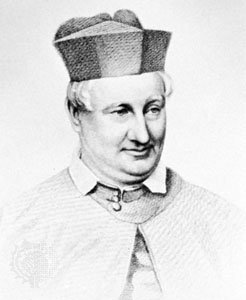
Frederick William Faber
An Oxford hymn-writer who followed Newman into the Catholic Church.
The record
- Born
- June 28, 1814, Calverley, Yorkshire
- Converted
- received into the Catholic Church, November 17, 1845, Northampton
- Became
- founder of the London (Brompton) Oratory; hymn-writer
- Died
- September 26, 1863, London
Frederick William Faber was born in Yorkshire in 1814, took orders in the Church of England, and became a Fellow of University College, Oxford, and rector of the parish of Elton. He was a gifted hymn-writer and, like many of the ablest young Oxford men of the 1840s, a follower of John Henry Newman. As Newman moved toward Rome, so did Faber — and, in his letters, against his own resistance:
God grant that self-will may not accelerate, nor self-interest retard, any change He may beckon me to.F. W. Faber, letter to Bishop Wareing (1845), in J. E. Bowden, The Life and Letters of Frederick William Faber (1869)
As to myself, nothing retains me but the fear of self-will; I grow more Roman every day, but I hope not wilfully.F. W. Faber, letter (1845), in Bowden, The Life and Letters of Frederick William Faber (1869)
Newman was received into the Catholic Church in October 1845. The following month Faber resigned his parish and followed. He was received at Northampton by Bishop Wareing on 17 November 1845, taking the name Wilfrid. Two days later he wrote to a friend:
I was confirmed yesterday morning, and made my first Communion… every hour now seems to dispel doubts, and so to augment inward peace… there is such a repose of conscience as more than compensates for the intense and fiery struggle which began on the Tuesday and only ended on the Monday morning following.F. W. Faber, letter to J. B. Morris, November 19, 1845, in Bowden, The Life and Letters of Frederick William Faber (1869)
At the foot of a letter dictated in those first days as a Catholic, he added three words in his own hand: “Peace, peace, peace!”
Faber joined the Oratory of St. Philip Neri and in 1850 founded its London house — later the Brompton Oratory — serving as its first superior. He wrote hymns still sung in English-speaking churches, among them “Faith of Our Fathers” and “Sweet Saviour, bless us ere we go.” He died in London on 26 September 1863.