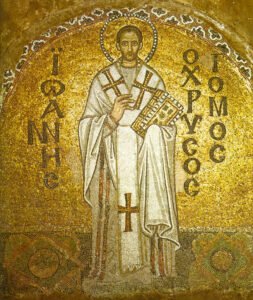
John Chrysostom · A.D. 347–407 A.D. 391
“In order then that we may become this not by love only, but in very deed, let us be blended into that flesh. This is effected by the food which He hath freely given us, desiring to show the love which He hath for us. On this account He hath mixed up Himself with us; He hath kneaded up His body with ours, that we might be a certain One Thing, like a body joined to a head.”
John Chrysostom · A.D. 347–407 A.D. 407
“(Hom. in Matt. Hom. ii.) Or he therefore entitles it, The book of the generation, because this is the sum of the whole dispensation, the root of all its blessings; viz. that God became man; for this once effected, all other things followed of course.”
John Chrysostom · A.D. 347–407 A.D. 407
“And do not consider this genealogy a small thing to hear: for truly it is a marvellous thing that God should descend to be born of a woman, and to have as His ancestors David and Abraham.”
John Chrysostom · A.D. 347–407 A.D. 407
“But why would it not have been enough to name one of them, David alone, or Abraham alone? Because the promise had been made to both of Christ to be born of their seed. To Abraham, And in thy seed shall all the nations of the earth he blessed. (Gen. 22:18.) To David, Of the fruit of thy body will I set upon thy seat. (Ps. 132:11.) He therefore calls Christ the Son of both, to shew that in Him was fulfilled the promise to both. Also because Christ was to have three dignities; King, Prophet, Priest; but Abraham was prophet and priest; priest, as God says to him in Genesis, Take an heifer; (Gen. 15:9.) Prophet, as the Lord said to Abimelech concerning him, He is a prophet, and shall pray for thee. (Gen. 20:7.) David was king and prophet, but not priest. Thus He is expressly called the son of both, that the threefold dignity of His forefathers might be recognized by hereditary right in Christ.”
John Chrysostom · A.D. 347–407 A.D. 407
“(Hom. iii.) Matthew then, desiring to preserve in memory the lineage of the Lord’s humanity through the succession of His parents, begins with Abraham, saying, Abraham begat Isaac. Why does he not mention lsmael, his first-born? And again, Isaac begat Jacob; why does he not speak of Esau his first-born? Because through them he could not have come down to David.”
John Chrysostom · A.D. 347–407 A.D. 407
“(Hom. iii.) Or, he names all the twelve Patriarchs that he may lower that pride which is drawn from a line of noble ancestry. For many of these were born of maidservants, and yet were Patriarchs and heads of tribes.”
John Chrysostom · A.D. 347–407 A.D. 407
“Besides this, it shews that all are equally liable to sin; for here is Thamar accusing Judah of incest, and David begat Solomon with a woman with whom he had committed adultery. But if the Law was not fulfilled by these great ones, neither could it be by their less great posterity, and so all have sinned, and the presence of Christ is become necessary.”
John Chrysostom · A.D. 347–407 A.D. 407
“(Hom. iv.) Having gone through all the ancestry, and ended in Joseph, he adds, The husband of Mary, thereby declaring that it was for her sake that he was included in the genealogy.”
John Chrysostom · A.D. 347–407 A.D. 407
“Or he divided the whole genealogy into three parts, to shew that not even by the change of their government were they made better, but under Judges, Kings, High Priests, and Priests, held the same evil course. For which cause also he mentions the captivity in Babylon, shewing that neither by this were they corrected. But the going down into Egypt is not mentioned, because they were not still in terror of the Egyptians as they were of the Assyrians or Parthians; and because that was a remote, but this a recent event; and because they had not been carried thither for sin as they had to Babylon.”
John Chrysostom · A.D. 347–407 A.D. 407
“He announces that he is to relate the manner of the generation, shewing therein that he is about to speak some new thing; that you may not suppose when you hear mention of Mary’s husband, that Christ was born by the law of nature.”
John Chrysostom · A.D. 347–407 A.D. 407
“What follows, Before they came together, does not mean before she was brought to the bridegroom’s house, for she was already within. For it was a frequent custom among the ancients to have their betrothed wives home to their house before marriage; as we see done now also, and as the sons-in-law of Lot were with him in the house.”
John Chrysostom · A.D. 347–407 A.D. 407
“He says exactly was found, for so we use to say of things not thought of. And that you should not molest the Evangelist by asking in what way was this birth of a virgin, he clears himself shortly, saying, Of the Holy Ghost. As much as to say, it was the Holy Ghost that wrought this miracle. For neither Gabriel nor Matthew could say any further.”
John Chrysostom · A.D. 347–407 A.D. 407
“The Evangelist having said that she was found with child of the Holy Ghost, and without knowledge of man, that you should not herein suspect Christ’s disciple of inventing wonders in honour of his Master, brings forward Joseph confirming the history by his own share in it; Now Joseph her husband, being a just man.”
John Chrysostom · A.D. 347–407 A.D. 407
“But it should be known, that just here is used to denote one who is in all things virtuous. For there is a particular justice, namely, the being free from covetousness; and another universal virtue, in which sense Scripture generally uses the word justice. Therefore being just, that is kind, merciful, he was minded to put away privily her who according to the Law was liable not only to dismissal, but to death. But Joseph remitted both, as though living above the Law. For as the sun lightens up the world, before he shews his rays, so Christ before He was born caused many wonders to be seen.”
John Chrysostom · A.D. 347–407 A.D. 407
“Also observe the mercifulness of Joseph, that he imparted his suspicions to none, not even to her whom he suspected, but kept them within himself.”
John Chrysostom · A.D. 347–407 A.D. 407
“He did not appear so openly to Joseph as to the Shepherds, because he was faithful; the shepherds needed it, because they were ignorant. The Virgin also needed it, as she had first to be instructed in these mighty wonders. In like manner Zacharias needed the wonderful vision before the conception of his son.”
John Chrysostom · A.D. 347–407 A.D. 407
“But by saying, Be not afraid, he shews him to be in fear that he had offended God, by having an adulteress; for only as such would he have ever thought of putting her away.”
John Chrysostom · A.D. 347–407 A.D. 407
“He says, Fear not to take unto thee; that is, to keep at home; for in thought she was already dismissed.”
John Chrysostom · A.D. 347–407 A.D. 407
“Or, The Angel appeared to Joseph when he was in this perplexity, that his wisdom might be apparent to Joseph, and that this might be a proof to him of those things that he spoke. For when lie heard out of the mouth of the Angel those very things that he thought within himself, this was an undoubted proof, that he was a messenger from God, who alone knows the secrets of the heart. Also the account of the Evangelist is beyond suspicion, as he describes Joseph feeling all that a husband was likely to feel. The Virgin also by this was more removed from suspicion, in that her husband had felt jealousy, yet took her home, and kept her with him after her conception. She had not told Joseph the things that the Angel had said to her, because she did not suppose that she should be believed by her husband, especially as he had begun to have suspicions concerning her. But to the Virgin the Angel announced her conception before it took place, lest if he should defer it till afterwards she should be in straits. And it behoved that Mother who was to receive the Maker of all things to be kept free from all trouble. Not only does the Angel vindicate the Virgin from all impurity, but shews that the conception was supernatural, not removing his fears only, but adding matter of joy; saying, That which is born in her is of the Holy Spirit.”
John Chrysostom · A.D. 347–407 A.D. 407
“What the Angel thus told Joseph, was beyond human thought, and the law of nature, therefore he confirms his speech not only by revealing to him what was past, but also what was to come; She shall bring forth a Son.”
John Chrysostom · A.D. 347–407 A.D. 407
“Or, he left it unappropriated, to shew that she bare Him to the whole world.”
John Chrysostom · A.D. 347–407 A.D. 407
“This further shews that this birth should be wonderful, because it is God that sends down His name from above by His Angel; and that not any name, but one which is a treasure of infinite good. Therefore also the Angel interprets it, suggesting good hope, and by this induces him to believe what was spoken. For we lean more easily to prosperous things, and yield our belief more readily to good fortune.”
John Chrysostom · A.D. 347–407 A.D. 407
“Otherwise; the Angel seeing the depths of the Divine mercy, the laws of nature broken through and reconciliation made, He who was above all made lower than all; all these wonders, all this he comprises in that one saying, Now all this hath happened; as though he had said, Do not suppose that this is newly devised of God, it was determined of old. And he rightly cites the Prophet not to the Virgin, who as a maiden was untaught in such things, but to Joseph, as to one much versed in the Prophets. And at first he had spoken of Mary as thy wife, but now in the words of the Prophet he brings in the word “Virgin,” that he might hear this from the Prophet, as a thing long before determined. Therefore to confirm what he had said, he introduces Isaiah, or rather God; for he does not say, Which was spoken by Isaiah, but, Which was spoken of the Lord by the Prophet.”
John Chrysostom · A.D. 347–407 A.D. 407
“As it is the manner of Scripture to convey a knowledge of events under the form of a name, so here, They shall call His name Emmanuel, means nothing else than, They shall see God among men. Whence he says not, ‘Thou shalt call,’ but, They shall call.”
John Chrysostom · A.D. 347–407 A.D. 407
“Herod the king, mentioning his dignity, because there was another Herod who put John to death.”
John Chrysostom · A.D. 347–407 A.D. 407
“The object of astrology is not to learn from the stars the fact of one’s birth; but from the hour of their nativity to forecast the fate of those that are born. But these men knew not the time of the nativity to have forecast the future from it, but the converse.”
John Chrysostom · A.D. 347–407 A.D. 407
“This was manifestly not one of the common stars of Heaven. First, because none of the stars moves in this way, from east to south, and such is the situation of Palestine with respect to Persia. Secondly, from the time of its appearance, not in the night only, but during the day. Thirdly, from its being visible and then again invisible; when they entered Jerusalem it hid itself, and then appeared again when they left Herod. Further, it had no stated motion, but when the Magi were to go on, it went before them; when to stop, it stopped like the pillar of cloud in the desert. Fourthly, it signified the Virgin’s delivery, not by being fixed aloft, but by descending to earth, shewing herein like an invisible virtue formed into the visible appearance of a star.”
John Chrysostom · A.D. 347–407 A.D. 407
“Observe the exactness of the prophecy; it is not He shall be in Bethlehem, but shall come out of Bethlehem; shewing that He should be only born there. What reason is there for applying this to Zorobabel, as some do? For his goings forth were not from everlasting; nor did he go forth from Bethlehem, but was born in Babylonia. The expression, art not the least, is a further proof, for none but Christ could make the town where He was born illustrious. And after that birth, there came men from the utmost ends of the earth to see the stable and manger. He calls Him not ‘the Son of God,’ but (he Ruler who shall govern My people Israel; for thus He ought to condescend at the first, that they should not be scandalized, but should preach such things as more pertained to salvation, that they might be gained. Who shall rule My people Israel, is said mystically, for those of the Jews who believed; for if Christ ruled not all the Jews, theirs is the blame. Meanwhile he is silent respecting the Gentiles, that the Jews might not be scandalized. Mark this wonderful ordinance; Jews and Magi mutually instruct each other; the Jews learn of the Magi that a star had proclaimed Christ in the east, the Magi from the Jews that the Prophets had spoken of Him of old. Thus confirmed by a twofold testimony, they would look with more ardent faith for One whom the brightness of the star and the voice of the Prophets equally proclaimed.”
John Chrysostom · A.D. 347–407 A.D. 407
“Or, the star appeared to them long time before, because the journey would take up some time, and they were to stand before Him immediately on His birth, that seeing Him in swaddling clothes, He might seem the more wonderful.”
John Chrysostom · A.D. 347–407 A.D. 407
“Concerning the young Child, he says, not ‘of the King;’ he envics Him the regal title.”
John Chrysostom · A.D. 347–407 A.D. 407
“Let Marcion and Paul of Samosata then blush, who will not see what the Magi saw, those progenitors of the Church adoring God in the flesh. That He was truly in the flesh, the swaddling clothes and the stall prove; yet that they worshipped Him not as mere man, but as God, the gifts prove which it was becoming to offer to a God. Let the Jews also be ashamed, seeing the Magi coming before them, and themselves not even earnest to tread in their path.”
John Chrysostom · A.D. 347–407 A.D. 407
“(Hom. viii.) See the faith of the Magi; they were not offended, nor said within themselves, What need now of flight? or of secret return, if this Boy be really some great one? Such is true faith; it asks not the reason of any command, but obeys.”
John Chrysostom · A.D. 347–407 A.D. 407
“See how immediately on His birth the tyrant is furious against Him, and the mother with her Child is driven into foreign lands. So should you in the beginning of your spiritual career seem to have tribulation, you need not to be discouraged, but bear all things manfully, having this example.”
John Chrysostom · A.D. 347–407 A.D. 407
“It is a law of prophecy, that in a thousand places many things are said of some and fulfilled of others. As it is said of Simeon and Levi, I will divide them in Jacob, and scatter them in Israel; (Gen. 49:7.) which was fulfilled not in themselves, but in their descendants. So here Christ is by nature the Son of God, and so the prophecy is fulfilled in Him.”
John Chrysostom · A.D. 347–407 A.D. 407
“(Hom. ix.) The Evangelist by this history of so bloody a massacre, having filled the reader with horror, now again sooths his feelings, shewing that these things were not done because God could not hinder, or knew not of them; but as the Prophet had foretold.”
John Chrysostom · A.D. 347–407 A.D. 407
“And when he had once left the country of His birth, all the occurrences passed out of mind; the rage of persecution had been spent in Bethlehem and its neighbourhood. By choosing Nazareth therefore, Joseph both avoided danger, and returned to his country.”
John Chrysostom · A.D. 347–407 A.D. 407
“(non occ.) But why must John thus go before Christ with a witness of deeds preaching Him? First; that we might hence learn Christ’s dignity, that He also, as the Father has, has prophets, in the words of Zacharias, And thou, Child, shalt be called the Prophet of the Highest. (Luke 1:76.) Secondly; That the Jews might have no cause for offence; as He declared, John came neither eating nor drinking, and they say, He hath a devil. The Son of Man came eating and drinking, and they say, Behold a gluttonous man. (Luke 7:33.) It needeth moreover that the things concerning Christ should be told by some other first, and not by Himself; or what would the Jews have said, who after the witness of John made complaint, Thou bearest witness of thyself, thy witness is not true. (John 8:13.)”
John Chrysostom · A.D. 347–407 A.D. 407
“And he preaches what the Jews had never heard, not even from the Prophets, Heaven, namely, and the Kingdom that is there, and of the kingdoms of the earth he says nothing. Thus by the novelty of those things of which he speaks, he gains their attention to Him whom he preaches.”
John Chrysostom · A.D. 347–407 A.D. 407
“For it was wonderful to see such fortitude in a human body; this it was that chiefly attracted the Jews, seeing in him the great Elias. It also contributed to fill them with wonder that the grace of Prophecy had long failed among them, and now seemed to have at length revived. Also the manner of his preaching being other than that of the old prophets had much effect; for now they heard not such things as they were wont to hear, such as wars, and conquests of the king of Babylon, or of Persia; but of Heaven and the Kingdom there, and the punishment of hell.”
John Chrysostom · A.D. 347–407 A.D. 407
“(Hom. xi.) He does not forbid them to say they are his, but to trust in that, neglecting virtues of the soul.”
John Chrysostom · A.D. 347–407 A.D. 407
“That men should be made out of stones, is like Isaac coming from Sarah’s womb; Look into the rock, says Isaiah, whence ye were hewn. Reminding them thus of this prophecy, he shews that it is possible that the like might even now happen.”
John Chrysostom · A.D. 347–407 A.D. 407
“By saying Every, he cuts off all privilege of nobility: as much as to say, Though thou be the son of Abraham, if thou abide fruitless thou shalt suffer the punishment.”
John Chrysostom · A.D. 347–407 A.D. 407
“(Hom. x. 1.) For while as yet the sacrifice had not been offered, nor remission of sin sent, nor the Spirit had descended on the water, how could sin be forgiven? But since the Jews never perceived their own sin, and this was the cause of all their evils, John came to bring them to a sense of them by calling them to repentance.”
John Chrysostom · A.D. 347–407 A.D. 407
“When you hear for He is mightier than I, do not suppose this to be said by way of comparison, for I am not worthy to be numbered among his servants, that I might undertake the lowest office.”
John Chrysostom · A.D. 347–407 A.D. 407
“He does not say, shall give you the Holy Ghost, but shall baptize you in the Holy Ghost, shewing in metaphor the abundance of the grace. fThis further shews, that even under the faith there is need of the will alone for justification, not of labours and toilings; and even as easy a thing as it is to be baptized, even so easy a thing it is to be changed and made better. By fire he signifies the strength of grace which cannot be overcome, and that it may be understood that He makes His own people at once like to the great and old prophets, most of the prophetic visions were by fire.”
John Chrysostom · A.D. 347–407 A.D. 407
“(Hom. x. 1.) Because after His baptism Christ was to put an end to the Law, He therefore came to be baptized at this age, that having so kept the Law, it might not be said that He cancelled it, because He could not observe it.”
John Chrysostom · A.D. 347–407 A.D. 407
“(Hom. xii.) But since John’s baptism was to repentance, and therefore shewed the presence of sin, that none might suppose Christ’s coming to the Jordan to have been on this account, John cried to Him, I have need to be baptized of Thee, and comest Thou to me? As if he had said,”
John Chrysostom · A.D. 347–407 A.D. 407
“But though you see it not, be not therefore unbelieving, for in the beginnings of spiritual matters sensible visions are always offered, for their sakes who can form no idea of things that have no body; which if they occur not in later times, yet faith may be established by those wonders once wrought.”
John Chrysostom · A.D. 347–407 A.D. 407
“It is moreover an allusion to ancient history; for in the deluge this creature appeared bearing an olive-branch, and tidings of rest to the world. All which things were a type of things to come. For now also a dove appears pointing out to us our liberator, and for an olive-branch bringing the adoption of the human race.”
John Chrysostom · A.D. 347–407 A.D. 407
“(Hom. xiii.) Whoever thou art then that after thy baptism sufferest grievous trials, be not troubled thereat; for this thou receivedst arms, to fight, not to sit idle. God does not hold all trial from us; first, that we may feel that we are become stronger; secondly, that we may not be puffed up by the greatness of the gifts we have received; thirdly, that the Devil may have experience that we have entirely renounced him; fourthly, that by it we may be made stronger; fifthly, that we may receive a sign of the treasure entrusted to us; for the Devil would not come upon us to tempt us, did he not see us advanced to greater honours.”
John Chrysostom · A.D. 347–407 A.D. 407
“The Devil is wont to be most urgent with temptation, when he sees us solitary; thus it was in the beginning he tempted the woman when he found her without the man, and now too the occasion is offered to the Devil, by the Saviour’s being led into the desert.”
John Chrysostom · A.D. 347–407 A.D. 407
“But that you may learn how great a good is fasting, and what a mighty shield against the Devil, and that after baptism you ought to give attention to fasting and not to lusts, therefore Christ fasted, not Himself needing it, but teaching us by His example.”
John Chrysostom · A.D. 347–407 A.D. 407
“But He exceeded not the measure of Moses and Elias, lest it should bring into doubt the reality of His assumption of the flesh.”
John Chrysostom · A.D. 347–407 A.D. 407
“Observe that Scripture is brought forward by the Lord only with an apt meaning, but by the Devil irreverently; for that where it is written, He shall give his Angels charge over thee, is not an exhortation to cast Himself headlong.”
John Chrysostom · A.D. 347–407 A.D. 407
“(Hom. xiv.) It is not blameworthy not to throw one’s self into peril, but when one has fallen into it, not to endure manfully. He departed from Judæa both to soften Jewish animosity, and to fulfil a prophecy, seeking moreover to fish for those masters of the world who dwelt in Galilee. Note also how when He would depart to the Gentiles, He received good cause from the Jews; His forerunner was thrown into prison, which compelled Jesus to pass into Galilee of the Gentiles.”
John Chrysostom · A.D. 347–407 A.D. 407
“But that you may learn that he speaks not of natural day and night, he calls the light, a great light, which is in other places called the true light; and he adds, the shadow of death, to explain what he means by darkness. The words arose, and shined, shew, that they found it not of their own seeking, but God Himself appeared to them, they did not first run to the light; for men were in the greatest miseries before Christ’s coming; they did not walk but sate in darkness; which was a sign that they hoped for deliverance; for as not knowing what way they should go, shut in by darkness they sate down, having now no power to stand. By darkness he means here, error and ungodliness.”
John Chrysostom · A.D. 347–407 A.D. 407
“For another cause also He did not preach till John was in prison, that the multitude might not be split into two parties; or as John did no miracle, all men would have been drawn to Christ by His miracles.”
John Chrysostom · A.D. 347–407 A.D. 407
“Also observe how that in this His first address He says nothing of Himself openly; and that very suitably to the case, for they had yet no right opinion concerning Him. In this commencement moreover He speaks nothing severe, nothing burdensome, as John had concerning the axe laid to the root of the condemned tree, and the like; but he puts first things merciful, preaching the glad tidings of the kingdom of heaven.”
John Chrysostom · A.D. 347–407 A.D. 407
“He calls them while actually working at their employment, to shew that to follow Him ought to be preferred to all occupations. They were just then casting a net into the sea, which agreed with their future office.”
John Chrysostom · A.D. 347–407 A.D. 407
“To so great a promise they trusted, and believed that they should catch others by those same words by which themselves had been caught.”
John Chrysostom · A.D. 347–407 A.D. 407
“It is no small sign of goodness, to bear poverty easily, to live by honest labour, to be bound together by virtue of affection, to keep their poor father with them, and to toil in his service.”
John Chrysostom · A.D. 347–407 A.D. 407
“He made no promise to them when He called them, as He had to the former, for the obedience of the first had made the way plain for them. Besides, they had heard many things concerning Him, as being friends and townsmen of the others.”
John Chrysostom · A.D. 347–407 A.D. 407
“a By which too He shewed the Jews that He came not as an enemy of God, or a seducer of souls, but as consenting with his Father.”
John Chrysostom · A.D. 347–407 A.D. 407
“We must consider that when some great change is being wrought, as the introduction of a new polity, God is wont to work miracles, giving pledges of His power to those who are to receive His laws. Thus when He would make man, He first created a world, and then at length gave man in paradise a law. When He would dispense a law to the holy Noah, he shewed truly great wonders; and again when He was about to ordain the Law for the Jews, He first shewed great prodigies, and then at length gave them the commandments. So now when about to introduce a sublime discipline of life, He first provided a sanction to His instructions by mighty signs, because the eternal kingdom He preached was not seen, by the things which did appear, He made sure that which as yet did not appear.”
John Chrysostom · A.D. 347–407 A.D. 407
“Observe the reserve of the Evangelist; he does not give an account of any one of the various cases of healing, but passes in one brief phrase an abundance of miracles, they brought to him all their sick.”
John Chrysostom · A.D. 347–407 A.D. 407
“He requires no direct profession of faith from them, both because He had not yet given them any proofs of His miraculous power, and because in bringing their sick from far they had shewn no small faith.”
John Chrysostom · A.D. 347–407 A.D. 407
“(Hom. xv.) By not choosing His seat in the city, and the market place, but on a mountain in a desert, He has taught us to do nothing with ostentation, and to depart from crowds, above all when we are to be employed in philosophy, or in speaking of serious things.”
John Chrysostom · A.D. 347–407 A.D. 407
“He ascended a mountain, first, that He might fulfil the prophecy of Esaias, Get thee up into a mountain; (Is. 40:9.) secondly, to shew that as well he who teaches, as he who hears the righteousness of God should stand on an high ground of spiritual virtues; for none can abide in the valley and speak from a mountain. If thou stand on the earth, speak of the earth; if thou speak of heaven, stand in heaven. Or, He ascended into the mountain to shew that all who would learn the mysteries of the truth should go up into the Mount of the Church of which the Prophet speaks, The hill of God is a hill of fatness. (Ps. 68:15.)”
John Chrysostom · A.D. 347–407 A.D. 407
“Or, that we may understand that He sometimes teaches by opening His mouth in speech, sometimes by that voice which resounds from His works.”
John Chrysostom · A.D. 347–407 A.D. 407
“Or, He here calls all loftiness of soul and temper spirit; for as there are many humble against their will, constrained by their outward condition, they have no praise; the blessing is on those who humble themselves by their own choice. Thus He begins at once at the root, pulling up pride which is the root and source of all evil, setting up as its opposite humility as a firm foundation. If this be well laid, other virtues may be firmly built thereon; if that be sapped, whatever good yon gather upon it perishes.”
John Chrysostom · A.D. 347–407 A.D. 407
“Or, the poor in spirit may be those who fear and tremble at God’s commandments, whom the Lord by the Prophet Isaiah commends. Though why more than simply humble? Of the humble there may be in this place but few, in that again an abundance.”
John Chrysostom · A.D. 347–407 A.D. 407
“Otherwise; Christ here has mixed things sensible with things spiritual. Because it is commonly supposed that he who is meek loses all that he possesses, Christ here gives a contrary promise, that he who is not forward shall possess his own in security, but that he of a contrary disposition many times loses his soul and his paternal inheritance. But because the Prophet had said, The meek shall inherit the earth, (Ps. 36:11.) He used these well-known words in conveying His meaning.”
John Chrysostom · A.D. 347–407 A.D. 407
“And though it were enough for such to receive pardon, yet He rests not His mercy only there, but makes them partakers of many comforts both here and hereafter. God’s mercies are always greater than our troubles.”
John Chrysostom · A.D. 347–407 A.D. 407
“We may remark that this blessing is given not simply, but with great force and emphasis; it is not simply, ‘who have grief,’ but who mourn. And indeed this command is the sum of all philosophy. For if they who mourn for the death of children or kinsfolk, throughout all that season of their sorrow, are touched with no other desires, as of money, or honour, burn not with envy, feel not wrongs, nor are open to any other vicious passion, but are solely given up to their grief; much more ought they, who mourn their own sins in such manner as they ought to mourn for them, to shew this higher philosophy.”
John Chrysostom · A.D. 347–407 A.D. 407
“He may mean either general righteousness, or that particular virtue which is the opposite of covetousness. (ἡ καθόλου ἀρετή.) As He was going on to speak of mercy, He shews beforehand of what kind our mercy should be, that it should not be of the gains of plunder or covetousness, hence He ascribes to righteousness that which is peculiar to avarice, namely, to hunger and thirst.”
John Chrysostom · A.D. 347–407 A.D. 407
“Or, this is again a promise of a temporal reward; for as covetousness is thought to make many rich, He affirms on the contrary that righteousness rather makes rich, for He who loves righteousness possesses all things in safety.”
John Chrysostom · A.D. 347–407 A.D. 407
“The reward here seems at first to be only an equal return; but indeed it is much more; for human mercy and divine mercy are not to be put on an equality.”
John Chrysostom · A.D. 347–407 A.D. 407
“By the pure are here meant those who possess a perfect goodness, conscious to themselves of no evil thoughts, or again those who live in such temperance as is mostly necessary to seeing God according to that of St. Paul, Follow peace with all men, and holiness, without which no man shall see God. For as there are many merciful, yet unchaste, to shew that mercy alone is not enough, he adds this concerning purity.”
John Chrysostom · A.D. 347–407 A.D. 407
“Or, if the peacemakers are they who do not contend one with another, but reconcile those that are at strife, they are rightly called the sons of God, seeing this was the chief employment of the Only-begotten Son, to reconcile things separated, to give peace to things at war.”
John Chrysostom · A.D. 347–407 A.D. 407
“Blessed are they who suffer persecution for righteousness’ sake, that is for virtue, for defending others, for piety, for all these things are spoken of under the title of righteousness. This follows the beatitude upon the peacemakers, that we may not be led to suppose that it is good to seek peace at all times.”
John Chrysostom · A.D. 347–407 A.D. 407
“Wonder not if you do not hear ‘the kingdom’ mentioned under each beatitude; for in saying shall be comforted, shall find mercy, and the rest, in all these the kingdom of heaven is tacitly understood, so that you must not look for any of the things of sense. For indeed he would not be blessed who was to be crowned with those things which depart with this life.”
John Chrysostom · A.D. 347–407 A.D. 407
“At the same time He signifies His equality in honour with His Father, as if He had said, As they suffered for my Father, so shall ye suffer for me. And in saying, The Prophets who were before you, He teaches that they themselves are already become Prophets.”
John Chrysostom · A.D. 347–407 A.D. 407
“When He had delivered to His Apostles such sublime precepts, so much greater than the precepts of the Law, that they might not be dismayed and say, How shall we be able to fulfil these things? He sooths their fears by mingling praises with His instructions, saying, Ye are the salt of the earth. This shews them how necessary were these precepts for them. Not for your own salvation merely, or for a single nation, but for the whole world is this doctrine committed to you. It is not for you then to flatter and deal smoothly with men, but, on the contrary, to be rough and biting as salt is. When for thus offending men by reproving them ye are reviled, rejoice; for this is the proper effect of salt to be harsh and grating to the depraved palate. Thus the evil-speaking of others will bring you no inconvenience, but will rather be a testimony of your firmness.”
John Chrysostom · A.D. 347–407 A.D. 407
“Mark how great His promise to them, men who were scarce known in their own country that the fame of them should reach to the ends of the earth. The persecutions which He had foretold, were not able to dim their light, yea they made it but more conspicuous.”
John Chrysostom · A.D. 347–407 A.D. 407
“Thus shewing them that they ought to be careful of their own walk and conversation, seeing they were set in the eyes of all, like a city on a hill, or a lamp on a stand.”
John Chrysostom · A.D. 347–407 A.D. 407
“Or, in the illustration of the city, He signified His own power, by the lamp He exhorts the Apostles to preach with boldness; as though He said, ‘I indeed have lighted the lamp, but that it continue to burn will be your care, not for your own sakes only, but both for others who shall receive its light and for God’s glory.’”
John Chrysostom · A.D. 347–407 A.D. 407
“(Hom. xvi.) Christ then fulfilled the Prophets by accomplishing what was therein foretold concerning Himself—and the Law, first, by transgressing none of its precepts; secondly, by justifying by faith, which the Law could not do by the letter.”
John Chrysostom · A.D. 347–407 A.D. 407
“He speaks not this of the old laws, but of those which He was now going to enact, of which he says, the least, though they were all great. For as He so oft spoke humbly of Himself, so does He now speak humbly of His precepts.”
John Chrysostom · A.D. 347–407 A.D. 407
“Or, when you hear the words, least in the kingdom of heaven, imagine nothing less than the punishment of hell. For He oft uses the word ‘kingdom,’ not only of the joys of heaven, but of the time of the resurrection, and of the terrible coming of Christ.”
John Chrysostom · A.D. 347–407 A.D. 407
“By righteousness is here meant universal virtue. But observe the superior power of grace, in that He requires of His disciples who were yet uninstructed to be better than those who were masters under the Old Testament. Thus He does not call the Scribes and Pharisees unrighteous, but speaks of their righteousness. And see how even herein He confirms the Old Testament that He compares it with the New, for the greater and the less are always of the same kind.”
John Chrysostom · A.D. 347–407 A.D. 407
“This, it was said by them of old time, shews that it was long ago that they had received this precept. He says this that He might rouse His sluggish hearers to proceed to more sublime precepts, as a teacher might say to an indolent boy, Know you not how long time you have spent already in merely learning to spell? In that, I say unto you, mark the authority of the legislator, none of the old Prophets spoke thus; but rather, Thus saith the Lord. They as servants repeated the commands of their Lord; He as a Son declared the will of His Father, which was also His own. They preached to their fellow servants; Ha as master ordained a law for his slaves.”
John Chrysostom · A.D. 347–407 A.D. 407
“Or, Racha is a word signifying contempt, and worthlessness. For where we in speaking to servants or children say, Go thou, or, Tell thou him; in Syriac they would say Racha for ‘thou.’ For the Lord descends to the smallest trifles even of our behaviour, and bids us treat one another with mutual respect.”
John Chrysostom · A.D. 347–407 A.D. 407
“This is the first mention of hell, though the kingdom of Heaven had been mentioned some time before, which shews that the gifts of the one comes of His love, the condemnation of the other of our sloth. Many thinking this a punishment too severe for a mere word, say that this was said figuratively. But I fear that if we thus cheat ourselves with words here, we shall suffer punishment in deed there. Think not then this too heavy a punishment, when so many sufferings and sins have their beginning in a word; a little word has often begotten a murder, and overturned whole cities. And yet it is not to be thought a little word that denies a brother reason and understanding by which we are men, and differ from the brutes.”
John Chrysostom · A.D. 347–407 A.D. 407
“Or, the judgment and the council denote punishment in this word; hell-fire future punishment. He denounces punishment against anger, yet does not mention any special punishment, shewing therein that it is not possible that a man should be altogether free from the passion. The Council here means the Jewish senate, for He would not seem to be always superseding all their established institutions, and introducing foreignf.”
John Chrysostom · A.D. 347–407 A.D. 407
“If love alone is not enough to induce us to be reconciled to our neighbour, the desire that our work should not remain imperfect, and especially in the holy place, should induce us.”
John Chrysostom · A.D. 347–407 A.D. 407
“Or, He here speaks of the judges of this world, of the way which leads to this judgment, and of human prisons; thus not only employing future but present inducements, as those things which are before the eyes affect us most, as St. Paul also declares, If thou doest evil fear the power, for he beareth not the sword in vain. (Rom. 13:4.)”
John Chrysostom · A.D. 347–407 A.D. 407
“(Hom. xvii.) The Lord having explained how much is contained in the first commandment, namely, Thou shalt not kill, proceeds in regular order to the second.”
John Chrysostom · A.D. 347–407 A.D. 407
“If you permit yourself to gaze often on fair countenances you will assuredly be taken, even though you may be able to command your mind twice or thrice. For you are not exalted above nature and the strength of humanity. She too who dresses and adorns herself for the purpose of attracting men’s eyes to her, though her endeavour should fail, yet shall she be punished hereafter; seeing she mixed the poison and offered the cup, though none was found who would drink thereof. For what the Lord seems to speak only to the man, is of equal application to the woman; inasmuch as when He speaks to the head, the warning is meant for the whole body.”
John Chrysostom · A.D. 347–407 A.D. 407
“Say not here, It is enough her husband has put her away; for even after she is put away she continues the wife of him that put her away.”
John Chrysostom · A.D. 347–407 A.D. 407
“Note how He exalts the elements of the world, not from their own nature, but from the respect which they have to God, so that there is opened no occasion of idolatry.”
John Chrysostom · A.D. 347–407 A.D. 407
“Or; of evil, that is, from their weakness to whom the Law permitted the use of an oath. Not that by this the old Law is signified to be from the Devil, but He leads us from the old imperfection to the new abundance.”
John Chrysostom · A.D. 347–407 A.D. 407
“(Hom. xviii.) The word here used signifies to drag unjustly, without cause, and with insult.”
John Chrysostom · A.D. 347–407 A.D. 407
“Note through what steps we have now ascended hither, and how He has set us on the very pinnacle of virtue. The first step is, not to begin to do wrong to any; the second, that in avenging a wrong done to us we be content with retaliating equal; the third, to return nothing of what we have suffered; the fourth, to offer one’s self to the endurance of evil; the fifth, to be ready to suffer even more evil than the oppressor desires to inflict; the sixth, not to hate him of whom we suffer such things; the seventh, to love him; the eighth, to do him good; the ninth, to pray for him. And because the command is great, the reward proposed is also great, namely, to be made like unto God, Ye shall be the sons of your Father which is in heaven.”
John Chrysostom · A.D. 347–407 A.D. 407
“(Hom. xix.) Yet be it known that the desire of fame is near a kin to virtue.”
John Chrysostom · A.D. 347–407 A.D. 407
“Observe how He has begun as it were describing some beast hard to be discerned, and ready to steal upon him who is not greatly on his guard against it; it enters in secretly, and carries off insensibly all those things that are within.”
John Chrysostom · A.D. 347–407 A.D. 407
“Let not thy left hand know what thy right hand doeth, is said as an extreme expression, as much as to say, If it were possible, that you should not know yourself, and that your very hands should be hid from your sight, that is what you should most strive after.”
John Chrysostom · A.D. 347–407 A.D. 407
“If therefore you desire spectators of your good deeds, behold you have not merely Angels and Archangels, but the God of the universe.”
John Chrysostom · A.D. 347–407 A.D. 407
“He calls them hypocrites, because feigning that they are praying to God, they are looking round to men; and, He adds, they love to pray in the synagogues.”
John Chrysostom · A.D. 347–407 A.D. 407
“It is a good thing to be drawn away from the thought of empty glory, but especially in prayer. For our thoughts are apt to stray of themselves; if then we address ourselves to prayer with this disease upon us, how shall we understand those things that are said by us?”
John Chrysostom · A.D. 347–407 A.D. 407
“He says, have received, because God was ready to give them that reward which comes from Himself, but they prefer rather that which comes from men. He then goes on to teach how we should pray.”
John Chrysostom · A.D. 347–407 A.D. 407
“He said not ‘shall freely give thee,’ but, shall reward thee; thus He constitutes Himself your debtor.”
John Chrysostom · A.D. 347–407 A.D. 407
“Hereby He dissuades from empty speaking in prayer; as, for example, when we ask of God things improper, as dominions, fame, overcoming of our enemies, or abundance of wealth. He commands then that our prayers should not be long; long, that is, not in time, but in multitude of words. For it is right that those who ask should persevere in their asking; being instant in prayer, as the Apostle instructs; but does not thereby enjoin us to compose a prayer of ten thousand verses, and speak it all; which He secretly hints at, when He says, Do not ye use many words.”
John Chrysostom · A.D. 347–407 A.D. 407
“You do not then pray in order to teach God your wants, but to move Him, that you may become His friend by the importunity of your applications to Him, that you may be humbled, that you may be reminded of your sins.”
John Chrysostom · A.D. 347–407 A.D. 407
“For what hurt does such kindred with those beneath us, when we are all alike kin to One above us? For who calls God Father, in that one title confesses at once the forgiveness of sins, the adoption, the heirship, the brotherhood, which he has with the Only-begotten, and the gift of the Spirit. For none can call God Father, but he who has obtained all these blessings. In a two-fold manner, therefore, he moves the feeling of them that pray, both by the dignity of Him who is prayed to, and the greatness of those benefits which we gain by prayer.”
John Chrysostom · A.D. 347–407 A.D. 407
“In heaven, not confining God’s presence to that, but withdrawing the thoughts of the petitioner from earth and fixing them on things above.”
John Chrysostom · A.D. 347–407 A.D. 407
“Or; He bids us in praying beg that God may be glorified in our life; as if we were to say, Make us to live so that all things may glorify Thee through us. For hallowed signifies the same as glorified. It is a petition worthy to be made by man to God, to ask nothing before the glory of the Father, but to postpone all things to His praise.”
John Chrysostom · A.D. 347–407 A.D. 407
“See how excellently this follows; having taught us to desire heavenly things by that which He said, Thy kingdom come, before we come to Heaven He bids us make this earth into Heaven, in that saying, Thy will he done as in heaven, so in earth.”
John Chrysostom · A.D. 347–407 A.D. 407
“For virtue is not of our own efforts, but of grace from above. Here again is enjoined on each one of us prayer for the whole world, inasmuch as we are not to say, Thy will be done in me, or in us; but throughout the earth, that error may cease, truth be planted, malice be banished, and virtue return, and thus the earth not differ from heaven.”
John Chrysostom · A.D. 347–407 A.D. 407
“It should be thought upon how when He had delivered to us this petition, Thy will be done as in heaven so in earth, then because He spake to men in the flesh, and not like angelic natures without passion or appetite, He now descends to the needs of our bodies. And He teaches us to pray not for money or the gratification of lust, but for daily bread; and as yet further restriction, He adds, this day, that we should not trouble ourselves with thought for the coming day.”
John Chrysostom · A.D. 347–407 A.D. 407
“That this prayer is meant for the faithful, both the laws of the Church teach, and the beginning of the prayer which instructs us to call God Father. In thus bidding the faithful pray for forgiveness of sin, He shews that even after baptism sin can be remitted (against the Novatians.)”
John Chrysostom · A.D. 347–407 A.D. 407
“Having made us anxious by the mention of our enemy, in this that He has said Deliver us from evil, He again restores confidence by that which is added in some copies, For thine is the kingdom, and the power, and the glory, since if His be the kingdom, none need fear, since even he who fights against us, must be His subject. But since His power and glory are infinite, He can not only deliver from evil, but also make glorious.”
John Chrysostom · A.D. 347–407 A.D. 407
“He mentions heaven and the Father to claim our attention, for nothing so likens you to God, as to forgive him who has injured you. And it were indeed unmeet should the son of such a Father become a slave, and should one who has a heavenly vocation live as of this earth, and of this life only.”
John Chrysostom · A.D. 347–407 A.D. 407
“(Hom. xx.) In almsgiving indeed, He did not say simply, ‘Do not your alms before men,’ but added, ‘to be seen of them.’ But in fasting and prayer He added nothing of this sort; because alms cannot be so done as to be altogether hid, fasting and prayer can be so done. The contempt of men’s praise is no small fruit, for thereby we are freed from the heavy slavery of human opinion, and become properly workers of virtue, loving it for itself and not for others. For as we esteem it an affront if we are loved not for ourselves but for others’ sake, so ought we not to follow virtue on the account of these men, nor to obey God for men’s sake but for His own. Therefore it follows here, But to thy Father which seeth in secret.”
John Chrysostom · A.D. 347–407 A.D. 407
“When He has driven away the disease of vanity, He does well to bring in speech of contempt of riches. For there is no greater cause of desire of money than love of praise; for this men desire troops of slaves, horses accoutred in gold, and tables of silver, not for use or pleasure, but that they may be seen of many; therefore He says, Lay not up for yourselves treasure on earth.”
John Chrysostom · A.D. 347–407 A.D. 407
“Saying, Lay not up for yourselves treasure on earth, He adds, where rust and moth destroy, in order to shew the insecurity of that treasure that is here, and the advantage of that which is in Heaven, both from the place, and from those things which harm. As though He had said; Why fear you that your wealth should be consumed, if you should give alms? Yea rather give alms, and they shall receive increase, for those treasures that are in Heaven shall be added to them, which treasures perish if ye do not give alms. He said not, You leave them to others, for that is pleasant to men.”
John Chrysostom · A.D. 347–407 A.D. 407
“But forasmuch as not every earthly treasure is destroyed by rust or moth, or carried away by thieves, He therefore brings in another motive, For where your treasure is, there will your heart be also. As much as to say; Though none of these former losses should befal you, you will yet sustain no small loss by attaching your affections to things beneath, and becoming a slave to them, and in falling from Heaven, and being unable to think of any lofty thing.”
John Chrysostom · A.D. 347–407 A.D. 407
“Having spoken of the bringing the understanding into captivity because it was not easy to be understood of many, He transfers it to a sensible instance, saying, The light of thy body is thy eye. As though He had said, If you do not know what is meant by the loss of the understanding, learn a parable of the bodily members; for what the eye is to the body, that the understanding is to the soul. As by the loss of the eyes we lose much of the use of the other limbs, so when the understanding is corrupted, your life is filled with many evils.”
John Chrysostom · A.D. 347–407 A.D. 407
“Or; The eye He speaks of is not the external but the internal eye. The light is the understanding, through which the soul sees God. He whose heart is turned to God, has an eye full of light; that is, his understanding is pure, not distorted by the influence of worldly lusts. The darkness in us is our bodily senses, which always desire the things that pertain to darkness. Whoso then has a pure eye, that is, a spiritual understanding, preserves his body in light, that is, without sin; for though the flesh desires evil, yet by the might of divine fear the soul resists it. But whoever has an eye, that is, an understanding, either darkened by the influence of the malignant passions, or fouled by evil lusts, possesses his body in darkness; he does not resist the flesh when it lusts after evil things, because he has no hope in Heaven, which hope alone gives us the strength to resist desire.”
John Chrysostom · A.D. 347–407 A.D. 407
“(Hom. xxi.) Or otherwise; in what had gone before He had restrained the tyranny of avarice by many and weighty motives, but He now adds yet more. Riches do not only harm us in that they arm robbers against us, and that they cloud our understanding, but they moreover turn us away from God’s service. This He proves from familiar notions, saying, No man can serve two masters; two, He means, whose orders are contrary; for concord makes one of many. This is proved by what follows, for either he will hate the one. He mentions two, that we may see that change for the better is easy. For if one were to give himself up in despair as having been made a slave to riches, namely, by loving them, he may hence learn, that it is possible for him to change into a better service, namely, by not submitting to such slavery, but by despising it.”
John Chrysostom · A.D. 347–407 A.D. 407
“He does not hereby mean that the 1spirit needs food, for it is incorporeal, but He speaks according to common usage, for the soul cannot remain in the body unless the body be fed.”
John Chrysostom · A.D. 347–407 A.D. 407
“Or we may connect the context otherwise; When the Lord had inculcated contempt of money, that none might say, How then shall we be able to live when we have given up our all? He adds, Therefore I say unto you, Take no thought for your life.”
John Chrysostom · A.D. 347–407 A.D. 407
“(Hom. xxii.) Having shewn that it is not right to be anxious about food, He passes to that which is less; (for raiment is not so necessary as food;) and asks, And why are ye careful wherewith ye shall be clothed? He uses not here the instance of the birds, when He might have drawn some to the point, as the peacock, or the swan, but brings forward the lilies, saying, Consider the lilies of the field. He would prove in two things the abundant goodness of God; to wit, the richness of the beauty with which they are clothed, and the mean value of the things so clothed with it.”
John Chrysostom · A.D. 347–407 A.D. 407
“He forbids not labour but carefulness, both here and above when He spoke of sowing.”
John Chrysostom · A.D. 347–407 A.D. 407
“As widely as truth differs from falsehood, so widely do our clothes differ from flowers. If then Solomon, who was more eminent than all other kings, was yet surpassed by flowers, how shall you exceed the beauty of flowers by your garments? And Solomon was exceeded by the flowers not once only, or twice, but throughout his whole reign; and this is that He says, In all his glory; for no one day was he arrayed as are the flowers.”
John Chrysostom · A.D. 347–407 A.D. 407
“He calls them no more lilies, but the grass of the field, to shew their small worth; and adds moreover another cause of their small value; which to-day is. And He said not, and to-morrow is not, but what is yet greater fall, is cast into the oven. In that He says How much more you, is implicitly conveyed the dignity of the human race, as though He had said, You to whom He has given a soul, for whom He has contrived a body, to whom He has sent Prophets and gave His Only-begotten Son.”
John Chrysostom · A.D. 347–407 A.D. 407
“He said not ‘God knoweth,’ but, Your Father knoweth, in order to lead them to higher hope; for if He be their Father, He will not endure to forget his children, since not even human fathers could do so. He says, That ye have need of all these things, in order that for that very reason, because they are necessary, ye may the more lay aside all anxiety. For he who denies his son bare necessaries, after what fashion is he a father? But for superfluities they have no right to look with the like confidence.”
John Chrysostom · A.D. 347–407 A.D. 407
“And He said not, Shall be given, but, Shall be added, that you may learn that the things that are now, are nought to the greatness of the things that shall be.”
John Chrysostom · A.D. 347–407 A.D. 407
“Nothing brings so much pain to the spirit as anxiety and cark. That He says, The morrow shall he anxious for itself, comes of desire to make more plain what He speaks; to that end employing a prosopopeia of time, after the practice of many in speaking to the rude populace; to impress them the more, He brings in the day itself complaining of its too heavy cares. Has not every day a burden enough of its own, in its own cares? why then do you add to them by laying on those that belong to another day?”
John Chrysostom · A.D. 347–407 A.D. 407
“Wherefore He does not say, ‘Do not cause a sinner to cease,’ but do not judge; that is, be not a bitter judge; correct him indeed, but not as an enemy seeking revenge, but as a physician applying a remedy.”
John Chrysostom · A.D. 347–407 A.D. 407
“Otherwise; He does not forbid us to judge all sin absolutely, but lays this prohibition on such as are themselves full of great evils, and judge others for very small evils. In like manner Paul does not absolutely forbid to judge those that sin, but finds fault with disciples that judged their teacher, and instructs us not to judge those that are above us.”
John Chrysostom · A.D. 347–407 A.D. 407
“Many do this, if they see a Monk having a superfluous garment, or a plentiful meal, they break out into bitter accusation, though themselves daily seize and devour, and suffer from excess of drinking.”
John Chrysostom · A.D. 347–407 A.D. 407
“And it is to be noted, that whenever He intends to denounce any great sin, He begins with an epithet of reproach, as below, Thou wicked servant, I forgave thee all that debt; (Mat. 18:32.) and so here, Thou hypocrite, cast out first. For each one knows better the things of himself than the things of others, and sees more the things that be great, than the things that be lesser, and loves himself more than his neighbour. Therefore He bids him who is chargeable with many sins, not to be a harsh judge of another’s faults, especially if they be small. Herein not forbidding to arraign and correct; but forbidding to make light of our own sins, and magnify those of others. For it behoves you first diligently to examine how great may be your own sins, and then try those of your neighbour; whence it follows, and then shalt thou see clearly to cast the mote out of thy brother’s eye.”
John Chrysostom · A.D. 347–407 A.D. 407
“And to those that are right-minded and have understanding, when revealed they appear good; but to those without understanding, they seem to be more deserving reverence because they are not understood.”
John Chrysostom · A.D. 347–407 A.D. 407
“Well is that said, Lest they turn; for they feign meekness that they may learn; and when they have learned, they attack.”
John Chrysostom · A.D. 347–407 A.D. 407
“And in that He adds seek, and knock, He bids us ask with much importunateness and strength. For one who seeks, casts forth all other things from his mind, and is turned to that thing singly which he seeks; and he that knocks comes with vehemence and warm soul.”
John Chrysostom · A.D. 347–407 A.D. 407
“There are two things behoveful for one that prays; that he ask earnestly; and that he ask such things as he ought to ask. And those are spiritual things; as Solomon, because he asked such things as were right, received speedily.”
John Chrysostom · A.D. 347–407 A.D. 407
“This He said not detracting from human nature, nor confessing the whole human race to be evil; but He calls paternal love evil when compared with His own goodness. Such is the superabundance of His love towards men.”
John Chrysostom · A.D. 347–407 A.D. 407
“Otherwise; The Lord desires to teach that men ought to seek aid from above, but at the same time to contribute what lays in their power; wherefore when He had said, Ask, seek, and knock, He proceeds to teach openly that men should be at pains for themselves, adding, Whatsoever ye would &c.”
John Chrysostom · A.D. 347–407 A.D. 407
“He says not, All things whatsoever, simply, but All things therefore, as though He should say, If ye will be heard, besides those things which I have now said to you, do this also. And He said not, Whatsoever you would have done for you by God, do that for your neighbour; lest you should say, But how can I? but He says, Whatsoever you would have done to you by your fellow-servant, do that also to your neighbour.”
John Chrysostom · A.D. 347–407 A.D. 407
“Whence what we ought to do is clear, as in our own cases we all know what is proper, and so we cannot take refuge in our ignorance.”
John Chrysostom · A.D. 347–407 A.D. 407
“But seeing He declares below, My yoke is pleasant, and my burden light, how is it that He says here that the way is strait and narrow? Even here He teaches that it is light and pleasant; for here is a way and a gate as that other, which is called the wide and broad, has also a way and a gate. Of these nothing is to remain; but all pass away. But to pass through toil and sweat, and to arrive at a good end, namely life, is sufficient solace to those who undergo these struggles. For if sailors can make light of storms and soldiers of wounds in hope of perishable rewards, much more when Heaven lies before, and rewards immortal, will none look to the impending dangers. Moreover the very circumstance that He calls it strait contributes to make it easy; by this He warned them to be always watching; this the Lord speaks to rouse our desires. He who strives in a combat, if he sees the prince admiring the efforts of the combatants, gets greater heart. Let us not therefore be sad when many sorrows befal us here, for the way is strait, but not the city; therefore neither need we look for rest here, nor expect any thing of sorrow there. When He says, Few there be that find it, He points to the sluggishness of the many, and instructs His hearers not to look to the prosperity of the many, but to the toils of the few.”
John Chrysostom · A.D. 347–407 A.D. 407
“Having taught that the gate is strait, because there are many that pervert the way that leads to it, He proceeds, Take heed of false prophets. In the which that they might be the more careful, He reminds them of the things that were done among their fathers, calling them false prophets; for even in that day the like things fell out.”
John Chrysostom · A.D. 347–407 A.D. 407
“Yet He may seem here to have aimed under the title of false prophets, not so much at the heretic, as at those who, while their life is corrupt, yet wear an outward face of virtuousness; whence it is said, By their fruits ye shall know them. For among heretics it is possible many times to find a good life, but among those I have named never.”
John Chrysostom · A.D. 347–407 A.D. 407
“And a hypocrite is easily discerned; for the way they are commanded to walk is a hard way, and the hypocrite is loth to toil. And that you may not say that you are unable to find out them that are such, He again enforces what He had said by example from men, saying, Do men gather grapes of thorns, or figs of thistles?”
John Chrysostom · A.D. 347–407 A.D. 407
“But that none should say, An evil tree brings forth indeed evil fruit, but it brings forth also good, and so it becomes hard to discern, as it has a two-fold produce; on this account He adds, A good tree cannot bring forth evil fruit, neither can an evil tree bring forth good fruit.”
John Chrysostom · A.D. 347–407 A.D. 407
“He had not enjoined them to punish the false prophets, and therefore shews them the terrors of that punishment that is of God, saying, Every tree that bringeth not forth good fruit shall be hewn down, and cast into the fire. In these words He seems to aim also at the Jews, and thus calls to mind the word of John the Baptist, denouncing punishment against them in the very same words. For he had thus spoken to the Jews, warning them of the axe impending, the tree that should be cut down, and the fire that could not be extinguished. But if one will examine somewhat closely, here are two punishments, to be cut down, and to be burned; and he that is burned is also altogether cut out of the kingdom; which is the harder punishment. Many indeed fear no more than hell; but I say that the fall of that glory is a far more bitter punishment, than the pains of hell itself. For what evil great or small would not a father undergo, that he might see and enjoy a most dear son? Let us then think the same of that glory; for there is no son so dear to his father as is the rest of the good, to be deceased and to be with Christ. The pain of hell is indeed intolerable, yet are ten thousand hells nothing to falling from that blessed glory, and being held in hate by Christ.”
John Chrysostom · A.D. 347–407 A.D. 407
“(Hom. xxiv.) Wherein He seems to touch the Jews chiefly who placed every thing in dogmas; as Paul accuses them, If thou art called a Jew, and restest in the Law. (Rom. 2:17.)”
John Chrysostom · A.D. 347–407 A.D. 407
“He said not he that doth My will, but the will of my Father, for it was fit so to adapt it in the mean while to their weakness. But the one secretly implied the other, seeing the will of the Son is no other than the will of the Father.”
John Chrysostom · A.D. 347–407 A.D. 407
“See how He thus secretly brings in Himself. Here in the end of His Sermon He shews Himself as the Judge. The punishment that awaits sinners He had shewn before, but now only reveals who He is that shall punish, saying, Many shall say to me in that day.”
John Chrysostom · A.D. 347–407 A.D. 407
“But there are that say that they spoke this falsely, and therefore were not saved. But they would not have dared to say this to the Judge in His presence. But the very answer and question prove that it was in His presence that they spoke thus. For having been here wondered at by all for the miracles which they wrought, and there seeing themselves punished, they say in wonderment, Lord, have we not prophesied in thy name? Others again say, that they did sinful deeds not while they thus were working miracles, but at a time later. But if this be so, that very thing which the Lord desired to prove would not be established, namely, that neither faith nor miracles avail ought where there is not a good life; as Paul also declares, If I have faith that I may remove mountains, but have not charity, I am nothing. (1 Cor. 13:2.)”
John Chrysostom · A.D. 347–407 A.D. 407
“For all are not alike fit for all things; these are of pure life, but have not so great faith; those again have the reverse. Therefore God converted these by the means of those to the shewing forth much faith; and those that had faith He called by this unspeakable gift of miracles to a better life; and to that end gave them this grace in great richness. And they say, We have done many mighty works. But because they were ungrateful towards those who thus honoured them, it follows rightly, Then will I confess unto you, I never knew you.”
John Chrysostom · A.D. 347–407 A.D. 407
“He says to them, I never knew you, as it were, not at the day of judgment only, but not even then when ye were working miracles. For there are many whom He has now in abhorrence, and yet turns away His wrath before their punishment.”
John Chrysostom · A.D. 347–407 A.D. 407
“Because there would be some who would admire the things that were said by the Lord, but would not add that shewing forth of them which is in action, He threatens them before, saying, Every man that hears these words of mine, and does them, shall be likened to a wise man.”
John Chrysostom · A.D. 347–407 A.D. 407
“(Hom. xxv.) He adds the cause of their wonderment, saying, He taught them as one having authority, and not as the Scribes and Pharisees. But if the Scribes drove Him from them, seeing His power shewn in works, how would they not have been offended when words only manifested His power? But this was not so with the multitude; for being of benevolent temper, it is easily persuaded by the word of truth. Such however was the power wherewith He taught them, that it drew many of them to Him, and caused them to wonder; and for their delight in those things which were spoken they did not leave Him even when He had done speaking; but followed Him as He came down from the mount. They were mostly astonished at His power, in that He spoke not referring to any other as the Prophets and Moses had spoken, but every where shewing that He Himself had authority; for in delivering each law, He prefaced it with, But I say unto you.”
John Chrysostom · A.D. 347–407 A.D. 407
“He said not, If Thou wilt ask of God, or, If Thou wilt make adoration to God; but, If thou wilt. Nor did he say, Lord, cleanse me; but left all to Him, thereby making Him Lord, and attributing to Him the power over all.”
John Chrysostom · A.D. 347–407 A.D. 407
“He was able, to cleanse by a word, or even by mere will, but He put out His hand, He stretched forth his hand and touched him, to shew that He was not subject to the Law, and that to the pure nothing is impure. Elisha truly kept the Law in all strictness, and did not go out and touch Naaman, but sends him to wash in Jordan. But the Lord shews that He does not heal as a servant, but as Lord heals and touches; His hand was not made unclean by the leprosy, but the leprous body was made pure by the holy hand. For He came not only to heal bodies, but to lead the soul to the true wisdom. As then He did not forbid to eat with unwashen hands, so here He teaches us that it is the leprosy of the soul we ought only to dread, which is sin, but that the leprosy of the body is no impediment to virtue.”
John Chrysostom · A.D. 347–407 A.D. 407
“But for touching the leprous man there is none that accuses Him, because His hearers were not yet seized with envy against Him.”
John Chrysostom · A.D. 347–407 A.D. 407
“No where else do we see Him using this word though He be working ever so signal a miracle; but He here adds, I will, to confirm the opinion of the people and the leprous man concerning His power. Nature obeyed the word of the Purifier with proper speed, whence it follows, and straight his leprosy was cleansed. But even this word straightway is too slow to express the speed with which the deed was done.”
John Chrysostom · A.D. 347–407 A.D. 407
“Jesus when healing his body bids him tell no man; Jesus saith unto him, See thou tell no man. Some say that He gave this command that they might not through malice distrust his cure. But this is said foolishly, for He did not so cure him as that his purity should be called in question; but He bids him tell no man, to teach that He does not love ostentation and glory. How is it then that to another to whom He had healed He gives command to go and tell it? What He taught in that was only that we should have a thankful heart; for He does not command that it should be published abroad, but that glory should be given to God. (Mark 5:19.) He teaches us then through this leper not to be desirous of empty honour; by the other, not to be ungrateful, but to refer all things to the praise of God.”
John Chrysostom · A.D. 347–407 A.D. 407
“He neither every where broke, nor every where observed, the Law, but sometimes the one, sometimes the other. The one was preparing the way for the wisdom that was to come, (ἡ μέλλουσα φιλοσοφία.) the other was silencing the irreverent tongue of the Jews, and condescending to their weakness. Whence the Apostles also are seen sometimes observing, sometimes neglecting, the Law.”
John Chrysostom · A.D. 347–407 A.D. 407
“For Christ, knowing beforehand that they would not profit by this, said not, ‘for their amendment,’ but, for a testimony to them; that is, for an accusation of them, and in attestation that all things that should have been done by Me, have been done. But though He thus knew that they would not profit by it, yet He did not omit any thing that behoved to be done; but they remained in their former ill-will. Also He said not, ‘The gift that I command,’ but, that Moses commanded, that in the meantime He might hand them over to the Law, and close the mouths of the unjust. That they might not say that He usurped the honour of the Priests, He fulfilled the work of the Law, and made a trial of them.”
John Chrysostom · A.D. 347–407 A.D. 407
“(Hom. xxvi.) But some say that he says these things in excuse of himself, as reasons why he did not bring the sick man himself. For it was impossible to bring one in a palsy, in great torment, and at the point to die. But I rather think it a mark of his great faith; inasmuch as he knew that a word alone was enough to restore the sick man, he deemed it superfluous to bring him.”
John Chrysostom · A.D. 347–407 A.D. 407
“Jesus here does what He never did; He always follows the wish of the supplicant, but here He goes before it, and not only promises to heal him, but to go to his house. This He does, that we may learn the worthiness of the centurion.”
John Chrysostom · A.D. 347–407 A.D. 407
“But some say that these are two different occurrences; an opinion which has much to support it. Of Him in Luke it is said, He loveth our nation, and has built us a synagogue; but of this one Jesus says, I have not found so great faith in Israel; whence it might seem that the other was a Jew. But in my opinion they are both the same person. What Luke relates that he sent to Jesus to come to him, betrays the friendly services of the Jews. We may suppose that when the centurion sought to go to Jesus, he was prevented by the Jews, who offered to go themselves for the purpose of bringing him. But as soon as he was delivered from their importunity, then he sent to say, Do not think that it was from want of respect that I did not come, but because I thought myself unworthy to receive you into my house. When then Matthew relates, that he spoke thus not through friends, but in his own person, it does not contradict Luke’s account; for both have only represented the centurion’s anxiety, and that he had a right opinion of Christ. And we may suppose that he first sent this message to Him by friends as He approached, and after, when He was come thither, repeated it Himself. But if they are relating different stories, then they do not contradict each other, but supply mutual deficiencies.”
John Chrysostom · A.D. 347–407 A.D. 407
“For indeed there is no necessary contradiction between Luke’s statement, that he had built a synagogue, and this, that he was not an Israelite; for it was quite possible, that one who was not a Jew should have built a synagogue, and should love the nation.”
John Chrysostom · A.D. 347–407 A.D. 407
“As what the leper had affirmed concerning Christ’s power, If thou will, thou canst cleanse me, was confirmed by the mouth of Christ, saying, I will, be thou clean; so here He did not blame the centurion for bearing testimony to Christ’s authority, but even commended him. Nay more; it is something greater than commendation that the Evangelist signifies in the words, But Jesus hearing marvelled.”
John Chrysostom · A.D. 347–407 A.D. 407
“Wherefore He is said to have thus wondered in the presence of all the people, giving them an example that they also should wonder at Him; for it follows, And he said to them that followed, I have not found so great faith in Israel.”
John Chrysostom · A.D. 347–407 A.D. 407
“For it is a different thing for a Jew to believe and for a Gentile.”
John Chrysostom · A.D. 347–407 A.D. 407
“Or, He calls them the children of the kingdom, because the kingdom was prepared for them, which was the greater grief to them.”
John Chrysostom · A.D. 347–407 A.D. 407
“But that none might suppose that these were nothing more than fair words, He makes them credible by the miracles following, And Jesus said to the centurion, Go, and be it done to thee as thou hast believed.”
John Chrysostom · A.D. 347–407 A.D. 407
“Wherein admire the speediness, shewing Christ’s power, not only to heal, but to do it in a moment of time.”
John Chrysostom · A.D. 347–407 A.D. 407
“(Hom. xxvii.) Why did He enter into Peter’s house? I think to take food; for it follows, And she arose, and ministered to them. For He abode with His disciples to do them honour, and to make them more zealous. Observe Peter’s reverence towards Christ; though his mother-in-law lay at home sick of a fever, yet he did not force Him thither at once, but waited till His teaching should be completed, and others healed. For from the beginning he was instructed to prefer others to himself. Wherefore he did not even bring Him thither, but Christ went in of Himself; purposing, because the centurion had said, I am not worthy that thou shouldest come under my roof, to shew what He granted to a disciple. And He did not scorn to enter the humble hut of a fisherman, instructing us in every thing to trample upon human pride. Sometimes He heals by a word, sometimes He reaches forth His hand; as here, He touched her hand, and the fever left her. For He would not always work miracles with display of surpassing power, but would sometimes be hid. By touching her body He not only banished the fever, but restored her to perfect health. Because her sickness was such as art could cure, He shewed his power to heal, in doing what medicine could not do, giving her back perfect health and strength at once; which is intimated in what the Evangelist adds, And she arose, and ministered to them.”
John Chrysostom · A.D. 347–407 A.D. 407
“This, she arose and ministered unto them, shews at once the Lord’s power, and the woman’s feeling towards Christ.”
John Chrysostom · A.D. 347–407 A.D. 407
“Because the multitude of believers was now very great, they would not depart from Christ, though time pressed; but in the evening they bring unto Him the sick. When it was evening, they brought unto him many that had dœmons.”
John Chrysostom · A.D. 347–407 A.D. 407
“Observe how great a multitude of cured the Evangelist here runs through, not relating the case of each, but in one word introducing an innumerable flood of miracles. That the greatness of the miracle should not raise unbelief that so much people and so various diseases could be healed in so short a space, he brings forward the Prophet to bear witness to the things that were done, That it might be fulfilled which was spoken by Esaias the Prophet, saying, Himself took our infirmities.”
John Chrysostom · A.D. 347–407 A.D. 407
“The Prophet seems to have meant this of sins; how then does the Evangelist explain it of bodily diseases? It should be understood, that either he cites the text literally, or he intends to inculcate that most of our bodily diseases have their origin in sins of the soul; for death itself has its root in sin.”
John Chrysostom · A.D. 347–407 A.D. 407
“Because Christ not only healed the body, but purified the soul also, He desired to shew forth true wisdom, not only by curing diseases, but by doing nothing with ostentation; and therefore it is said, Now when Jesus saw great multitudes about him, he commanded his disciples to cross over to the other side. This He did at once teaching us to be lowly, softening the ill-will of the Jews, and teaching us to do nothing with ostentation.”
John Chrysostom · A.D. 347–407 A.D. 407
“Observe that He does not dismiss the multitudes, that He may not offend them. He did say to them, Depart ye, but bade His disciples go away from thence, thus the crowds might hope to be able to follow.”
John Chrysostom · A.D. 347–407 A.D. 407
“Observe also how great his pride; approaching and speaking as though he disdained to be considered as one of the multitude; desiring to shew that he was above the rest.”
John Chrysostom · A.D. 347–407 A.D. 407
“So Christ answers him not so much to what he had said, but to the obvious purpose of his mind. Jesus saith unto him, The foxes have holes, and the birds of the air have nests, but the Son of man hath not where to lay his head; as though He had said;”
John Chrysostom · A.D. 347–407 A.D. 407
“This was not to send him away, but rather to convict him of evil intentions; at the same time permitting him if he would to follow Christ with the expectation of poverty.”
John Chrysostom · A.D. 347–407 A.D. 407
“This saying does not condemn natural affection to our parents, but shews that nothing ought to be more binding on us than the business of heaven; that to this we ought to apply ourselves with all our endeavours, and not to be slack, however necessary or urgent are the things that draw us aside. For what could be more necessary than to bury a father? What more easy? For it could not need much time. But in this the Lord rescued him from much evil, weeping, and mourning, and from the pains of expectation. For after the funeral there must come examination of the will, division of the inheritance, and other things of the same sort; and thus trouble following trouble, like the waves, would have borne him far from the port of truth. But if you are not yet satisfied, reflect further that oftentimes the weak are not permitted to know the time, or to follow to the grave; even though the dead be father, mother, or son; yet are they not charged with cruelty that hinder them; it is rather the reverse of cruelty. And it is a much greater evil to draw one away from spiritual discourse; especially when there were who should perform the rites; as here, Leave the dead to bury their dead.”
John Chrysostom · A.D. 347–407 A.D. 407
“This moreover shews that this dead man was not his; for, I suppose, he that was dead was of the unbelieving. If you wonder at the young man, that in a matter so necessary he should have asked Jesus, and not have gone away of his own accord, wonder much more that he abode with Jesus after he was forbidden to depart; which was not from lack of affection, but that he might not interrupt a business yet more necessary.”
John Chrysostom · A.D. 347–407 A.D. 407
“(Hom. xxviii.) He took His disciples with Him, and in a boat, that they might learn two lessons; first, not to be confounded in dangers, secondly, to think lowly of themselves in honour. That they should not think great things of themselves because He kept them while He sent the rest away, He suffers them to be tossed by the waves. Where miracles were to be shewn, He suffers the people to be present; where temptations and fears were to be stilled, there He takes with Him only the victors of the world, whom He would prepare for strife.”
John Chrysostom · A.D. 347–407 A.D. 407
“They had seen others made partakers of Christ’s mercies, but forasmuch as no man has so strong a sense of those things that are done in the person of another as of what is done to himself, it behoved that in their own bodies they should feel Christ’s mercies. Therefore He willed that this tempest should arise, that in their deliverance they might have a more lively sense of His goodness. This tossing of the sea was a type of their future trials of which Paul speaks, I would not have you ignorant, brethren, how that we were troubled beyond our strength. (2 Cor. 1:8.) But that there might be time for their fear to arise, it follows, But he was asleep. For if the storm had arisen while He was awake, they would either not have feared, or not have prayed Him, or would not have believed that He had the power to still it.”
John Chrysostom · A.D. 347–407 A.D. 407
“If any should say, that this was a sign of no small faith to go and rouse Jesus; it is rather a sign that they had not a right opinion concerning Him. They knew that when wakened He could rebuke the waves, but they did not yet know that He could do it while sleeping. For this cause He did not do this wonder in the presence of the multitudes, that they should not be charged with their little faith; but He takes His disciples apart to correct them, and first stills the raging of the waters. Then he arose, and rebuked the winds and the sea, and there was a great calm.”
John Chrysostom · A.D. 347–407 A.D. 407
“Observe also that the storm is stilled at once entirely, and no trace of disturbance appears; which is beyond nature; for when a storm ceases in the course of nature, yet the water is wont to be agitated for some time longer, but here all is tranquillity at once. Thus what is said of the Father, He spake, and the storm of wind ceased, (Ps. 107:25.) this Christ fulfilled in deed; for by His word and bidding only He stayed and checked the waters. For from His appearance, from His sleeping, and His using a boat, they that were present supposed Him a man only, and on this account they fell into admiration of Him; And the men marvelled, saying, What manner of man is this, for the winds and the sea obey him?”
John Chrysostom · A.D. 347–407 A.D. 407
“Because there were who thought Christ to be a man, therefore the dæmons came to proclaim His divinity, that they who had not seen the sea raging and again still, might hear the dæmons crying; And when he was come to the other side in the country of the Gergesenes, there met him two men having dæmons.”
John Chrysostom · A.D. 347–407 A.D. 407
“Or; Luke and Mark chose to speak of one who was more grievously afflicted; whence also they add a further description of his calamity; Luke saying that he brake his bonds and was driven into the desert; Mark telling that he ofttimes cut himself with stones. But they neither of them say that there was only one, which would be to contradict Matthew. What is added respecting them that they came from among the tombs, alludes to a mischievous opinion, that the souls of the dead become dæmons. Thus many soothsayers use to kill children, that they may have their souls to cooperate with them; and dæmoniacs also often cry out, I am the spirit of such an one. But it is not the soul of the dead man that then cries out, the dæmon assumes his voice to deceive the hearers. For if the soul of a dead man has power to enter the body of another, much more might it enter its own. And it is more unreasonable to suppose that a soul that has suffered cruelty should cooperate with him that injured it, or that a man should have power to change an incorporeal being into a different kind of substance, such as a human soul into the substance of a dæmon. For even in material body, this is beyond human power; as, for example, no man can change the body of a man into that of an ass. And it is not reasonable to think that a disembodied spirit should wander to and fro on the earth. The souls of the righteous are in the hand of God, (Wisd. 3:1.) therefore those of young children must be so, seeing they are not evil. And the souls of sinners are at once conveyed away from hence, as is clear from Lazarus, and the rich man. Because none dared to bring them to Christ because of their fierceness, therefore Christ goes to them. This their fierceness is intimated when it is added, Exceeding fierce, so that no man might pass that way. So they who hindered all others from passing that way, found one now standing in their way. For they were tortured in an unseen manner, suffering intolerable things from the mere presence of Christ. And, lo, they cried out, saying, What have we to do with thee, Jesus, thou Son of David?”
John Chrysostom · A.D. 347–407 A.D. 407
“That this should not be thought to be flattery, they cry out what they were experiencing, Art thou come to torment us before the time?”
John Chrysostom · A.D. 347–407 A.D. 407
“They could not say they had not sinned, because Christ had found them doing evil, and marring the workmanship of God; whence they supposed that for their more abundant wickedness the time of the last punishment which shall be at the day of judgment should not be tarried for to punish them.”
John Chrysostom · A.D. 347–407 A.D. 407
“Jesus did not say this, as though persuaded by the dæmons, but with many designs1 therein. One, that He might shew the mighty power to hurt of these dæmons, who were in possession of the two men; another, that all might see that they had no power against the swine unless by His sufferance; thirdly, to shew that they would have done more grievous hurt to the men, had they not even in their calamities been aided by Divine Providence, for they hate men more than irrational animals. By this it is manifest that there is no man who is not supported by Divine Providence; and if all are not equally supported by it, neither after one manner, this is the highest characteristic of Providence, that it is extended to each man according to his need. Besides the above-mentioned things, we learn also that He cares not only for the whole together, but for each one in particular; which one may see clearly in these dæmoniacs, who would have been long before choked in the deep, had not Divine care preserved them. He also permitted them to go into the herd of swine, that they that dwelt in those parts might know His power. For where He was known to none, there He makes His miracles to shine forth, that He may bring them to a confession of His divinity.”
John Chrysostom · A.D. 347–407 A.D. 407
“The dæmons destroyed the swine because they are ever striving to bring men into distress, and rejoice in destruction. The greatness of the loss also added to the fame of that which was done; for it was published by many persons; namely, by the men that were healed, by the owners of the swine, and by those that fed them; as it follows, But they that fed them fled, and went into the town, and told all, and concerning them that had the dæmons; and, behold, the whole town went out to meet Jesus. But when they should have adored Him, and wondered at His excellent power, they cast Him from them, as it follows, And when they saw him, they besought him that he would depart out of their coasts. Observe the clemency of Christ next to His excellent power; when those who had received favours from Him would drive Him away, He resisted not, but departed, and left those who thus pronounced themselves unworthy of His teaching, giving them as teachers those who had been delivered from the dæmons, and the feeders of the swine.”
John Chrysostom · A.D. 347–407 A.D. 407
“(Hom. xxix.) Christ had above shewn His excellent power by teaching, when he taught them as one having authority; in the leper, when He said, I will, be thou clean; by the centurion, who said to Him, Speak the word, and my servant shall be healed; by the sea which He calmed by a word; by the dæmons who confessed Him; now again, in another and greater way, He compels His enemies to confess the equality of His honour with the Father; to this end it proceeds, And Jesus entered into a ship, and passed over, and came into his own city. He entered a boat to cross over, who could have crossed the sea on foot; for He would not be always working miracles, that He might not take away the reality of His incarnation.”
John Chrysostom · A.D. 347–407 A.D. 407
“By his own city is here meant Capharnaum. For one town, to wit, Bethlehem, had received Him to be born there; another had brought Him up, to wit, Nazareth; and a third received Him to dwell there continually, namely, Capharnaum.”
John Chrysostom · A.D. 347–407 A.D. 407
“This paralytic is not the same as he in John. For he lay by the pool, this in Capharnaum; he had none to assist him, this was borne on a bed.”
John Chrysostom · A.D. 347–407 A.D. 407
“He does not universally demand faith of the sick, as, for example, when they are mad, or from any other sore sickness are not in possession of their minds; as it is here, seeing their faith;”
John Chrysostom · A.D. 347–407 A.D. 407
“Seeing then that they shewed so great faith, He also shews His excellent power; with full power forgiving sin, as it follows, He said to the paralytic, Be of good courage, son, thy sins are forgiven thee.”
John Chrysostom · A.D. 347–407 A.D. 407
“Or, we may suppose even the sick man to have had faith; otherwise he would not have suffered himself to be let down through the roof as the other Evangelist relates.”
John Chrysostom · A.D. 347–407 A.D. 407
“The Scribes in their desire to spread an ill report of Him, against their will made that which was done be more widely known; Christ using their envy to make known the miracle. For this is of His surpassing wisdom to manifest His deeds through His enemies; whence it follows, Behold, some of the Scribes said among themselves, This man blasphemeth.”
John Chrysostom · A.D. 347–407 A.D. 407
“He did not indeed contradict their suspicions so far as they had supposed Him to have spoken as God. For had He not been equal to God the Father, it would have behoved Him to say, I am far from this power, that of forgiving sin. But He confirms the contrary of this, by His words and His miracle; Whether is it easier to say, Thy sins are forgiven thee, or to say, Arise, and walk? By how much the soul is better than the body, by so much is it a greater thing to forgive sin than to heal the body. But forasmuch as the one may be seen with the eyes, but the other is not sensibly perceived, He does the lesser miracle which is the more evident, to be a proof of the greater miracle which is imperceptible.”
John Chrysostom · A.D. 347–407 A.D. 407
“Above, He said to the paralytic, Thy sins are forgiven thee, not, I forgive thee thy sins; but now when the Scribes made resistance, He shews the greatness of His power by saying, The Son of Man hath power on earth to forgive sins. And to shew that He was equal to the Father, He said not that the Son of Man needed any to forgive sins, but that He hath power.”
John Chrysostom · A.D. 347–407 A.D. 407
“This command He added, that it might be seen there was no delusion in the miracle; so it follows to establish the reality of the cure, And he arose, and went away to his own house. But they that stood by yet grovel on the earth, whence it follows, But the multitude seeing it were afraid, and glorified God, who had bestowed such power among men. For had they rightly considered among themselves, they would have acknowledged Him to be the Son of God. Meanwhile it was no little matter to esteem Him as one greater than men, and to have come from God.”
John Chrysostom · A.D. 347–407 A.D. 407
“(Hom. xxx.) Having wrought this miracle, Christ would not abide in the same place, lest He should rouse the envy of the Jews. Let us also do thus, not obstinately opposing those who lay in wait for us. And as Jesus departed thence, (namely from the place in which He had done this miracle,) he saw a man sitting at the receipt of custom, Matthew by name.”
John Chrysostom · A.D. 347–407 A.D. 407
“Herein he shews the excellent power of Him that called him; while engaged in this dangerous office He rescued him from the midst of evil, as also Paul while he was yet mad against the Church. He saith unto him, Follow me. As you have seen the power of Him that calleth, so learn the obedience of him that is called; he neither refuses, nor requests to go home and inform his friends.”
John Chrysostom · A.D. 347–407 A.D. 407
“But why did He not call him at the same time with Peter and John and the others? Because he was then still in a hardened state, but after many miracles, and great fame of Christ, when He who knows the inmost secrets of the heart, perceived him more disposed to obedience, then He called him.”
John Chrysostom · A.D. 347–407 A.D. 407
“Why is it then that nothing is said of the rest of the Apostles how or when they were called, but only of Peter, Andrew, James, John, and Matthew? Because these were in the most alien and lowly stations, for nothing can be more disreputable than the office of Publican, nothing more abject than that of fisherman.”
John Chrysostom · A.D. 347–407 A.D. 407
“Matthew being honoured by the entrance of Jesus into his house, called together all that followed the same calling with himself; Behold many Publicans and sinners came and sat down with Jesus, and with his disciples.”
John Chrysostom · A.D. 347–407 A.D. 407
“Thus they came near to our Redeemer, and that not only to converse with Him, but to sit at meat with Him; for so not only by disputing, or healing, or convincing His enemies, but by eating with them, He oftentimes healed such as were ill-disposed, by this teaching us, that all times, and all actions, may be made means to our advantage. When the Pharisees saw this they were indignant; And the Pharisees beholding said to his disciples, Why eateth your Master with Publicans and sinners? It should be observed, that when the disciples seemed to be doing what was sinful, these same addressed Christ, Behold, thy disciples are doing what it is not allowed to do on the Sabbath. (Mat. 12:2.) Here they speak against Christ to His disciples, both being the part of malicious persons, seeking to detach the hearts of the disciple from the Master.”
John Chrysostom · A.D. 347–407 A.D. 407
“Having first spoken in accordance with common opinion, He now addresses them out of Scripture, saying, Go ye, and learn what that meaneth, I will have mercy and not sacrifice.”
John Chrysostom · A.D. 347–407 A.D. 407
“As much as to say; How do you accuse me for reforming sinners? Therefore in this you accuse God the Father also. For as He wills the amendment of sinners, even so also do I. And He shews that this that they blamed was not only not forbidden, but was even by the Law set above sacrifice; for He said not, I will have mercy as well as sacrifice, but chooses the one and rejects the other.”
John Chrysostom · A.D. 347–407 A.D. 407
“Whence we may suppose that He is speaking ironically, as when it is said, Behold now Adam is become as one of us. (Gen. 3:22.) For that there is none righteous on earth Paul shews, All have sinned, and need glory of God. (Rom. 3:23.) By this saying He also consoled those who were called; as though He had said, So far am I from abhorring sinners, that for their sakes only did I come.”
John Chrysostom · A.D. 347–407 A.D. 407
“What they say comes to this, Be it that you do this as Physician of souls, but why do your disciples neglect fasting and approach such tables? And to augment the weight of their charge by comparison, they put themselves first, and then the Pharisees. They fasted as they learnt out of the Law, as the Pharisee spoke, I fast twice in the week; (Luke 18:12.) the others learnt it of John.”
John Chrysostom · A.D. 347–407 A.D. 407
“Or; Luke relates that the Pharisees, but Matthew that the disciples of John, said thus, because the Pharisees had taken them with them to ask the question, as they afterwards did the Herodians. Observe how when strangers, as before the Publicans, were to be defended, He accuses heavily those that blamed them; but when they brought a charge against His disciples, He makes answer with mildness. And Jesus saith unto them, Can the children of the bridegroom mourn as long as the bridegroom is with them? Before He had styled Himself Physician, now Bridegroom, calling to mind the words of John which he had said, He that hath the bride is the bridegroom. (John 3:29.)”
John Chrysostom · A.D. 347–407 A.D. 407
“He means this; The present is a time of joy and rejoicing; sorrow is therefore not to be now brought forward; and fasting is naturally grievous, and to all those that are yet weak; for to those that seek to contemplate wisdom, it is pleasant; He therefore speaks here according to the former opinion. He also shews that this they did was not of gluttony, but of a certain dispensation.”
John Chrysostom · A.D. 347–407 A.D. 407
“Here again He confirms what He has said by examples of common things; No man putteth a patch of undressed cloth into an old garment; for it taketh away its wholeness from, the garment, and the rent is made worse; which is to say, My disciples are not yet become strong, but have need of much consideration; they are not yet renewed by the Spirit. On men in such a state it is not behoveful to lay a burden of precepts. Herein He establishes a rule for His disciples, that they should receive with leniency disciples from out of the whole world.”
John Chrysostom · A.D. 347–407 A.D. 407
“Herein He also shews us the cause of those condescending words which He often addressed to them because of their weakness.”
John Chrysostom · A.D. 347–407 A.D. 407
“(Hom. xxxi.) After His instructions He adds a miracle, which should mightily discomfit the Pharisees, because he who came to beg this miracle, was a ruler of the synagogue, and the mourning was great, for she was his only child, and of the age of twelve years, that is, when the flower of youth begins; While he spake these things unto them, behold, there came one of their chief men unto him.”
John Chrysostom · A.D. 347–407 A.D. 407
“Or; The ruler says, she is dead, exaggerating his calamity. As it is the manner of those that prefer a petition to magnify their distresses, and to represent them as something more than they really are, in order to gain the compassion of those to whom they make supplication; whence he adds, But come and lay thy hand upon her, and she shall live. See his dullness. He begs two things of Christ, to come, and to lay His hand upon her. This was what Naaman the Syrian required of the Prophet. For they who are constituted thus hard of heart have need of sight and things sensible.”
John Chrysostom · A.D. 347–407 A.D. 407
“Mark and Luke say that He took with Him three disciples only, namely, Peter, James, and John; He took not Matthew, to quicken his desires, and because he was yet not perfectly minded1; and for this reason He honours these three, that others may become like-minded. It was enough meanwhile for Matthew to see the things that were done respecting her that had the issue of blood, concerning whom it follows; And, behold, a woman who had suffered an issue of blood twelve years, came behind and touched the hem of his garment.”
John Chrysostom · A.D. 347–407 A.D. 407
“She came not to Christ with an open address through shame concerning this her disease, believing herself unclean; for in the Law this disease was esteemed highly unclean. For this reason she hides herself.”
John Chrysostom · A.D. 347–407 A.D. 407
“Or because the woman was fearful, therefore He said, Be of good cheer. He calls her daughter, for her faith had made her such.”
John Chrysostom · A.D. 347–407 A.D. 407
“She had not yet a perfect mind respecting Christ, or she would not have supposed that she could be hid from Him; but Christ would not suffer her to go away unobserved, not that He sought fame, but for many reasons. First, He relieves the woman’s fear, that she should not be pricked in her conscience as though she had stolen this boon; secondly, He corrects her error in supposing she could be hid from Him; thirdly, He displays her faith to all for their imitation; and fourthly, He did a miracle, in that He shewed He knew all things, no less than in drying the fountain of her blood. It follows, And the woman was made whole from that hour.”
John Chrysostom · A.D. 347–407 A.D. 407
“We may suppose that He proceeded slowly, and spake longer to the woman whom He had healed, that He might suffer the maid to die, and thus an evident miracle of restoring to life might be wrought. In the case of Lazarus also He waited till the third day. And when he saw the minstrels and the people making a noise; this was a proof of her death.”
John Chrysostom · A.D. 347–407 A.D. 407
“But Christ put forth all the pipers, but took in the parents, that it might not be said that He had healed her by any other means; and before the restoring to life He excites their expectations by His words, And he said, Give place: for the maid is not dead, but sleepeth.”
John Chrysostom · A.D. 347–407 A.D. 407
“By this saying, He soothes the minds of those that were present, and shews that it is easy to Him to raise the dead; the like He did in the case of Lazarus, Our friend Lazarus sleepeth. (John 11:11.) This was also a lesson to them not to be afraid of death; forasmuch as He Himself also should die, He made His disciples learn in the persons of others confidence and patient endurance of death. For when He was near, death was but as sleep. When He had said this, They mocked him. And He did not rebuke their mocking; that this mocking, and the pipes and all other things, might be a proof of her death. For ofttimes at His miracles when men would not believe, He convicted them by their own answers; as in the case of Lazarus, when He said, Where have ye laid him? so that they that answered, Come and see, and, He stinketh, for he hath now been dead four days, could no longer disbelieve that He had raised a dead man.”
John Chrysostom · A.D. 347–407 A.D. 407
“He restored her to life not by bringing in another soul, but by recalling that which had departed, and as it were raising it from sleep, and through this sight preparing the way for belief of the resurrection. And He not only restores her to life, but commands food to be given her, as the other Evangelists relate, that that which was done might be seen to be no delusion. And the fame of him went abroad into all that country.”
John Chrysostom · A.D. 347–407 A.D. 407
“(Hom. xxxii.) Here is no small charge against the Jews, that these men, having lost their sight, yet believe by means of their heaving only; while they who had sight, would not believe the miracles that were done. Observe their eagerness; they do not simply come to Him, but with crying, and asking for nothing but mercy; they call Him Son of David, because that seemed to be a name of honour.”
John Chrysostom · A.D. 347–407 A.D. 407
“Observe that the Lord oftentimes desired to be asked to heal, that none should think that He was eager to seize an occasion of display.”
John Chrysostom · A.D. 347–407 A.D. 407
“Here again He teaches us to exclude the desire of fame; because there was a house hard by, He takes them there to heal them apart.”
John Chrysostom · A.D. 347–407 A.D. 407
“And not for this reason only, but that He might make manifest that they were worthy of healing, and that none might object, that if mercy alone saved, then ought all to be saved. Therefore also He requires faith of them, that He may thereby raise their thoughts higher; they had called Him the Son of David, therefore He instructs them that they should think higher things of Him. Thus He does not say to them, Believe ye that I can ask the Father? But, Believe ye that I am able to do this? They say unto him, Yea, Lord. They call Him no more Son of David, but exalt Him higher, and confess His dominion. Then He lays His hand upon them; as it follows, Then he touched their eyes, saying, According to your faith be it unto you. This He says confirming their faith, and testifying that what they had said were not words of flattery. Then follows the cure, And their eyes were opened. And after this, His injunction that they should tell it to no man; and this not a simple command, but with much earnestness, And Jesus straitly charged them, saying, See that no man know it; but they went forth, and spread abroad the fame of him through the whole country.”
John Chrysostom · A.D. 347–407 A.D. 407
“That He said to another man, Go, and proclaim the glory of God, (Luke 8:39.) is not contrary to this; for what He would teach is, that we should hinder those that would commend us for ourselves. But when it is the Lord’s glory that is to be praised, we ought not to forbid, but to promote it ourselves.”
John Chrysostom · A.D. 347–407 A.D. 407
“This was not a mere natural defect; but was from the malignity of the dæmon; and therefore he needed to be brought of others, for he could not ask any thing of others as living without voice, and the dæmon chaining his spirit together with his tongue. Therefore Christ does not require faith of him, but immediately healed his disorder; as it follows, And when the dæmon was cast out, the dumb spake.”
John Chrysostom · A.D. 347–407 A.D. 407
“They set Him thus above others, because He not only healed, but with such ease, and quickness; and cured diseases both infinite in number, and in quality incurable. This most grieved the Pharisees, that they set Him before all others, not only those that then lived, but all who had lived before, on which account it follows, But the Pharisees said, He casteth out dæmons through the Prince of dæmons.”
John Chrysostom · A.D. 347–407 A.D. 407
“What can be more foolish than this speech of theirs? For it cannot be pretended that one dæmon would cast out another; for they are wont to consent to one another’s deeds, and not to be at variance among themselves. But Christ not only cast out dæmons, but healed the lepers, raised the dead, forgave sins, preached the kingdom of God, and brought men to the Father, which a dæmon neither could nor would do.”
John Chrysostom · A.D. 347–407 A.D. 407
“The Lord would refute by actions the charge of the Pharisees, who said, He casteth out dæmons by the Prince of the dæmons; for a dæmon having suffered rebuke, does not return good but evil to those who have not shewn him honour. But the Lord on the other hand, when He has suffered blasphemy and contumely, not only does not punish, but does not utter a hard speech, yea He shews kindness to them that did it, as it here follows, And Jesus went about all their towns and villages. Herein He teaches us not to return accusations to them that accuse us, but kindness. For he that ceases to do good because of accusation, shews that his good has been done because of men. But if for God’s sake you do good to your fellow-servants, you will not cease from doing good whatever they do, that your reward may be greater.”
John Chrysostom · A.D. 347–407 A.D. 407
“Nor does Christ’s goodness rest here, but He manifests His care for them, opening the bowels of His mercy towards them; whence it follows, And seeing the multitudes, he had compassion upon them.”
John Chrysostom · A.D. 347–407 A.D. 407
“This is an accusation against the rulers of the Jews, that being shepherds they appeared like wolves; not only not improving the multitude, but hindering their progress. For when the multitude marvelled and said, It was never so seen in Israel, these opposed themselves, saying, He casteth out dæmons by the prince of the dæmons. (vid. Ps. 102:19.)”
John Chrysostom · A.D. 347–407 A.D. 407
“He privately insinuates Himself to be the Lord; for it is He Himself who is Lord of the harvest. For if He sent the Apostles to reap what they had not sown, it is manifest that He sent them not to reap the things of others, but what He had sown by the Prophets. But since the twelve Apostles are the labourers, He said, Pray ye the Lord of the harvest, that he would send labourers into his harvest; and notwithstanding He added none to their number, but rather He multiplied those twelve many times, not by increasing their numbers, but by giving them more abundant grace.”
John Chrysostom · A.D. 347–407 A.D. 407
“He shews us that it is a great gift that one should have the power of rightly preaching, in that He tells them that they ought to pray for it. Also we are here reminded of the words of John concerning the threshing-floor, and the fan, the chaff, and the wheat.”
John Chrysostom · A.D. 347–407 A.D. 407
“He makes them confident not only by calling their ministry a sending forth to the harvest, but by giving them strength for the ministry; whence it follows, He gave them power over all unclean spirits to cast them out, and to heal every sickness and every disease.”
John Chrysostom · A.D. 347–407 A.D. 407
“This is no small honour (done to Peter), He places Peter from his merit, Andrew from the nobility he had in being the brother of Peter. Mark names Andrew next after the two heads, namely, Peter and John; but this one not so; for Mark has arranged them in order of dignity.”
John Chrysostom · A.D. 347–407 A.D. 407
“Observe that he does not place them according to their dignity; for to me John would seem to be greater not than others only, but even than his brother.”
John Chrysostom · A.D. 347–407 A.D. 407
“Observe the propriety of the time in which they are sent. After they had seen the dead raised, the sea rebuked, and other like wonders, and had had both in word and deed sufficient proof of His excellent power, then He sends them.”
John Chrysostom · A.D. 347–407 A.D. 407
“Also they were sent to the Jews first, in order that being trained in Judæa, as in a palæstra, they might enter on the arena of the world to contend; thus He taught them like weak nestlings to fly.”
John Chrysostom · A.D. 347–407 A.D. 407
“Also that they should not suppose that they were hated of Christ because they had reviled Him, and branded Him as demoniac, He sought first their cure, and withholding His disciples from all other nations, He sent this people physicians and teachers; and not only forbid them to preach to any others before the Jews, but would not that they should so much as approach the way that led to the Gentiles; Go not into the way of the Gentiles. And because the Samaritans, though more readily disposed to be converted to the faith, were yet at enmity with the Jews, He would not suffer the Samaritans to be preached to before the Jews.”
John Chrysostom · A.D. 347–407 A.D. 407
“From these then He diverts his disciples, and sends them to the children of Israel, whom He calls perishing sheep, not straying; in every way contriving an apology for them, and drawing them to Himself.”
John Chrysostom · A.D. 347–407 A.D. 407
“Behold the greatness of their ministry, behold the dignity of the Apostles. They are not to preach of any thing that can be an object of sense, as Moses and the Prophets did; but things new and unlooked for; those preached earthly goods, but these the kingdom of heaven and all the goods that are there.”
John Chrysostom · A.D. 347–407 A.D. 407
“But afterwards they ceased when a reverence for the faith was universally established. Or, if they were continued at all, they were few and seldom; for it is usual with God to do such things when evil is increased, then He shews forth His power.”
John Chrysostom · A.D. 347–407 A.D. 407
“Observe how He is as careful that they should be upright in moral virtue, as that they should have the miraculous powers, shewing that miracles without these are nought. Freely ye have received, seems a check upon their pride; freely give, a command to keep themselves pure from filthy lucre. Or, that what they should do might not be thought to be their own benevolence, He says, Freely ye have received; as much as to say; Ye bestow nothing of your own on those ye relieve; for ye have not received these things for money, nor for wages of labour; as ye have received them, so give to others; for indeed it is not possible to receive a price equal to their value.”
John Chrysostom · A.D. 347–407 A.D. 407
“The Lord having forbidden to make merchandize of spiritual things, proceeds to pull up the root of all evil, saying, Possess neither gold, nor silver.”
John Chrysostom · A.D. 347–407 A.D. 407
“This precept then first frees the Apostles from all suspicions; secondly, from all care, so that they may give up their whole time to preaching the word; thirdly, teaches them their excellence. This is what He said to them afterwards, Was any thing lacking to you, when I sent you without bag or scrip?”
John Chrysostom · A.D. 347–407 A.D. 407
“A happy exchange! In place of gold and silver, and the like, they received power to heal the sick, to raise the dead. For He had not commanded them from the beginning, Possess neither gold nor silver; but only then when He said at the same time, Cleanse the lepers, cast out dæmons. Whence it is clear that He made them Angels more than men, freeing them from all anxiety of this life, that they might have but one care, that of teaching; and even of that He in a manner takes away the burden, saying, Be not careful what ye shall speak. Thus what seemed hard and burdensome, He shews them to be light and easy. For nothing is so pleasant as to be delivered from all care and anxiety, more especially when it is possible, being delivered from this, to lack nothing, God being present, and being to us instead of all things.”
John Chrysostom · A.D. 347–407 A.D. 407
“It behoved the Apostles to be supported by their disciples, that neither they should be haughty towards those whom they taught, as though they gave all, and received nothing; and that the others, on their part, should not fall away, as overlooked by them. Also that the Apostles might not cry, He bids us lead the life of beggars, and should be ashamed thereat, He shews that this is their due, calling them labourers, and that which is given their hire. For they were not to suppose that because what they gave was only words, therefore they were to esteem it but a small benefit that they conferred; therefore He says, The labourer is worthy of his meat. This He said not to signify that the labours of the Apostles were only worth so much, but laying down a rule for the Apostles, and persuading those that gave, that what they gave was only what was due.”
John Chrysostom · A.D. 347–407 A.D. 407
“The Lord had said above, The workman is worthy of his meat; that they should not hence suppose that He would open all doors to them, He here commands them to use much circumspection in the choice of a host, saying, Into what city or town ye enter, enquire who in it is worthy.”
John Chrysostom · A.D. 347–407 A.D. 407
“How then did Christ Himself abide with the publican? Because he was made worthy by his conversion; for this command that he should be worthy, had respect not to their rank, but to their furnishing food. For if he be worthy he will provide them with food, especially when they need no more than bare necessaries. Observe how though He stripped them of all property, He supplied all their wants, suffering them to abide in the houses of those whom they taught. For so they were both themselves set free from care, and convinced men that it was for their salvation only that they had come, seeing they carried nothing about with them, and desired nothing beyond necessaries. And they did not lodge at all places indiscriminately, for He would not have them known only by their miracles, but much more by their virtues. But nothing is a greater mark of virtue, than to discard superfluities.”
John Chrysostom · A.D. 347–407 A.D. 407
“Also observe that He has not yet endowed them with all gifts; for He has not given them power to discern who is worthy, but bids them seek out; and not only to find out who is worthy, but also not to pass from house to house, saying, And there remain until ye depart out of that city; so they would neither make their entertainer sorrowful, nor themselves incur suspicion of lightness or gluttony.”
John Chrysostom · A.D. 347–407 A.D. 407
“The Lord instructs them, that though they were teachers, yet they should not look to be first saluted by others; but that they should honour others by first saluting them. And then He shews them that they should give not a salutation only, but a benediction, when He says, If that house be worthy, your peace shall rest upon it.”
John Chrysostom · A.D. 347–407 A.D. 407
“(Hom. xxxiii.) Having removed all care and anxiety from the Apostles, and armed them with the miraculous powers, He proceeds to foretell the evils which should befal them. First, that they might know his knowledge of the future; secondly, that they should not think that these things befel them because of the want of power in their Master; thirdly, that they might not be amazed if these things had come upon them unexpectedly; fourthly, that after hearing these things, they might not be dismayed in the season of His cross; and lastly, that they might learn a new method of warfare. He sends them unprovided, bidding them look to those who should receive them for support; but rests not in that, but shews his power still further, Lo, I send you as sheep in the midst of wolves. Where observe that He does not say merely ‘to wolves,’ but in the midst of wolves, to shew His excellent might therein, that the sheep would overcome the wolves though they were in the midst of them; and though they received many bites from them, yet were they not destroyed, but rather convert them. And it is a much greater and a more wonderful power that can change their hearts than that can kill them. Among wolves He teaches them to shew the meekness of sheep.”
John Chrysostom · A.D. 347–407 A.D. 407
“Their consolation under their hardships was the excellent power of Him who sent them; wherefore He puts that before all, Lo, I send you. Be not dismayed, though you be sent into the midst of wolves; for I am able to bring it to pass that you suffer no hurt, and that ye should not only prevail over the wolves, but be made more terrible than lions. But it is good that it should be thus; hereby your virtue is made brighter, and My power is more manifested. Also that somewhat should proceed from themselves, that they should not think themselves to be crowned without reason, He adds, Be ye therefore wise as serpents, simple as doves.”
John Chrysostom · A.D. 347–407 A.D. 407
“But as we ought to have the wisdom of the serpent, that we should not be hurt in any deadly part, so also we should have the simplicity of the dove, not to retaliate when we are hurt, nor to avenge ourselves on those who have designed aught against us.”
John Chrysostom · A.D. 347–407 A.D. 407
“What is harder than these commands? It is not enough that we suffer ill, but we must not be angry thereat, as is the dove’s nature, for anger is extinguished not by anger, but by meekness.”
John Chrysostom · A.D. 347–407 A.D. 407
“How wonderful that men who had never been beyond the lake in which they fished, did not straightway depart from Him on hearing these things. It was not only of their goodness, but of the wisdom of their Teacher. For to each evil He attaches somewhat of alleviation; as here He adds, for my sake; for it is no light consolation to suffer for Christ’s sake, for they did not suffer as evil or wrong doers. Again He adds, for a testimony against them.”
John Chrysostom · A.D. 347–407 A.D. 407
“This was matter of consolation to them, not that they sought the punishment of others, but that they were confident that in all things they had One present with them, and all-knowing.”
John Chrysostom · A.D. 347–407 A.D. 407
“To the foregoing topics of consolation, He adds another not a little one; that they should not say, How shall we be able to persuade such men as these, when they shall persecute us? He bids them be of good courage respecting their answer, saying, When they shall deliver you up, take no thought how or what ye shall speak.”
John Chrysostom · A.D. 347–407 A.D. 407
“Thus He raises them to the dignity of the Prophets, who have spoken by the Spirit of God. He who says here, Take no thought what ye shall speak, (1 Pet. 3:15.) has said in another place, Be ye always ready to give an answer to him that demandeth a reason of the hope that is in you. When it is a dispute among friends, we are commanded to be ready; but before the awful judgment, and the raging people, aid is ministered by Christ, that they may speak boldly and not be dismayed.”
John Chrysostom · A.D. 347–407 A.D. 407
“What follows is yet more dreadful, Ye shall be hated of all men; they sought to exterminate them as common enemies of all the world. To this again is added the consolation, For my name’s sake; and yet further to cheer them, Whosoever shall endure to the end, he shall be saved. For many are hot and zealous in the beginning, but afterwards grow cool, for these, He says, I look at the end. For where is the profit of seeds that only sprout at first? wherefore He requires a sufficient endurance from them.”
John Chrysostom · A.D. 347–407 A.D. 407
“But that no man should say, that Christ wrought all things in His Apostles, and therefore it is nothing wonderful that they were made such as they were, since they did not bear the burden of these things, therefore He says, that perseverance was their work. For though they were rescued from their first perils; they are preserved for still harder trials, which again shall be followed by others, and they shall be in danger of snares as long as they live. This He covertly intimates when he says, Whosoever shall endure to the end, he shall be saved.”
John Chrysostom · A.D. 347–407 A.D. 407
“(Hom. xxxiv.) Having foretold the fearful things which should come upon them after His Cross, resurrection, and ascension, He leads them to gentler prospects; He does not bid them presumptuously to offer themselves for persecution, but to fly from it; When they persecute you in this city, flee ye to another. For because this was the first beginning of their conversion, He adapts His words to their state.”
John Chrysostom · A.D. 347–407 A.D. 407
“But that they should not say, What then if we fly from persecution, and again they cast us out thence whither we have fled? To remove this fear, He says, Verily I say unto you, ye shall not have completed, &c. that is, ye shall not have made the circuit of Palestine and return to Me, before I shall take you to Me.”
John Chrysostom · A.D. 347–407 A.D. 407
“Because it should come to pass that His disciples among their other persecutions should suffer loss of character, which to many is the most grievous of all calamities, He consoles them from His own example, and those things that were spoken of Him; a comfort to which no other can be compared.”
John Chrysostom · A.D. 347–407 A.D. 407
“Understand, so long as he is a disciple or servant, he is not above his master or lord by the nature of honour. And do not here object to me such cases as rarely happen, but receive this according to the common course of things.”
John Chrysostom · A.D. 347–407 A.D. 407
“He said not here ‘slaves,’ but those of his household, to shew how dear they were to Him; as elsewhere He said, I will not call you slaves, but my friends. (John 15:15.)”
John Chrysostom · A.D. 347–407 A.D. 407
“And He says not only, If they have reviled the master of the house, but expresses the very words of railing, for they had called Him Beelzebub.”
John Chrysostom · A.D. 347–407 A.D. 407
“Otherwise; It might seem that what is here said should be applied generally; but it is by no means intended as a general maxim, but is spoken solely with reference to what had gone before with this meaning; If you are grieved when men revile you, think that in a little time you will be delivered from this evil. They call you indeed impostors, sorcerers, seducers, but have a little patience, and all men shall call you the saviours of the world, when in the course of things you shall be found to have been their benefactors, for men will not judge by their words but by the truth of things.”
John Chrysostom · A.D. 347–407 A.D. 407
“Then having delivered them from all fear, and set them above all calumny, He follows this up appropriately with commanding that their preaching should be free and unreserved; What I say to you in darkness, that speak ye in the light; what ye hear in the ear, that preach ye upon the housetops.”
John Chrysostom · A.D. 347–407 A.D. 407
“As He said, He that believeth on me, the works that I do he shall do also, and greater things than these shall he do; (John 14:12.) so here He shews that He works all things through them more than through Himself; as though He had said, I have made a beginning, but what is beyond, that I will to complete through your means. So that this is not a command but a prediction, shewing them that they shall overcome all things.”
John Chrysostom · A.D. 347–407 A.D. 407
“Observe how He sets them above all others, encouraging them to set at nought cares, reproaches, perils, yea even the most terrible of all things, death itself, in comparison of the fear of God. But rather fear him, who can destroy both soul and body in hell.”
John Chrysostom · A.D. 347–407 A.D. 407
“Note also, that He does not hold out to them deliverance from death, but encourages them to despise it; which is a much greater thing than to be rescued from death; also this discourse aids in fixing in their minds the doctrine of immortality.”
John Chrysostom · A.D. 347–407 A.D. 407
“Having set aside fear of death, that the Apostles should not think that if they were put to death they were deserted by God, He passes to discourse of God’s providence, saying, Are not two sparrows sold for a farthing, and one of them does not fall to the ground without your Father?”
John Chrysostom · A.D. 347–407 A.D. 407
“Not that God reckons our hairs, but to shew His diligent knowledge, and great carefulness over us.”
John Chrysostom · A.D. 347–407 A.D. 407
“The Lord having banished that fear which haunted the minds of His disciples, adds further comfort in what follows, not only casting out fear, but by hope of greater rewards encouraging them to a free proclamation of the truth, saying, Every man who shall confess me before men, I also will confess him before my Father which is in heaven. And it is not properly shall confess me, but as it is in the Greek, shall confess in me, shewing that it is not by your own strength but by grace from above, that you confess Him whom you do confess.”
John Chrysostom · A.D. 347–407 A.D. 407
“Here observe that the punishment is manifold more than the evil done, and the reward more than the good done. As much as to say, your deed was more abundant in confessing or denying Me here; so shall My deed to you-ward be more abundant in confessing or denying you there. Wherefore if you have done any good thing, and have not received retribution, be not troubled, for a manifold reward awaits you in the time to come. And if you have done any evil, and have not paid the punishment thereof, do not think that you have escaped, for punishment will overtake you, unless you are changed and become better.”
John Chrysostom · A.D. 347–407 A.D. 407
“He not only requires faith which is of the mind, but confession which is by the mouth, that He may exalt us higher, and raise us to a more open utterance, and a larger measure of love. For this is spoken not to the Apostles only, but to all; He gives strength not to them only, but to their disciples. And he that observes this precept will not only teach with free utterance, but will easily convince all; for the observance of this command drew many to the Apostles.”
John Chrysostom · A.D. 347–407 A.D. 407
“(Hom. xxxv.) How then did He enjoin them, that when they should entor any house they should say, Peace be to this house, as also the Angels sung, Glory to God in the highest, on earth peace to men. (Luke 2:14.) That is the most perfect peace when that which is diseased is lopped off, when that which introduces strife is taken away, for so only is it possible that heaven should be joined to earth. For so does the physician save the rest of the body, namely by cutting off that which cannot be healed. So it came to pass at the tower of Babel; a happy discord broke up their bad union. So also Paul divided those who were conspired together against him. For concord is not in all cases good; for there is honour among thieves. And this combat is not of His setting before them, but of the plots of the world.”
John Chrysostom · A.D. 347–407 A.D. 407
“This He said as it were comforting His disciples, as much as to say, Be not troubled as though these things fell upon you unexpectedly; for, for this cause I came that I might send war upon the earth—nay He says not ‘war,’ but what is yet harder, a sword. For He sought by sharpness of speech so to rouse their attention, that they should not fall off in time of trial and difficulty, or say that He had told them smooth things, and had hid the difficulties. For it is better to meet with softness in deeds than in words; and therefore He stayed not in words, but shewing them the nature of their warfare, He taught them that it was more perilous than a civil war; saying, I am come to set a man against his father, and daughter against her mother, and daughter-in-law against her mother-in-law. So this warfare will be between not acquaintances merely, but the nearest and dearest kindred; and this shews Christ’s very great power; that His disciples after having heard this, yet undertook the mission, and brought over others. Yet was it not Christ who made this division, but the evil nature of the parties; when He says that it is He that does it, He speaks according to the manner of Scripture. As it is written, God hath given them eyes that they should not see. (Is. 6:10.) Here is also a great proof that the Old Testament is like the New. For among the Jews a man was to put his neighbour to death if he found him making a calf, or sacrificing to Baalphegor; so here to shew that it was the same God who ordained both that and these precepts, He reminds them of the prophecy, A man’s foes are they of his household. For this same thing happened among the Jews; there were Prophets, and false Prophets; there the multitude was divided, and houses were set against themselves; there some believed one part, and some another.”
John Chrysostom · A.D. 347–407 A.D. 407
“Yet when Paul bids us obey our parents in all things, we are not to marvel; for we are only to obey in such things as are not hurtful to our piety to God. It is holy to render them every other honour, but when they demand more than is due, we ought not to yield. This is likewise agreeable to the Old Testament; in it the Lord commands that all who worshipped idols, should not only be held in abhorrence, but should be stoned. And in Deuteronomy it is said, He who saith to his father and his mother, I know you not; and to his brethren, Ye are strangers; he hath kept thy saying. (Deut. 33:9.)”
John Chrysostom · A.D. 347–407 A.D. 407
“Then that those to whom the love of God is preferred should not be offended thereat, He leads them to a higher doctrine. Nothing is nearer to a man than his soul, and yet He enjoins that this should not only be hated, but that a man should be ready to deliver it up to death, and blood; not to death only, but to a violent and most disgraceful death, namely, the death of the cross; therefore it follows, And whoso taketh not up his cross and followeth me, is not worthy of me. He had as yet said nothing to them respecting his own sufferings, but instructs them in the meanwhile in these things, that they may the more readily receive His words concerning His passion.”
John Chrysostom · A.D. 347–407 A.D. 407
“Because these commands seemed burdensome, He proceeds to shew their great use and benefit, saying, He that findeth his life shall lose it. As much as to say, Not only do these things that I have inculcated do no harm, but they are of great advantage to a man; and the contrary thereof shall do him great hurt—and this is His manner every where. He uses those things which men’s affections are set upon as a means of bringing them to their duty. Thus: Why are you loath to contemn your life? Because you love it? For that very reason contemn it, and you will do it the highest service.”
John Chrysostom · A.D. 347–407 A.D. 407
“Enough had been said above to persuade those who should have to entertain the Apostles. For who would not with all willingness take in to his house men who were so courageous, that they despised all dangers that others might be saved? Above He had threatened punishment to those who should not receive them, He now promises reward to such as should receive them. And first He holds out to those who should entertain them the honour, that in so doing they were entertaining Christ, and even the Father; He who receiveth me, receiveth him that sent me. What honour to be compared to this of receiving the Father and the Son?”
John Chrysostom · A.D. 347–407 A.D. 407
“A further reward also He promises, saying, He who receiveth a prophet in the name of a prophet, shall receive a prophet’s reward. He said not merely, Whoso receiveth a prophet, or a righteous man, but in the name of a prophet, and in the name of a righteous man; that is, not for any greatness in this life, or other temporal account, but because he is a prophet, or a righteous man.”
John Chrysostom · A.D. 347–407 A.D. 407
“A prophet’s reward, and a righteous man’s reward, are such rewards as it is fitting he should have who entertains a prophet, or a righteous man: or, such a reward as a prophet or righteous man should have.”
John Chrysostom · A.D. 347–407 A.D. 407
“(Hom. xxxvi.) Having sent them forth, He withdrew Himself, giving them opportunity and time to do the things that He had enjoined; for while He was present and ready to heal, no man would come to His disciples.”
John Chrysostom · A.D. 347–407 A.D. 407
“But this seems hardly reasonable. For John was not in ignorance of His death, but was the first to preach it, saying, Behold the Lamb of God, that taketh away the sins of the world. For thus calling Him the Lamb, he plainly shews forth the Cross; and no otherwise than by the Cross did He take away the sins of the world. Also how is he a greater prophet than these, if he knew not those things which all the prophets knew, for Isaiah says, He was led as a sheep to the slaughter. (Is. 53:7.)”
John Chrysostom · A.D. 347–407 A.D. 407
“But is this a more reasonable explanation than the other? for why then did he not say, Art Thou Ho that is coming to the world beneath? and not simply, Art thou he that is to come? And the reason of his seeking to know, namely, that he might preach Him there, is even ridiculous. For the present life is the time of grace, and after death the judgment and punishment; therefore there was no need of a forerunner thither. Again, if the unbelievers who should believe after death should be saved, then none would perish; all would then repent and worship; for every knee shall bow, both of things in heaven, and things on earth, and things under the earth. (Phil. 2:10)”
John Chrysostom · A.D. 347–407 A.D. 407
“Yet whilst John was with them he held them rightly convinced concerning Christ. But when he was going to die, he was more concerned on their behalf. For he feared that he might leave his disciples a prey to some pernicious doctrine, and that they should remain separate from Christ, to whom it had been his care to bring all his followers from the beginning. Had he said to them, Depart from me, for He is better than me, he would not have prevailed with them, as they would have supposed that he spoke this in humility, which opinion would have drawn them more closely to him. What then does he? He waits to hear through them that Christ works miracles. Nor did he send all, but two only, (whom perhaps he chose as more ready to believe than the rest,) that the reason of his enquiry might be unsuspected, and that from the things themselves which they should see they might understand the difference between him and Jesus.”
John Chrysostom · A.D. 347–407 A.D. 407
“So also Christ as knowing the mind of John, said not, I am He; for thus He would have put an obstacle in the way of those that heard Him, who would have at least thought within themselves, if they did not say, what the Jews did say to Christ, Thou bearest witness of thyself. (John 8:13.) Therefore He would have them learn from His miracles, and so presented His doctrine to them more clear, and without suspicion. For the testimony of deeds is stronger than the testimony of words. Therefore He straightway healed a number of blind, and lame, and many other, for the sake not of John who had knowledge, but of others who doubted; as it follows, And Jesus answered and said unto them, Go and tell John what ye have heard and scen; The blind see, the lame walk, the lepers are cleansed, the deaf hear, the dead are raised, the poor have the Gospel preached to them.”
John Chrysostom · A.D. 347–407 A.D. 407
“And blessed is he who shall not be offended in me, is directed against the messengers; they were offended in Him. But He not publishing their doubts, and leaving it to their conscience alone, thus privately introduced a refutation of them.”
John Chrysostom · A.D. 347–407 A.D. 407
“(Hom. xxxvii.) Sufficient had been now done for John’s disciples; they returned certified concerning Christ by the wonderful works which they had seen. But it behoved that the multitude also should be corrected, which had conceived many things amiss from the question of John’s disciples, not knowing the purpose of John in sending them. They might say, He who bare such witness to Christ, is now of another mind, and doubts whether this be He. Doth he this because he hath jealousy against Jesus? Has the prison taken away his courage? Or spake he before but empty and untrue words?”
John Chrysostom · A.D. 347–407 A.D. 407
“As they departed, that He should not seem to speak flattery of the man; and in correcting the error of the multitude, He does not openly expose, their secret suspicions, but by framing his words against what was in their hearts, He shews that He knows hidden things. But He said not as to the Jews, Why think ye evil in your hearts? though indeed it was evil that they had thought; yet it proceeded not from wickedness, but from ignorance; therefore He spake not to them harshly, but answered for John, shewing that he had not fallen from his former opinion. This He teaches them, not by His word only, but by their own witness, the witness of their own actions, as well as their own words. What went ye out into the wilderness to see? As much as to say, Why did ye leave the towns and go out into the wilderness? So great multitudes would not have gone with such haste into the desert, if they had not thought that they should see one great, and wonderful, one more stable than the rock.”
John Chrysostom · A.D. 347–407 A.D. 407
“And note that making no mention of any other fault, He clears John of fickleness, which the multitude had suspected him of, saying, A reed shaken by the wind?”
John Chrysostom · A.D. 347–407 A.D. 407
“Otherwise; That John is not as a waving reed, yourselves have shewn by going out unto the desert to him. Nor can any say that John was once firm, but has since become wilful and wavering; for as some are prone to anger by natural disposition, others become so by long weakness and indulgence, so in inconstancy, some are by nature inconstant, some become so by yielding to their own humour and self-indulgence. But John was neither inconstant by natural disposition, this he means by saying, What went ye out for to see, a reed shaken by the wind? Neither had he corrupted an excellent nature by self-indulgence, for that he had not served the flesh is shewn by his raiment, his abode in the desert, his prison. Had he sought soft raiment, he would not have dwelt in the desert, but in kings’ houses; Lo they that are clothed in soft raiment, are in kings’ houses.”
John Chrysostom · A.D. 347–407 A.D. 407
“Having described his habits of life from his dwelling-place, his dress, and the concourse of men to hear him, He now brings in that he is also a prophet, But what went ye out for to see? A prophet? yea, I say unto you, and more than a prophet.”
John Chrysostom · A.D. 347–407 A.D. 407
“Then he shews in what respect He is greater, saying, This is he of whom it is written, Behold, I send my angel before thy face.”
John Chrysostom · A.D. 347–407 A.D. 407
“He shews wherein it is that John is greater than the Prophets, namely, in that he is nigh unto Christ, as he says, I send before thy face, that is, near Thee, as those that walk next to the king’s chariot are more illustrious than others, so likewise is John because of his nearness to Christ.”
John Chrysostom · A.D. 347–407 A.D. 407
“Having first delivered the Prophet’s testimony in praise of John, He rested not there, but added His own decision respecting him, saying, Among them that are born of women there has not arisen a greater than John the Baptist.”
John Chrysostom · A.D. 347–407 A.D. 407
“That the abundance of this praise might not beget a wrong inclination in the Jews to set John above Christ, he corrects this, saying, He that is least in the kingdom of heaven is greater than he.”
John Chrysostom · A.D. 347–407 A.D. 407
“The kingdom of heaven, that is, in the spiritual world, and all relating thereto. But some say that Christ spoke this of the Apostles.”
John Chrysostom · A.D. 347–407 A.D. 407
“Or; All who come thereto with haste take by force the kingdom of God through the faith of Christ; whence He says, from, the days of John until now, and thus He brings them in haste to His faith, and at the same time adds support to those things which had been spoken by John. For if all things were fulfilled until John, then is Jesus He that should come; wherefore He adds, All the Prophets and the Law prophesied until John.”
John Chrysostom · A.D. 347–407 A.D. 407
“Then He adds another token of him, saying, And if ye will receive it, this is Elias who was to come. (Mal. 4:5) The Lord speaks in Malachias, I will send you Elias the Tishbite; and of the same again, Behold, I send my messenger before thy face.”
John Chrysostom · A.D. 347–407 A.D. 407
“If ye will receive it, shewing their freedom, and requiring of them a willing mind. John the Baptist is Elias, and Elias is John, because both were forerunners of Christ.”
John Chrysostom · A.D. 347–407 A.D. 407
“Whence He puts this question, shewing that nothing had been omitted that ought to be done for their salvation, saying, To whom shall I liken this generation?”
John Chrysostom · A.D. 347–407 A.D. 407
“We have played music to you, and ye have not danced; that is, I have shewed you an unrestricted life, and ye are not convinced; We have mourned unto you, and ye have not lamented; that is, John lived a hard life, and ye heeded him not. Yet does not he speak one thing, and I another, but both speak the same thing, because both have one and the same object. For John came neither eating nor drinking, and they say, He hath a dæmon. The Son of man came &c.”
John Chrysostom · A.D. 347–407 A.D. 407
“He says therefore, Jesus came, as much as to say, I and John came opposite ways, to do the same thing; as two hunters chasing the same animal from opposite sides, so that it might fall into the hands of one of them. But all mankind admire fasting and severity of life; and for this reason it was ordained from his infancy that John should be so brought up, that the things that he should say should receive credit. The Lord also walked in this way when He fasted forty days; but He had other means of teaching men to have confidence in Him; for it was a much greater thing that John who had walked in this way should bear witness to Him, than that He Himself should walk in that way. Again, John had nothing to shew besides his life, and his righteousness; whereas Christ had also the witness of His miracles. Leaving therefore to John the representation of fasting, He Himself walked in a contrary way, entering to the table of the publicans, and eating and drinking with them.”
John Chrysostom · A.D. 347–407 A.D. 407
“What excuse then shall be given for them? Therefore He adds, And wisdom is justified of her children; that is, though ye were not convinced, yet have ye nothing whereof to accuse me, as also of the Father the Prophet speaks, That thou mightest be justified in thy sayings. (Ps. 51:4.) For though nought be effected in you by that goodness which is extended to you, yet He fulfils all His part that you may not have the shadow of excuse for your ungrateful doubt.”
John Chrysostom · A.D. 347–407 A.D. 407
“You should not be surprised at His using trite instances, such as that respecting the children; for He spoke to the weakness of His hearers; as Ezekiel spoke many things adapted to the Jews, but unworthy of the greatness of God.”
John Chrysostom · A.D. 347–407 A.D. 407
“That you should not say that they were by nature evil, He names Bethsaida, a town from which the Apostles had come, namely, Philip, and two pair of the chief of the Apostles, Peter and Andrew, James and John.”
John Chrysostom · A.D. 347–407 A.D. 407
“This makes the accusation heavier, for it is a proof of extreme wickedness, that they are worse, not only than any then living, but than the wickedest of all past time.”
John Chrysostom · A.D. 347–407 A.D. 407
“(Horn. xxxviii.) Or when He says, The wise, He does not speak of true wisdom, but of that which the Scribes and Pharisees seemed to have by their speech. Wherefore He said not, ‘And hast revealed them to the foolish,’ but, to babes, that is, uneducated, or simple; teaching us in all things to keep ourselves from pride, and to seek humility.”
John Chrysostom · A.D. 347–407 A.D. 407
“That it is revealed to the one is matter of joy, that it is hid from the other not of joy, but of sorrow; He does not therefore joy on this account, but He joys that these have known what the wise have not known.”
John Chrysostom · A.D. 347–407 A.D. 407
“These things which the Lord spoke to His disciples, made them more zealous. As afterwards they thought great things of themselves, because they cast out dæmons, therefore He here reproves them; for what they had, was by revelation, not by their own efforts. The Scribes who esteemed themselves wise and understanding were excluded because of them-pride, and therefore He says, Since on this account the mysteries of God were hid from them, fear ye, and abide as babes, for this it is that has made you partakers in the revelation. But as when Paul says, God gave them, over to a reprobate mind, (Rom. 1:28), he does not mean that God did this, but they who gave Him cause, so here, Thou hast hid these things from the wise and understanding. And wherefore were they hid from them? Hear Paul speaking, Seeking to set up their own righteousness, they were not subject to the righteousness of God (Rom. 10:3.)”
John Chrysostom · A.D. 347–407 A.D. 407
“Because He had said, I confess unto thee, Father, because thou hast hid these things from the wise, that you should not suppose that He thus thanks the Father as though He Himself was excluded from this power, He adds, All things are committed to me by my Father. Hearing the words are committed, do not admit suspicion of any thing human, for He uses this word that you may not think there be two gods unbegotten. For at the time that He was begotten He was Lord of all.”
John Chrysostom · A.D. 347–407 A.D. 407
“By this that He only knows the Father, He shews covertly that He is of one substance with the Father. As though He had said, What wonder if I be Lord of all, when I have somewhat yet greater, namely to know the Father and to be of the same substance with Him?”
John Chrysostom · A.D. 347–407 A.D. 407
“When He says, Neither does any know the Father but the Son, He does not mean that all men are altogether ignorant of Him; but that none knows Him with that knowledge wherewith He knows Him; which may also be said of the Son. For it is not said of some unknown God (i. e. who was not the Creator.) as Marcion declares.”
John Chrysostom · A.D. 347–407 A.D. 407
“If then He reveals the Father, He reveals Himself also. But the one he omits as a thing manifest, but mentions the other because there might be a doubt concerning it. Herein also He instructs us that He is so one with the Father, that it is not possible for any to come to the Father, but through the Son. For this had above all things given offence, that He seemed to be against God, and therefore He strove by all means to overthrow this notion.”
John Chrysostom · A.D. 347–407 A.D. 407
“By what He had said, He brought His disciples to have a desire towards Him, shewing them His unspeakable excellence; and now He invites them to Him, saying, Come unto me, all ye that labour and are heavy laden.”
John Chrysostom · A.D. 347–407 A.D. 407
“He said not, Come ye, this man and that man, but All whosoever are in trouble, in sorrow, or in sin, not that I may exact punishment of you, but that I may remit your sins. Come ye, not that I have need of your glory, but that I seek your salvation. And I will refresh you; not, I will save you, only; but that is much greater, I will refresh you, that is, I will set you in all quietness.”
John Chrysostom · A.D. 347–407 A.D. 407
“And therefore in beginning the Divine Law He begins with humility, and sets before us a great reward, saying, And ye shall find rest for your souls. This is the highest reward, you shall not only be made useful to others, but shall make yourself to have peace; and He gives you the promise of it before it comes, but when it is come, you shall rejoice in perpetual rest. And that they might not be afraid because He had spoken of a burden, therefore He adds, For my yoke is pleasant, and my burden light.”
John Chrysostom · A.D. 347–407 A.D. 407
“(Hon. xxxix.) Why then did He lead them through the corn fields on the sabbath, seeing He knew all things, unless He desired to break the sabbath? This he desired indeed, but not absolutely, therefore He broke it not without cause, but furnished a sufficient reason; so that He both caused the Law to cease, and yet offended not against it. Thus in order to soften the Jews, He here introduces a natural necessity; this is what is said, And his disciples being an hungred, began to pluck the ears of corn, and to eat. Although in things which are manifestly sinful, there can be no excuse, he who kills another cannot plead rage, nor he who commits adultery, lust, or any other cause; yet here saying that the disciples were hungry, He delivers them from all accusation.”
John Chrysostom · A.D. 347–407 A.D. 407
“Here admire the disciples, who are so limited in their desires, that they have no care of the things of the body, but despise the support of the flesh; they are assailed by hunger, and yet they go not away from Christ; for had not they been hard pressed by hunger, they would not have done thus. What the Pharisees said to this is added, The Pharisees seeing it said unto Him, Behold, thy disciples do what is not lawful to do on the sabbath.”
John Chrysostom · A.D. 347–407 A.D. 407
“To clear His disciples, He brings forward the instance of David, whose glory as a Prophet was great among the Jews. Yet they could not here answer that this was lawful for him, because he was a Prophet; for it was not Prophets, but Priests only who might eat. And the greater was he who did this, the greater is the defence of the disciples; yet though David was a Prophet, they that were with him were not.”
John Chrysostom · A.D. 347–407 A.D. 407
“But some one will say, How is this instance applicable to the question in hand? For David did not transgress the sabbath. Herein is shewn the wisdom of Christ, that He brings forward an instance stronger than the sabbath. For it is by no means the same thing to violate the sabbath, and to touch that sacred table, which is lawful for none. And again, He adds yet another answer, saying, Or have ye not read in the Law, that on the sabbath days the Priests in the temple profane the sabbath, and are blameless?”
John Chrysostom · A.D. 347–407 A.D. 407
“But that you should not say to me, that to find an instance of another’s sin is not to excuse our own—indeed where the thing done and not the doer of it is accused, we excuse the thing done. But this is not enough, He said what is yet more, that they are blameless. But see how great things He brings in; first, the place, in the Temple; secondly, the time, on the sabbath; the setting aside the Law, in the word profane, not merely break; and that they are not only free from punishment but from blame; and are blameless. And this second instance is not like the first which He gave respecting David; for that was done but once, by David who was not a Priest, and was a case of necessity; but this second is done every sabbath, and by the Priests, and according to the Law. So that not only by indulgence, as the first case would establish, but by the strict law the disciples are to be held blameless. But are the disciples Priests? yea, they are yet greater than Priests, forasmuch as He was there who is the Lord of the Temple, who is the reality and not the type; and therefore it is added, But I say unto you, one greater than the Temple is here.”
John Chrysostom · A.D. 347–407 A.D. 407
“And because what He had said seemed hard to those that heard it, He again exhorts to mercy, introducing His discourse with emphasis, saying, But had ye known what that meaneth, I will have mercy and not sacrifice, ye would never have condemned the innocent.”
John Chrysostom · A.D. 347–407 A.D. 407
“Observe again how in leading the discourse towards an apology for them, He shews His disciples to be above the need of any apology, and to be indeed blameless, as He had said above of the Priests. And He adds yet another plea which clears them of blame, For the Son of Man is Lord also of the sabbath.”
John Chrysostom · A.D. 347–407 A.D. 407
“(Hom. xl.) They do not ask that they may learn, but that they may accuse Him; as it follows, that they might accuse him. Though the action itself would have been enough, yet they sought occasion against Him in His words also, thus providing for themselves greater matter of complaint.”
John Chrysostom · A.D. 347–407 A.D. 407
“Observe how He shews many reasons for this breaking of the sabbath. But forasmuch as the man was incurably sick, He proceeds straightway to the work, as it follows, Then saith he to the man, Reach forth thy hand: and he reached it forth, and it was restored whole as the other.”
John Chrysostom · A.D. 347–407 A.D. 407
“And that you may not be troubled at those things which are done, and at the incredible madness of the Pharisees, He introduces the Prophet’s words. For such was the carefulness of the Prophets, that they had not omitted even this, but had noted all His ways and movements, and the meaning with which He did this; that you might learn that He spoke all things by the Holy Spirit, for if it be impossible to know the thoughts of men, much more to know the meaning of Christ, unless the Holy Spirit revealed it. Therefore it follows, That it might be fulfilled which was spoken by Esaias the Prophet, saying, Behold my servant whom I have chosen.”
John Chrysostom · A.D. 347–407 A.D. 407
“This the Prophet puts in the beginning, that you might learn that that which is here said was according to the counsel of the Father. For he that is beloved does according to his will who loveth him. And again, he that is chosen, does not as an enemy break the law, nor as one being an adversary of the legislator, but as one in agreement with Him. Because therefore He is beloved, I will put my Spirit upon him.”
John Chrysostom · A.D. 347–407 A.D. 407
“Further, to shew His lowliness, He says, He shall not strive; and so He was offered up as the Father had willed, and gave Himself willingly into the hands of His persecutors. Neither shall he cry; so He was dumb as a lamb before his shearer. Nor shall any hear voice in the streets.”
John Chrysostom · A.D. 347–407 A.D. 407
“The Lord sought to heal the Jews by this mildness. But though they rejected Him, yet He did not resist them by destroying them; whence the Prophet, displaying His power and their weakness, says, A bruised reed he shall not break, and a smoking flax he shall not quench.”
John Chrysostom · A.D. 347–407 A.D. 407
“Or this, He shall not break a bruised reed, shews that it was as easy for Him to break them all, as to break a reed, and that a bruised reed. And, He shall not quench a smoking flax, shews that their rage was fired, and that the power of Christ was strong to quench such rage with all readiness; hence in this is shewn the great mercy of Christ.”
John Chrysostom · A.D. 347–407 A.D. 407
“But one might say, What then, shall these things be always thus? Will He endure for ever those who thus lay snares, and are mad against Him? Far from it; when His own work shall be all complete, then shall He work these things also. And. this He signifies, saying, Until he shall send forth judgment to victory; as much as to say, When He shall have accomplished all things which are of Himself, then shall He bring in perfect vengeance; then shall they receive punishment when He has made his victory illustrious, that there be not left to them any irreverent opportunity of contradiction,”
John Chrysostom · A.D. 347–407 A.D. 407
“But the things of this dispensation will not rest in this only, that they who have not believed should be punished, but He will also draw the world to Him; whence it follows, And in his name shall the Gentiles hope.”
John Chrysostom · A.D. 347–407 A.D. 407
“We may wonder at the wickedness of the dæmon; he had obstructed both inlets by which he could believe, namely, hearing and sight. But Christ opened both, whence it follows, And he healed him., insomuch that the blind and dumb both spake and saw.”
John Chrysostom · A.D. 347–407 A.D. 407
“(Hom. xli.) Above they had accused Christ of having cast out dæmons by Beelzebub; but then He did not reprove them, suffering them, if they would, to acknowledge Him from further miracles, and to learn His greatness from His doctrine. But because they continued to maintain the same things, He now rebukes them, although their accusation had been very unreasonable. But jealousy recks not what it says, so that only it say somewhat. Yet does not Christ contemn them, but answers with a gracious mildness, teaching us to be gentle to our enemies, and not to be troubled, even though they should speak such things against us, as we neither acknowledge in us, nor have any reasonableness in themselves. Therein also He proves that the things which they had said against Him were false, for it is not of one having a dæmon to shew such mercy, and to know the thoughts. Moreover, because this their accusation was very unreasonable, and they feared the multitude, they did not dare to proclaim it openly, but kept it in their thoughts; wherefore he says, Knowing their thoughts. He does not repeat their thoughts in His answer, not to divulge their wickedness; but He brings forward an answer; it was His object to do good to the sinners, not to proclaim their sin. He does not answer them out of the Scriptures, because they would not hearken to Him as they explained them differently, but He refutes them from common opinions. For assaults from without are not so destructive as quarrels within; and this is so in bodies and in all other things. But in the mean while He draws instances from matters more known, saying, Every kingdom divided against itself shall be brought to desolation; for there is nothing on earth more powerful than a kingdom, and yet that is destroyed by contention. What then must we say concerning a city or a family, that whether it be great or small, it is destroyed when it is at discord within itself.”
John Chrysostom · A.D. 347–407 A.D. 407
“Or thus; If he is divided, he is made weak, and perishes; but if he perishes, how can he cast out another?”
John Chrysostom · A.D. 347–407 A.D. 407
“After the first answer, He comes to a second more plain than the first, saying, And if I by Beelzebub cast out dæmons, by whom do your sons cast them out? Therefore shall they be your judges.”
John Chrysostom · A.D. 347–407 A.D. 407
“Yet He said not, My disciples, or Apostles, but your children; that if they chose to return again to their own privileges, they might take occasion hence; but if they should be ungrateful, they might not have even an impudent excuse. And the Apostles cast out dæmons by virtue of power which they had from Him, and yet the Pharisees made no such charge against them; for it was not the actions themselves, but the person of Christ to which they were opposed. Desiring then to shew that the things which were said against Him were only jealous suspicions, He brings forward the Apostles. And also He leads them to a knowledge of Himself, shewing how they stood in the way of their own good, and resisted their own salvation; whereas they ought to be joyful because He had come to bestow great goods upon them; If I by the Spirit of God cast out dæmons, then is the kingdom of God come upon you. This also shews that it is a matter of great power to cast out dæmons, and not an ordinary grace. And thus it is He reasons, Therefore is the kingdom of God come upon you, as much as to say, If this indeed be so, then is the Son of God come upon you. But this He hints darkly, that it may not seem hard to them. Also to draw their attention, He said not merely, The kingdom hath come, but, upon you; that is to say, These good things are coming for you; why do you oppose your own salvation; for this is the very sign given by the Prophets of the presence of the Son of God, that such works as these should be wrought by Divine power.”
John Chrysostom · A.D. 347–407 A.D. 407
“Having concluded the second answer, He brings forward yet a third, saying, Or how can any enter into a strong man’s house? For that Satan cannot cast out Satan is clear from what has been said; and that no other can cast him out, till he have first overcome him, is plain to all. Thus the same as before is established yet more abundantly; for He says, So far am I from having the Devil for my ally, that I rather am at war with him, and bind him; and in that I cast out after this sort, I therein spoil his goods. Thus He proves the very contrary of that they strove to establish. They would shew that He did not cast out dæmons of His own power; He proves that not only dæmons, yea but the prince also of the dæmons He hath bound, as is shewn by that which He hath wrought. For if their Prince were not overcome, how were the dæmons who are His subjects thus spoiled. This speech seems also to me to be a prophecy; inasmuch as He not only casts out dæmons, but will take away all error out of the world, and dissolve the craft of the Devil; and He says not rob, but spoil, shewing that He will do it with power.”
John Chrysostom · A.D. 347–407 A.D. 407
“He calls him strong, shewing therein his old reign, which arose out of our sloth.”
John Chrysostom · A.D. 347–407 A.D. 407
“After that third reply, here follows a fourth, He that is not with me is against me.”
John Chrysostom · A.D. 347–407 A.D. 407
“Therefore whoso gathereth not with me, nor is with me, may not be compared together with me, that with me he should cast out dæmons, but rather seeks to scatter what is mine. But tell me; If you were to have fought together with some one, and he should not be willing to come to your aid, is he not therefore against you? The Lord also Himself said in another place, He that is not against you is for you. (Luke 9:50) To which that which is here said is not contrary. For here He is speaking of the Devil who is our adversary—there of some man who was on their side, of whom it is said, We saw one casting out dæmons in thy name. Here He seems to allude to the Jews, classing them with the Devil; for they were against Him, and scattered what He would gather. But it is fair to allow that He spoke this of Himself; for He was against the Devil, and scattered abroad the things of the Devil.”
John Chrysostom · A.D. 347–407 A.D. 407
“The Lord had refuted the Pharisees by explaining His own actions, and He now proceeds to terrify them. For this is no small part of correction, to threaten punishment, as well as to set right false accusation.”
John Chrysostom · A.D. 347–407 A.D. 407
“Otherwise according to the first exposition. The Jews were indeed ignorant of Christ, but of the Holy Ghost they had had a sufficient communication, for the Prophets spake by Him. What He here saith then is this; Be it that ye have stumbled at Me because of the flesh which is around Me; but can ye in the same manner say of the Holy Spirit, We know Him not? Wherefore this blasphemy cannot be forgiven you, and ye shall be punished both here and hereafter, for since to cast out dæmons and to heal diseases are of the Holy Spirit, you do not speak evil against Me only, but also against Him; and so your condemnation is inevitable both here and hereafter. For there are who are punished in this life only; as they who among the Corinthians were unworthy partakers of the mysteries; others who are punished only in the life to come, as the rich man in hell; but those here spoken of are to be punished both in this world, and in the world to come, as were the Jews, who suffered horrible things in the taking of Jerusalem, and shall there undergo most heavy punishment.”
John Chrysostom · A.D. 347–407 A.D. 407
“(Hom. xlii.) After his former answers He here again refutes them in another manner. This He does not in order to do away their charges against Himself, but desiring to amend them, saying, Either make the tree good and his fruit good, or make the tree corrupt, and his fruit corrupt. As much as to say, None of you has said that it is an evil thing for a man to be delivered from dæmons. But because they did not speak evil of the works, but said that it was the Devil that wrought them, He shews that this charge is contrary to the common sense of things, and human conceptions. And to invent such charges can only proceed from unbounded impudence.”
John Chrysostom · A.D. 347–407 A.D. 407
“For the discerning of a tree is done by its fruits, not the fruits by the tree. A tree is known by its fruits. For though the tree is the cause of the fruit, yet the fruit is the evidence of the tree. But ye do the very contrary, having no fault to allege against the works, ye pass a sentence of evil against the tree, saying that I have a dæmon.”
John Chrysostom · A.D. 347–407 A.D. 407
“But as speaking not for Himself but for the Holy Spirit, He accordingly rebukes them, saying, Generation of vipers, how can ye being evil speak good things? This is both a rebuke of them, and a proof in their own characters of those things which had been said. As though He had said, So ye being corrupt trees cannot bring forth good fruit. I do not wonder then that you thus speak, for you are ill nourished of ill parentage, and have an evil mind. And observe He said not, How can ye speak good things, seeing ye are a generation of vipers? for these two are not connected together; but He said, How can ye being evil speak good things? He calls them generation of vipers, because they made boast of their forefathers; in order therefore to cut off this their pride, He shuts them out of the race of Abraham, assigning them a parentage corresponding to their characters.”
John Chrysostom · A.D. 347–407 A.D. 407
“Herein also He shews His Godhead as knowing the hidden things of the heart; for not for words only, yea but for evil thoughts also they shall receive punishment. For it is the order of nature that the store of the wickedness which abounds within should be poured forth in words through the mouth. Thus when you shall hear any speaking evil, you must infer that his wickedness is more than what his words express; for what is uttered without is but the overflowing of that within; which was a sharp rebuke to them. For if that which was spoken by them were so evil, consider how evil must be the root from whence it sprung. And this happens naturally; for oftentimes the hesitating tongue does not suddenly pour forth all its evil, while the heart, to which none other is privy, begets whatsoever evil it will, without fear; for it has little fear of God. But when the multitude of the evils which are within is increased, the things which had been hidden then burst forth through the mouth. This is that He says, Out of the abundance of the heart the mouth speaketh.”
John Chrysostom · A.D. 347–407 A.D. 407
“The Lord follows up what He had said before by moving their fears, shewing that they that have thus sinned shall receive the most extreme punishment, I say unto you, that every idle word that men shall speak, they shall give an account thereof in the day of judgment.”
John Chrysostom · A.D. 347–407 A.D. 407
“He said not ‘which ye have spoken,’ but makes His teaching of universal application to the whole race of mankind, and at the same time His words less grievous to them that heard them. By an idle word is meant one that is false, that accuses any falsely. Some indeed say that it includes all light talk, all such as stirs immoderate laughter, or shameful and immodest words.”
John Chrysostom · A.D. 347–407 A.D. 407
“See that this sentence is not a burdensome one. The Judge will pass sentence not according to what any other has said concerning you, but according to what you have yourself spoken. They that are accused then have no need to fear, but they that accuse; for those are not charged of those evil things that have been spoken of them, but these of those evil things that they have spoken.”
John Chrysostom · A.D. 347–407 A.D. 407
“(Hom. xliii.) Because the Lord had so oft repressed the shameless tongue of the Pharisees by His sayings, they now turn to His works, whereat the Evangelist wondering, says, Then certain of the Scribes and Pharisees answered, saying, Master, we would see a sign of thee; and that at a time when they should have been moved, when they should have wondered, and been dumb with astonishment; yet even at such time they desist not from their malice. For they say, We would see a sign of thee, that they may take Him as in a snare.”
John Chrysostom · A.D. 347–407 A.D. 407
“But their words are full of hypocrisy and irony. But now they were railing against Him, saying that He had a dæmon; now they fawn upon Him, calling Him, Master. Wherefore the Lord rebukes them severely; He answered and said unto them, An evil and adulterous generation seeketh after a sign. When they railed on Him, He had answered them mildly; now they approached Him with smooth and deceitful words, He rebukes them sharply; shewing that He was above either affection, and was neither moved to anger by evil speaking, nor was to be gained by flattery. What He says is this; What wonder that ye do thus to Me who am unknown to you, when you have done the same to the Father, of whom ye have had such large knowledge, in that, despising Him ye went after dæmons? He calls them an evil generation, because they have ever been ungrateful to their benefactors, and were made worse when they received benefits, which is the extreme of wickedness.”
John Chrysostom · A.D. 347–407 A.D. 407
“Which also proves Him to be equal to the Father, if not to believe in Him makes them adulterous.”
John Chrysostom · A.D. 347–407 A.D. 407
“For the signs He wrought were not in order to move them, for He knew that they were hard as stone, but for the profit of others. Or because they had not received it when He had given them a sign such as they now desired. And a sign was given them, when by their own punishment they learned His power. This He alludes to when He says, No sign shall he given it. As much as to say; I have shewn you many mercies; yet none of these has brought you to honour My power, which you will then know when you shall behold your city thrown down upon the ground in punishment. In the mean time He brings in a saying concerning the Resurrection which they should after understand by those things that they should suffer; saying, Except the sign of the Prophet Jonas. For verily His Cross would not have been believed, unless it had had signs to testify to it. But if that were not believed, truly the Resurrection would not have been believed. For this reason also He calls this a sign, and brings forward a figure thereof, that the verity itself may be believed. It follows, As Jonas was three days and three nights in the belly of the whale,”
John Chrysostom · A.D. 347–407 A.D. 407
“He said not openly that He should rise again, because they would have derided him, but hints it distantly that even they might believe that He foreknew it. He said not in the earth, but in the heart of the earth, therein declaring His tomb, and that none might suspect that there was only the semblance of death. Therefore also He spake of three days, that it should be believed that He was dead. But the sign itself proves the truth of it; for Jonas was in the whale’s belly not in figure but in deed; and surely the sign did not happen in very deed, if the thing signified happened only in figure. Wherefore it is manifest that they are children of the Devil who follow Marcion asserting that the passion of Christ was only a phantasy. And that He should suffer for them also, though they would not profit by it, is shewn by that which He speaks, that to this generation should be given the sign of Jonas the Prophet.”
John Chrysostom · A.D. 347–407 A.D. 407
“That none should think that the same things would come to pass now among the Jews, as had of old been among the Ninevites; that as Jonas converted them and their city was delivered out of danger, so the Jews should be converted after the resurrection, the Lord now shews the contrary, that they should have no fruit of the benefit of the passion, but should suffer moreover grievous things, as He signifies below in the example of the dæmon. But now He first shews what just punishment they shall suffer, saying, The men of Nineveh shall rise in judgment with this generation.”
John Chrysostom · A.D. 347–407 A.D. 407
“Yet does not the Lord stay here, but adds another denunciation, saying, The queen of the south shall rise in the judgment with this generation, and shall condemn it, for she came from the ends of the earth to hear the wisdom of Solomon. This was yet more than that first. Jonas went to them; the queen of the south waited not for Solomon to come to her, but herself sought him. Both a woman and a barbarian, and dwelling so far away, she was not afraid of death in her desire to hear his wise words. This woman went to Solomon, I came hither; she rose up from the ends of the earth, I go round about your towns and villages; he spake of trees and wood, I of unspeakable mysteries.”
John Chrysostom · A.D. 347–407 A.D. 407
“The Lord had said to the Jews, The men of Nineveh shall rise in the judgment with this generation, and shall condemn it; that they should not therefore be careless, He tells them that not only in the world to come but here also they should suffer grievous things; setting forth in a sort of riddle the punishment that should fall upon them; whence He says, When the unclean spirit has gone out of a man.”
John Chrysostom · A.D. 347–407 A.D. 407
“Or, herein He may be shewing forth their punishment. As when dæmoniacs have been loosed from their infirmity, if they after become remiss, they draw upon themselves more grievous illusions, so shall it be among you—before ye were possessed by a dæmons, when you worshipped idols, and slew your sons to dæmon yet I forsook you not, but cast out that dæmon by the Prophets, and afterwards came Myself seeking to purify you altogether. Since then ye would not hearken to me, but have fallen into more heinous crime, (as it is greater wickedness to slay Christ than to slay the Prophets,) therefore ye shall suffer more heavy calamities. For what befel them under Vespasian and Titus, were much more grievous than they had suffered in Egypt, in Babylon, and under Antiochus. And this indeed is not all He shews concerning them, but also that since they were destitute of every virtue, they were more fit for the habitation of dæmons than before. It is reasonable to suppose that these things were said not to them only, but also to us. If after being enlightened and delivered from our former evils, we are again possessed by the same wickedness, the punishment of these latter sins will be greater than of the first; as Christ spake to the paralytic, Behold, thou art made whole, sin not, lest a worse thing come upon thee. (John 5:14)”
John Chrysostom · A.D. 347–407 A.D. 407
“(Hom. xliv.) But mart the loftiness of His brethrena; when they should have come in and heartened with the crowd, or if they would not this, to have waited the end of His speech, and then to have approached Him—they on the contrary call Him out to them, and do this before the multitude, therein shewing their superabundant love of honour, and also, that with all authority they lay their commands upon Christ. This the Evangelist covertly hints when he says, While he yet spake; as much as to say, Was there no other time? But what did they seek to say? Was it aught of the dogmas of truth? then should they have brought it forth before all, that all might profit thereby. But if of other things that concerned themselves alone, they should not have called Him in such haste, whence it is plain that they did this out of vain glory.”
John Chrysostom · A.D. 347–407 A.D. 407
“For He said not, Go and say unto her, She is not My mother, but continues His discourse to him that had brought Him word; as it follows; But he answered and said unto him that told him, Who is my mother? and who are my brethren?”
John Chrysostom · A.D. 347–407 A.D. 407
“But had He desired to disown His mother, He would have done it at the time when the Jews cast His birth in His teeth.”
John Chrysostom · A.D. 347–407 A.D. 407
“And besides what has been said, He taught also somewhat more, namely, that we should not neglect virtue relying on any kindred. For if it profited His mother nothing that she was such, if she had not had virtue, who is there that shall be saved by his kindred? For there is one only nobility, to do the will of God, and therefore it follows, Whoso shall do the will of my Father which is in heaven, the same is my brother, and sister, and mother. Many women have blessed that holy Virgin and her womb, and have desired to be made such mothers. What is it then that hinders? Behold, He hath set before you a broad way, and not women only, but men likewise, may become the mother of God.”
John Chrysostom · A.D. 347–407 A.D. 407
“When He had rebuked him that told Him of His mother and His brethren, He then did according to their request; He departed out of the house, having first corrected His brethren for their weak desire of vainglory; He then paid the honour due to His mother, as it is said, The same day Jesus went forth out of the house, and sat down by the sea side.”
John Chrysostom · A.D. 347–407 A.D. 407
“The Evangelist did not relate this without a purpose, but that he might shew the Lord’s will therein, who desired so to place the people that He should have none behind Him, but all should be before His face.”
John Chrysostom · A.D. 347–407 A.D. 407
“He had not done thus on the mount; He had not framed His discourse by parables. For there were the multitudes only, and a mixed crowd, but here the Scribes and Pharisees. But He speaks in parables not for this reason only, but to make His sayings plainer, and fix them more fully in the memory, by bringing things before the eyes.”
John Chrysostom · A.D. 347–407 A.D. 407
“He first sets forth a parable to make His hearers more attentive, and because He was about to speak enigmatically, He attracts the attention by this first parable, saying, Behold, a sower went forth to sow his seed.”
John Chrysostom · A.D. 347–407 A.D. 407
“Whence then went out He who is every where present, and how went He out? Not in place; but by His incarnation being brought nearer to us by the garb of the flesh. Forasmuch as we because of our sins could not enter in unto Him, He therefore came forth to us.”
John Chrysostom · A.D. 347–407 A.D. 407
“When you hear the words, the sower went out to sow, do not suppose that is a tautology. For the sower goes out oftentimes for other ends; as, to break up the ground, to pluck up noxious weeds, to root up thorns, or perform any other species of industry, but this man went forth to sow. What then becomes of that seed? three parts of it perish, and one is preserved; but not all in the same manner, but with a certain difference, as it follows, And as he sowed, some fell by the wayside.”
John Chrysostom · A.D. 347–407 A.D. 407
“Next, how is it according to reason to sow seed among thorns, or on stony ground, or by the wayside? Indeed in the material seed and soil of this world it would not be reasonable; for it is impossible that rock should become soil, or that the way should not be the way, or that thorns should not be thorns. But with minds and doctrines it is otherwise; there it is possible that the rock be made rich soil, that the way should be no more trodden upon, and that the thorns should be extirpated. That the most part of the seed then perished, came not of him that sowed, but of the soil that received it, that is the mind. For He that sowed put no difference between rich and poor, wise or foolish, but spoke to all alike; filling up his own part, though foreseeing all things that should come to pass, so that He might say, What ought I to have done that I have not done? (Is. 5:4) He does not pronounce sentence upon them openly and say, this the indolent received and have lost it, this the rich and have choked it, this the careless and have lost it, because He would not harshly reprove them, that He might not alienate them altogether. By this parable also He instructs His disciples, that though the greater part of those that heard them were such as perished, yet that they should not therefore be remiss; for the Lord Himself who foresaw all things, did not on this account desist from sowing.”
John Chrysostom · A.D. 347–407 A.D. 407
“(Hom, xlv.) Wherein it is worthy admiration, that the disciples who desire to learn of Him, know when they ought to ask Him, for they do not this before the multitude. This Matthew declares, when he says, And they came to him; (Mark 4:10) and Mark more expressly says, that they came to him when he was alone.”
John Chrysostom · A.D. 347–407 A.D. 407
“And observe moreover their goodness, how great their thought for others, that they enquire about what concerns others, before what relates to themselves. For they say not, ‘Why speakest thou to us in parables?’ but to them. And he answered and said unto them, Because it is given to you to know the mystery of the kingdom of heaven.”
John Chrysostom · A.D. 347–407 A.D. 407
“In saying this, He does not imply any necessity or fate, but shews at once, that they, to whom it is not given, are the cause of all their own miseries, and yet that the knowledge of the Divine mysteries is the gift of God, and a grace given from above. Yet this does not destroy free will, as is manifest from what follows, for to prevent that either these should despair, or those be remiss, when they hear that to you it is given, He shews that the beginning of all lays with ourselves, and then He adds, For whoso hath, to him shall be given, and he shall abound; and whoso hath not, from him shall be taken what he hath. As much as to say, Whoso has the desire and the zeal, to him shall be given all those things which are of God; but whoso lacketh these, and does not contribute that part that pertains to him, to him neither are the things which are of God given, but even those things that he hath are taken from him; not because God takes them away, but because he hath made himself unworthy of those that he has. Wherefore we also, if we see any hearkening carelessly, and having exhorted him to attend, he do not heed us, let us be silent; for should we persevere in urging him, his sloth-fulness will be the more charged against him. But him that is zealous to learn, we draw onwards, pouring forth many things. And He well said according to another Evangelist, That which he seemeth to have; (Luke 8:18.) for, in truth, he has not even that he has.”
John Chrysostom · A.D. 347–407 A.D. 407
“But that what He had said might be made more manifest He adds, Therefore speak I unto them in parables, because seeing they see not, and hearing they hear not, neither do they understand. Had this been a natural blindness, He ought to have opened their eyes; but forasmuch as it is voluntary, therefore He said not simply, ‘They see not,’ but, Seeing they see not. For they had seen the dæmons going out, and they said, He casts out dæmons by Beelzebub; they heard that He drew all men to God, and they say, This man is not of God. (John 9:16) Therefore because they spake the very contrary to what they saw and heard, to see and to hear is taken from them; for they profit nothing, but rather fall under judgment. For this reason He spake to them at first not in parables, but with much clearness; but because they perverted all they saw and heard, He now speaks in parables.”
John Chrysostom · A.D. 347–407 A.D. 407
“And that they should not say, He slanders us as an enemy, He brings forward the Prophet declaring the same opinion, as it follows, That there might be fulfilled in them the prophecy of Isaiah, who said, With the hearing ye shall hear and shall not understand, and seeing ye shall see and shall not behold. (Is. 6:9)”
John Chrysostom · A.D. 347–407 A.D. 407
“This He said because they had taken away their own sight and hearing, shutting their eyes, and hardening their hearts. For not only did they not hear at all, but they heard obtusely, as it follows, The heart of this people is waxed gross, and they have heard hardly with their ears.”
John Chrysostom · A.D. 347–407 A.D. 407
“Herein He points out how extreme their wickedness, how determined their aversion. Again to draw them towards Him, He adds, And be converted, and I should heal them; which shews that if they would be converted, they should be healed. As if one should say, If he would ask me I would immediately forgive him, this would point out how he might be reconciled; so here when He says, Lest they should he converted and I should heal them, He, shews that it was possible they should be converted, and having done penitence should be saved.”
John Chrysostom · A.D. 347–407 A.D. 407
“These things then which the Apostles saw and heard, are such as His presence, His voice, His teaching. And in this He sets them before not the evil only, but even before the good, pronouncing them more blessed than even the righteous men of old. For they saw not only what the Jews saw not, but also what the righteous men and Prophets desired to see, and had not seen. For they had beheld these things only by faith, but these by sight, and even yet more clearly. You see how He identifies the Old Testament with the New, for had the Prophets been the servants of any strange or hostile Deity, they would not have desired to see Christ.”
John Chrysostom · A.D. 347–407 A.D. 407
“(Hom. xlvi.) In the foregoing parable the Lord spoke to such as do not receive the word of God; here of those who receive a corrupting seed. This is the contrivance of the Devil, ever to mix error with truth.”
John Chrysostom · A.D. 347–407 A.D. 407
“He then points out the manner of the Devil’s snares, saying, While men slept, his enemy came and sowed tares in the midst of the wheat, and departed. He here shews that error arose after truth, as indeed the course of events testifies; for the false prophets came after the Prophets, the false apostles after the Apostles, and Antichrist after Christ. For unless the Devil sees somewhat to imitate, and some to lay in wait against, he does not attempt any thing. Therefore because he saw that this man bears fruit an hundred, this sixty, and this thirty-fold, and that he was not able to carry off or to choke that which had. taken root, he turns to other insidious practices, mixing up his own seed, which is a counterfeit of the true, and thereby imposes upon such as are prone to be deceived. So the parable speaks, not of another seed, but of tares which bear a great likeness to wheat com. Further, the malignity of the Devil is shewn in this, that he sowed when all else was completed, that he might do the greater hurt to the husbandman.”
John Chrysostom · A.D. 347–407 A.D. 407
“In what follows He more particularly draws the picture of an heretic, in the words, When the blade grew, and put forth fruit, then appeared the tares also. For heretics at first keep themselves in the shade; but when they have had long license, and when men have held communication with them in discourse, then they pour forth their venom.”
John Chrysostom · A.D. 347–407 A.D. 407
“He is called the enemy on account of the losses he inflicts on men; for the assaults of the Devil are made upon us, though their origin is not in his enmity towards us, but in his enmity towards God.”
John Chrysostom · A.D. 347–407 A.D. 407
“Wherein observe the thoughtfulness and affection of the servants; they hasten to root up the tares, thus shewing their anxiety about the good seed; for this is all to which they look, not that any should be punished, but that that which is sown should not perish. The Lord’s answer follows, And he saith unto them, Nay.”
John Chrysostom · A.D. 347–407 A.D. 407
“This the Lord spake to forbid any putting to death. For we ought not to kill an heretic, seeing that so a never-ending war would be introduced into the world; and therefore He says, Lest ye root out with them the wheat also; that is, if you draw the sword and put the heretic to death, it must needs be that many of the saints will fall with them. Hereby He does not indeed forbid all restraint upon heretics, that their freedom of speech should be cut off, that their synods and their confessions should be broken up—but only forbids that they should be put to death.”
John Chrysostom · A.D. 347–407 A.D. 407
“But why does He say, Gather first the tares? That the good should hare no fears lest the wheat should be rooted up with them:”
John Chrysostom · A.D. 347–407 A.D. 407
“Seeing the Lord had said above that three parts of the seed perish, and one only is preserved, and of that one part there is much loss by reason of the tares that are sown upon it; that none might say, Who then and how many shall they be that believe; He removes this cause of fear by the parable of the mustard seed: therefore it is said, Another parable put he forth unto them, saying, The kingdom of heaven is like unto a grain of mustard seed.”
John Chrysostom · A.D. 347–407 A.D. 407
“Or; The seed of the Gospel is the least of seeds, because the disciples were weaker than the whole of mankind; yet forasmuch as there was great might in them, their preaching spread throughout the whole world, and therefore it follows, But when it is grown it is the greatest among herbs, that is among dogmas.”
John Chrysostom · A.D. 347–407 A.D. 407
“The same thing the Lord sets forth in this parable of the leaven, as much as to say to His disciples, As leaven changes into its own kind much wheat-flour, so shall ye change the whole world. Note here the wisdom of the Saviour; He first brings instances from nature, proving that as the one is possible so is the other. And He says not simply ‘put,’ but hid; as much as to say, So ye, when ye shall be cast down by your enemies, then ye shall overcome them. And so leaven is kneaded in, without being destroyed, but gradually changes all things into its own nature; so shall it come to pass with your preaching. Fear ye not then because I said that many tribulations shall come upon you, for so shall ye shine forth, and shall overcome them all. He says, three measures, to signity a great abundance; that definite number standing for an indefinite quantity.”
John Chrysostom · A.D. 347–407 A.D. 407
“(Hom. xlvii.) After the foregoing parables, that none might think that Christ was bringing forward any thing new, the Evangelist quotes the Prophet, foretelling even this His manner of preaching: Mark’s words are, And with many such parables spake he the word unto them, as they were able to hear it. (Mark 4:33.) So marvel not that, in speaking of the kingdom, He uses the similitudes of a seed, and of leaven; for He was discoursing to common men, and who needed to be led forward by such aids.”
John Chrysostom · A.D. 347–407 A.D. 407
“For though He had spoken many things not in parables, when not speaking before the multitudes, yet at this time spake He nothing without a parable.”
John Chrysostom · A.D. 347–407 A.D. 407
“The Lord had spoken to the multitude in parables, that He might induce them to ask Him of their meaning; yet, though He had spoken so many things in parables, no man had yet asked Him aught, and therefore He sends them away; Then Jesus sent the multitude away, and went into the house. None of the Scribes followed Him here, from which it is clear that they followed Him for no other purpose than that they might catch Him in His discourse.”
John Chrysostom · A.D. 347–407 A.D. 407
“Before, though desirous to learn, they had feared to ask; but now they ask freely and confidently because they had heard, To you it is given to know the mystery of the kingdom of heaven; and therefore they ask when alone, not envying the multitude to whom it was not so given. They pass over the parables of the leaven and the mustard-seed as plain; and ask concerning the parable of the tares, which has some agreement with the foregoing parable concerning the seed, and shews somewhat more than that. And accordingly the Lord expounds it to them, as it follows, He answered and said unto them, He that sows the good seed is the Son of man.”
John Chrysostom · A.D. 347–407 A.D. 407
“The field is the world. Seeing it is He that sows His own field, it is plain that this present world is His. It follows, The good seed are the children of the kingdom.”
John Chrysostom · A.D. 347–407 A.D. 407
“For this is part of the wiles of the Devil, to be ever mixing up truth with error. The harvest is the end of the world. In another place He says, speaking of the Samaritans, Lift up your eyes, and consider the fields that they are already white for the harvest; (John 4:35.) and again, The harvest truly is great, but the labourers are few, (Luke 10:2.) in which words He speaks of the harvest as being already present. How then does He here speak of it as something yet to come? Because He has used the figure of the harvest in two significations as He says there that it is one that soweth, and another that reapeth; but here it is the same who both sows and reaps; indeed there He brings forward the Prophets, not to distinguish them from Himself, but from the Apostles, for Christ Himself by His Prophets sowed among the Jews and Samaritans. The figure of harvest is thus applied to two different things. Speaking of first conviction and turning to the faith, He calls that the harvest, as that in which the whole is accomplished; but when He enquires into the fruits ensuing upon the hearing the word of God, then He calls the end of the world the harvest, as here.”
John Chrysostom · A.D. 347–407 A.D. 407
“Or we may understand it of the kingdom of the heavenly Church; and then there will be held out here a two-fold punishment; first that they fall from glory as that is said, And they shall gather out of his kingdom all offences, to the end, that no offences should be seen in His kingdom; and then that they are burned. And they shall cast them into a furnace of fire.”
John Chrysostom · A.D. 347–407 A.D. 407
“Behold the unspeakable love of God towards men! He is ready to shew mercy, slow to punish; when He sows, He sows Himself; when He punishes, He punishes by others, sending His Angels to that. It follows, There shall be weeping and gnashing of teeth.”
John Chrysostom · A.D. 347–407 A.D. 407
“Not that they shall not shine with higher brightness, but because we know no degree of brightness that surpasses that of the sun, therefore He uses an example adapted to our understanding.”
John Chrysostom · A.D. 347–407 A.D. 407
“The foregoing parables of the leaven, and the grain of mustard-seed, are referred to the power of the Gospel preaching, which has subdued the whole world; in order to shew its value and splendour, He now puts forth parables concerning a pearl and a treasure, saying, The kingdom of heaven is like unto treasure hid in a field. For the Gospel preaching is hidden in this world; and if you do not sell your all you will not purchase it; and this you ought to do with joy; wherefore it follows, which when a man hath found, he hideth it.”
John Chrysostom · A.D. 347–407 A.D. 407
“The Gospel preaching not only offers manifold gain as a treasure, but is precious as a pearl; wherefore after the parable concerning the treasure, He gives that concerning the pearl. And in preaching, two things are required, namely, to be detached from the business of this life, and to be watchful, which are denoted by this merchantman. Truth moreover is one, and not manifold, and for this reason it is one pearl that is said to be found. And as one who is possessed of a pearl, himself indeed knows of his wealth, but is not known to others, ofttimes concealing it in his hand because of its small bulk, so it is in the preaching of the Gospel; they who possess it know that they are rich, the unbelievers, not knowing of this treasure, know not of our wealth. Jerome; By the goodly pearls may be understood the Law and the Prophets. Hear then Marcion and Manichæus; the good pearls are the Law and the Prophets. One pearl, the most precious of all, is the knowledge of the Saviour and the sacrament of His passion and resurrection, which when the merchantman has found, like Paul the Apostle, he straightway despises all the mysteries of the Law and the Prophets and the old observances in which he had lived blameless, counting them as dung that he may win Christ. (Phil. 3:8.) Not that the finding of a new pearl is the condemnation of the old pearls, but that in omparison of that, all other pearls are worthless.”
John Chrysostom · A.D. 347–407 A.D. 407
“In the foregoing parables He has commended the Gospel preaching; now, that we may not trust in preaching only, nor think that faith alone is sufficient for our salvation, He adds another fearful parable, saying, Again, the kingdom of heaven is like unto a net cast into the sea.”
John Chrysostom · A.D. 347–407 A.D. 407
“Wherein does this parable differ from the parable of the tares? There, as here, some perish and some are saved; but there, because of their heresy of evil dogmas; in the first parable of the sower, because of their not attending to what was spoken; here, because of their evil life, because of which, though drawn by the net, that is, enjoying the knowledge of God, they cannot be saved. And when you hear that the wicked are cast away, that you may not suppose that this punishment may be risked, He adds an exposition shewing its severity, saying, Thus shall it be in the end of the world; the angels shall come forth and sever the wicked from among the just, and shall cast them into the furnace of fire, there shall be wailing and gnashing of teeth. Though He elsewhere declares, that He shall separate them as a shepherd separates the sheep from the goats; He here declares, that the Angels shall do it, as also in the parable of the tares.”
John Chrysostom · A.D. 347–407 A.D. 407
“Then He praises them because they had understood; He saith unto them; Therefore every Scribe instructed in the kingdom of heaven is like unto an householder who bringeth out of his treasure things new and old.”
John Chrysostom · A.D. 347–407 A.D. 407
“(Hom. xlviii.) By his own country here, He means Nazareth; for it was not there but in Capharnaum that, as is said below, He wrought so many miracles; but to these He shews His doctrine, causing no less wonder than His miracles.”
John Chrysostom · A.D. 347–407 A.D. 407
“Therefore were they in all things insensate, seeing they lightly esteemed Him on account of him who was regarded as His father, notwithstanding the many instances in old times of sons illustrious sprung from ignoble fathers; as David was the son of a husbandman, Jesse; Amos the son of a shepherd, himself a shepherd. And they ought to have given Him more abundant honour, because, that coming of such parents, He spake after such manner; clearly shewing that it came not of human industry, but of divine grace.”
John Chrysostom · A.D. 347–407 A.D. 407
“Observe Christ’s mercifulness; He is evil spoken of, yet He answers with mildness; Jesus said unto them, A prophet is not without honour, but in his own country, and in his own house.”
John Chrysostom · A.D. 347–407 A.D. 407
“But if His miracles raised their wonder, why did He not work many? Because He looked not to display of Himself, but to what would profit others; and when that did not result, He despised what pertained only to Himself that He might not increase their punishment. Why then did He even these few miracles? That they should not say, We should have believed had any miracles been done among us.”
John Chrysostom · A.D. 347–407 A.D. 407
“It is not without reason that the Evangelist here specifies the time, but that you may understand the pride and carelessness of the tyrant; inasmuch as he had not at the first made himself acquainted with the things concerning Christ, but now only after long time. Thus they, who in authority are fenced about with much pomp, learn these things slowly, because they do not much regard them.”
John Chrysostom · A.D. 347–407 A.D. 407
“Observe how great a thing is virtue; Herod fears John even after he is dead, and philosophizes concerning the resurrection; as it follows; And he saith to his servants, This is John the Baptist, he is risen from the dead, and therefore mighty works are wrought in him.”
John Chrysostom · A.D. 347–407 A.D. 407
“And this relation is not set before us as a principal matter, because the Evangelist’s only object was to tell us concerning Christ, and nothing beyond, unless so far as it furthered this object. He says then, For Herod had seized John, and bound him.”
John Chrysostom · A.D. 347–407 A.D. 407
“Yet he speaks not to the woman but to the husband, as he was the chief person.”
John Chrysostom · A.D. 347–407 A.D. 407
“Here is a twofold accusation against the damsel, that she danced, and that she chose to ask an execution as her reward. Observe how Herod is at once cruel and yielding; he obliges himself by an oath, and leaves her free to choose her request. Yet when he knew what evil was resulting from her request, he was grieved, And the king was sorry, for virtue gains praise and admiration even among the bad.”
John Chrysostom · A.D. 347–407 A.D. 407
“If he was afraid to have so many witnesses of his perjury, how much more ought he to have feared so many witnesses of a murder?”
John Chrysostom · A.D. 347–407 A.D. 407
“(Hom. xlix.) Observe how John’s disciples are henceforth more attached to Jesus; they it is who told Him what was done concerning John; And they came and told Jesus. For leaving all they take refuge with Him, and so by degrees after their calamity, and the answer given by Christ, they are set right.”
John Chrysostom · A.D. 347–407 A.D. 407
“Or; He did this because He desired to prolong the œconomy of His humanity, the time not being yet come for openly manifesting His deity; wherefore also He charged His disciples that they should tell no man that He was the Christ. But after His resurrection He would have this made manifest. Therefore although He knew of Himself what was done, yet before it was told Him He withdrew not, that He might shew the verity of His incarnation in all things; for He would that this should be assured not by sight only, but by His actions. And when He withdrew, He did not go into the city, but into the desert by ship that none might follow Him. Yet do not the multitudes leave Him even for this, but still follow after Him, not deterred by what had been done concerning John; whence it follows, And when the multitudes had heard thereof, they followed him on foot out of the cities.”
John Chrysostom · A.D. 347–407 A.D. 407
“And they immediately reap the reward of this; for it follows, And he went out and saw a great multitude, and he had compassion upon them, and healed their sick. For though great was the affection of those who had left their cities, and sought Him carefully, yet the things that were done by Him surpassed the reward of any zeal. Therefore he assigns compassion as the cause of this healing. And it is great compassion to heal all, and not to require faith.”
John Chrysostom · A.D. 347–407 A.D. 407
“It is a proof of the faith of these multitudes that they endured hunger in waiting for the Lord even till evening; to which purpose it follows, And when it was evening, his disciples came unto him, saying, This is a desert place, and the time is now past. The Lord purposing to feed them waits to be asked, as always not stepping forward first to do miracles, but when called upon. None out of the crowd approached Him, both because they stood in great awe of Him, and because in their zeal of love they did not feel their hunger. But even the disciples do not come and say, Give them to eat; for the disciples were as yet in an imperfect condition; but they say, This is a desert place. So that what was proverbial among the Jews to express a miracle, as it is said, Can he spread a table in the wilderness? (Ps. 78:19.) this also He shews among his other works. For this cause also He leads them out into the desert, that the miracle might be clear of all suspicion, and that none might suppose that any thing was supplied towards the feast from any neighbouring town. But though the place be desert, yet is He there who feeds the world; and though the hour is, as they say, past, yet He who now commanded was not subjected to hours. And though the Lord had gone before His disciples in healing many sick, yet they were so imperfect that they could not judge what He would do concerning food for them, wherefore they add, Send the multitude away, that they may go into the towns, and buy themselves food. Observe the wisdom of the Master; He says not straightway to them, ‘I will give them to eat;’ for they would not easily have received this, but, Jesus said unto them, They need not depart, Give ye them to eat.”
John Chrysostom · A.D. 347–407 A.D. 407
“Yet not even by these words were the disciples set right, but speak yet to Him as to man; They answered unto Him, We have here but five loaves and two fishes. From this we learn the philosophy of the disciples, how far they despised food; they were twelve in number, yet they had but five loaves and two fishes; for things of the body were contemned by them, they were altogether possessed by spiritual things. But because the disciples were yet attracted to earth, the Lord begins to introduce the things that were of Himself; He saith unto them, Bring them hither to me. Wherefore does He not create out of nothing the bread to feed the multitude with? That He might put to silence the mouth of Marcion and Manichæus, who take away from God His creatures, (i. e. deny that God created the visible world.) and by His deeds might teach that all things that are seen are His works and creation, and that it is He that has given us the fruits of the earth, who said in the beginning, Let the earth bring forth the green herb; (Gen. 1:11.) for this is no less a deed than that. For of five loaves to make so many loaves, and fishes in like manner, is no less a thing than to bring fruits from the earth, reptiles and other living things from the waters; which shewed Him to be Lord both of land and sea. By the example of the disciples also we ought to be taught, that though we should have but little, we ought to give that to such as have need. For they when bid to bring their five loaves say not, Whence shall we satisfy our own hunger? but immediately obey; And He commanded the multitude to sit down on the grass, and took the five loaves and the two fishes, and looking up to heaven blessed them, and brake. Why did He look to heaven and bless? For it should be believed concerning Him that He is from the Father, and that He is equal with the Father. His equality He shews when He does all things with power. That He is from the Father He shews by referring to Him whatsoever He does, and calling upon Him on all occasions. To prove these two things therefore, He works His miracles at times with power, at other times with prayer. It should be considered also that in lesser things He looks to heaven, but in greater He does all with power. When He forgave sins, raised the dead, stilled the sea, opened the secrets of the heart, opened the eyes of him that was born blind, which were works only of God, He is not seen to pray; but when He multiplies the loaves, a work less than any of these, He looks up to heaven, that you may learn that even in little things He has no power but from His Father. And at the same time He teaches us not to touch our food, until we have returned thanks to Him who gives it us. For this reason also He looks up to heaven, because His disciples had examples of many other miracles, but none of this.”
John Chrysostom · A.D. 347–407 A.D. 407
“In doing which He not only honoured them, but would that upon this miracle they should not be unbelieving, nor forget it when it was past, seeing their own hands had borne witness to it. Therefore also He suffers the multitudes first to feel the sense of hunger, and His disciples to come to Him, and to ask Him, and He took the loaves at their hands, that they might have many testimonies of that that was done, and many things to remind them of the miracle. From this that He gave them, nothing more than bread and fish, and that He set this equally before all, He taught them moderation, frugality, and that charity by which they should have all things in common. This He also taught them in the place, in making them sit down upon the grass; for He sought not to feed the body only, but to instruct the mind. But the bread and fish multiplied in the disciples’ hands; whence it follows, And they did all eat, and were filled. But the miracle ended not here; for He caused to abound not only whole loaves, but fragments also; to shew that the first loaves were not so much as what was left, and that they who were not present might learn what had been done, and that none might think that what had been done was a phantasy; And they took up fragments that were left, twelve baskets full.”
John Chrysostom · A.D. 347–407 A.D. 407
“For this reason also He caused twelve baskets to remain over and above, that Judas might bear his basket. He took up the fragments, and gave them to the disciples and not to the multitudes, who were yet more imperfectly trained than the disciples.”
John Chrysostom · A.D. 347–407 A.D. 407
“This was to the very great credit of the people, that the women and the men stood up when these remnants still remained.”
John Chrysostom · A.D. 347–407 A.D. 407
“Desiring to occasion a diligent examination of the things that had been done, He commanded those who had beheld the foregoing sign to be separated from Him; for even if He had continued present it would have been said that He had wrought the miracle fantastically, and not in verity; but it would never be urged against Him that He had done it in His absence; and therefore it is said, And straightway Jesus compelled his disciples to get into a ship, and to go before him to the other side, while he sent the multitudes away.”
John Chrysostom · A.D. 347–407 A.D. 407
“It should be observed, that when the Lord works a great miracle, He sends the multitudes away, teaching us thereby never to pursue the praise of the multitude, nor to attract them to us. Further, He teaches us that we should not be ever mixed with crowds, nor yet always shunning them; but that both may be done with profit; whence it follows, And when he had sent the multitude away, he went up into a mountain apart to pray; shewing us that solitude is good, when we have need to pray to God. For this also He goes into the desert, and there spends the night in prayer, to teach us that for prayer we should seek stillness both in time and place.”
John Chrysostom · A.D. 347–407 A.D. 407
“Again, the disciples suffer shipwreck, as they had done before; but then they had Him in the boat, but now they are alone. Thus gradually He leads them to higher things, and instructs them to endure all manfully.”
John Chrysostom · A.D. 347–407 A.D. 407
“But He suffers them to be tossed the whole night, exciting their hearts by fear, and inspiring them with greater desire and more lasting recollection of Him; for this reason He did not stand by them immediately, but as it follows, in the fourth watch of the night he came to them walking upon the sea.”
John Chrysostom · A.D. 347–407 A.D. 407
“Teaching them not to seek a speedy riddance of coming evil, but to bear manfully such things as befal them. But when they thought that they were delivered, then was their fear increased, whence it follows, And seeing him walking upon the sea, they were troubled, saying, It is a vision, and through fear they cried out. For this the Lord ever does; when He is to rescue from any evil, He brings in things terrible and difficult. For since it is impossible that our temptation should continue a long time, when the warfare of the righteous is to be finished, then He increases their conflicts, desiring to make greater gain of them; which He did also in Abraham, making his hot conflict his trial of the loss of his son.”
John Chrysostom · A.D. 347–407 A.D. 407
“Christ then did not reveal Himself to His disciples until they cried out; for the more intense their fear, the more did they rejoice in His presence; whence it follows, And immediately Jesus spoke to them, saying, Be of good cheer, it is J, be not afraid. This speech took away their fear, and prepared their confidence.”
John Chrysostom · A.D. 347–407 A.D. 407
“See how great his warmth, how great his faith. He said not, Pray and entreat for me; but Bid me; he believes not only that Christ can Himself walk on the sea, but that He can lead others also thereon; also he wishes to come to Him speedily, and this, so great a thing, he asks not from ostentation, but from love. For he said not, Bid me walk upon the waters, but, Bid me come unto thee. And it seems that having shewn in the first miracle that He has power over the sea, He now leads them to a more powerful sign; He saith unto him, Come. And Peter, going forth of the boat, walked on the sea, that he might go to Jesus.”
John Chrysostom · A.D. 347–407 A.D. 407
“Peter overcame that which was greater, the waves, namely, of the sea, but is troubled by the lesser, the blowing wind, for it follows, But seeing the wind boisterous, he was afraid. Such is human nature, in great trials ofttimes holding itself aright, and in lesser falling into fault. This fear of Peter shewed the difference between Master and disciple, and thereby appeased the other disciples. For if they had indignation when the two brothers prayed to sit on the right and left hand, much more had they now. For they were not yet made spiritual; afterwards when they had been made spiritual, they every where yield the first place to Peter, and appoint him to lead in harangues to the people.”
John Chrysostom · A.D. 347–407 A.D. 407
“He bade not the winds to cease, but stretched forth His hand and caught him, because his faith was required. For when our own means fail, then those which are of God stand. Then to shew that not the strength of the tempest, but the smallness of his faith worked the danger, He saith unto him, O thou of little faith, why didst thou doubt? which shews that not even the wind would have been able to hurt him, if his faith had been firm. But as the mother bears on her wings and brings back to the nest her chick which has left the nest before its time and has fallen, so did Christ. And when they were come into the boat, the wind ceased. Then they that were in the boat came and worshipped him, saying, Truly thou art the Son of God.”
John Chrysostom · A.D. 347–407 A.D. 407
“Observe how He leads all gradually to that which is above them; He had before rebuked the sea, now He shews forth His power yet more by walking upon the sea, by bidding another to do the same, and by saving him in his peril; therefore they said unto Him, Truly thou art the Son of God, which they had not said above.”
John Chrysostom · A.D. 347–407 A.D. 407
“But the Evangelist shews that it was now long time since Christ had come into these parts; for it follows, And when the men of that place knew him, they sent into all that region.”
John Chrysostom · A.D. 347–407 A.D. 407
“Nor do they now as before drag Him to their houses, and seek the touch of His hand, but they draw Him by their greater faith, for they brought unto him all them that were sick, and besought him that they might touch but the hem of his garment. For the woman who suffered under the issue of blood had taught them all this wisdom, namely, that by touching the hem only of Christ’s garment they might be saved; therefore it follows, And as many as touched, were made whole.”
John Chrysostom · A.D. 347–407 A.D. 407
“But we have not a hem or a garment only of Christ, but have even His body, that we may eat thereof. If then they who touched the hem of His garment derived so much virtue therefrom, much more they that shall receive Himself whole.”
John Chrysostom · A.D. 347–407 A.D. 407
“(Hom. li.) For this reason also the Evangelist marks the time that He may shew their iniquity overcome by nothing; for they came to Him at a time when He had wrought many miracles, when He had healed the sick by the touch of His hem. That the Scribes and Pharisees are here said to have come from Jerusalem, it should be known that they were dispersed through all the tribes, but those that dwelt in the Metropolis were worse than the others, their higher dignity inspiring them with a greater degree of pride.”
John Chrysostom · A.D. 347–407 A.D. 407
“Observe, how they are taken in their own question. They say not, ‘Why do they transgress the Law of Moses?’ but, the tradition of the elders; whence it is manifest that the Priests had introduced many new things, although Moses had said, Ye shall not add ought to the word which I set before you this day, neither shall ye take ought away from it; (Deut. 4:2.) and when they ought to have been set free from observances, then they bound themselves by many more; fearing lest any should take away their rule and power, they sought to increase the awe in which they were held, by setting themselves forth as legislators.”
John Chrysostom · A.D. 347–407 A.D. 407
“But the disciples now did not eat with washen hands, because they already despised all things superfluous, and attended only to such as were necessary; thus they accepted neither washing nor not washing as a rule, but did either as it happened. For how should they who even neglected the food that was necessary for them, have any care about this rite?”
John Chrysostom · A.D. 347–407 A.D. 407
“Christ made no excuse for them, but immediately brought a counter charge, shewing that he that sins in great things ought not to take offence at the slight sins of others. He answered and said unto them, Why do ye also transgress the commandment of God because of your tradition? He says not that they do well to transgress that He may not give room for calumny; nor on the other hand does He condemn what the Apostles had done, that He may not sanction their traditions; nor again does He bring any charge directly against them of old, that they might not put Him from them as a calumniator; but He points His reproof against those who had come to Him; thus at the same time touching the elders who had laid down such a tradition; saying,”
John Chrysostom · A.D. 347–407 A.D. 407
“He desired to shew the great honour that ought to be paid to parents, and therefore attached both a reward and a penalty. But in this occasion the Lord passes over the reward promised to such as did honour their parents, namely, that they should live long upon the earth, and brings forward the terrible part only, namely, the punishment, that He might strike these dumb and attract others; And he that curseth father and mother, let him die the death; thus He shews that they deserved even death. For if ho who dishonours his parent even in word is worthy of death, much more ye who dishonour him in deed; and ye not only dishonour your parents, but teach others to do so likewise. Ye then who do not deserve even to live, how accuse ye my disciples? But how they transgress the commandment of God is clear when He adds, But ye say, Whoso shall say to his father or his mother, If in a gift, whatsoever thou mightest be profited by me.”
John Chrysostom · A.D. 347–407 A.D. 407
“The Lord had shewn that the Pharisees were not worthy to aceuse those who transgressed the commands of the elders, seeing they overthrew the law of God themselves; and He again proves this by the testimony of the Prophet; Hypocrites, well did Esaias prophesy of you, saying, This people honoureth me with their lips, but their heart is far from me.”
John Chrysostom · A.D. 347–407 A.D. 407
“Having added weight to His accusation of the Pharisees by the testimony of the Prophet, and not having amended them, He now ceases to speak to them, and turns to the multitudes, And he called the multitude, and said unto them, Hear and understand. Because He was about to set before them a high dogma, and full of much philosophy, He does not utter it nakedly, but so frames His speech that it should be received by them. First, by exhibiting anxiety on their account, which the Evangelist expresses by the words, And he called the multitude to him. Secondly, the time He chooses recommends His speech; after the victory He has just gained over the Pharisees. And He not merely calls the multitude to Him, but rouses their attention by the words, Hear and understand; that is, Attend, and give your minds to what ye are to hear. But He said not unto them, The observance of meats is nought; nor, Moses bade you wrongly; but in the way of warning and advice, drawing His testimony from natural things, Not what entereth in at the mouth defileth a man, but what goeth forth of the mouth that defileth a man.”
John Chrysostom · A.D. 347–407 A.D. 407
“When the Pharisees heard the things that went before, they made no reply to them, because He had so mightily overthrown them, not only refuting their arguments, but detecting their fraud, but they, not the multitudes, were offended at them; Then came his disciples unto him and said, Knowest thou that the Pharisees were offended after they heard this saying?”
John Chrysostom · A.D. 347–407 A.D. 407
“Christ does not remove the stumblingblock out of the way of the Pharisees, but rather rebukes them; as it follows, But he answered and said, Every plant which my heavenly Father has not planted shall be rooted up. This Manichæus affirmed was spoken of the Law, but what has been already said is a sufficient refutation of this. For if He had said this of the Law, how would He have above contended for the Law, saying, Why transgress ye the commandment of God through your tradition? Or would He have cited the Prophet? Or how, if God said, Honour thy father and thy mother, is not this, being spoken in the Law, a plant of God?”
John Chrysostom · A.D. 347–407 A.D. 407
“Or, The Lord blames him, because it was not from any uncertainty that he asked this, but from offence which he had taken. The multitudes had not understood what had been said; but the disciples were offended at it, whence at the first they had desired to ask Him concerning the Pharisees, but had been stayed by that mighty declaration, Every plant, &c. But Peter, who is ever zealous, is not silent even so; therefore the Lord reproves him, adding a reason for His reproof, Do ye not understand, that whatsoever entereth in at the mouth goeth into the belly, and is cast out into the draught?”
John Chrysostom · A.D. 347–407 A.D. 407
“But the Lord in thus speaking answers His disciples after Jewish infirmity; He says that the food does not abide, but goes out; but if it did abide, yet would it not make a man unclean. But they could not yet hear these things. Thus Moses also pronounces that they continued unclean, so long as the food continued in them; for he bids them wash in the evening, and then they should be clean, calculating the time of digestion and egestion.”
John Chrysostom · A.D. 347–407 A.D. 407
“For the things which are of the heart, remain within a man, and defile him in going out of him, as well as in abiding in him; yea, more in going out of him; wherefore He adds, Out of the heart proceed evil thoughts; He gives these the first place, because this was the very fault of the Jews, who laid snares for Him.”
John Chrysostom · A.D. 347–407 A.D. 407
“He said not that to eat the meats forbidden in the Law defiles not a man, that they might not have what to answer to Him again, but He concludes in that concerning which the disputation had been.”
John Chrysostom · A.D. 347–407 A.D. 407
“(Hom. lii.) It should be observed, that when He delivered the Jews from the observance of meats, He then also opened the door to the Gentiles, as Peter was first bidden in the vision to break this law, and was afterwards sent to Cornelius. But if any should ask, how it is that He bade His disciples go not into the way of the Gentiles, and yet now Himself walks this way; we will answer, first, that that precept which He had given His disciples was not obligatory on Him; secondly, that He went not to preach, whence Mark even says, that He purposely concealed Himself.”
John Chrysostom · A.D. 347–407 A.D. 407
“The Evangelist says that she was a Chananæan, to shew the power of Christ’s presence. For this nation, which had been driven out that they might not corrupt the Jews, now shewed themselves wiser than the Jews, leaving their own borders that they might go to Christ. And when she came to Him, she asked only for mercy, as it follows, She cried unto Him, saying, Have mercy on me, Lord, thou Son of David.”
John Chrysostom · A.D. 347–407 A.D. 407
“(Hom. in quædam loca, xlvii.) Note the wisdom (ΦιλθσόΦιαν) of this woman, she went not to men who promised fair, she sought not useless bandages, but leaving all devilish charms, she came to the Lord. She asked not James, she did not pray John, or apply to Peter, but putting herself under the protection of penitence, she ran alone to the Lord. But, behold, a new trouble. She makes her petition, raising her voice into a shout, and God, the lover of mankind, answers not a word.”
John Chrysostom · A.D. 347–407 A.D. 407
“I judge that the disciples were sorry for the woman’s affliction, yet dared not say ‘Grant her this mercy,’ but only Send her away, as we, when we would persuade any one, oftentimes say the very contrary to what we wish. He answered and said, I am not sent but to the lost sheep of the house of Israel.”
John Chrysostom · A.D. 347–407 A.D. 407
“But when the woman saw that the Apostles had no power, she became bold with commendable boldness; for before she had not dared to come before His sight; but, as it is said, She crieth after us. But when it seemed that she must now retire without being relieved, she came nearer, But she came and worshipped him.”
John Chrysostom · A.D. 347–407 A.D. 407
“And therefore she said not Ask, or Pray God for me, but Lord, help me. But the more the woman urged her petition, the more He strengthened His denial; for He calls the Jews now not sheep but sons, and the Gentiles dogs; He answered and said unto her, It is not meet to take the children’s bread, and give it to dogs.”
John Chrysostom · A.D. 347–407 A.D. 407
“Observe this woman’s prudence; she does not dare to contradict Him, nor is she vexed with the commendation of the Jews, and the evil word applied to herself; But she said, Yea, Lord, yet the dogs eat of the crumbs which fall from their masters’ table. He said, It is not good; she answers, ‘Yet even so, Lord;’ He calls the Jews children, she calls them masters; He called her a dog, she accepts the office of a dog; as if she had said, I cannot leave the table of my Lord.”
John Chrysostom · A.D. 347–407 A.D. 407
“This was the cause why Christ was so backward, that He knew what she would say, and would not have her so great excellence hid; whence it follows, Then Jesus answered and said unto her, O woman, great is thy faith, be it unto thee according to thy will. Observe how the woman herself had contributed not a little to her daughter’s healing and therefore Christ said not unto her, ‘Let thy daughter be healed,’ but, Be it unto thee according to thy will; that you may perceive that she had spoken in sincerity, and that her words were not words of flattery, but of abundant faith. And this word of Christ is like that word which said, Let there be a firmament (Gen. 1:6.) and it was made; so here, And her daughter was made whole from that hour. Observe how she obtains what the Apostles could not obtain for her; so great a thing is the earnestness of prayer. He would rather that we should pray for our own offences ourselves, than that others should pray for us.”
John Chrysostom · A.D. 347–407 A.D. 407
“It should be considered that sometimes the Lord goes about to heal the sick, sometimes He sits and waits for them to come; and accordingly here it is added, And there came great multitudes unto him, having with them those that were dumb, lame, blind, maimed, and many others.”
John Chrysostom · A.D. 347–407 A.D. 407
“These shewed their faith in two points especially, in that they went up the mountain, and in that they believed that they had need of nothing beyond but to cast themselves at Jesus’ feet; for they do not now touch the hem even of His garment, but have attained to a loftier faith; And cast them down at Jesus’ feet. The woman’s daughter He healed with great slackness, that He might shew her virtue; but to these He administers healing immediately, not because they were better than that woman, but that He might stop the mouths of the unbelieving Jews, as it follows, and he healed them all. But the multitude of those that were healed, and the ease with which it was done, struck them with astonishment. Insomuch that the multitude wondered when they saw the dumb to speak,”
John Chrysostom · A.D. 347–407 A.D. 407
“(Hom. liii.) For the multitude when they came to be healed, had not dared to ask for food, but He that loveth man, and hath care of all creatures, gives it to them unasked; whence He says, I have compassion upon the multitude. That it should not be said that they had brought provision with them on their way, He says, Because they continue with me now three days, and have nothing to eat. For though when they came they had food, it was now consumed, and for this reason He did it not on the first or second day, but on the third, when all was consumed that they might have brought with them; and thus they having been first placed in need, might take the food that was now provided with keener appetite. That they had come from far, and that nothing was now left them, is shewn in what He says, And I will not send, them, away fasting, lest they faint by the way. Yet He does not immediately proceed to work the miracle, that He may rouse the disciples’ attention by this questioning, and that they may shew their faith by saying to Him, Create loaves. And though at the time of the former miracle Christ had done many things to the end that they should remember it, making them distribute the loaves, and divide the baskets among them, yet they were still imperfectly disposed, as appears from what follows; And his disciples say unto him, Whence should we have so much, bread in the wilderness as to fill so great a multitude? This they spoke out of the infirmity of their thoughts, yet thereby making the ensuing miracle to be beyond suspicion; for that none might suspect that the loaves had been got from a neighbouring village, this miracle is wrought in the wilderness far distant from villages. Then to arouse His disciples’ thoughts, He puts a question to them, which may call the foregone miracle to their minds; And Jesus saith unto them, How many loaves have ye? They said unto him, Seven, and a few little fishes. But they do not add, ‘But what are they among so many?’ as they had said before; for they had advanced somewhat, though they did not yet comprehend the whole. Admire in the Apostles their love of truth, though themselves are the writers, they do not conceal their own great faults; and it is no light self-accusation to have so soon forgotten so great a miracle. Observe also their wisdom in another respect, how they had overcome their appetite, taking so little care of their meals, that though they had been three days in the desert, yet they had with them only seven loaves. Some other things also He does like to what had been done before. He makes them to sit down on the ground, and the bread to grow in the hands of the disciples; as it follows, And he commanded the multitude to sit down on the ground.”
John Chrysostom · A.D. 347–407 A.D. 407
“The end of the two miracles is different; And they took up of the broken meat that was left seven baskets full. Now they that had eaten were four thousand men, besides children and women. Whence are the fragments fewer in this miracle than in the former, although they that ate were not so many? It is either that the basket1 in this miracle is of larger capacity than the basket2 in the former, or that by this point of difference they might remember the two separate miracles; for which reason also He then made the number of baskets equal to the number of the disciples, but now to the number of the loaves.”
John Chrysostom · A.D. 347–407 A.D. 407
“As the Lord sent the multitudes away after the miracle of the five loaves, so also now, not on foot, but by boat, that the multitudes may not follow Him; And he sent away the multitude, and entered into a ship, and came into the coasts of Magedan.”
John Chrysostom · A.D. 347–407 A.D. 407
“As then in the sky there is one sign of fair weather, and another of rain, so ought ye to think concerning me; now, in this My first coming, there is need of these signs which are done in the earth; but those which are done in heaven are reserved for the time of the second coming. Now I come as a physician, then as a judge; now I come in secret, then with much pomp, when the powers of the heavens shall be shaken. But now is not the time of these signs, now have I come to die, and to suffer humiliations; as it follows, An evil and adulterous generation seeketh after a sign, and there shall no sign be given it, but the sign of Jonas the prophet.”
John Chrysostom · A.D. 347–407 A.D. 407
“And when the Pharisees heard this, they ought to have asked Him, What it was He meant? But they had not asked at first with any desire of learning, and therefore the Lord leaves them, as it follows, And he left them, and went his way.”
John Chrysostom · A.D. 347–407 A.D. 407
“Why did He not say plainly, Take heed of the doctrine of the Pharisees? Because He would remind them of those things that had been done in the multiplication of the loaves, knowing them to be forgetful. To have given them this charge at once bluntly would have seemed unreasonable; but to find fault with them on occasion furnished by themselves prepared the way for the charge; therefore it is that the Evangelist brings forward their thoughts; But they thought within themselves, saying, It is because we have taken no bread.”
John Chrysostom · A.D. 347–407 A.D. 407
“Because the disciples still grovelled about Jewish observances, the Lord sharply rebukes them for the benefit of all; whence it follows, But Jesus knowing their thoughts said unto them, O ye of little faith, why consider ye among yourselves because ye have no bread?”
John Chrysostom · A.D. 347–407 A.D. 407
“This He does that He may put away from them all care for food. But why did He not reprove them, when they said, Whence should we have so much bread in the wilderness? for that seemed a more fitting occasion. He did not blame them at that time that He might not seem to be by that urged on to do miracles, and He was unwilling to find fault with them before the people. Also there was more reason in the charge, when after two miracles of multiplication of loaves, they had anxiety about food. Observe with what mildness He rebukes them; He makes an excuse in answer Himself, saying, Do ye not yet understand, nor remember the five loaves?”
John Chrysostom · A.D. 347–407 A.D. 407
“By this calling to mind what was past, and rousing their attention to what was to come.”
John Chrysostom · A.D. 347–407 A.D. 407
“But that you may learn what force Christ’s reproof had upon His disciples, and how it roused their sluggish spirit, hear what says the Evangelist; Then they understood how that he bade them not beware of the leaven of bread, but of the doctrine of the Pharisees and the Sadducees; yet He had not interpreted this to them. This instruction of the Lord them drew them away from Jewish observances, and made them attentive instead of careless, and raised them out of their little faith, that whenever they should seem to have but little provision of bread they should have no fear about food, but should despise all those things.”
John Chrysostom · A.D. 347–407 A.D. 407
“(Hom. liv.) He adds ‘of Philip,’ to distinguish it from the other Cæsarea, of Strato. And He asks this question in the former place, leading His disciples far out of the way of the Jews, that being set free from all fear, they might say freely what was in their mind.”
John Chrysostom · A.D. 347–407 A.D. 407
“He says not, Whom do the Scribes and Pharisees say that I am? but, Whom do men say that I am? searching into the minds of the common people, which were not perverted to evil. For though their opinion concerning Christ was much below what it ought to have been, yet it was free from wilful wickedness; but the opinion of the Pharisees concerning Christ was full of much malice.”
John Chrysostom · A.D. 347–407 A.D. 407
“The disciples having recounted the opinion of the common people, He then by a second question invites them to higher thoughts concerning Him, and therefore it follows, Jesus saith unto them, Whom say ye that I am? You who are with Me always, and have seen greater miracles than the multitudes, ought not to agree in the opinion of the multitudes. For this reason He did not put this question to them at the commencement of His preaching, but after He had done many signs; then also He spoke many things to them concerning His Deity.”
John Chrysostom · A.D. 347–407 A.D. 407
“When the Lord enquires concerning the opinion of the multitudes, all the disciples answer; but when all the disciples are asked, Peter as the mouth and head1 of the Apostles answers for all, as it follows, Simon Peter answered and said, Thou art Christ, the Son of the living God.”
John Chrysostom · A.D. 347–407 A.D. 407
“It would be without meaning to say, Thou art the son of Jonas, unless he intended to shew that Christ is as naturally the Son of God, as Peter is the son of Jonas, that is, of the same substance as him that begot him.”
John Chrysostom · A.D. 347–407 A.D. 407
“And truly if Peter had not confessed that Christ was in a peculiar sense born of the Father, there had been no need of revelation; nor would he have been worthy of this blessing for confessing Christ to be one of many adopted sons; for before this they who were with Him in the ship had said, Truly thou art the Son of God. (John 1:49.) Nathanael also said, Rabbi, thou art the Son of God. Yet were not these blessed because they did not confess such sonship as does Peter here, but thought Him one among many, not in the true sense a son; or, if chief above all, yet not the substance of the Father. But see how the Father reveals the Son, and the Son the Father; from none other comes it to confess the Son than of the Father, and from none other to confess the Father than of the Son; so that from this place even it is manifest that the Son is of the same substance, and to be worshipped together with the Father. Christ then proceeds to shew that many would hereafter believe what Peter had now confessed, whence He adds, And I say unto thee, that thou art Peter,”
John Chrysostom · A.D. 347–407 A.D. 407
“That is, On this faith and confession I will build my Church. Herein shewing that many should believe what Peter had confessed, and raising his understanding, and making him His shepherd.”
John Chrysostom · A.D. 347–407 A.D. 407
“Then He speaks of another honour of Peter, when He adds, And I will give thee the keys of the kingdom of heaven; as much as to say, As the Father hath given thee to know Me, I also will give something unto thee, namely, the keys of the kingdom of heaven.”
John Chrysostom · A.D. 347–407 A.D. 407
“See how Christ leads Peter to a high understanding concerning himself. These things that He here promises to give him, belong to God alone, namely to forgive sins, and to make the Church immoveable amidst the storms of so many persecutions and trials.”
John Chrysostom · A.D. 347–407 A.D. 407
“For what having once had root has afterwards been torn up, if it is again planted, is with difficulty retained among the multitude; but what having been once rooted has continued ever after unmoved, is easily brought on to a further growth. He therefore dwells on these sorrowful things, and repeats His discourse upon them, that He may open the minds of His disciples.”
John Chrysostom · A.D. 347–407 A.D. 407
“For what wonder is it that this should befal Peter, who had never received a revelation concerning these things? For that you may learn that that confession which he made concerning Christ was not spoken of himself, observe how in these things which had not been revealed to him, he is at a loss. Estimating the things of Christ by human and earthly principles, he judged it mean and unworthy of Him that He should suffer. Therefore the Lord added, For thou savourest not the things that be of God, but the things that be of men.”
John Chrysostom · A.D. 347–407 A.D. 407
“(Hom. lv.) Peter had said, Be it far from thee, Lord, this shall not be unto thee; and had been answered, Get thee behind me, Satan; but the Lord was not satisfied with this rebuke, but over and above desired to shew the impropriety of those things which Peter had said, and the fruit of His own passion; whence it is added, Then said Jesus to his disciples, If any man will to come after me, let him deny himself, and take up his cross, and follow me; as much as to say, You say unto me, Be it far from thee; but I say unto you, that not only is it harmful for you to hinder Me from My Passion, but yourself will not be able to be saved unless you suffer and die, and renounce your life always. And note, that He does not speak of it as compulsory, for He does not say, Though ye will not yet must ye suffer this, but, If any man will. By saying this He rather attracted them; for he who leaves his auditor at liberty, attracts him the more; whereas he that uses violence oftentimes hinders him. And He proposes this doctrine, not to His disciples only, but in common to the whole world, saying, If any man will, that is, if woman, if man, if king, if free, if slave; there are three things mentioned; let him deny himself, take up his cross, and follow me.”
John Chrysostom · A.D. 347–407 A.D. 407
“Otherwise; He that disowns another, whether a brother, or a servant, or whosoever it be, he may see him beaten, or suffering aught else, and neither succours nor befriends him; thus it is he would have us deny our body, and whether it be beaten or afflicted in any other way, not to spare it. For this is to spare. So parents do then most spare their children when they hand them over to tutors, bidding them not to spare them. And that you should not think that this denial of self extends only to words or affronts, he shews to what degree we should deny ourselves, namely, to death the most shameful, even that of the cross; this He signifies when He says, And take up his cross, and follow me.”
John Chrysostom · A.D. 347–407 A.D. 407
“And because malefactors often suffer grievous things, that you should not suppose that simply to suffer evil is enough, He adds the reason of suffering, when He says, And follow me. For His sake you are to endure all, and to learn His other virtues; for this is to follow Christ aright, to be diligent in the practice of virtues, and to suffer all things for His sake.”
John Chrysostom · A.D. 347–407 A.D. 407
“And then because this seemed severe, He softens it by shewing the abundant rewards of our pains, and the punishment of evil, He that will save his life shall lose it.”
John Chrysostom · A.D. 347–407 A.D. 407
“Because He had said, Whoso will save, shall lose, and whoso will lose shall save, opposing saving to losing, that none should hence conclude that there was any equality between the losing on one side, and the saving on the other, He adds, What does it profit a man, if he shall gain the whole world, but suffer the loss of his soul? As though He had said, Say not that he who escapes the dangers which threaten him for Christ’s sake, saves his soul, that is, his temporal life; but add to his temporal life the whole world, and what of all these things will profit a man if his soul perishes for ever? Suppose you should see all your servants in joy, and yourself placed in the greatest evils, what profit would you reap from being their master? Think over this within your own soul, when by the indulgence of the flesh that soul looks for its own destruction,”
John Chrysostom · A.D. 347–407 A.D. 407
“But if you should reign over the whole world, you would not be able to buy your soul; whence it follows, Or what shall a man give in exchange for his soul? As much as to say, if you lose goods, you may have it in your power to give other goods to recover them; but if you lose your soul, you can neither give another soul, nor any thing else in ransom for it. And what marvel is it if this happen in the soul, when we see the same happen in the body; for if you should surround a body afflicted with an incurable disease with ten thousand diadems, they would not heal it.”
John Chrysostom · A.D. 347–407 A.D. 407
“He said not in such glory as is that of the Father, that you might not suppose a difference of glory, but He says, The glory of the Father, that it might be shewn to be the same glory. But if the glory is one, it is evident that the substance is one. What then fearest thou, Peter, hearing of death? For then shalt thou see Me in glory. But if I be in glory, so also shall ye be. But in making mention of His glory, He mingleth therewith things terrible, bringing forward the judgment, as it follows, And then shall he render to each man according to his works.”
John Chrysostom · A.D. 347–407 A.D. 407
“This He said to call to their minds not only the punishment of sinners, but the prizes and crowns of the righteous.”
John Chrysostom · A.D. 347–407 A.D. 407
“(Hom. lvi.) Willing to shew what is that glory in which He shall come hereafter, He revealed it to them in this present life, so far as it was possible for them to receive it, that they might not have sorrow in their Lord’s death.”
John Chrysostom · A.D. 347–407 A.D. 407
“Therefore He does not reveal the names of those who should ascend into the mount, because the rest would be very desirous to accompany them whither they might look upon the pattern of His glory, and would be grieved as though they were passed over.”
John Chrysostom · A.D. 347–407 A.D. 407
“He does not take them up immediately upon the promise being made, but six days after, for this reason, that the other disciples might not be touched with any human passion, as a feeling of jealousy; or else that during these days’ space, those disciples who were to be taken up might become kindled with a more eager desire.”
John Chrysostom · A.D. 347–407 A.D. 407
“He took these three because He set them before others. But observe how Matthew does not conceal who were preferred to himself; the like does John also when he records the preeminent praise given to Peter. For the company of Apostles was free from jealousy and vain glory.”
John Chrysostom · A.D. 347–407 A.D. 407
“There are many reasons why these should appear. The first it, this; because the multitudes said He was Elias, or Jeremias, or one of the Prophets, He here brings with Him the chief of the Prophets, that hence at least may be seen the difference between the servants and their Lord. Another reason is this; because the Jews were ever charging Jesus with being a transgressor of the Law and blasphemer, and usurping to Himself the glory of the Father, that He might prove Himself guiltless of both charges, He brings forward those who were eminent in both particulars; Moses, who gave the Law, and Elias, who was jealous for the glory of God. Another reason is, that they might learn that He has the power of life and death; by producing Moses, who was dead, and Elias, who had not yet experienced death. A further reason also the Evangelist discovers, that He might shew the glory of His cross, and thus soothe Peter, and the other disciples, who were fearing His death; for they talked, as another Evangelist declares, of His decease which He should accomplish at Jerusalem. Wherefore He brings forward those who had exposed themselves to death for God’s pleasure, and for the people that believed; for both had willingly stood before tyrants, Moses before Pharaoh, Elias before Ahab. Lastly, also, He brings them forward, that the disciples should emulate their privileges, and be meek as Moses, and zealous as Elias.”
John Chrysostom · A.D. 347–407 A.D. 407
“Hereupon follows what the warm Peter spake, Peter answered and said unto Jesus, Lord, it is good for us to be here. Because he had heard that He must go up to Jerusalem, he yet fears for Christ; but after his rebuke he dares not again say, Be propitious to thyself, Lord, but suggests the same covertly under other guise. For seeing in this place great quietness and solitude, he thought that this would be a fit place to take up their abode in, saying, Lord, it is good for us to be here. And he sought to remain here ever, therefore he proposes the tabernacles, If thou wilt, let us make here three tabernacles. For he concluded if he should, do this, Christ would not go up to Jerusalem, and if He should not go up to Jerusalem, He should not die, for he knew that there the Scribes laid wait for Him.”
John Chrysostom · A.D. 347–407 A.D. 407
“When the Lord threatens, He shews a dark cloud, as on Sinai; but here where He sought not to terrify but to teach, there appeared a bright cloud.”
John Chrysostom · A.D. 347–407 A.D. 407
“Neither Moses, nor Elias speak, but the Father greater than all sends a voice out of the cloud, that the disciples might believe that this voice was from God. For God has ordinarily shewn Himself in a cloud, as it is written, Clouds and darkness are round about Him; (Ps. 97:2.) and this is what is said, Behold, a voice out of the cloud.”
John Chrysostom · A.D. 347–407 A.D. 407
“Fear not then, Peter; for if God is mighty, it is manifest that the Son is also mighty; wherefore if He is loved, fear not thou; for none forsakes Him whom He loves; nor dost thou love Him equally with the Father. Neither does He love Him merely because He begot Him, but because He is of one will with Himself; as it follows, In whom I am well pleased; which is to say, in whom I rest content, whom I accept, for all things of the Father He performs with care, and His will is one with the Father; so if He will to be crucified, do not then speak against it.”
John Chrysostom · A.D. 347–407 A.D. 407
“But when before in Christ’s baptism, such a voice came from heaven, yet none of the multitude then present suffered any thing of this kind, how is it that the disciples on the mount fell prostrate? Because in sooth their solicitude was much, the height and loneliness of the spot great, and the transfiguration itself attended with terrors, the clear light and the spreading cloud; all these things together wrought to terrify them.”
John Chrysostom · A.D. 347–407 A.D. 407
“(Hom. lvii.) The disciples knew not of the coming of Elias out of the Scriptures; but the Scribes made it known to them; and this report was current among the ignorant multitude, as was that concerning Christ. Yet the Scribes did not explain the coming of Christ and of Elias, as they ought to have done. For the Scriptures speak of two comings of Christ; that which has taken place, and that which is yet to be. But the Scribes, blinding the people, spake to them only of His second coming, and said, If this be the Christ, then should Elias have come before Him. Christ thus resolves the difficulty, He answered and said, Elias truly shall come, and restore all things; but I say unto you, that Elias has already come. Think not that here is a contradiction in His speech, if He first say that Elias shall come, and then that he is come. For when He says that Elias shall come and restore all things, He speaks of Elias himself in his own proper person, who indeed shall restore all things, in that he shall correct the unbelief of the Jews, who shall then be to be found; and that is the turning the hearts of the fathers to the children, that is, the hearts of the Jews to the Apostles.”
John Chrysostom · A.D. 347–407 A.D. 407
“But if there shall so much good arise out of the presence of Elias, why did He not send him at that time? We shall say, Because they then held Christ to be Elias, and yet believed not on Him. But they shall hereafter believe Elias, because when he shall come after so great expectation announcing Jesus, they will more readily receive what shall be taught by Him. But when He says that Elias is come already, He calls John the Baptist Elias from the resemblance of their ministry; for as Elias shall be the forerunner of His second coming, so was John the forerunner of His first. And He calls John Elias, to shew that His first coming was agreeable to the Old Testament, and to prophecy.”
John Chrysostom · A.D. 347–407 A.D. 407
“He takes the opportunity from the passion of John to refer to His own passion, thus giving them much comfort.”
John Chrysostom · A.D. 347–407 A.D. 407
“is to be noted, that were not man fortified here by Providence, he would long since have perished; for the dæmons who cast him into the fire, and into the water, would have killed him outright, had God not restrained him.”
John Chrysostom · A.D. 347–407 A.D. 407
“See herein also his folly, in that before the multitude he appeals to Jesus against His disciples. But He clears them from shame, inputing their failure to the patient himself; for many things shew that he was weak in faith. But He addresses His reproof not to the man singly, that He may not trouble him, but to the Jews in general. For many of those present, it is likely, had improper thoughts concerning the disciples, and therefore it follows, Jesus answered and said, O faithless and perverse generation, how long shall I be with you, how long shall I suffer you? His How long shall I be with you? shews that death was desired by Him, and that He longed for His withdrawal.”
John Chrysostom · A.D. 347–407 A.D. 407
“When He had vindicated His disciples, He leads the boy’s father to a cheering hope of believing that he shall be delivered out of this evil and that the father might be led to believe the miracle that was coming, seeing the dæmons was disturbed even when the child was only called;”
John Chrysostom · A.D. 347–407 A.D. 407
“The disciples had received from the Lord the power over unclean spirits, and when they could not heal the dæmoniac thus brought to them, they seem to have had misgivings lest they had forfeited the grace once given to them; hence their question. And they ask it apart, not out of shame, but because of the unspeakable matter of which they were to ask. Jesus said unto them, Because of your unbelief.”
John Chrysostom · A.D. 347–407 A.D. 407
“Whence it is plain that the disciples’ faith was grown weak, yet not all, for those pillars were there, Peter, and James, and John.”
John Chrysostom · A.D. 347–407 A.D. 407
“But it is to be known, that, as ofttimes the faith of him that draweth near to receive supplies the miraculous virtue, so ofttimes the power of those that work the miracle is sufficient even without the faith of those who sought to receive. (Acts 10:4.) Cornelius and his household, by their faith, attracted to them the grace of the Holy Spirit; but the dead man who was cast into the sepulchre of Elisha, was revived solely by virtue of the holy body. (2 Kings 13:21.) It happened that the disciples were then weak in faith, for indeed they were but in an imperfect condition before the cross; wherefore He here tells them, that faith is the mean of miracles, Verily I say unto you, if ye shall have faith as a grain of mustard-seed, ye shall say to this mountain, Remove hence, and it shall remove.”
John Chrysostom · A.D. 347–407 A.D. 407
“So He not only promises the removal of mountains, but goes beyond, saying, And nothing shall be impossible to you.”
John Chrysostom · A.D. 347–407 A.D. 407
“If you shall ask, Where did the Apostles remove mountains? I answer, that they did greater things, bringing many dead to life. It is told also of some saints, who came after the Apostles, that they have in urgent necessity removed mountainsb. But if mountains were not removed in the. Apostles’ time, this was not because they could not, but because they would not, there being no pressing occasion. And the Lord said not that they should do this thing, but that they should have power to do it. Yet it is likely that they did do this, but that it is not written, for indeed not all the miracles that they wrought are written.”
John Chrysostom · A.D. 347–407 A.D. 407
“And this He says not of lunatics in particular, but of the whole class of dæmons. For fast endues with great wisdom, makes a man as an Angel from heaven, and beats down the unseen powers of evil. But there is need of prayer as even still more important. And who prays as he ought, and fasts, had need of little more, and so is not covetous, but ready to almsgiving. For he who fasts, is light and active, and prays wakefully, and quenches his evil lusts, makes God propitious, and humbles his proud stomach. And he who prays with his fasting, has two wings, lighter than the winds themselves. For he is not heavy and wandering in his prayers, (as is the case with many,) but his zeal is as the warmth of fire, and his constancy as the firmness of the earth. Such an one is most able to contend with dæmons, for there is nothing more powerful than a man who prays properly. But if your health be too weak for strict fast, yet is it not for prayer, and if you cannot fast, you can abstain from indulgences. And this is not a little, and not very different from fast.”
John Chrysostom · A.D. 347–407 A.D. 407
“For this is no long time that He speaks of continuing in death, when He says that He shall rise again on the third day.”
John Chrysostom · A.D. 347–407 A.D. 407
“For when God slew the firstborn of Egypt, He then accepted the tribe of Levi for them. (Numb. 3:44.) But because the numbers of this tribe were less than the number of firstborn among the Jews, it was ordained that redemption money should be paid for the number that came short; and thence sprang the custom of paying this tax. Because then Christ was a firstborn son, and Peter seemed to be the first among the disciples, they came to him. And as it seems to me this was not demanded in every district, they come to Christ in Capernaum, because that was considered His native place.”
John Chrysostom · A.D. 347–407 A.D. 407
“And him they address not with boldness, but courteously; for they do not arraign, but ask a question, Doth not your Master pay the didrachma?”
John Chrysostom · A.D. 347–407 A.D. 407
“What then does Peter say? He saith, Yea. To these then he said that He did pay, but to Christ he said not so, blushing perhaps to speak of such matters.”
John Chrysostom · A.D. 347–407 A.D. 407
“But this instance were brought to no purpose if He were not a son. But some one may say, He is son indeed, but not an own son. But then He were a stranger; and so this instance would not apply; for He speaks only of own sons, distinct from whom He calls them strangers who are actually born of parents. Mark how here also Christ certifies that relationship which was revealed to Peter from God, Thou art Christ, the Son of the living God.”
John Chrysostom · A.D. 347–407 A.D. 407
“Or He does not direct it to be paid out of that they had at hand, that He might shew that He was Lord also of the sea and the fish.”
John Chrysostom · A.D. 347–407 A.D. 407
“Observe also the wisdom of Christ; He neither refuses the tribute, nor merely commands that it be paid, but first proves that He is of right exempt, and then bids to give the money; the money was paid to avoid offence to the collectors; the vindication of His exemption was to avoid the offence to the disciples. Indeed in another place He disregards the offence of the Pharisees, in disputing of meats; teaching us herein to know the seasons in which we must attend to, and those in which we must slight the thoughts of, those who are like to be scandalized.”
John Chrysostom · A.D. 347–407 A.D. 407
“As you wonder at Christ’s power, so admire Peter’s faith, who was obedient in no easy matter. In reward of his faith he was joined with his Lord in the payment. An abundant honour! Thou shall find a stater, that take and give unto them for thee and for me.”
John Chrysostom · A.D. 347–407 A.D. 407
“Thus they suffered a human passion, which the Evangelist denotes by saying, At the same time come the disciples to Jesus, saying, Who, we pray thee, is the greatest in the kingdom of heaven? Ashamed to shew the feeling which was working within, they do not say openly, Why have you honoured Peter above us? but they ask in general, Who is the greatest? When in the transfiguration they saw three distinguished, namely, Peter, James, and John, they had no such feeling, but now that one is singled out for especial honour, then they are grieved. But do you remember, first, that it was nothing in this world that they sought; and, secondly, that they afterwards laid aside this feeling? Even their failings are above us, whose enquiry is not, Who is the greatest in the kingdom of heaven? but, Who is greatest in the kingdom of the world?”
John Chrysostom · A.D. 347–407 A.D. 407
“He chose, I suppose, quite an infant, devoid of any of the passions.”
John Chrysostom · A.D. 347–407 A.D. 407
“Not only if ye become such yourselves, but also if for My sake you shall pay honour to other such, ye receive reward; and as the return for the honour you pay them, I entail upon you the kingdom. He puts indeed what is far greater, Receiveth me.”
John Chrysostom · A.D. 347–407 A.D. 407
“And to make this word the rather received. He subjoins a penalty in what follows, Whoso offendeth one of these little ones, & c. as though he had said, As those who for My sake honour one of these, have their reward, so they who dishonour shall undergo the extreme punishment. And marvel not that He calls an evil word an offence, for many of feeble spirit are offended by only being despised,”
John Chrysostom · A.D. 347–407 A.D. 407
“To correspond with the foregoing, He should have said here, Receiveth not Me, which were bitterer than any punishment; but because they were dull, and the before-named punishment did not move them, by a familiar instance He shews that punishment awaited them; for He therefore says, it were better for him, because another more grievous punishment awaits him.”
John Chrysostom · A.D. 347–407 A.D. 407
“(Hom. lix.) This does not subvert the liberty of the will, or impose a necessity of any act, but foreshews what must come to pass. Offences are hindrances in the right way. But Christ’s prophecy does not bring in the offences, for it is not done because He foretold it, but He foretold it because it was certainly to come to pass. But some one will say, If all men are recovered, and if there be none to bring the offences, will not His speech be convicted of falsehood? By no means; for seeing that men were incurable, He therefore said, It must needs he that offences come; that is, they surely will come; which He never would have said, if all men might be amended.”
John Chrysostom · A.D. 347–407 A.D. 407
“For offences rouse men, and make them more attentive; and he who falls by them speedily rises again, and is more careful.”
John Chrysostom · A.D. 347–407 A.D. 407
“But that you may learn that there is no absolute necessity for offences, hear what follows, If thy hand or thy foot offend thee, & c. This is not said of the limbs of the body, but of friends whom we esteem as limbs necessary to us; for nothing is so hurtful as evil communications.”
John Chrysostom · A.D. 347–407 A.D. 407
“Or otherwise; As to shun the evil, so to honour the good, has great recompense. Above then He had bid them to cut off the friendships of those that gave offence, here He teaches them to shew honour and service to the saints.”
John Chrysostom · A.D. 347–407 A.D. 407
“Or because the perfect are esteemed of many as little ones, as poor, namely, and despicable.”
John Chrysostom · A.D. 347–407 A.D. 407
“Here He is speaking not of any Angels, but of the higher sort; for when He says, Behold the face of my Father, He shews that their presence before God is free and open, and their honour great.”
John Chrysostom · A.D. 347–407 A.D. 407
“He gives yet another reason weightier than the foregoing, why the little ones are not to be despised, For the Son of Man is come to save that which was lost.”
John Chrysostom · A.D. 347–407 A.D. 407
“And to this reasoning He adds a parable, in which He sets forth the Father as seeking the salvation of men, and saying, What think you, If a man have a hundred sheep.”
John Chrysostom · A.D. 347–407 A.D. 407
“(Hom. lx.) Having above given a severe sentence against those who were the cause of offence, making them to fear on all sides; so now that they to whom the offence is offered should not fall into the opposite fault of supineness and indifference, seeking to spare themselves in all things, and so be puffed up; the Lord here checks such a tendency, commanding that they be reproved, saying, If thy brother shall trespass against thee, go, tell him his fault between thee and him alone.”
John Chrysostom · A.D. 347–407 A.D. 407
“It is to be noted, that onewhile the Lord brings the offender to him whom he has offended; as when he says, If thou remember that thy brother has might against thee, go, be reconciled to thy brother: (Mat. 5:23.) otherwhiles He bids him that has suffered the wrong to forgive his neighbour; as where he says, Forgive us our debts, as we also forgive our debtors. (Mat. 6:12.) Here He has devised yet another method, for He brings him who has been grieved to him that grieved him, and therefore says, If thy brother sin against thee; for because he that did the wrong would not readily come to make amends, because of his shame, He draws to him him that has suffered the wrong; and not only draws him there, but with the very purpose of correcting what was done amiss; whence He says, Go and tell hint his fault.”
John Chrysostom · A.D. 347–407 A.D. 407
“And He says not, Accuse him, nor, Chide with him, nor, Demand redress,—but, Tell him of his fault; that is, remind him of his sin, tell him what things you have suffered from him. For he is held down by anger or by shame, stupefied as one in a deep slumber. Wherefore it behoves you who are in your right senses to go to him who is in a disease.”
John Chrysostom · A.D. 347–407 A.D. 407
“We are to tell his fault to the man himself who did it, and not to another, because the party takes it with the more patience from him, and above all when they are together alone. For when he who had a right to demand reparation, shews rather a carefulness to heal the sore, this has great power to propitiate.”
John Chrysostom · A.D. 347–407 A.D. 407
“In this it is made plain that enmities are a loss to both sides; for he said not, he has gained himself, but, you have gained him; which shews that both of you had suffered loss by your disagreement.”
John Chrysostom · A.D. 347–407 A.D. 407
“That is, to those that are over the Church.”
John Chrysostom · A.D. 347–407 A.D. 407
“Yet the Lord enjoins nothing of this sort to be observed towards those who are without the Church, such as He does in reproving a brother. Of those that are without He says. If any smite thee on the one cheek, offer to him the other also. (Mat. 5:39.) as Paul speaks, What have I to do to judge them that are without? (1 Cor. 5:12.) But brethren he bids us reprove, and turn away from.”
John Chrysostom · A.D. 347–407 A.D. 407
“And be it noted, that He said not to the Primate1 of the Church, Bind such a man; but, If ye shall bind him, the bonds shall be indissoluble; leaving the other to his discretion. And see how He has set the incorrigible person under the yoke of a twofold necessity; to wit, the punishment that is here, namely, the casting forth out of the Church, when He said, Let him be to thee as a heathen; and the future punishment, saying, that he shall be bound in heaven; thus by the weight of his penalties lessening his brother’s wrath against him.”
John Chrysostom · A.D. 347–407 A.D. 407
“Or, because He had said, It shall be done unto them by My Father; therefore, to shew that He is the Giver together with His Father, He adds this, where two or three, &c.”
John Chrysostom · A.D. 347–407 A.D. 407
“Yet He said not barely, Where they are gathered together, but added, in my name, as much as to say, If any man look upon Me as the chief motive of his love to his neighbour, I will be with him, though he is virtue be shewn towards other men. How is it then that those who thus agree together do not obtain what they ask for? First, because they ask things not expedient, and because they do not bring on their parts that which they ought to contribute; wherefore He says, If two of you, that is, who shew an evangelic conversation. Thirdly, because they pray seeking vengeance against those who have grieved them. And fourthly, because they seek mercy for sinners who have not repented.”
John Chrysostom · A.D. 347–407 A.D. 407
“(Hom. lxi.) Peter thought that he had made a large allowance; but what answers Christ the Lover of men? it follows, Jesus saith unto him, I say not unto thee, Until seven times, but, Until seventy times seven.”
John Chrysostom · A.D. 347–407 A.D. 407
“When He says, Until seventy times seven, He does not limit a definite number within which forgiveness must be kept; but He signifies thereby something endless and ever enduring.”
John Chrysostom · A.D. 347–407 A.D. 407
“That none should think that the Lord had enjoined something great and burdensome in saying that we must forgive till seventy times seven, He adds a parable.”
John Chrysostom · A.D. 347–407 A.D. 407
“This command issued not of cruelty, but of unspeakable tenderness. For he seeks by these terrors to bring him to plead that he be not sold, which fell out, as he shews when he adds, The servant therefore fell down and besought him, saying, Have patience with me, and I will pay thee all.”
John Chrysostom · A.D. 347–407 A.D. 407
“See the exuberance of heavenly love! The servant asked only a brief respite, but he gives him more than he had asked, a full remittance and cancelling of the whole debt. He was minded to have forgiven him from the very first, but he would not have it to be of his own mere motion, but also of the other’s suit, that he might not depart without a gift. But he did not remit the debt till he had taken account, because he would have him know how great debts he set him free of, that by this he should at the least be made more merciful to his fellow servants. And indeed as far as what has gone he was worthy to be accepted; for he made confession, and promised that he would pay the debt, and fell down and begged, and confessed the greatness of his debt. But his after deeds were unworthy of the former, for it follows, But the same servant went out, and found one of his fellow-servants which owed him a hundred denarii.”
John Chrysostom · A.D. 347–407 A.D. 407
“But there is as great difference between sins committed against men, and sins committed against God, as between ten thousand talents and a hundred denarii; yea rather there is still greater difference. This appears from the difference of the persons, and from the fewness of the offenders. For when we are seen of man we withhold and are loath to sin, but we cease not daily though God see us, but act and speak all things fearlessly. Not by this only are our sins against God shewn to be more heinous, but also by reason of the benefits which we have received from Him; He gave us being, and has done all things in our behalf, has breathed into us a rational soul, has sent His Son, has opened heaven to us, and made us His sons. If then we should every day die for Him, could we make Him any worthy return? By no means; it should rather redound again to our advantage. But, on the contrary, we offend against His laws.”
John Chrysostom · A.D. 347–407 A.D. 407
“By saying, as he went out, He shews that it was not after long time, but immediately, while the favour he had received still sounded in his ears, he abused to wickedness the liberty his lord had accorded him. What the other did is added, And his fellow-servant fell down, and besought him, saying, Have patience with me, and I will pay thee all,”
John Chrysostom · A.D. 347–407 A.D. 407
“Observe the Lord’s tenderness, and the servant’s cruelty; the one for ten thousand talents, the other for ten denarii; the one a suitor to his fellow, the other to his lord; the one obtained entire remission, the other sought only respite, but he got it not. They who owed nought grieved with him; his fellow-servants, seeing what was done, were very sorry.”
John Chrysostom · A.D. 347–407 A.D. 407
“When he owed him ten thousand talents, he did not call him wicked, nor did he at all chide him, but had mercy on him; but now when he had been ungenerous to his fellow-servant, then he says to him, Thou wicked servant; and this is what is said, Oughtest thou not to have had mercy upon thy fellow-servant.”
John Chrysostom · A.D. 347–407 A.D. 407
“Because kindness had not mended him, it remains that he be corrected by punishment; whence it follows, And the lord of that servant was angry, and delivered him to the torturers until he should pay the whole debt. He said not merely, Delivered him, but was angry, this he had not said before; when his Lord commanded that he should be sold; for that was not in wrath, but in love, for his correction; now this is a sentence of penalty and punishment,”
John Chrysostom · A.D. 347–407 A.D. 407
“By this is shewn that his punishment shall be increasing and eternal, and that he shall never pay. And however irrevocable are the graces and callings of God, yet wickedness has that force, that it seems to break even this law.”
John Chrysostom · A.D. 347–407 A.D. 407
“(Hom. lxii.) The Lord had before left Judæa because of their jealousy, but now He keeps Himself more to it, because His passion was near at hand. Yet does He not go up to Judæa itself, but into the borders of Judæa; whence it is said, And it came to pass when Jesus had ended all these sayings, he departed from Galilee.”
John Chrysostom · A.D. 347–407 A.D. 407
“It should be also observed, that the Lord is not either ever delivering doctrine, or ever working miracles, but one while does this, and again turns to that; that by His miracles faith might be given to what He said, and by His teaching might be shewed the profit of those things which He wrought.”
John Chrysostom · A.D. 347–407 A.D. 407
“For indeed Christ so healed men, as to do good both to themselves, and through them to many other. For these men’s healing was to others the occasion of their knowledge of God; but not to the Pharisees, who were only hardened by the miracles; whence it follows; And the Pharisees came to him, tempting him,, and saying, Is it lawful for a man to put away his wife for every cause?”
John Chrysostom · A.D. 347–407 A.D. 407
“Observe their wickedness even in the way of putting their question. The Lord had above disputed concerning thus law, but they now ask Him as though He had spoken nothing thereof, supposing He had forgot what He had before delivered in this matter.”
John Chrysostom · A.D. 347–407 A.D. 407
“But not by the law of creation only, but also by the practice of the law, He shews that they ought to be joined one and one, and never put asunder, And he said, For this cause shall a man leave his father and his mother, and shall cleave to his wife.”
John Chrysostom · A.D. 347–407 A.D. 407
“See the wisdom of the Teacher. Being asked, Is it lawful, He said not straight, It is not lawful, lest they should be troubled, but establishes it through a proof. For God made them from the beginning male and female, and not merely joined them together, but bade them quit father and mother; and not bade the husband merely approach his wife, but be joined to her, shewing by this manner of speaking the inseparable bond. He even added a still closer union, saying, And they twain shall be one flesh.”
John Chrysostom · A.D. 347–407 A.D. 407
“When He had brought forward the words and facts of the old law, He then interprets it with authority, and lays down a law, saying, Therefore they are no more twain, but one flesh. For as those who love one another spiritually are said to be one soul, And all they that believed had one heart and one soul, (Acts 4:32.) so husband and wife who love each other after the flesh, are said to be one flesh. And as it is a wretched thing to cut the flesh, so is it an unjust thing to put away a wife.”
John Chrysostom · A.D. 347–407 A.D. 407
“He brings in God yet again, saying, What God has joined, let no man put asunder, shewing that it is against both nature and God’s law to put away a wife; against nature, because one flesh is therein divided; against law, because God has joined and forbidden to sunder them.”
John Chrysostom · A.D. 347–407 A.D. 407
“Had the Lord been opposed to the Old Testament, He would not thus have contended in Moses’ behalf, nor have gone about to shew that what was his was in agreement with the things of old. But the unspeakable wisdom of Christ made answer and excuse for these in this manner, He saith unto them, Moses for the hardness of your hearts suffered you to put away your wives. By this He clears Moses from their charge, and retorts it all upon their own head.”
John Chrysostom · A.D. 347–407 A.D. 407
“At last, because what He had said was severe, He goes back to the old law, saying, From the beginning it was not so.”
John Chrysostom · A.D. 347–407 A.D. 407
“Having stopped their mouths, He now set forth the Law with authority, saying, But I say unto you, that whosoever shall put away his wife, except for fornication, and marrieth another, committeth adultery.”
John Chrysostom · A.D. 347–407 A.D. 407
“For it is a lighter thing to contend with himself, and his own lust, than with an evil woman.”
John Chrysostom · A.D. 347–407 A.D. 407
“Then to shew that this is possible, He says, For there are some eunuchs, which were made eunuchs of men; as much as to say, Consider, had you been so made of others, you would have lost the pleasure without gaining the reward.”
John Chrysostom · A.D. 347–407 A.D. 407
“When he says, Who have made themselves eunuchs, He does not mean cutting off of members, but a putting away of evil thoughts. For he that cuts off a limb is under a curse, for such an one undertakes the deeds of murderers, and opens a door to Manicheans who depreciate the creature, and cut off the same members as do the Gentiles. For to cut off members is of the temptation of dæmons. But by the means of which we have spoken desire is not diminished but made more urgent; for it has its source elsewhere, and chiefly in a weak purpose and an unguarded heart, For if the heart be well governed, there is no danger from the natural motions; nor does the amputation of a member bring such peacefulness and immunity from temptation as does a bridle upon the thoughts.”
John Chrysostom · A.D. 347–407 A.D. 407
“Or the disciples would have thrust them away, from respect to Christ’s dignity1. But the Lord teaching them holy thoughts, and to subdue the pride of this world, took the children into His arms, and promised to such the kingdom of heaven; But Jesus saith unto them, Suffer little children and forbid them not to come unto me, for of such is the kingdom of heaven.”
John Chrysostom · A.D. 347–407 A.D. 407
“(Hom. lxiii.) But I for my part, though I deny not that he was a lover of money, because Christ convicts him as such, cannot consider him to have been a hypocrite, because it is unsafe to decide in uncertain cases, and especially in making charges against any. Moreover Mark removes all suspicion of this kind, for he says that he came to Him, and knelt before Him; (Mark 10:17.) and that Jesus when He looked on him, loved him. And if he had come to tempt Him, the Evangelist would have signified as much, as he has done in other places. Or if he had said nothing thereof, Christ would not have suffered him to be hid, but would either have convicted him openly, or have covertly suggested it. But He does not this; for it follows, He saith unto him, Why askest thou me concerning good?”
John Chrysostom · A.D. 347–407 A.D. 407
“Wherein then was the profit that He answered thus? He leads him by degrees, and teaches him to lay aside false flattery, and rising above the things which are upon earth to cleave to God, to seek things to come, and to know Him that is truly good, the root and source of every good.”
John Chrysostom · A.D. 347–407 A.D. 407
“This he said not to tempt Him, but because he supposed that they were other than the commandments of the Law, which should be the means of life to him.”
John Chrysostom · A.D. 347–407 A.D. 407
“But because all the commandments that the Lord had recounted were contained in the Law, The young man saith unto him. All these have I kept from my youth up. And did not even rest there, but asked further, What lack I yet? which alone is a mark of his intense desire.”
John Chrysostom · A.D. 347–407 A.D. 407
“And because He spake of riches warning us to strip ourselves of them, He promises to repay things greater, by how much heaven is greater than earth, and therefore He says, And thou shalt have treasure in heaven. By the word treasure He denotes the abundance and endurance of the reward.”
John Chrysostom · A.D. 347–407 A.D. 407
“For they that have little, and they that abound, are not in like measure encumbered. For the acquisition of riches raises a greater flame, and desire is more violently kindled.”
John Chrysostom · A.D. 347–407 A.D. 407
“What He spoke was not condemning riches in themselves, but those who were enslaved by them; also encouraging His disciples that being poor they should not be ashamed by reason of their poverty.”
John Chrysostom · A.D. 347–407 A.D. 407
“Having said that it was hard for a rich man to enter into the kingdom of heaven, He now proceeds to shew that it is impossible, And again I say unto you, It is easier for a camel to go through the eye of a needle, than for a rich man to enter into the kingdom of heaven, (Is. 60:6.)”
John Chrysostom · A.D. 347–407 A.D. 407
“The disciples though poor are troubled for the salvation of others, beginning even now to have the bowels of doctors.”
John Chrysostom · A.D. 347–407 A.D. 407
“This therefore He proceeds to shew is the work of God, there needing much grace to guide a man in the midst of riches; But Jesus beheld them, and said unto them, With men this is impossible, but with God all things are possible. By the word beheld them, the Evangelist conveys that He soothed their troubled soul by His merciful eye.”
John Chrysostom · A.D. 347–407 A.D. 407
“And this is not said that you should sit supinely, and let alone what may seem impossibilities; but considering the greatness of righteousness, you should strive to enter in with entreaty to God.”
John Chrysostom · A.D. 347–407 A.D. 407
“(Hom. lxiv.) What was this all, O blessed Peter? The reeds, your net, and boat. But this he says, not to call to mind his own magnanimity, but in order to propose the case of the multitude of poor. A poor man might have said, If I have nought, I cannot become perfect. Peter therefore puts this question that you, poor man, may learn that you are in nothing behind. For he had already received the kingdom of heaven, and therefore secure of what was already there, he now asks for the whole world. And see how carefully he frames his question after Christ’s requirements: Christ required two things of a rich man, to give what he had to the poor, and to follow Him; wherefore he adds, and have followed thee.”
John Chrysostom · A.D. 347–407 A.D. 407
“He therefore said not the Gentiles and the whole world, but, the tribes of Israel, because the Apostles and the Jews had been brought up under the same laws and customs. So that when the Jews should plead that they could not believe in Christ, because they were hindered by their Law, the disciples will be brought forward, who had the same Law. But some one may say, What great thing is this, when both the Ninevites and the Queen of the South will have the same? He had before and will again promise them the highest rewards; and even now He tacitly conveys something of the same. For of those others He had only said, that they shall sit, and shall condemn this generation; but He now says to the disciples, When the Son of Man shall sit, ye also shall sit. It is clear then that they shall reign with Him, and shall share in that glory; for it is such honour and glory unspeakable that He intends by the thrones. How is this promise fulfilled? Shall Judas sit among them? By no means. For the law was thus ordained of the Lord by Jeremiah the Prophet, I will speak it upon my people, and upon the kingdom, that I may build, and plant it. Bui if it do evil in my sight, then will I repent we of the good which I said I would do to them; (Jer. 18:9.) as much as to say, If they make themselves unworthy of the promise, I will no more perform that I promised. But Judas shewed himself unworthy of the preeminence; wherefore when He gave this promise to His disciples, He did not promise it absolutely, for He said not, Ye shall sit, but, Ye which, have followed me shall sit; at once excluding Judas, and admitting such as should be in after time; for neither was the promise confined to them only, nor yet did it include Judas who had already shewn himself undeserving.”
John Chrysostom · A.D. 347–407 A.D. 407
“Or; He holds out rewards in the future life to the Apostles, because they were already looking above, and desired nothing of things present; but to others. He promises things present.”
John Chrysostom · A.D. 347–407 A.D. 407
“But when He says, He that has forsaken wife, it is not to be taken of actual severing of the marriage tie, but that we should hold the ties of the faith dearer than any other. And here is, I think, a covert allusion to times of persecution; for because there should be many who would draw away their sons to heathenism, when that should happen, they should be held neither as fathers, nor husbands.”
John Chrysostom · A.D. 347–407 A.D. 407
“But we ought not to pursue through every particular the circumstances of a parable, but enter into its general scope, and seek nothing further. This then is not introduced in order to represent some as moved with envy, but to exhibit the honour that shall be given us as so great as that it might stir the jealousy of others.”
John Chrysostom · A.D. 347–407 A.D. 407
“That He called not all of them at once, but some in the morning, some at the third hour, and so forth, proceeded from the difference of their minds1. He then called them when they would obey; as He also called the thief when he would obey. Whereas they say, Because no man hath hired us, we ought not to force a sense out of every particular in a parable. Further, it is the labourers and not the Lord who speak thus; for that He, as far as it pertains to Him, calls all men from their earliest years, is shewn in this, He went out early in the morning to hire labourers.”
John Chrysostom · A.D. 347–407 A.D. 407
“When He says, The first shall be last, and the last first, He alludes secretly to such as were at the first eminent, and afterwards set at nought virtue; and to others who have been reclaimed from wickedness, and have surpassed many. So that this parable was made to quicken the zeal of those who are converted in extreme old age, that they should not suppose that they shall have less than others.”
John Chrysostom · A.D. 347–407 A.D. 407
“(Hom. lxv.) The Lord leaving Galilee, did not go up straightway to Jerusalem, but first wrought miracles, refuted the pharisees, and taught the disciples concerning perfection of life, and its reward; now when about to go up to Jerusalem, He again speaks to them of His passion.”
John Chrysostom · A.D. 347–407 A.D. 407
“He had indeed told it, and to many, but obscurely, as in that, Destroy this temple; (John 2:19.) and again, There shall no sign be given it but the sign of Jonas the Prophet. (Mat. 12:39.) But now He imparted it clearly to His disciples.”
John Chrysostom · A.D. 347–407 A.D. 407
“He forewarns them also in order that they should learn that He comes to His passion wittingly, and willingly. And at the first He had foretold only His death, but now that they are more disciplined, He brings forth yet more, as, They shall deliver him to the Gentiles.”
John Chrysostom · A.D. 347–407 A.D. 407
“This was added, that when they should see the sufferings, they should look for the resurrection.”
John Chrysostom · A.D. 347–407 A.D. 407
“They saw the disciples honoured before others, and had heard that ye shall sit upon twelve thrones, (Mat. 19:28.) whereupon they sought to have the primacy of that seat. And that others were in greater honour with Christ they knew, and they feared that Peter was preferred before them; wherefore (as is mentioned by another Evangelist) because they were now near to Jerusalem, they thought that the kingdom of God was at the door, that is, was something to be perceived by sense. Whence it is clear that they sought nothing spiritual, and had no conception of a kingdom above.”
John Chrysostom · A.D. 347–407 A.D. 407
“This He says to shew either that they sought nothing spiritual, or that had they known for what they asked, they would not have asked that which was so far beyond their faculties.”
John Chrysostom · A.D. 347–407 A.D. 407
“He says therefore, Can ye drink it? as much as to say, You ask me of honours and crowns, but I speak to you of labour and travail, for this is no time for rewards. He draws their attention by the manner of His question, for He says not, Are ye able to shed your blood? but, Are ye able to drink of the cup? then He adds, which I shall drink of?”
John Chrysostom · A.D. 347–407 A.D. 407
“Or they offer this in the eagerness of their desire, expecting that for their thus speaking they should have what they desired. But He foretels great blessings for them, to wit, that they should be made worthy of martyrdom. He saith unto them, Ye shall indeed drink of my cup.”
John Chrysostom · A.D. 347–407 A.D. 407
“Or otherwise. That seat seems to be unapproachable to all, not only men, but Angels also; for so Paul assigns it peculiarly to the Only-Begotten, saying, To which of the Angels said he at any time, Sit thou on my right hand? (Heb. 1:13.) The Lord therefore makes answer, not as though in verity there were any that should sit there, but as condescending to the apprehensions of the petitioners. They asked but this one grant, to be before others near Him; but the Lord answers, Ye shall die for My sake, yet is not that sufficient to make you obtain the first rank. For if there shall come another with martyrdom, and having virtue greater than yours, I will not, because I love you, put him out, and give you precedence. But that they should not suppose that he lacked power, He said not absolutely, It is not Mine to give, but, It is not mine to give to you, but to those for whom it is prepared; that is, to those who are made illustrious by their deeds.”
John Chrysostom · A.D. 347–407 A.D. 407
“So long as the judgment of Christ upon this request was in suspense, the other disciples were not indignant; but when they heard Him rebuke them, they were sorrowful; whence it is said, And when the ten heard it, they had indignation against the two brethren.”
John Chrysostom · A.D. 347–407 A.D. 407
“For when the Lord rebuked them, then they perceived that this request was from the disciples. For though they were grieved in their hearts when they saw them so especially honoured in the transfiguration, they yet dared not so express themselves, out of respect to their teacher.”
John Chrysostom · A.D. 347–407 A.D. 407
“By thus calling them to Him, and speaking to them face to face, he sooths them in their discomposure; for the two had been speaking with the Lord apart by themselves. But not now as before does He it by bringing forward a child, but He proves it to them by reasoning from contraries; Ye know that the princes of the Gentiles exercise dominion over them.”
John Chrysostom · A.D. 347–407 A.D. 407
“He shews here that it is of the Gentiles to desire preeminence; and by this comparison of the Gentiles He calms their troubled souls.”
John Chrysostom · A.D. 347–407 A.D. 407
“How much soever you humble yourself, you cannot descend so far as did your Lord.”
John Chrysostom · A.D. 347–407 A.D. 407
“(Hom. lxvi.) Christ suffered them to be forbidden, that their desire might be the more evidenced. Hence learn that though we be repulsed, yet if we come to God with earnestness, of ourselves, we shall obtain that we ask. It follows, And Jesus stood still, and called them, and said, What will ye that I should do unto you?”
John Chrysostom · A.D. 347–407 A.D. 407
“But as before this bounty they had been persevering, so after the receiving it they were not ungrateful.”
John Chrysostom · A.D. 347–407 A.D. 407
“And think not this a little thing which was now done, for who was it that wrought with the owners of the beasts that they refused not, but yielded them? By this also He instructs His disciples that He could have restrained the Jews, but would not; and further teaches them that they should grant whatever is asked of them; for if they who knew not Christ, now granted this, much more it becomes His disciples to give unto all. For that which is said, But will straightway let them go,”
John Chrysostom · A.D. 347–407 A.D. 407
“To me it seems that He was mounted upon the ass, not only because of the mystery, but to give us a lesson of wisdom, teaching us therein that it needs not to be mounted on horses, but that it is sufficient to employ an ass, and be content with that which is necessary. But enquire of the Jews, what King has entered Jerusalem mounted upon an ass? They can name none other, but this one only.”
John Chrysostom · A.D. 347–407 A.D. 407
“(Hom. lxvii.) Which aggravates the fault of the Jews, who after He had done the same thing twice, yet persisted in their hardness.”
John Chrysostom · A.D. 347–407 A.D. 407
“But not even thus were the Chief Priests convinced, but at His miracles and the shouts of the children they had indignation.”
John Chrysostom · A.D. 347–407 A.D. 407
“This was at once a type of the Gentiles, and no small comfort to the Apostles; for that they might not be perplexed, contriving how having no education for the purpose they should preach the Gospel, these children going before them did away that fear; for He who made these to sing His praises, shall give speech to those. This miracle also shews that Christ was the Framer of nature; seeing the children spoke things full of meaning, and agreeing with the Prophets, whereas the men uttered things meaningless, and full of frenzy.”
John Chrysostom · A.D. 347–407 A.D. 407
“He came not because He was an hungred, but for His disciples’ sake; for because He ever did good and inflicted suffering on none, it behoved that He should set forth an example of His power of punishment; and this He would not exert upon man, but upon a plant.”
John Chrysostom · A.D. 347–407 A.D. 407
“This was only a supposition of the disciples that it was cursed because it had not fruit; for another Evangelist says that it was not yet the season. Why then was it cursed? For the disciples’ sake, that they might learn that He had power to wither up those who crucified Him. And He worked this miracle in that which of all plants is the most juicy, that the greatness of the miracle might be more apparent. And when aught of this kind is done to brutes or vegetables, ask not whether the fig were with justice withered up, seeing it was not the season for its fruit; for to enquire thus were extreme madness, for in such creatures there can be neither fault nor punishment; but consider the miracle, and admire the Worker of it.”
John Chrysostom · A.D. 347–407 A.D. 407
“And that you may learn that this was done for their sakes, to the end, namely, that they should be stirred up to confidence, hear what is said further. Jesus answered and said unto them, Verily I say unto you, if ye shall have faith.”
John Chrysostom · A.D. 347–407 A.D. 407
“This that the Lord speaks of He ascribes to prayer and faith; whence He continues, And all things whatsoever ye shall ask in prayer believing ye shall receive.”
John Chrysostom · A.D. 347–407 A.D. 407
“Forasmuch as they could not detract from His miracles, they bring matter of blame from His forbidding to sell in the Temple. As though they had said, Hast Thou assumed the seat of authority? Hast Thou been anointed Priest, that Thou exertest this power?”
John Chrysostom · A.D. 347–407 A.D. 407
“(Hom. lxviii.) The design of this further parable is to shew that their guilt was heinous, and unworthy to be forgiven.”
John Chrysostom · A.D. 347–407 A.D. 407
“Or, it applies to His long-suffering, in that He did not always bring down immediate punishment on their sins.”
John Chrysostom · A.D. 347–407 A.D. 407
“(non occ. ap. Chrys.) He calls the Prophets servants, who as the Lord’s Priests offer the fruits of the people, and the proofs of their obedience in their works. But they shewed their wickedness not only in refusing the fruits, but in having indignation against those that come to them, as it follows, And the husbandmen took his servants, and beat one, and killed another, and stoned another.”
John Chrysostom · A.D. 347–407 A.D. 407
“Wherefore then did He not send Him immediately? That from what they had done to the others they might accuse themselves, and putting away their madness they might reverence His Son when He came.”
John Chrysostom · A.D. 347–407 A.D. 407
“Or He speaks as declaring what ought to be; they ought to reverence Him; thus shewing that their sin was great, and void of all excuse.”
John Chrysostom · A.D. 347–407 A.D. 407
“Or there is no contradiction, because both are right; they first made answer in these words, and then the Lord repeated them.”
John Chrysostom · A.D. 347–407 A.D. 407
“Or otherwise: the Lord proposed this parable to them with this intent, that not understanding it they should give sentence against themselves; as was done by Nathan to David. Again, when they perceived the meaning of the things that had been said against them, they said, God forbid.”
John Chrysostom · A.D. 347–407 A.D. 407
“Christ is the stone, the builders are the Jewish teachers who rejected Christ, saying, This man is not of God. (John 9:16.)”
John Chrysostom · A.D. 347–407 A.D. 407
“And that they might know that nothing that had been done was against God’s will, He adds, It is the Lord’s doing.”
John Chrysostom · A.D. 347–407 A.D. 407
“Or, He here points out their twofold destruction; first in their stumbling and being offended at Him, signified in that, Whosoever shall fall upon this stone; the other in the captivity that should come upon them, signified by that, But upon whomsoever it shall fall.”
John Chrysostom · A.D. 347–407 A.D. 407
“(Hom. lxix.) Forasmuch as He had said, And it shall be given to a nation bringing forth the fruits thereof, He now proceeds to shew what nation that is.”
John Chrysostom · A.D. 347–407 A.D. 407
“These occupations seem to be entirely reasonable; but we learn hence, that however necessary the things that take up our time, we ought to prefer spiritual things to every thing beside. But it seems to me that they only pretended these engagements as a cloak for their disregard of the invitation.”
John Chrysostom · A.D. 347–407 A.D. 407
“(Hom. lxx.) They send their disciples and Herod’s soldiers together, that whatever opinion the might give might be found fault with. Yet would they rather have had Him say somewhat against the Herodians; for being themselves afraid to lay hands on Him because of the populace, they sought to bring Him into danger through His liability to pay tribute.”
John Chrysostom · A.D. 347–407 A.D. 407
“This was a covert allusion to Herod and Cæsar.”
John Chrysostom · A.D. 347–407 A.D. 407
“They knew that certain had before suffered death for this very thing, as plotting a rebellion against the Romans, therefore they sought by such discourse to bring Him into the same suspicion.”
John Chrysostom · A.D. 347–407 A.D. 407
“But when you hear this command to render to Cæsar the things of Cæsar, know that such things only are intended which in nothing are opposed to religion; if such there be, it is no longer Cæsar’s but the Devil’s tribute. And moreover, that they might not say that He was subjecting them to man, He adds, And unto God the things that, are God’s.”
John Chrysostom · A.D. 347–407 A.D. 407
“The disciples of the Pharisees with the Herodians being thus confuted, the Sadducees next offer themselves, whereas the overthrow of those before them ought to have kept them back. But presumption is shameless, stubborn, and ready to attempt things impossible. So the Evangelist, wondering at their folly, expresses this, saying, The same day came to him the Sadducees.”
John Chrysostom · A.D. 347–407 A.D. 407
“(non occ.) For because death to the Jews, who did all things for the present life, seemed an unmixed evil, Moses ordered that the wife of one who died without sons should be given to his brother, that a son might be born to the dead man by his brother, and his name should not perish, which was some alleviation of death. And none other but a brother or relation was commanded to take the wife of the dead; otherwise the child born would not have been considered the son of the dead; and also because a stranger could have no concern in establishing the house of him that was dead, as a brother whose kindred obliged him thereto.”
John Chrysostom · A.D. 347–407 A.D. 407
“Which is an apt reply to their question. For their reason for judging that there would be no resurrection, was that they supposed that their condition when risen would be the same; this reason then He removes by shewing that their condition would be altered.”
John Chrysostom · A.D. 347–407 A.D. 407
“And because they had put forward Moses in their question, He confutes them by Moses, adding, But concerning the resurrection of the dead, have ye not read.”
John Chrysostom · A.D. 347–407 A.D. 407
“How then is it said in another place, Whether we live or die, we are the Lord’s. (Rom. 14:8.) This which is said here differs from that. The dead are the Lord’s, those, that is, who are to live again, not those who have disappeared for ever, and shall not rise again.”
John Chrysostom · A.D. 347–407 A.D. 407
“(Hom. lxxi.) He first asked His disciples what others said of Christ, and then what they themselves said; but not so to these. For they would have said that He was a deceiver, and wicked. They thought that Christ was to be mere man, and therefore they say unto Him, The Son of David. To reprove this, He brings forward the Prophet, witnessing His dominion, proper Sonship, and His joint honour with His Father.”
John Chrysostom · A.D. 347–407 A.D. 407
“But He rests not with this, but that they may fear, He adds, Till I make thine enemies thy footstool; that at least by terror He might gain them.”
John Chrysostom · A.D. 347–407 A.D. 407
“This conclusion He put to their questionings, as final, and sufficient to stop their mouth. Henceforward accordingly they held their peace, not by their own good-will, but from not having aught to say.”
John Chrysostom · A.D. 347–407 A.D. 407
“(Hom. lxxii.) But that none should say, For this cause am I slack to practise, because my instructor is evil, He removes every such plea, saying, All therefore whatsoever they say unto you, that observe and do, for they speak not their own, but God’s, which things He taught through Moses in the Law. And look with how great honour He speaks of Moses, shewing again what harmony there is with the Old Testament.”
John Chrysostom · A.D. 347–407 A.D. 407
“Look with what He begins His reproof of them, For they say, and do not. Every one who transgresses the Law is deserving of blame, but especially he who has the post of instruction. And this for a threefold cause; first, because he is a transgressor; secondly, because when he ought to set others right, be himself halts; thirdly, because, being in the rank of a teacher, his influence is more corrupting. Again, He brings a further charge against them, that they oppress those that are put under them; They bind heavy burdens; in this He shews a double evil in them; that they exacted without any allowance the utmost rigour of life from those that were put under them, while they allowed themselves large licence herein. But a good ruler should do the contrary of this, to be to himself a severe judge, to others a merciful one. Observe in what forcible words He utters His reproof; He says not they cannot, but they will not; and not, lift them, but touch them with one of their fingers.”
John Chrysostom · A.D. 347–407 A.D. 407
“The Lord had charged the Scribes and Pharisees with harshness and neglect; He now brings forward their vain-glory, which made them depart from God.”
John Chrysostom · A.D. 347–407 A.D. 407
“Note the intensive force of the words of His reproofs. He says not merely that they do their works to be seen of men, but added, all their works. And not only in great things but in some things trivial they were vainglorious, They make broad their phylacteries and enlarge the borders of their garments.”
John Chrysostom · A.D. 347–407 A.D. 407
“Observe where vain glory governed them, to wit, in the synagogues, whither they entered to guide others. It had been tolerable to have felt thus at feasts, notwithstanding that a doctor ought to be had in honour in all places alike, and not in the Churches only. But if it be blameworthy to love such things, how wrong is it to seek to attain them?”
John Chrysostom · A.D. 347–407 A.D. 407
“Or otherwise; Of the foregoing things with which He had charged the Pharisees, He now passes over many as of no weight, and such as His disciples needed not to be instructed in; but that which was the cause of all evils, namely, ambition of the master’s seat, that He insists upon to instruct His disciples.”
John Chrysostom · A.D. 347–407 A.D. 407
“Not that when Christ is here said to be our Master, the Father is excluded, as neither when God is said to be our Father, is Christ excluded, Who is the Father of men.”
John Chrysostom · A.D. 347–407 A.D. 407
“Not only does the Lord forbid us to seek supremacy, but would lead His hearer to the very opposite; He that is greatest among you shall be your servant.”
John Chrysostom · A.D. 347–407 A.D. 407
“(Hom. lxxiii.) Next the Lord rebukes them for their gluttony, and what was the worst, that not from the rich but from widows they took wherewith to fill their bellies, thus burdening the poverty of those whom they should have relieved.”
John Chrysostom · A.D. 347–407 A.D. 407
“The manner of this plundering is grievous, for they make long prayers. Every one who does evil deserves punishment; but he who takes occasion for his offence from religion, deserves more severe punishment; Therefore ye shall receive the greater damnation.”
John Chrysostom · A.D. 347–407 A.D. 407
“This the next charge against them is, that they are unequal to the salvation of many, seeing they need so much labour to bring one to salvation; and not only are they slack in conversion, but destroy even those whom they do convert, by corrupting them by example of evil life.”
John Chrysostom · A.D. 347–407 A.D. 407
“For a disciple imitates a virtuous master, but goes beyond a vicious one.”
John Chrysostom · A.D. 347–407 A.D. 407
“The Lord had said above that they bound heavy burdens upon others, which they themselves would not touch; He now again shews how they aimed at being correct in little things, but neglected weighty matters.”
John Chrysostom · A.D. 347–407 A.D. 407
“Note, that speaking of tithes He said, These things ought ye to have done, and not to leave the other undone: for tithes are a kind of alms, and what wrong is it to give alms? Yet said He it not to enforce a legal superstition. But here, discoursing of things clean and unclean, He does not add this, but distinguishes and shews that external purity of necessity follows internal; the outside of the cup and platter signifying the body, the inside the soul.”
John Chrysostom · A.D. 347–407 A.D. 407
“(Hom. lxxiv.) He does not blame them for building the sepulchres, but discovers the design with which they built them; which was not to honour the slain, but to erect to themselves a triumphal monument of the murder, as fearing that in process of time the memory of this their audacious wickedness should perish.”
John Chrysostom · A.D. 347–407 A.D. 407
“What kind of accusation is this, to Call one the son of a murderer, who partakes not in his father’s disposition? Clearly there is no guilt in being so; wherefore this must be said in proof of their resemblance in wickedness.”
John Chrysostom · A.D. 347–407 A.D. 407
“He had said against the Scribes and Pharisees, that they were the children of those who killed the Prophets; now therefore He shews that they were like them in wickedness, and that that was false that they said, If we had been in the days of our fathers, we would not have been partakers with them in the blood of the Prophets. Wherefore He now says, Fill ye up the measure of your fathers. This is not a command, but a prophecy of what is to be.”
John Chrysostom · A.D. 347–407 A.D. 407
“Then to shew them that they should not do this without punishment, He holds out an unspeakable terror over them, That upon you may come all the righteous blood.”
John Chrysostom · A.D. 347–407 A.D. 407
“Moreover, He names Abel, to shew that it would be out of envy that they would kill Christ and His disciples. He names Zacharias, because there was a twofold resemblance in his case, the sacred place, as well as the sacred person.”
John Chrysostom · A.D. 347–407 A.D. 407
“And to take away all excuse from them that they might not say, Because you sent them to the Gentiles thereat were we offended, He foretels that His disciples should be sent to them, and it is of their punishment that He adds, Verily I say unto you, all these things shall come upon this generation.”
John Chrysostom · A.D. 347–407 A.D. 407
“Otherwise; Because He delayed the punishment of hell which He had threatened them with, He pronounces against them threats of present evil, saying, All these things shall come upon this generation.”
John Chrysostom · A.D. 347–407 A.D. 407
“For he who having seen many sinning yet remains uncorrected, but rather does the same or worse, is obnoxious to heavier punishment.”
John Chrysostom · A.D. 347–407 A.D. 407
“The Lord next turns to address the city, desiring to instruct His hearers thereby. O Jerusalem, Jerusalem: this repetition of the name is a mark of compassion and intense love.”
John Chrysostom · A.D. 347–407 A.D. 407
“Having thus addressed her, and spoken of her cruel murders, He said, as justifying Himself, How often would I have gathered thy children together? as much as to say, Notwithstanding, these thy murders have not alienated Me from thee, but I would have taken thee to Me, not once or twice, but many times. The strength of His affection He shews by the comparison of a hen.”
John Chrysostom · A.D. 347–407 A.D. 407
“Then He threatens the punishment of which they were ever in fear, to wit, the overthrow of the city and temple, saying, Behold, your house is left unto you desolate.”
John Chrysostom · A.D. 347–407 A.D. 407
“Otherwise; In this He covertly alludes to His second coming, when surely they shall worship Him. Henceforth, means from the time of His crucifixion.”
John Chrysostom · A.D. 347–407 A.D. 407
“(Hom. Ixxv.) How means He this, that one stone shall not be left upon another? Either as conveying the notion of its utter overthrow; or with respect to the place in which it stood, for its parts were broken up to its very foundations. But I would add, that, after the fate it underwent, the most captious might be satisfied that its very fragments have perished.”
John Chrysostom · A.D. 347–407 A.D. 407
“They asked Him in private, because they were great things about which they were going to ask Him. They wished to know the day of His coming, for the vehement desire they had to see His glory.”
John Chrysostom · A.D. 347–407 A.D. 407
“Luke speaks of one enquiry, that concerning Jerusalem, as though the disciples supposed that Christ’s coming should be then, and the end of the world should be when Jerusalem should be destroyed. Whereas Mark does not state them all to have asked concerning the destruction of Jerusalem, but Peter, James, John, and Andrew, as having more bold and free speech with Christ.”
John Chrysostom · A.D. 347–407 A.D. 407
“His first answer is neither concerning the destruction of Jerusalem, nor concerning His second coming, but concerning the evils which were to be immediately encountered.”
John Chrysostom · A.D. 347–407 A.D. 407
“Here He speaks of the battles which should be fought at Jerusalem; when He says, Ye shall hear wars, and rumours of wars.”
John Chrysostom · A.D. 347–407 A.D. 407
“And because this might alarm the disciples, He continues, See that ye be not troubled. And because they supposed that the end of the world would follow immediately after the war in which Jerusalem should be destroyed, He corrects their suspicions concerning this, These things must come to pass, but the end is not yet.”
John Chrysostom · A.D. 347–407 A.D. 407
“And to shew that He also should fight against the Jews, He tells them not only of wars, but of calamities inflicted by Providence, And there shall be pestilences, and famines, and earthquakes in divers places.”
John Chrysostom · A.D. 347–407 A.D. 407
“And these things shall not happen according to the order of nature before established among men, but shall come of wrath from heaven, and therefore He said not that they should come only, or come suddenly, but adds significantly, These all are the beginnings of troubles, that is, of the Jewish troubles.”
John Chrysostom · A.D. 347–407 A.D. 407
“Or otherwise; The disciples when they heard these things which were spoken of Jerusalem might suppose that they should be beyond reach of harm, as though what they now heard was the sufferings of others, while they themselves should meet with nothing but prosperous times, He therefore announces the grievous things which should befal them, putting them in fear for themselves. First He had bid them be on their guard against the arts of false teachers, He now foretels to them the violence of tyrants. In good season He thus introduces their own woes, as here they will receive consolation from the common calamities; and He held out to them not this comfort only, but also that of the cause for which they should suffer, shewing that it was for His name’s sake, And ye shall be hated of all men for my name’s sake.”
John Chrysostom · A.D. 347–407 A.D. 407
“Having named two sources of opposition, that from seducers, and that from enemies, He adds a third, that from false brethren; And then shall many be offended, and shall betray one another, and shall hate one another. See Paul bewailing these same things, Without were fightings, within were fears; (2 Cor. 7:5. 2 Cor. 11:26. v. 13.) and in another place; In perils among false brethren, of whom he says, Such are false Apostles, deceitful workers.”
John Chrysostom · A.D. 347–407 A.D. 407
“And He adds, what is still more cruel, that such false Prophets shall have no alleviation in charity; Because iniquity shall abound, the love of many shall wax cold.”
John Chrysostom · A.D. 347–407 A.D. 407
“Then that they should not say, How then shall we live among so many evils? He promises not only that they should live, but that they should teach every where. And this Gospel of the kingdom shall be preached in all the world.”
John Chrysostom · A.D. 347–407 A.D. 407
“That before the taking of Jerusalem the Gospel was preached every where, hear what Paul says, Their sound is gone out into all the earth; (Rom. 10:18.) and see himself travelling from Jerusalem into Spain. And if one had so large a province, think how much all must have done. Whence writing to certain, he says of the Gospel, It bears fruit, and increases in every creature under heaven. (Col. 1:6.) And this is the strongest proof of Christ’s power, that in thirty years or a little more, the word of the Gospel filled the ends of the world. Though the Gospel was preached every where, yet all did not believe, whence He adds, For a witness unto all nations, in accusation, that is, of such as believe not, they who have believed bearing witness against them that believed not, and condemning them. And in fit season did Jerusalem fall, namely, after the Gospel had been preached throughout the world; as it follows, And then shall the consummation come, i. e. the end of Jerusalem. For they who have seen Christ’s power shining forth every where, and in brief space spread over the whole world, what mercy did they deserve when they continued still in ingratitude?”
John Chrysostom · A.D. 347–407 A.D. 407
“As above He had obscurely intimated the end of Jerusalem; He now proceeds to a more plain announcement of it, citing a prophecy which should make them believe it.”
John Chrysostom · A.D. 347–407 A.D. 407
“Or because he who desolated the city and the temple placed his statue there. He says, When ye shall see, because these things were to happen while some of them were yet alive. Wherein admire Christ’s power, and the courage of the disciples, who preached through those times in which all things Jewish were the object of attack. The Apostles, being Jews, introduced new laws in opposition to the Roman authority. The Romans conquered countless thousands of Jews, but could not overcome twelve unarmed unprotected men.”
John Chrysostom · A.D. 347–407 A.D. 407
“(Hom. lxxvi.) But because it had often happened to the Jews to be recovered in very desperate circumstances, as in the times of Sennacherib and Antiochus, that no man might look for any such event now, He gave command to His disciples to fly, saying, Then let them which are in Judæa flee to the mountains.”
John Chrysostom · A.D. 347–407 A.D. 407
“Then to shew how inevitable the evils that should come upon the Jews, and how infinite their calamity, He adds, And let him which is on the housetop, not come down to take any thing out of his house, for it was better to be saved, and to lose his clothes, than to put on a garment and perish; and of him who is in the field He says the same. For if those who are in the city fly from it, little need is there for those who are abroad to return to the city. But it is easy to despise money, and not hard to provide other raiment; but how can one avoid natural circumstances? How can a woman with child be made active for flight, or how can she that gives suck desert the child she has brought forth? Woe, therefore, to them that are with child, and to them that give suck in those days; to the one, because they are encumbered, and cannot easily fly, bearing about the burden of the womb; to the other, because they are held by compassion for their children, and cannot save with them those whom they are suckling.”
John Chrysostom · A.D. 347–407 A.D. 407
“Note how this speech is directed against the Jews; for when these things were done by Vespasian, the Apostles could neither observe the Sabbath nor fly, seeing most of them were already dead, and those who survived were living in distant countries. And why they should pray for this He adds a reason, For then shall be great tribulation, such as was not since the beginning of the world to this time, no, nor shall be.”
John Chrysostom · A.D. 347–407 A.D. 407
“I ask the Jews, whence came upon them so grievous wrath from heaven more woful than all that had come upon them before? Plainly it was because of the desperate crime1 and the denial of the Cross. But He shews that they deserved still heavier punishment than they received, when He adds, And except those days should be shortened, there should no flesh he saved; that is, If the siege by the Romans should be continued longer, all the Jews would perish; for by all flesh, He means all the Jewish nation, those within and those without; for the Romans were at war not only with those in Judæa, but with the whole race wherever dispersed.”
John Chrysostom · A.D. 347–407 A.D. 407
“But that the Jews should not say that these evils came because of the preaching and the disciples of Christ, He shews them that had it not been for His disciples, they would have totally perished, but for the elect’s sake those days shall be shortened.”
John Chrysostom · A.D. 347–407 A.D. 407
“Observe this economy of the Holy Spirit in this, that John wrote nothing of all this, that he might not seem to be writing a history after the event; for he survived sometime the taking of Jerusalem. But these who died before it, and saw nothing of it, these write it, that the power of prophecy may shine manifestly forth.”
John Chrysostom · A.D. 347–407 A.D. 407
“When the Lord had finished all that related to Jerusalem, He came in the rest to His own coming, and gives them signs thereof, useful not for them only, but for us and for all who shall be after us. As above, the Evangelist said, In those days came John the Baptist, (Mat. 3:1.) not implying immediately after what had gone before, but thirty years after; so here, when He says Then, He passes over the whole interval of time between the taking of Jerusalem and the beginnings of the consummation of the world. Among the signs which He gives of His second coming He certifies them concerning the place, and the deceivers. For it shall not be then as at His former coming, when He appeared in Bethlehem, in a corner of the world, unknown of any; but He shall come openly so as not to need any to announce His approach, wherefore, If any man shall say unto you, Lo, here is Christ, or there, believe not.”
John Chrysostom · A.D. 347–407 A.D. 407
“He speaks here of Antichrist, and of certain his ministers, whom He calls false Christs and false prophets, such as were many in the time of the Apostles; but before Christ’s second coming there shall come others more bitter than the former, And they shall shew great signs and wonders. (cf. 2 Thes. 2:8.)”
John Chrysostom · A.D. 347–407 A.D. 407
“As He had above described in what guise Antichrist should come, so here He describes how He Himself shall come. For as the lightning needeth none to herald or announce it, but is in an instant of time visible throughout the whole world, even to those that are sitting in their chambers, so the coming of Christ shall be seen every where at once, because of the brightness of His glory. Another sign He adds of His coming, Wheresoever the body is, thither will the eagles be gathered together. The eagles denote the company of the Angels, Martyrs, and Saints.”
John Chrysostom · A.D. 347–407 A.D. 407
“By the tribulation, He means the times of Antichrist and the false Prophets; for when there are so many deceivers, the tribulation will be great. But it shall not extend through any great length of time. For if for the elect’s sake the Jewish war is shortened, much more shall this tribulation be shortened for their sakes; for which reason He said not After, but Immediately after, for He shall come immediately after.”
John Chrysostom · A.D. 347–407 A.D. 407
“Very fitly shall they be shaken and dismayed, seeing so mighty a change being wrought, their fellow-servants punished, and the universe standing before a terrible tribunal.”
John Chrysostom · A.D. 347–407 A.D. 407
“But because the sun will be darkened, the cross would not be seen, if it were not far brighter than the rays of the sun. That the disciples might not be ashamed, and grieve over the cross, He speaks of it as a sign, with a kind of distinction. The sign of the cross will appear to overthrow the shamelessness of the Jews, when Christ shall appear in the judgment, shewing not only His wounds, but His most ignominious death, And then all the tribes of the earth shall mourn. For when they shall see the cross, they shall bethink them how they have gained nought by His death, and that they have crucified Him whom they ought to have worshipped.”
John Chrysostom · A.D. 347–407 A.D. 407
“He adds this, that having heard of the cross, they should not now imagine a similar degradation.”
John Chrysostom · A.D. 347–407 A.D. 407
“The sound of the trump refers to the resurrection, and the rejoicing, and to represent the astonishment which shall be then, and the woe of those that shall be left, and shall not be snatched up into the clouds.”
John Chrysostom · A.D. 347–407 A.D. 407
“That the Lord calls His elect by His Angels pertains to the honour of the elect; and Paul also says that they shall be caught into the clouds; (1 Thes. 4:17.) that is, the Angels shall gather together those that have risen, and when they are gathered together, the clouds shall receive them.”
John Chrysostom · A.D. 347–407 A.D. 407
“(Hom. 77.) Because He had said that these things should come to pass immediately after the tribulation of those days, they might ask, How long time hence? He therefore gives them an instance in the fig”
John Chrysostom · A.D. 347–407 A.D. 407
“He shews that the interval of time shall not be great, but that the coming of Christ will be presently. By the comparison of the tree He signifies the spiritual summer and peace that the just shall enjoy after their winter, while sinners on the other hand shall have a winter after summer.”
John Chrysostom · A.D. 347–407 A.D. 407
“This analogy also adds credit to His foregoing discourse; for wherever He speaks of what must by all means come to pass, Christ ever brings forward parallel physical laws.”
John Chrysostom · A.D. 347–407 A.D. 407
“All these things therefore mean what was said of the end of Jerusalem, of the false prophets, and the false Christs, and all the rest which shall happen down to the time of Christ’s coming. That He said, This generation, He meant not of the men then living, but of the generation of the faithful; for so Scripture uses to speak of generations, not of time only, but of place, life, and conversation; as it is said, This is the generation of them that seek the Lord. (Ps. 24:6.) Herein He teaches that Jerusalem shall perish, and the greater part of the Jews be destroyed, but that no trial shall overthrow the generation of the faithful.”
John Chrysostom · A.D. 347–407 A.D. 407
“He brings forward the elements of the earth to shew that the Church is of more value than either heaven or earth, and that He is Maker of all things.”
John Chrysostom · A.D. 347–407 A.D. 407
“The Lord having described all the tokens that shall precede His coming, and brought His discourse to the very doors, yet would not name the day; Of that day and hour knoweth no man, no not the Angels of heaven, but my Father only.”
John Chrysostom · A.D. 347–407 A.D. 407
“That you may perceive that it is not owing to ignorance that He is silent of the day and hour of the judgment, He brings forward another token, As it the as in we days of Noe, so shall the coming of the Son of Man be. By this He means that He shall come sudden and unlooked for, and while men are taking their pleasure; of which Paul also speaks, When they shall say, Peace and safety, then sudden destruction cometh upon them. (1 Thess. 5:3.)”
John Chrysostom · A.D. 347–407 A.D. 407
“Or, To such as are thoughtlessly disposed, it shall be a time of peace and enjoyment; as the Apostle said not, ‘When there shall be peace,’ but When they shall say, Peace and safety, shewing their insensibility to be such as was theirs in the days of Noe, when the wicked, and not the good, indulged themselves, but their end was sorrow and tribulation. This shews also, that when Antichrist shall come, those who are wicked, and despair of their salvation, shall ran into illicit pleasures; therefore He chooses an instance suitable. For while the ark was building, Noe preached among them, foretelling the evils that should come; but those wicked giving no heed to him, wantoned as though no evil should ever come; so now, because many would not believe things future, He makes credible what He says from what has happened. Another token He gives to shew how unexpectedly that day shall come, and that He is not ignorant of the day, Then two shall be in the field, one shall be taken and the other left. These words shew that masters and servants, they that work, and they that work not, shall be taken or left alike.”
John Chrysostom · A.D. 347–407 A.D. 407
“He would have them ever ready, and therefore He says, Watch.”
John Chrysostom · A.D. 347–407 A.D. 407
“In this He rebukes such as have less care for their souls, than they have of guarding their money against an expected thief.”
John Chrysostom · A.D. 347–407 A.D. 407
“That He says, Whom think ye is that faithful and nine servant, does not imply ignorance, for even the Father we find asking a question, as that, Adam, where art thou? (Gen. 3:9.)”
John Chrysostom · A.D. 347–407 A.D. 407
“He requires two things of such servant, fidelity and prudence; He calls him faithful, because he appropriates to himself none of his Lord’s goods, and wastes nought idly and unprofitably. He calls him prudent, as knowing on what he ought to lay out the things committed to him.”
John Chrysostom · A.D. 347–407 A.D. 407
“This parable may be also fitted to the case of secular rulers; for each ought to employ the things he has to the common benefit, and not to the hurt of his fellow-servants, nor to his own ruin; whether it be wisdom or dominion, or whatever else he has.”
John Chrysostom · A.D. 347–407 A.D. 407
“And He instructs His hearer not only by the honour which awaits the good, but by the punishment which threatens the wicked, adding, If that evil servant shall say in his heart, &c.”
John Chrysostom · A.D. 347–407 A.D. 407
“(Hom. lxxviii.) In the foregoing parable the Lord set forth the punishment of the man who beat, and was drunk, and wasted his Lord’s goods; in this He declares his punishment who profits not, and does not prepare for himself abundantly the things of which he has need; for the foolish virgins had oil, but not enough.”
John Chrysostom · A.D. 347–407 A.D. 407
“And He employs the character virgins in this parable to shew, that though virginity be a great thing, yet if it be not accompanied by works of mercy, it shall be cast out with the adulterers.”
John Chrysostom · A.D. 347–407 A.D. 407
“Or, The oil denotes charity, alms, and every aid rendered to the needy; the lamps denote the gifts of virginity; and He calls them foolish, because after having gone through the greater toil, they lost all for the sake of a less; for it is greater labour to overcome the desires of the flesh than of money.”
John Chrysostom · A.D. 347–407 A.D. 407
“Or otherwise; These virgins were foolish, not only because they departed hence, lacking store of mercy, but because they deemed to receive it from those of whom they importunately begged it. For though nothing could be more merciful than those wise virgins, who for this very mercifulness were approved, yet would they not grant the prayer of the foolish virgins. But the wise answered, saying, Not so, lest there be not enough for us and you; hence we lean that none of us shall be able in that day to stand forth as patron1 of those who are betrayed by their own works, not because he will not, but because he cannot.”
John Chrysostom · A.D. 347–407 A.D. 407
“You see then how great merchants the poor are to us; but the poor are not there, but here, and therefore we must store up oil here, that we may have it to use there when occasion shall require.”
John Chrysostom · A.D. 347–407 A.D. 407
“That, While they went to buy, shews that even, if we should become merciful after death, it will avail us nothing to escape punishment, as it was no profit to the rich man, that he became merciful and careful about those who belonged to him.”
John Chrysostom · A.D. 347–407 A.D. 407
“This parable is delivered against those who will not assist their neighbours either with money, or words, or in any other way, but hide all that they have.”
John Chrysostom · A.D. 347–407 A.D. 407
“Observe also that the Lord does not require the reckoning immediately, that you may learn His long suffering. To me He seems to say this covertly, alluding to the resurrection.”
John Chrysostom · A.D. 347–407 A.D. 407
“Thou good servant, (Ps. 16:11.) this he means of that goodness which is shewn towards our neighbour.”
John Chrysostom · A.D. 347–407 A.D. 407
“By this word joy He expresses complete blessedness.”
John Chrysostom · A.D. 347–407 A.D. 407
“Also he who has the graces of eloquence and of teaching to profit withal, and uses it not, loses that grace; but he who does his endeavour in putting it to use acquires a larger share.”
John Chrysostom · A.D. 347–407 A.D. 407
“The wicked servant is punished not only by loss of his talent, but by intolerable infliction, and a denunciation in accusation joined therewith.”
John Chrysostom · A.D. 347–407 A.D. 407
“Observe that not only he who robs others, or who works evil, is punished with extreme punishment, but he also who does not good works.”
John Chrysostom · A.D. 347–407 A.D. 407
“(Hom. lxxix.) To this most sweet section of Scripture which we cease not continually to ponder, let us now listen with all attention and compunction of spirit, for Christ does indeed clothe this discourse with more terrors and vividness. He does not accordingly say of this as of the others, The kingdom of heaven is like, but shews of Himself by direct revelation, saying, When the Son of man shall come in his majesty.”
John Chrysostom · A.D. 347–407 A.D. 407
“For all his Angels shall be with him to bear witness to the things wherein they have administered to men’s salvation at His bidding.”
John Chrysostom · A.D. 347–407 A.D. 407
“Or, He calls the one sheep and the other goats, to denote the unprofitableness of the one, and the fruitfulness of the other, for sheep are greatly productive in fleece, milk, and lambs.”
John Chrysostom · A.D. 347–407 A.D. 407
“Then He separates them in place.”
John Chrysostom · A.D. 347–407 A.D. 407
“Observe that He says not ‘Receive,’ but possess, or inherit, as duo to you from of old.”
John Chrysostom · A.D. 347–407 A.D. 407
“For what the Saints obtain the boon of this heavenly kingdom He shews when He adds, I was an hungred, and ye gave me to eat.”
John Chrysostom · A.D. 347–407 A.D. 407
“But if they are His brethren, why does He call them the least? Because they are lowly, poor, and outcast. By these He means not only the monks who have retired to the mountains, but every believer though he should be secular, though an hungred, or the like, yet He would have him obtain merciful succours, for baptism and communication of the Divine mysteries makes him a brother.”
John Chrysostom · A.D. 347–407 A.D. 407
“Observe how they had failed in mercifulness, not in one or two respects only, but in all; not only did they not feed Him when He was hungry, but they did not even visit Him when He was sick, which was easier. And look how light things He enjoins; He said not, I was in prison, and ye did not set me free, but, and ye visited me not. Also His hunger required no costly dainties, but necessary food. Each of these counts then is enough for their punishment. First, the slightness of His prayer, viz. for bread; secondly, the destitution of Him who sought it, for He was poor; thirdly, the natural feelings of compassion, for He was a man; fourthly, the expectation of His promise, for He promised a kingdom; fifthly, the greatness of Him who received, for it is God who receives in the poor man; sixthly, the preeminent honour, in that He condescended to take of men; and, seventhly, the righteousness of so bestowing it, for what He takes from us is our own. But avarice blinds men to all these considerations.”
John Chrysostom · A.D. 347–407 A.D. 407
“Thus convicted by the words of the Judge, they make answer submissively, Lord, when saw we thee &c.”
John Chrysostom · A.D. 347–407 A.D. 407
“With such ill designs they came to the chief Priest, seeking a sanction whence a prohibition should have issued. There were at that time several Chief Priests, while the Law allowed but of one, whence it was manifest that the dissolution of the Jewish state was having its beginning. For Moses had commanded that there should be one Chief Priest, whose office should be filled up at death; but in process of time it grew to be annual. All those then who had been Chief Priests1, are here called Chief Priests.”
John Chrysostom · A.D. 347–407 A.D. 407
“For what then did they conspire, to seize Him secretly, or put Him to death? For both; but they feared the people, and therefore waited till the feast was over, for they said, not on the feast-day. For the Devil would not that Christ should suffer at the Passover, that His Passion might not be notorious. The Chief Priests had no fear in respect of God, namely, that their guilt might be aggravated by the season, but took into account human things only, Lest there be an uproar among the people.”
John Chrysostom · A.D. 347–407 A.D. 407
“But their fury set aside their caution, and finding a betrayer, they put Christ to death in the middle of the feast.”
John Chrysostom · A.D. 347–407 A.D. 407
“(Hom. lxxx.) And in this way it may be the same in the three Evangelists, Matthew, Mark, and Luke. And not without good reason does the Evangelist mention Simon’s leprosy, to shew what gave this woman confidence to come to Christ. The leprosy was an unclean disease; when then she saw that Jesus had healed the man with whom He now lodged, she trusted that He could also cleanse the uncleanness of her soul; and so whereas other women came to Christ to be healed in their bodies, she came only for the honour and the healing of her soul, having nothing diseased in her body; and for this she is worthy our highest admiration. But she in John is a different woman, the wonderful sister of Lazarus.”
John Chrysostom · A.D. 347–407 A.D. 407
“The disciples had heard their Master say, I will have mercy, and not sacrifice, (Matt. 9:13.) wherefore they thought among themselves, If He accepts not burnt-offerings, much less will He the application of such ointment as this.”
John Chrysostom · A.D. 347–407 A.D. 407
“The disciples then thought thus, but Jesus, who saw the thoughts of the woman, suffered it. For her piety was great, and her ardour unspeakable, wherefore He condescended to suffer her to pour the ointment on His head. As the Father admitted the smoke and odour of the slain victim, so also Christ admitted this votive anointing of His head, though the disciples, who saw not her heart, murmured.”
John Chrysostom · A.D. 347–407 A.D. 407
“And He says not merely, She hath wrought a good work, but says first, Why trouble ye the woman? to teach us that every good act that is wrought by any, even though it lack somewhat of exact propriety, yet we ought to receive, cherish, and cultivate it, and not to require strict correctness in a beginner. If He had been asked before this was done by the woman, He would not have directed its doing; but when it was done, the rebuke of the disciples had no longer any place, and He Himself to guard the woman from importunate attacks speaks these things for her comfort.”
John Chrysostom · A.D. 347–407 A.D. 407
“That this mention of His death and burial might not cause her to despond, He comforts her by what follows, Verily I say unto you, Wheresoever &c.”
John Chrysostom · A.D. 347–407 A.D. 407
“Behold the accomplishment of this saying; to whatsoever part of the world you go, you will find this woman famous, and this has been wrought by the power of Him who spake this word. How many victories of kings and captains have passed into oblivion; how many who built cities and enslaved many nations are now known neither by report nor by name; but the deed of this woman pouring forth ointment in the house of a leper in the presence of twelve men, this resoimds throughout the world, and though so much time has elapsed, the memory of that which was done is not effaced. But why promised He no spiritual gift to this woman, but everlasting remembrance only? Because this He did promise made her confident of receiving the other also; whereas she wrought a good work, it is clear that she shall receive an adequate reward.”
John Chrysostom · A.D. 347–407 A.D. 407
“Then, when, that is, he heard that this Gospel should be preached every where; for that made him afraid, as it was indeed a mark of unspeakable power.”
John Chrysostom · A.D. 347–407 A.D. 407
“One of the twelve, as much as to say, of that first band who are elected for preeminent merit1.”
John Chrysostom · A.D. 347–407 A.D. 407
“(Hom. lxxxi.) Or, by the first day, he means the day before the days of unleavened bread. For the Jews always reckoned their day from the evening; and this day of which he speaks was that on the evening of which they were to kill the Passover, namely, the fifth day of the weekb.”
John Chrysostom · A.D. 347–407 A.D. 407
“Hence it is evident that He had neither house nor lodging. Nor, I conclude, had the disciples any, for they would surely have invited Him thither.”
John Chrysostom · A.D. 347–407 A.D. 407
“Or, we may say that this, to such a man, shews that He sent them to some person unknown to them, teaching them thereby that He was able to avoid His Passion. For He who prevailed with this man to entertain Him, how could He not have prevailed with those who crucified Him, had He chosen not to suffer? Indeed, I marvel not only that he entertained Him, being a stranger, but that he did it in contempt of the hatred of the multitude.”
John Chrysostom · A.D. 347–407 A.D. 407
“My time is at hand, this He said, both by so manifold announcements of His Passion, fortifying His disciples against the event, and at the same time shewing that He undertook it voluntarily. I will keep the Passover at thy house, wherein we see, that to the very last day He was not disobedient to the Law. With my disciples, He adds, that there might be sufficient preparation made, and that he to whom He sent might not think that He desired to be concealed.”
John Chrysostom · A.D. 347–407 A.D. 407
“The Evangelist relates how as they sat at meat, Jesus declares Judas’ treachery, that the wickedness of the betrayer may be more apparent from the season and the circumstances.”
John Chrysostom · A.D. 347–407 A.D. 407
“I rather think that Christ did this out of regard for him, and to bring him to a better mind.”
John Chrysostom · A.D. 347–407 A.D. 407
“This He said to comfort His disciples, that they might not think that it was through weakness that He suffered; and at the same time for the correction of His betrayer. And notwithstanding His Passion had been foretold, Judas is still guilty; and not his betrayal wrought our salvation, but God’s providence, which used the sins of others to our profit.”
John Chrysostom · A.D. 347–407 A.D. 407
“Though the Lord could have said, Hast thou covenanted to receive silver, and darest to ask Me this? But Jesus, most merciful, said nothing of all this, therein laying down for us rules and landmarks of endurance of evil. He saith unto him, Thou hast said.”
John Chrysostom · A.D. 347–407 A.D. 407
“(Hom. lxxxii.) And this John shews when he says, After the sop, Satan entered into him John 13:27. For his sin was aggravated in that he came near to these mysteries with such a heart, and that having come to them, he was made better neither by fear, kindness, nor honour. Christ hindered him not, though He knew all things, that you may learn that He omits nothing which serves for correction.”
John Chrysostom · A.D. 347–407 A.D. 407
“He gave thanks to instruct us after what manner we ought to celebrate this mystery, and shewed also thereby that He came not to His Passion against His will. Also He taught us to bear whatsoever we suffer with thanksgiving, and infused into us good hopes. For if the type of this sacrifice, to wit, the offering of the paschal lamb, became the deliverance of the people from Egyptian bondage, much more shall the reality thereof be the deliverance of the world. And gave it to them, saying, Drink ye all of it. That they should not be distressed at hearing this, He first drank His own blood to lead them without fear to the communion of these mysteries.”
John Chrysostom · A.D. 347–407 A.D. 407
“This is my blood of the new testament; that is, the new promise, covenant, law; for this blood was promised from of old, and this guarantees the new covenant; for as the Old Testament had the blood of sheep and goats, so the New has the Lord’s Blood.”
John Chrysostom · A.D. 347–407 A.D. 407
“And in calling it blood, He foreshows His Passion, My blood … which shall be shed for many. Also the purpose for which He died, adding, For the remission of sins; as much as to say, The blood of the lamb was shed in Egypt for the salvation of the first born of the Israelites, this My Blood is shed for the remission of sins.”
John Chrysostom · A.D. 347–407 A.D. 407
“Thus saying, He shews that His Passion is a mystery of the salvation of men, by which also He comforts His disciples. And as Moses said, This shall be an ordinance to thee for ever, (Ex. 12:24.) so Christ speaks as Luke relates, This do in remembrance of me. (Luke 22:19.)”
John Chrysostom · A.D. 347–407 A.D. 407
“And having spoken of His Passion and Cross, He proceeds to speak of His resurrection, I say unto you, I will not drink henceforth, &c. By the kingdom He means His resurrection. And He speaks this of His resurrection, because He would then drink with the Apostles, that none might suppose His resurrection a phantasy. Thus when they would convince any of His resurrection, they said, We did eat and drink with him after he rose from the dead. (Acts 10:41.) This tells them that they shall see Him after He is risen, and that He will be again with them. That He says, New, is plainly to be understood, after a new manner, He no longer having a passible body, or needing food. For after His resurrection He did not eat as needing food, but to evidence the reality of the resurrection. And forasmuch as there are some heretics who use water instead of wine in the sacred mysteriesn, He shews in these words, that when He now gave them these holy mysteries, He gave them wine, and drank the like after He was risen; for He says, Of this fruit of the vine, but the vine produces wine, and not water.”
John Chrysostom · A.D. 347–407 A.D. 407
“Let them hear this, who like swine with no thought but of eating rise from the table drunk, when they should have given thanks, and closed with a hymn. Let them hear who will not tarry for the final prayer in the sacred mysteries; for the last prayer of the mysteries represents that hymn. He gave thanks before He delivered the holy mysteries to the disciples, that we also might give thanks; He sung a hymn after He had delivered them, that we also should do the like.”
John Chrysostom · A.D. 347–407 A.D. 407
“In this we see what the disciples were both before and after the cross. They who could not stand with Christ whilst He was crucified, became after the death of Christ harder than adamant. This flight and fear of the disciples is a demonstration of Christ’s death against those who are infected with the heresy of Marcion. If the had been neither bound nor crucified, whence arose the terror of Peter and the rest?”
John Chrysostom · A.D. 347–407 A.D. 407
“He produces this prophecy to teach them to attend to the things that are written, and to shew that His crucifixion was according to the counsel of God, and (as He does throughout) that He was not a stranger to the Old Testament, but that it prophesied of Him. But He did not suffer them to continue in sorrow, but announces glad tidings, saying, When I am risen again, I will go before you into Galilee. After His resurrection He does not appear to them immediately from heaven, nor depart into any far country, but in the very same nation in which He was crucified, almost in the very place, giving them thereby assurance, that He who was crucified was the same as He who rose again, thereby to cheer their cast-down countenances. He fixes upon Galilee, that, being delivered from fear of the Jews, they might believe what He spoke to them.”
John Chrysostom · A.D. 347–407 A.D. 407
“What sayest thou, Peter? The Prophet says, The sheep shall be scattered abroad, and Christ has confirmed it, yet thou sayest, Never. When He said, One of you shall betray me, thou fearedst for thyself, although thou wert not conscious of such a thought; now when He openly affirms, All ye shall be offended, you deny it. But because when he was relieved of the anxiety he had concerning the betrayal, he grew confident concerning the rest, he therefore says thus, I will never be offended.”
John Chrysostom · A.D. 347–407 A.D. 407
“[I suppose also that Peter fell into these words through ambition and boastfulness. And they had disputed at supper which of them should be greatest, whence we see that the love of empty glory disturbed them much. And so to deliver him from such passions, Christ withdrew His aid from him. Moreover observe how after the resurrection, taught by his fall he speaks to Christ more humbly, and does not any more resist His words. All this his fall wrought for him; for before he had attributed all to himself, when he ought rather to have said, I will not deny Thee if Thou succour me with Thy aid. But afterwards he shews that every thing is to be ascribed to God; Why look ye so earnestly upon us, as though by our own power and holiness we had made this man to walk?]q (Act 3:12.) Hence then we learn the great doctrine, that man’s wish is not enough, unless he enjoys Divine support.”
John Chrysostom · A.D. 347–407 A.D. 407
“(Hom. Ixxxiii.) He says, Sit ye here, while I go and pray yonder, because the disciples adhered inseparably to Christ; but it was His practice to pray apart from them, therein teaching us to study quiet and retirement for our prayers.”
John Chrysostom · A.D. 347–407 A.D. 407
“He finds them sleeping, both because it was a late hour of the night, and their eyes were heavy with sorrow.”
John Chrysostom · A.D. 347–407 A.D. 407
“But as they had all said the same, He charges them all with weakness; they had chosen to die with Christ, and yet could not even watch with Him.”
John Chrysostom · A.D. 347–407 A.D. 407
“That He prays for this a second and a third time, comes of the feelings belonging to human frailty, through which also He feared death, thus giving assurance that He was truly made man. For in Scripture when any thing is repeated a second and third time, that is the greatest proof of its truth and reality; as, for example, when Joseph says to Pharaoh, And for that thou sawedst it twice, it is proof of the thing being established by God. (Gen. 41:32.)”
John Chrysostom · A.D. 347–407 A.D. 407
“Indeed it behoved them then to watch, but He said this to shew that the prospect of coming evils was more than they would bear, that He had no need of their aid, and that it must needs be that He should be delivered up.”
John Chrysostom · A.D. 347–407 A.D. 407
“The words, the hour is at hand, point out that all that has been done was by Divine interference; and that, into the hands of sinners, shew that this was the work of their wickedness, not that He was guilty of any crime.”
John Chrysostom · A.D. 347–407 A.D. 407
“Or, because whenever they had hitherto attempted to seize Him, He had escaped them they knew not how; as also He might then have done had He been so minded.”
John Chrysostom · A.D. 347–407 A.D. 407
“(Hom. Ixxxiv.) So Luke relates, the Lord had said to His disciples at supper, He that hath a purse, let him take it, and likewise his scrip; and he that hath no sword, let him sell his garment and buy one; (Luke 22:36.) and the disciples answered, Lo, here are two swords. It was natural that there should be swords there for the paschal lamb which they had been eating. Hearing then that the pursuers were coming to apprehend Christ, when they went out from supper they took these swords, as though to fight in defence of their Master against His pursuers.”
John Chrysostom · A.D. 347–407 A.D. 407
“To move the disciple to this, He adds a threat, saying, All they that take the sword, shall perish by the sword.”
John Chrysostom · A.D. 347–407 A.D. 407
“He not only soothed His disciples, by this declaration of punishment against His enemies, but convinced them that it was voluntarily that He suffered, Thinkest thou that I cannot pray to my Father, &c. Because He had shewn many qualities of human infirmity, He would have seemed to say what was incredible, if He had said that He had power to destroy them, therefore He says, Thinkest thou that I cannot now pray to my Father?”
John Chrysostom · A.D. 347–407 A.D. 407
“And He quiets their fears not thus only, but by reference to Scripture, How then shall the Scriptures he fulfilled that thus it must be?”
John Chrysostom · A.D. 347–407 A.D. 407
“They did not lay hands on Him in the temple because they feared the multitude, therefore also the Lord went forth that He might give them place and opportunity to take Him. This then teaches them, that if He had not suffered them of His own free choice, they would never have had strength to take Him. Then the Evangelist assigns the reason why the Lord was willing to be taken, adding, All this was done that the Scriptures of the Prophets might be fulfilled.”
John Chrysostom · A.D. 347–407 A.D. 407
“The disciples who had remained when the Lord was apprehended, fled when He spoke these things to the multitudes, Then all the disciples forsook him and fled; for they then understood that He could not escape but rather gave Himself up voluntarily.”
John Chrysostom · A.D. 347–407 A.D. 407
“Great was the zeal of Peter, who fled not when He saw the others fly, but remained, and entered in. For though John also went in, yet he was known to the Chief Priest. He followed afar off, because he was about to deny his Lord.”
John Chrysostom · A.D. 347–407 A.D. 407
“When the Chief Priests were thus assembled, this conventicle of ruffians sought to give their conspiracy the character of a legal trial. But it was entirely a scene of confusion and uproar, as what follows shews, Though many false witnesses came, yet found they none.”
John Chrysostom · A.D. 347–407 A.D. 407
“Why did they not bring forward now His breaking the Sabbath? Because He had so often confuted them on this point.”
John Chrysostom · A.D. 347–407 A.D. 407
“He said this with a design to draw from Him some indefensible answer which might be made a snare for Him. But Jesus held his peace, for defence had availed nothing when none would listen to it. For here was only a mockery of justice, it was in truth nothing more than the anarchy of a den of robbers.”
John Chrysostom · A.D. 347–407 A.D. 407
“This He did to give weight to the accusation, and to confirm by deeds what He taught in words.”
John Chrysostom · A.D. 347–407 A.D. 407
“Then, after rending his garment, he did not give sentence of himself, but asked of others, saying, What think ye? As was always done in undeniable cases of sin, and manifest blasphemy, and as by force driving them to a certain opinion, he anticipates the answer, What need we any further witnesses? Behold, now ye have heard his blasphemy. What was this blasphemy? For before He had interpreted to them as they were gathered together that text, The Lord said unto my Lord, Sit thou on my right hand, (Matt. 22:44.) and they had held their peace, and had not contradicted Him. How then do they call what He now says blasphemy? They answered and said, He is guilty of death, the same persons at once accusers, examiners, and sentencers.”
John Chrysostom · A.D. 347–407 A.D. 407
“(Hom. lxxxv.) As hunters who have started their game, so they exhibit a wild and drunken exultation.”
John Chrysostom · A.D. 347–407 A.D. 407
“Observe how circumstantially the Evangelist recounts all those particulars even which seem most disgraceful, hiding or extenuating nothing, but thinking it the highest glory that the Lord of the earth should endure such things for us. This let us read continually, let us imprint in our minds, and in these things let us boast.”
John Chrysostom · A.D. 347–407 A.D. 407
“And he, who, when he saw his Master laid hands on, drew his sword and cut off the ear, now when he sees Him enduring such insults becomes a denier, and cannot withstand the taunts of a mean servant girl. A damsel came unto him, saying, Thou also wast with Jesus of Galilee.”
John Chrysostom · A.D. 347–407 A.D. 407
“But not once, but twice and thrice did he deny within a short time.”
John Chrysostom · A.D. 347–407 A.D. 407
“To shew that the sound did not keep him from denial, nor bring his promise to mind.”
John Chrysostom · A.D. 347–407 A.D. 407
“(Hom. lxxxiv.) They did not put Him to death in secret, because they sought to destroy His reputation, and the wonder with which He was regarded by many. For this reason they were minded to put Him to death openly before all, and therefore they led Him to the governor.”
John Chrysostom · A.D. 347–407 A.D. 407
“Observe that he repents only when his sin is finished and complete; for so the Devil suffers not those who are not watchful to see the evil before they bring it to an end.”
John Chrysostom · A.D. 347–407 A.D. 407
“The Chief Priests knowing that they had purchased a murder were condemned by their own conscience; they said, It is the price of blood.”
John Chrysostom · A.D. 347–407 A.D. 407
“(Hom. Ixxxvi.) Pilate asked Christ that which His enemies were continually casting in His teeth, for because they knew that Pilate cared not for matters of their Law, they had recourse to a public charge.”
John Chrysostom · A.D. 347–407 A.D. 407
“He acknowledges Himself to be a King, but a heavenly one, as it is more expressly said in another Gospel, My kingdom is not of this world, (John 18:36.) so that neither the Jews nor Pilate were excusable for insisting on this accusation.”
John Chrysostom · A.D. 347–407 A.D. 407
“He said this out of a wish to release Him, if He should justify Himself in His answer. But the Jews, though they had so many practical proofs of His power, His meekness and humbleness, were yet enraged against Him, and urged on by a perverted judgment. Wherefore He answers nothing, or if He makes any answer He says little, that total silence might not be construed into obstinacy.”
John Chrysostom · A.D. 347–407 A.D. 407
“Because Christ had answered nothing to the accusations of the Jews, by which Pilate could acquit Him of what was alleged against Him, he contrives other means of saving Him. Now on the feast day the governor we as wont to release unto the people a prisoner whom they would.”
John Chrysostom · A.D. 347–407 A.D. 407
“And he sought to rescue Christ by means of this practice, that the Jews might not have the shadow of an excuse left them. A convicted murderer is put in comparison with Christ, Barabbas, whom he calls not merely a robber, but a notable one, that is, renowned for crime.”
John Chrysostom · A.D. 347–407 A.D. 407
“Whom will ye that I release unto you? &c. As much as to say, If ye will not let him go as innocent, at least, yield Him, as convicted, to this holy day. For if you would have released one of whose guilt there was no doubt, much more should you do so in doubtful cases. Observe how circumstances are reversed. It is the populace who are wont to petition for the condemned, and the prince to grant, but here it is the reverse, the prince asks of the people, and renders them thereby more violent.”
John Chrysostom · A.D. 347–407 A.D. 407
“Then is added something else which alone was enough to deter all from putting Him to death; When we he as set on the judgment seat, his wife sent unto him, saying, Have thou nothing to do with that just man. For joined with the proof afforded by the events themselves, a dream was no light confirmation.”
John Chrysostom · A.D. 347–407 A.D. 407
“But why did Pilate himself not see this vision? Because his wife was more worthy; or because if Pilate had seen it, he would not have had equal credit, or perhaps would not have told it; wherefore it is provided by God that his wife should see it, and thus it be made manifest to all. And she not merely sees it, but suffers many things because of him, so that sympathy with his wife would make the husband more slack to put Him to death. And the time agreed well, for it was the same night that she saw it.”
John Chrysostom · A.D. 347–407 A.D. 407
“(Hom. iii. in Cæn. Dom.) Thus then the judge is terrified through his wife, and that he might not consent in the judgment to the accusation of the Jews, himself endured judgment in the affliction of his wife; the judge is judged, and tortured before he tortures.”
John Chrysostom · A.D. 347–407 A.D. 407
“But none of the foregoing things moved Christ’s enemies, because envy had altogether blinded them, and of their own wickedness they corrupt the people, for they persuaded the people that they should ask Barabbas, and destroy Jesus.”
John Chrysostom · A.D. 347–407 A.D. 407
“Observe here the infatuation of the Jews; their headlong haste, and destructive passions will not let them see what they ought to see, and they curse themselves, saying, His blood be upon us, and even entail the curse upon their children. Yet a merciful God did not ratify this sentence, but accepted such of them and of their children as repented; for Paul was of them, and many thousands of those who in Jerusalem believed.”
John Chrysostom · A.D. 347–407 A.D. 407
“(Hom. iii. in Cæna Dom.) See the Lord is made ready for the scourge, see now it descends upon Him! That sacred skin is torn by the fury of the rods; the cruel might of repeated blows lacerates His shoulders. Ah me! God is stretched out before man, and He, in whom not one trace of sin can be discerned, suffers punishment as a malefactor.”
John Chrysostom · A.D. 347–407 A.D. 407
“(Hom. lxxxvii.) What should we henceforth care if any one insults us, after Christ has thus suffered? The utmost that cruel outrage could do was put in practice against Christ; and not one member only, but His whole body suffered injuries; His head from the crown, the reed, and the buffetings; His face which was spit upon; His cheeks which they smote with the palms of their hands; His whole body from the scourging, the stripping to put on the cloak, and the mockery of homage; His hands from the reed which they put into them in mimicry of a sceptre; as though they were afraid of omitting aught of indignity.”
John Chrysostom · A.D. 347–407 A.D. 407
“(Hom. de Cruc. et Lat. ii.) The Lord would not suffer under a roof, or in the Jewish Temple, that you should not suppose that He was offered for that people alone; but without the city, without the walls, that you might know that the sacrifice was common, that it was the offering of the whole earth, that the purification was general.”
John Chrysostom · A.D. 347–407 A.D. 407
“(Hom. de Cruc. et Lat. ii.) He suffered on a lofty cross, and not under a roof, to the end that the nature of the air might be purified; the earth also partook a like benefit, being cleansed by the blood that dropped from His side.”
John Chrysostom · A.D. 347–407 A.D. 407
“It is to be noted, that this is no small degradation of Christ. For they did this as to one utterly abject and worthless, yet for the thieves they did not the same. For they share the garments only in the case of condemned persons so mean and poor as to possess nothing more.”
John Chrysostom · A.D. 347–407 A.D. 407
“Having stripped and crucified Christ, they go yet further, and seeing Him on the cross revile Him.”
John Chrysostom · A.D. 347–407 A.D. 407
“And as beginning to extenuate His former miracles, they add, Save thyself; if thou be the Son of God, come down from the cross.”
John Chrysostom · A.D. 347–407 A.D. 407
“(Hom. de Cruc. et Latr. ii.) But He, on the contrary, does not come down from the cross, because He is the Son of God; for He therefore came that He might be crucified for us.”
John Chrysostom · A.D. 347–407 A.D. 407
“He trusted in God, let him now deliver him, if he will. O most foul! Were they therefore not Prophets or righteous men, because God did not deliver them out of their perils? But if He would not oppose their glory, which accrued to them out of the perils which you brought upon them, much more in this man ought you not to be offended because of what He suffers; what He has ever said ought to remove any such suspicion. When they add, Because he said, I am the Son of God, they desire to intimate that He suffered as an impostor and seducer, and as making high and false pretences. And not only the Jews and the soldiers from below, but from above likewise. The thieves, which were crucified with him, cast the same in his teeth.”
John Chrysostom · A.D. 347–407 A.D. 407
“At first both reviled Him, but afterwards not so. For that you should not suppose that the thing was arranged by any collusion, and that the thief was not a thief, he shews you by his wanton reproaches, that even after he was crucified he was a thief and a foe, but was afterwards totally changed.”
John Chrysostom · A.D. 347–407 A.D. 407
“(Hom. lxxxviii.) This darkness lasted three hours, whereas an eclipse is transient, and not enduring, as they know who have studied the matter.”
John Chrysostom · A.D. 347–407 A.D. 407
“Or otherwise; The wonder was in this, that the darkness was over the whole earth, which had never come to pass before, save only in Egypt what time the Passover was celebrated; for the things done then were a type of these. And consider the time when this is done; at mid-day, while over the whole world it was day, that all the dwellers on the earth might perceive it. This is the sign He promised to them that asked Him, An evil and adulterous generation seeketh a sign, and there shall no sign be given it save the sign of Jonas the Prophet, (Matt. 12:39.) alluding to His cross and resurrection. And it was a much greater marvel that this should come to pass when He was fastened to the cross, than when He was walking at large on the earth. Surely here was enough to convert them, not by the greatness of the miracle alone, but because it was done not till after all these instances of their frenzy, when their passion was past, when they had uttered all that they would, and were satiated with taunts and gibes. But how did they not all marvel and conclude Him to be God? Because the human race was at that time plunged in exceeding sluggishness and vice, and this wonder was but one, and quickly past away, and none cared to search out its cause, or perhaps they attributed it to eclipse, or some other physical consequence. And on this account He shortly afterwards lifts up His voice to shew that He yet lives, and Himself wrought this miracle; And about the ninth hour Jesus cried with a loud voice, &c.”
John Chrysostom · A.D. 347–407 A.D. 407
“He uttered this word of prophecy, that He might bear witness to the very last hour to the Old Testament, and that they might see that He honours the Father, and is not against God. And therefore too, He used the Hebrew tongue, that what He said might be intelligible to them.”
John Chrysostom · A.D. 347–407 A.D. 407
“Also for this reason He cried out with a loud voice to shew that this is done by His own power. For by crying out with a loud voice when dying, He shewed incontestably that He was the true God; because a man in dying can scarcely utter even a feeble sound.”
John Chrysostom · A.D. 347–407 A.D. 407
“When He remained on the cross they had said tauntingly, He saved others, himself he cannot save. But what He would not do for Himself, that He did and more than that for the bodies of the Saints. For if it was a great thing to raise Lazarus after four days, much more was it that they who had long slept should now shew themselves alive; this is indeed a proof of the resurrection to come. But that it might not be thought that that which was done was an appearance merely, the Evangelist adds, And came out of the graves after his resurrection., and went into the holy city, and appeared unto many.”
John Chrysostom · A.D. 347–407 A.D. 407
“These women thus watching the things that are done are the most compassionate, the most sorrowful. They had followed Him ministering, and remained by Him in danger, shewing the highest courage, for when the disciples fled they remained.”
John Chrysostom · A.D. 347–407 A.D. 407
“Consider this man’s courage; he risked his life, and took upon him many enmities in order to render this service; and not only dares to ask for Christ’s body, but also to bury it.”
John Chrysostom · A.D. 347–407 A.D. 407
“(Hom. lxxxix.) Observe how against their will they concert to demonstrate the truth, for by their precautions irrefragable demonstration of the resurrection was attained. The sepulchre was watched, and so no fraud could have been practised; and if there was no collusion, it is certain that the Lord rose again.”
John Chrysostom · A.D. 347–407 A.D. 407
“Pilate will not suffer that the soldiers alone should seal. But as though he had learnt the truth concerning Christ, he was no longer willing to be partner in their acts, and says, Seal it as ye will yourselves, that ye may not be able to accuse others. For had the soldiers alone sealed, they might have said that the soldiers had suffered the disciples to steal the body, and so given the disciples a handle to forge a tale concerning the resurrection; but this could they not say now, when they themselves had sealed the sepulchre.”
John Chrysostom · A.D. 347–407 A.D. 407
“Or the earthquake was to rouse and waken the women, who had come to anoint the body; and as all these things were done in the night-time, it was probable that some of them had fallen asleep.”
John Chrysostom · A.D. 347–407 A.D. 407
“As much as to say, If ye believe me not, remember His own words. And then follows further proof, when he adds, Come, see the place where the Lord lay.”
John Chrysostom · A.D. 347–407 A.D. 407
“And, behold, he shall go before you, that is, to save you from danger, lest fear should prevail over faith.”
John Chrysostom · A.D. 347–407 A.D. 407
“(Hom. xc.) Of the signs which were shewn around Christ, some were common to the whole world, as the darkness; some peculiar to the watch, as the wonderful apparition of Angels, and the earthquake, which were wrought for the soldiers’ sake, that they might be stunned with amazement, and bear testimony to the truth. For when truth is proclaimed by its adversaries, it adds to its brightness. Which befel now; Some of the watch came into the city, and shewed unto the Chief Priests all the things that were done.”
John Chrysostom · A.D. 347–407 A.D. 407
“How should the disciples carry Him away by stealth, men poor, and of no station, and who scarcely dared to shew themselves? They fled when afterwards they saw Christ alive, how, when He was dead, would they not have feared so great a multitude of soldiers? How were they to remove the door of the sepulchre? One might have done it unperceived by the guard. But a large stone was rolled to the mouth requiring many hands. And was not the seal thereon? And why did they not attempt it the first night, when there was none at the sepulchre? For it was on the Sabbath that they begged the body of Jesus. Moreover, what mean these napkins which Peter sees laid here? Had the disciples stolen the Body, they would never have stripped it, both because it might so receive hurt, and cause unnecessary delay to themselves, and so expose them to be taken by the watch; especially since the Body and clothes were covered with myrrh, a glutinous spice, which would cause them to adhere. The allegation of the theft then is improbable. So that their endeavours to conceal the Resurrection do but make it more manifest. For when they say, His disciples stole the body, they confess that it is not in the sepulchre. And as they thus confess that they had not the Body, and as the watch, the sealing, and the fears of the disciples, make the theft improbable, there is seen evidence of the Resurrection not to be gainsaid.”
John Chrysostom · A.D. 347–407 A.D. 407
“See how all are corrupted; Pilate persuaded; the people stirred up; the soldiers bribed; as it follows, And they look the money, and did as they were instructed. If money prevailed with a disciple so far as to make him become the betrayer of his Master, what wonder that the soldiers are overcome by it.”
John Chrysostom · A.D. 347–407 A.D. 407
“And because what He had laid upon them was great, therefore to exalt their spirits He adds, And, lo, I am with you alway, even unto the end of the world. As much as to say, Tell Me not of the difficulty of these things, seeing I am with you, Who can make all things easy. A like promise He often made to the Prophets in the Old Testament, to Jeremiah who pleaded his youth, to Moses, and to Ezekiel, when they would have shunned the office imposed upon them. And not with them only does He say that He will be, but with all who shall believe after them. For the Apostles were not to continue till the end of the world, but He says this to the faithful as to one body.”
John Chrysostom · A.D. 347–407 A.D. 407
“He brings before them the end of the world, that He may the more draw them on, and that they may not look merely to present inconveniences, but to the infinite goods to come. As much as to say, The grievous things which you shall undergo, terminate with this present life, seeing that even this world shall come to an end, but the good things which ye shall enjoy endure for ever.”
John Chrysostom · A.D. 347–407 A.D. 407
“Because indeed John preached repentance, he wore the marks of repentance in his garment and in his food, wherefore there follows, And John was clothed in camel’s hair.”
John Chrysostom · A.D. 347–407 A.D. 407
“(Hom in Matt. xiii) Because all that Christ did and suffered was for our teaching, He began after His baptism to dwell in the wilderness, and fought against the devil, that every baptized person might patiently sustain greater temptations after His baptism, nor be troubled, as if this which happened to Him was contrary to His expectation, but might bear up against all things, and come off conqueror. For although God allows that we should be tempted for many other reasons, yet for this cause also He allows it, that we may know, that man when tempted is placed in a station of greater honour. For the Devil approaches not save where he has beheld one set in a place of greater honour; and therefore it is said, And immediately the Spirit drove him into the wilderness. And the reason why He does not simply say, that He went into the wilderness, but was driven, is, that thou mayest understand that it was done according to the word of Divine Providence. By which also He shews, that no man should thrust himself into temptation, but that those who from some other state are as it were driven into temptation, remain conquerors.”
John Chrysostom · A.D. 347–407 A.D. 407
“(in Mat. Hom. xiii) But the Spirit drove Him into the wilderness, because He designed to provoke the devil to tempt Him, and thus gave Him an opportunity not only by hunger, but also by the place. For then most of all does the devil thrust himself in, when he sees men remaining solitary.”
John Chrysostom · A.D. 347–407 A.D. 407
“(Hom. 25. in Matt) Further, the reason why He touches the leper, and did not confer health upon him by word alone, was, that it is said by Moses in the Law, that he who touches a leper, shall be unclean till the evening; that is, that he might shew, that this uncleanness is a natural one, that the Law was not laid down for Him, but on account of mere men. Furthermore, He shews that He Himself is the Lord of the Law; and the reason why He touched the leper, though the touch was not necessary to the working of the cure, was to shew that He gives health, not as a servant, but as the Lord.”
John Chrysostom · A.D. 347–407 A.D. 407
“(Hom. 25. in Matt) Moreover, by this, not only did He not take away the opinion of Him entertained by the leper, but He confirmed it; for He puts to flight the disease by a word, and what the leper had said in word, He filled up in deed; wherefore there follows, And when he had spoken, immediately, &c.”
John Chrysostom · A.D. 347–407 A.D. 407
“(Hom. 25) As if He said, It is not yet time that My works should be preached, I require not thy preaching. By which He teaches us not to seek worldly honour as a reward for our works. It goes on: But go thy way, shew thyself to the chief of the priests. Our Saviour sent him to the priest for the trial of his cure, and that he might not be cast out of the temple, but still be numbered with the people in prayer. He sends him also, that he might fulfil all the parts of the Law, in order to stop the evil-speaking tongue of the Jews. He Himself indeed completed the work, leaving them to try it.”
John Chrysostom · A.D. 347–407 A.D. 407
“(non occ.) For the leper every where proclaimed his wonderful cure, so that all ran to see and to believe on the Healer; thus the Lord could not preach the Gospel, but walked in desert places; wherefore there follows, And they came together to him from all places.”
John Chrysostom · A.D. 347–407 A.D. 407
“(non occ.) Further, He first healed by the remission of sins that which He had come to seek, that is, a soul, so that when they faithlessly doubted, then He might bring forward a work before them, and in this way His word might be confirmed by the work, and a hidden sign be proved by an open one, that is, the health of the soul by the healing of the body.”
John Chrysostom · A.D. 347–407 A.D. 407
“(non occ.) Now this is the same publican who is named by all the Evangelists; Matthew by Matthew; simply Levi by Luke; and Levi, the son of Alphæus, by Mark; for he was the son of Alphæus. And you may find persons with two names in other parts of Scripture; as Moses’ father in law is sometimes called Jethro, sometimes Raguel.”
John Chrysostom · A.D. 347–407 A.D. 407
“(non occ.) The disciples of John, therefore, and of the Pharisees, being jealous of Christ, ask Him, whether He alone of all men with His disciples could, without abstinence and toil, conquer in the fight of the passions.”
John Chrysostom · A.D. 347–407 A.D. 407
“(non occ. sed v. Chrys. Hom. 39, in Matt) But being hungry, they ate simple food, not for pleasure, but on account of the necessity of nature. The Pharisees however, serving the figure and the shadow, accused the disciples of doing wrong. Wherefore there follows, But the Pharisees said unto him, Behold, why do they on the sabbath day that which is not lawful.”
John Chrysostom · A.D. 347–407 A.D. 407
“(non occ.) From this it is manifest that His brethren and His mother were not always with Him; but because He was beloved by them, they come from reverence and affection, waiting without. Wherefore it goes on, And the multitude sat about him, &c.”
John Chrysostom · A.D. 347–407 A.D. 407
“(non occ.) By this, the Lord shews that we should honour those who are relations by faith rather than those who are relations by blood. A man indeed is made the mother of Jesus by preaching Himq; for He, as it were, brings forth the Lord, when he pours Him into the heart of his hearers.”
John Chrysostom · A.D. 347–407 A.D. 407
“(Hom. in Matt. 44) Which we must understand was not done without a purpose, but that He might not leave any one behind Him, but have all His hearers before His face.”
John Chrysostom · A.D. 347–407 A.D. 407
“(ubi sup.) For He rouses the minds of His hearers by a parable, pointing out objects to the sight, to make His discourse more manifest.”
John Chrysostom · A.D. 347–407 A.D. 407
“(ubi sup.) Not that He went out in space, Who is present in all space, and fills all, but in the form and economy by which He is made more near to us through the clothing of flesh. For since we were not able to go to Him, because sins impeded our path, He went out to us. But He went out, preaching in order to sow the word of piety, which He spake abundantly. Now He does not needlessly repeat the same word, when He says, A sower went out to sow, for sometimes a sower goes out that he may break up land for tillage, or to pull up weeds, or for some other work. But this one went out to sow.”
John Chrysostom · A.D. 347–407 A.D. 407
“(ubi sup.) Further, as a sower does not make a distinction in the ground which is beneath him, but simply and without distinction puts in the seed, so also He Himself addresses all. And to signify this, He says, And as he sowed, some Jell by the way-side.”
John Chrysostom · A.D. 347–407 A.D. 407
“(ubi sup.) But further He mentions good ground, saying, And other fell on good ground. For the difference of the fruits follows the quality of the ground. But great is the love of the Sower for men, for the first He commends, and rejects not the second, and gives a place to the third.”
John Chrysostom · A.D. 347–407 A.D. 407
“(ubi sup.) This, however, the greater portion of the seed is not lost through the fault of the owner, but of the earth, which received it, that is, of the soul, which hears. And indeed the real husbandman, if he sowed in this way, would be rightly blamed; for he is not ignorant that rock, or the road, or thorny ground, cannot become fertile. But in spiritual things it is not so; for there it is possible that stony ground may become fertile; and that the road should not be trodden down, and that the thorns may be destroyed, for if this could not take place, he would not have sown there. By this therefore He gives to us hope of repentance. It goes on, And he said unto them, He that hath ears to hear, let him hear.”
John Chrysostom · A.D. 347–407 A.D. 407
“(in Matt. Hom. 44.) And indeed the prophet has compared the teaching of the people to the planting of a vine; (Isa. 5) in this place however it is compared to sowing, to shew that obedience is now shorter and more easy, and will sooner yield fruit.”
John Chrysostom · A.D. 347–407 A.D. 407
“(non occ.) After the question of the disciples concerning the parable, and its explanation, He well subjoins, And he said unto them, Is a candle brought, &c. As if he said, A parable is given, not that it should remain obscure, and hidden as if under a bed or a bushel, but that it should be manifested to those who are worthy. The candle within us is that of our intellectual nature, and it shines either clearly or obscurely according to the proportion of our illumination. For if meditations which feed the light, and the recollection with which such a light is kindled, are neglected, it is presently extinguished.”
John Chrysostom · A.D. 347–407 A.D. 407
“(in Matt. Hom. 15) Or else, There is nothing hid; as if He said, If ye conduct your life with care, accusation will not be able to obscure your light.”
John Chrysostom · A.D. 347–407 A.D. 407
“(non occ.) Again it may be said, that he hath not, who has not truth. But our Lord says that he hath, because he has a lie, for every one whose understanding believes a lie, thinks that he has something.”
John Chrysostom · A.D. 347–407 A.D. 407
“(non occ. leg. ap. Possin. Cyril.) And also because the wisdom spoken amongst the perfect expands, to an extent greater than all other sayings, that which was told to men in short discourses, for there is nothing greater than this truth.”
John Chrysostom · A.D. 347–407 A.D. 407
“(non occ. sed v. Cat. in Marc.) Then after this, Mark, who delights in brevity, to shew the nature of the parables, subjoins, And with many such parables spake he the word unto them as they could hear him.”
John Chrysostom · A.D. 347–407 A.D. 407
“(Hom. in Matt. 28) The Lord took the disciples indeed, that they might be spectators of the miracle which was coming, but He took them alone, that no others might see that they were of such little faith. Wherefore, to shew that others went across separately, it is said, And there were also with him other ships. Lest again the disciples might be proud of being alone taken, He permits them to be in danger; and besides this, in order that they might learn to bear temptations manfully. Wherefore it goes on, And there arose a great storm of wind; and that He might impress upon them a greater sense of the miracle which was to be done, He gives time for their fear, by sleeping. Wherefore there follows, And he was himself in the hinder part of the ship, &c. For if He had been awake, they would either not have feared, nor have asked Him to save them when the storm arose, or they would not have thought that He could do any such things.”
John Chrysostom · A.D. 347–407 A.D. 407
“(Hom. in Matt. 28) Shewing His humility, and thus teaching us many lessons of wisdom. But not yet did the disciples who remained about Him know His glory; they thought indeed that if He arose He could command the winds, but could by no means do so reposing or asleep. And therefore there follows, And they awake him, and say unto him, Master, carest thou not that we perish?”
John Chrysostom · A.D. 347–407 A.D. 407
“(Vict. Ant. e Cat. in Marc. et v. Chrys. Hom. in Matt. 28) Or else, Mark and Luke relate what was most worthy of compassion, and for this reason they put down more at length what had happened to this man; for there follows, no man could bind him, no, not with chains. They therefore simply said, a man possessed of a devil, without taking heed to the number; or else, that he might shew the greater virtue in the Worker; for He who had cured one such, might cure many others. Nor is there any discrepancy shewn here, for they did not say that there was one alone, for then they would have contradicted Matthew. Now devils dwelt in tombs, wishing to convey a false opinion to many, that the souls of the dead were changed to devils.”
John Chrysostom · A.D. 347–407 A.D. 407
“(Vict. Ant. e Cat. in Marc. et v. Chrys. Hom. in Matt. 28) Then praying to Him, he subjoins, I adjure thee by God, that thou torment me not. For he considered being cast out to be a torment, or else he was also invisibly tortured. For however bad the devils are, they know that there awaits them at last a punishment for their sins; but that the time of their last punishment was not yet come, they full well knew, especially as they were permitted to mix among men. But because Christ had come upon them as they were doing such dreadful deeds, they thought that, such was the heinousness of their crimes, He would not wait for the last times, to punish them; for this reason they beg that they may not be tormented.”
John Chrysostom · A.D. 347–407 A.D. 407
“(non occ.) But although he bade others, whom he healed, to tell it to no one, he nevertheless fitly bids this one proclaim it, since all that region, being possessed by devils, remained without God.”
John Chrysostom · A.D. 347–407 A.D. 407
“(Hom. in Mat. 31) This woman, who was celebrated and known to all, did not dare to approach the Saviour openly, nor to come to Him, because, according to the law, she was unclean; for this reason she touched Him behind, and not in front, for that she durst not do, but only ventured to touch the hem of His garment. It was not however the hem of the garment, but her frame of mind that made her whole. There follows, For she said, If I may but touch his clothes, I shall be whole.”
John Chrysostom · A.D. 347–407 A.D. 407
“(Vict. Ant. e Cat. in Macr. v. Chrys. Hom. in Mat. 31.) He calls her daughter because she was saved by her faith; for faith in Christ makes us His children.”
John Chrysostom · A.D. 347–407 A.D. 407
“(non occ.) Or else, to take away all display, He suffered not all to be with Him; that, however, He might leave behind Him witnesses of His divine power, He chose His three chief disciples and the father and mother of the damsel, as being necessary above all. And He restores life to the damsel both by His hand, and by word of mouth. Wherefore it says, And he took the damsel by the hand, and said unto her, Talitha cumi; which is, being interpreted, Damsel, I say unto thee, Arise. For the hand of Jesus, having a quickening power, quickens the dead body, and His voice raises her as she is lying; wherefore it follows, And straightway the damsel arose and walked.”
John Chrysostom · A.D. 347–407 A.D. 407
“(Hom. in Mat. 31) To shew that He had raised her really, and not only to the eye of fancy.”
John Chrysostom · A.D. 347–407 A.D. 407
“(Vict. Ant. e Cat. in Marc. v. Chrys. Hom in Matt. 49) Now it was with fitness that He looked up to heaven, for the Jews, when receiving manna in the desert, presumed to say of God, Can he give bread? (Ps. 78:20) To prevent this therefore, before He performed the miracle, He referred to His Father what He was about to do.”
John Chrysostom · A.D. 347–407 A.D. 407
“(v. Chrys. Hom. in Matt. 50) As soon then as they knew Him by His voice, their fear left them.”
John Chrysostom · A.D. 347–407 A.D. 407
“(Hom. in Mat. 54) From the manner, however, itself of the question, He leads them to a higher feeling, and to higher thoughts, concerning Him, that they might not agree with the multitude. But the next words shew what the head of the disciples, the mouth of the Apostles, answered; when all were asked, Peter answereth and saith unto him, Thou art the Christ.”
John Chrysostom · A.D. 347–407 A.D. 407
“(ubi sup.) Or else, that He might wait to fix the pure faith in their minds, till the Crucifixion, which was an offence to them, was over, for after it was once perfected, about the time of His ascension, He said unto the Apostles, Go ye and teach all nations.”
John Chrysostom · A.D. 347–407 A.D. 407
“(Vict. Ant. e Cat. in Marc. v. Chrys. ubi sup.) The reason, however, why the Lord told them this, was to shew, that after His cross and resurrection, Christ must be preached by His witnesses. Again, Peter alone, from the fervour of his disposition, had the boldness to dispute about these things. Wherefore it goes on, And Peter took him up, and began to rebuke hime.”
John Chrysostom · A.D. 347–407 A.D. 407
“But how is this, that Peter, gifted with a revelation from the Father, has so soon fallen, and become unstable? Surely, however, it was not wonderful that one who had received no revelation concerning the Passion should be ignorant of this. For that He was the Christ, the Son of the living God, he had learnt by revelation; but the mystery of His cross and resurrection had not yet been revealed to him. He Himself, however, shewing that He must come to His Passion, rebuked Peter; wherefore there follows, And when he had turned about and looked on his disciples, he rebuked Peter, &c.”
John Chrysostom · A.D. 347–407 A.D. 407
“(Hom. in Matt. 55) As if He would say to Peter, Thou indeed dost rebuke Me, who am willing to undergo My passion, but I tell thee, that not only is it wrong to prevent Me from suffering, but neither canst thou be saved unless thou thyself diest. Again He says, Whosoever wishes to come after me; as if He said, I call you to those good things which a man should wish for, I do not force you to evil and burdensome things; for he who does violence to his hearer, often stands in his way; but he who leaves him free, rather draws him to himself. And a man denies himself when he cares not for his body, so that whether it be scourged, or whatever of like nature it may suffer, he bears it patiently.”
John Chrysostom · A.D. 347–407 A.D. 407
“(ubi sup.) But He says not, a man should not spare himself, but what is more, that he should deny himself, as if he had nothing in common with himself, but face danger, and look upon such things as if another were suffering; and this is really to spare himself; for parents then most truly act kindly to their children, when they give them up to their masters, with an injunction not to spare them. Again, He shews the degree to which a man should deny himself, when He says, And take up his cross, by which He means, even to the most shameful death.”
John Chrysostom · A.D. 347–407 A.D. 407
“(ubi sup.) And this He says, because it may happen that a man may suffer and yet not follow Christ, that is, when he does not suffer for Christ’s sake; for he follows Christ, who walks after Him, and conforms himself to His death, despising those principalities and powers under whose power, before the coming of Christ, he committed sin. Then there follows, For whosoever will save his life shall lose it; but whosoever shall lose his life for my sake and the Gospel’s, the same shall save it. I give you these commands, as it were to spare you; for whosoever spares his son, brings him to destruction, but whosoever does not spare him, saves him. It is therefore right to be always prepared for death; for if in the battles of this world, he who is prepared for death fights better than others, though none can restore him to life after death, much more is this the case in spiritual battle, when so great a hope of resurrection is set before him, since he who gives up his soul unto death saves it.”
John Chrysostom · A.D. 347–407 A.D. 407
“(ubi sup.) As therefore He had said, For who so ever will save his life shall lose it, lest any one should suppose this loss to be equivalent to that salvation, He adds, For what shall it profit a man, if he shall gain the whole world, and lose his own soul, &c. As if He said, Think not that he has saved his soul, who has shunned the perils of the cross; for when a man, at the cost of his soul, that is, his life, gains the whole world, what has he besides, now that his soul is perishing? Has he another soul to give for his soul? For a man can give the price of his house in exchange for the house, but in losing his soul, he has not another soul to give. And it is with a purpose that He says, Or what shall a man give in exchange for his soul? for God, in exchange for our salvation, has given the precious blood of Jesus Christ.”
John Chrysostom · A.D. 347–407 A.D. 407
“(Hom. in Matt. 56) And He did not declare the names of those who were about to go up, lest the other disciples should feel some touch of human frailty, and He tells it to them beforehand, that they might come with minds better prepared to be taught all that concerned that vision.”
John Chrysostom · A.D. 347–407 A.D. 407
“(Hom. in Matt. 65) Luke in saying, After eight days, does not contradict this; for he reckoned in both the day on which Christ had spoken what goes before, and the day on which he took them up. And the reason that he took them up after six days, was that they might be filled with a more eager desire during the space of these days, and with a watchful and anxious mind attend to what they saw.”
John Chrysostom · A.D. 347–407 A.D. 407
“(Hom. in Matt. 56) He brings Moses and Elias before them; first, indeed, because the multitudes said that Christ was Elias, and one of the Prophets, He shews Himself to the Apostles with them, that they might see the difference between the Lord, and His servants. And again because the Jews accused Christ of transgressing the law, and thought Him a blasphemer, as if He arrogated to Himself the glory of His Father, He brought before them those who shone conspicuous in both ways; for Moses gave the Law, and Elias was zealous for the glory of God; for which reason neither would have stood near Him, if He had been opposed to God and to His law. And that they might know that He holds the power of life and of death, He brings before them both Moses who was dead, and Elias who had not yet suffered death. Furthermore He signified by this that the doctrine of the Prophets was the schoolmaster to the doctrine of Christ. He also signified the junction of the New and Old Testament, and that the Apostles shall be joined in the resurrection with the Prophets, and both together shall go forth to meet their common King. It goes on, And Peter answered and said to Jesus, Master, it is good for us to be here; and let us make three tabernacles, one for thee, and one for Moses, and one for Elias.”
John Chrysostom · A.D. 347–407 A.D. 407
“f Again, Peter neither comprehended that the Lord worked His transfiguration for the shewing forth of His true glory, nor that He did this in order to teach men, nor that it was impossible for them to leave the multitude and dwell in the mountain. It goes on, For they were sore afraid. But this fear of theirs was one by which they were raised from their usual state of mind to one higher, and they recognised that those who appeared to them were Moses and Elias. The soul also was drawn on to a state of heavenly feeling, as though carried away from human sense by the heavenly vision.”
John Chrysostom · A.D. 347–407 A.D. 407
“(Hom. in Matt. 56) The voice proceeded from a cloud in which God is wont to appear, that they might believe that the voice was sent forth from God. But in that He says, This is my beloved Son, He declares that the will of the Father and the Son is one, and that, save in that He is the Son, He is in all things One with Him who begot Him.”
John Chrysostom · A.D. 347–407 A.D. 407
“Or else, white garments are the writings of Evangelists and Apostles, the like to which no interpreter can frame.”
John Chrysostom · A.D. 347–407 A.D. 407
“(Hom in Matt. 56) Where He not only orders them to be silent, but mentioning His Passion, He implies the cause why they were to be silent.”
John Chrysostom · A.D. 347–407 A.D. 407
“(non occ.) The design of the disciples in asking this question seems to me to be this. We indeed have seen Elias with Thee, and have seen Thee before seeing Elias, but the Scribes say that Elias cometh first; we therefore believe that they have lied.”
John Chrysostom · A.D. 347–407 A.D. 407
“(Hom. in Matt. 57) But what Christ answered to this, is seen by what follows, And he answered and told them, Elias verily cometh first, and restoreth all things; in which He shews that Elias will come before His second advent. For the Scriptures declare two advents of Christ, namely, one which has taken place, and another which is to come; but the Lord asserts that Elias is the forerunner of the second advent.”
John Chrysostom · A.D. 347–407 A.D. 407
“(ubi sup.) Now as the Lord asserted that Elias was to be the forerunner of the second advent, so consequently He asserted that John was the forerunner of the first; wherefore He subjoins, But I say unto you, that Elias is indeed come.”
John Chrysostom · A.D. 347–407 A.D. 407
“(ubi sup.) The Scriptures declare that this man was weak in faith, for Christ says, O faithless generation: and He adds, If thou canst believe. But although his want of faith was the cause of their not casting out the devil, he nevertheless accuses the disciples; wherefore it is added, And I spake to thy disciples that they should cast him out; but they could not. Now observe his folly; in praying to Jesus in the midst of the crowd, he accuses the disciples, wherefore the Lord before the multitude so much the more accuses him, and not only aims the accusation at himself, but also extends it to all the Jews; for it is probable that many of those present had been offended, and had held wrong thoughts concerning His disciples. Wherefore there follows, He answereth them and saith, O faithless generation, how long shall I be with you? how long shall I suffer you? By which He shewed both that He desired death, and that it was a burden to Him to converse with them.”
John Chrysostom · A.D. 347–407 A.D. 407
“(ubi sup.) But this the Lord permitted for the sake of the father of the boy, that when he saw the devil vexing his child, he might be brought on to believe that the miracle was to be wrought.”
John Chrysostom · A.D. 347–407 A.D. 407
“(Vict. Ant. e Cat. in Marc. sed v. Chrys. ubi sup.) His meaning is; such a plenitude of virtue is there in Me, that not only can I do this, but I will make others to have that power; where fore if thou canst believe as thou oughtest to do, thou shalt be able to cure not only him, but many more. In this way then, He endeavoured to bring back to the faith, the man who as yet speaks unfaithfully. There follows, And straightway the father of the child cried out, and said with tears, Lord, I believe; help thou mine unbelief. But if he had already believed, saying, I believe, how is it that he adds, help thou mine unbelief? We must say then that faith is manifold, that one sort of faith is elementary, another perfect; but this man, being but a beginner in believing, prayed the Saviour to add to his virtue what was wanting.”
John Chrysostom · A.D. 347–407 A.D. 407
“(ubi sup.) They feared that perchance they had lost the grace conferred upon them; for they had already received power over unclean spirits. It goes on: And he said unto them, This kind can come forth by nothing but by prayer and fasting.”
John Chrysostom · A.D. 347–407 A.D. 407
“(Vict. Ant. e Cat. in Marc. Sed v. Chrys. Hom. in Matt. 58) By the very sight, persuading them to humility and simplicity; for this little one was pure from envy and vain glory, and from a desire of superiority. But He does not only say, If ye become such, ye shall receive a great reward, but also, if ye will honour others, who are such for my sake. Wherefore there follows: And when he had taken him in his arms, he said unto them, Whosoever shall receive one of such children in my name, receiveth me.”
John Chrysostom · A.D. 347–407 A.D. 407
“(Hom. in Matt. 59) He says not this of our limbs, but of our intimate friends, whom as being necessary to us we look upon as our limbs; for nothing is so hurtful as mischievous society.”
John Chrysostom · A.D. 347–407 A.D. 407
“(Vict. Ant. e Cat. in Marc. et v. Chrys. Hom. 62) For being asked, whether it is lawful, he does not immediately reply, it is not lawful, lest they should raise an outcry, but He first wished them to answer Him as to the sentence of the law, that they by their answer might furnish Him with what it was right to say. Wherefore it goes on, And he answered and said unto them, What did Moses command you? And afterwards, And they said, Moses suffered to write a bill of divorcement, and to put her away. They put forward indeed this that Moses had said either on account of the question of our Saviour, or wishing to excite against Him a multitude of men. For divorce was an indifferent thing among the Jews, and all practised it, as though it were permitted by the law.”
John Chrysostom · A.D. 347–407 A.D. 407
“(ubi sup.) If however he had wished one wife to be put away and another to be brought in, He would have created several women. Nor did God only join one woman to one man, but He also bade a man quit his parents and cleave to his wife. Wherefore it goes on: And he said, (that is, God said by Adam,) For this cause shall a man leave his father and mother, and cleave to his wife. From the very mode of speech, shewing the impossibility of severing marriage, because He said, He shall cleave.”
John Chrysostom · A.D. 347–407 A.D. 407
“(ubi sup.) Being framed out of one root, they will join into one body. It goes on: So then they are no more twain, but one flesh.”
John Chrysostom · A.D. 347–407 A.D. 407
“(ubi sup.) After this, bringing forward an awful argument, He said not, do not divide, but He concluded, What therefore God hath joined together, let not man put asunder.”
John Chrysostom · A.D. 347–407 A.D. 407
“(non occ.) But if two persons, whom God has joined together, are not to be separated; much more is it wrong to separate from Christ, the Church, which God has joined to Him.”
John Chrysostom · A.D. 347–407 A.D. 407
“(ubi sup.) But the disciples, out of regard for the dignity of Christ, forbade those who brought them. And this is what is added: And his disciples rebuked those who brought them. But our Saviour, in order to teach His disciples to be modest in their ideas, and to tread under foot worldly pride, takes the children to Him, and assigns to them the kingdom of God: wherefore it goes on: And he said unto them, Suffer little children to come unto me, and forbid them not.”
John Chrysostom · A.D. 347–407 A.D. 407
“(ubi sup.) For indeed the mind of a child is pure from all passions, for which reason, we ought by free choice to do those works, which children have by nature.”
John Chrysostom · A.D. 347–407 A.D. 407
“(Hom. in Matt. 63) Because however he had come to Christ as he would to a man, and to one of the Jewish doctors, Christ answered him as Man. Wherefore it goes on: And Jesus said unto him, Why callest thou me good? there is none good but the One God. In saying which He does not exclude men from goodness, but from a comparison with the goodness of God.”
John Chrysostom · A.D. 347–407 A.D. 407
“(ubi sup.) Well too did He say, not eternal life, but treasure, saying, And thou shalt have treasure in heaven; for since the question was concerning wealth, and the renouncing of all things, He shews that He returns more things than He has bidden us leave, in proportion as heaven is greater than earth.”
John Chrysostom · A.D. 347–407 A.D. 407
“(ubi sup.) And the Evangelist adds the cause of his grief, saying, For he had great possessions. The feelings of those who have little and those who have much are not the same, for the increase of acquired wealth lights up a greater flame of covetousness. There follows: And Jesus looked round about, and said unto his disciples, How hardly shall they that have riches enter into the kingdom of God.”
John Chrysostom · A.D. 347–407 A.D. 407
“(ubi sup.) But the Lord said this to His disciples, who were poor and possessed nothing, in order to teach them not to blush at their poverty, and as it were to make an excuse to them, and give them a reason, why He had not allowed them to possess any thing. It goes on: And the disciples were astonished at his words; for it is plain, since they themselves were poor, that they were anxious for the salvation of others.”
John Chrysostom · A.D. 347–407 A.D. 407
“(ubi sup.) Or else, after saying difficult, He then shews that it is impossible, and that not simply, but with a certain vehemence; and he shews this by an example, saying, It is easier for a camel to pass through the eye of a needle, than for a rich man to enter the kingdom of heaven.”
John Chrysostom · A.D. 347–407 A.D. 407
“(ubi sup.) And the reason why He says that this is the work of God is, that He may shew that he who is put into this path by God, has much need of grace; from which it is proved, that great is the reward of those rich men, who are willing to follow the 1discipline of Christ.”
John Chrysostom · A.D. 347–407 A.D. 407
“(Hom. in Matt. 64) But it seems to me that by these words He intended covertly to proclaim that there were to be persecutions, as it would come to pass that many fathers would allure their sons to impiety, and many wives their husbands.1 Again He delays not to say, for my name’s sake and the Gospel’s, as Mark says, or for the kingdom of God, as Luke says; the name of Christ is the power of the Gospel, and of His kingdom; for the Gospel is received in the name of Jesus Christ, and the kingdom is made known, and comes by His name.”
John Chrysostom · A.D. 347–407 A.D. 407
“(Vict. Ant. e Cat. in Marc. sed v. Chrys. Hom. 65) And He enumerates each thing that was to happen to Him; lest if He should pass any thing over, they should be troubled afterwards at suddenly seing it; wherefore he adds, Behold, we go up to Jerusalem, and the Son of Man.”
John Chrysostom · A.D. 347–407 A.D. 407
“(Hom. in Matt. 65) But that when they were saddened on account of His Passion and death, they should then also look for His resurrection, He adds, And the third day he shall rise again; for since He had not hid from them the sorrows and insults which happened, it was fitting that they should believe Him on other points.”
John Chrysostom · A.D. 347–407 A.D. 407
“(v. Chrys. ubi sup.) The disciples hearing Christ oftentimes speaking of His kingdom, thought that this kingdom was to be before His death, and therefore now that His death was foretold to them, they came to Him, that they might immediately be made worthy of the honours of the kingdom: wherefore it is said, And James and John, the sons of Zebedee, came unto him, saying, Master, we would that thou shouldest do for us whatsoever we shall desire. For ashamed of the human weakness which they felt, they came to Christ, taking Him apart from the disciples; but our Saviour, not from ignorance of what they wanted to ask, but from a wish of making them answer Him, puts this question to them; And he said unto them, What would ye that I should do for you?”
John Chrysostom · A.D. 347–407 A.D. 407
“(ubi sup.) Or we may fitly say that both took place; for seeing themselves honoured above the rest, they thought that they could easily obtain the foregoing petition; and that they might the more easily succeed in their request, they took their mother with them, that they might pray unto Christ together with her.”
John Chrysostom · A.D. 347–407 A.D. 407
“(ubi sup.) Or else He says, Ye know not what ye ask; as if He said, Ye speak of honours, but I am discoursing of wrestlings and toil; for this is not a time of rewards, but of blood, of battles, and dangers. Wherefore He adds, Can ye drink of the cup that I drink of, and be baptized with the baptism that I am baptized withal? He draws them on by way of question, that by communication with Himself, their eagerness might increase.”
John Chrysostom · A.D. 347–407 A.D. 407
“(ubi sup.) And they answered thus quickly, because they expected that what they had asked would be listened to; it goes on: And Jesus said unto them, Ye shall indeed drink of the cup that I drink of, and with the baptism that I am baptized withal shall ye be baptized; t at is, ye shall be worthy of martyrdom, and suffer even as I.”
John Chrysostom · A.D. 347–407 A.D. 407
“(ubi sup.) Where two questions are raised, one is, whether a seat on His right hand is prepared for any one; the other, whether the Lord of all has it not in His power to give it to those for whom it is prepared. To the first then we say, that no one sits on His right hand or on His left, for that throne is inaccessible to a creature. How then did He say, To sit on my right hand or on my left is not mine to give you, as though it belonged to some who were to sit there? He however answers the thoughts of those who asked Him, condescending to their meaning; for they did not know that lofty throne and seat, which is on the right hand of the Father, but sought one thing alone, that is, to possess the chief place, and to be set over others. And since they had heard it said of the Apostles, that they were to sit on twelve thrones, they begged for a place higher than all the rest, not knowing what was said. To the second question we must say, that such a gift does not transcend the power of the Son of God, but what is said by Matthew (Matt. 20:23), it is prepared by My Father, is the same as if it were said, “by Me,” wherefore also Mark did not say here, by My Father. What therefore Christ says here is this, Ye shall die, He says, for Me, but this is not enough to enable you to obtain the highest place, for if another person comes possessing besides martyrdom all other virtues, he will possess much more than you; for the chief place is prepared for those, who by works are enabled to become the first. Thus then the Lord instructed them not to trouble themselves vainly and absurdly for high places; at the same time He would not have them made sad.”
John Chrysostom · A.D. 347–407 A.D. 407
“(Hom. in Matt. 66) Or He asks, lest men should think that what He granted the man was not what he wanted. For it was His practice to make the good disposition of those who were to be cured known to all men, and then to apply the remedy, in order to stir up others to emulation, and to shew that he who was to be cured was worthy to obtain the grace. It goes on: The blind man said unto him, Lord, that I may receive my sight.”
John Chrysostom · A.D. 347–407 A.D. 407
“(ubi sup.) Now that the Lord had given sufficient proof of His virtue, and the cross was at hand, even at the door, He did those things which were about to excite them against Him with a greater openness; therefore although He had so often gone up to Jerusalem, He never however had done so in such a conspicuous manner as now.”
John Chrysostom · A.D. 347–407 A.D. 407
“(in Matt. Hom. 67) How is it that He was hungry in the morning, as Matthew says, if it were not that by an economy He permitted it to His flesh? There follows, And seeing a fig tree afar off having leaves, he came, if haply he might find any thing thereon. Now it is evident that this expresses a conjecture of the disciples, who thought that it was for this reason that Christ came to the fig tree, and that it was cursed, because He found no fruit upon it. For it goes on: And when he came to it, he found nothing but leaves; for the time of figs was not yet. And Jesus answered and said unto it, No man eat fruit of thee hereafter for ever. He therefore curses the fig tree for His disciples sake, that they might have faith in Him. For He every where distributed blessings, and punished no one, yet at the same time, it was right to give them a proof of His chastising power, that they might learn that He could even cause the persecuting Jews to wither away; He was however unwilling to give this proof on men, wherefore He shewed them on a plant a sign of His power of punishing. This proves that He came to the fig tree principally for this reason, and not on account of His hunger, for who is so silly as to suppose that in the morning He felt so greatly the pains of hunger, or what prevented the Lord from eating before He left Bethany? Nor can it be said that the sight of the figs excited His appetite to hunger, for it was not the season of figs; and if He were hungry, why did He not seek food elsewhere, rather than from a fig-tree which could not yield fruit before its time? What punishment also did a fig tree deserve for not having fruit before its time? From all this then we may infer, that He wished to shew His power, that their minds might not be broken by His Passion.”
John Chrysostom · A.D. 347–407 A.D. 407
“(non occ.) We may also say, in another sense, that the Lord sought for fruit on the fig tree before its time, and not finding it, cursed it, because all who fulfil the commandments of the Law, are said to bear fruit in their own time, as, for instance, that commandment, Thou shalt not commit adultery; but he who not only abstains from adultery but remains a virgin, which is a greater thing, excels them in virtue. But the Lord exacts from the perfect not only the observance of virtue, but also that they bear fruit over and above the commandments.”
John Chrysostom · A.D. 347–407 A.D. 407
“(non occ.) The wonder of the disciples was the consequence of imperfect faith, for this was no great thing for God to do; since then they did not clearly know His power, their ignorance made them break out into wonder; and therefore it is added, And Jesus answering saith unto them, Have faith in God. For verily I say unto you, That whosoever shall say unto this mountain, &c. That is; Thou shalt not only be able to dry up a tree, but also to change a mountain by thy command and order.”
John Chrysostom · A.D. 347–407 A.D. 407
“(non occ.) Or else, as He did not dry up the fig tree for its own sake, but for a sign that Jerusalem should come to destruction, in order to shew His power, in the same way we must also understand the promise concerning the mountain, though a removal of this sort is not impossible with God.”
John Chrysostom · A.D. 347–407 A.D. 407
“(de Prod. Jud. Hom. 1) Why dost thou tell me of his country? would that I could also have been ignorant of his existence. But there was another disciple called Judas the zealot, the brother of James, and lest by calling him by this name there should arise a confusion between the two, he separates the one from the other. But he says not Judas the traitor, that he may teach us to be guiltless of detraction, and to avoid accusing others. In that however he says, one of the twelve, he enhanced the detestable guilt of the traitor; for there were seventy other disciples, these however were not so intimate with Him, nor admitted to such familiar intercourse. But these twelve were approved by Him, these were the regal band, out of which the wicked traitor came forth.”
John Chrysostom · A.D. 347–407 A.D. 407
“(ubi sup.) Oh! the madness, yea, the avarice of the traitor, for his covetousness brought forth all the evil. For covetousness retains the souls which it has taken, and confines them in every way when it has bound them, and makes them forget all things, maddening their minds. Judas, taken captive by this madness of avarice, forgets the conversation, the table of Christ, his own discipleship, Christ’s warnings and persuasion. For there follows, And he sought how he might conveniently betray him.”
John Chrysostom · A.D. 347–407 A.D. 407
“(ubi sup.) Whilst Judas was plotting how to betray Him, the rest of the disciples were taking care of the preparation of the Passover: wherefore it is said, And the first day of unleavened bread, when they killed the Passover, his disciples said unto him, Where wilt thou that we go and prepare where thou mayest eat the Passover.”
John Chrysostom · A.D. 347–407 A.D. 407
“(ubi sup.) Not our Passover, but in the meanwhile that of the Jews; but He did not only appoint ours, but Himself became our Passover. Why too did He eat it? Because He was made under the Law, to redeem them that were under the Law, (Gal. 4:4) and Himself give rest to the Law. And lest any one should say that He did away with it, because He could not fulfil its hard and difficult obedience, He first Himself fulfilled it, and then set it to rest.”
John Chrysostom · A.D. 347–407 A.D. 407
“(ubi sup.) Where it is evident that He did not proclaim him openly to all, lest He should make him the more shameless; at the same time He did not altogether keep it silent, lest thinking that he was not discovered, he should boldly hasten to betray Him.”
John Chrysostom · A.D. 347–407 A.D. 407
“(ubi sup.) Even now also that Christ is close to us; He who prepared that table, Himself also consecrates it. For it is not man who makes the offerings to be the Body and Blood of Christ, but Christ who was crucified for us. The words are spoken by the mouth of the Priest, and are consecrated by the power and the grace of God. By this word which He spoke, This is my body, the offerings are consecrated; and as that word which says, Increase and multiply, and fill the earth, (Gen. 1:28) was sent forth but once, yet has its effect throughout all time, when nature does the work of generation; so also that voice was spoken once, yet gives confirmation to the sacrifice through all the tables of the Church even to this day, even to His advent.”
John Chrysostom · A.D. 347–407 A.D. 407
“(ubi sup.) For Christ offered His blood to him who betrayed Him, that he might have remission of his sins, if he had chosen to cease to be wicked.”
John Chrysostom · A.D. 347–407 A.D. 407
“(ubi sup.) Let there not be therefore a Judas at the table of the Lord; this sacrifice is spiritual food, for as bodily food, working on a belly filled with humours which are opposed to it, is hurtful, so this spiritual food if taken by one polluted with wickedness, rather brings him to perdition, not by its own nature, but through the fault of the recipient. Let therefore our mind be pure in all things, and our thought pure, for that sacrifice is pure. There follows: And he said unto them, This is my blood of the New Testament, which is shed for many.”
John Chrysostom · A.D. 347–407 A.D. 407
“(Comm. in Act. Apost. Hom. i.) The Evangelist was so far from being content with his single testimony, that he refers the whole to the Apostles, seeking from them a confirmation of his words; and therefore he adds, as they handed them down to us, who were themselves from the beginning eyewitnesses.”
John Chrysostom · A.D. 347–407 A.D. 407
“(sup.) He says, were eyewitnesses, because this is our chief ground for believing in a thing, that we derive it from those who were actually eyewitnesses.”
John Chrysostom · A.D. 347–407 A.D. 407
“(sup.) Or it may be, “That thou mightest feel certain and satisfied as to the truth of those things which thou hast heard, now that thou beholdest the same in writing.””
John Chrysostom · A.D. 347–407 A.D. 407
“(noc occ.) St. Luke commences the history of his Gospel with Zacharias and the birth of John; relating one marvellous event before another, the less before the greater. For since a virgin was about to become a mother, it had been fore-ordained by grace that the old should previously conceive. He fixes the time, when he says, In the days of Herod, and in the following words adds his rank, king of Judæa. (in Matt. cap. 2.). There was another Herod, who killed John; he was tetrarch, whereas this one was king.”
John Chrysostom · A.D. 347–407 A.D. 407
“(ex Hom. in Gen. 49.) Not only Elisabeth, but the wives of the Patriarchs also, Sarah, Rebecca, Rachel, were barren, which was counted a disgrace among the ancients. Not that their barrenness was the effect of sin, since all were just and virtuous, but ordained rather for your benefit, that when you saw a virgin giving birth to the Lord, you might not be faithless, or perplexing your mind with respect to the womb of the barren.”
John Chrysostom · A.D. 347–407 A.D. 407
“(Hom. 2. de Inc. Dei Nat.) When Zacharias entered into the temple to offer up prayers to God for all men, interceding between God and man, he saw an angel standing within, as it is said, And there appeared unto him an angel.”
John Chrysostom · A.D. 347–407 A.D. 407
“(Hom. li. in Matt.) But the angel evidently came not in a dream, because the tidings he brought were too hard to be understood, and needed therefore a more visible and marvellous manifestation.”
John Chrysostom · A.D. 347–407 A.D. 407
“(de Inc. Dei Nat.) The justest of men can not without fear behold an angel; Zacharias therefore, not sustaining the sight of the angel’s presence, nor able to withstand his brightness, is troubled, as it is added, Zacharias was troubled. But as it happens, when a charioteer is frightened, and has let loose his reins, the horses run headlong, and the chariot is overturned; so is it with the soul, when it is taken by any surprise or alarm; as it is here added, and fear fell upon him.”
John Chrysostom · A.D. 347–407 A.D. 407
“(sup.) Or it means, that this was to be the proof of his prayer having been heard, namely, that a son should be born to him, crying, Behold the Lamb of God!”
John Chrysostom · A.D. 347–407 A.D. 407
“(Joann. Hom. xviii.) Which must be the meaning here, for those who from their earliest years were destined to shine forth in virtue, received their names at the very first from a divine source; while those who were to rise up in later years, had a name given them afterwards.”
John Chrysostom · A.D. 347–407 A.D. 407
“(Hom. ii. De Inc. Nat. Dei sup.) Considering his own age, and moreover the barrenness of his wife, Zacharias doubted; as it is said, And Zacharias said unto the angel, Whereby shall I know this? as if he said, “How shall this be?” And he adds the reason of his doubting; For I am an old man. An unseasonable time of life, an ill-suited nature; the planter infirm, the soil barren. But it is thought by some a thing unpardonable. in the priest, that he raises a course of objections; for whenever God declares any thing, it becomes us to receive it in faith, and moreover, disputes of this kind are the mark of a rebellious spirit. Hence it follows; And the angel answering said unto him, I am Gabriel, who stand before God.”
John Chrysostom · A.D. 347–407 A.D. 407
“(sup.) That when you hear that I am sent from God, you should deem none of the things which are said unto thee to be of man, for I speak not of myself, but declare the message of Him who sends me. And this is the merit and excellence of a messenger to relate nothing of his own.”
John Chrysostom · A.D. 347–407 A.D. 407
“(sup.) That the bonds might be transferred from the powers of generation to the vocal organs. From no regard to the priesthood was he spared, but for this reason was the more smitten, because in a matter of faith he ought to have set an example to others.”
John Chrysostom · A.D. 347–407 A.D. 407
“(sup.) But the Angel says, And, behold; in other words, “At this instant.” But mark the mercy of God in what follows: Until the day in which these things shall be performed. As if he said, “When by the issues of events I shall have proved my words, and thou shalt perceive that thou art rightly punished, I will remove the punishment from thee.” And he points out the cause of the punishment, adding, Because thou believest not my words, which shall be fulfilled in their season; not considering His power Who sent me, and before Whom I stand. But if he who was incredulous about a mortal birth is punished, how shall he escape vengeance, who speaks falsely of the heavenly and unspeakable birth?”
John Chrysostom · A.D. 347–407 A.D. 407
“Truly He has loosed her barrenness, a supernatural gift He has bestowed upon her, and the unfruitful rock has produced the green blade. He has taken away her disgrace, in that He has made her to bring forth. Hence it follows: In the days wherein he looked on me, to take away my reproach among men.”
John Chrysostom · A.D. 347–407 A.D. 407
“(Homil. de Anna.) Her joy therefore is twofold. The Lord has taken away from her the mark of barrenness, and also given her an illustrious offspring. In the case of other births, the coming together of the parents only occurs; this birth was the effect of heavenly grace.”
John Chrysostom · A.D. 347–407 A.D. 407
“(sup. Mat. Hom. 4.) The angel announces the birth to the virgin not after the conception, lest she should be thereby too much troubled, but before the conception he addresses her, not in a dream, but standing by her in visible shape. For as great indeed were the tidings she receives, she needed before the issue of the event an extraordinary visible manifestation.”
John Chrysostom · A.D. 347–407 A.D. 407
“But he who earns favour in the sight of God has nothing to fear. Hence it follows, For thou hast found favour before God. But how shall any one find it, except through the means of his humility. For God giveth grace to the humble. (James 4:6, 1 Pet. 5:5.)”
John Chrysostom · A.D. 347–407 A.D. 407
“(non occ.) But since it seems shocking or unworthy to some men that God should inhabit a body, is the Sun, I would ask, the heat whereof is felt by each body that receives its rays, at all sullied as to its natural purity? Much more then does the Sun of Righteousness, in taking upon Himself a most pure body from the Virgin’s womb, escape not only defilement, but even shew forth His own mother in greater holiness.”
John Chrysostom · A.D. 347–407 A.D. 407
“(Hom. vii. in Matt.) Now He assigns to the present house of Jacob all those who were of the number of the Jews that believed on Him. For as Paul says, They are not all Israel which are of Israel, but the children of the promise are counted for the seed.”
John Chrysostom · A.D. 347–407 A.D. 407
“(Hom. 49 in Gen.) As if he said, Look not for the order of nature in things which transcend and overpower nature. Dost thou say, How shall this be, seeing I know not a man? Nay rather, shall it happen to thee for this very reason, that thou hast never known a husband. For if thou hadst, thou wouldest not have been thought worthy of the mystery, not that marriage is unholy, but virginity more excellent. It became the common Lord of all both to take part with us, and to differ with us in His nativity; for the being born from the womb, He shared in common with us, but in that He was born without cohabitation, He was exalted far above us.”
John Chrysostom · A.D. 347–407 A.D. 407
“(49 in Gen.) Seeing that his previous words had overcome the mind of the virgin, the angel drops his discourse to a humbler subject, persuading her by reference to sensible things. Hence he says, And, behold, Elisabeth thy cousin, &c. Mark the discretion of Gabriel; he did not remind her of Sarah, or Rebecca, or Rachel, because they were examples of ancient times, but he brings forward a recent event, that he might the more forcibly strike her mind. For this reason also he noticed the age, saying, She also hath conceived a son in her old age; and the natural infirmity also. As it follows, And this is the sixth month with her who was called barren. For not immediately at the beginning of Elisabeth’s conception did he make this announcement, but after the space of six months, that the swelling of her womb might confirm its truth.”
John Chrysostom · A.D. 347–407 A.D. 407
“For the Lord of nature can do all things as He will, Who executes and disposes all things, holding the reins of life and death.”
John Chrysostom · A.D. 347–407 A.D. 407
“(Hom. iv. in Matt.) Or else the Virgin kept to herself all those things which have been said, not revealing them to any one, for she did not believe that any credit would be given to her wonderful story; nay, she rather thought she would suffer reproach if she told it, as if wishing to screen her own guilt.”
John Chrysostom · A.D. 347–407 A.D. 407
“And for that reason the Lord kept back the delivery of Elisabeth, that her joy might be increased, and her fame the greater. Hence it follows, And her neighbours and cousins heard, &c. For they who had known her barrenness were made the witnesses of the Divine grace, and no one seeing the child departed in silence, but gave praise to God, Who had vouchsafed him beyond their expectation.”
John Chrysostom · A.D. 347–407 A.D. 407
“(in Gen. Hom. 39.) The rite of circumcision was first delivered to Abraham as a sign of distinction, that the race of the Patriarch might be preserved in unmixed purity, and so might be able to obtain the promises. But now that the promise of the covenant is fulfilled, the sign attached to it is removed. So then through Christ circumcision ceased, and baptism came in its place; but first it was right that John should be circumcised; as it is said, And it came to pass, that on the eighth day, &c. For the Lord had said, Let the child of eight days be circumcised among you. (Gen. 17:13.) But this measurement of time I conceive was ordered by Divine mercy for two reasons. First, because in its most tender years the child the more easily bears the cutting of the flesh. Secondly, that from the very operation itself we might be reminded that it was done for a sign; for the young child scarcely distinguishes any of the things that are around him. But after the circumcision, the name was conferred, as it follows, And they called him. But this was done because we must first receive the seal of the Lord, then the name of man. Or, because no man except he first cast aside his fleshly lusts, which circumcision signifies, is worthy to have his name written in the book of life.”
John Chrysostom · A.D. 347–407 A.D. 407
“But the name John is also interpreted the grace of God. Because then by the favour of Divine grace, not by nature, Elisabeth conceived this son, they engraved the memory of the benefit on the name of the child.”
John Chrysostom · A.D. 347–407 A.D. 407
“That is, “with the working of the Holy Spirit;” for he had obtained the grace of the Holy Spirit, not in any manner, but fully; and the gift of prophecy shone forth in him; as it follows, And he prophesied.”
John Chrysostom · A.D. 347–407 A.D. 407
“Zacharias, when he is blessing God, says, that He hath visited His people, meaning thereby either the Israelites in the flesh, for He came to the lost sheep of the house of Israel; (Matt. 15:24.) or the spiritual Israel, that is, the faithful, who were worthy of this visitation, making the providence of God of good effect towards them.”
John Chrysostom · A.D. 347–407 A.D. 407
“(Serm. de Anna. IV.) Now by a horn he means power, glory, and honour, deriving it metaphorically from the brute creatures, to whom God has given horns for defence and glory.”
John Chrysostom · A.D. 347–407 A.D. 407
“Having said that a horn of salvation had risen up to us from the house of David, he shews that through it we are partakers of His glory, and escape the assaults of the enemy. As he says, That being delivered out of the hands of our enemies, we might serve him without fear. The two things above mentioned will not easily be found united. For many escape danger, but fail of a glorious life, as criminals discharged from prison by the king’s mercy. On the other hand, some reap glory, but are compelled for its sake to encounter dangers, as soldiers in war embracing a life of honour are oftentimes in the greatest peril. But the horn brings both safety and glory. Safety indeed as it rescues us from the hands of our enemies, not slightly but in a wonderful manner, insomuch that we have no more fear, which arc his very words; that being delivered from the hand of our enemies, we might serve him without fear.”
John Chrysostom · A.D. 347–407 A.D. 407
“Zacharias glorifies the Lord, because He hath made us to serve Him with full confidence, not in the flesh as Judah did with the blood of victims, but in the spirit with good works. And this is what he means by in holiness and righteousness. For holiness is, a proper observance of our duty towards God, righteousness of our duty towards man; as, for example, when a man devoutly performs the Divine commands, and lives honourably among his fellow men. But he does not say “before men,” as of hypocrites desirous to please men, but “before God,” as of those whose praise is not of men, but of God; (Rom. 2:29.) and this not once or for a time; but all the days of their life, as it is said, all our days.”
John Chrysostom · A.D. 347–407 A.D. 407
“But as kings have their companions in arms, who stand nearest to them, so John, who was the friend of the Bridegroom, went before Him nigh unto His coming. And this is what follows, For thou shalt go before the face of the Lord to prepare his ways. For some prophets have preached the mystery of Christ at a distance, but he preached it nearer the time, that he might both see Christ, and declare Him to others.”
John Chrysostom · A.D. 347–407 A.D. 407
“(Hom. xiv. in Matt.) Which mercy we find not indeed by our own seeking, but God from on high hath appeared to us, as it follows; Whereby (i. e. by His tender mercy) the dayspring from on high (that is, Christ) hath visited us, taking upon Him our flesh.”
John Chrysostom · A.D. 347–407 A.D. 407
“(ubi sup.) By darkness he means not material darkness, but error and distance from the faith, or ungodliness.”
John Chrysostom · A.D. 347–407 A.D. 407
“(ut sup.) He rightly says sitting, for we were not walking in darkness, but sitting down as having no hope of deliverance.”
John Chrysostom · A.D. 347–407 A.D. 407
“(in diem natal. Christi.) It was the Lord who directed Augustus to give this edict, that he might minister unto the coming of the Only-begotten; for it was this edict that brought Christ’s mother into her country as the prophets had foretold, namely, to Bethlehem of Judæa, according to the word, to a city of David, which is called Bethlehem.”
John Chrysostom · A.D. 347–407 A.D. 407
“(non occ.) Surely if He had so willed it, He might have come moving the heavens, making the earth to shake, and shooting forth His thunderbolts; but such was not the way of His going forth; His desire was not to destroy, but to save; and to trample upon human pride from its very birth, therefore He is not only man, but a poor man, and has chosen a poor mother, who had not even a cradle where she might lay her new born Child; as it follows, and she laid him in the manger.”
John Chrysostom · A.D. 347–407 A.D. 407
“To Joseph the Angel appeared in a dream, as to one who might be easily brought to believe, but to the shepherds in visible shape as to men of a ruder nature. But the Angel went not to Jerusalem, sought not for Scribes and Pharisees, (for they were corrupt and tormented with envy.) But these were simple men living in the ancient practices of Moses and the Patriarchs. There is a certain road which leads by innocence to Philosophy.”
John Chrysostom · A.D. 347–407 A.D. 407
“Of old, indeed, Angels were sent to punish, as, for instance to the Israelites, to David, to the men of Sodom, to the valley of weeping. (Bochim. Judges 2:1.) Now on the other hand they sing the song of thanksgiving to God: because He hath revealed to them His coming down to men.”
John Chrysostom · A.D. 347–407 A.D. 407
“Behold the wonderful working of God. He first brings Angels down to men, and then brings men up to heaven. The heaven became earth, when it was about to receive earthly things.”
John Chrysostom · A.D. 347–407 A.D. 407
“As the light though it may annoy weak eyes, is still light; in like manner the Saviour endures, though many fall away, for His office is not to destroy; but their way is madness. Wherefore not only by the salvation of the good, but by the scattering of the wicked, is His power shewn. For the sun the brighter it shines, is the more trying to the weak sight.”
John Chrysostom · A.D. 347–407 A.D. 407
“The resurrection is a new life and conversation. For when the sensual man becomes chaste, the covetous merciful, the cruel man gentle, a resurrection takes place. Sin being dead, righteousness rises again. It follows, And for a sign which shall be spoken against.”
John Chrysostom · A.D. 347–407 A.D. 407
“(Orat. cont. Judæos.) At the feast of the Hebrews the law commanded men not only to observe the time, but the place, and so the Lord’s parents wished to celebrate the feast of the Passover only at Jerusalem.”
John Chrysostom · A.D. 347–407 A.D. 407
“(sup. Joh. Hom. 20.) The Lord truly did no miracle in His childhood, yet this one fact St. Luke mentions, which made men look with wonder upon Him.”
John Chrysostom · A.D. 347–407 A.D. 407
“(in Matt. Hom. 10.) The word of God here mentioned was a commandment, for the son of Zacharias came not of himself, but God moved him.”
John Chrysostom · A.D. 347–407 A.D. 407
“(ubi sup.) For as the sacrifice had not yet been offered up, nor had the holy Spirit descended, how could remission of sins be given? What is it then that St. Luke means by the words, for the remission of sins? Seeing the Jews were ignorant, and knew not the weight of their sins, and because this was the cause of their evils, in order that they might be convinced of their sins and seek a Redeemer, John came exhorting them to repentance, that being thereby made better and sorrowful for their sins, they might be ready to receive pardon. Rightly then after saying, that he came preaching the baptism of repentance, he adds, for the remission of sins. As if he should say, The reason by which he persuaded them to repent was, that thereby they would the more easily obtain subsequent pardon, believing on Christ. For if they were not led by repentance, in vain could they ask for grace, other than as a preparation for faith in Christ.”
John Chrysostom · A.D. 347–407 A.D. 407
“(ubi sup.) But to cry, Prepare ye the way of the Lord, was not the office of the king, but of the forerunner. And so they called John the voice, because he was the forerunner of the Word.”
John Chrysostom · A.D. 347–407 A.D. 407
“(ubi sup.) He denounces the haughty and arrogant by the name of mountains, whom Christ has brought low. But by the hills He implies the wreckless, not only because of the pride of their hearts, but because of the barrenness of despair. For the hill produces no fruit.”
John Chrysostom · A.D. 347–407 A.D. 407
“(in Matt. Hom. 10.) Or by these words he declares the difficulties of the law to be turned into the easiness of faith; as if he said, No more toils and labours await us, but grace and remission of sins make an easy way to salvation.”
John Chrysostom · A.D. 347–407 A.D. 407
“(ubi sup.) He then adds the cause of these things, saying, And all flesh shall see, &c. shewing that the virtue and knowledge of the Gospel shall be extended even to the end of the world, turning mankind from savage manners and perverse wills to meekness and gentleness. Not only Jewish converts but all mankind shall see the salvation of God.”
John Chrysostom · A.D. 347–407 A.D. 407
“(Hom. in Matt. 10.) The dweller in the wilderness, when he saw all the people of Palestine standing round him and wondering, bent not beneath the weight of such respect, but rose up against them and reproved them. (Hom. in Gen. 12.) The holy Scripture often gives the names of wild beasts to men, according to the passions which excite them, calling them sometimes dogs because of their impudence, horses on account of their lust, asses for their folly, lions and panthers for their ravening and wantonness, asps for their guile, serpents and vipers for their poison and cunning; and so in this place John calls the Jews a generation of vipers.”
John Chrysostom · A.D. 347–407 A.D. 407
“(Hom. in Matt. 11.) Now they say that the female viper kills the male in copulation, and the fœtus as it increases in the womb kills the mother, and so comes forth into life, bursting open the womb in revenge as it were of its father’s death; the viper progeny therefore are parricides. Such also were the Jews, who killed their spiritual fathers and teachers. But what if he found them not sinning, but beginning to be converted? He ought not surely to rebuke them, but to comfort them. We answer, that he gave not heed to those things which are outward, for he knew the secrets of their hearts, the Lord revealing them to him; for they vaunted themselves too much in their forefathers. Cutting therefore at this root, he calls them a generation of vipers, not indeed that he blamed the Patriarchs, or called them vipers.”
John Chrysostom · A.D. 347–407 A.D. 407
“(ubi sup.) For it is not sufficient for the penitent to leave off his sins, he must also bring forth the fruits of repentance, as it is in the Psalms, depart from evil and do good, (Ps. 34:14.) just as in order to heal, it will not do to pluck out the arrow only, but we must also apply a salve to the wound. But he says not fruit, but fruits, signifying abundance.”
John Chrysostom · A.D. 347–407 A.D. 407
“(ubi sup.) Not meaning thereby that they had not descended in their natural course from Abraham, but that it avails them nothing to have Abraham for their father, unless they observed the relationship in respect of virtue. For Scripture is accustomed to entitle laws of relationship, such as do not exist by nature, but are derived from virtue or vice. To whichsoever of these two a man conforms himself, he is called its son or brother.”
John Chrysostom · A.D. 347–407 A.D. 407
“(ubi sup.) As if He said, Think not that if you perish the Patriarch will be deprived of sons, for God even from stones can produce men unto him, and prolong the line of his descendants. For so has it been from the beginning, seeing that for men to be made from stones unto Abraham is but equivalent to the coming forth of a son from the dead womb of Sarah.”
John Chrysostom · A.D. 347–407 A.D. 407
“It is elegantly said, that beareth not fruit, and it is added, good. For God created man an animal fond of employment, and constant activity is natural to him, but idleness is unnatural. For idleness is hurtful to every member of the body, but much more to the soul. For the soul being by nature in constant motion does not admit of being slothful. But as idleness is an evil, so also is an unworthy activity. But having before spoken of repentance, he now declares that the axe lies near, not indeed actually cutting, but only striking terror.”
John Chrysostom · A.D. 347–407 A.D. 407
“(Hom. in Matt. 24.) Great is the force of virtue that makes the rich seek the way of salvation from the poor, from him that hath nothing.”
John Chrysostom · A.D. 347–407 A.D. 407
“(Hom. in Matt. 11.) But John’s desire when he spoke to the Publicans and soldiers, was to bring them over to a higher wisdom, for which as they were not fitted, he reveals to them commoner truths, lest if he put forward the higher they should pay no attention thereto, and be deprived of the others also.”
John Chrysostom · A.D. 347–407 A.D. 407
“(ubi sup.) And having said that his own baptism was only with water, he next shews the excellence of that baptism which was brought by Christ, adding, He shall baptize you with the Holy Spirit, and fire, signifying by the very metaphor which he uses the abundance of grace. For he says not, “He shall give you the Holy Spirit,” but He shall baptize you. And again, by the addition of fire, he shews the power of grace. And as Christ calls the grace of the Spirit, water, (John 4:14; 7:38.) meaning by water the purity resulting from it, and the abundant consolation which is brought to minds which are capable of receiving Him; so also John, by the word fire, expresses the fervour and uprightness of grace, as well as the consuming of sins.”
John Chrysostom · A.D. 347–407 A.D. 407
“Now there was a Jewish baptism which removed the pollutions of the flesh, not the guilt of the conscience; but our baptism parts us from sin, washes the soul, and gives us largely the outpouring of the Spirit. But John’s baptism was more excellent than the Jewish; for it did not bring men to the observance of bodily purifications, but taught them to turn from sin to virtue. But it was inferior to our baptism, in that it conveyed not the Holy Spirit, nor shewed forth the remission which is by grace, for there was a certain end as it were of each baptism. But neither by the Jewish nor our own baptism was Christ baptized, for He needed not the pardon of sins, nor was that flesh destitute of the Holy Spirit which from the very beginning was conceived by the Holy Spirit; He was baptized by the baptism of John, that from the very nature of the baptism, you might know that He was not baptized because He needed the gift of the Spirit. But he says, being baptized and praying, that you might consider how fitting to one who has received baptism is constant prayer.”
John Chrysostom · A.D. 347–407 A.D. 407
“But he says, The heavens opened, as if till then they had been shut. But now the higher and the lower sheep-fold being brought into one, and there being one Shepherd of the sheep, the heavens opened, and man was incorporated a fellow citizen with the Angels.”
John Chrysostom · A.D. 347–407 A.D. 407
“The Holy Spirit descended also upon Christ as upon the Founder of our race, that He might be in Christ first of all who received Him not for Himself, but rather for us. Hence it follows: And the Holy Spirit descended. Let not any one imagine that He received Him because He had Him not. For He as God sent Him from above, and as man received Him below. Therefore from Him the Spirit fled down to Him, i. e. from His deity to His humanity.”
John Chrysostom · A.D. 347–407 A.D. 407
“That baptism savoured partly of antiquity, partly of novelty. For that He should receive baptism from a Prophet shewed antiquity, but the Spirit’s descent denoted something new.”
John Chrysostom · A.D. 347–407 A.D. 407
“Or to shew the meekness of the Lord, the Spirit now appears in the form of a dove, but at Pentecost like fire, to signify punishment. For when He was about to pardon offences, gentleness was necessary; but having obtained grace, there remaineth for us the time of trial and judgment.”
John Chrysostom · A.D. 347–407 A.D. 407
“Christ indeed had already manifested Himself at His birth by many oracles, but because men would not consult them, He who had in the mean time remained secret, again more clearly revealed Himself in a second birth. For formerly a star in the heavens, now the Father at the waves of Jordan declared Him, and as the Spirit descended upon Him, pouring forth that voice over the head of Him who was baptized, as it follows, And a voice came from heaven, Thou art my beloved Son.”
John Chrysostom · A.D. 347–407 A.D. 407
“Or, He waited accomplishing the whole law until that age which takes in every sin, that none might say that He abrogated the law because He was not able to fulfil it.”
John Chrysostom · A.D. 347–407 A.D. 407
“(Hom. 31, in Ep. ad Rom.) But because this part of the Gospel consists of a series of names, men think there is nothing valuable to be derived therefrom. Lest then we should feel this, let us try to examine every step. For from the mere name we may extract an abundant treasure, for names are indicative of many things. For they savour of the Divine mercy and the offerings of thanks by women, who when they obtained sons gave a name significant of the gift.”
John Chrysostom · A.D. 347–407 A.D. 407
“(Hom. in Matt 1.) Matthew, who wrote as for the Jews, had no further object than to shew that Christ proceeded from Abraham and David, for this was most grateful to the Jews. Luke however, as speaking to all men in common, carried his account beyond as far even as Adam. Hence it follows, Who was the son of Thara.”
John Chrysostom · A.D. 347–407 A.D. 407
“(Hom. 13. in Matt.) But very wisely, He exceeded not their number of days, lest indeed He should be thought to have come in appearance only, and not to have really received the flesh, or lest the flesh should seem to be something beyond human nature.”
John Chrysostom · A.D. 347–407 A.D. 407
“For it is of the devil to cast one’s self into dangers, and try whether God will rescue us.”
John Chrysostom · A.D. 347–407 A.D. 407
“But mark how the Lord, instead of being troubled, condescends to dispute from the Scriptures with the wicked one, that thou, as far as thou art able, mightest become like Christ. The devil knew the arms of Christ, beneath which he sunk. Christ took him captive by meekness, He overcame him by humility. Do thou also, when thou seest a man who has become a devil coming to meet thee, subdue him in like manner. Teach thy soul to conform its words to those of Christ. For as a Roman judge, who on the bench refuses to hear the reply of one who knows not how to speak as he does; so also Christ, except thou speakest after His manner, will neither hear thee nor protect thee.”
John Chrysostom · A.D. 347–407 A.D. 407
“(in Ps. 125.) The word captivity has many meanings. There is a good captivity, which St. Paul speaks of when he says, Bringing into captivity every thought to the obedience of Christ. (2 Cor. 10:5.) There is a bad captivity also, of which it is said, Leading captive silly women laden with sins. (2 Tim. 3:6.) There is a captivity present to the senses, that is by our bodily enemies. But the worst captivity is that of the mind, of which he here speaks. For sin exercises the worst of all tyrannies, commanding to do evil, and destroying them that obey it. From this prison of the soul Christ lets us free.”
John Chrysostom · A.D. 347–407 A.D. 407
“(Hom. 48. in Matt.) When our Lord came to Nazareth, He refrains from miracles, lest He should provoke the people to greater malice. But He sets before them His teaching no less wonderful than His miracles. For there was a certain ineffable grace in our Saviour’s words which softened the hearts of the hearers. Hence it is said, And they all bare him witness.”
John Chrysostom · A.D. 347–407 A.D. 407
“(ubi sup.) But foolish men though wondering at the power of His words little esteemed Him because of His reputed father. Hence it follows, And they said, Is not this the son of Joseph?”
John Chrysostom · A.D. 347–407 A.D. 407
“(ubi sup.) For though after a long time and when He had begun to shew forth His miracles, He came to them; they did not receive Him, but again were inflamed with envy. Hence it follows, And he said unto them, Ye will surely say unto me this proverb, Physician, heal thyself.”
John Chrysostom · A.D. 347–407 A.D. 407
“He himself, an earthly angel, a heavenly man, who had neither house, nor food, nor clothing like others, carries the keys of the heavens on his tongue. And this is what follows, When the heaven was shut. But as soon as he had closed the heavens and made the earth barren, hunger reigned and bodies wasted away, as it follows, when there was a famine through the land.”
John Chrysostom · A.D. 347–407 A.D. 407
“(Hom. in Pet. et Eli.) But when the stream was dried up by which the cup of the righteous man was filled, God said, Go to Sarepta, a city of Sidon; there I wall command a widow woman to feed you. As it follows, But to none of them was Elias sent, save unto Sarepta, a city of Sidon, unto a woman that was a widow. And this was brought to pass by a particular appointment of God. For God made him go a long journey, as far as Sidon, in order that having seen the famine of the country he should ask for rain from the Lord. But there were many rich men at that time, but none of them did any thing like the widow. For in the respect shewn by the woman toward the prophet, consisted her riches not of lands, but of good will.”
John Chrysostom · A.D. 347–407 A.D. 407
“(48. in Joann.) Herein He shews both His human nature and His divine. To stand in the midst of those who were plotting against Him, and not be seized, betokened the loftiness of His divinity; but His departure declared the mystery of the dispensation, i. e. His incarnation.”
John Chrysostom · A.D. 347–407 A.D. 407
“The devil wished also to disturb the order of things, and to deprive the Apostles of their dignity, and to incline the many to obey Him.”
John Chrysostom · A.D. 347–407 A.D. 407
“(Hom. 27. in Matt.) For He honoured His disciples by dwelling among them, and so making them the more zealous.”
John Chrysostom · A.D. 347–407 A.D. 407
“(ut sup.) Because Matthew is silent on the point of asking Him, he does not differ from Luke, or it matters not, for one Gospel had brevity in view, the other accurate research. It follows: And he stood over her, &c.”
John Chrysostom · A.D. 347–407 A.D. 407
“(ut sup.) For since the disease was curable, He shewed His power by the manner of the cure, doing what art could never do. For after the allaying of the fever, the patient needs much time ere he be restored to his former health, but at this time all took place at once.”
John Chrysostom · A.D. 347–407 A.D. 407
“But in what follows, And he rebuking them suffered them not to speak, mark the humility of Christ, who would not let the unclean spirits make Him manifest. For it was not fit that they should usurp the glory of the Apostolical office, nor did it become the mysteries of Christ to be made public by impure tongues.”
John Chrysostom · A.D. 347–407 A.D. 407
“When he had bestowed sufficient favour upon the people by miracles, it was necessary for Him to depart. For miracles are always thought greater when the worker is gone, since they themselves are then the more heeded, and have in their turn a voice; as it is said, But when it was day, he departed, and went.”
John Chrysostom · A.D. 347–407 A.D. 407
“(Hom. 25. in Matt.) The Pharisees indeed, seeing how that the miracles themselves published His fame, were offended at His power. But the people hearing His words, assented and followed; as it is said, And the multitudes sought him, not indeed any of the chief priests, or scribes, but all those who had not been blackened with the dark stain of malice, and preserved their consciences unhurt.”
John Chrysostom · A.D. 347–407 A.D. 407
“(Hom. 48. in Matt.) Observe also, that He might, by abiding in the same place, have drawn all men over to Himself. He did not however do so, giving us an example to go about and seek those who are perishing, as the shepherd his lost sheep, and as the physician the sick. For by recovering one soul, we may be able to blot out a thousand sins. Hence also it follows, And he was preaching in the synagogues of Galilee. He frequently indeed went to the synagogues, to shew them that He was no deceiver. For if He were constantly to dwell in the desolate places, they would spread abroad that He was concealing Himself.”
John Chrysostom · A.D. 347–407 A.D. 407
“(Hom. 25. in Matt.) For they clung to Him with love and admiration, and longed to keep Him with them. For who would depart while He performed such miracles? who would not be content to see only His face, and the mouth that uttered such things? Nor as performing miracles only was He an object of admiration, but His whole appearance was overflowing with grace. Therefore when He speaks, they listen to Him in silence, interrupting not the chain of His discourse; for it is said, that they might hear the word of God, &c. It follows, And he stood near the lake of Gennesaret.”
John Chrysostom · A.D. 347–407 A.D. 407
“This was a sign of leisure, but according to Matthew He finds them mending their nets. For so great was their poverty, that they patched up their old nets, not being able to buy new ones. But our Lord was very desirous to collect the multitudes, that none might remain behind, but they might all behold Him face to face; He therefore enters into a ship, as it is said, And he entered into a ship, which was Simon’s, and prayed him.”
John Chrysostom · A.D. 347–407 A.D. 407
“After having performed many miracles, He again commences His teaching, and being on the sea, He fishes for those who were on the shore. Hence it follows, And he sat down and taught the people out of the ship.”
John Chrysostom · A.D. 347–407 A.D. 407
“(Hom. 6. in Matt.) For in His condescension to men, He called the wise men by a star, the fishermen by their art of fishing.”
John Chrysostom · A.D. 347–407 A.D. 407
“(Hom. 14. in Matt.) But mark their faith and obedience. For though they were eagerly engaged in the employment of fishing, yet when they heard the command of Jesus, they delayed not, but forsook all and followed Him. Such is the obedience which Christ demands of us; we must not forego it, even though some great necessity urges us. Hence it follows, And having brought their ships to land.”
John Chrysostom · A.D. 347–407 A.D. 407
“(Hom. 26. in Matt.) And since frequently men, when they are sick, remember God, but when they recover, wax dull, He bids him to always keep God before his eyes, giving glory to God. Hence it follows, But go and shew thyself to the Priest, in order that the leprous man being cleansed might submit himself to the inspection of the Priest, and so by his sanction be counted as healed.”
John Chrysostom · A.D. 347–407 A.D. 407
“(ubi sup.) Or, for a testimony against them, i. e. as a reproof of them, and a testimony that I respect the law. For now too that I have cured thee, I send thee for the examination of the priests, that thou shouldest bear me witness that I have not played false to the law. And although the Lord in giving out remedies advised telling them to no one, instructing us to avoid pride; yet His fame flew about every where, instilling the miracle into the ears of every one, as it follows, But so much the more went there a fame abroad of him.”
John Chrysostom · A.D. 347–407 A.D. 407
“But they are to be admired who brought in the paralytic, since on finding that they could not enter in at the door, they attempted a new and untried way. As it follows, And when they could not find by what way they might bring him in, they went upon the housetop, &c. But unroofing the house they let down the couch, and place the paralytic in the midst, as it follows, And they let him down through the things. Some one may say, that the place was let down, from which they lowered the couch of the palsied man through the things.”
John Chrysostom · A.D. 347–407 A.D. 407
“(Hom. 29. in Matt.) But there was combined in this the faith also of the sufferer himself. For he would not have submitted to be let down, had he not believed.”
John Chrysostom · A.D. 347–407 A.D. 407
“(ubi sup.) Now if we suffer bodily, we are enough concerned to get rid of the hurtful thing; but when there has harm happened to the soul, we delay, and so are neither cured of our bodily ailments. Let us then remove the fountain of evil, and the waters of sickness will cease to flow. But from fear of the multitude, the Pharisees durst not openly expose their designs, but only meditated them in their hearts Hence it follows, And they began to reason, saying, Who is this which speaketh blasphemies?”
John Chrysostom · A.D. 347–407 A.D. 407
“(ubi sup.) If then you disbelieve the first, (i. e. the forgiveness of sins,) behold, I add another, seeing that I lay open your inmost thoughts. Again, another that I make whole the body of the palsied man. Hence He adds, Whether is it easier? It is very plain that it is easier to restore the body to health. For as the soul is far nobler than the body, so is the forgiveness of sins more excellent than the healing of the body. But since you believe not the former, because it is hid; I will add that which is inferior, yet more open, in order that thereby that which is secret may be made manifest. And indeed in addressing the sick man, He said not, I forgive thee thy sins, expressing His own power, but, Thy sins are forgiven thee. But they compelled Him to declare more plainly His own power to them, when He said, But that you may know.”
John Chrysostom · A.D. 347–407 A.D. 407
“(ubi sup.) He shews the pardon of sins by the healing of the body. Hence it follows, He says unto the sick of the palsy, I say unto thee, Rise. But He manifests the healing of the body by the carrying of the bed, that so that which took place might be accounted no shadow. Hence it follows, Take up thy bed. As if He said, “I was willing through thy suffering to cure those who think that they are in health, while their souls are sick, but since they are unwilling, go and correct thy household.””
John Chrysostom · A.D. 347–407 A.D. 407
“(ubi sup.) The Jews creep on by degrees, glorifying God, yet thinking Him not God, for His flesh stood in their way. But still it was no slight thing to consider Him the chief of mortal men, and to have proceeded from God.”
John Chrysostom · A.D. 347–407 A.D. 407
“(Hom. 30. in Matt.) Here mark both the power of the caller, and the obedience of him that was called. For he neither resisted nor wavered, but forthwith obeyed; and like the fishermen, he did not even wish to go into his own house that he might tell it to his friends.”
John Chrysostom · A.D. 347–407 A.D. 407
“(ubi sup.) But the Lord honoured Levi, whom He had called, by immediately going to his feast. For this testified the greater confidence in him. Hence it follows, And Levi made him a great feast in his own house. Nor did He sit down to meat with him alone, but with many, as it follows, And there was a great company of Publicans and others that sat down with them. For the publicans came to Levi as to their colleague, and a man in the same line with themselves, and he too glorying in the presence of Christ, called them all together. For Christ displayed every sort of remedy, and not only by discoursing and displaying cures, or even by rebuking the envious, but also by eating with them, He corrected the faults of some, thereby giving us a lesson, that every time and occasion brings with it its own profit. But He shunned not the company of Publicans, for the sake of the advantage that might ensue, like a physician, who unless he touch the afflicted part cannot cure the disease.”
John Chrysostom · A.D. 347–407 A.D. 407
“(ubi sup.) But nevertheless the Lord was blamed by the Pharisees, who were envious, and wished to separate Christ and His disciples, as it follows, And the Pharisees murmured, saying, Why do you eat with Publicans, &c.”
John Chrysostom · A.D. 347–407 A.D. 407
“(ubi sup.) But our Lord refutes all their charges, shewing, that so far from its being a fault to mix with sinners, it is but a part of His merciful design, as it follows, And Jesus answering said unto them, They that are whole need not a physician; in which He reminds them of their common infirmities, and shews them that they are of the number of the sick, but adds, He is the Physician. It follows, I came not to call the righteous, but sinners to repentance. As if He should say, So far am I from hating sinners, that for their sakes only I came, not that they should remain sinners, but be converted and become righteous.”
John Chrysostom · A.D. 347–407 A.D. 407
“Now He speaks of the righteous ironically, as when He says, Behold Adam is become as one of us. (Gen. 3:22.) But that there was none righteous upon the earth St. Paul shews, saying, All have sinned, and need the grace of God. (Rom. 3:23.)”
John Chrysostom · A.D. 347–407 A.D. 407
“(Hom. 30. in Matt.) As if He should say, The present time is one of joy and gladness, sorrow must not then be mixed up with it.”
John Chrysostom · A.D. 347–407 A.D. 407
“(Hom. 39. in Matt.) For there was a double feast; one on the principal sabbath, another on the next solemn day succeeding, which was also called a sabbath.”
John Chrysostom · A.D. 347–407 A.D. 407
“(ut sup.) And mark, that whenever the Lord speaks for His servants, (i. e. His disciples,) He brings forward servants, as for example David and the Priests; but when for Himself, He introduces His Father; as in that place, My Father worketh hitherto, and I work. (John 5:17.)”
John Chrysostom · A.D. 347–407 A.D. 407
“(ubi sup.) But Mark declares that He uttered this of our common nature, for He said, The sabbath was made for man, not, man for the sabbath. It is therefore more fitting that the sabbath should be subject to man, than that man should bow his neck to the sabbath.”
John Chrysostom · A.D. 347–407 A.D. 407
“(Hom. in Matt. 40.) And as Matthew relates, they go out to take counsel, that they should kill him.”
John Chrysostom · A.D. 347–407 A.D. 407
“(Hom. ad Pop. Ant. 42. et in Act. c. 16. Ed. Lat.) Rise then thou also at night time. The soul is then purer, the very darkness and great silence are in themselves enough to lead us to sorrow for our sins. But if thou lookest upon the heaven itself studded with stars as with unnumbered eyes, if thou thinkest that they who wanton and do unjustly in day time are then nothing different from the dead, thou wilt loathe all human undertakings. All these things serve to raise the mind. Vain-glory then disquiets not, no tumult of passion has the mastery; fire does not so destroy the rust of iron as nightly prayer the blight of sin. He whom the heat of the sun has fevered by day is refreshed by the dew; nightly tears are better than any dew, and are proof against desire and fear. But if a man is not cherished by the dew we speak of, he withers in the day. Wherefore although thou prayest not much at night, pray once with watching, and it is enough; shew that the night belongs not only to the body, but to the soul.”
John Chrysostom · A.D. 347–407 A.D. 407
“(Hom. 18. ad pop. Ant.) But godly sorrow is a great thing, and it worketh repentance to salvation. Hence St. Paul when he had no failings of his own to weep for, mourned for those of others. Such grief is the source of gladness, as it follows, For ye shall laugh. For if we do no good to those for whom we weep, we do good to ourselves. For he who thus weeps for the sins of others, will not let his own go unwept for; but the rather he will not easily fall into sin. Let us not be ever relaxing ourselves in this short life, lest we sigh in that which is eternal. Let us not seek delights from which flow lamentation, and much sorrow, but let us be saddened with sorrow which brings forth pardon. We often find the Lord sorrowing, never laughing.”
John Chrysostom · A.D. 347–407 A.D. 407
“Great and little are measured by the dignity of the speaker. Let us enquire then who promised the great reward. If indeed a prophet or an apostle, little had been in his estimation great; but now it is the Lord in whose hands are eternal treasures and riches surpassing man’s conception, who has promised great reward.”
John Chrysostom · A.D. 347–407 A.D. 407
“For this expression, woe, is always said in the Scriptures to those who cannot escape from future punishment.”
John Chrysostom · A.D. 347–407 A.D. 407
“(Hom. 6. in Matt.) But tell me, why art thou distracting and wasting thyself away with pleasures, who must stand before the awful judgment, and give account of all things done here?”
John Chrysostom · A.D. 347–407 A.D. 407
“What is said here is not opposed to what our Lord says elsewhere, Let your light shine before men; (Matt. 5:16.) that is, that we should be eager to do good for the glory of God, not our own. For vain-glory is a baneful thing, and from hence springs iniquity, and despair, and avarice, the mother of evil. But if thou seekest to turn away from this, ever raise thy eyes to God, and be content with that glory which is from Him. For if in all things we must choose the more learned for judges, how dost thou trust to the many the decision of virtue, and not rather to Him, who before all others knoweth it, and can give and reward it, whose glory therefore if thou desirest, avoid the praise of men. For no one more excites our admiration than he who rejects glory. And if we do this, much more does the God of all. Be mindful then, that the glory of men quickly faileth, seeing in the course of time it is past into oblivion. It follows, For so did their fathers to the false prophets.”
John Chrysostom · A.D. 347–407 A.D. 407
“(Hom. 18. in Matt.) But He says not, Do not hate, but love; nor did He merely command to love, but also to do good, as it follows, Do good to them which hate you.”
John Chrysostom · A.D. 347–407 A.D. 407
“For they who pierce their own souls deserve tears and weeping, not curses. For nothing is more hateful than a cursing heart, or more foul than a tongue which utters curses. O man, spit not forth the poison of asps, nor be turned into a beast. Thy mouth was given thee not to bite with, but to heal the wounds of others. But he commands us to count our enemies in the rank of our friends, not only in a general way, but as our particular friends for whom we are accustomed to pray; as it follows, Pray for them which persecute you. But many on the contrary falling down, and striking their faces upon the ground, and stretching forth their hands, pray God not for their sins, but against their enemies, which is nothing else but piercing their own selves. When thou prayest to Him that He would hear thee cursing thy enemies, who has forbidden thee to pray against thy enemies, how is it possible for thee to be heard, since thou art calling Him to hear thee by striking an enemy in the king’s presence, not with the hand indeed, but with thy words. What art thou doing, O man? thou standest to obtain pardon of your sins, and thou fillest thy mouth with bitterness. It is a time of forgiveness, prayer, and mourning, not of rage.”
John Chrysostom · A.D. 347–407 A.D. 407
“(Hom. 18. in Matt.) For physicians also, when they are attacked by madmen, have then most compassion on them, and exert themselves to restore them. Have thou also a like consideration towards thy persecutors; for it is they who are under the greatest infirmity. And let us not cease until they have exhausted all their bitterness, they will then overpower thee with thanks, and God Himself will give thee a crown, because thou hast delivered thy brother from the worst disease.”
John Chrysostom · A.D. 347–407 A.D. 407
“(ubi sup.) Now He said not, Bear humbly the rule of thy persecutor, but, Go on wisely, and prepare thyself to suffer what he desires thee to do; overcoming his insolence by thy great prudence, that he may depart with shame at thy excellent endurance.
But some one will say, How can this be? When thou hast seen God made man, and suffering so many things for thee, dost thou still ask and doubt how it is possible to pardon the iniquities of thy fellow servants? Who has suffered what thy God has, when He was bound, scourged, enduring to be spat upon, suffering death? Here it follows, But to every one who seeks, give.”
John Chrysostom · A.D. 347–407 A.D. 407
“Herein however we do not lightly err, when not only we give not to those who seek, but also blame them? Why (you say) does he not work, why is the idle man fed? Tell me, dost thou then possess by labour? but still if thou workest, dost thou work for this, that thou shouldest blame another? For a single loaf and coat dost thou call a man covetous? Thou givest nothing, make then no reproaches. Why dost thou neither take pity thyself, and dissuadest those who would? If we spend upon all indifferently, we shall always have compassion: for because Abraham entertains all, he also entertains angels. For if a man is a homicide and a robber, does he not, thinkest thou, deserve to have bread? Let us not then be severe censors of others, lest we too be strictly judged.
It follows, And of him that taketh away thy goods, ask them not again.”
John Chrysostom · A.D. 347–407 A.D. 407
“(Hom. 10. in 1 Cor.) Every thing we have we receive from God. But when we speak of “mine and thine,” they are only bare words. For if you assert a house to be yours, you have uttered an expression which wants the substance of reality. For both the air, the soil, and the moisture, are the Creator’s. Thou again art he who has built the house; but although the use is thine, it is doubtful, not only because of death, but also on account of the issues of things. Thy soul is not thy own possession, and will be reckoned to thee in like manner as all thy goods. God wishes those things to be thine which are entrusted to thee for thy brethren, and they will be thine if thou hast dispensed them for others. But if thou hast spent richly upon thyself what things are thine, they are now become another’s. But through a wicked desire of wealth men strive together in a state contrary to Christ’s words, And of him that taketh away thy goods, ask them not again.”
John Chrysostom · A.D. 347–407 A.D. 407
“(Hom. 13. ad Pop. Ant.) Now we have a natural law implanted in us, by which we distinguish between what is virtue, and what is vice. Hence it follows, And as ye would that men should do unto you, do ye also to them. He does not say, Whatever ye would not that men should do unto you, do not ye. For since there are two ways which lead to virtue, namely, abstaining from evil, and doing good, he names one, signifying by it the other also. And if indeed He had said, That ye may be men, love the beasts, the command would be a difficult one. But if they are commanded to love men, which is a natural admonition, wherein lies the difficulty, since even the wolves and lions observe it, whom a natural relation compels to love one another. It is manifest then that Christ has ordained nothing surpassing our nature, but what He had long before implanted in our conscience, so that thy own will is the law to thee. And if thou wilt have good done unto thee, thou must do good to others; if thou wilt that another should shew mercy to thee, thou must shew mercy to thy neighbour.”
John Chrysostom · A.D. 347–407 A.D. 407
“(Hom. i. in Col.) The Lord had said that we must love our enemies, but that you might not think this an exaggerated expression, regarding it solely as spoken to alarm them, he adds the reason, saying, For if you love them which love you, what thank have ye? There are indeed several causes which produce love; but spiritual love exceeds them all. For nothing earthly engenders it, neither gain, nor kindness, nor nature, nor time, but it descends from heaven. But why wonder that it needs not kindness to excite it, when it is not even overcome of malice? A father indeed suffering wrong bursts the bands of love. A wife after a quarrel leaves her husband. A son, if he sees his father come to a great age, is troubled. But Paul went to those who stoned him to do them good. (Acts 14:17) Moses is stoned by the Jews, and prays for them. (Exod. 17:4) Let us then reverence spiritual love, for it is indissoluble. Reproving therefore those who were inclined to wax cold, he adds, For sinners even love those which love them. As if he said, Because I wish you to possess more than these, I do not advise you only to love your friends, but also your enemies. It is common to all to do good to those who do good to them. But he shews that he seeks something more than is the custom of sinners, who do good to their friends. Hence it follows, And if you do good to those who do good to you, what thank have ye?”
John Chrysostom · A.D. 347–407 A.D. 407
“(Hom. 58. in Gen.) Whereby thou wilt confer more upon thyself than him. For he is beloved by a fellow servant, but thou art made like unto God. But it is a mark of the greatest virtue when we embrace with kindness those who wish to do us harm. Hence it follows, And do good. For as water, when cast upon a lighted furnace, extinguishes it, so also reason joined with gentleness. But what water is to fire, such is lowliness and meekness to wrath; and as fire is not extinguished by fire, so neither is anger soothed by anger.”
John Chrysostom · A.D. 347–407 A.D. 407
“(Hom. 3. in. Gen.) Observe the wonderful nature of lending, one receives and another binds himself for his debts, giving a hundred fold at the present time, and in the future eternal life.”
John Chrysostom · A.D. 347–407 A.D. 407
“Judge not thy superior, that is, thou a disciple must not judge thy master, nor a sinner the innocent. Thou must not blame them, but advise and correct with love; neither must we pass judgment in doubtful and indifferent matters, which bear no resemblance to sin, or which are not serious or forbidden.”
John Chrysostom · A.D. 347–407 A.D. 407
“You will not easily find any one, whether a father of a family or an inhabitant of the cloister, free from this error. But these are the wiles of the tempter. For he who severely sifts the fault of others, will never obtain acquittal for his own. Hence it follows, And ye shall not be judged. For as the merciful and meek man dispels the rage of sinners, so the harsh and cruel adds to his own crimes.”
John Chrysostom · A.D. 347–407 A.D. 407
“(Hom. 42. in Matt.) But although the fruit is caused by the tree, yet it brings to us the knowledge of the tree, because the distinctive nature of the tree is made evident by the fruit, as it follows, For every tree is known by its fruit.”
John Chrysostom · A.D. 347–407 A.D. 407
“(Hom. 42. in Matt.) For it is a natural consequence when wickedness abounds within, that wicked words are breathed as far as the mouth; and therefore when you hear of a man uttering abominable things, do not suppose that there lies only so much wickedness in him as is expressed in his words, but believe the fountain to be more copious than the stream.”
John Chrysostom · A.D. 347–407 A.D. 407
“(Hom. 24. in Matt.) The Lord also shews us that faith profiteth a man nothing, if his manner of life be corrupt. Hence it follows, But he that heareth and doeth not, is like a man, that without a foundation, built an house upon the earth, &c.”
John Chrysostom · A.D. 347–407 A.D. 407
“(Hom. 26. in Matt.) How again does Matthew tell us that the centurion said, I am not worthy that thou shouldest enter under my roof, while Luke says here, that he beseeches Him that He would come. Now it seems to me that Luke sets before us the flatteries of the Jews. For we may believe that when the centurion wished to depart, the Jews drew him back, enticing him, saying, We will go and bring him. Hence also their prayers are full of flattery, for it follows, But when they came to Jesus, they besought him instantly, saying that he was worthy. Although it became them to have said, He himself was willing to come and supplicate Thee, but we detained him, seeing the affliction, and the body which was lying in the house, and so to have drawn out the greatness of his faith; but they would not for envy reveal the faith of the man, lest He should seem some great one to whom the prayers were addressed. But wherein Matthew represents the centurion to be not an Israelite, while Luke says, he has built us a synagogue, there is no contradiction, for he might not have been a Jew, and yet built a synagogue.”
John Chrysostom · A.D. 347–407 A.D. 407
“(ubi sup.) For as soon as he was freed from the annoyance of the Jews, he then sends, saying, Think not that it was from negligence I came not unto Thee, but I counted myself unworthy to receive Thee in my house.”
John Chrysostom · A.D. 347–407 A.D. 407
“(ubi sup.) Here observe that the centurion held a right opinion concerning the Lord; he said not, pray, but, command; and in doubt lest He should from humility refuse him, he adds, For I also am a man set under authority, &c.”
John Chrysostom · A.D. 347–407 A.D. 407
“(contra Anom. Hom. 17.) We must here remark, that this word, Fac, signifies a command given to a servant. So God when He wished to create man, said not to the Only-begotten, “Make man,” but, Let us make man, that by the form of unity in the words he might make manifest the equality of the agents. Because then the centurion considered in Christ the greatness of His dominion, therefore saith He, say in a word. For I also say to my servant. But Christ blames him not, but confirmed his wishes, as it follows, When Jesus heard these things, he marvelled.”
John Chrysostom · A.D. 347–407 A.D. 407
“(Hom. 27. in Matt.) But that you might see plainly that the Lord said this for the instruction of others, the Evangelist wisely explains it, adding, Verily I say unto you, I have not found so great faith, no, not in Israel.”
John Chrysostom · A.D. 347–407 A.D. 407
“(Tit. Bost.) But when He bids us cease from weeping Who consoles the sorrowful, He tells us to receive consolation from those who are now dead, hoping for their resurrection. But life meeting death stops the bier, as it follows, And he came.”
John Chrysostom · A.D. 347–407 A.D. 407
“But we are then most raised up to Him when we are fallen into straits. John therefore, being cast into prison, takes the opportunity, when his disciples were most in need of Jesus, to send them to Christ. For it follows, And John calling two of his disciples sent them to Jesus, saying, Art thou he that should come, &c.”
John Chrysostom · A.D. 347–407 A.D. 407
“(Hom. 29. in ep. ad Heb.) But a soft garment relaxes the austerity of the soul; and if worn by a hard and rigorous body, soon, by such effeminacy, makes it frail and delicate. But when the body becomes softer, the soul must also share the injury; for generally its workings correspond with the conditions of the body.”
John Chrysostom · A.D. 347–407 A.D. 407
“(Hom. 37. in Matt.) By each of these sayings He shews John to be neither naturally nor easily shaken or diverted from any purpose.”
John Chrysostom · A.D. 347–407 A.D. 407
“(ubi sup.) The voice of the Lord is indeed sufficient to bear testimony to John’s pre-eminence among men. But any one will find the real facts of the case confirming the same, by considering his food, his manner of life, the loftiness of his mind. For he dwelt on earth as one who had come down from heaven, casting no care upon his body, his mind raised up to heaven, and united to God alone, taking no thought for worldly things; his conversation grave and gentle, for with the Jewish people he dealt honestly and zealously, with the king boldly, with his own disciples mildly. He did nothing idle or trifling, but all things becomingly.”
John Chrysostom · A.D. 347–407 A.D. 407
“(ubi sup.) For He adds this, that the abundant praise of John might not give the Jews a pretext to prefer John to Christ. But do not suppose that he spoke comparatively of His being greater than John.”
John Chrysostom · A.D. 347–407 A.D. 407
“(Hom. 37. in Matt.) Having declared the praises of John, he next exposes the great fault of the Pharisees and lawyers, who would not after the publicans receive the baptism of John. Hence it is said, And all the people that heard him, and the Publicans, justified God.”
John Chrysostom · A.D. 347–407 A.D. 407
“(Hom. in Ps. 108.) But by the children of wisdom, He means the wise. For Scripture is accustomed to indicate the bad rather by their sin than their name, but to call the good the children of the virtue which characterizes them.”
John Chrysostom · A.D. 347–407 A.D. 407
“(Hom. 6. in Matt.) Thus the harlot became then more honourable than the virgins. For no sooner was she inflamed with penitence, than she burst forth in love for Christ. And these things indeed which have been spoken of were done outwardly, but those which her mind pondered within itself, were much more fervent. God alone beheld them.”
John Chrysostom · A.D. 347–407 A.D. 407
“(Hom. 6. in Matt.) But as after the breaking of a violent storm there comes a calm, so when tears have burst forth, there is peace, and gloomy thoughts vanish; and as by water and the Spirit, so by tears and confession we are again made clean. Hence it follows, Wherefore I say unto you, Her sins which are many are forgiven, for she loveth much. For those who have violently plunged into evil, will in time also eagerly follow after good, being conscious to what debts they have made themselves responsible.”
John Chrysostom · A.D. 347–407 A.D. 407
“(Hom. 67. in Matt.) We have need then of a fervent spirit, for nothing hinders a man from becoming great. Let then no sinner despair, no virtuous man fall asleep; neither let the one be self-confident, for often the harlot shall go before him, nor the other distrustful, for he may even surpass the foremost. Hence it is also here added, But he said unto her, Thy sins are forgiven thee.”
John Chrysostom · A.D. 347–407 A.D. 407
“(Hom. 44. in Matt.) Now His going, Who is every where, was not local, but through the vail of the flesh He approached us. But Christ fitly denominates His advent, His going forth. For we were aliens from God, and cast out as criminals, and rebels to the king, but he who wishes to reconcile man, going out to them, speaks to them without, until having become meet for the royal presence, He brings them within; so also did Christ.”
John Chrysostom · A.D. 347–407 A.D. 407
“(Hom. 44. in Matt.) For as the thorns do not let the seed grow up, but when it has been sown choke it by thickening round it, so the cares of this present life permit not the seed to bear fruit. But in things of sense the husbandman must be reproved who would sow amid thorns on a rock and the way side, for it is impossible that the rocks should become earth, the way not be a way, the thorns not be thorns. But in rational things it is otherwise. For it is possible that the rock should be converted into a fruitful soil, the way not be trodden down, the thorns dispersed.”
John Chrysostom · A.D. 347–407 A.D. 407
“(Hom. 44. in Matt.) And to sum up many things in a few words. Some indeed as careless hearers, some as weak, but others as the very slaves of pleasure and worldly things, hold aloof from what is good. The order of the way side, the rock, and the thorns is well, for we have first need of recollection and caution, next of fortitude, and then of contempt of things present. He therefore places the good ground in opposition to the way, the rock, and the thorns. But that on the good ground are they, which in an honest and good heart, having heard the word, keep it, &c. For they who are on the way side keep not the word, but the devil takes away their seed. But they who are on the rock sustain not patiently the assaults of temptation through weakness. But they who are among thorns bear no fruit, but are choked.”
John Chrysostom · A.D. 347–407 A.D. 407
“(Hom. 15. in Matt.) By these words he leads them to diligence of life, teaching them to be strong as exposed to the view of all men, and fighting in the world as on a stage. As if he said, Think not that we dwell in a small part of the world, for ye will be known of all men, since it cannot be that so great virtue should lie hid.”
John Chrysostom · A.D. 347–407 A.D. 407
“(Hom. 44. in Matt.) Think what it was, when the whole people stood by, and were hanging upon His mouth, (for His teaching had already begun,) to withdraw Him away from them. Our Lord accordingly answers as it were rebuking them, as it follows, And he answered and said unto them, My mother and my brethren are they which hear the word of God, and do it, &c.”
John Chrysostom · A.D. 347–407 A.D. 407
“(Hom. 41. in Matt.) Now He does not say this by way of reproof to His mother, but to greatly assist her, for if He was anxious for others to beget in them a just opinion of Himself, much more was He for His mother. And He had not raised her to such a height if she were always to expect to be honoured by Him as a son, and never to consider Him as her Lord.”
John Chrysostom · A.D. 347–407 A.D. 407
“(Hom. 27. in Matt.) Luke indeed avoids the question which might be put to him with regard to the order of time, saying, that He went into a ship on a certain day. Now if the storm had arisen when our Lord was awake, the disciples either had not feared, or not believed that He could do such a thing. For this cause He sleeps, giving them an occasion for fear; for it follows, But as they sailed he fell asleep; and there came down a storm of wind on the lake.”
John Chrysostom · A.D. 347–407 A.D. 407
“(Hom. 28. in Matt.) But as soon as our Lord had departed from the sea, He meets with another more awful wonder. For the demoniac, like an evil slave, when he sees Him confirms his bondage, as it follows, And when he went forth to land, there met him out of the city a certain man, &c.”
John Chrysostom · A.D. 347–407 A.D. 407
“(Hom. 28. in Matt.) Or, Luke selected from the two the one who was most savage. Hence he gives the most melancholy account of his calamity, adding, And he wore no clothes, neither abode in any house, but in the tombs. But the evil spirits visit the tombs of the dead, to instil into men that dangerous notion, that the souls of the dead become evil spirits.”
John Chrysostom · A.D. 347–407 A.D. 407
“(ubi sup.) But because the people acknowledged Him to be man, the devils came publishing His divinity, which even the sea had proclaimed by its calmness. Hence it follows, When he saw Jesus he fell down before him, and with a loud voice said, &c.”
John Chrysostom · A.D. 347–407 A.D. 407
“(ubi sup.) Therefore since no one could hold the possessed, Christ goes to him and addresses him. It follows, And Jesus asked him, saying, What is thy name?”
John Chrysostom · A.D. 347–407 A.D. 407
“(ubi sup.) But when the Lord had overcome the evil spirits which disturbed His creatures, they thought that because of the enormity of those things which had been done, He would not wait the time of their punishment, and therefore since they could not deny their guilt, they entreat that they may not quickly undergo the penalty. As it follows, And they besought him that he would not command them to go out into the deep.”
John Chrysostom · A.D. 347–407 A.D. 407
“(ubi sup.) But observe the humility of Christ; for when after conferring so great benefits upon them they sent Him away, He offers no obstacle, but departs, leaving those who had proclaimed themselves unworthy of His teaching. It follows, And he went up into the ship, and returned back again.”
John Chrysostom · A.D. 347–407 A.D. 407
“(ubi sup.) And so abandoning those who had proclaimed themselves unworthy of His teaching, He appoints as their teacher the man who had been released from the evil spirits.”
John Chrysostom · A.D. 347–407 A.D. 407
“(Hom. 31. in Matt.) But mark his dulness of heart, for it follows, and besought him that he would come into his house; being ignorant in truth that He was able to heal when absent. For if he had known, he would have said as the centurion did, Speak the word, and my daughter shall be healed.”
John Chrysostom · A.D. 347–407 A.D. 407
“(ubi sup.) But the Lord had come not to judge the world, but to save it. Whereupon He does not weigh the rank of the petitioner, but calmly undertakes the work, knowing that what was to happen would be greater than what was asked. For He was called to heal the sick, but He knew that He would raise up one that was by this time dead, and implant on the earth a firm hope of the resurrection.”
John Chrysostom · A.D. 347–407 A.D. 407
“(Hom. 31. in Matt.) For by the custom of the Law a malady of this kind was accounted a great uncleanness. (Lev. 15:19–25.) Independently of this also, she had not yet a right estimation of Him, else she would not have thought to remain concealed, but nevertheless she came trusting to be healed.”
John Chrysostom · A.D. 347–407 A.D. 407
“But not the garments alone saved her, (for the soldiers also allotted them among themselves,) but the earnestness of her faith.”
John Chrysostom · A.D. 347–407 A.D. 407
“(ubi sup.) For first He removes the woman’s fear, lest she should suffer the pangs of conscience, for as it were stealing the grace. Next He reproves her for thinking to lie concealed. Thirdly, He makes known her faith publicly for the sake of others, and betrays no less a miracle than the stanching of blood, by shewing that all things are open to His sight.”
John Chrysostom · A.D. 347–407 A.D. 407
“(ubi sup.) Now our Lord did not immediately discover her, for this reason, that by shewing that all things are known to Him, He might make the woman publish what was done, that the miracle might be free from all suspicion. Hence it follows, And when the woman saw that she was not hid, she came trembling.”
John Chrysostom · A.D. 347–407 A.D. 407
“(Hom. 31. in Matt.) Our Lord conveniently waited until the death of the girl, that the miracle of her resurrection might be made public. For which reason also He goes slower, and speaks longer with the woman, that the daughter of the ruler of the synagogue may expire, and messengers come to tell Him. As it is said, While he yet spake, there cometh one from the ruler of the synagogue’s house, saying unto him, Thy daughter is dead.”
John Chrysostom · A.D. 347–407 A.D. 407
“(ubi sup.) But He took not with Him His other disciples, so provoking them to a strange desire, because also they were not yet fully prepared, but He took Peter, and with him the sons of Zebedee, that the others also might imitate them. He took also the parents as witnesses, lest any should say the evidence of the resurrection was false. Luke adds to this also, that He shut out from the house those that were weeping, and shewed that they were unworthy of a sight of this kind. For it follows, And they all wept, and bewailed her. But if He then shut them out, much more now. For then it had not yet been revealed that death was turned into sleep. Let no one then hereafter despise himself, bringing an insult to the victory of Christ, whereby He has overcome death, and turned it into sleep. In proof of which it is added, But he said, Weep not; she is not dead, but sleepeth, &c. shewing that all things were at His command, and that He would bring her to life as if He were awakening her from sleep. They yet nevertheless laughed Him to scorn. For it follows, And they laughed him to scorn. He did not reprove them nor put an end to their laughter, that laughter also might be a sign of death. For since generally, after a miracle has been performed men continue unfaithful, He takes them by their own words. But that He might by sight dispose to the belief of the resurrection, He takes the hand of the maid. As it follows, But he took her by the hand, and called, saying, Maid, arise. And when He had taken her by the hand, He awoke her. As it follows, And her spirit returned, and she arose straightway. For He poured not into her another soul, but restored the same which she had breathed forth. Nor does he only awake the maid, but orders her to take food. For it follows, And he commanded to give her meat. That it might not seem like a vision what was done. Nor did He Himself give to her, but He commanded others to do it. As also He said in the case of Lazarus, Loose him. (John 11:44.) And afterwards He made him partake of meat with Him.”
John Chrysostom · A.D. 347–407 A.D. 407
“(Hom. 22. in Matt.) But after that they had been sufficiently strengthened by His guidance, and had received competent proofs of His power, He sends them out, as it follows, And he sent them to preach the kingdom of God. And here we must remark, that they are not commissioned to speak of sensible things as Moses and the Prophets; for they promised a land and earthly goods, but these a kingdom, and whatsoever is contained in it.”
John Chrysostom · A.D. 347–407 A.D. 407
“(ubi sup.) Many things indeed He ordained hereby; first indeed it rendered the disciples unsuspected; secondly, it held them aloof from all care, so that they might give their whole study to the word; thirdly, it taught them their own proper virtue. But perhaps some one will say that the other things indeed are reasonable, but for what reason did He command them to have no scrip on their way, nor two coats, nor staff? In truth, because He wished to rouse them to all diligence, taking them away from all the cares of this life, that they might be occupied by the one single care of teaching.”
John Chrysostom · A.D. 347–407 A.D. 407
“(Hom. 48. in Matt.) It was not till a long time had passed that Herod took notice of the things that were done by Jesus, (to shew you the pride of a tyrant,) for he did not acknowledge them at first, as it is said, Now Herod heard, &c.”
John Chrysostom · A.D. 347–407 A.D. 407
“For sinners fear both when they know, and when they are ignorant; they are afraid of shadows, are suspicious about every thing, and are alarmed at the slightest noise. Such in truth is sin; when no one blames or finds fault, it betrays a man, when no one accuses it condemns, and makes the offender timid and backward. But the cause of fear is stated afterwards, in the words, Because that it was said of some.”
John Chrysostom · A.D. 347–407 A.D. 407
“(ubi sup.) When Herod then heard of the miracles which Jesus was performing, he says, John have I beheaded, which was not an expression of boasting, but by way of allaying his fears, and bringing his distracted soul to recollect that he had killed. And because he had beheaded John, he adds, but who is this.”
John Chrysostom · A.D. 347–407 A.D. 407
“(Hom. 49. in Matt.) Now He did not depart before, but after it was told Him what had happened, manifesting in each particular the reality of His incarnation.”
John Chrysostom · A.D. 347–407 A.D. 407
“(ubi sup.) Or He went into a desert place that no one might follow Him. But the people did not retire, but accompanied Him, as it follows, And the people when they knew it, followed him.”
John Chrysostom · A.D. 347–407 A.D. 407
“(Hom. 49. in Matt.) And to make men believe that He came from the Father, Christ when He was about to work the miracle looked up to heaven. As it follows, Then he took the five loaves, &c.”
John Chrysostom · A.D. 347–407 A.D. 407
“(ubi sup.) He distributes to them by the hands of His disciples, so honouring them that they might not forget it when the miracle was past. Now He did not create food for the multitude out of what did not exist, that He might stop the mouth of the Manichæans, who say that the creatures are independent (ἀλλοτριούντων. κτίσιν.) of Him; shewing that He Himself is both the Giver of food, and the same who said, Let the earth bring forth, &c.He makes also the fishes to increase, to signify that He has dominion over the seas, as well as the dry land. But well did He perform a special miracle for the weak, at the same time that He gives also a general blessing in feeding all the strong as well as the weak. And they did all eat, and were filled.”
John Chrysostom · A.D. 347–407 A.D. 407
“(ubi sup.) But He caused not loaves to remain over, but fragments, that He might shew them to be the remnants of the loaves, and these were made to be of that number, that there might be as many baskets as disciples.”
John Chrysostom · A.D. 347–407 A.D. 407
“(Hom. 54. in Matt.) Timely also was our Lord’s command that no one should tell that He was Christ, in order that when offences should be taken away and the sufferings of the cross completed, a proper opinion of Him might be firmly rooted in the minds of the hearers. For that which has once taken root and afterwards been torn up. when fresh planted will scarcely ever be preserved. But that which when once planted continues undisturbed, grows up securely. For if Peter was offended merely by what he heard, what would be the feelings of those many who, after they had heard that He was the Son of God, saw Him crucified, and spit upon?”
John Chrysostom · A.D. 347–407 A.D. 407
“(Hom. 55. in Matt.) Now the Saviour of His great mercy and lovingkindness will have no one serve Him unwillingly and from constraint, but those only who come of their own accord, and are grateful for being allowed to serve Him. And so not by compelling men and putting a yoke upon them, but by persuasion and kindness, He draws unto Him every where those who are willing, saying, If any man will, &c.”
John Chrysostom · A.D. 347–407 A.D. 407
“(Hom. 56. in Matt.) Or else this took place because the multitude said He was Elias or Jeremias, to shew the distinction between our Lord and His servants. And to make it plain that He was not an enemy of God, and transgressor of the law, He shewed these two standing by Him; (for else, Moses the lawgiver, and Elias who was zealous for the glory of God, had not stood by Him,) but also to give testimony to the virtues of the men. For each had ofttimes exposed Himself to death in keeping the divine commands. He wishes also His disciples to imitate them in the government of the people, that they might be indeed meek like Moses, and zealous like Elias. He introduces them also to set forth the glory of His cross, to console Peter and the others who feared His Passion. Hence it follows, And spake of his decease, which he should accomplish at Jerusalem.”
John Chrysostom · A.D. 347–407 A.D. 407
“(Hom. 56. in Matt.) Or, by the word sleep, he means that strange maze that fell upon them by reason of the vision. For it was not night time, but the exceeding brightness of the light weighed down their weak eyes.”
John Chrysostom · A.D. 347–407 A.D. 407
“(ubi sup.) Or else Peter heard that it was necessary Christ must die, and on the third day rise again, but he saw around him a very remote and solitary place; he supposed therefore that the place had some great protection. For this reason he said, It is good for us to be here. (Exod. 24:15, 2 Kings 1:12.) Moses, too was present, who entered into the cloud. Elias, who on the mount brought down fire from heaven. The Evangelist then, to indicate the confusion of mind in which he utters this, added, Not knowing what he said.”
John Chrysostom · A.D. 347–407 A.D. 407
“(Hom. 57. in Matt.) But that this man was much weakened in faith, the writings of the Gospel shew us in several places. In that place where he says, Help thou my unbelief; (Mark 9:21, 23.) and, If thou canst. And in that where Christ said, All things are possible to him that believeth, &c.”
John Chrysostom · A.D. 347–407 A.D. 407
“(ubi sup.) Hence it seems to me more correct to account the father of the demoniac unbelieving, because he also casts reproach upon the holy Apostles, saying that they could not subdue the evil spirits. But it were better to have sought favour from God by honouring Him, for He has respect to them that fear Him. But he who says that those are weak with respect to their power over evil spirits, who have obtained that power from Christ, calumniates rather the grace than those who are adorned with that grace in whom Christ works. Christ is therefore offended with the accusation of the saints, to whom was entrusted the word of holy preaching. Wherefore the Lord rebukes him and those like-minded with him, saying, O faithless and perverse generation. As if He said, Because of your unbelief the grace has not received its accomplishment.”
John Chrysostom · A.D. 347–407 A.D. 407
“(Hom. 57. in Matt.) Now He does not direct His words to him alone, but to all the Jews, lest He should cause him to doubt. For it must have been that many were offended.”
John Chrysostom · A.D. 347–407 A.D. 407
“(ubi sup.) Hereby also He shews that His departure was desired by Him, not because the suffering of the cross was grievous, but rather their conversation.”
John Chrysostom · A.D. 347–407 A.D. 407
“(ubi sup.) The Lord however does this not for display, but for the father’s sake, that upon seeing the devil disturbed at the mere summons, he might thus at least be led to the belief of the future miracles; of which it follows, And Jesus rebuked the unclean spirit, and healed the child, and delivered him again unto his father.”
John Chrysostom · A.D. 347–407 A.D. 407
“(Hom. 41. in Matt.) For in the other place when He said, He that is not with me is against me, He shews the Devil and the Jews to be opposed to Him; but here He shews that he who in Christ’s name cast out devils, is partly on their side.”
John Chrysostom · A.D. 347–407 A.D. 407
“See how our Lord sets forth by his works the poverty which he taught. For him was no table spread, no lights, no house, nor any such thing.”
John Chrysostom · A.D. 347–407 A.D. 407
“(Hom. 27. in Matt.) But what more necessary than the burial of his father, what more easy, seeing that there would not be much time given to it? We are then hereby taught that it becomes us not to spend even the slightest portion of our time in vain, although we have a thousand things to compel us, nay to prefer spiritual things to even our greatest necessities. For the devil watchfully presses close upon us, wishing to find any opening, and if he causes a slight negligence, he ends in producing a great weakness.”
John Chrysostom · A.D. 347–407 A.D. 407
“(ubi sup.) By thus saying, their dead, he shews that this man’s father was not his dead, for I suppose that the deceased was of the number of the unbelieving.”
John Chrysostom · A.D. 347–407 A.D. 407
“But how does He give the name of harvest to a work only just now at its beginning? the plough not yet put down, nor the furrows turned, He yet speaks of harvests, for His disciples might waver and say, How can we so small a number convert the whole world, how can foolish men reform the wise, naked men those that are armed, subjects their rulers? Lest they should be disturbed then by such thoughts, He calls the Gospel a harvest; as if He says, All things are ready, I send you to a gathering of fruits already prepared. Ye can sow and reap the same day. As then the husbandman goes out to harvest rejoicing, much more also and with greater cheerfulness must you go out into the world. For this is the true harvest, which shews the fields all prepared for you.”
John Chrysostom · A.D. 347–407 A.D. 407
“(Hom. 32. in Matt.) But he afterwards increased them greatly, not by adding to their number, but awarding to them power. He implies that it is a great gift to send labourers into the divine harvest, by His saying that the Lord of the harvest must be prayed to upon this account.”
John Chrysostom · A.D. 347–407 A.D. 407
“(Hom. 33. in Matt.) For their comfort amid every danger was the power of Him who sent them. And therefore saith He, Behold, I send you; as if he said, This will suffice for your consolation, this will be enough to make you hope, instead of fearing the coming evils which He signifies, adding, as lambs among wolves.”
John Chrysostom · A.D. 347–407 A.D. 407
“(Hom. 33 in Matt.) For this was a clear announcement of glorious triumph, that the disciples of Christ, when surrounded by their enemies as lambs among wolves, should still convert them.”
John Chrysostom · A.D. 347–407 A.D. 407
“(Hom. 35. in Matt.) Peace is the mother of all good things, without it all other things are vain. Our Lord therefore commanded His disciples on entering a house first to pronounce peace as a sign of good things, saying, Into whatever house ye enter, first say, Peace be to this house.”
John Chrysostom · A.D. 347–407 A.D. 407
“(Hom. 32. in Matt. Orat. cont. Jud. 3.) And hence he who presides in the Church gives it, saying, Peace unto all. Now holy men ask for peace, not only that which dwells among men in mutual intercourse, but that which belongs to ourselves. For oftentimes we wage war in our hearts, and are disturbed even when no one troubles us; bad desires also frequently rise up against us.”
John Chrysostom · A.D. 347–407 A.D. 407
“(ubi sup.) But lest any one should say, I am spending my own property in preparing a table for strangers, He first makes them offer the gift of peace, to which nothing is equal, that you may know that you receive greater things than you give.”
John Chrysostom · A.D. 347–407 A.D. 407
“(Hom. 32. in Matt.) Now mark the excellence of the Apostles. They are bid to utter nothing relating to sensible things, such as Moses and the Prophets spoke of, namely, earthly goods, but certain new and marvellous things, namely, the kingdom of God.”
John Chrysostom · A.D. 347–407 A.D. 407
“(Hom. 38. in Matt.) Our Lord mourns over these cities for our example, because shedding tears and bitter lamentations over those who are insensible to grief, is no slight antidote, tending both to the correction of the insensible, and to the remedy and consolation of those who mourn over them. Again, He draws them over to what is good, not only by lamenting over them, but also by alarming them. Hence it follows, But it shall be more tolerable for Tyre and Sidon, &c. This we ought also to listen to. For not upon them alone, but upon us also, He hath passed sentence, if we receive not the guests who come to us, since He commanded them to shake off the very dust from their feet. And in another place: Now when our Lord had done many mighty works in Capernaum, and had Himself dwelt there, it seemed to be exalted above the other cities, but through unbelief fell to destruction. Hence it follows, And thou, Capernaum, which art exalted to heaven, shall be thrust down to hell; that, in fact, the judgment might be in proportion to the honour.”
John Chrysostom · A.D. 347–407 A.D. 407
“Then lest we should suppose this was spoken of beasts, He added, And over all the power of the enemy.”
John Chrysostom · A.D. 347–407 A.D. 407
“(Hom. 38. in Matt.) Now He does not rejoice and give thanks because the mysteries of God were hid from the Scribes and Pharisees, (for this were not a subject of rejoicing, but of lament,) but for this cause gives He thanks, that what the wise knew not, babes knew. But moreover He gives thanks to the Father, together with whom He Himself does this, to shew the great love wherewith He loves us. He explains in the next place, that the cause of this thing was first His own will and the Father’s, who of His own will did this. As it follows, Even so, Father; for so it seemed good in thy sight.”
John Chrysostom · A.D. 347–407 A.D. 407
“(Hom. 38. in Matt.) But after He had said, I thank thee that thou hast revealed them to babes, lest you should suppose that Christ was destitute of the power to do this, He adds, All things are delivered to me of my Father.”
John Chrysostom · A.D. 347–407 A.D. 407
“(in Joan. Hom. 8.) Now from this saying many imagine that the prophets were without the knowledge of Christ. But if they desired to see what the Apostles saw, they knew that He would come to men, and dispense those things which He did. For no one desires what he has no conception of; they therefore knew the Son of God. Hence He does not merely say, They desired to see me, but those things which ye see, nor to hear me, but those things which ye hear. For they saw Him, but not yet Incarnate, nor thus conversing with men, nor speaking with such authority to them.”
John Chrysostom · A.D. 347–407 A.D. 407
“(Hom. 32. in 1 Cor.) Yet observe how, almost to the same extent of obedience he requires the performance of each command, For of God he says, with all thy heart. Of our neighbour, as thyself. Which if it were diligently kept, there would be neither slave nor free man, neither conqueror nor conquered, (or rather, neither prince nor subject,) rich nor poor, nor would the devil be even known, for the chaff would rather stand the touch of fire than the devil the fervour of love; so surpassing all things is the constancy of love.”
John Chrysostom · A.D. 347–407 A.D. 407
“(Hom. in loc. Ed. Lat.) First, we must needs pity the ill fortune of the man who fell unarmed and helpless among robbers, and who was so rash and unwise as to choose the road in which he could not escape the attack of robbers. For the unarmed can never escape the armed, the heedless the villain, the unwary the malicious. Since malice is ever armed with guile, fenced round with cruelty, fortified with deceit, and ready for fierce attack.”
John Chrysostom · A.D. 347–407 A.D. 407
“(ubi sup.) At the beginning of the world then the devil accomplished his treacherous attack upon man, against whom he practised the poison of deceit, and directed all the deadliness of his malice.”
John Chrysostom · A.D. 347–407 A.D. 407
“(ubi sup.) Here then was man (that is, Adam) lying destitute of the aid of salvation, pierced with the wounds of his sins, whom neither Aaron the high priest passing by could advantage by his sacrifice; for it follows, And by chance there came down a certain priest that way, and when he saw him, he passed by on the other side. Nor again could his brother Moses the Levite assist him by the Law, as it follows, And likewise a Levite, when he was at the place, came and looked on him, and passed by on the other side.”
John Chrysostom · A.D. 347–407 A.D. 407
“(Hom. in loc.) Or, he poured in wine, that is, the blood of His passion, and oil, that is, the anointing of the chrism, that pardon might be granted by His blood, sanctification be conferred by the chrism. The wounded parts are bound up by the heavenly Physician, and containing a salve within themselves, are by the working of the remedy restored to their former soundness. Having poured in wine and oil, he placed him upon His beast, as it follows, and placing him upon his beast, &c.”
John Chrysostom · A.D. 347–407 A.D. 407
“(ut sup.) For the Inn is the Church, which receives travellers, who are tired with their journey through the world, and oppressed with the load of their sins; where the wearied traveller casting down the burden of his sins is relieved, and after being refreshed is restored with wholesome food. And this is what is here said, and took care of him. For without is every thing that is conflicting, hurtful and evil, while within the Inn is contained all rest and health.”
John Chrysostom · A.D. 347–407 A.D. 407
“(in Heb. Hom. 10.) As if He said, If thou seest any one oppressed, say not, Surely he is wicked; but be he Gentile or Jew and need help, dispute not, he has a claim to thy assistance, into whatever evil he has fallen.”
John Chrysostom · A.D. 347–407 A.D. 407
“It is not said of Mary simply that she sat near Jesus, but at His feet, to shew her diligence, stedfastness, and zeal, in hearing, and the great reverence which she had for our Lord.”
John Chrysostom · A.D. 347–407 A.D. 407
“For as when a man gazes upon the beauty of the heavens, he says, Glory be thee, O God; so likewise when He beholds a man’s virtuous actions, seeing that the virtue of man glorifies God much more than the heavens.”
John Chrysostom · A.D. 347–407 A.D. 407
“As if He says, Enable us, O Lord, to follow the heavenly life, that whatever Thou willest, we may will also.”
John Chrysostom · A.D. 347–407 A.D. 407
“(Hom. 23. in Matt.) We must then require of God the necessities of life; not varieties of meats, and spiced wines, and the other things which please the palate, while they load thy stomach and disturb thy mind, but bread which is able to support the bodily substance, that is to say, which is sufficient only for the day, that we may take no thought of the morrow. But we make only one petition about things of sense, that the present life may not trouble us.”
John Chrysostom · A.D. 347–407 A.D. 407
“Considering then these things, we ought to shew mercy to our debtors. For they are to us if we are wise the cause of our greatest pardon; and though we perform only a few things, we shall find many. For we owe many and great debts to the Lord, of which if the least part should be exacted from us, we should soon perish.”
John Chrysostom · A.D. 347–407 A.D. 407
“(Hom. 23. in Matt.) Now by asking, He means prayer, but by seeking, zeal and anxiety, as He adds, Seek, and ye shall find. For those things which are sought require great care. And this is particularly the case with God. For there are many things which block up our senses. As then we search for lost gold, so let us anxiously seek after God. He shews also, that though He does not forthwith open the gates, we must yet wait. Hence he adds, Knock, and it shall be opened unto you; for if you continue seeking, you shall surely receive. For this reason, and as the door shut makes you knock, therefore he did not at once consent that you might entreat.”
John Chrysostom · A.D. 347–407 A.D. 407
“(Hom. 41. in Matt.) The suspicion of the Pharisees being utterly without reason, they dared not divulge it for fear of the multitude, but pondered it in their minds. Hence it is said, But he, knowing their thoughts, said unto them, Every kingdom divided against itself will be brought to desolation.”
John Chrysostom · A.D. 347–407 A.D. 407
“(ubi sup.) He did not answer them from the Scriptures, since they gave no heed to them, explaining them away falsely; but he answers them from things of every day occurrence. For a house and a city if it be divided is quickly scattered to nothing; and likewise a kingdom, than which nothing is stronger. For the harmony of the inhabitants maintains houses and kingdoms. If then, says He, I cast out devils by means of a devil, there is dissension among them, and their power perishes. Hence He adds, But if Satan be divided against himself, how shall he stand? For Satan resists not himself, nor hurts his soldiers, but rather strengthens his kingdom. It is then by Divine power alone that I crush Satan under my feet.”
John Chrysostom · A.D. 347–407 A.D. 407
“(Hom. 23. in Matt) This then is the first answer; the second which relates to His disciples He gives as follows, And if I by Beelzebub cast out devils, by whom do your sons cast them out? He says not, “My disciples,” but your sons, wishing to soothe their wrath.”
John Chrysostom · A.D. 347–407 A.D. 407
“(ut sup.) For since they who come forth from you are obedient unto Me, it is plain that they will condemn those who do the contrary.”
John Chrysostom · A.D. 347–407 A.D. 407
“(Hom. 41. ut sup.) But it is said, upon you, that He might draw them to Him; as if He said, If prosperity comes to you, why do you despise your good things?”
John Chrysostom · A.D. 347–407 A.D. 407
“(Hom. 41. in Matt.) He calls the devil a strong man, not because he is naturally so, but referring to his ancient dominion, of which our weakness was the cause.”
John Chrysostom · A.D. 347–407 A.D. 407
“(ubi sup.) Next we have the fourth answer, where it is added, He who is not with me is against me; as if He says, I wish to present men to God, but Satan the contrary. How then would he who does not work with Me, but scatters what is Mine, become so united with Me, as with Me to cast out devils? It follows, And he who gathereth not with me, scattereth.”
John Chrysostom · A.D. 347–407 A.D. 407
“(Hom. 41. in Matt.) But if he who does not work with Me is My adversary, how much more he who opposes Me? It seems however to me that he here under a figure refers to the Jews, ranging them with the devil. For they also acted against, and scattered those whom He gathered together.”
John Chrysostom · A.D. 347–407 A.D. 407
“(Hom. 43. in Matt.) Now the evil spirits who dwell in the souls of the Jews, are worse than those in former times. For then the Jews raged against the Prophets, now they lift up their hands against the Lord of the Prophets, and therefore suffered worse things from Vespasian and Titus than in Egypt and Babylon. Hence it follows, And the last state of that man is worse than the former. Then too they had with them the Providence of God, and the grace of the Holy Spirit; but now they are deprived even of this protection, so that there is now a greater lack of virtue, and their sorrows are more intense, and the tyranny of the evil spirits more terrible.”
John Chrysostom · A.D. 347–407 A.D. 407
“(ut sup.) Let us receive the words which follow, as said not only to them, but also to ourselves, And the last state of that man shall be worse than the first; for if enlightened and released from our former sins we again return to the same course of wickedness, a heavier punishment will await our latter sins.”
John Chrysostom · A.D. 347–407 A.D. 407
“(Hom. 44. in Matt.) In this answer He sought not to disown His mother, but to shew that His birth would have profited her nothing, had she not been really fruitful in works and faith. But if it profited Mary nothing that Christ derived His birth from her, without the inward virtue of her heart, much less will it avail us to have a virtuous father, brother, or son, while we ourselves are strangers to virtue.”
John Chrysostom · A.D. 347–407 A.D. 407
“(non occ.) The judgment of condemnation comes from men like or unlike to those who are condemned. From like, for instance, as in the parable of the ten virgins, but from unlike, when the Ninevites condemn those who lived at the time of Christ, that so their condemnation might be the more remarkable. (Hom. 43. in Matt.). For the Ninevites indeed were barbarians, but these Jews. The one enjoying the prophetic teaching, the other having never received the divine word. To the former came a servant, to the latter the Master, of whom the one foretold destruction, the other preached the kingdom of heaven. To all men then was it known that the Jews ought rather to have believed, but the contrary happened; therefore he adds, For they repented at the preaching of Jonas, and, behold, a greater than Jonas is here.”
John Chrysostom · A.D. 347–407 A.D. 407
“(Hom. 20. in Matt.) If then we have corrupted the understanding, which is able to let loose the passions, we have done violence to the whole soul, and suffer dreadful darkness, being blinded by the perversion of our understanding. Therefore adds he, Take heed, therefore, that the light which is in thee be not darkness. He speaks of a darkness which may be perceived, but which has its origin within itself, and which we every where carry about with us, the eye of the soul being put out. Concerning the power of this light He goes on to say, If thy whole body therefore be full of light, &c. &c.”
John Chrysostom · A.D. 347–407 A.D. 407
“(Hom. 72. in Joan.) Now He says, give alms, not injury. For almsgiving is that which is free from all injury. It makes all things clean, and is more excellent than fasting; which though it be the more painful, the other is the more profitable. It enlightens the soul, enriches it, and makes it good and beautiful, He who resolves to have compassion on the needy, will sooner cease from sin. For as the physician who is in the habit of healing the diseased is easily grieved by the misfortunes of others; so we, if we have devoted ourselves to the relief of others, shall easily despise things present, and be raised up to heaven. The unction of almsgiving then is no slight good, since it is capable of being applied to every wound.”
John Chrysostom · A.D. 347–407 A.D. 407
“(Hom. 73. in Matt.) Where indeed the subject treated was the Jewish cleansing, He altogether passed it by, but as the tithe is a kind of almsgiving, and the time was not yet come for absolutely destroying the customs of the law, therefore He says, these ought ye to have done.”
John Chrysostom · A.D. 347–407 A.D. 407
“(Hom. 73.) But that the Pharisees were so, cannot be wondered at. But if we who are counted worthy to be the temples of God suddenly become graves full only of corruption, this is indeed the lowest wretchedness.”
John Chrysostom · A.D. 347–407 A.D. 407
“(Hom. 74. in Matt.) But if He means that the Jews are about to suffer worse things, this will not be undeserved, for they have dared to do worse than all. And they have been corrected by none of their past calamities, but when they saw others sin, and punished, they were not made better, but did likewise; yet it will not be that one shall suffer punishment for the sins of others.”
John Chrysostom · A.D. 347–407 A.D. 407
“(Hom. 34. in Matt.) As if He says to His disciples, Although now some call you deceivers and wizards, time shall reveal all things and convict them of calumny, while it makes known your virtue. Therefore whatsoever things I have spoken to you in the small corner of Palestine, these boldly and with open brow, casting away all fear, proclaim to the whole world. And therefore He adds, Whatsoever ye have spoken in darkness shall be heard in light.”
John Chrysostom · A.D. 347–407 A.D. 407
“(Hom. 22. in Matt.) Observe how our Lord makes His disciples superior to all, by exhorting them to despise that very death which is terrible to all. At the same time also he brings them proofs of the immortality of the soul: adding, I will forewarn you whom ye shall fear: fear him, which after he hath killed hath power to cast into hell.”
John Chrysostom · A.D. 347–407 A.D. 407
“(Hom. 34. in Matt.) The Lord is not then content with an inward faith, but requires an outward confession, urging us to confidence and greater love. And since this is useful for all, He speaks generally, saying, Whosoever shall confess me, &c.”
John Chrysostom · A.D. 347–407 A.D. 407
“(ubi sup.) Both in condemnation a greater punishment is announced, and in blessing a greater reward; as if He said, Now you confess and deny, but I then, for a far greater recompense of good and evil awaits them in the world to come.”
John Chrysostom · A.D. 347–407 A.D. 407
“There are other modes also of denying which St. Paul describes, saying, They profess that they know God, but in works they deny him. (Tit. 1:16.) And again, If any provide not for his own, and specially for those of his own house, he hath denied the faith, and is worse than an infidel. (1 Tim. 5:8.) Also, Flee from covetousness, which is idolatry. (Col. 3:5.) Since then there are so many modes of denial, it is plain that there are many likewise of confession, which whosoever has practised, shall hear that most blessed voice with which Christ greets all who have confessed Him. But mark the precaution of the words. For in the Greek he says, Whosoever shall confess in Me, shewing that not by his own strength, but by the aid of grace from above, a man confesses Christ. But of him who denies, He said not “in Me,” but me. For though being destitute of grace he denies, he is nevertheless condemned, because the destitution is owing to him who is forsaken, or he is forsaken for his own fault.”
John Chrysostom · A.D. 347–407 A.D. 407
“(Hom. 33. in Matt.) But elsewhere it is said, Be ready to answer every one who shall ask you for a reason of the hope that is in you. When indeed a contest or strife arises among friends, He bids us take thought, but when there are the terrors of a court of justice and fear on every side, He gives His own strength so as to inspire boldness and utterance, but not dismay.”
John Chrysostom · A.D. 347–407 A.D. 407
“(Hom. 8. in 2 ad Tim.) But in this he errs, that he thinks those things good which are indifferent. For there are some things good, some evil, some between the two. The good are chastity, and humility, and the like, which when a man chooses he becomes good. But opposed to these are the evil, which when a man chooses he becomes bad; and there are the neutral, as riches, which at one time indeed are directed to good, as to almsgiving, at other times to evil, as to covetousness. And in like manner poverty at one time leads to blasphemy, at another to wisdom, according to the disposition of the user.”
John Chrysostom · A.D. 347–407 A.D. 407
“(Hom. 39, 8. in 1 ad Cor.) Now it behoves us not to indulge in delights which fattening the body make lean the soul, and bring a heavy burden upon it, and spread darkness over it, and a thick covering, because in pleasure our governing part which is the soul becomes the slave, but the subject part, namely the body, rules. But the body is in need not of luxuries but of food, that it may be nourished, not that it may be racked and melt away. For not to the soul alone are pleasures hurtful, but to the body itself, because from being a strong body it becomes weak, from being healthy diseased, from being active slothful, from being beautiful unshapely, and from youthful old.”
John Chrysostom · A.D. 347–407 A.D. 407
“(Concio. 2. de Lazar.) They shall require of thee, for perhaps certain dread powers were sent to require it, since if when going from city to city we want a guide, much more will the soul when released from the body, and passing to a future life, need direction. On this account many times the soul rises and sinks into the deep again, when it ought to depart from the body. For the consciousness of our sins is ever pricking us, but most of all when we are going to be dragged before the awful tribunal. For when the whole accumulation of crimes is brought up again, and placed before the eyes, it astounds the mind. And as prisoners are always indeed sorrowful, but particularly at the time when they are going to be brought before the judge; so also the soul at this time is greatly tormented by sin and afflicted, but much more after it has been removed.”
John Chrysostom · A.D. 347–407 A.D. 407
“(Hom. 23. in Gen.) For here shalt thou leave those things, and not only reap no advantage from them, but carry a load of sins upon thy own shoulders. And these things which thou hast laid up will for the most part come into the hands of enemies, but of thee shall an account of them be required. It follows, So is he that layeth up treasure for himself, and is not rich toward God.”
John Chrysostom · A.D. 347–407 A.D. 407
“(Hom. 21. in Matt.) Now the words, Take no thought, are not the same as do no work, but, “Have not your minds fixed on earthly things.” For it so happens, that the man who is working takes no thought.”
John Chrysostom · A.D. 347–407 A.D. 407
“(Hom. 21. in Matt.) Observe, that when God has once given a soul, it abides the same, but the body is taking growth daily. Passing over then the soul as not receiving increase, he makes mention only of the body, giving us to understand that it is not increased by food alone, but by the Divine Providence, from the fact that no one by receiving nourishment can add any thing to his stature. It is therefore concluded, If ye then be not able to do that thing which is least, take no thought for the rest.”
John Chrysostom · A.D. 347–407 A.D. 407
“(Hom. 22. in Matt.) As our Lord had before given instruction about food, so now also about raiment, saying, Consider the lilies of the field how they grow; they toil not, neither do they spin, that is, to make themselves clothing. Now as above when our Lord said, the birds sow not, He did not reprove sowing, but all superfluous trouble; so when He said, They toil not, neither do they spin, He does not put an end to work, but to all anxiety about it.”
John Chrysostom · A.D. 347–407 A.D. 407
“(Hom. 22. in Matt.) He does not here employ the example of the birds, making mention of a swan or a peacock, but the lilies, for he wishes to give force to the argument on both sides, that is to say, both from the meanness of the things which have obtained such honour, and from the excellence of the honour conferred upon them; and hence a little after He does not call them lilies, but grass, as it is added, If then God so clothe the grass, which to-day is, He says not, which to-morrow is not, but to-morrow is cast into the oven; nor does He say simply, God clothe, but He says, God so clothe, which has much meaning, and adds, how much more you, which expresses His estimation and care of the human race. Lastly, when it behoves Him to find fault, He deals here also with mildness, reproving them not for unbelief, but for littleness of faith, adding, O ye of little faith, that He may so the more rouse us up to believe in His words, that we should not only take no thought about our apparel, but not even admire elegance in dress.”
John Chrysostom · A.D. 347–407 A.D. 407
“(Hom. 22. in Matt.) He said not “God,” but your Father, to incite them to greater confidence. For who is a father, and would not allow the want of his children to be supplied? But He adds another thing also; for you could not say that He is indeed a father, yet knoweth not that we are in need of these things. For He who has created our nature, knoweth its wants.”
John Chrysostom · A.D. 347–407 A.D. 407
“(ubi sup.) Now Christ promises not only a kingdom, but also riches with it; for if we rescue from cares those who neglecting their own concerns are diligent about ours, much more will God.”
John Chrysostom · A.D. 347–407 A.D. 407
“(Hom. 25. in Act.) For there is no sin which almsgiving does not avail to blot out. It is a salve adapted to ever wound. But almsgiving has to do not only with money, but with all matters also wherein man succours man, as when the physician heals, and the wise man gives counsel.”
John Chrysostom · A.D. 347–407 A.D. 407
“(ubi sup.) For without alms it is impossible to see the kingdom. For as a fountain if it keeps its waters within itself grows foul, so also rich men when they retain every thing in their possession.”
John Chrysostom · A.D. 347–407 A.D. 407
“(Hom. 77. in Matt.) But our Lord here asks the question not as ignorant, who was a faithful and wise steward, but wishing to imply the rareness of such, and the greatness of this kind of chief government.”
John Chrysostom · A.D. 347–407 A.D. 407
“(Hom. 77. in Matt.) But our Lord not only by the honours kept in store for the good, but by threats of punishment upon the bad, leads the hearer to correction, as it follows, But if that servant shall say in his heart, My Lord delayeth his coming.”
John Chrysostom · A.D. 347–407 A.D. 407
“(Hom. 26. in Matt.) For all things are not judged alike in all, but greater knowledge is an occasion of greater punishment. Therefore shall the Priest, committing the same sin with the people, suffer a far heavier penalty.”
John Chrysostom · A.D. 347–407 A.D. 407
“For by the earth He now means not that which we tread under our feet, but that which was fashioned by His hands, namely, man, upon whom the Lord pours out fire for the consuming of sins, and the renewing of souls.”
John Chrysostom · A.D. 347–407 A.D. 407
“(non occ.) Now hereby He declared a future event, for it so happened in the same house that there have been believers whose fathers wished to bring them to unbelief; but the power of Christ’s doctrines has so prevailed, that fathers were left by sons, mothers by daughters, and children by parents. For the faithful in Christ were content not only to despise their own, but at the same time also to suffer all things as long as they were not without the worship of their faith. But if He were mere man, how would it have occurred to Him to conceive it possible that He should be more loved by fathers than their children were, by children than their fathers, by husbands than their wives, and they too not in one house or a hundred, but throughout the world? And not only did he predict this, but accomplish it in deed.”
John Chrysostom · A.D. 347–407 A.D. 407
“(Hom. 16. in Matt.) It seems to me that He is speaking of the present judges, and of the way to the present judgment, and of the prison of this world. For by these things which are visible and at hand, ignorant men are wont to gain improvement. For often He gives a lesson, not only from future good and evil but from present, for the sake of His ruder hearers.”
John Chrysostom · A.D. 347–407 A.D. 407
“(de Laz. Conc. 3.) For God punishes some sinners by cutting off their iniquities, and appointing to them hereafter a lighter punishment, or perhaps even entirely releasing them, and correcting those who are living in wickedness by their punishment. Again, he does not punish others, that if they take heed to themselves by repentance they may escape both the present penalty and future punishment, but if they continue in their sins, suffer still greater torment.”
John Chrysostom · A.D. 347–407 A.D. 407
“(ubi sup.) And herein he shews that He permitted them to suffer such things, that the heirs of the kingdom yet living might be dismayed by the dangers of others. “What then,” you will say, “is this man punished, that I might become better?” Nay, but he is punished for his own crimes, and hence arises an opportunity of salvation to those who see it.”
John Chrysostom · A.D. 347–407 A.D. 407
“(ubi sup.) Again, there had been eighteen others crushed to death by the falling of a tower, of whom He adds the same things, as it follows, Or those eighteen upon whom the tower of Siloam fell and slew them, think ye that they were sinners above all men that dwell in Jerusalem? I tell you, Nay, For he does not punish all in this life, giving them a time meet for repentance. Nor however does he reserve all for future punishment, lest men should deny His providence.”
John Chrysostom · A.D. 347–407 A.D. 407
“He teaches indeed not separately, but in the synagogues; calmly, neither wavering in any thing, nor determining aught against the law of Moses; on the Sabbath also, because the Jews were then engaged in the hearing of the law.”
John Chrysostom · A.D. 347–407 A.D. 407
“Well then does he call the ruler of the synagogue a hypocrite, for he had the appearance of an observer of the law, but in his heart was a crafty and envious man. For it troubles him not that the Sabbath is broken, but that Christ is glorified. Now observe, that whenever Christ orders a work to be done, (as when He ordered the man sick of the palsy to take up his bed,) He raises His words to something higher, convincing men by the majesty of the Father, as He says, My Father worketh until now, and I work. (John 5:17.) But in this place, as doing every thing by word, He adds nothing further, refuting their calumny by the very things which they themselves did.”
John Chrysostom · A.D. 347–407 A.D. 407
“(24, 40. in Matt.) What then is that which our Lord says elsewhere, My yoke is easy, and my burden is light? (Matt. 11:30.) There is indeed no contradiction, but the one was said because of the nature of temptations, the other with respect to the feeling of those who overcame them. For whatever is troublesome to our nature may be considered easy when we undertake it heartily. Besides also, though the way of salvation is narrow at its entrance, yet through it we come into a large space, but on the contrary the broad way leadeth to destruction.”
John Chrysostom · A.D. 347–407 A.D. 407
“(Hom. 75. in Matt.) For the twice repeated word betokens compassion or very great love. For the Lord speaks, if we may say it, as a lover would to his mistress who despised him, and was therefore about to be punished.”
John Chrysostom · A.D. 347–407 A.D. 407
“(non occ.) And so the seeker of honour obtained not that which he coveted, but suffered a defeat, and busying himself how he might be loaded with honours, is treated with dishonour. And because nothing is of so much worth as modesty, He leads His hearer to the opposite of this seeking; not only forbidding him to seek the highest place, but bidding him search for the lowest. As it follows; But when thou art bidden, go and sit down in the lowest room.”
John Chrysostom · A.D. 347–407 A.D. 407
“(Hom. 1, 3. in ep. Col.) Many are the sources from which friendships are made. Leaving out all unlawful ones, we shall speak only of those which are natural and moral; the natural are, for instance, between father and son, brother and brother, and such like; which He meant, saying, Nor thy brethren, nor thy kinsmen; the moral, when a man has become your guest or neighbour; and with reference to these He says, nor thy neighbours.”
John Chrysostom · A.D. 347–407 A.D. 407
“Let us not then bestow kindness on others under the hope of return. For this is a cold motive, and hence it is that such a friendship soon vanishes. But if you invite the poor, God, who never forgets, will be your debtor, as it follows, But when ye make a feast, call the poor, the maimed, the lame, and the blind.”
John Chrysostom · A.D. 347–407 A.D. 407
“(Hom. 45. in Act.) For the humbler our brother is, so much the more does Christ come through him and visit us. For he who entertains a great man does it often from vainglory. And elsewhere, But very often interest is his object, that through such a one he may gain promotion. I could indeed mention many who for this pay court to the most distinguished of the nobles, that through their assistance they may obtain the greater favour from the prince. Let us not then ask those who can recompense us, as it follows, And thou shalt be blessed, for they cannot recompense thee. And let us not be troubled when we receive no return of a kindness, but when we do; for if we have received it we shall receive nothing more, but if man does not repay us, God will. As it follows, For thou shall be recompensed at the resurrection of the just.”
John Chrysostom · A.D. 347–407 A.D. 407
“But thou sayest, the poor are unclean and filthy. Wash him, and make him to sit with thee at table. If he has dirty garments, give him clean ones. Christ comes to thee through him, and dost thou stand trifling?”
John Chrysostom · A.D. 347–407 A.D. 407
“(Hom. 45. in Act.) It would become thee then to receive them above in the best chamber, but if thou shrinkest, at least admit Christ below, where are the menials and servants. Let the poor man be at least thy door keeper. For where there is alms, the devil durst not enter. And if thou sittest not down with them, at any rate send them the dishes from thy table.”
John Chrysostom · A.D. 347–407 A.D. 407
“He means not that we should place a beam of wood on our shoulders, but that we should ever have death before our eyes. As also Paul died daily and despised death. (1 Cor. 15:31.)”
John Chrysostom · A.D. 347–407 A.D. 407
“(non occ.) By the preceding parable, in which the race of mankind was spoken of as a wandering sheep, we were shewn to be the creatures of the most high God, who has made us, and not we ourselves, and we are the sheep of his pasture. (Ps. 95:7.) But now is added a second parable, in which the race of man is compared to a piece of silver which was lost, by which he shews that we were made according to the royal likeness and image, that is to say, of the most high God. For the piece of silver is a coin having the impress of the king’s image, as it is said, Or what woman having ten pieces of silver, if she lose one, &c.”
John Chrysostom · A.D. 347–407 A.D. 407
“(Hom. de Patre et duobus Filiis.) There is also in the above-mentioned parable a rule of distinction with reference to the characters or dispositions of the sinners. The father receives his penitent son, exercising the freedom of his will, so as to know from whence he had fallen; and the shepherd seeks for the sheep that wanders and knows not how to return, and carries it on his shoulders, comparing to an irrational animal the foolish man, who, taken by another’s guile, had wandered like a sheep. This parable is then set forth as follows; But he said, A certain man had two sons. There are some who say of these two sons, that the elder is the angels, but the younger, man, who departed on a long journey, when he fell from heaven and paradise to earth; and they adapt what follows with reference to the fall or condition of Adam. This interpretation seems indeed a lenient one, but I know not if it be true. For the younger son came to repentance of his own accord, remembering the past plenty of his father’s house, but the Lord coming called the race of man to repentance, because he saw that to return of their own accord to whence they had fallen had never been in their thoughts; and the elder son is vexed at the return and safety of his brother, whereas the Lord says, There is joy in heaven over one sinner repenting.”
John Chrysostom · A.D. 347–407 A.D. 407
“(ut sup.) The younger son set out into a distant country, not locally departing from God, who is every where present, but in heart. For the sinner flees from God that he may stand afar off.”
John Chrysostom · A.D. 347–407 A.D. 407
“(ut sup.) Now the Scripture says, that the father divided equally between his two sons his substance, that is, the knowledge of good and evil, which is a true and everlasting possession to the soul that uses it well. The substance of reason which flows from God to men at their earliest birth, is given equally to all who come into this world, but after the intercourse that follows, each one is found to possess more or less of the substance; since one believing that which he has received to be from his father, preserves it as his patrimony, another abuses it as something that may be wasted away, by the liberty of his own possession. But the freedom of will is shewn in that the father neither kept back the son who wished to depart, nor forced the other to go that desired to remain, lest he should seem rather the author of the evil that followed. But the youngest son went afar off, not by changing his place, but by turning aside his heart. Hence it follows, He took a journey into a far country.”
John Chrysostom · A.D. 347–407 A.D. 407
“(ut sup.) Or he who is destitute of spiritual riches, as wisdom and understanding, is said to feed swine, that is, to nourish in his soul sordid and unclean thoughts, and he devours the material food of evil conversation, sweet indeed to him who lacks good works, because every work of carnal pleasure seems sweet to the depraved, while it inwardly unnerves and destroys the powers of the soul. Food of this kind, as being swines’ food and hurtfully sweet, that is, the allurements of fleshly delights, the Scripture describes by the name of husks.”
John Chrysostom · A.D. 347–407 A.D. 407
“(Hom. de Patre et duobus Filiis.) After that he had suffered in a foreign land all such things as the wicked deserve, constrained by the necessity of his misfortunes, that is, by hunger and want, he becomes sensible of what had been his ruin, who through fault of his own will had thrown himself from his father to strangers, from home to exile, from riches to want, from abundance and luxury to famine; and he significantly adds, But I am here perishing with hunger. As though he said; I am not a stranger, but the son of a good father, and the brother of an obedient son; I who am free and noble am become more wretched than the hired servants, sunk from the highest eminence of exalted rank, to the lowest degradation.”
John Chrysostom · A.D. 347–407 A.D. 407
“(ubi sup.) When he says, Before thee, he shews that this father must be understood as God. For God alone beholds all things, from Whom neither the simple thoughts of the heart can be hidden.”
John Chrysostom · A.D. 347–407 A.D. 407
“(ut sup.) Or by heaven in this place may be understood Christ. For he who sins against heaven, which although above us is yet a visible element, is the same as he who sins against man, whom the Son of God took into Himself for our salvation.”
John Chrysostom · A.D. 347–407 A.D. 407
“(Hom. 14. in Ep. Rom.) Who after that he said, I will go to my father, (which brought all good things,) tarried not, but took the whole journey; for it follows, And he arose, and came to his father. Let us do likewise, and not be wearied with the length of the way, for if we are willing, the return will become swift and easy, provided that we desert sin, which led us out from our father’s house. But the father pitieth those who return. For it is added, And when he was yet afar off.”
John Chrysostom · A.D. 347–407 A.D. 407
“(Hom. 10. in Ep. Rom. Greg. ubi sup.) Now the father perceiving his penitence did not wait to receive the words of his confession, but anticipates his supplication, and had compassion on him, as it is added, and was moved with pity.”
John Chrysostom · A.D. 347–407 A.D. 407
“(Hom. de Patre et duob. Fil.) For what else means it that he ran, but that we through the hindrance of our sins cannot by our own virtue reach to God. But because God is able to come to the weak, he fell on his neck. The mouth is kissed, as that from which has proceeded the confession of the penitent, springing from the heart, which the father gladly received.”
John Chrysostom · A.D. 347–407 A.D. 407
“(non occ.) The father does not direct his words to his son, but speaks to his steward, for he who repents, prays indeed, but receives no answer in word, yet beholds mercy effectual in operation. For it follows, But the father said unto his servants, Bring forth the best robe, and put it on him.”
John Chrysostom · A.D. 347–407 A.D. 407
“(ubi sup.) Or he orders the ring to be given, which is the symbol of the seal of salvation, or rather the badge of betrothment, and pledge of the nuptials with which Christ espouses His Church. Since the soul that recovers is united by this ring of faith to Christ.”
John Chrysostom · A.D. 347–407 A.D. 407
“(Hom. de Patre et duobus Filiis.) Or he bids them put shoes on his feet, either for the sake of covering the soles of his feet that he may walk firm along the slippery path of the world, or for the mortification of his members. For the course of our life is called in the Scriptures a foot, and a kind of mortification takes place in shoes; inasmuch as they are made of the skins of dead animals. He adds also, that the fatted calf must be killed for the celebration of the feast. For it follows, And bring the fatted calf, that is, the Lord Jesus Christ, whom he calls a calf, because of the sacrifice of a body without spot; but he called it fatted, because it is rich and costly, inasmuch as it is sufficient for the salvation of the whole world. But the Father did not Himself sacrifice the calf, but gave it to be sacrificed to others. For the Father permitting, the Son consenting thereto by men was crucified.”
John Chrysostom · A.D. 347–407 A.D. 407
“(ut sup.) For the father himself rejoices in the return of his son, and feasts on the calf, because the Creator, rejoicing in the acquisition of a believing people, feasts on the fruit of His mercy by the sacrifice of His Son. Hence it follows, For this my son was dead, and is alive again.”
John Chrysostom · A.D. 347–407 A.D. 407
“(Hom. 64. in Matt.) But it is asked, whether one who grieves at the prosperity of others is affected by the passion of envy. We must answer, that no Saint grieves at such things; but rather looks upon the good things of others as his own. Now we must not take every thing contained in the parable literally, but bringing out the meaning which the author had in view, search for nothing farther. This parable then was written to the end that sinners should not despair of returning, knowing that they shall obtain great things. Therefore he introduces others so troubled at these good things as to be consumed with envy, but those who return, treated with such great honour as to become themselves an object of envy to others.”
John Chrysostom · A.D. 347–407 A.D. 407
“Mark also that He said not, “that they may receive you into their own habitations.” For it is not they who receive you. Therefore when He said, Make to yourselves friends, he added, of the mammon of unrighteousness, to shew, that their friendship will not alone protect us unless good works accompany us, unless we righteously cast away all riches unrighteously amassed. The most skilful then of all arts is that of almsgiving. For it builds not for us houses of mud, but lays up in store an everlasting life. Now in each of the arts one needs the support of another; but when we ought to shew mercy, we need nothing else but the will alone.”
John Chrysostom · A.D. 347–407 A.D. 407
“(Hom. 37. in Matt. Pseudo-Chrys. Hom. 19. op. imp.) He hereby disposes them readily to believe on Him, because if as far as John’s time all things were complete, I am He who am come. For the Prophets had not ceased unless I had come; but you will say, “how” were the Prophets until John, since there have been many more Prophets in the New than the Old Testament. But He spoke of those prophets who foretold Christ’s coming.”
John Chrysostom · A.D. 347–407 A.D. 407
“There was, not is, because he had passed away as a fleeting shadow.”
John Chrysostom · A.D. 347–407 A.D. 407
“(ut sup.) Ashes, dust, and earth he covered with purple, and silk; or ashes, dust, and earth bore upon them purple and silk. As his garments were, so was also his food. Therefore with us also as our food is, such let our clothing be Hence it follows, And he fared sumptuously every day.”
John Chrysostom · A.D. 347–407 A.D. 407
“(ut sup.) But a parable is that in which an example is given, while the names are omitted. Lazarus is interpreted, “one who was assisted.” For he was poor, and the Lord helped him.”
John Chrysostom · A.D. 347–407 A.D. 407
“(Hom. 6. in 2 ad Cor.) He died then indeed in body, but his soul was dead before. For he did none of the works of the soul. All that warmth which issues from the love of our neighbour had fled, and he was more dead than his body. (Conc. 2. de Lazaro.). But no one is spoken of as having ministered to the rich man’s burial as to that of Lazarus. Because when he lived pleasantly in the broad road, he had many busy flatterers; when he came to his end, all forsook him. For it simply follows, and was buried in hell. But his soul also when living was buried, enshrined in its body as it were in a tomb.”
John Chrysostom · A.D. 347–407 A.D. 407
“(Conc. 2. de Lazaro.) As it made the poor man’s affliction heavier while he lived to lie before the rich man’s gate, and to behold the prosperity of others, so when the rich man was dead it added to his desolation, that he lay in hell and saw the happiness of Lazarus, feeling not only by the nature of His own torments, but also by the comparison of Lazarus’s honour, his own punishment the more intolerable. Hence it follows, But lifting up his eyes, He lifted up his eyes that he might look on him, not despise him; for Lazarus was above, he below. Many angels earned Lazarus; he was seized by endless torments. Therefore it is not said, being in torment, but torments. For he was wholly in torments, his eyes alone were free, so that he might behold the joy of another. His eyes are allowed to be free that he may be the more tortured, not having that which another has. The riches of others are the torments of those who are in poverty.”
John Chrysostom · A.D. 347–407 A.D. 407
“(ad Hom. 2. in ep. Phil. Chrys. Conc. de Laz.) There were many poor righteous men, but he who lay at his door met his sight to add to his woe. For it follows, And Lazarus in his bosom. It may here be observed, that all who are offended by us are exposed to our view. But the rich man sees Lazarus not with any other righteous man, but in Abraham’s bosom. For Abraham was full of love, but the man is convicted of cruelty. Abraham sitting before his door followed after those that passed by, and brought them into his house, the other turned away even them that abode within his gate.”
John Chrysostom · A.D. 347–407 A.D. 407
“(ubi sup.) But not because he was rich was he tormented, but because he was not merciful.”
John Chrysostom · A.D. 347–407 A.D. 407
“His tongue too had spoken many proud things. Where the sin is, there is the punishment; and because the tongue offended much, it is the more tormented.”
John Chrysostom · A.D. 347–407 A.D. 407
“Or, in that he wishes his tongue to be cooled, when he was altogether burning in the flame, that is signified which is written, Death and life are in the hands of the tongue, (Prov. 18:21.) and with the mouth confession is made to salvation; (Rom. 10:10.) which from pride he did not do, but the tip of the finger means the very least work in which a man is assisted by the Holy Spirit.”
John Chrysostom · A.D. 347–407 A.D. 407
“(Conc. 2, 3. de Lazaro.) Behold the kindness of the Patriarch; he calls him son, (which may express his tenderness,) yet gives no aid to him who had deprived himself of cure. Therefore he says, Remember, that is, consider the past, forget not that thou delightedst in thy riches, and thou receivedst good things in thy life, that is, such as thou thoughtest to be good. Thou couldest not both have triumphed on earth, and triumph here. Riches can not be true both on earth and below. It follows, And Lazarus likewise evil things; not that Lazarus thought them evil, but he spoke this according to the opinion of the rich man, who thought poverty, and hunger, and severe sickness, evils. When the heaviness of sickness harasses us, let us think of Lazarus, and joyfully accept evil things in this life.”
John Chrysostom · A.D. 347–407 A.D. 407
“(Conc. 3. de Lazaro.) He says, Thou receivedst good things in thy life, (as if thy due;) as though he said, If thou hast done any good thing for which a reward might be due, thou hast received all things in that world, living luxuriously, abounding in riches, enjoying the pleasure of prosperous undertakings; but he if he committed any evil has received all, afflicted with poverty, hunger, and the depths of wretchedness. And each of you came hither naked; Lazarus indeed of sin, wherefore he receives his consolation; thou of righteousness, wherefore thou endurest thy inconsolable punishment; and hence it follows, But now he is comforted, and thou art tormented.”
John Chrysostom · A.D. 347–407 A.D. 407
“(Conc. 3. de Lazaro.) But you will say, Is there no one who shall enjoy pardon, both here and there? This is indeed a hard thing, and among those which are impossible. For should poverty press not, ambition urges; if sickness provoke not, anger inflames; if temptations assail not, corrupt thoughts often overwhelm. It is no slight toil to bridle anger, to cheek unlawful desires, to subdue the swellings of vain-glory, to quell pride or haughtiness, to lead a severe life. He that doeth not these things, can not be saved.”
John Chrysostom · A.D. 347–407 A.D. 407
“(in Conc. de Laz.) But after the mercy of God, we must seek in our own endeavours for hope of salvation, not in numbering fathers, or relations, or friends. For brother does not deliver brother; and therefore it is added, And beside all this between us and yon there is a great gulf fixed.”
John Chrysostom · A.D. 347–407 A.D. 407
“The gulf is said to be fixed, because it cannot be loosened, moved, or shaken.”
John Chrysostom · A.D. 347–407 A.D. 407
“As if he says, We can see, we cannot pass; and we see what we have escaped, you what you have lost; our joys enhance your torments, your torments our joys.”
John Chrysostom · A.D. 347–407 A.D. 407
“Now mark his perverseness; not even in the midst of his torments does he keep to truth. If Abraham is thy father, how sayest thou, Send him to thy father’s house? But thou hast not forgotten thy father, for he has been thy ruin.”
John Chrysostom · A.D. 347–407 A.D. 407
“(Conc. 4. de Lazaro.) As if he said, Thy brethren are not so much thy care as God’s, who created them, and appointed them teachers to admonish and urge them. But by Moses and the Prophets, he here means the Mosaic and prophetic writings.”
John Chrysostom · A.D. 347–407 A.D. 407
“(ut sup.) But that it is true that he who hears not the Scriptures, takes no heed to the dead who rise again, the Jews have testified, who at one time indeed wished to kill Lazarus, but at another laid hands upon the Apostles, notwithstanding that some had risen from the dead at the hour of the Cross. Observe this also, that every dead man is a servant, but whatever the Scriptures say, the Lord says. Therefore let it be that dead men should rise again, and an angel descend from heaven, the Scriptures are more worthy of credit than all. For the Lord of Angels, the Lord as well of the living and the dead, is their author. But if God knew this that the dead rising again, profited the living, He would not have omitted it, seeing that He disposes all things for our advantage. Again, if the dead were often to rise again, this too would in time be disregarded. And the devil also would easily insinuate perverse doctrines, devising resurrection also by means of his own instruments, not indeed really raising up the deceased, but by certain delusions deceiving the sight of the beholders, or contriving, that is, setting up some to pretend death.”
John Chrysostom · A.D. 347–407 A.D. 407
“Or he had five brothers, that is, the five senses, to which he was before a slave, and therefore he could not love Lazarus because his brethren loved not poverty. Those brethren have sent thee into these torments, they cannot be saved unless they die; otherwise it must needs be that the brethren dwell with their brother. But why seekest thou that I should send Lazarus? They have Moses and the Prophets. Moses was the poor Lazarus who counted the poverty of Christ greater than the riches of Pharaoh. (Heb. 11:26.) Jeremiah, cast into the dungeon, was fed on the bread of affliction; and all the prophets teach those brethren. (Jer. 38:9.) But those brethren cannot be saved unless some one rise from the dead. For those brethren, before Christ was risen, brought me to death; He is dead, but those brethren have risen again. For my eye sees Christ, my ear hears Him, my hands handle Him. From what we have said then, we determine the fit place for Marcion and Manichæus, who destroy the Old Testament. See what Abraham says, If they hear not Moses and the prophets. As though he said, Thou doest well by expecting Him who is to rise again; but in them Christ speaks. If thou wilt hear them, thou wilt hear Him also.”
John Chrysostom · A.D. 347–407 A.D. 407
“But by the punishment of the man who offends, learn the reward of him who saves. For had not the salvation of one soul been of such exceeding care to Christ, He would not threaten with such a punishment the offender.”
John Chrysostom · A.D. 347–407 A.D. 407
“(Hom. 57. in Matt.) He mentions the mustard seed, because, though small in size, it is mightier in power than all the others. He implies then that the least part of faith can do great things. But though the Apostles did not transplant the mulberry tree, do not thou accuse them; for our Lord said not, You shall transplant, but, You shall be able to transplant. But they did not, because there was no need, seeing that they did greater things. (Hom. 32 in 1 ad Cor. c. 13:2.). But some one will ask, How does Christ say, that it is the least part of faith which can transplant a mulberry tree or a mountain, whereas Paul says that it is all faith which moves mountains? We must then answer, that the Apostle imputes the moving of mountains to all faith, not as though only the whole of faith could do this, but because this seemed a great thing to carnal men on account of the vastness of the body.”
John Chrysostom · A.D. 347–407 A.D. 407
“The mulberry may be also compared to the devil, for as by the leaves of the mulberry tree certain worms are fed, so the devil, by the imaginations which proceed from him, is feeding for us a never dying worm; but this mulberry tree faith is able to pluck out of our souls, and plunge it into the deep.”
John Chrysostom · A.D. 347–407 A.D. 407
“(Hom. 1, in Ep. 1. ad Thess.) For refusing to believe the words of warning they were suddenly visited with a real punishment from God; but their unbelief proceeded from self-indulgence, and softness of mind. For such as a man’s wishes and inclinations are, will also be his expectations. Therefore it follows, they eat and drank.”
John Chrysostom · A.D. 347–407 A.D. 407
“He who hath redeemed thee, hath shewn thee what He would have thee do. He would have thee be instant in prayer, He would have thee ponder in thy heart the blessings thou art praying for, He would have thee ask and receive what His goodness is longing to impart. He never refuses His blessings to them that pray, but rather stirs men up by His mercy not to faint in praying. Gladly accept the Lord’s encouragement: be willing to do what He commands, not to do what He forbids. Lastly, consider what a blessed privilege is granted thee, to talk with God in thy prayers, and make known to Him all thy wants, while He though not in words, yet by His mercy, answers thee, for He despiseth not petitions, He tires not but when thou art silent.”
John Chrysostom · A.D. 347–407 A.D. 407
“(Hom. 2. de Pœn.) To despise the whole race of man was not enough for him; he must yet attack the Publican. He would have sinned, yet far less if he had spared the Publican, but now in one word he both assails the absent, and inflicts a wound on him who was present. (Hom. 3. in Matt.). To give thanks is not to heap reproaches on others. When thou returnest thanks to God, let Him be all in all to thee. Turn not thy thoughts to men, nor condemn thy neighbour.”
John Chrysostom · A.D. 347–407 A.D. 407
“He who rails at others does much harm both to himself and others. First, those who hear him are rendered worse, for if sinners they are made glad in finding one as guilty as themselves, if righteous, they are exalted, being led by the sins of others to think more highly of themselves. Secondly, the body of the Church suffers; for those who hear him are not all content to blame the guilty only, but to fasten the reproach also on the Christian religion. Thirdly, the glory of God is evil spoken of; for as our well-doing makes the name of God to be glorified, so our sins cause it to be blasphemed. Fourthly, the object of reproach is confounded and becomes more reckless and immoveable. Fifthly, the ruler is himself made liable to punishment for uttering things which are not seemly.”
John Chrysostom · A.D. 347–407 A.D. 407
“He heard the words, that I am not as the Publican. He was not angry, but pricked to the heart. The one uncovered the wound, the other seeks for its remedy. Let no one then ever put forth so cold an excuse as, I dare not, I am ashamed, I cannot open my mouth. The devils have that kind of fear. The devil would fain close against thee every door of access to God.”
John Chrysostom · A.D. 347–407 A.D. 407
“(de Inc. Dei Nat. Hom. 5.) This parable represents to us two chariots on the race course, each with two charioteers in it. In one of the chariots it places righteousness with pride, in the other sin and humility. You see the chariot of sin outstrip that of righteousness, not by its own strength but by the excellence of humility combined with it, but the other is defeated not by righteousness, but by the weight and swelling of pride. For as humility by its own elasticity rises above the weight of pride, and leaping up reaches to God, so pride by its great weight easily depresses righteousness. Although therefore thou art earnest and constant in well doing, yet thinkest thou mayest boast thyself, thou art altogether devoid of the fruits of prayer. But thou that bearest a thousand loads of guilt on thy conscience, and only thinkest this thing of thyself that thou art the lowest of all men, shalt gain much confidence before God. And He then goes on to assign the reason of His sentence. For every one who exalteth himself shall be abased, and he that humbleth himself shall be exalted. (in Ps. 142). The word humility has various meanings. There is the humility of virtue, as, A humble and contrite heart, O God, thou wilt not despise. (Ps. 51:17.) There is also a humility arising from sorrows, as, He has humbled my life upon the earth. (Ps. 142:3.) There is a humility derived from sin, and the pride and insatiability of riches. For can any thing be more low and debased than those who grovel in riches and power, and count them great things?”
John Chrysostom · A.D. 347–407 A.D. 407
“(Hom. de Prof. Ev.) This inflation of pride can cast down even from heaven the man that taketh not warning, but humility can raise a man up from the lowest depth of guilt. The one saved the Publican before the Pharisee, and brought the thief into Paradise before the Apostles; the other entered even into the spiritual powers. But if humility though added to sin has made such rapid advances, as to pass by pride united to righteousness, how much swifter will be its course when you add to it righteousness? It will stand by the judgment-seat of God in the midst of the angels with great boldness. Moreover if pride joined to righteousness had power to depress it, unto what a hell will it thrust men when added to sin? This I say not that we should neglect righteousness, but that we should avoid pride.”
John Chrysostom · A.D. 347–407 A.D. 407
“(Hom. 63. in Matt.) Or else; I shall not hesitate to call this ruler covetous, for with this Christ reproaches him, but I say not that he was a tempter.”
John Chrysostom · A.D. 347–407 A.D. 407
“(Hom. 22. in 1 ad Cor.) God might indeed feed the poor without our taking compassion upon them, but He wishes the givers to be bound by the ties of love to the receivers.”
John Chrysostom · A.D. 347–407 A.D. 407
“(Hom. 32. in 1. ad Cor.) But it is asked, how does Christ acknowledge the giving all things to the poor to be perfection, whereas St. Paul declares this very thing without charity to be imperfect. Their harmony is shewn in the words which succeed, And come, follow me, which betokens it to be from love. For herein shall all men know that ye are my, disciples, if ye have love one toward another. (John 13:35.)”
John Chrysostom · A.D. 347–407 A.D. 407
“(Hom. 24. in 1 ad Cor.) Abraham indeed possessed wealth for the poor. And all they who righteously possess it, spend it as receiving it from God, according to the divine command, while those who have acquired wealth in an ungodly way, are ungodly in their use of it; whether in squandering it on harlots or parasites, or hiding it in the ground, but sparing nothing for the poor. (Hom. 18. in Joan.). He does not then forbid men to be rich, but to be the slaves of their riches. He would have us use them as necessary, not keep guard over them. It is of a servant to guard, of a master to dispense. Had he wished to preserve them, He would never have given them to men, but left them to remain in the earth.”
John Chrysostom · A.D. 347–407 A.D. 407
“(Hom. 80. in Matt.) There is no profit in riches while the soul suffers poverty, no hurt in poverty, while the soul abounds in wealth. But if the sign of a man waxing rich is to be in need of nothing, and of becoming poor to be in want, it is plain that the poorer a man is, the richer he grows. For it is far easier for one in poverty to despise wealth, than for the rich. Nor again is avarice wont to be satisfied by having more, for thereby are men only the more inflamed, just as a fire spreads, the more it has to feed upon. Those which seem to be the evils of poverty, it has in common with riches, but the evils of riches are peculiar to them.”
John Chrysostom · A.D. 347–407 A.D. 407
“(Hom. 63. in Matt.) These weighty words so far exceeded the capacity of the disciples, that when they heard them, they asked, Who then can be saved? not that they feared for themselves, but for the whole world.”
John Chrysostom · A.D. 347–407 A.D. 407
“(Hom. 65. in Matt.) He speaks with His disciples apart, concerning His Passion. For it was not fitting to publish this word to the multitudes, lest they should be troubled, but to His disciples He foretold it, that being habituated by expectation, they might be the more able to bear it.”
John Chrysostom · A.D. 347–407 A.D. 407
“(ubi sup.) Esaias prophesied of this when he said, I gave my back to the smiters, and my cheeks to them that plucked off the hair: I hid not my face from shame and spitting. (Isa. 50:5.) The Prophet also foretold the crucifixion, saying, He hath poured out his soul unto death, and was numbered with the transgressors; (Isa. 53:12.) as it is said here, And after they have scourged him, they shall put him to death. But David foretold Christ’s resurrection, For thou shalt not leave my soul in hell, (Ps. 16:10.) and so it is here added, And on the third day he shall rise again.”
John Chrysostom · A.D. 347–407 A.D. 407
“Holy Scripture is accustomed to use the number ten as a sign of perfection, for if any one wishes to count beyond it, he has again to begin from unity, having in ten as it were arrived at a goal. And so in the giving of the talents, the one who reaches the goal of divine obedience is said to have received ten pounds.”
John Chrysostom · A.D. 347–407 A.D. 407
“(Hom. 39. in 1. ad Cor.) Holy Scripture notes two kingdoms of God, one indeed by creation, since by right of creation He is King over all men; the other by justification, since He reigns over the just, of their own will made subject to Him. And this is the kingdom which He is here said to have received.”
John Chrysostom · A.D. 347–407 A.D. 407
“For in earthly wealth it does not belong to one man to be made rich without another being made poor, but in spiritual riches, without his making another rich also. For in earthly matters participation lessens, in spiritual it increases wealth.”
John Chrysostom · A.D. 347–407 A.D. 407
“In the payment of earthly riches the debtors are obliged only to strictness. Whatever they receive, so much must they return, nothing more is required of them. But with regard to the words of God, we are not only bound diligently to keep, but we are commanded to increase; and hence it follows, that at my coming I might have required the same with usury.”
John Chrysostom · A.D. 347–407 A.D. 407
“(Hom. 43. in Act.) He says then to them that stood by, Take from him the pound, because it is not the part of a wise man to punish, but he needs some one else as the minister of the judge in executing punishment. For even God does not Himself inflict punishment, but through the ministry of His angels.”
John Chrysostom · A.D. 347–407 A.D. 407
“These things are of force against the Marcionists. For Christ also says, Bring hither my enemies, and slay them before me. (Mat. 21:41). Whereas they say Christ indeed is good, but the God of the Old Testament evil. Now it is plain that both the Father and the Son do the same things. For the Father sends His army to the vineyard, and the Son causes His enemies to be slain before Him.”
John Chrysostom · A.D. 347–407 A.D. 407
“(Hom. 78. in Matt. Mat. 25.) This parable as it is related in Luke is different from that given in Matthew concerning the talents. For in the former indeed out of one and the same principal there were different sums produced, seeing that from the profits of one pound received, one servant brought five, another ten pounds. But with Matthew it is very different. For he who received two pounds, thereto added two more. He who received five, gained as much again. So the rewards given are unlike also.”
John Chrysostom · A.D. 347–407 A.D. 407
“(Hom. 66. in Matt.) At the beginning of His ministry our Lord shewed Himself indifferent to the Jews, but when He had given sufficient token of His power, He transacts every thing with the highest authority. Many are the miracles which then took place. He foretold to them, ye shall find an unbroken colt. He foretels also that no one should hinder them, but as soon as they heard it, should hold their peace.”
John Chrysostom · A.D. 347–407 A.D. 407
“Now it was not accidentally but part of the purpose of the divine dispensation that Christ came after the prophets. For God does not pursue all things at once, but accommodates Himself to mankind through His great mercy; for if they despised His Son coming after His servants, much less would they have heard Him before. For they who listened not to the inferior commands, how would they have heard the greater?”
John Chrysostom · A.D. 347–407 A.D. 407
“(de Anna, Serm. 4.) As the saints claim as their own the common Lord of the world, not as derogating from His dominion, but testifying their affection after the manner of lovers, who do not brook to love with many, but desire to express a certain peculiar and especial attachment; so likewise does God call Himself especially the God of these, not thereby narrowing but enlarging His dominion; for it is not so much the multitude of His subjects that manifests His power, as the virtue of His servants. Therefore He does not so delight in the name of the God of heaven and earth, as in that of the God of Abraham, Isaac, and Jacob. Now among men servants are thus denominated by their masters; for we say, ‘The steward of such a man,’ but on the contrary God is called the God of Abraham.”
John Chrysostom · A.D. 347–407 A.D. 407
“David in truth was both the Father and the servant of Christ, the former indeed according to the flesh, the latter in the Spirit.”
John Chrysostom · A.D. 347–407 A.D. 407
“(Hom. 19. in Joann.) Now nothing is more powerful than to argue from the Prophets. For this is even of more weight than miracles themselves. For when Christ worked miracles, He was often gainsayed. But when He cited the Prophets, men were at once silent, because they had nothing to say. But when they were silent, He warns against them; as it is said, Then in the audience of all the people he said to his disciples.”
John Chrysostom · A.D. 347–407 A.D. 407
“Thrusting themselves also into the possessions of widows, they grind down their poverty, not content to eat as it may be afforded them, but greedily devouring; using prayer also to an evil end, they thus expose themselves to a heavier condemnation; as it follows, These shall receive the greater damnation.”
John Chrysostom · A.D. 347–407 A.D. 407
“(Hom. 1. in Ep. ad Heb., Hom. 28.) For God regarded not the scantiness of the offering, but the overflowing of the affection. Almsgiving is not the bestowing a few things out of many, but it is that of the widow emptying, herself of her whole substance. But if you cannot offer as much as the widow, at least give all that remains over.”
John Chrysostom · A.D. 347–407 A.D. 407
“(Hom. 11. in Acta.) For an earthquake is at one time a sign of wrath, as when our Lord was crucified the earth shook; but at another time it is a token of God’s providence, as when the Apostles were praying, the place was moved where they were assembled. It follows, and pestilence.”
John Chrysostom · A.D. 347–407 A.D. 407
“But He says, that the end of the city shall not come immediately, that is, the taking of Jerusalem, but there shall be many battles first.”
John Chrysostom · A.D. 347–407 A.D. 407
“(adv. oppug. mon. vit.) He next assigns the cause of what he had just now said, For there shall be great distress in the land, and wrath upon this people. For the miseries that took hold of them were such as, in the words of Josephus, no calamity can henceforth compare to them.”
John Chrysostom · A.D. 347–407 A.D. 407
“For as in this world the moon and the stars are soon dimmed by the rising of the sun, so at the glorious appearance of Christ shall the sun become dark, and the moon not shed her ray, and the stars shall fall from heaven, stripped of their former attire, that they may put on the robe of a better light.”
John Chrysostom · A.D. 347–407 A.D. 407
“(ad Olymp. Ep. 2.) Or the heavenly powers shall be shaken, although themselves know it not. For when they see the innumerable multitudes condemned, they shall not stand there without trembling.”
John Chrysostom · A.D. 347–407 A.D. 407
“For God ever appears in a cloud, according to the Psalms, clouds and darkness are round about him. (Ps. 17:11.) Therefore shall the Son of man come in the clouds as God, and the Lord, not secretly, but in glory worthy of God. Therefore He adds, with great power and majesty.”
John Chrysostom · A.D. 347–407 A.D. 407
“The actions of the Jews were a shadow of our own. Accordingly if you ask of a Jew concerning the Passover, and the feast of unleavened bread, he will tell you nothing momentous, mentioning the deliverance from Egypt; whereas should a man inquire of me he would not hear of Egypt or Pharaoh, but of freedom from sin and the darkness of Satan, not by Moses, but by the Son of God;”
John Chrysostom · A.D. 347–407 A.D. 407
“Chrys. Hom. 79. in Matt.) The Chief Priests set about their impious deed on the feast, as it follows, And the Chief Priests and Scribes, &c. Moses ordained only one Priest, at whose death another was to be appointed. But at that time, when the Jewish customs had begun to fall away, there were many made every year. These then wishing to kill Jesus, are not afraid of God, lest in truth the holy time should aggravate the pollution of their sin, but every where fear man. Hence it follows, For they feared the people.”
John Chrysostom · A.D. 347–407 A.D. 407
“(Hom. 80. in Matt.) St. Luke gives his surname, because there was another Judas.”
John Chrysostom · A.D. 347–407 A.D. 407
“(ut sup.) Observe the exceeding iniquity of Judas, that he both sets out by himself, and that he does this for gain. It follows, And he went his way, and communed with the chief priests and captains.”
John Chrysostom · A.D. 347–407 A.D. 407
“(ut sup.) By covetousness then Judas became what he was, for it follows, And they covenanted to give him money. Such are the evil passions which covetousness engenders, it makes men irreligious, and compels them to lose all knowledge of God, though they have received a thousand benefits from Him, nay, even to injure Him, as it follows, And he contracted with them.”
John Chrysostom · A.D. 347–407 A.D. 407
“(Hom. 81. in Matt.) But as they knew not to whom they were sent, He gave them a sign, as Samuel to Saul, as it follows, And he said unto them, Behold, when ye are entered into the city, there shall a man meet you bearing a pitcher of water; follow him into the house where he entereth in. (1 Sam. 10:3.)”
John Chrysostom · A.D. 347–407 A.D. 407
“Or He says this, because after that Passover the Cross was at hand. But we find Him frequently prophesying of His own Passion, and desiring it to take place.”
John Chrysostom · A.D. 347–407 A.D. 407
“(conc. de Laz.) Remember then when thou sittest down to meat that after the meal thou must pray; therefore satisfy thy hunger, but with moderation, lest being overcharged thou shouldest not be able to bend thy knees in supplication and prayer to God. Let us not then after our meals turn to sleep, but to prayer. For Christ plainly signifies this, that the partaking of food should not be followed by sleep or rest, but by prayer and reading the holy Scripture. It follows, For I say unto you, I will not drink of the fruit of the vine, until the kingdom of God come.”
John Chrysostom · A.D. 347–407 A.D. 407
“(Hom. 46. in Joan.) Christ did this to bring us to a closer bond of friendship, and to betoken His love toward us, giving Himself to those who desire Him, not only to behold Him, but also to handle Him, to eat Him, to embrace Him with the fulness of their whole heart. Therefore as lions breathing fire do we depart from that table, rendered objects of terror to the devil.”
John Chrysostom · A.D. 347–407 A.D. 407
“(Hom. 46. in Joan.) For this Blood moulds in us a royal image, it suffers not our nobleness of soul to waste away, moreover it refreshes the soul, and inspires it with great virtue. This Blood puts to flight the devils, summons angels, and the Lord of angels. This Blood poured forth washed the world, and made heaven open. They that partake of it are built up with heavenly virtues, and arrayed in the royal robes of Christ; yea rather clothed upon by the King Himself. And since if thou comest clean, thou comest healthfully; so if polluted by an evil conscience, thou comest to thy own destruction, to pain and torment. For if they who defile the imperial purple are smitten with the same punishment as those who tear it asunder, it is not unreasonable that they who with an unclean heart receive Christ should be beaten with the same stripes as they were who pierced Him with nails.”
John Chrysostom · A.D. 347–407 A.D. 407
“(Hom. 82. in Matt.) Yet though partaking of the mystery, he was not converted. Nay, his wickedness is made only the more awful, as well because under the pollution of such a design, he came to the mystery, as that coming he was not made better, either by fear, gratitude, or respect.”
John Chrysostom · A.D. 347–407 A.D. 407
“(Hom. 81. in Matt.) Because then Judas in the things which are written of him acted with an evil purpose, in order that no one might deem him guiltless, as being the minister of the dispensation, Christ adds, Woe unto that man by whom he is betrayed.”
John Chrysostom · A.D. 347–407 A.D. 407
“(Hom. 65. in Matt.) He mentions the Gentiles, to shew thereby how faulty it was. For it is of the Gentiles to seek after precedence.”
John Chrysostom · A.D. 347–407 A.D. 407
“As if He says, Think not that thy disciple needs you, but that you do not need him. For I who need no one whom all things in heaven and earth need, have condescended to the degree of a servant.”
John Chrysostom · A.D. 347–407 A.D. 407
“(Hom. 64. in Matt.) What then will Judas also sit there? Observe what the law was which God gave by Jeremiah, If I have promised any good, and thou art counted unworthy of it, I will punish you. (Jerem. 18:10.) Therefore speaking to His disciples He did not make a general promise, but added, Ye who have continued with me in my temptations.”
John Chrysostom · A.D. 347–407 A.D. 407
“(Hom. 82. in Matt.) Now He said not, ‘I have granted,’ but I have prayed. For He speaks humbly as approaching unto His Passion, and that He may manifest His human nature. For He who had spoken not in supplication, but by authority, Upon this rock I will build my Church, and I will give thee the keys of the kingdom of heaven, (Matt. 16:18.) how should He have need of prayer that He might stay one agitated soul? He does not say, “I have prayed that thou deny not,” but that thou do not abandon thy faith.”
John Chrysostom · A.D. 347–407 A.D. 407
“(in illud ad Rom. 16. Salutate Priscillam.) Now as one who teaches to swim, at first indeed placing his hands under his pupils, carefully supports them, but afterward frequently withdrawing his hand, bids them help themselves, nay even lets them sink a little; so likewise did Christ deal with His disciples. At the beginning truly He was present to them, giving them most richly abundance of all things; as it follows, And they said unto them, Nothing. But when it was necessary for them to shew their own strength, He withdrew from them for a little His grace, bidding them do something of themselves; as it follows, But now he that hath a purse, that is, wherein to carry money, let him take it, and likewise his scrip, that is, to carry provisions in. And truly when they had neither shoes, nor girdle, nor staff, nor money, they never suffered the want of any thing. But when He allowed them purse and scrip, they seem to suffer hunger, and thirst, and nakedness. As if He said to them, Hitherto all things have been most richly supplied to you, but now I would have you also experience poverty, therefore I hold you no longer to the former rule, but I command you to get purse and scrip. Now God might even to the end have kept them in plenty, but for many reasons He was unwilling to do so. First that they might impute nothing to themselves, but acknowledge that every thing flowed from God; secondly, that they might learn moderation; thirdly, that they might not think too highly of themselves. For this cause while He permitted them to fall into many unlooked for evils, He relaxed the rigour of the former law, lest it should become grievous and intolerable.”
John Chrysostom · A.D. 347–407 A.D. 407
“What is, this? He who said, If any one strike you on the right cheek, turn unto him the other also, (Matt. 5:39.) now arms His disciples, and with a sword only. For if it were fitting to be completely armed, not only must a man possess a sword, but shield and helmet. But even though a thousand had arms of this kind, how could the eleven be prepared for all the attacks and lying in wait of people, tyrants, allies, and nations, and how should they not quake at the mere sight of armed men, who had been brought up near lakes and rivers? We must not then suppose that He ordered them to possess swords, but by the swords He points at the secret attack of the Jews. And hence it follows, For I say unto you, that this that is written must be accomplished in me: And he was numbered with the transgressors. (Isa. 53:12.)”
John Chrysostom · A.D. 347–407 A.D. 407
“And in truth, if He wished them to use human aid, not a hundred swords would have sufficed; but if He willed not the assistance of man, even two are superfluous.”
John Chrysostom · A.D. 347–407 A.D. 407
“Now every art is set forth by the words and works of him who teacheth it. Because then our Lord had come to teach no ordinary virtue, therefore He speaks and does the same things. And so having in words commanded to pray, lest they enter into temptation, He does the same likewise in work, saying, Father, if thou be willing, remove this cup from me. He saith not the words, If thou wilt, as if ignorant whether it was pleasing to the Father. For such knowledge was not more difficult than the knowledge of His Father’s substance, which He alone clearly knew, according to John, As the Father knoweth me, even so have I known the Father. (John 10:15.) Nor says He this, as refusing His Passion. For He who rebuked a disciple, who wished to prevent His Passion, (Matt. 16:23.) so as even after many commendations, to call him Satan, how should He be unwilling to be crucified? Consider then why it was so said. How great a thing was it to hear that the unspeakable God, who passes all understanding, was content to enter the virgin’s womb, to suck her milk, and to undergo every thing human. Since then that was almost incredible which was about to happen, He sent first indeed Prophets to announce it, afterwards He Himself comes clothed in the flesh, so that you could not suppose Him to be a phantom. He permits His flesh to endure all natural infirmities, to hunger, to thirst, to sleep, to labour, to be afflicted, to be tormented; on this account likewise He refuses not death, that He might manifest thereby His true humanity.”
John Chrysostom · A.D. 347–407 A.D. 407
“And because not in appearance but in reality He took upon Himself our flesh, in order to confirm the truth of the dispensation He submits to bear human suffering; for it follows, And being in an agony he prayed more earnestly.”
John Chrysostom · A.D. 347–407 A.D. 407
“For it was midnight, and the disciples’ eyes were heavy from grief, and their sleep was not that of drowsiness but sorrow.”
John Chrysostom · A.D. 347–407 A.D. 407
“For just as incurable wounds yield neither to severe nor soothing remedies, so the soul when once it is taken captive, and has sold itself to any particular sin, will reap no benefit from admonition. And so it was with Judas, who desisted not from His betrayal, though deterred by Christ by every manner of warning. Hence it follows, And drew near unto Jesus to kiss him.”
John Chrysostom · A.D. 347–407 A.D. 407
“(Conc. 1. de Laz.) Now we must not depart from admonishing our brethren, albeit nothing comes of our words. For even the streams though no one drink therefrom still flow on, and him whom thou hast not persuaded to-day, peradventure thou mayest to-morrow. For the fisherman after drawing empty nets the whole day, when it was now late takes a fish. And thus our Lord, though He knew that Judas was not to be converted, yet ceased not to do such things as had reference to him. It follows, But Jesus said unto him, Judas, betrayest thou the Son of man with a kiss?”
John Chrysostom · A.D. 347–407 A.D. 407
“And He gives him his proper name, which was rather like one lamenting and recalling him, than one provoked to anger.”
John Chrysostom · A.D. 347–407 A.D. 407
“But He said not, “Betrayest thou thy Master, thy Lord, thy Benefactor,” but the Son of man, that is, the humble and meek, who though He were not thy Master and Lord, forasmuch as He has borne himself so gently toward thee, should have never been betrayed by thee.”
John Chrysostom · A.D. 347–407 A.D. 407
“For they had come at night fearing an outbreak of the multitude, therefore He says, “What need was there of these arms against one who was always with you?” as it follows, When I was daily with you.”
John Chrysostom · A.D. 347–407 A.D. 407
“(Hom. 83. in Matt.) It is therefore said, to the house of the High Priest, that nothing whatever might be done without the consent of the chief of the Priests. For thither had they all assembled waiting for Christ. Now the great zeal of Peter is manifested in his not flying when he saw all the others doing so; for it follows, But Peter followed afar off.”
John Chrysostom · A.D. 347–407 A.D. 407
“(Hom. 83. in Joan.) Marvel now at the case of the Master, who though He was a prisoner, had exercised much forethought for His disciple, whom by a look He brought to Himself, and provoked to tears; for it follows, And the Lord turned, and looked upon Peter.”
John Chrysostom · A.D. 347–407 A.D. 407
“Jesus, the Lord of heaven and earth, sustains and suffers the mockings of the ungodly, giving us an example of patience.”
John Chrysostom · A.D. 347–407 A.D. 407
“For they thought they could add this, namely, that Jesus was worse than a robber, and so wicked, that neither for mercy’s sake, or by the privilege of the feast, ought He to be let free.”
John Chrysostom · A.D. 347–407 A.D. 407
“(Hom. 87. in Matt.) Two thieves also they crucified on the two sides, that He might be a partaker of their reproach; as it follows, And the thieves one on his right hand, the other on his left. But it did not so turn out. For of them nothing is said, but His cross is every where honoured. Kings, laying aside their crowns, assume the cross on their purple, on their diadems, on their arms. On the consecrated table, throughout the whole earth, the cross glitters. Such things are not of men. For even in their lifetime those who have acted nobly are mocked by their own actions, and when they perish their actions perish also. But in Christ it is quite different. For before the cross all things were gloomy, after it all things are joyful and glorious, that you may know that not a mere man was crucified.”
John Chrysostom · A.D. 347–407 A.D. 407
“Because the Lord had said, Pray for them that persecute you, (Matt. 5:44.) this likewise He did, when He ascended the cross, as it follows, Then said Jesus, Father, forgive them, not that He was not able Himself to pardon them, but that He might teach us to pray for our persecutors, not only in word, but in deed also. But He says, Forgive them, if they should repent. For He is gracious to the penitent, if they are willing after so great wickedness to wash away their guilt by faith.”
John Chrysostom · A.D. 347–407 A.D. 407
“Here the condemned performs the office of judge, and he begins to decide concerning truth who before Pilate confessed his crime only after many tortures. For the judgment of man from whom secret things are hid is of one kind; the judgment of God who searches the heart of another. And in the former case punishment follows after confession, but here confession is made unto salvation. But he also pronounces Christ innocent, adding, But this man hath done nothing wrong: as if to say, Behold a new injury, that innocence should be condemned with crime. We kill the living, He raised the dead. We have stolen from others, He bids us give up even what is our own. The blessed thief thus taught those that stood by, uttering the words by which he rebuked the other. But when he saw that the ears of those who stood by were stopped up, he turns to Him who knoweth the hearts; for it follows, And he said to Jesus, Lord, remember me when thou comest into thy kingdom. Thou beholdest the Crucified, and thou acknowledgest Him to be thy Lord. Thou seest the form of a condemned criminal, and thou proclaimest the dignity of a king. Stained with a thousand crimes, thou askest the Fountain of righteousness to remember thy wickedness, saying, But I discover thy hidden kingdom; and thou turnest away my public iniquities, and acceptest the faith of a secret intention. Wickedness usurped the disciple of truth, truth did not change the disciple of wickedness.”
John Chrysostom · A.D. 347–407 A.D. 407
“Here then might one see the Saviour between the thieves weighing in the scales of justice faith, and unbelief. The devil cast Adam out of Paradise. Christ brought the thief into Paradise before the whole world, before the Apostles. By a mere word and by faith alone he entered into Paradise, that no one after his sins might despair of entrance. Mark the rapid change, from the cross to heaven, from condemnation to Paradise, that you may know that the Lord did it all, not with regard to the thief’s good intention, but His own mercy.
But if the reward of the good has already taken place, surely a resurrection will be superfluous. For if He introduced the thief into Paradise while his body remained in corruption without, it is clear there is no resurrection of the body. Such are the words of some, But shall the flesh which has partaken of the toil be deprived of the reward? Hear Paul speaking, Then must this corruptible put on incorruption. (1 Cor. 15:53.) But if the Lord promised the kingdom of heaven, but introduced the thief into Paradise, He does not yet recompense him the reward. But they say, Under the name of Paradise He signified the kingdom of heaven, using a well-known name in addressing a thief who knew nothing of difficult teaching. Now some do not read it, This day shall thou be with me in Paradise, but thus, I say unto thee on this day, and then follows, thou shalt be with me in Paradise. But we will add a still more obvious solution. For physicians when they see a man in a desperate state, say, He is already dead. So also the thief, since he no longer fears his falling back to perdition, is said to have entered Paradise.”
John Chrysostom · A.D. 347–407 A.D. 407
“Now this voice teaches us, that the souls of the saints are not henceforth shut up in hell as before, but are with God, Christ being made the beginning of this change.”
John Chrysostom · A.D. 347–407 A.D. 407
“(Hom. 90. in Matt.) But the stone was rolled away after the resurrection, on account of the women, that they might believe that the Lord had risen again, seeing indeed the grave without the body. Hence it follows, And they entered in, and found not the body of the Lord Jesus.”
John Chrysostom · A.D. 347–407 A.D. 407
“And therefore our Lord goes on to shew that all these things did not happen in a common way, but from the predestined purpose of God. Hence it follows, And beginning at Moses and all the Prophets, he expounded to them in all the Scriptures the things concerning himself. As if He said, Since ye are slow I will render you quick, by explaining to you the mysteries of the Scriptures. For the sacrifice of Abraham, when releasing Isaac he sacrificed the ram, prefigured Christ’s sacrifice. But in the other writings of the Prophets also there are scattered about mysteries of Christ’s cross and the resurrection.”
John Chrysostom · A.D. 347–407 A.D. 407
“This was said not of their bodily eyes, but of their mental sight.”
John Chrysostom · A.D. 347–407 A.D. 407
“For He did not shew Himself to all at the same time, in order that He might sow the seeds of faith. For he who had first seen and was sure, told it to the rest. Afterwards the word going forth prepared the mind of the hearer for the sight, and therefore He appeared first to him who was of all the most worthy and faithful. For He had need of the most faithful soul to first receive this sight, that it might be least disturbed by the unexpected appearance. And therefore He is first seen by Peter, that he who first confessed Christ should first deserve to see His resurrection, and also because he had denied Him He wished to see him first, to console him, lest he should despair. But after Peter, He appeared to the rest, at one time fewer in number, at another more, which the two disciples attest; for it follows, And they told what things were done by the way, and how he was known of them in breaking of bread.”
John Chrysostom · A.D. 347–407 A.D. 407
“The report of Christ’s resurrection being published every where by the Apostles, and while the anxiety of the disciples was easily awakened to see Christ, He that was so much desired comes, and is revealed to them that were seeking and expecting Him. Nor in a doubtful manner, but with the clearest evidence, He presents Himself, as it is said, And as they thus spake, Jesus himself stood in the midst of them.”
John Chrysostom · A.D. 347–407 A.D. 407
“(Hom. i. in Act.) Further, lest any should say that abandoning their acquaintances they went to shew themselves, (or as it were to vaunt themselves with a kind of pomp,) to strangers, therefore first among the very murderers themselves are the signs of the resurrection displayed, in that very city wherein the frantic outrage burst forth. For where the crucifiers themselves are seen to believe, there the resurrection is most of all demonstrated.”
John Chrysostom · A.D. 347–407 A.D. 407
“(Hom. i. in Act.) But as a general does not permit his soldiers who are about to meet a large number, to go out until they are armed, so also the Lord does not permit His disciples to go forth to the conflict before the descent of the Spirit. And hence He adds, But tarry ye in the city of Jerusalem, until ye be endued with power from on high.”
John Chrysostom · A.D. 347–407 A.D. 407
“(ut sup.) But why did not the Spirit come while Christ was present, or immediately on His departure? Because it was fitting that they should become desirous of grace, and then at length receive it. For we are then most awakened towards God, when difficulties press upon us. It was necessary in the mean time that our nature should appear in Heaven, and the covenants be completed, and that then the Spirit should come, and pure joys be experienced. Mark also what a necessity He imposed upon them of being at Jerusalem, in that He promised that the Spirit should there be given them. For lest they should again flee away after His resurrection, by this expectation, as it were a chain, He kept them all there together. But He says, until ye be endued from on high. He did not express the time when, in order that they may be constantly watchful. But why then marvel that He does not reveal to us our last day, when He would not even make known this day which was close at hand.”
John Chrysostom · A.D. 347–407 A.D. 407
“Or He said, Receive ye the Holy Spirit, that He might make them fit to receive it, or indicated as present that which was to come.”
John Chrysostom · A.D. 347–407 A.D. 407
“But observe, that the Lord submits to our sight the promised rewards. He had promised the resurrection of the body; He rose from the dead, and conferred with His disciples for forty days. It is also promised that we shall be caught up in the clouds through the air; this also He made manifest by His works. For it follows, And it came to pass, while he blessed them, he was parted, &c.”
John Chrysostom · A.D. 347–407 A.D. 407
“But you will say, How does this concern me? Because thou also shalt be taken up in like manner into the clouds. For thy body is of like nature to His body, therefore shall thy body be so light, that it can pass through the air. For as is the head, so also is the body; as the beginning, so also the end. See then how thou art honoured by this beginning. Man was the lowest part of the rational creation, but the feet have been made the head, being lifted up aloft into the royal throne in their head.”
John Chrysostom · A.D. 347–407 A.D. 407
“(Hom. iv. [iii.] in Joan) While all the other Evangelists begin with the Incarnation, John, passing over the Conception, Nativity, education, and growth, speaks immediately of the Eternal Generation, saying, In the beginning was the Word.”
John Chrysostom · A.D. 347–407 A.D. 407
“(Hom. in Joan. ii. [i.] §. 4) But why omitting the Father, does he proceed at once to speak of the Son? Because the Father was known to all; though not as the Father, yet as God; whereas the Only-Begotten was not known. As was meet then, he endeavours first of all to inculcate the knowledge of the Son on those who knew Him not; though neither in discoursing on Him, is he altogether silent on the Father. And inasmuch as he was about to teach that the Word was the Only-Begotten Son of God, that no one might think this a passible (παθητὴν) generation, he makes mention of the Word in the first place, in order to destroy the dangerous suspicion, and shew that the Son was from God impassibly. And a second reason is, that He was to declare unto us the things of the Father. (John. 15:15) But he does not speak of the Word simply, but with the addition of the article, in order to distinguish It from other words. For Scripture calls God’s laws and commandments words; but this Word is a certain Substance, or Person, an Essence, coming forth impassibly from the Father Himself.”
John Chrysostom · A.D. 347–407 A.D. 407
“(Hom. i) Observe the spiritual wisdom of the Evangelist. He knew that men honoured most what was most ancient, and that honouring what is before every thing else, they conceived of it as God. On this account he mentions first the beginning, saying, In the beginning was the Word.”
John Chrysostom · A.D. 347–407 A.D. 407
“(Hom. i) As then when our ship is near shore, cities and port pass in survey before us, which on the open sea vanish, and leave nothing whereon to fix the eye; so the Evangelist here, taking us with him in his flight above the created world, leaves the eye to gaze in vacancy on an illimitable expanse. For the words, was in the beginning, are significative of eternal and infinite essence.”
John Chrysostom · A.D. 347–407 A.D. 407
“(Hom. in Joan. iii. [ii.] §. 2.) But they say that In the beginning does not absolutely express eternity: for that the same is said of the heaven and the earth: In the beginning God made the heaven and the earth. (Gen. 1:1) But are not made and was, altogether different? For in like manner as the word is, when spoken of man, signifies the present only, but when applied to God, that which always and eternally is; so too was, predicated of our nature, signifies the past, but predicated of God, eternity.”
John Chrysostom · A.D. 347–407 A.D. 407
“(Hom. iii. [ii.] 3) Because it is an especial attribute of God, to be eternal and without a beginning, he laid this down first: then, lest any one on hearing in the beginning was the Word, should suppose the Word Unbegotten, he instantly guarded against this; saying, And the Word was with God.”
John Chrysostom · A.D. 347–407 A.D. 407
“(Hom. iii) He has not said, was in God, but was with God: exhibiting to us that eternity which He had in accordance with His Person.”
John Chrysostom · A.D. 347–407 A.D. 407
“(Hom. ii. [i.] §. 4) Not asserting, as Plato does, one to be intelligence,1 the other soul;2 for the Divine Nature is very different from this.… But you say, the Father is called God with the addition of the article, the Son without it. What say you then, when the Apostle. writes, The great God and our Saviour Jesus Christ; (Tit. 2:13) and again, Who is over all, God; (Rom. 9:5) and Grace be unto you and peace from God our Father; (Rom. 1:7) without the article? Besides, too, it were superfluous here, to affix what had been affixed just before. So that it does not follow, though the article is not affixed to the Son, that He is therefore an inferior God.”
John Chrysostom · A.D. 347–407 A.D. 407
“(Hom. iv. [iii.] §. 1) Or, lest hearing that In the beginning was the Word, you should regard It as eternal, but yet understand the Father’s Life to have some degree of priority, he has introduced the words, The Same was in the beginning with God. For God was never solitary, apart from Him, but always God with God. (ibid. 3). Or forasmuch as he said, the Word was God, that no one might think the Divinity of the Son inferior, he immediately subjoins the marks of proper Divinity, in that he both again mentions Eternity, The Same was in the beginning with God; and adds His attribute of Creator (τδ δημιουργικὸν), All things were made by Him.”
John Chrysostom · A.D. 347–407 A.D. 407
“(Hom. v. [iv.] 1) Moses indeed, in the beginning of the Old Testament, speaks to us in much detail of the natural world, saying, In the beginning God made the heaven and the earth; and then relates how that the light, and the firmament, and the stars, and the various kinds of animals were created. But the Evangelist sums up the whole of this in a word, as familiar to his hearers; and hastens to loftier matter, making the whole of his book to bear not on the works, but on the Maker.”
John Chrysostom · A.D. 347–407 A.D. 407
“(Hom. in Joan. v. [iv.] c. 2) If the preposition by perplex thee, and thou wouldest learn from Scripture that the Word Itself made all things, hear David, Thou, Lord, in the beginning hast laid the foundation of the earth, and the heavens are the work of Thy hands. (Ps. 101) That he spoke this of the Only-Begotten, you learn from the Apostle, who in the Epistle to the Hebrews applies these words to the Son.”
John Chrysostom · A.D. 347–407 A.D. 407
“(Hom. v. c. 2. 3) But if you say that the prophet spoke this of the Father, and that Paul applied it to the Son, it comes to the same thing. For he would not have mentioned that as applicable to the Son, unless he fully considered that the Father and the Son were of equal dignity. If again thou dream that in the preposition by any subjection is implied, why does Paul use t of the Father? as, God is faith ful, by Whom ye were called into the fellowship of His Son; (1 Cor. 1:9) and again, Paul an Apostle by the will of God. (2 Cor. 1:1)”
John Chrysostom · A.D. 347–407 A.D. 407
“(Hom. v. in princ.) That you may not suppose, when he says, All things were made by Him, that he meant only the things Moses had spoken of, he seasonably brings in, And without Him was not any thing made, nothing, that is, cognizable either by the senses, or the understanding. Or thus; Lest you should suspect the sentence, All things were made by Him, to refer to the miracles which the other Evangelists had related, he adds, and without Him was not any thing made.”
John Chrysostom · A.D. 347–407 A.D. 407
“(Hom. v. [iv.] in Joan. c. 1, 2) Or to give an other explanation. We will not put the stop at without Him was not any thing made, as the heretics do. For they wishing to prove the Holy Ghost a creature, read, That which was made in Him, was life. But this cannot be so understood. For first, this was not the place for making mention of the Holy Ghost. But let us suppose it was; let us take the passage for the present according to their reading, we shall see that it leads to a difficulty. For when it is said, That, which was made in Him, was life; they say the life spoken of is the Holy Ghost. But this life is also light; for the Evangelist proceeds, The life was the light of men. Where fore according to them, he calls the Holy Ghost the light of all men. But the Word mentioned above, is what he here calls consecutively, God, and Life, and Light. Now the Word was made flesh. It follows that the Holy Ghost is incarnate, not the Son. Dismissing then this reading, we adopt a more suitable one, with the following meaning: All things were made by Him, and without Him was not any thing made which was made: there we make a stop, and begin a fresh sentence: In Him was life. Without Him was not any thing made which wan made; (γενητὸν) i. e. which could be made. You see how by this short addition, he removes any difficulty which might follow. For by introducing without Him was not any thing made, and adding, which was made, be includes all things invisible, and excepts the Holy Spirit: for the Spirit cannot be made. (δημιουργίας) To the mention of creation, succeeds that of providence. In Him was life1. As a fountain which produces vast depths of water, and yet is nothing diminished at the fountain head; so worketh the Only-Begotten. How great soever His creations be, He Himself is none the less for them. By the word life here is meant not only creation, but that providence by which the things created are preserved. But when you are told that in Him was life, do not suppose Him compounded; for, as the Father hath life in Himself, so hath He given to the Son to have life in Himself. (John 5:26) As then you would not call the Father compounded, so neither should you the Son.”
John Chrysostom · A.D. 347–407 A.D. 407
“(Hom. v. [iv.] c. 3) Or thus: throughout the whole foregoing passage he had been speaking of creation; then he mentions the spiritual benefits which the Word brought with it: and the life was the light of men. He saith not, the light of Jews, but of all men without exception; for not the Jews only, but the Gentiles also have come to this knowledge. The Angels he omits, for he is speaking of human nature, to whom the Word came bringing glad tidings.”
John Chrysostom · A.D. 347–407 A.D. 407
“(Hom. v. [iv.] c. 3)l. Life having come to us, the empire of death is dissolved; a light having shone upon us, there is darkness no longer: but there remaineth ever a life which death, a light which darkness cannot overcome. Whence he continues, And the light shineth in darkness: by darkness meaning death and error, for sensible light does not shine in darkness, but darkness must be removed first; whereas the preaching of Christ shone forth amidst the reign of error, and caused it to disappear, and Christ by dying changed death into life, so overcoming it, that, those who were already in its grasp, were brought back again. Forasmuch then as neither death nor error hath overcome his light, which is every where conspicuous, shining forth by its own strength; therefore he adds, And the darkness comprehended it notm.”
John Chrysostom · A.D. 347–407 A.D. 407
“(Hom. vi. [v.] c. 1) After this esteem nothing that he says as human; for he speaketh not his own, but his that sent him. And therefore the Prophet calls him a messenger, I send My messenger, (Mal. 3:1) for it is the excellence of a messenger, to say nothing of his own. But the expression, was sent, does not mean his entrance into life, but to his office. As Esaias was sent on his commission, not from any place out of the world, but from where he saw the Lord sitting upon His high and lofty throne; (Isai. 6:1.) in like manner John was sent from the desert to baptize; for he says, He that sent me to baptize with water, the same said unto me, Upon Whom thou shalt see the Spirit descending, and remaining on Him, the same is He which baptizeth with the Holy Ghost. (John 1:33)”
John Chrysostom · A.D. 347–407 A.D. 407
“(Hom. vi. [v.] in Joh. c. 1) Not because the light wanted the testimony, but for the reason which John himself gives, viz. that all might believe on Him. For as He put on flesh to save all men from death; so He sent before Him a human preacher, that the sound of a voice like their own, might the readier draw men to Him.”
John Chrysostom · A.D. 347–407 A.D. 407
“(Hom. vi. in Joh. c. 1) Forasmuch however as with us, the one who witnesses, is commonly a more important, a more trustworthy person, than the one to whom he bears witness, to do away with any such notion in the present case the Evangelist proceeds; He was not that Light, but was sent to bear witness of that Light. If this were not his intention, in repeating the words, to bear witness of the Light, the addition would be superfluous, and rather a verbal repetition, than the explanation of a truth.”
John Chrysostom · A.D. 347–407 A.D. 407
“(Hom. in Joan. vii. [vi.] 1) Or thus; Having said above that John had come, and was sent, to bear witness of the Light, lest any from the recent coming of the witness, should infer the same of Him who is witnessed to, the Evangelist takes us back to that existence which is beyond all beginning, saying, That was the true Light.”
John Chrysostom · A.D. 347–407 A.D. 407
“(Hom. viii. c. 2) Where are those too, who deny Him to be very God? We see here that He is called very Light. But if He lighteneth every man that cometh into the world, how is it that so many have gone on without light? For all have not known the worship of Christ. The answer is: He only enlighteneth every man, so far as pertains to Him. If men shut their eyes, and will not receive the rays of this light, their darkness arises not from the fault of the light, but from their own wickedness, inasmuch as they voluntarily deprive themselves of the gift of grace. For grace is poured out upon all; and they, who will not enjoy the gift, may impute it to their own blindness.”
John Chrysostom · A.D. 347–407 A.D. 407
“(Hom. in Joan. viii. c. 1) And again, because He was in the world, but not coeval with the world, for this cause he introduced the words, and the world was made by Him: thus taking you back again to the eternal existence of the Only-Begotten. For when we are told that the whole of creation was made by Him, we must be very dull not to acknowledge that the Maker existed before the work.”
John Chrysostom · A.D. 347–407 A.D. 407
“(Hom. viii. c. 8. 56.) But they who were the friends of God, knew Him even before His presence in the body; whence Christ saith below, Your father Abraham rejoiced to see My day. When the Gentiles then interrupt us with the question, Why has He come in these last times to work our salvation, having neglected us so long? we reply, that He was in the world before, superintending what He had made, and was known to all who were worthy of Him; and that, if the world knew Him not, those of whom the world was not worthy knew Him. The reason follows, why the world knew Him not. The Evangelist calls those men the world, who are tied to the world, and savour of worldly things; for there is nothing that disturbs the mind so much, as this melting with the love of present things.”
John Chrysostom · A.D. 347–407 A.D. 407
“(Hom. in Joan. ix. 1) When He said that the world knew Him not, he referred to the times of the old dispensation, but what follows has reference to the time of his preaching; He came unto his own.”
John Chrysostom · A.D. 347–407 A.D. 407
“(Hom. x. [ix.] 2) He came then unto His own, not for His own good, but for the good of others. But whence did He Who fills all things, and is every where present, come? He came out of condescension to us, though in reality He had been in the world all along. But the world not seeing Him, because it knew Him not, He deigned to put on flesh. And this manifestation and condescension is called His advent. But the merciful God so contrives His dispensations, that we may shine forth in proportion to our goodness, and therefore He will not compel, but invites men, by persuasion and kindness, to come of their own accord: and so, when He came, some received Him, and others received Him not. He desires not an unwilling and forced service; for no one who comes unwillingly devotes himself wholly to Him. Whence what follows, And his own received him not. (Hom. ix. [viii.] 1). He here calls the Jews His own, as being his peculiar people; as indeed are all men in some sense, being made by Him. And as above, to the shame of our common nature, he said, that the world which was made by Him, knew not its Maker: so here again, indignant at the ingratitude of the Jews, he brings a heavier charge, viz. that His own received Him not.”
John Chrysostom · A.D. 347–407 A.D. 407
“(Hom. in Joan. x. [ix.] 2) Whether they be bond or free, Greek or Barbarian, wise or unwise, women or men, the young or the aged, all are made meet for the honour, which the Evangelist now proceeds to mention. To them gave He power to become the sons of God.”
John Chrysostom · A.D. 347–407 A.D. 407
“(Hom. x. [ix.] 2) He saith not that He made them the sons of God, but gave them power to become the sons of God: shewing that there is need of much care, to preserve the image, which is formed by our adoption in Baptism, untarnished: and shewing at the same time also that no one can take this power from us, except we rob ourselves of it. Now, if the delegates of worldly governments have often nearly as much power as those governments themselves, much more is this the case with us, who derive our dignity from God. But at the same time the Evangelist wishes to shew that this grace comes to us of our own will and endeavour: that, in short, the operation of grace being supposed, it is in the power of our free will to make us the sons of God.”
John Chrysostom · A.D. 347–407 A.D. 407
“(Hom. x. 2) And because in the matter of these ineffable benefits, the giving of grace belongs to God, but the extending of faith to man, He subjoins, even to those who believe on his name. Why then declarest thou not, John, the punishment of those who received Him not? Is it because there is no greater punishment than that, when the power of becoming the sons of God is offered to men, they should not become such, but voluntarily deprive themselves of the dignity? But besides this, inextinguishable fire awaits all such, as will appear clearly farther on.”
John Chrysostom · A.D. 347–407 A.D. 407
“(Hom. x. [ix.] 3) The Evangelist makes this declaration, that being taught the vileness and inferiority of our former birth, which is through blood, and the will of the flesh, and understanding the loftiness and nobleness of the second, which is through grace, we might hence receive great knowledge, worthy of being bestowed by him who begat us, and after this shew forth much zeal.”
John Chrysostom · A.D. 347–407 A.D. 407
“(Hom. xi. [x.] 1) Or thus, After saying that they were born of God, who received Him, he sets forth the cause of this honour, viz. the Word being made flesh, God’s own Son was made the son of man, that he might make the sons of men the sons of God. Now when thou hearest that the Word was made flesh, be not disturbed, for He did not change His substance into flesh, which it were indeed impious to suppose; but remaining what He was, took upon Him the form of a servant. But as there are some who say, that the whole of the incarnation was only in appearance, to refute such a blasphemy, he used the expression, was made, meaning to represent not a conversion of substance, but an assumption of real flesh. But if they say, God is omnipotent; why then could He not be changed into flesh? we reply, that a change from an unchangeable nature is a contradiction.”
John Chrysostom · A.D. 347–407 A.D. 407
“(Hom. in Joan. xi. [x.] 2) Lest from it being said, however, that the Word was made flesh, you should infer improperly a change of His incorruptible nature, he subjoins, And dwelt among us. For that which inhabits is not the same, but different from the habitation: different, I say, in nature; though as to union and conjunction, God the Word and the flesh are one, without confusion or extinction of substance.”
John Chrysostom · A.D. 347–407 A.D. 407
“(Hom. xii. [xi.] 1.) Having said that we are made the sons of God, and in no other way than because the Word was made flesh; he mentions another gift, And we saw His glory. Which glory we should not have seen, had He not, by His alliance with humanity, become visible to us. For if they could not endure to look on the glorified face of Moses, but there was need of a veil, how could soiled and earthly creatures, like ourselves, have borne the sight of undisguised Divinity, which is not vouchsafed even to the higher powers themselves.”
John Chrysostom · A.D. 347–407 A.D. 407
“(Hom. in Joan. xii. [xi.] 1.) He subjoins, As of the Only-Begotten of the Father: for many prophets, as Moses, Elijah, and others, workers of miracles, had been glorified, and Angels also who appeared unto men, shining with the brightness belonging to their nature; Cherubim and Seraphim too, who were seen in glorious array by the prophets. But the Evangelist withdrawing our minds from these, and raising them above all nature, and every preeminence of fellow servants, leads us up to the summit Himself; as if he said, Not of prophet, or of any other man, or of Angel, or Archangel, or any of the higher powers, is the glory which we beheld; but as that of the very Lord, very King, very and true Only-Begotten Son.”
John Chrysostom · A.D. 347–407 A.D. 407
“(Hom. xii. [xi.] 1) As if he said: We saw His glory, such as it was becoming and proper for the Only-Begotten and true Son to have. We have a form of speech, like it, derived from our seeing kings always splendidly robed. When the dignity of a man’s carriage is beyond description, we say, In short, he went as a king. So too John says, We saw His glory, the glory as of the Only Begotten of the Father. For Angels, when they appeared, did every thing as servants who had a Lord, but He as the Lord appearing in humble form. Yet did all creatures recognise their Lord, the star calling the Magi, the Angels the shepherds, the child leaping in the womb acknowledged Him: yea the Father bore witness to Him from heaven, and the Paraclete descending upon Him: and the very universe itself shouted louder than any trumpet, that the King of heaven had come. For devils fled, diseases were healed, the graves gave up the dead, and souls were brought out of wickedness, to the utmost height of virtue. What shall one say of the wisdom of precepts, of the virtue of heavenly laws, of the excellent institution of the angelical life?”
John Chrysostom · A.D. 347–407 A.D. 407
“(Hom. in Joan. xiii. [xii.] 1, 2, 3) Or he introduces this, as if to say, Do not suppose that we bear witness to this out of gratitude, because we were with Him a long time, and partook of His table; for John who had never seen Him before, nor tarried with Him, bare witness to Him. The Evangelist repeats John’s testimony many times here and there, because he was held in such admiration by the Jews. Other Evangelists refer to the old prophets, and say, This was done that it might be fulfilled which was spoken by the prophet. But he introduces a loftier, and later witness, not intending to make the servant vouch for the master, but only condescending to the weakness of his hearers. For as Christ would not have been so readily received, had He not taken upon Him the form of a servant; so if he had not excited the attention of servants by the voice of a fellow-servant beforehand, there would not have been many Jews embracing the word of Christ. It follows, And cried; that is, preached with openness, with freedom, without reservation. He did not however begin with asserting that this one was the natural only-begotten Son of God, but cried, saying, This was He of whom I spake, He that cometh after me is preferred before me, for He was before me. For as birds do not teach their young all at once to fly, but first draw them outside the nest, and afterwards try them with a quicker motion; so John did not immediately lead the Jews to high things, but began with lesser flights, saying, that Christ was better than he; which in the mean time was no little advance. And observe how prudently he introduces his testimony; he not only points to Christ when He appears, but preaches Him beforehand; as, This is He of whom I spake. This would prepare men’s minds for Christ’s coming: so that when He did come, the humility of His garb would be no impediment to His being received. For Christ adopted so humble and common an appearance, that if men had seen Him without first hearing John’s testimony to His greatness, none of the things spoken of Him would have had any effect.”
John Chrysostom · A.D. 347–407 A.D. 407
“(Hom. xiii. [xii.] 3) Or this does not refer to the birth from Mary; for Christ was born, when this was said by John; but to His coming for the work of preaching. He then saith, is madea before me; that is, is more illustrious, more honourable; as if he said, Do not suppose me greater than He, because I came first to preach.”
John Chrysostom · A.D. 347–407 A.D. 407
“(Hom. xiii. [xii.] 3) If the words, made before me, referred to His coming into being, it was superfluous to add, For He was before me. For who would be so foolish as not to know, that if He was made before him, He was before him. It would have been more correct to say, He was before me, because He was made before me. The expression then, He was made before me, must be taken in the sense of honour: only that which was to take place, he speaks of as having taken place already, after the style of the old Prophets, who commonly talk of the future as the past.”
John Chrysostom · A.D. 347–407 A.D. 407
“(in Joan. Hom. xiv. [xiii.] 1) Or thus; John the Evangelist here adds his testimony to that of John the Baptist, saying, And of his fulness have we all received. These are not the words of the forerunner, but of the disciple; as if he meant to say, We also the twelve, and the whole body of the faithful, both present and to come, have received of His fulness.”
John Chrysostom · A.D. 347–407 A.D. 407
“(Hom. xiv. [xiii.] sparsim.) Or we have received grace for grace; that is, the new in the place of the old. For as there is a justice and a justice besides, an adoption and another adoption, a circumcision and another circumcision; so is there a grace and another grace: only the one being a type, the other a reality. He brings in the words to shew that the Jews as well as ourselves are saved by grace: it being of mercy and grace that they received the law. Next, after he has said, Grace for grace, he adds something to shew the magnitude of the gift; For the law was given by Moses, but grace and truth were made by Jesus Christ. John when comparing himself with Christ above had said, He is preferred before me: but the Evangelist draws a comparison between Christ, and one much more in admiration with the Jews than John, viz. Moses. And observe his wisdom. He does not draw the comparison between the persons, but the things, contrasting grace and truth to the law: the latter of which he says was given, a word only applying to an administrator; the former made, as we should speak of a king, who does every thing by his power: though in this King it would be with grace also, because that with power He remitted all sins. Now His grace is shewn in His gift of Baptism, and our adoption by the Holy Spirit, and many other things; but to have a better insight into what the truth is, we should study the figures of the old law: for what was to be accomplished in the New Testament, is prefigured in the Old, Christ at His Coming filling up the figure. Thus was the figure given by Moses, but the truth made by Christ.”
John Chrysostom · A.D. 347–407 A.D. 407
“(in Joan. Hom. xiv. [xiii.] 1) Or thus; the Evangelist after shewing the great superiority of Christ’s gifts, compared with those dispensed by Moses, wishes in the next place to supply an adequate reason for the difference. The one being a servant was made a minister of a lesser dispensation: but the other Who was Lord, and Son of the King, brought us far higher things, being ever coexistent with the Father, and beholding Him. Then follows, No man hath seen God at any time, &c.”
John Chrysostom · A.D. 347–407 A.D. 407
“(Hom. xv. [xiv.]) If the old fathers had seen That very Nature, they would not have contemplated It so variously, for It is in Itself simple and without shape; It sits not, It walks not; these are the qualities of bodies. Whence he saith through the Prophet, I have multiplied visions, and used similitudes, by the ministry of the Prophets: (Hosea 12:10) i. e. I have condescended to them, I appeared that which I was not. For inasmuch as the Son of God was about to manifest Himself to us in actual flesh, men were at first raised to the sight of God, in such ways as allowed of their seeing Him.”
John Chrysostom · A.D. 347–407 A.D. 407
“(Hom. xv. [xiv.] 1) That very existence which is God, neither Prophets, nor even Angels, nor yet Archangels, have seen. For enquire of the Angels; they say nothing concerning His Substance; but sing, Glory to God in the highest, and Peace on earth to men of good will. (Luke 2:1) Nay, ask even Cherubim and Seraphim; thou wilt hear only in reply the mystic melody of devotion, and that heaven and earth are full of His glory. (Is. 6:3)”
John Chrysostom · A.D. 347–407 A.D. 407
“(Hom. xv. [xiv.] 1.) In this complete sense only the Son and the Holy Ghost see the Father. For how can created nature see that which is uncreated? So then no man knoweth the Father as the Son knoweth Him: and hence what follows, The Only-Begotten Son, Who is in the bosom of the Father, He hath declared Him. That we might not be led by the identity of the name, to confound Him with the sons made so by grace, the article is annexed in the first place; and then, to put an end to all doubt, the name Only-Begotten is introduced.”
John Chrysostom · A.D. 347–407 A.D. 407
“(Hom. xv. [xiv.] 2.) He adds, Which is in the bosom of the Father. To dwell in the bosom is much more than simply to see. For he who sees simply, hath not the knowledge thoroughly of that which he sees; but he who dwells in the bosom, knoweth every thing. When you hear then that no one knoweth the Father save the Son, do not by any means suppose that he only knows the Father more than any other, and does not know Him fully. For the Evangelist sets forth His residing in the bosom of the Father on this very account: viz. to shew us the intimate converse of the Only-Begotten, and His coeternity with the Father.”
John Chrysostom · A.D. 347–407 A.D. 407
“(Hom. xv. [xiv.] 3) But what hath He declared? That God is one. But this the rest of the Prophets and Moses proclaim: what else have we learnt from the Son Who was in the bosom of the Father? In the first place, that those very truths, which the others declared, were declared through the operation of the Only Begotten: in the next place, we have received a far greater doctrine from the Only Begotten; viz. that God is a Spirit, and those who worship Him must worship Him in spirit and in truth; and that God is the Father of the Only Begotten.”
John Chrysostom · A.D. 347–407 A.D. 407
“(Hom. xvi. [xv.] 1.) The text then, No man hath seen God at any time, applies not to the Father only, but also to the Son: for He, as Paul saith, is the Image of the invisible God; but He who is the Image of the Invisible, must Himself also be invisible.”
John Chrysostom · A.D. 347–407 A.D. 407
“(in Joan. Hom. xvi. [xv.]) Such confidence had they in John, that they were ready to believe him on his own words: witness how it is said, To ask him, Who art thou?”
John Chrysostom · A.D. 347–407 A.D. 407
“(Hom. xvi. [xv.] 1, 2) Or take this explanation: The Jews were influenced by a kind of human sympathy for John, whom they were reluctant to see made subordinate to Christ, on account of the many marks of greatness about him; his illustrious descent in the first place, he being the son of a chief priest; in the next, his hard training, and his contempt of the world. Whereas in Christ the contrary were apparent; a humble birth, for which they, reproach Him; Is not this the carpenter’s son? (Mat. 13:55) an ordinary way of living; a dress such as every one else wore. As John then was constantly sending to Christ, they send to him, with the view of having him for their master, and thinking to induce him, by blandishments, to confess himself Christ. They do not therefore send inferior persons to him, ministers and Herodians, as they did to Christ, but Priests and Levites; and not of these an indiscriminate party, but those of Jerusalem, i. e. the more honourable ones; but they send them with this question, to ask, Who art thou? not from a wish to be informed, but in order to induce him to do what I have said. John replies then to their intention, not to their interrogation: And he confessed, and denied not; but confessed, I am not the Christ. And observe the wisdom of the Evangelist: he repeats the same thing three times, to shew John’s virtue, and the malice and madness of the Jews. For it is the character of a devoted servant, not only to forbear taking to himself his lord’s glory, but even, when numbers offer it to him, to reject it. The multitude indeed believed from ignorance that John was the Christ, but in these it was malice; and in this spirit they put the question to him, thinking, by their blandishments to bring him over to their wishes. For unless this had been their design, when he replied, I am not the Christ, they would have said, We did not suspect this; we did not come to ask this. When caught, however, and discovered in their purpose, they proceed to another question: And they asked him, What then? Art thou Elias?”
John Chrysostom · A.D. 347–407 A.D. 407
“(Hom. xvi. [xv.] 2) You see them here pressing him still more strongly with their questions, while he on the other hand quietly puts down their suspicions, where they are untrue, and establishes the truth in their place: saying, I am the voice of one crying in the wilderness.”
John Chrysostom · A.D. 347–407 A.D. 407
“(Hom. xvi. [al. xv.] 2) Or, those very same priests and Levites were of the Pharisees, and, because they could not undermine him by blandishments, began accusing, after they had compelled him to say what he was not. And they asked him, saying, Why baptizest thou then, if thou art not the Christ, neither Elias, neither that Prophet? As if it were an act of audacity in him to baptize, when he was neither the Christ, nor His precursor, nor His proclaimer, i. e. that Prophet.”
John Chrysostom · A.D. 347–407 A.D. 407
“(xvi. 3) One among you. It was fitting that Christ should mix with the people, and be one of the many, shewing every where His humility. Whom ye know not; i. e. not, in the most absolute and certain sense; not, who He is, and whence Ho is.”
John Chrysostom · A.D. 347–407 A.D. 407
“(Hom. xvi. [al. xv.] 3) As if he said, Do not think that every thing is contained in my baptism; for if my baptism were perfect, another would not come after me with another baptism. This baptism of mine is but an introduction to the other, and will soon pass away, like a shadow, or an image. There is One coming after me to establish the truth: and therefore this is not a perfect baptism; for, if it were, there would be no room for a second: and therefore he adds, Who is made before me: i. e. is more honourable, more lofty.”
John Chrysostom · A.D. 347–407 A.D. 407
“(Hom. xvi. [al. xv.] 3) But lest thou shouldest think this to be the result of comparison, he immediately shews it to be a superiority beyond all comparison; Whose shoe’s latchet I am not worthy to unloose: as if He said, He is so much before me, that I am unworthy to be numbered among the lowest of His attendants: the unloosing of the sandal being the very lowest kind of service.”
John Chrysostom · A.D. 347–407 A.D. 407
“(Hom. xvii. [al. xvi.] 1. in Joan) John having preached the thing concerning Christ publicly and with becoming liberty, the Evangelist mentions the place of His preaching: These things were done in Bethany beyond Jordan, where John was baptizing. For it was in no house or corner that John preached Christ, but beyond Jordan, in the midst of a multitude, and in the presence of all whom He had baptized. Some copies read more correctly Bethabara: for Bethany was not beyond Jordan, or in the desert, but near Jerusalem.”
John Chrysostom · A.D. 347–407 A.D. 407
“(Hom. xvii) He mentions this too for another reason, viz. that as He was relating events which had only recently happened, He might, by a reference to the place, appeal to the testimony of those who were present and saw them.”
John Chrysostom · A.D. 347–407 A.D. 407
“(Hom. xvii. [al. xvi.]) Or; Matthew relates directly Christ’s coming to His baptism, John His coming a second time subsequent to His baptism, as appears from what follows: I saw the Spirit descending, &c. The Evangelists have divided the periods of the history between them; Matthew passing over the part before John’s imprisonment, and hastening to that event; John chiefly dwelling on what took place before the imprisonment. Thus he says, The next day John seeth Jesus coming to him. But why did He come to him the next day after His baptism? Having been baptized with the multitude, He wished to prevent any from thinking that He came to John for the same reason that others did, viz. to confess His sins, and be washed in the river unto repentance. He comes therefore to give John an opportunity of correcting this mistake; which John accordingly did correct; viz. by those words, Behold the Lamb of God, which taketh away the sin of the world. For He Who was so pure, as to be able to absolve other men’s sins, evidently could not have come thither for the sake of confessing His own; but only to give John an opportunity of speaking of Him. He came too the next day, that those who had heard the former testimonies of John, might hear them again more plainly; and other besides. For he saith, Behold the Lamb of God, signifying that He was the one of old sought after, and reminding them of the prophecy of Isaiah, and of the shadows of the Mosaic law, in order that through the figure he might the easier lead them to the substance.”
John Chrysostom · A.D. 347–407 A.D. 407
“(Hom. xvii. [al. xvi.] 2) That He might not seem however to give His testimony from any motive of friendship or kindred, in consequence of his being related to our Lord according to the flesh, he says, I knew Him not. John could not of course know Him, having lived in the desert. And the miraculous events of Christ’s childhood, the journey of the Magi, and such like, were now a long time past; John having been quite an infant, when they happened. And throughout the whole of the interval, He had been absolutely unknown: insomuch that John proceeds, But that He should be made manifest to Israel, therefore am I come baptizing with water. (And hence it is clear that the miracles said to have been performed by Christ in His childhood, are false and fictitious. For if Jesus had performed miracles at this early age, he would not have been unknown to John, nor would the multitude have wanted a teacher to point Him out.) Christ Himself then did not want baptism; nor was that washing for any other reason, than to give a sign beforehand of faith in Christ. For John saith not, in order to change men, and deliver from sin, but, that he should be made manifest in Israel, have I come baptizing. But would it not have been lawful for him to preach, and bring crowds together, without baptizing? Yes: but this was the easier way, for he would not have collected such numbers, had he preached without baptizing.”
John Chrysostom · A.D. 347–407 A.D. 407
“(Hom. xvii. [al. xvi.] 2) John having made a declaration, so astonishing to all his hearers, viz. that He, whom he pointed out, did of Himself take away the sins of the world, confirms it by a reference to the Father and the Holy Spirit. For John might be asked, how did you know Him? Wherefore he replies beforehand, by the descent of the Holy Spirit: And John bare record, saying, I saw the Spirit descending from heaven like a dove, and it abode upon him.”
John Chrysostom · A.D. 347–407 A.D. 407
“(Hom. xvii [al. xvi.] 2. in Joan.) Should any however think that Christ really wanted the Holy Spirit, in the way that we do, he corrects this notion also, by informing us that the descent of the Holy Ghost took place only for the purpose of manifesting Christ: And I knew Him not: but He that sent me to baptize with water, the same said unto me, Upon whom thou shalt see the Spirit descending, and remaining on Him, the same is He which baptizeth with the Holy Ghost.”
John Chrysostom · A.D. 347–407 A.D. 407
“(Hom. xvii. [al. xvi.] c. 3. in Joan.) When he saith, I knew Him not, he is speaking of time past, not of the time of his baptism, when he forbad Him, saying, I have need to be baptized of Thee.”
John Chrysostom · A.D. 347–407 A.D. 407
“(Hom. xvii. [al. xvi.] 3) The Father having sent forth a voice proclaiming the Son, the Holy Spirit came besides, bringing the voice upon the head of Christ, in order that no one present might think that what was said of Christ, was said of John. But it will be asked: How was it that the Jews believed not, if they saw the Spirit? Such sights however require the mental vision, rather than the bodily. If those who saw Christ working miracles were so drunken with malice, that they denied what their own eyes had seen, how could the appearance of the Holy Spirit in the form of a dove overcome their incredulity? Some say however that the sight was not visible to all, but only to John, and the more devotional part. But even if the descent of the Spirit, as a dove, was visible to the outward eye, it does not follow that because all saw it, all understood it. Zacharias himself, Daniel, Ezechiel, and Moses saw many things, appearing to their senses, which no one else saw: and therefore John adds, And I saw and bare record that this is the Son of God. He had called Him the Lamb before, and said that He would baptize with the Spirit; but he had no where called Him the Son before.”
John Chrysostom · A.D. 347–407 A.D. 407
“(Hom. xviii. [al. xvii.] 1) Many not having attended to John’s words at first, he rouses them a second time: Again the next day after John stood, and two of his disciples.”
John Chrysostom · A.D. 347–407 A.D. 407
“(Hom. xviii. [al. xvii.] c. 2) But wherefore went he not all about, preaching in every place of Judæa; instead of standing near the river, waiting for His coming, that he might point Him out? Because he wished this to be done by the works of Christ Himself. And observe how much greater an effort was produced; He struck a small spark, and suddenly it rose into a flame. Again, if John had gone about and preached, it would have seemed like human partiality, and great suspicion would have been excited. Now the Prophets and Apostles all preached Christ absent; the former before His appearance in the flesh, the latter after His assumption. But He was to be pointed out by the eye, not by the voice only; and therefore it follows: And looking upon Jesus us He walked, he saith, Behold the Lamb of God!”
John Chrysostom · A.D. 347–407 A.D. 407
“(Hom. xviii. 1. in Joan) He makes not a long discourse, having only one object before him, to bring them and join them to Christ; knowing that they would not any further need his witness. (c. 2.). John does not however speak to his disciples alone, but publicly in the presence of all. And so, undertaking to follow Christ, through this instruction common to all, they remained thenceforth firm, following Christ for their own advantage, not as an act of favour to their masterx. John does not exhort: he simply gazes in admiration on Christ, pointing out the gifty He came to bestow, the cleansing from sin: and the mode in which this would be accomplished: both of which the word Lamb testifies to. Lamb has the article affixed to it, as a sign of preeminence.”
John Chrysostom · A.D. 347–407 A.D. 407
“(Hom. xviii. 1 et sq.) Observe; when he said, He that cometh after me is made before me, and, Whose shoe’s latchet I am not worthy to unloose, he gained over none; but when he made mention of the economy, and gave his discourse a humbler turn, saying, Behold the Lamb of God, then his disciples followed Christ. For many persons are less influenced by the thoughts of God’s greatness and majesty, than when they hear of His being man’s Helper and Friend; or any thing pertaining to the salvation of men. Observe too, when John says, Behold the Lamb of God, Christ says nothing. The Bridegroom stands by in silence; others introduce Him, and deliver the Bride into His hands; He receives her, and so treats her that she no longer remembers those who gave her in marriage. Thus Christ came to unite to Himself the Church; He said nothing Himself; but John, the friend of the Bridegroom, came forth, and put the Bride’s right hand in His; i. e. by his preaching delivered into His hands men’s souls, whom receiving He so disposed of, that they returned no more to John. And observe farther; As at a marriage the maiden goes not to meet the bridegroom, (even though it be a king’s son who weds a humble handmaid,) but he hastens to her; so is it here. For human nature ascended not into heaven, but the Son of God came down to human nature, and took her to His Father’s house. Again; There were disciples of John who not only did not follow Christ, but were even enviously disposed toward Him; but the better part heard, and followed; not from contempt of their former master, but by his persuasion; because he promised them that Christ would baptize with the Holy Ghost. And see with what modesty their zeal was accompanied. They did not straight way go and interrogate Jesus on great and necessary doctrines, nor in public, but sought private converse with Him; for we are told that Jesus turned, and saw them following, and saith unto them, What seek ye? Hence we learn, that when we once begin to form good resolutions, God gives us opportunities enough of improvement. Christ asks the question, not because He needed to be told, but in order to encourage familiarity and confidence, and shew that He thought them worthy of His instructions.”
John Chrysostom · A.D. 347–407 A.D. 407
“(Hom. xviii. in Joan. sparsim) And besides following Him, their questions shewed their love for Christ; They said unto Him, Rabbi, (which is, being interpreted, Master,) where dwellest Thou? They call Him, Master, before they have learnt any thing from Him; thus encouraging themselves in their resolution to become disciples, and to shew the reason why they followed.”
John Chrysostom · A.D. 347–407 A.D. 407
“(Hom. xviii. [al. xvii.] 3) Christ does not describe His house and situation, but brings them after Him, shewing that he had already accepted them as His own. He says not, It is not the time now, to-morrow ye shall hear if ye wish to learn; but addresses them familiarly, as friends who had lived with him a long time. But how is it that He saith in another place, The Son of man hath not where to lay His head? (Matt. 8:20) when here He says, Come and see where I live? His not having where to lay His head, could only have meant that He had no dwelling of His own, not that He did not live in a house at all: for the next words arc, They came and saw where He dwelt, and abode with Him that day. Why they stayed the Evangelist does not say: it being obviously for the sake of His teaching.”
John Chrysostom · A.D. 347–407 A.D. 407
“(Hom. xviii. 3) It shewed a strong desire to hear Him, since even at sunset they did not turn from Him. To sensual persons the time after meals is unsuitable for any grave employment, their bodies being overloaded with food. But John, whose disciples these were, was not such an one. His evening was a more abstemious one than our mornings.”
John Chrysostom · A.D. 347–407 A.D. 407
“(Hom. xviii. 3) One of the two which heard John speak and followed Him was Andrew, Simon Peter’s brother. Why is the other name left out? Some say, because this Evangelist himself was that other. Others, that it was a disciple of no eminence, and that there was no use in telling his name any more than those of the seventy-two, which are omitted.”
John Chrysostom · A.D. 347–407 A.D. 407
“(Chrys. Hom. xix. 1) Andrew kept not our Lord’s words to himself; but ran in haste to his brother, to report the good tidings: He first findeth his own brother Simon, and saith unto him, We have found the Messias, which is, being interpreted, the Christ.”
John Chrysostom · A.D. 347–407 A.D. 407
“(Hom. xix. [al. xviii.] 1) The Evangelist docs not mention what Christ said to those who followed Him; but we may infer it from what follows. Andrew declares in few words what he had learnt, discloses the power of that Master Who had persuaded them, and his own previous longings after Him. For this exclamation, We have found, expresses a longing for His coming, turned to exultation, now that He was really come.”
John Chrysostom · A.D. 347–407 A.D. 407
“(Hom. xix. 1, 2) And therefore he said not Messias, but the Messias. Mark the obedience of Peter from the very first; ho went immediately without delay, as appears from the next words: And he brought him to Jesus. Nor let us blame him as too yielding, because he did not ask many questions, before he received the word. It is reasonable to suppose that his brother had told him all, and sufficiently fully; but the Evangelists often make omissions for the sake of brevity. But, besides this, it is not absolutely said that he did believe, but only, He took him to Jesus; i. e. to learn from the mouth of Jesus Himself, what Andrew had reported. Our Lord begins now Himself to reveal the things of His Divinity, and to exhibit them gradually by prophecy. For prophecies are no less persuasive than miracles; inasmuch as they are preeminently God’s work, and are beyond the power of devils to imitate, while miracles may be phantasy or appearance: the foretelling future events with certainty is an attribute of the incorruptible nature alone: And when Jesus beheld him, He said, Thou art Simon the son of Jonas; thou shall be called Cephas, which is by interpretation, A stone.”
John Chrysostom · A.D. 347–407 A.D. 407
“(Hom. xix. [al. xviii. 2]) He changed the name too to shew that He was the same who done so before in the Old Testament; who had called Abram Abraham, Sarai Sarah, Jacob Israel. Many He had named from their birth, as Isaac and Samson; others again after being named by their parents, as were Peter, and the sons of Zebedee. Those whose virtue was to be eminent from the first, have names given them from the first; those who were to be exalted afterwards, are named afterwards.”
John Chrysostom · A.D. 347–407 A.D. 407
“(Hom. xix) After gaining these disciples, Christ proceeded to convert others, viz. Philip and Nathanael: The day following, Jesus would go forth into Galilee.”
John Chrysostom · A.D. 347–407 A.D. 407
“(Hom. xx. 1) Observe, He did not call them, before some had of their own accord joined Him: for had He invited them, before any had joined Him, perhaps they would have started back: but now having determined to follow of their own free choice, they remain firm ever after. He calls Philip, however, because he would be known to him, from living in Galilee. But what made Philip follow Christ? Andrew heard from John the Baptist, and Peter from Andrew; he had heard from no one; and yet on Christ saying, Follow Me, was persuaded instantly. It is not improbable that Philip may have heard John: and yet it may have been the mere voice of Christ which produced this effect.”
John Chrysostom · A.D. 347–407 A.D. 407
“(Hom. xx. 1) The power of Christ appears by His gathering fruit out of a barren country. For from that Galilee, out of which there ariseth no prophet, He takes His most distinguished disciples.”
John Chrysostom · A.D. 347–407 A.D. 407
“(Hom. xx. 1) Philip is not persuaded himself, but begins preaching to others: Philip findeth Nathanael, and saith unto him, We have found Him of whom Moses in the Law, and the Prophets, did write, Jesus of Nazareth, the Son of Joseph. See how zealous he is, and how constantly he is meditating on the books of Moses, and looking for Christ’s coming. That Christ was coming he had known before; but he did not know that this was the Christ, of whom Moses and the Prophets did write: He says this to give credibility to his preaching, and to shew his zeal for the Law and the Prophets, and how that he had examined them attentively. Be not disturbed at his calling our Lord the Son of Joseph; this was what He was supposed to be.”
John Chrysostom · A.D. 347–407 A.D. 407
“(Hom. xx. 1, 2) Nathanael knew from the Scriptures, that Christ was to come from Bethlehem, according to the prophecy of Micah, And thou, Bethlehem, in the land of Judah,—out of thee shall come a Governor, that shall rule my people Israel. (Micah 5:2) On hearing of Nazareth, then, he doubted, and was not able to reconcile Philip’s tidings with prophecy. For the Prophets call Him a Nazarene, only in reference to His education and mode of life. Observe, however, the discretion and gentleness with which he communicates his doubts. He does not say, Thou deceivest me, Philip; but simply asks the question, Can any good thing come out of Nazareth? Philip too in turn is equally discrete. He is not confounded by the question, but dwells upon it, and lingers in the hope of bringing him to Christ: Philip saith unto him, Come and see. He takes him to Christ, knowing that when he had once tasted of His words and doctrine, he will make no more resistance.”
John Chrysostom · A.D. 347–407 A.D. 407
“(Hom. xix) Nathanael, in difficulty as to Christ coming out of Nazareth, shewed the care with which he had read the Scriptures: his not rejecting the tidings when brought him, shewed his strong desire for Christ’s coming. He thought that Philip might be mistaken as to the place. It follows, Jesus saw Nathanael coming to Him, and saith of him, Behold an Israelite indeed, in whom is no guile! There was no fault to be found with him, though he had spoken like one who did not believe, because he was more deeply read in the Prophets than Philip. He calls him guileless, because he had said nothing to gain favour, or gratify malice.”
John Chrysostom · A.D. 347–407 A.D. 407
“(Hom. xx) He asks as man, Jesus answers as God: Jesus answered and said unto him, Before that Philip called thee, when thou wast under the fig tree, I saw thee: not having beheld him as man, but as God discerning him from above. I saw thee, He says, that is, the character of thy life, when thou wast under the fig tree: where the two, Philip and Nathanael, had been talking together alone, nobody seeing them; and on this account it is said, that on seeing him a long way off, He said, Behold an Israelite indeed; whence it appears that this speech was before Philip came near, so that no suspicion could attach to Christ’s testimony. Christ would not say, I am not of Nazareth, as Philip told you, but of Bethlehem; in order to avoid an argument: (ἀμφισβητήσιμον λόγον.) and because it would not have been sufficient proof, had He mentioned it, of His being the Christ. He preferred rather proving this by His having been present at their conversation.”
John Chrysostom · A.D. 347–407 A.D. 407
“(Hom. xx) That our Lord then had this knowledge, had penetrated into his mind, had not blamed but praised his hesitation, proved to Nathanael that He was the true Christ: Nathanael answered and saith unto Him, Rabbi, Thou art the Son of God, Thou art the King of Israel: as if he said, Thou art He who was expected, thou art He who was sought for. Sure proof being obtained, he proceeds to make confession; herein shewing his devotion, as his former hesitation had shewn his diligence.”
John Chrysostom · A.D. 347–407 A.D. 407
“(Hom. xxi. [al. xx.] 1) Many when they read this passage, are perplexed at finding that, whereas Peter was pronounced blessed for having, after our Lord’s miracles and teaching, confessed Him to be the Son of God, Nathanael, who makes the same confession before, has no such benediction. The reason is this. Peter and Nathanael both used the same words, but not in the same meaning. Peter confessed our Lord to be the Son of God, in the sense of very God; the latter in the sense of mere man; for after saying, Thou art the Son of God, he adds, Thou art the King of Israel; whereas the Son of God was not the King of Israel only, but of the whole world. This is manifest from what follows. For in the case of Peter Christ added nothing, but, as if his faith were perfect, said, that he would build the Church upon his confession; whereas Nathanael, as if his confession were very deficient, is led up to higher things: Jesus answered and said unto him, Because I said unto thee, I saw thee under the fig tree, believest thou? Thou shalt see greater things than these. As if He said, What I have just said has appeared a great matter to thee, and thou hast confessed Me to be King of Israel; what wilt thou say when thou seest greater things than these? What that greater thing is He proceeds to shew: And He saith unto him, Verily, verily, I say unto you, Hereafter ye shall see heaven open, and the angels of God ascending and descending upon the Son of man. See how He raises him from earth for a while, and forces him to think that Christ is not a mere man: for how could He be a mere man, whom angels ministered to? It was, as it were, saying, that He was Lord of the Angels; for He must be the King’s own Son, on whom the servants of the King descended and ascended; descended at His crucifixion, ascended at His resurrection and ascension. Angels too before this came and ministered unto Him, and angels brought the glad tidings of His birth. Our Lord made the present a proof of the future. After the powers He had already shewn, Nathanael would readily believe that much more would follow.”
John Chrysostom · A.D. 347–407 A.D. 407
“(Hom. xxi. [al. xx.] 1) Our Lord being known in Galilee, they invite Him to a marriage: And the third day there was a marriage in Cana of Galilee.”
John Chrysostom · A.D. 347–407 A.D. 407
“(Hom. xxi. 1) They invite our Lord to the marriage, not as a great person, but merely as one they knew, one of the many; for which reason the Evangelist says, And the mother of Jesus was there. As they invited the mother, so they invited the Son: and therefore, Jesus was called, and His disciples to the marriage: and He came, as caring more for our good, than His own dignity. He who disdained not to take upon Him the form of a servant, disdained not to come to the marriage of servants.”
John Chrysostom · A.D. 347–407 A.D. 407
“(Hom. xxi. 1, 2) But how came it into the mother’s mind to expect so great a thing from her Son? for he had done no miracle as yet: as we read afterwards, This beginning of miracles did Jesus. His real nature, however, was beginning now to be revealed by John, and His own conversations with His disciples; besides that His conception, and the circumstances of His birth, had from the first given rise to high expectations in her mind: as Luke tells us, His mother kept all these sayings in her heart. (Luke 2:51) Why then did she never ask Him to work a miracle before? Because the time had now come that He should be made known. Before He had lived so much like an ordinary person, that she had not had the confidence to ask Him. But now that she heard that John had borne witness to Him, and that He had disciples, she asks Him confidently.”
John Chrysostom · A.D. 347–407 A.D. 407
“(Hom. xxi. [al. xx.] 2) That He greatly venerated His mother, we know from St. Luke, who tells us that He was subject unto His parents. For where parents throw no obstacle in the way of God’s commands, it is our duty to be subject to them; but when they demand any thing at an unseasonable time, or cut us off from spiritual things, we should not be deceived into compliance.”
John Chrysostom · A.D. 347–407 A.D. 407
“(Hom. xxi. [al. xx.] 2) And for another reason, viz. to prevent any suspicion attaching to His miracles: for these it was proper should be asked for by those who wanted them, not by His mother. He wished to shew them that He would perform all in their proper time, not all at once, to prevent confusion; (xxii. [al. xxi] 1). for He saith, Mine hour is not yet come; i. e. I am not yet known to the persons present; nay, they know not that the wine hath failed; let them find out that first; he who perceives not his want beforehand, will not perceive when his want is supplied.”
John Chrysostom · A.D. 347–407 A.D. 407
“(Hom. xxii. [al. xxi.] 1.) Although He had said, Mine hour is not yet come, He afterwards did what His mother told Him, in order to shew plainly, that He was not under subjection to the hour. For if He was, how could He have done this miracle before the hour appointed for it? In the next place, He wished to shew honour to His mother, and mate it appear that He did not go counter to her eventually. He would not put her to shame in the presence of so many; especially as she had sent the servants to Him, that the petition might come from a number, and not from herself only; His mother saith unto the servants, Whatsoever He saith unto you, do it.”
John Chrysostom · A.D. 347–407 A.D. 407
“(Hom. xxii. [al. xxi.] 2.) Palestine being a dry country, with few fountains or wells, they used to fill waterpots with water, to prevent the necessity of going to the river, if they were unclean, and to have materials for washing at hand. To prevent any unbeliever from suspecting that a very thin wine was made by the dregs having been left in the vessels, and water poured in upon them, He says expressly, According to the manner of the purifying of the Jews: which shews that those vessels were never used to hold wine.”
John Chrysostom · A.D. 347–407 A.D. 407
“(Hom. xxii. 2) But why did He not work the miracle before they had filled the waterpots, which would have been much more wonderful; inasmuch as it is one thing to change the quality of some existing substance, another to make it that substance out of nothing? The latter miracle would be the more wonderful, but the former would be the more easy of belief. And this principle often acts as a check, to moderate the greatness of our Lord’s miracles: He wishes to make them more credible, therefore He makes them less marvellous; a refutation this of the perverse doctrine of some, that He was a different Being from the Maker of the world. For we see He performs most of His miracles upon subject-matter already existing, whereas were He contrary to the Creator of the world, He would not use a material thus alien, to demonstrate His own power. He did not draw out the water Himself which He made wine, but ordered the servants to do so. This was for the sake of having witnesses of the miracle; And He saith unto them, Draw out now, and bear unto the governor of the feast.”
John Chrysostom · A.D. 347–407 A.D. 407
“(Hom. xxii. 2) Or thus; It might be said that the guests were drunken, and could not, in the confusion of their senses, tell whether it were water or wine. But this objection could not be brought against the attendants, who must have been sober, being occupied wholly in performing the duties of their service gracefully and in order. Our Lord therefore bid the attendants bear unto the governor of the feast; who again would of course be perfectly sober. He did not say, Give to the guests to drink.”
John Chrysostom · A.D. 347–407 A.D. 407
“(Hom. xxii. 2, 3) Our Lord wished the power of His miracles to be seen gradually; and therefore He did not reveal what He had done Himself, nor did the ruler of the feast call upon the servants to do so; (for no credit would have been given to such testimony concerning a mere man, as our Lord was supposed to be,) but He called the bridegroom, who was best able to see what was done. Christ moreover did not only make wine, but the best wine. And (the ruler of the feast) saith unto him, Every man at the beginning doth set forth good wine, and when men have well drunk, then that which is worse; but thou hast kept the good wine until now. The effects of the miracles of Christ are more beautiful and better than the productions of nature. So then that the water was made wine, the servants could testify; that it was made good wine, the ruler of the feast and the bridegroom. It is probable that the bridegroom made some answer; but the Evangelist omits it, only mentioning what it was necessary for us to know, viz. the water being made wine. He adds, This beginning of miracles did Jesus in Cana of Galilee. (Hom. xxiii. 1.). It was very necessary to work miracles just then, when His devoted disciples were all collected, and present at the place, attending to what was going on.”
John Chrysostom · A.D. 347–407 A.D. 407
“(Hom. xx) Should any say that there is not sufficient proof of this being the beginning of miracles, because it is added, in Cana of Galilee, as if some had been preferred elsewhere: we answer, as we did before, that John says below, That He might be made manifest to Israel, therefore have I come baptizing. (c. 1) (Hom. xxi. 2). Now if He had performed miracles in the earlier part of His life, the Jews would not have wanted another person to point Him out. If our Lord in a short time became so distinguished for the number of His miracles, that His Name was known to every one, would He not have been much more so, had He worked miracles from His earliest years? for the things themselves would have been the more extraordinary, being performed by a Child, and in so long a time must have become notorious. It was fit and proper however that He should not begin to work miracles at so early an age: for men would have thought the Incarnation a phantasy, and in the extremity of envy would have delivered Him to be crucified before the appointed time.”
John Chrysostom · A.D. 347–407 A.D. 407
“(Hom. xxiii. 1) He manifests His glory, as far as related to His own act; and if at the time many knew it not, yet was it afterwards to be heard and known of all. And His disciples believed on Him. It was probable that these would believe more readily, and give more attention to what went on.”
John Chrysostom · A.D. 347–407 A.D. 407
“(Hom. xxiii) Our Lord being about shortly to go up to Jerusalem, proceeded to Capernaum, that He might not take His mother and brethren every where about with Him: After this he went down to Capernaum, He, and His mother, and His brethren, and His disciples, and they continued there not many days.”
John Chrysostom · A.D. 347–407 A.D. 407
“(Hom. xxiii. 1) He did not perform any miracle at Capernaum, the inhabitants of which city were in a very corrupt state, and not well disposed to Him; He went there however, and stayed some time out of respect to His motherd.”
John Chrysostom · A.D. 347–407 A.D. 407
“(Hom. xxiii. in Joan. c. 2) Lo, He speaks of God as His Father, and they are not angry, for they think He means it in a common sense. But afterwards when He spoke more openly, and shewed that He meant equality, they were enraged. In Matthew’s account too, (c. 21) on driving them out, He says, Ye have made it (My Father’s house) a den of thieves. (21:13.) This was just before His Passion, and therefore He uses severer language. But the former being at the beginning of His miracles, His answer is milder and more indulgent.”
John Chrysostom · A.D. 347–407 A.D. 407
“(Hom. xxiii. 2) But why did Christ use such violence? He was about to heal on the Sabbath day, and to do many things which appeared to them transgressions of the Law. That He might not appear therefore to be acting contrary to God, He did this at His own peril; and thus gave them to understand, that He who exposed Himself to such peril to defend the decency of the house, did not despise the Lord of that house. For the same reason, to shew His agreement with God, He said not, the Holy house, but, My Father’s house. It follows, And His disciples remembered what was written; The zeal of thine house hath eaten me up.”
John Chrysostom · A.D. 347–407 A.D. 407
“(Hom. xxiii. 2) But were signs necessary for His putting a stop to evil practices? Was not the having such zeal for the house of God, the greatest sign of His virtue? They did not however remember the prophecy, but asked for a sign; at once irritated at the loss of their base gains, and wishing to prevent Him from going further. For this dilemma, they thought, would oblige Him either to work miracles, or give up His present course. But He refuses to give them the sign, as He did on a like occasion, when He answers, An evil and adulterous generation seeketh after a sign, and there shall no sign he given it, but the sign of Jonas the prophet; (Mat. 12:39) only the answer is more open there than here. He however who even anticipated men’s wishes, and gave signs when He was not asked, would not have rejected here a positive request, had He not seen a crafty design in it. As it was, Jesus answered and said unto them, Destroy this temple, and in three days I will raise it up.”
John Chrysostom · A.D. 347–407 A.D. 407
“(Hom. xxiii. 3) But why does He give them the sign of His resurrection? Because this was the greatest proof that He was not a mere man; shewing, as it did, that He could triumph over death, and in a moment overthrow its long tyranny.”
John Chrysostom · A.D. 347–407 A.D. 407
“(Hom. xxiii. in Joan. 3) TWO. things there were in the mean time very far removed from the comprehension of the disciples: one, the resurrection of our Lord’s Body: the other, and the greater mystery, that it was God who dwelt in that Body: as our Lord declares by saying, Destroy this temple, and in three days I will raise it up. And thus it follows, When therefore He had risen from the dead, His disciples remembered that He had said this unto them: and they believed the Scripture, and the word which Jesus had said.”
John Chrysostom · A.D. 347–407 A.D. 407
“(Hom. xxiv. 1) Those had been wiser disciples, however, who were brought to Christ not by His miracles, but by His doctrine. For it is the duller sort who are attracted by miracles; the more rational are convinced by prophecy, or doctrine. And therefore it follows, But Jesus did not commit Himself unto them.”
John Chrysostom · A.D. 347–407 A.D. 407
“(Hom. xxv. 1) Or it means that He did not place confidence in them, as perfect disciples, and did not, as if they were brethren of confirmed faith, commit to them all His doctrines, for He did not attend to their outward words, but entered into their hearts, and well knew how short-lived was their zeal1. Because He knew all men, and needed not that any should testify of man, for He knew what was in man. To know what is in man’s heart, is in the power of God alone, who fashioned the heart. He does not want witnesses, to inform Him of that mind, which was of His own fashioning.”
John Chrysostom · A.D. 347–407 A.D. 407
“(Hom. xxiv. 1) As yet however he was withheld by Jewish infirmity: and therefore he came in the night, being afraid to come in the day. Of such the Evangelist speaks elsewhere, Nevertheless, among the chief rulers also many believed on Him; but because of the Pharisees they did not confess Him, lest they should be put out of the synagogue. (John 12:42)”
John Chrysostom · A.D. 347–407 A.D. 407
“(Hom. xxiv. 2. in Joan) He did not however conceive any great idea of them from His miracles; and attributed to Him as yet only a human character, speaking of Him as a Prophet, sent to execute a commission, and standing in need of assistance to do His work; whereas the Father had begotten Him perfect, selfsufficient, and free from all defect. It being Christ’s design however for the present not so much to reveal His dignity, as to prove that He did nothing contrary to the Father; in words He is often humble, while His acts ever testify His power. And therefore to Nicodemus on this occasion He says nothing expressly to magnify Himself; but He imperceptibly corrects his low views of Him, and teaches him that He was Himself all-sufficient, and independent in His miraculous works. Hence He answers, Verily, verily, I say unto you, Except a man be born again, he cannot see the kingdom of God.”
John Chrysostom · A.D. 347–407 A.D. 407
“(Hom. xxiv. 2) He says therefore, Except a man be born again, he cannot see the kingdom of God: as if He said, Thou art not yet born again, i. e. of God, by a spiritual begetting; and therefore thy knowledge of Me is not spiritual, but carnal and human. But I say unto thee, that neither thou, nor any one, except he be born again of God, shall be able to see the glory which is around me, but shall be out of the kingdom: for it is the begetting by baptism, which enlightens the mind. Or the meaning is, Except thou art born from above, and hast received the certainty of my doctrines, thou wanderest out of the way, and art far from the kingdom of heaven. By which words our Lord discloses His nature, shewing that He is more than what He appears to the outward eye. The expression, From abovea, means, according to some, from heaven, according to others, from the beginning. Had the Jews heard it, they would have left Him in scorn; but Nicodemus shews the love of a disciple, by staying to ask more questions.”
John Chrysostom · A.D. 347–407 A.D. 407
“(Hom. xxiv. 3) Nicodemus coming to Jesus, as to a man, is startled on learning greater things than man could utter, things too lofty for him. His mind is darkened, and he does not stand firm, but reels like one on the point of falling away from the faith. Therefore he objects to the doctrine as being impossible, in order to call forth a fuller explanation. Two things there are which astonish him, such a birth, and such a kingdom; neither yet heard of among the Jews. First he urges the former difficulty, as being the greatest marvel. Nicodemus saith unto him, How can a man be born when he is old? can he enter a second time into his mother’s womb, and be born?”
John Chrysostom · A.D. 347–407 A.D. 407
“(Hom. xxiv. 2) Thou callest Him Rabbi, and sayest that He comes from God, and yet receivest not His sayings, but usest to thy master a word which brings in endless confusion; for that how, is the enquiry of a man who has no strong belief; and many who have so enquired, have fallen from the faith; some asking, how God became incarnate? others, how He was bornb? Nicodemus here asks from anxiety. But observe when a man trusts spiritual things to reasonings of his own, how ridiculously he talks.”
John Chrysostom · A.D. 347–407 A.D. 407
“(Hom. xxiv. 3) While Nicodemus stumbles, dwelling upon our birth here, Christ reveals more clearly the manner of our spiritual birth; Jesus answered, Verily, verily, I say unto you, Except a man be born of water and of the Spirit, he cannot enter into the kingdom of God.”
John Chrysostom · A.D. 347–407 A.D. 407
“(Hom. xxv. 1) If any one asks how a man is born of water, I ask in return, how Adam was born from the ground. For as in the beginning though the element of earth was the subject-matter, the man was the work of the fashioner; so now too, though the element of water is the subject-matter, the whole work is done by the Spirit of grace. He then gave Paradise for a place to dwell in; now He hath opened heaven to us. (c. 2.). But what need is there of water, to those who receive the Holy Ghost? It carries out the divine symbols of burial, mortification, resurrection, and life. For by the immersion of our heads in the water, the old man disappears and is buried as it were in a sepulchre, whence he ascends a new man. Thus shouldest thou learn, that the virtue of the Father, and of the Son, and of the Holy Ghost, filleth all things. For which reason also Christ lay three days in the grave before His resurrection. (Hom. xxvi. 1.). That then which the womb is to the offspring, water is to the believer; he is fashioned and formed in the water. But that which is fashioned in the womb needeth time; whereas the water all is done in an instant. For the nature of the body is such as to require time for its completion; but spiritual creations are perfect from the beginning. From the time that our Lord ascended out of the Jordan, water produces no longer reptiles, i. e. living souls; but souls rational and endued with the Spirit.”
John Chrysostom · A.D. 347–407 A.D. 407
“(Hom. xxvi. in Joan. 1) Do not look then for any material production, or think that the Spirit generates flesh; for even the Lord’s flesh is generated not by the Spirit only, but also by the flesh. That which is born of the Spirit is spiritual. The birth here spoken of takes place not according to our substance, but according to honour and grace. But the birth of the Son of God is otherwise; for else what would He have been more than all who are born again? And He would be proved too inferior to the Spirit, inasmuch as His birth would be by the grace of the Spirit. How does this differ from the Jewish doctrine?—But mark next the part of the Holy Spirit, in the divine work. For whereas above some are said to be born of God, (c. 1:13.) here, we find, the Spirit generates them.—The wonder of Nicodemus being roused again by the words, He who is born of the Spirit is spirit, Christ meets him again with an instance from nature; Marvel not that I said unto thee, Ye must be born again. The expression, Marvel not, shews that Nicodemus was surprised at His doctrine. He takes for this instance some thing, not of the grossness of other bodily things, but still removed from the incorporeal nature, the wind; The wind bloweth where it listeth, and thou hearest the sound thereof, but canst not tell whence it cometh, and whither it goeth: so is every one that is born of the Spirit. That is to say, if no one can restrain the wind from going where it will; much less can the laws of nature, whether the condition of our natural birth, or any other, restrain the action of the Spirit. That He speaks of the wind here is plain, from His saying, Thou hearest the sound thereof, i. e. its noise when it strikes objects. He would not in talking to an unbeliever and ignorant person, so describe the action of the Spirit. He says, Bloweth where it listethc; not meaning any power of choice in the wind, but only its natural movements, in their uncontrolled power. But canst not tell whence it cometh or whither it goeth; i. e. If thou canst not explain the action of this wind which comes under the cognizance both of thy feeling and hearing, why examine into the operation of the Divine Spirit? He adds, So is every one that is born of the Spirit.”
John Chrysostom · A.D. 347–407 A.D. 407
“(Hom. xxvi. 2) Forasmuch then as he still remains a Jew, and, after such clear evidence, persists in a low and carnal system, Christ addresses him henceforth with greater severity: Jesus answered and said unto him, Art thou a master in Israel, and knowest not these things?”
John Chrysostom · A.D. 347–407 A.D. 407
“(Hom. xxvi. 2) Nevertheless He does not charge the man with wickedness, but only with want of wisdom, and enlightenment. But some one will say, What connexion hath this birth, of which Christ speaks, with Jewish doctrines? Thus much. The first man that was made, the woman that was made out of his rib, the barren that bare, the miracles which were worked by means of water, I mean, Elijah’s bringing up the iron from the river, the passage of the Red Sea, and Naaman the Syrian’s purification in the Jordan, were all types and figures of the spiritual birth, and of the purification which was to take place thereby. Many passages in the Prophets too have a hidden reference to this birth: as that in the Psalms, Making thee young and lusty as an eagle: (Ps. 102:5) and, Blessed is he whose unrighteousness is forgiven. (Ps. 31:1) And again, Isaac was a type of this birth. Referring to these passages, our Lord says, Art thou a master in Israel, and knowest not these things? A second time however He condescends to his infirmity, and makes use of a common argument to render what He has said credible: Verily, verily, I say unto thee, We speak that we do know, and testify that we have seen, and ye receive not our testimony. (ver. 11) Sight we consider the most certain of all the senses; so that when we say, we saw such a thing with our eyes, we seem to compel men to believe us. In like manner Christ, speaking after the manner of men, does not indeed say that he has seen actually, i. e. with the bodily eye, the mysteries He reveals; but it is clear that He means it of the most certain absolute knowledge. This then, viz. That we do know, he asserts of Himself alone.”
John Chrysostom · A.D. 347–407 A.D. 407
“(Hom. xxvi. 3) They are words of gentleness, not of anger; a lesson to us, when we: argue and cannot converse, not by sore and angry words, but by the absence of anger and clamour, (for clamour is the material of anger,) to prove the soundness of our views. Jesus in entering upon high doctrines, ever checks Himself in compassion to the weakness of His hearer: and does not dwell continuously on the most important truths, but turns to others more humble. Whence it follows: If I have told you earthly things, and ye believe not, how shall ye believe if I tell you of heavenly things.”
John Chrysostom · A.D. 347–407 A.D. 407
“(Hom. xxvii. 1) Or thus: Be not surprised at His calling Baptism earthly. It is performed upon earth, and is compared with that stupendous birth, which is of the substance of the Father, an earthly birth being one of mere grace. And well hath He said, not, Ye understand not, but, Ye believe not: for when the understanding cannot take in certain truths, we attribute it to natural deficiency or ignorance: but where that is not received which it belongs to faith only to receive, the fault is not deficiency, but unbelief. These truths, however, were revealed that posterity might believe and benefit by them, though the people of that age did not.”
John Chrysostom · A.D. 347–407 A.D. 407
“(Hom. xxvii. 1) Or thus: Nicodemus having said, We know that Thou art a teacher sent from God; our Lord says, And no man hath ascended, &c. in that He might not appear to be a teacher only like one of the Prophets.”
John Chrysostom · A.D. 347–407 A.D. 407
“(Hom. xxvii. 1) By the title Son of man here, He does not mean His flesh, but Himself altogether; the lesser part of His nature being put to express the whole. It is not uncommon with Him to name Himself wholly from His humanity, or wholly from His divinity.”
John Chrysostom · A.D. 347–407 A.D. 407
“(Hom xxvii. 1) That too which seemeth very lofty is still unworthy of His vastness. For He is not in heaven only, but every where, and filleth all things. But for the present He accommodates Himself to the weakness of His hearer, that by degrees He may convert him.”
John Chrysostom · A.D. 347–407 A.D. 407
“(Hom. xxvii. 1) Having made mention of the gift of baptism, He proceeds to the. source of it, i. e. the cross: And as Moses lifted up the serpent in the wilderness, even so must the Son of man be lifted up.”
John Chrysostom · A.D. 347–407 A.D. 407
“(Hom. xxvii. 2) Wherefore He does not say, ‘The Son of man must be suspended, but lifted up, a more honourable term, but coming near the figure. He uses the figure to shew that the old dispensation is akin to the new, and to shew on His hearers’ account that He suffered voluntarily; and that His death issued in life.”
John Chrysostom · A.D. 347–407 A.D. 407
“(Hom. xxvii. 2) Observe; He alludes to the Passion obscurely, in consideration to His hearer; but the fruit of the Passion He unfolds plainly; viz. that they who believe in the Crucified One should not perish. And if they who believe in the Crucified live, much more shall the Crucified One Himself.”
John Chrysostom · A.D. 347–407 A.D. 407
“Having said, Even so must the Son of man be lifted up, alluding to His death; lest His hearer should be cast down by His words, forming some human notion of Him, and thinking of His death as an evil1, He corrects this by saying, that He who was given up to death was the Son of God, and that His death would be the source of life eternal; So God loved the world, that He gave His only begotten Son, that whosoever believeth in Him should not perish, but have everlasting life; as if He said, Marvel not that I must be lifted up, that you may be saved: for so it seemeth good to the Father, who hath so loved you, that He hath given His Son to suffer for ungrateful and careless servants. The text, God so loved the world, shews intensity of love. For great indeed and infinite is the distance between the two. He who is without end, or beginning of existence, Infinite Greatness, loved those who were of earth and ashes, creatures laden with sins innumerable. And the act which springs from the love is equally indicative of its vastness. For God gave not a servant, or an Angel, or an Archangel, but His Son. Again, had He had many sons, and given one, this would have been a very great gift; but new He hath given His Only Begotten Son.”
John Chrysostom · A.D. 347–407 A.D. 407
“(Hom. xxviii. 1) Because however He says this, slothful men in the multitude of their sins, and excess of carelessness, abuse God’s mercy, and say, There is no hell, no punishment; God remits us all our sins. But let us remember, that there are two advents of Christ; one past, the other to come. The former was, not to judge but to pardon us: the latter will be, not to pardon but to judge us. It is of the former that He says, I have not come to judge the world. Because He is merciful, instead of judgment, He grants an internal remission of all sins by baptism; and even after baptism opens to us the door of repentance, which had He not done all had been lost; for all have sinned, and come short of the glory of God. (Rom. 3:23) Afterwards, however, there follows something about the punishment of unbelievers, to warn us against flattering ourselves that we can sin with impunity. Of the unbeliever He says, ‘he is judged already.’—But first He says, He that believeth on Him is not judged. He who believeth, He says, not who enquires. But what if his life be impure? Paul very strongly declares that such are not believers: They confess, he says, that they know God, but in works deny Him. (Tit. 1:16) That is to say, Such will not be judged for their belief, but will receive a heavy punishment for their works, though unbelief will not be charged against them.”
John Chrysostom · A.D. 347–407 A.D. 407
“(Hom. xxviii. 1) Or the meaning is, that disbelief itself is the punishment of the impenitent: inasmuch as that is to be without light, and to be without light is of itself the greatest punishment. Or He is announcing what is to be. Though a murderer be not yet sentenced by the Judge, still his crime has already condemned him. In like manner he who believes not, is dead, even as Adam, on the day that he ate of the tree, died.”
John Chrysostom · A.D. 347–407 A.D. 407
“(Hom. xxviii. 2) As if He said, So far from their having sought for it, or laboured to find it light itself hath come to them, and they have refused to admit it; Men loved darkness rather than light. Thus He leaves them no excuse. He came to rescue them from darkness, and bring them to light; who can pity him who does not choose to approach the light when it comes unto him?”
John Chrysostom · A.D. 347–407 A.D. 407
“(Hom. xxviii. 2) Then because it seemed incredible that man should prefer light to darkness, he gives the reason of the infatuation, viz. that their deeds were evil. And indeed had He come to Judgment, there had been some reason for not receiving Him; for he who is conscious of his crimes, naturally avoids the judge. But criminals are glad to meet one who brings them pardon. And therefore it might have been expected that men conscious of their sins would have gone to meet Christ, as many indeed did; for the publicans and sinners came and sat down with Jesus. But the greater part being too cowardly to undergo the toils of virtue for righteousness’ sake, persisted in their wickedness to the last; of whom our Lord says, Every one that doeth evil, hateth the light. He speaks of those who choose to remain in their wickedness.”
John Chrysostom · A.D. 347–407 A.D. 407
“(Hom. xxvii. 2) No one reproves a Pagan, because his own practice agrees with the character of his gods; his life is in accordance with his doctrines. But a Christian who lives in wickedness all must condemn. If there are any Gentiles whose life is good, I know them not. But are there not Gentiles? it may be asked. For do not tell me of the naturally amiable and honest; this is not virtue. But shew me one who has strong passions, and lives with wisdom. You cannot. For if the announcement of a kingdom, and the threats of hell, and other inducements, hardly keep men virtuous when they are so, such calls will hardly rouse them to the attainment of virtue in the first instance. Pagans, if they do produce any thing which looks well, do it for vain-glory’s sake, and will therefore at the same time, if they can escape notice, gratify their evil desires as well. And what profit is a man’s sobriety and decency of conduct, if he is the slave of vain-glory? The slave of vain-glory is no less a sinner than a fornicator; nay, sins oven oftener, and more grievously. However, even supposing there are some few Gentiles of good lives, the exceptions so rare do not affect my argument.”
John Chrysostom · A.D. 347–407 A.D. 407
“(Hom. xxviii. 3) He does not say this of those who are brought up under the Gospel, but of those who are converted to the true faith from Paganism or Judaism. He shews that no one will leave a false religion for the true faith, till he first resolve to follow a right course of life.”
John Chrysostom · A.D. 347–407 A.D. 407
“(Hom. xxix. 1) Nothing is more open than truth, nothing bolder; it neither seeks concealment, or avoids danger, or fears the snare, or cares for popularity. It is subject to no human weakness. Our Lord went up to Jerusalem at the feasts, not from ostentation or love of honour, but to teach the people His doctrines, and shew miracles of mercy. After the festival He visited the crowds who were collected at the Jordan. After these things came Jesus and His disciples into the land of Judæa; and there he tarried with them, and baptized.”
John Chrysostom · A.D. 347–407 A.D. 407
“(Hom. xxix. 1) As the Evangelist says afterwards, that Jesus baptized not but His disciples, it is evident that he means the same here, i. e. that the disciples only baptized.”
John Chrysostom · A.D. 347–407 A.D. 407
“(Hom. xxix. 1) Notwithstanding the disciples of Jesus baptized, John did not leave off till his imprisonment; as the Evangelist’s language intimates, For John was not yet cast into prison.”
John Chrysostom · A.D. 347–407 A.D. 407
“(Hom. xx. 1) But why did he go on baptizing now? Because, had he left off, it might have been attributed to envy or anger: whereas, continuing to baptize, he got no glory for himself, but sent hearers to Christ. And he was better able to do this service, than were Christ’s own disciples; his testimony being so free from suspicion, and his reputation with the people so much higher than theirs. He therefore continued to baptize, that he might not increase the envy felt by his disciples against our Lord’s baptism. Indeed, the reason, I think, why John’s death was permitted, and, in his room, Christ made the great preacher, was, that the people might transfer their affections wholly to Christ, and no longer be divided between the two. For the disciples of John did become so envious of Christ’s disciples, and even of Christ Himself, that when they saw the latter baptizing, they threw contempt upon their baptism, as being inferior to that of John’s; And there arose a question from some of John’s disciples with the Jews about purifying. That it was they who began the dispute, and not the Jews, the Evangelist implies by saying, that there arose a question from John’s disciples, whereas he might have said, The Jews put forth a question.”
John Chrysostom · A.D. 347–407 A.D. 407
“(Hom. xxix. 2) Meaning, He, Whom thou baptizedst, baptizeth. They did not say expressly, Whom thou baptizedst, for they did not wish to be reminded of the voice from heaven, but, He Who was with thee, i. e. Who was in the situation of a disciple, who was nothing more than any of us, He now separateth Himself from thee, and baptizeth. They add, To Whom thou barest witness; as if to say, Whom thou shewedst to the world, Whom thou madest renowned, He now dares to do as thou dost. Behold, the Same baptizeth. And in addition to this, they urge the probability that John’s doctrines would fall into discredit. All men come to Him.”
John Chrysostom · A.D. 347–407 A.D. 407
“(Hom. xxix. 2) John, on this question being raised, does not rebuke his disciples, for fear they might separate, and turn to some other school, but replies gently, John answered and said, A man can receive nothing, except it be given him from heaven; as if he said, No wonder that Christ does such excellent works, and that all men come to Him; when He Who doeth it all is God. Human efforts are easily seen through, are feeble, and short-lived. These are not such: they are not therefore of human, but of divine originating. He seems however to speak somewhat humblyk of Christ, which will not surprise us, when we consider that it was not fitting to tell the whole truth, to minds prepossessed with such a passion as envy. He only tries for the present to alarm them, by shewing that they are attempting impossible things, and fighting against God.”
John Chrysostom · A.D. 347–407 A.D. 407
“(Hom. xxix. 2) And see; the very argument by which they thought to have overthrown Christ, To whom, thou barest witness, he turns against them; Ye yourselves bear me witness, that I said, I am not the Christ; as if he said, If ye think my witness true, ye must acknowledge Him more worthy of honour than myself. He adds, But that I was sent before Him; that is to say, I am a servant, and perform the commission of the Father which sent me; my witness is not from favour or partiality; I say that which was given me to say.”
John Chrysostom · A.D. 347–407 A.D. 407
“(Hom. xxviii. 2) But how doth he who said above, Whose shoe’s latchet I am not worthy to unloose, call himself a friend? As an expression not of equality, but of excess of joy: (for the friend of the Bridegroom is always more rejoiced than the servant,) and also, as a condescension to the weakness of his disciples, who thought that he was pained at Christ’s ascendancy. For he hereby assures them, that so far from being pained, he was right glad that the Bride recognised her Spouse.”
John Chrysostom · A.D. 347–407 A.D. 407
“(Hom. xxix. 3) Or thus; The expression, which standeth, is not without meaning, but indicates that his part is now over, and that for the future he must stand and listen. This is a transition from the parable to the real subject. For having introduced the figure of a bride and bridegroom, he shews how the marriage is consummated, viz. by word and doctrine. Faith cometh by hearing, and hearing by the word of God. (Rom. 10:17) And since the things he had hoped for had come to pass, he adds, This my joy therefore is fulfilled; i. e. The work which I had to do is finished, and nothing more is left, that I can do.”
John Chrysostom · A.D. 347–407 A.D. 407
“(Hom. xxix. 3) He next dismisses the motions of envy, not only as regards the present, but also the future, saying, He must increase, but I must decrease: as if he said, My office hath ceased, and is ended; but His advanceth.”
John Chrysostom · A.D. 347–407 A.D. 407
“(Hom. xxx. 1) As the worm gnaws wood, and rusts iron, so vainglory destroys the soul that cherishes it. But it is a most obstinate fault. John with all his arguments can hardly subdue it in his disciples: for after what he has said above, he saith yet again, He that cometh from above is above all: meaning, Ye extol my testimony, and say that the witness is more worthy to be believed, than He to whom he bears witness. Know this, that He who cometh from heaven, cannot be accredited by an earthly witness. He is above all; being perfect in Himself, and above comparison.”
John Chrysostom · A.D. 347–407 A.D. 407
“(Hom. xxx. 1) And yet he was not altogether of the earth; for he had a soul, and partook of a spirit, which was not of the earth. What means he then by saying that he is of the earth? Only to express his own worthlessness, that he is one born on the earth, creeping on the ground, and not to be compared with Christ, Who cometh from above. Speaketh of the earth, does not mean that he spoke from his own understanding; but that, in comparison with Christ’s doctrine, he spoke of the earth: as if he said, My doctrine is mean and humble, compared with Christ’s; as becometh an earthly teacher, compared with Him, (Col. 2:3) in Whom are hid all the treasures of wisdom and knowledge.”
John Chrysostom · A.D. 347–407 A.D. 407
“(Hom. xxx. 1) Having corrected the bad feeling of his disciples, he comes to discourse more deeply upon Christ. Before this it would have been useless to reveal the truths which could not yet gain a place in their minds. It follows therefore, He that cometh from heaven.”
John Chrysostom · A.D. 347–407 A.D. 407
“(Hom. xxx. 1) But after this high and solemn mention of Christ, his tone lowers: And what he hath seen and heard, that he testifieth. As our senses are our surest channels of knowledge, and teachers are most depended on who have apprehended by sight or hearing what they teach, John adds this argument in favour of Christ, that, what he hath seen and heard, that he testifieth; meaning that every thing which He saith is true. I want, saith John, to hear what things He, Who cometh from above, hath seen and heard, i. e. what He, and He alone, knows with certainty.”
John Chrysostom · A.D. 347–407 A.D. 407
“(Hom. xxx. 1) Having said, And what he hath seen and heard, that he testifieth, to prevent any from supposing, that what he said was false, because only a few for the present believed, he adds, And no man receiveth his testimony; i. e. only a few; for he had disciples who received his testimony. John is alluding to the unbelief of his own disciples, and to the insensibility of the Jews, of whom we read in the beginning of the Gospel, He came unto His own, and His own received Him not.”
John Chrysostom · A.D. 347–407 A.D. 407
“(Hom. xxx. 2) i. e. hath shewn that God is true. This is to alarm them: for it is as much as saying, no one can disbelieve Christ without convicting God, Who sent Him, of falsehood: inasmuch as He speaks nothing but what is of the Father. For He, it follows, Whom God hath sent, speaketh the words of God.”
John Chrysostom · A.D. 347–407 A.D. 407
“(Hom. xxx. 2) By Spirit here is meant the operation of the Holy Spirit. He wishes to shew that all of us have received the operation of the Spirit by measure, but that Christ contains within Himself the whole operation of the Spirit. How then shall He be suspected, Who saith nothing, but what is from God, and the Spirit? For He makes no mention yet of God the Word, but rests His doctrine on the authority of the Father and the Spirit. For men knew that there was God, and knew that there was the Spirit, (although they had not right belief about His nature;) but that there was the Son they did not know.”
John Chrysostom · A.D. 347–407 A.D. 407
“(Hom. xxxi. 1) He means not here, that to believe on the Son is sufficient to gain everlasting life, for elsewhere He says, Not every one that saith unto Me, Lord, Lord, shall enter into the kingdom of heaven. (Matt. 7) And the blasphemy against the Holy Ghost is of itself sufficient to send into hell. But we must not think that even a right belief on Father, Son, and Holy Ghost, is sufficient for salvation; for we have need of a good life and conversation. Knowing then that the greater part are not moved so much by the promise of good, as by the threat of punishment, he concludes, But He that believeth not the Son, shall not see life; but the wrath of God abideth on him. See how He refers to the Father again, when He speaketh of punishment. He saith not, the wrath of the Son, though the Son is judge; but maketh the Father the judge, in order to alarm men more. And He does not say, in Him, but on Him, meaning that it will never depart from Him; and for the same reason He says, shall not see life, i. e. to shew that He did not mean only a temporary death.”
John Chrysostom · A.D. 347–407 A.D. 407
“(Hom. xxxi. 1) He did it too to pacify the envy of men, and perhaps to avoid bringing the dispensation of the incarnation into suspicion. For had he been taken and escaped, the reality of His flesh would have been doubted.”
John Chrysostom · A.D. 347–407 A.D. 407
“(Hom. xxxi. 1) Christ Himself did not baptize, but those who reported the fact, in order to raise the envy of their hearers, so represented it as to appear that Christ Himself baptized. (non occ.). The reason why He baptized not Himself, had been already declared by John, He shall baptize you with the Holy Ghost and with fire. (Luke 3:16) Now He had not yet given the Holy Spirit: it was therefore fitting that He should not baptize. But His disciples baptized, as an efficacious mode of instruction; better than gathering up believers here and there, as had been done in the case of Simon and his brother. Their baptism, however, had no more virtue than the baptism of John; both being without the grace of the Spirit, and both having one object, viz. that of bringing men to Christ.”
John Chrysostom · A.D. 347–407 A.D. 407
“(Hom. xxxi. 2) Christ on withdrawing from Judæa, joined those whom He was with before, as we read next, And departed again into Galilee. As the Apostles, when they were expelled by the Jews, went to the Gentiles, so Christ goes to the Samaritans. But, to deprive the Jews of all excuse, He does not go to stay there, but only takes it on His road, as the Evangelist implies by saying, And he must needs go through Samaria. Samaria receives its name from Somer, a mountain there, so called from the name of a former possessor of it. The inhabitants of the country were formerly not Samaritans, but Israelites. But in process of time they fell under God’s wrath, and the king of Assyria transplanted them to Babylon and Media; placing Gentiles from various parts in Samaria in their room. God however, to shew that it was not for want of power on His part that He delivered up the Jews, but for the sins of the people themselves, sent lions to afflict the barbarians. This was told the king, and he sent a priest to instruct them in God’s law. But not even then did they wholly cease from their iniquity, but only half changed. For in process of time they turned to idols again, though they still worshipped God, calling themselves after the mountain, Samaritans.”
John Chrysostom · A.D. 347–407 A.D. 407
“(xxxi. 2) It was the place where Simeon and Levi made a great slaughter for Dinah.”
John Chrysostom · A.D. 347–407 A.D. 407
“(Hom. xxxi. 3) Christ prefers labour and exercise to ease and luxury, and therefore travels to Samaria, not in a carriage but on foot; until at last the exertion of the journey fatigues Him; a lesson to us, that so far from indulging in superfluities, we should often even deprive ourselves of necessaries: Jesus therefore being wearied with His journey, &c.”
John Chrysostom · A.D. 347–407 A.D. 407
“(Hom. xxx. 3) As if to say, not on a seat, or a couch, but on the first place He saw—upon the ground. He sat down because He was wearied, and to wait for the disciples. The coolness of the well would be refreshing in the midday heat: And it was about the sixth hour.”
John Chrysostom · A.D. 347–407 A.D. 407
“(Hom. xxxi. 4) That this conversation might not appear a violation of His own injunctions against talking to the Samaritans, the Evangelist explains how it arose; viz. for He did not come with the intention beforehand of talking with the woman, but only would not send the woman away, when she had come. There came a woman of Samaria to draw water. Observe, she comes quite by chance.”
John Chrysostom · A.D. 347–407 A.D. 407
“(Hom. xxxi. 3) This shews us too not only our Lord’s strength and endurance as a traveller, but also his carelessness about food; for His disciples did not carry about food with them, since it follows, His disciples were gone away into the city to buy food. Herein is shewn the humility of Christ; He is left alone. It was in His power, had He pleased, not to send away all, or, on their going away, to leave others in their place to wait on Him. But He did not choose to have it so: for in this way He accustomed His disciples to trample upon pride of every kind. However some one will say, Is humility in fishermen and tent-makers so great a matter? But these very men were all on a sudden raised to the most lofty situation upon earth, that of friends and followers of the Lord of the whole earth. And men of humble origin, when they arrive at dignity, are on this very account more liable than others to be lifted up with pride; the honour being so new to them. Our Lord therefore to keep His disciples humble, taught them in all things to subdue themselves. The woman on being told, Give Me to drink, very naturally asks, How is it that Thou, being a Jew, askest drink of me, who am a woman of Samaria? She knew Him to be a Jew from His figure and speech. Here observe her simpleness. For even had our Lord been bound to abstain from dealing with her, that was His concern, not hers; the Evangelist saying not that the Samaritans would have no dealings with the Jews, but that the Jews have no dealings with the Samaritans. The woman however, though not in fault herself, wished to correct what she thought a fault in another. The Jews after their return from the captivity entertained a jealousy of the Samaritans, whom they regarded as aliens, and enemies; and the Samaritans did not use all the Scriptures, but only the writings of Moses, and made little of the Prophets. They claimed to be of Jewish origin, but the Jews considered them Gentiles, and hated them, as they did the rest of the Gentile world.”
John Chrysostom · A.D. 347–407 A.D. 407
“But why did Christ ask what the law allowed not? It is no answer to say that He knew she would not give it, for in that case, He clearly ought not to have asked for it. Rather His very reason for asking, was to shew His indifference to such observances, and to abolish them for the future.”
John Chrysostom · A.D. 347–407 A.D. 407
“(Hom. xxxii) In Scripture the grace of the Holy Spirit is sometimes called fire, sometimes water, which shews that these words are expressive not of its substance, but of its action. The metaphor of fire conveys the lively and sin-consuming property of grace; that of water the cleansing of the Spirit, and the refreshing of the souls who receive Him.”
John Chrysostom · A.D. 347–407 A.D. 407
“(Hom. xxxi. 4) These words raised the woman’s notions of our Lord, and make her think Him no common person. She addresses Him reverentially by the title of Lord; The woman saith unto Him, Lord, Thou hast nothing to draw with, and the well is deep: from whence then hast Thou that living water?”
John Chrysostom · A.D. 347–407 A.D. 407
“(Hom. xxxi. 4) As if she said, Thou canst not say that Jacob gave us this spring, and used another himself; for he and they that were with him drank thereof, which would not have been done, had he had another better one. Thou canst not then give me of this spring; and Thou hast not another better spring, unless Thou confess Thyself greater than Jacob. Whence then hast Thou the water, which Thou promisest to give us?”
John Chrysostom · A.D. 347–407 A.D. 407
“(Hom. xxxi. 4) See how she thrusts herself upon the Jewish stock. The Samaritans claimed Abraham as their ancestor, on the ground of his having come from Chaldea; and called Jacob their father, as being Abraham’s grandson.”
John Chrysostom · A.D. 347–407 A.D. 407
“(Hom. xxxii. 1) To the woman’s question, Art Thou greater than our father Jacob? He does not reply, I am greater, lest He should seem to boast; but His answer implies it; Jesus answered and said to her, Whosoever drinketh of this water shall thirst again: but whosoever drinketh of the water that I shall give him shall never thirst; as if He said, If Jacob is to be honoured because he gave you this water, what wilt thou say, if I give thee far better than this? He makes the comparison however not to depreciate Jacob, but to exalt Himself. For He does not say, that this water is vile and counterfeit, but asserts a simple fact of nature, viz. that whosoever drinketh of this water shall thirst again.”
John Chrysostom · A.D. 347–407 A.D. 407
“(Hom. xxxii. 1) The excellence of this water, viz. that he that drinketh of it never thirsts, He explains in what follows, But the water that I shall give him shall be in him a well of water springing up into everlasting life. As a man who had a spring within him, would never feel thirst, so will not he who has this water which I shall give him.”
John Chrysostom · A.D. 347–407 A.D. 407
“(Hom. xxxii. 1) See how the woman is led by degrees to the highest doctrine. First, she thought He was some lax Jew. Then hearing of the living water, she thought it meant material water. Afterwards she understands it as spoken spiritually, and believes that it can take away thirst, but she does not yet know what it is, only understands that it was superior to material things: The woman saith unto Him, Sir, give me this water, that I thirst not, neither come hither to draw. Observe, she prefers Him to the patriarch Jacob, for whom she had such veneration.”
John Chrysostom · A.D. 347–407 A.D. 407
“(Hom. xxxii. 2) The woman then being urgent in asking for the promised water, Jesus saith unto her, Go call thy husband; to shew that he too ought to have a share in these things. But she was in a hurry to receive the gift, and wished to conceal her guilt, (for she still imagined she was speaking to a man:) The woman answered and said, I have no husband. Christ answers her with a seasonable reproof; exposing her as to former husbands, and as to her present one, whom she had concealed; Jesus said unto her, Thou hast well said, I have no husband.”
John Chrysostom · A.D. 347–407 A.D. 407
“(Hom. xxxii) The woman is not offended at Christ’s rebuke. She does not leave Him, and go away. Far from it: her admiration for Him is raised: The woman saith unto Him, Sir, I perceive that Thou art a Prophet: as if she said, Thy knowledge of me is unaccountable, Thou must be a prophet.”
John Chrysostom · A.D. 347–407 A.D. 407
“(Hom. xxxii. 2) And having come to this belief she asks no questions relating to this life, the health or sickness of the body: she is not troubled about thirst, she is eager for doctrine.”
John Chrysostom · A.D. 347–407 A.D. 407
“(Hom. xxxii. 2) By, our fathers, she means Abraham, who is said to have offered up Isaac here.”
John Chrysostom · A.D. 347–407 A.D. 407
“(Hom. xxxii. 3) Christ however does not solve this question immediately, but leads the woman to higher things, of which He had not spoken till she acknowledged Him to be a prophet, and therefore listened with a more full belief: Jesus saith unto her, Woman, believe Me, the hour cometh, when ye shall neither in this mountain, nor yet at Jerusalem, worship the Father. He says, Believe me, because we have need of faith, the mother of all good, the medicine of salvation, in order to obtain any real good. They who endeavour without it, are like men who venture on the sea without a boat, and, being able to swim only a little way, are drowned.”
John Chrysostom · A.D. 347–407 A.D. 407
“(Hom. xxxiii. 1) There was no necessity for Christ to shew why the fathers worshipped in the mountain, and the Jews in Jerusalem. He therefore was silent on that question; but nevertheless asserted the religious superiority of the Jews on another ground, the ground not of place, but, of knowledge; Ye worship ye know not what, we know what we worship; for salvation if of the Jews.”
John Chrysostom · A.D. 347–407 A.D. 407
“(Hom. xxxiii. 1) The Samaritans worshipped they knew not what, a local, a partial God, as they imagined, of whom they had the same notion that they had of their idols. And therefore they mingled the worship of God with the worship of idols. But the Jews were free from this superstition: indeed they knew God to be the God of the whole world; wherefore He says, We worship what we know. He reckons Himself among the Jews, in condescension to the woman’s idea of Him; and says as if He were a Jewish prophet, We worship, though it is certain that He is the Being who is worshipped by all. The words, For salvation is of the Jews, mean that every thing calculated to save and amend the world, the knowledge of God, the abhorrence of idols, and all other doctrines of that nature, and even the very origin of our religion, comes originally from the Jews. In salvation too He includes His own presence, which He says is of the Jews, as we are told by the Apostle, Of whom as concerning the flesh Christ came. (Rom. 9:5) See how He exalts the Old Testament, which He shews to be the root of every thing good; thus proving in every way that He Himself is not opposed to the Law.”
John Chrysostom · A.D. 347–407 A.D. 407
“(Hom. xxxiii. 1) The Jewish worship then was far higher than the Samaritan; but even it shall be abolished; The hour cometh, and now is, when, the true worshippers shall worship the Father in spirit and in truth. He says, and now is, to shew that this was not a prediction, like those of the ancient Prophets, to be fulfilled in the course of ages. The event, He says, is now at hand, it is approaching your very doors. The words, true worshippers, are by way of distinction: for there are false worshippers who pray for temporal and frail benefits, or whose actions are ever contradicting their prayers.”
John Chrysostom · A.D. 347–407 A.D. 407
“(Hom. xxiii. 2) Or by saying, true, he excludes the Jews together with the Samaritans. For the Jews, though better than the Samaritans, were yet as much inferior to those who were to succeed them, as the type is to the reality. The true worshippers do not confine the worship of God to place, but worship in the spirit; as Paul saith, Whom I serve with my spirit. (Rom. 1:9)”
John Chrysostom · A.D. 347–407 A.D. 407
“(Hom. xxxiii. 2) He speaks here of the Church; wherein there is true worship, and such as becometh God; and therefore adds, For the Father seeketh such to worship Him. For though formerly He willed that mankind should linger under a dispensation of types and figures, this was only done in condescension to human frailty, and to prepare men for the reception of the truth.”
John Chrysostom · A.D. 347–407 A.D. 407
“(Hom. xxxii. 2) Or it signifies that God is incorporeal; and that therefore He ought to be worshipped not with the body, but with the soul, by the offering up a pure mind, i. e. that they who worship Him, must worship Him in spirit and in truth. The Jews neglected the soul, but paid great attention to the body, and had various kinds of purification. Our Lord seems here to refer to this, and to say, not by cleansing of the body, but by the incorporeal nature within us, i. e. the understanding, which He calls the spirit, that we must worship the incorporeal God.”
John Chrysostom · A.D. 347–407 A.D. 407
“(Hom. xxxii. 2) And that we are to worship in truth, means that whereas the former ordinances were typical; that is to say, circumcision, burnt offerings, and sacrifices; now, on the contrary, every thing is real.”
John Chrysostom · A.D. 347–407 A.D. 407
“(Hom. xxxii. 2) The woman was struck with astonishment at the loftiness of His teaching, as her words shew: The woman saith unto Him, I know that Messias cometh, which is called Christ.”
John Chrysostom · A.D. 347–407 A.D. 407
“(Hom. xxxii. 2) But what reason had the Samaritans for expecting Christ’s coming? They acknowledged the books of Moses, which foretold it. Jacob prophesies of Christ, The sceptre shall not depart from Judah, nor a lawgiver from beneath his feet, until Shiloh come. (Gen. 49:10) And Moses says, The Lord thy God shall raise up a Prophet from the midst of thee, of thy brethren. (Deut. 18:15)”
John Chrysostom · A.D. 347–407 A.D. 407
“(Hom. xxxiii. 2) Christ now reveals Himself to the woman: Jesus saith unto her, I that speak unto thee am He. Had He told the woman this to begin with, it would have appeared vanity. Now, having gradually awakened her to the thought of Christ, His disclosure of Himself is perfectly opportune. He is not equally open to the Jews, who ask Him, If Thou be the Christ, tell us plainly; (John 10:24) for this reason, that they did not ask in order to learn, but to do Him injury; whereas she spoke in the simplicity of her heart.”
John Chrysostom · A.D. 347–407 A.D. 407
“(Hom. xxxiii. 2, 3) The disciples arrive opportunely, and when the teaching is finished: And upon this came His disciples, and marvelled that He talked with the woman. They marvelled at the exceeding kindness and humility of Christ, in condescending to converse with a poor woman, and a Samaritan.”
John Chrysostom · A.D. 347–407 A.D. 407
“(Hom. xxxiii. 3) But notwithstanding their wonder, they asked Him no questions, No man said, What seekest Thou? or, Why talkest Thou with her? So careful were they to observe the rank of disciples, so great was their awe and veneration for Him. On subjects indeed which concerned themselves, they did not hesitate to ask Him questions. But this was not one.”
John Chrysostom · A.D. 347–407 A.D. 407
“(Hom. xxxiv. 1) As the Apostles, on being called, left their nets, so does she leave her waterpot, to do the work of an Evangelist, by calling not one person, but a whole city: She went her way into the city, and saith to the men, Come, see a man which told me all things that ever I did: is not this the Christ?”
John Chrysostom · A.D. 347–407 A.D. 407
“(Hom. xxxiv. 1) She was not prevented by shame-facedness from spreading about what had been said to her. For the soul, when it is once kindled by the divine flame, regards neither glory, nor shame, nor any other earthly thing, only the flame which consumes it. But she did not wish them to trust to her own report only, but to come and judge of Christ for themselves. Come, see a man, she says. She does not say, Come and believe, but, Come and see; which is an easier matter. For well she knew that if they only tasted of that well, they would feel as she did.”
John Chrysostom · A.D. 347–407 A.D. 407
“(Hom. xxxiv. 1) She then neither openly preaches Christ, nor wholly omits Him, but says, Is not this the Christ? This wakened their attention, Then they went out of the city, and came unto Him.”
John Chrysostom · A.D. 347–407 A.D. 407
“They all ask Him at once, Him so fatigued with the journey and heat. This is not impatience in them, but simply love, and tenderness to their Master.”
John Chrysostom · A.D. 347–407 A.D. 407
“(Hom. xxxiv. 1) The salvation of men He calls His food, shewing His great desire that we should be saved. As food is an object of desire to us, so was the salvation of men to Him. Observe, He does not express Himself directly, but figuratively; which makes some trouble necessary for His hearers, in order to comprehend His meaning, and thus gives a greater importance to that meaning when it is understood.”
John Chrysostom · A.D. 347–407 A.D. 407
“(Hom. xxxiv. 1) They shew, as usual, the honour and reverence in which they hold their Master, by talking among themselves, and not presuming to question Him.”
John Chrysostom · A.D. 347–407 A.D. 407
“(Hom. xxxiv. 1) What is the will of the Father He now proceeds to explain: Say ye not, There are yet four months, and then cometh harvest?”
John Chrysostom · A.D. 347–407 A.D. 407
“(Hom. xxxiv. 2) He leads them, as his custom is, from low things to high. Fields and harvest here express the great number of souls, which are ready to receive the word. The eyes are both spiritual, and bodily ones, for they saw a great multitude of Samaritans now approaching. This expectant crowd he calls very suitably white fields. For as the corn, when it grows white, is ready for the harvest; so were these ready for salvation. But why does He not say this in direct language? Because by making use in this way of the objects around them, he gave greater vividness and power to His words, and brought the truth home to them; and also that His discourse might be more pleasant, and might sink deeper into their memories.”
John Chrysostom · A.D. 347–407 A.D. 407
“(Hom. xxxiv. 2) Again, He distinguishes earthly from heavenly things, for as above He said of the water, that he who drank of it should never thirst, so here He says, He that reapeth gathereth fruit unto life eternal; adding, that both he that soweth and he that reapeth may rejoice together. The Prophets sowed, the Apostles reaped, yet are not the former deprived of their reward. For here a new thing is promised; viz. that both sowers and reapers shall rejoice together. How different this from what we see here. Now he that soweth grieveth because he soweth for others, and he only that reapeth rejoiceth. But in the new state, the sower and reaper share the same wages.”
John Chrysostom · A.D. 347–407 A.D. 407
“(Hom. xxxiv. 2) He confirms what He says by a proverb, And herein is that saying true, one soweth and another reapeth, i. e. one party has the labour, and another reaps the fruit. The saying is especially applicable here, for the Prophets had laboured, and the disciples reaped the fruits of their labours: I sent you to reap that whereon ye bestowed no labour.”
John Chrysostom · A.D. 347–407 A.D. 407
“(Hom. xxxiv. 2) I sent you to reap that whereon ye bestowed no labour, i. e. I have reserved you for a favourable time, in which the labour is less, the enjoyment greater. The more laborious part of the work was laid on the Prophets, viz. the sowing of the seed: Other men laboured, and ye are entered into their labours. Christ here throws light on the meaning of the old prophecies. He shews that both the Law and the Prophets, if rightly interpreted, led men to Him; and that the Prophets were sent in fact by Himself. Thus the intimate connexion is established between the Old Testament and the New.”
John Chrysostom · A.D. 347–407 A.D. 407
“(Hom. xxxiv. 2) It is now, as it were, harvest time, when the corn is gathered, and a whole floor soon covered with sheaves; And many of the Samaritans of that city believed on Him, for the saying of the woman which testified, He told me all that ever I did. They considered that, the woman would never of her own accord have conceived such admiration for one Who had reproved her offences, unless He were really some great and wonderful person. (Hom. xxxv. 1). And thus relying solely on the testimony of the woman, without any other evidence, they went out to beseech Christ to stay with them: So when the Samaritans were come to Him, they besought Him that He would tarry with them. The Jews when they saw His miracles, so far from begging Him to stay, tried in every way to get rid of His presence. Such is the power of malice, and envy, and vainglory, that obstinate vice which poisons even goodness itself. Though the Samaritans however wished to keep Him with them, He would not consent, but only tarried there two days.”
John Chrysostom · A.D. 347–407 A.D. 407
“(Hom. xxxv. 1) The Jews disbelieved in spite of miracles, while these exhibited great faith, before even a miracle was wrought, and when they had only heard our Lord’s words. And many more believed because of His own word. Why then do not the Evangelists give these words? To shew that they omit many important things, and because the result shews what they were; the result being that the whole city was convinced. On the other hand, when the hearers are not convinced, the Evangelists are obliged to give our Lord’s words, that the failure may be seen to be owing to the indifference of the hearers, not to any defect in the preacher. And now, having become Christ’s disciples, they dismiss their first instructor; And they said unto the woman, Now we believe not because of thy saying: for we have heard Him ourselves, and know that this is indeed the Christ, the Saviour of the world. How soon they understand that He was come for the deliverance of the whole world, and could not therefore confine His purposes to the Jews, but must sow the Word every where. Their saying too, The Saviour of the world, implies that they looked on this world as miserable and lost; and that, whereas Prophets and Angels had come to save it, this was the only real Saviour, the Author not only of temporal but eternal salvation. And, observe, whereas the woman had spoken doubtfully, Is not this the Christ? they do not say, we suspect, but we know, know, that this is indeed the Saviour of the world, not one Christ out of many. Though they had only heard His words, they said as much as they could have done, had they seen ever so many and great miracles.”
John Chrysostom · A.D. 347–407 A.D. 407
“(Hom. xxxv. 1) Or consider this the reason that He went, not to Capernaum, but to Galilee and Cana, as appears below, His country being, I think, Capernaum. As He did not obtain honour there, hear what He says; And thou, Capernaum, which art exalted unto heaven, shall be brought down to hell. (Mat. 11:23) He calls it His own country, because He had most resided here.”
John Chrysostom · A.D. 347–407 A.D. 407
“(Hom. xxxv. 2) But do we not see many held in admiration by their own people? We do; but we cannot argue from a few instances. If some are honoured in their own country, many more are honoured out of it, and familiarity generally subjects men to contempt. The Galileans however received our Lord: Then when He was come into Galilee, the Galileans received Him. Observe how those who are spoken ill of, are always the first to come to Christ. Of the Galileans we find it said below, Search and look, for out of Galilee ariseth no prophet. And He is reproached with being a Samaritan, Thou art a Samaritan, and hast a devil. And yet the Samaritans and Galileans believe, to the condemnation of the Jews. The Galileans however are superior to the Samaritans; for the latter believed from hearing the woman’s words, the former from seeing the signs which He did: Having seen all the things that He did at Jerusalem at the feast.”
John Chrysostom · A.D. 347–407 A.D. 407
“(Hom. xxxv. 2) On a former occasion our Lord attended a marriage in Cana of Galilee, now He goes there to convert the people, and confirm by His presence the faith which His miracle had produced. He goes there in preference to His own country.”
John Chrysostom · A.D. 347–407 A.D. 407
“(Hom. xxxv. 2) Some think that he is the same centurion, who is mentioned in Matthew. (Matt. 8:5) But that he is a different person is clear from this; that the latter, when Christ wished to come to his house, entreated Him not; whereas the former brought Christ to his house, though he had received no promise of a cure. And the latter met Jesus on His way from the mountain to Capernaum; whereas the former came to Jesus in Cana. And the latter servant was laid up with the palsy, the former’s son with a fever. Of this nobleman then we read, When he heard that Jesus was come out of Judæa into Galilee, he went unto Him, and besought Him that He would heal his son: for he was at the point of death”
John Chrysostom · A.D. 347–407 A.D. 407
“(Hom. xxxv. 2) And mark his earthly mind, shewn in hurrying Christ along with him; as if our Lord could not raise his son after death. Indeed it is very possible that he may have asked in unbelief. For fathers often are so carried away by their affection, as to consult not only those they depend upon, but even those they do not depend upon at all: not wishing to leave any means untried, which might save their children. But had he had any strong reliance upon Christ, he would have gone to Him in Judæa.”
John Chrysostom · A.D. 347–407 A.D. 407
“(Hom. xxxv. 2) Or thus; In the centurion there was confirmed faith and true devotion, and therefore our Lord was ready to go. But the nobleman’s faith was still imperfect, as he thought our Lord could not heal in the absence of the sick person. But Christ’s answer enlightened him. And the man believed the word which Jesus had spoken to him, and went his way. He did not believe, however, wholly or completely.”
John Chrysostom · A.D. 347–407 A.D. 407
“(Hom. xxxv. 3) They met him, to announce what had happened, and prevent Christ from coming, as He was no longer wanted. That the nobleman did not fully believe, is shewn by what follows: Then enquired he of them at what hour he began to amend. He wished to find out whether the recovery was accidental, or owing to our Lord’s word. And they said unto him, Yesterday at the seventh hour the fever left him. How obvious is the miracle? His recovery did not take place in an ordinary way, but all at once; in order that it might be seen to be Christ’s doing, and not the result of nature: So the father knew that it was at the same hour, in the which Jesus said unto him, Thy son livelh; and himself believed, and his whole house.”
John Chrysostom · A.D. 347–407 A.D. 407
“(Hom. xxxvi. 1) The second miracle, he says markedly. The Jews had not come to the more perfect faith of the Samaritans, who saw no miracle.”
John Chrysostom · A.D. 347–407 A.D. 407
“(Hom. xxxvi. 1) The feast of Pentecost. Jesus always went up to Jerusalem at the time of the feasts, that it might be seen that He was not an enemy to, but an observer of, the Law. And it gave Him the opportunity of impressing the simple multitude by miracles and teaching: as great numbers used then to collect from the neighbouring towns.”
John Chrysostom · A.D. 347–407 A.D. 407
“(Hom. xxxvi. 1) This pool was one among many types of that baptism, which was to purge away sin. First God enjoined water for the cleansing from the filth of the body, and from those defilements, which were not real, but legal, e. g. those from death, or leprosy, and the like. Afterwards infirmities were healed by water, as we read: In these (the porches) lay a great multitude of impotent folk, of blind, halt, withered, waiting for the moving of the water. This was a nearer approximation to the gift of baptism, when not only defilements are cleansed, but sicknesses healed. Types are of various ranks, just as in a court, some officers are nearer to the prince, others farther off. The water, however, did not heal by virtue of its own natural properties, (for if so the effect would have followed uniformly,) but by the descent of an Angel: For an Angel went down at a certain season into the pool, and troubled the water. In the same way, in Baptism, water does not act simply as water, but receives first the grace of the Holy Spirit, by means of which it cleanses us from all our sins. And the Angel troubled the water, and imparted a healing virtue to it, in order to prefigure to the Jews that far greater power of the Lord of the Angels, of healing the diseases of the soul. But then their infirmities prevented their applying the cure; for it follows, Whosoever then first after the troubling of the water stepped in, was made whole of whatsoever disease he had. But now every one may attain this blessing, for it is not an Angel which troubleth the water, but the Lord of Angels, which worketh every where. Though the whole world come, grace fails not, but remains as full as ever; like the sun’s rays which give light all day, and every day, and yet are not spent. The sun’s light is not diminished by this bountiful expenditure: no more is the influence of the Holy Spirit by the largeness of its outpourings. Not more than one could be cured at the pool; God’s design being to put before men’s minds, and oblige them to dwell upon, the healing power of water; that from the effect of water on the body, they might believe more readily its power on the soul.”
John Chrysostom · A.D. 347–407 A.D. 407
“(Hom. xxxiii. 1, 2) He did not, however, proceed immediately to heal him, but first tried by conversation to bring him into a believing state of mind. Not that He required faith in the first instance, as He did from the blind man, saying, Believe ye that I am able to do this? (Matt. 9:28) for the lame man could not well know who He was. Persons who in different ways had had the means of knowing Him, were asked this question, and properly so. But there were some who did not and could not know Him yet, but would be made to know Him by His miracles afterwards. And in their case the demand for faith is reserved till after those miracles have taken place: When Jesus saw him lie, and knew that he had been a long time in that case, He saith unto him, Wilt thou be made whole? He does not ask this question for His own information, (this were unnecessary,) but to bring to light the great patience of the man, who for thirty and eight years had sat year after year by the place, in the hope of being cured; which sufficiently explains why Christ passed by the others, and went to him. And He does not say, Dost thou wish Me to heal thee? for the man had not as yet any idea that He was so great a Person. Nor on the other hand did the lame man suspect any mockery in the question, to make him take offence, and say, Hast thou come to vex me, by asking me if I would be made whole; but he answered mildly, Sir, I have no man, when the water is troubled, to put me into the pool; but while I am coming, another steppeth down before me. He had no idea as yet that the Person who put this question to him would heal him, but thought that Christ might probably be of use in putting him into the water. But Christ’s word is sufficient, Jesus saith unto him, Rise, take up thy bed, and walk.”
John Chrysostom · A.D. 347–407 A.D. 407
“(Hom. xxxvi. 1, 2) Behold the richness of the Divine Wisdom. He not only heals, but bids him carry his bed also. This was to shew the cure was really miraculous, and not a mere effect of the imagination; for the man’s limbs must have become quite sound and compact, to allow him to take up his bed. The impotent man again did not deride and say, The Angel cometh down, and troubleth the water, and he only cureth one each time; dost Thou, who art a mere man, think that Thou canst do more than an Angel? On the contrary, he heard, believed Him who bade him, and was made whole: And immediately the man was made whole, and took up his bed, and walked.”
John Chrysostom · A.D. 347–407 A.D. 407
“(Hom. xxxvii. 2) This was wonderful, but what follows more so. As yet he had no opposition to face. It is made more wonderful when we see him obeying Christ afterwards in spite of the rage and railing of the Jews: And on the same day was the sabbath. The Jews therefore said unto him that was cured, It is the sabbath day, it is not lawful for thee to carry thy bed.”
John Chrysostom · A.D. 347–407 A.D. 407
“(Hom. xxxvii. 2) Had he been inclined to deal treacherously, he might have said, If it is a crime, accuse Him Who commanded it, and I will lay down my bed. And he would have concealed his cure, knowing, as he did, that their real cause of offence was not the breaking of the Sabbath, but the miracle. But he neither concealed it, nor asked for pardon, but boldly confessed the cure. They then ask spitefully; What man is that who said unto thee, Take up thy bed, and walk. They do not say, Who is it, who made thee whole? but only mention the offence. It follows, And he that was healed wist not who it was, for Jesus had conveyed Himself away, a multitude being in that place. This He had done first, because the man who had been made whole, was the best witness of the cure, and could give his testimony with less suspicion in our Lord’s absence; and secondly, that the fury of men might not be excited more than was necessary. For the mere sight of the object of envy, is no small incentive to envy. For these reasons He departed, and left them to examine the fact for themselves. Some are of opinion, that this is the same with the one who had the palsy, whom Matthew mentions. But he is not. For the latter had many to wait upon, and carry him, whereas this man had none. And the place where the miracle was performed, is different.”
John Chrysostom · A.D. 347–407 A.D. 407
“(Hom. xxxvii) The man, when healed, did not proceed to the market place, or give himself up to pleasure or vain glory, but, which was a great mark of religion, went to the temple: Afterward Jesus findeth him in the temple.”
John Chrysostom · A.D. 347–407 A.D. 407
“(Hom. xxxviii. 1) Here we learn in the first place, that his disease was the consequence of his sins. We are apt to bear with great indifference the diseases of our souls; but, should the body suffer ever so little hurt, we have recourse to the most energetic remedies. Wherefore God punishes the body for the offences of the soul. Secondly, we learn, that there is really a Hell. Thirdly, that it is a place of lasting and infinite punishment. Some say indeed, Because we have corrupted ourselves for a short time, shall we be tormented eternally? But see how long this man was tormented for his sins. Sin is not to be measured by length of time, but by the nature of the sin itself. And besides this we learn, that if, after undergoing a heavy punishment for our sins, we fall into them again, we shall incur another and a heavier punishment still: and justly; for one, who has undergone punishment, and has not been made better by it, proves himself to be a hardened person, and a despiser; and, as such, deserving of still greater torments. Nor let it embolden us, that we do not see all punished for their offences here: for if men do not suffer for their offences here, it is only a sign that their punishment will be the greater hereafter. Our diseases however do not always arise from sins; but only most commonly so. For some spring from other lax habits: some are sent for the sake of trial, as Job’s were. But why does Christ make mention of this palsied man’s sins? Some say, because he had been an accuser of Christ. And shall we say the same of the man afflicted with the palsy? For he too was told, Thy sins are forgiven thee? (Matt. 9:2) The truth is, Christ does not find fault with the man here for his past sins, but only warns him against future. In healing others, however, He makes no mention of sins at all: so that it would seem to be the case that the diseases of these men had arisen from their sins; whereas those of the others had come from natural causes only. Or perhaps through these, He admonishes all the rest. Or he may have admonished this man, knowing his great patience of mind, and that he would bear an admonition. It is a disclosure too of His divinity, for He implies in saying, Sin no more, that He knew what sins He had committed.”
John Chrysostom · A.D. 347–407 A.D. 407
“(Hom. xxxviii. 2) He was not so insensible to the benefit, and the advice he had received, as to have any malignant aim in speaking this news. Had it been done to disparage Christ, he could have concealed the cure, and put forward the offence. But he does not mention Jesus’s saying, Take up thy bed, which was an offence in the eyes of the Jews; but told the Jews that it was Jesus which had made him whole.”
John Chrysostom · A.D. 347–407 A.D. 407
“(Hom. xxxviii. 2) Christ defended His disciples, by putting forward the example of their fellow-servant David: but He defends Himself by a reference to the Father. We may observe too that He does not defend Himself as man, nor yet purely as God, but sometimes as one, sometimes as the other; wishing both to he believed, both the dispensation of His humiliation, and the dignity of His Godhead; wherefore He shews His equality to the Father, both by calling Him His Father emphatically, (My Father,) and by declaring that He doeth the same things, that the Father doth, (And I work.) Therefore, it follows, the Jews sought the more to kill Him, because he not only had broken the sabbath, but said also that God was His Father.”
John Chrysostom · A.D. 347–407 A.D. 407
“(Hom. xxxviii. s. 3) Were He not the Son by nature, and of the same substance, this defence would be worse than the former accusation made. For no prefect could clear Himself from a transgression of the king’s law, by urging that the king broke it also. But, on the supposition of the Son’s equality to the Father, the defence is valid. It then follows, that as the Father worked on the Sabbath without doing wrong: the Son could do so likewise.”
John Chrysostom · A.D. 347–407 A.D. 407
“(Hom. xxxviii. 3) Those however who are not well-disposed to this doctrine, do not admit that Christ made Himself equal to the Father, but only that the Jews thought He did. But let us consider what has gone before. That the Jews persecuted Christ, and that He broke the sabbath, and said that God was His Father, is unquestionably true. That which immediately follows then from these premises, viz. His making Himself equal with God, is true also.”
John Chrysostom · A.D. 347–407 A.D. 407
“And again, had it been that our Lord Himself did not mean this, but that the Jews misunderstood Him, He would not have overlooked their mistake. Nor would the Evangelist have omitted to remark upon it, as he does upon our Lord’s speech, Destroy this temple. (c. 2.)”
John Chrysostom · A.D. 347–407 A.D. 407
“(Hom. xxxviii. 4) Or thus; That the Son can do nothing of Himself, must be understood to mean, that He can do nothing contrary to, or displeasing to, the Father. And therefore He does not say that He does nothing contrary, but that He can do nothing; in order to shew His perfect likeness, and absolute equality to the Father. Nor is this a sign of weakness in the Son, but rather of goodness. For as when we say that it is impossible for God to sin, we do not charge Him with weakness, but bear witness to a certain ineffable goodness; so when the Son says, I can do nothing of myself, it only means, that He can do nothing contrary to the Father.”
John Chrysostom · A.D. 347–407 A.D. 407
“(Hom. xxxviii. 4) And this is confirmed by what follows: For whatsoever he doeth, these also doeth the Son likewise. For if the Father does all things by Himself, so does the Son also, if this likewise is to stand good. You see how high a meaning these humble words bear. He gives His thoughts a humble dress purposely. For whenever He expressed Himself loftily, He was persecuted, as an enemy of God.”
John Chrysostom · A.D. 347–407 A.D. 407
“(Hom. xxxviii. 1) As He gave Him life, i. e. begot Him living; so He gave Him judgment, i. e. begot Him a judge. Gave, it is said, that thou mayest not think Him unbegotten, and imagine two Fathers: All judgment, because He has the awarding both of punishment and reward.”
John Chrysostom · A.D. 347–407 A.D. 407
“(Hom. xxxix. 2) For, lest you should infer from hearing that the Author of His power was the Father, any difference of substance, or inequality of honour, He connects the honour of the Son with the honour of the Father, shewing that both have the same. But shall men then call Him the Father? God forbid; he who calls Him the Father, does not honour the Son equally with the Father, but confounds both.”
John Chrysostom · A.D. 347–407 A.D. 407
“(Hom. xxxix. 2) Or, He did not say, He that heareth My words, and believeth on Me; as they would have thought this empty boasting and arrogance. To say, Believeth on Him that sent Me, was a better way of making His discourse acceptable. To this end He says two things: one, that he who hears Him, believes on the Father; the other, that he who hears and believes shall not come into condemnation.”
John Chrysostom · A.D. 347–407 A.D. 407
“(Hom. xxxix. 2) After, The hour cometh, He adds, and now is; to let us know that it will not be long before it comes. For as in the future resurrection we shall be roused by hearing His voice speaking to us, so is it now.”
John Chrysostom · A.D. 347–407 A.D. 407
“(Hom. xxxix. 3) The likeness is perfect in all but one respect, viz. that, in point of essence, one is the Father, the other the Son.”
John Chrysostom · A.D. 347–407 A.D. 407
“(Hom. xxxix. s. 3) But why does He dwell so constantly on these subjects; judgment, resurrection, and life? Because these are the most powerful arguments for bringing men over to the faith, and the most likely ones to prevail with obstinate hearers. For one who is persuaded that he shall rise again, and be called by the Son to account for his misdeeds, will, though he know nothing more than this, be anxious to propitiate his Judge. It follows, Because He is the Son of man, marvel not at this. Paul of Samosata reads it, Hath given Him power to execute judgment also, because He is the Son of man. But this connexion has no meaning; for He does not receive the power to judge because He is man, (as, on this supposition, what would prevent all men from being judges:) but because He is the ineffable Son of God; therefore is He Judge. We must read it then, Because He is the Son of man, marvel not at this. As Christ’s hearers thought him a mere man, and as what He asserted of Himself was too high to be true of men, or even angels, or any being short of God Himself, there was a strong obstacle in the way of their believing, which our Lord notices in order to remove it: Marvel not, He says, that He is the Son of man: and then adds the reason why they should not marvel: For the hour is coming, in the which all that are in the graves shall hear the voice of the Son of God. And why did He not say, Marvel not that He is the Son of man: because in truth He is the Son of God? Because, having given out that it was He who should raise men from the dead, the resurrection being a strictly divine work, He leaves His hearers to infer that He is God, and the Son of God. Persons in arguing often do this. When they have brought out grounds amply sufficient to prove the conclusion they want, they do not draw that conclusion themselves; but, to make the victory greater, leave the opponent to draw it. In referring above to the resurrection of Lazarus and the rest, he said nothing about judgment, for Lazarus did not rise again for judgment; whereas now, that He is speaking of the general resurrection, He brings in the mention of the judgment: And (they) shall come forth, He says, they that have done good unto the resurrection of life, and they that have done evil unto the resurrection of damnation. Having said above, He that heareth My words, and believeth on Him that sent Me, hath everlasting life; that men might not suppose from this, that belief was sufficient for salvation, He proceeds to speak of works: And they that have done good,—and they that have done evil.”
John Chrysostom · A.D. 347–407 A.D. 407
“(Hom. xxxix. 4) That is, nothing that is a departure from, or that is unlike to, what the Father wishes, shall ye see done by Me, but as I hear, I judge. He is only shewing that it was impossible He should ever wish any thing but what the Father wished. I judge, His meaning is, as if it were My Father that judged.”
John Chrysostom · A.D. 347–407 A.D. 407
“(Hom. xxxix. 4) He shews that the Father’s will is not a different one from His own, but one and the same, as a ground of defence. Nor marvel if being hitherto thought no more than a mere man, He defends Himself in a somewhat human way, and shews his judgment to be just on the same ground which any other person would have taken; viz. that one who has his own ends in view, may incur suspicion of injustice, but that one who has not cannot.”
John Chrysostom · A.D. 347–407 A.D. 407
“(Hom. xl. 1) He now brings proof of those high declarations respecting Himself. He answers an objection: If I bear witness of Myself, My witness is not true. These are Christ’s own words. But does not Christ in many places bear witness of Himself? And if all this is false, where is our hope of salvation? Whence shall we obtain truth, when the Truth Itself says, My witness is not true. We must believe then that true, here, is said, not with reference to the intrinsic value of His testimony, but to their suspicions; for the Jews might say, We do not believe Thee, because no one who bears witness to himself is to be depended on. In answer then, he puts forth three clear and irrefragable proofs, three witnesses as it were, to the truth of what He had said; the works which He had done, the testimony of the Father, and the preaching of John: putting the least of these foremost, i. e. the preaching of John: There is another that beareth witness of Me: and I know that the witness which he witnesseth of Me is true.”
John Chrysostom · A.D. 347–407 A.D. 407
“(Hom. xl. 2) But according to the former interpretation, they might say to Him, If Thy witness is not true, how sayest Thou, I know that the witness of John is true? But His answer meets the objection: Ye sent unto John, and he bare witness of the truth: as if to say: Ye would not have sent to John, if ye had not thought him worthy of credit. And what is more remarkable, they did send to him, not to ask Him about Christ, but about himself. For they who were sent out did not say, What sayest thou of Christ? but, Who art thou? what sayest thou of thyself? (c. 1:22) In so great admiration did they hold him.”
John Chrysostom · A.D. 347–407 A.D. 407
“(Hom. xl. 2) Even the witness of John was the witness of God: for what he said, God taught him. But to anticipate their asking how it appeared that God taught John, as if the Jews had objected that John’s witness might not be true, our Lord anticipates them by saying, “Ye sought him yourselves to enquire of him; that is why I use his testimony, for I need it not.” He adds, But these things I say that ye might be saved. As if He said, I being God, needed not this human kind of testimony. But, since ye attend more to him, and think him more worthy of credit than any one else, while ye do not believe me, though I work miracles; for this cause I remind you of his testimony. But had they not received John’s testimony? Before they have time to ask this, He answers it: He was a burning and a shining light, and ye were willing for a season to rejoice in his light. He says this to shew, how lightly they had held by John, and how soon they had left him, thus preventing him from leading them to Christ. He calls him a candle, because John had not his light from himself, but from the grace of the Holy Spirit.”
John Chrysostom · A.D. 347–407 A.D. 407
“(Hom. xl. 2) I therefore direct you to John, not because I want his testimony, but that ye may be saved: for I have greater witness than that of John, i. e. that of my works; The works which the Father hath given Me to finish, the same works that I do bear witness of Me, that the Father hath sent Me.”
John Chrysostom · A.D. 347–407 A.D. 407
“(Hom. xl. 3) How then says Moses, Ask—whether there hath been any such thing as this great thing is: did ever people hear the voice of God, speaking out of the midst of the fire, as thou hast heard and seen? (Deut. 4:32, 33) Isaiah too, and many others, are said to have seen Him. So what does Christ mean here? He means to impress upon them the philosophical doctrine, that God has neither voice, or appearance, or shape; but is superior to such modes of speaking of Him. For as in saying, Ye have never heard His voice, He does not mean to say that He has a voice, only not an audible one to them; so when He says, Nor have even His shape, no tangible, sensible, or visible shape is implied to belong to God: but all such mode of speaking is pronounced inapplicable to God.”
John Chrysostom · A.D. 347–407 A.D. 407
“(Hom. xl. 3) But it was impossible for them to declare that they had received, and obeyed God’s commands: and therefore He adds, Ye have not His word abiding in you; i. e. the commandments, the law, and the prophets; though God instituted them, ye have them not. For if the Scriptures every where tell you to believe on Me, and ye believe not, it is manifest that His word is gone from you: For whom He hath sent, Him ye believe not.”
John Chrysostom · A.D. 347–407 A.D. 407
“(Hom. xl. 3) Or the connection may be given thus. They might say to Him, How, if we have never heard God’s voice, has God borne witness to you? So He says, Search the Scriptures; meaning that God had borne witness of Him by the Scriptures. He had borne witness indeed at the Jordan, and on the mount. But they did not hear the voice on the mount, and did not attend to it at the Jordan. Wherefore He sends them to the Scriptures, when they would also find the Father’s testimony. (Hom. xli. 1). He did not send them however to the Scriptures simply to read them, but to examine them attentively, because Scripture ever threw a shade over its own meaning, and did not display it on the surface. The treasure was, as it were, hidden from their eye. He does not say, For in them ye have eternal life, but, For in them ye think ye have eternal life; meaning that they did not reap much fruit from the Scriptures, thinking, as they did, that they should be saved by the mere reading of them, without faith. For which reason He adds, Ye will not come to Me; i. e. ye will not believe on Me.”
John Chrysostom · A.D. 347–407 A.D. 407
“(Hom. xli. 1) Our Lord having made mention of John, and the witness of God, and His own works, many, who did not see that His motive was to induce them to believe, might suspect Him of a desire for human glory, and therefore He says, I receive not honour from men: i. e. I do not want it. My nature is not such as to want that glory, which cometh from men. For if the Son receives no addition from the light of a candle, much more am not I in want of human glory.”
John Chrysostom · A.D. 347–407 A.D. 407
“(Hom. xli. 1) As if to say, I said this to prove that it is not from your love of God, that you persecute Me; for He bears witness to Me, by My own works, and by the Scriptures. So that, if ye loved God, as ye rejected Me, thinking Me against God, so now ye would come to Me. But ye do not love Him. And He proves this, not only from what they do now, but from what they will do in time to come: I am come in My Father’s name, and ye receive Me not; if another shall come in his own name, him ye will receive. He says plainly, I am come in the Father’s name, that they might never be able to plead ignorance as an excuse”
John Chrysostom · A.D. 347–407 A.D. 407
“(Hom. xli. 13.) Here is the crowning proof of their impiety. He says, as it were, If it was the love of God that made you persecute me, you would persecute Antichrist much more: for he does not profess to be sent by the Father, or to come according to His will; but, on the contrary, usurping what does not belong to him, will proclaim himself to be God over all. It is manifest that your persecution of Me is from malice and hatred of God. Then He gives the reason of their unbelief: How can ye believe, which receive honour one of another, and seek not the honour that cometh from God only? another proof this, that theirs was not a zeal for God, but a gratification of their own passions.”
John Chrysostom · A.D. 347–407 A.D. 407
“(Hom. xli. 2) For I am not come to condemn, but to save. There is one that accuseth you, even Moses, in whom you trust. As He had said of the Scriptures above: In them ye think ye have eternal life. So now of Moses He says, In whom ye trust, always answering them out of their authorities. But they will say, How will he accuse us? What hast Thou to do with Moses, Thou who hast broken the sabbath? So He adds: For had ye believed Moses, ye would perhaps have believed Me, for he wrote of me, This is connected with what was said before. For where evidence that He came from God had been forced upon them by His words, by the voice of John, and the testimony of the Father, it was certain that Moses would condemn them; (alluding to Deut. 13:1.) for he had said, If any one shall come, doing miracles, leading men to God, and foretelling the future with certainty, you must obey him. Christ did all this, and they did not obey Him.”
John Chrysostom · A.D. 347–407 A.D. 407
“(Hom. xli. 2) Indeed had they attended to His words, they ought and would have tried to learn from Him, what the things were which Moses had written of Him. But they are silent. For it is the nature of wickedness to defy persuasion. Do what you will, it retains its venom to the last.”
John Chrysostom · A.D. 347–407 A.D. 407
“(Hom. xlii. 1) As missiles rebound with great force from a hard body, and fly off in all directions, whereas a softer material retains and stops them; so violent men are only excited to greater rage by violence on the side of their opponents, whereas gentleness softens them. Christ quieted the irritation of the Jews by retiring from Jerusalem. He went into Galilee, but not to Cana again, but beyond the sea: After these things Jesus went over the sea of Galilee, which is the sea of Tiberias.”
John Chrysostom · A.D. 347–407 A.D. 407
“(Hom. xlii. 1) Though favoured with such teaching, they were influenced less by it, than by the miracles; a sign of their low state of belief: for Paul says of tongues, that they are for a sign, not to them that believe, but to them that believe not. (1 Cor. 14:22) They were wiser of whom it is said, that they were astonished at His doctrine. (Matt. 7:28) The Evangelist does not say what miracles He wrought, the great object of his book being to give our Lord’s discourses. It follows: And Jesus went up into a mountain, and there sat with His disciples. He went up into the mountain, on account of the miracle which was going to be done. That the disciples alone ascended with Him, implies that the people who stayed behind were in fault for not following. He went up to the mountain too, as a lesson to us to retire from the tumult and confusion of the world, and leave wisdom in solitude. And the passover, a feast of the Jews, was nigh. Observe, in a whole year, the Evangelist has told us of no miracles of Christ, except His healing the impotent man, and the nobleman’s son. His object was to give not a regular history, but only a few of the principal acts of our Lord. But why did not our Lord go up to the feast? He was taking occasion, from the wickedness of the Jews, gradually to abolish the Law.”
John Chrysostom · A.D. 347–407 A.D. 407
“(Hom. xlii. 1) Nor did He only sit with His disciples, but conversed with them familiarly, and gained possession of their minds. Then He looked, and saw a crowd advancing. But why did He ask Philip that question? Because He knew that His disciples, and he especially, needed further teaching. For this Philip it was who said afterwards, Shew us the Father, and it sufficeth us. (c. 14:8) And if the miracle had been performed at once, without any introduction, the greatness of it would not have been seen. The disciples were made to confess their own inability, that they might see the miracle more clearly; And this He said to prove him.”
John Chrysostom · A.D. 347–407 A.D. 407
“(Hom. xlii. s. 1) Or they are two different occasions altogether.”
John Chrysostom · A.D. 347–407 A.D. 407
“(Hom. xlii. 2.) Probably He had some reason in his mind for this speech. He would know of Elijah’s miracle, by which a hundred men were fed with twenty loaves. This was a great step; but here he stopped. He did not rise any higher. For his next words are, But what are these among so many? He thought that less could produce less in a miracle, and more more; a great mistake; inasmuch as it was as easy for Christ to feed the multitude from a few fishes as from many. He did not really want any material to work from, but only made use of created things for this purpose in order to shew that no part of the creation was severed from His wisdom.”
John Chrysostom · A.D. 347–407 A.D. 407
“(Hom. xlii. 2.) And let those of us, who are given to pleasure, observe the plain and abstemious eating of those great and wonderful menb. He made the men sit down before the loaves appeared, to teach us that with Him, things that are not are as things that are; as Paul says, Who calleth those things that be not, as though they were. (Rom. 4:17.) The passage proceeds then: And Jesus said, Make the men sit down.”
John Chrysostom · A.D. 347–407 A.D. 407
“(Hom. xlii. 2.) But why when He is going to heal the impotent, to raise the dead, to calm the sea, does He not pray, but here does give thanks? To teach us to give thanks to God, whenever we sit down to eat. And He prays more in lesser matters, in order to shew that He does not pray from any motive of need. For had prayer been really necessary to supply His wants, His praying would have been in proportion to the importance of each particular work. But acting, as He does, on His own authority, it is evident, He only prays out of condescension to us. And, as a great multitude was collected, it was an opportunity of impressing on them, that His coming was in accordance with God’s will. Accordingly, when a miracle was private, He did not pray; when numbers were present, He did.”
John Chrysostom · A.D. 347–407 A.D. 407
“(Hom. xlii. 3) Observe the difference between the servant and the lord. The Prophets received grace, as it were, by measure, and according to that measure performed their miracles: whereas Christ, working this by His own absolute power, produces a kind of superabundant result. When they were filled, He said unto His disciples, Gather up the fragments that remain, that nothing be lost. Therefore they gathered them together, and filled twelve baskets with the fragments. This was not done for needless ostentation, but to prevent men from thinking the whole a delusion; which was the reason why He made use of an existing material to work from. But why did He give the fragments to His disciples to carry away, and not to the multitude? Because the disciples were to be the teachers of the world, and therefore it was most important that the truth should be impressed upon them. Wherefore I admire not only the multitude of the loaves which were made, but the definite quantity of the fragments; neither more nor less than twelve baskets full, and corresponding to the number of the twelve Apostles.”
John Chrysostom · A.D. 347–407 A.D. 407
“Their expression, that should come into the world, shews that they expected the arrival of some great Prophet. And this is why they say, This is of a truth that Prophet: the article being put in the Greek, to shew that He was distinct from other Prophets.”
John Chrysostom · A.D. 347–407 A.D. 407
“(Hom. xlii. 3) See what the belly can do. They care no more for the violation of the Sabbath; all their zeal for God is fled, now that their bellies are filled: Christ has become a Prophet, and they wish to enthrone Him as king. But Christ makes His escape; to teach us to despise the dignities of the world. He dismisses His disciples, and goes up into the mountain.— (Hom. xliii. 1). These, when their Master had left them, went down in the evening to the sea; as we read; And when even was now come, His disciples went down unto the sea. They waited till evening, thinking He would come to them; and then, as He did not come, delayed no longer searching for Him, but in the ardour of love, entered into a ship, and went over the sea toward Capernaum. They went to Capernaum thinking they should find Him there.”
John Chrysostom · A.D. 347–407 A.D. 407
“(Hom. xlii. 1) The mention of the time is not accidental, but meant to shew the strength of their love. They did not mate excuses, and say, It is evening now, and night is coming on, but in the warmth of their love went into the ship. And now many things alarm them: the time, And it was now dark; and the weather, as we read next, And the sea arose by reason of a great wind that blew; their distance from land, So when they had rowed about five and twenty or thirty furlongs.”
John Chrysostom · A.D. 347–407 A.D. 407
“(Hom. xliii. 1) And at last He appears quite unexpectedly: They see Jesus walking upon the sea, drawing nigh. He reappears after His retirement, teaching them what it is to be forsaken, and stirring them to greater love; His reappearance manifesting His power. They were disturbed, were afraid, it is said. Our Lord comforts them: But He saith unto them, It is I, be not afraid.”
John Chrysostom · A.D. 347–407 A.D. 407
“(Hom. xliii. s. 1) He appeared to them in this way, to shew His power; for He immediately calmed the tempest: Then they wished to receive Him into the ship; and immediately the ship was at the land, whither they went. So great was the calm, He did not even enter the ship, in order to work a greater miracle, and to shew his Divinity more clearlyg.”
John Chrysostom · A.D. 347–407 A.D. 407
“(Hom. xliii. 1) Jesus does not shew Himself to the crowd walking on the sea, such a miracle being too much for them to hear. Nor even to the disciples did He shew Himself long, but disappeared immeditately.”
John Chrysostom · A.D. 347–407 A.D. 407
“(Hom. xliii. 1) Or take another explanation. This miracle seems to me to be a different one, from the one given in Matthew: for there they do not receive Him into the ship immediately, whereas here they doh: and there the storm lasts for some time, whereas here as soon as He speaks, there is a calm. He often repeats the same miracle in order to impress it on men’s minds.”
John Chrysostom · A.D. 347–407 A.D. 407
“(Hom. xliii. 2) Our Lord, though He did not actually shew Himself to the multitude walking on the sea, yet gave them the opportunity of inferring what had taken place; The day following, the people which stood on the other side of the sea saw that there was none other boat there, save that one whereinto His disciples were entered, and that Jesus went not with His disciples into the boat, but that His disciples were gone away alone. What was this but to suspect that He had walked across the sea, on His going away? For He could not have gone over in a ship, as there was only one there, that in which His disciples had entered; and He had not gone in with them.”
John Chrysostom · A.D. 347–407 A.D. 407
“(Hom. xliii. 1) Yet after so great a miracle, they did not ask Him how He had passed over, or shew any concern about it: as appears from what follows; And when they had found Him on the other side of the sea, they said unto Him, Rabbi, when earnest Thou hither? Except we say that this when meant how. And observe their lightness of mind. After saying, This is that Prophet, and wishing to take Him by force to make Him king, when they find Him, nothing of the kind is thought of.”
John Chrysostom · A.D. 347–407 A.D. 407
“(Hom. xliv. 1) Kindness and lenity are not always expedient. To the indolent or insensible disciple the spur must be applied; and this the Son of God does. For when the multitude comes with soft speeches, Rabbi, when earnest Thou hither? He shews them that He did not desire the honour that cometh from man, by the severity of His answer, which both exposes the motive on which they acted, and rebukes it. Jesus answered them and said, Verily, verily, I say unto you, Ye seek Me, not because ye saw the miracles, but because ye did eat of the loaves, and were filled.”
John Chrysostom · A.D. 347–407 A.D. 407
“(Hom. xliv. 1) After the rebuke, however, He proceeds to teach them: Labour not for the meat which perisheth, but for that meat which endureth unto everlasting life; meaning, Ye seek for temporal food, whereas I only fed your bodies, that ye might seek the more diligently for that food, which is not temporary, but contains eternal life.”
John Chrysostom · A.D. 347–407 A.D. 407
“(Hom. xliv. 1.) But, inasmuch as some who wish to live in sloth, pervert this precept, Labour not, &c. it is well to notice what Paul says, Let him that stole steal no more, but rather let him labour, working with his hands the thing which is good, that he may have to give to him that needeth. Ephes. 4:28) And he himself too, when he resided with Aquila and Priscilla at Corinth, worked with his hand. By saying, Labour not for the meat which perisheth, our Lord does not mean to tell us to be idle; but to work, and give alms. This is that meat which perisheth not; to labour for the meat which perisheth, is to be devoted to the interests of this life. Our Lord saw that the multitude had no thought of believing, and only wished to fill their bellies, without working; and this He justly called the meat which perisheth.”
John Chrysostom · A.D. 347–407 A.D. 407
“(Hom. xliv. 1) Or sealed, i. e. sent Him for this purpose, viz. to bring us food; or, sealed, was revealed the Gospel by means of His witness.”
John Chrysostom · A.D. 347–407 A.D. 407
“(Hom. xlv. 1) But they said this, not that they might learn, and do them, but to obtain from Him another exhibition of His bounty.”
John Chrysostom · A.D. 347–407 A.D. 407
“(Hom. xlv. 1) Nothing can be more unreasonable than their asking for another miracle, as if none had been given already. And they do not even leave the choice of the miracle to our Lord; but would oblige Him to give them just that sign, which was given to their fathers: Our fathers did eat manna in the desert.”
John Chrysostom · A.D. 347–407 A.D. 407
“(Hom. xlv. 1) Whereas many miracles were performed in Egypt, at the Red Sea, and in the desert, they remembered this one the best of any. Such is the force of appetite. They do not mention this miracle as the work either of God, or of Moses, in order to avoid raising Him on the one hand to an equality with God, or lowering Him on the other by a comparison with Moses; but they take a middle ground, only saying, Our fathers did eat manna in the desert.”
John Chrysostom · A.D. 347–407 A.D. 407
“(Hom. xxv. 1) Our Lord might have replied, that He had done miracles greater than Moses: but it was not the time for such a declaration. One thing He desired, viz. to bring them to taste the spiritual meat: then Jesus said unto them, Verily, verily, I say unto you, Moses gave you not that bread from heaven; but My Father giveth you the true bread from heaven. Did not the manna come from heaven? True, but in what sense did it? The same in which the birds are called, the birds of heavenk; and just as it is said in the Psalm, The Lord thundered out of heaven. (Ps. 17) He calls it the true bread, not because the miracle of the manna was false, but because it was the figure, not the reality. He does not say too, Moses gave it you not, but I: but He puts God for Moses, Himself for the manna.”
John Chrysostom · A.D. 347–407 A.D. 407
“(Hom. xlv. 1) Not only to the Jews, but to the whole world. The multitude, however, still attached a low meaning to His words: Then said they unto Him, Lord, evermore give us this bread. They say, Give us this bread, not, Ask Thy Father to give it us: whereas He had said that His Father gave this bread.”
John Chrysostom · A.D. 347–407 A.D. 407
“(Hom. xlv. 2) Our Lord now proceeds to set forth mysteries; and first speaks of His Divinity: And Jesus said unto them, I am the bread of life. He does not say this of His body, for He speaks of that at the end; The bread that I will give you is My flesh. Here He is speaking of His Divinity. The flesh is bread, by virtue of the Word; this bread is heavenly bread, on account of the Spirit which dwelleth in it.”
John Chrysostom · A.D. 347–407 A.D. 407
“(Hom. xliv. 2. c. 5.) Or, I said to you, refers to the testimony of the Scriptures, of which He said above, They are they which testify of Me; and again, I am come in My Father’s name, and ye receive Me not. That ye have seen Me, is a silent allusion to His miracles.”
John Chrysostom · A.D. 347–407 A.D. 407
“(Hom. xliv. 2) The expression, that the Father giveth Me, shews that it is no accident whether a man believes or not, and that belief is not the work of human cogitation, but requires a revelation from on high, and a mind devout enough to receive the revelation. Not that they are free from blame, whom the Father does not give, for they are deficient even in that which lies in their own power, the will to believe. This is a virtual rebuke to their unbelief, as it shews that whoever does not believe in Him, transgresses the Father’s will. Paul, however, says, that He gives them up to the Father: When He shall have given up the kingdom to God, even the Father. (1 Cor. 15:24) But as the Father, in giving, does not take from Himself, so neither does the Son when He gives up. The Son is said to give up to the Father, because we are brought to the Father by Him. And of the Father at the same time we read, By Whom ye were called unto the fellowship of His Son. (1 Cor. 1:9) Whoever then, our Lord says, cometh to Me, shall be saved, for to save such I took up flesh: For I came down from heaven not to do Mine own will, but the will of Him that sent Me. But what? Has thou one will, He another? No, certainly. Mark what He says afterwards; And this is the will of Him that sent Me, that every one which seeth the Son, and believeth on Him, should have everlasting life. And this is the Son’s will too; For the Son quickeneth whom He will. (c. 5:21) He says then, I came to do nothing but what the Father wills, for I have no will distinct from My Father’s: all things that the Father hath are Mine. But this not now: He reserves these higher truths for the end of His ministry.”
John Chrysostom · A.D. 347–407 A.D. 407
“(Hom. xliv. 3) I should lose nothing; He lets them know, he does not desire his own honour, but their salvation. After these declarations, I will in no wise cast out, and I should lose nothing, He adds, But should raise it up at the last day. In the general resurrection the wicked will be cast out, according to Matthew, Take him, and cast him into outer darkness. (Mat. 22:13) And, Who is able to cast both soul and body into hell. (Mat. 10:28) He often brings in mention of the resurrection for this purpose: viz. to warn men not to judge of God’s providence from present events, but to carry on their ideas to another world.”
John Chrysostom · A.D. 347–407 A.D. 407
“(Hom. xlvi. 1) The Jews, so long as they thought to get food for their carnal eating, had no misgivings; but when this hope was taken away, then, we read, the Jews murmured at Him because He said, I am the bread which came down from heaven. This was only a pretence. The real cause of their complaint was that they were disappointed in their expectation of a bodily feast. As yet however they reverenced Him, for His miracle; and only expressed their discontent by murmurs. What these were we read next: And they said, Is not this Jesus, the Son of Joseph, whose father and mother we know? how is it then that He saith, I came down from heaven?”
John Chrysostom · A.D. 347–407 A.D. 407
“(Hom. xlvi. 1) It is evident that they did not yet know of His miraculous birth: for they call Him the Son of Joseph. Nor are they blamed for this. Our Lord does not reply, I am not the Son of Joseph: for the miracle of His birth would have overpowered them. And if the birth according to the flesh were above their belief, how much more that higher and ineffable birth.”
John Chrysostom · A.D. 347–407 A.D. 407
“(Hom. xlvi. 1) But here the Manichees attack us, asserting that nothing is in our own power. Our Lord’s words however do not destroy our free agency, but only shew that we need Divine assistance. For He is speaking not of one who comes without the concurrence of his own will, but one who has many hindrances in the way of his coming.”
John Chrysostom · A.D. 347–407 A.D. 407
“(Hom. xlvi. 1) Great indeed is the Son’s dignity; the Father draws men, and the Son raises them up. This is no division of works, but an equality of power. He then shews the way in which the Father draws. It is written in the Prophets, And they shall all be taught of God. You see the excellence of faith; that it cannot be learnt from men, or by the teaching of man, but only from God Himself. The Master sits, dispensing His truth to all, pouring out His doctrine to all. But if all are to be taught of God, how is it that some believe not? Because all here only means the generality, or, all that have the will.”
John Chrysostom · A.D. 347–407 A.D. 407
“(Hom. xlvi. 1) An important distinction. All men before learnt the things of God through men; now they learn them through the Only Son of God, and the Holy Spirit.”
John Chrysostom · A.D. 347–407 A.D. 407
“(Hom. xlvi. s. 1) We are all from God. That which belongs peculiarly and principally to the Son, He omits the mention of, as being unsuitable to the weakness of His hearers.”
John Chrysostom · A.D. 347–407 A.D. 407
“([Nic.] Theoph.) The multitude being urgent for bodily food, and reminding Him of that which was given to their fathers, He tells them that the manna was only a type of that spiritual food which was now to be tasted in reality, I am that bread of life.”
John Chrysostom · A.D. 347–407 A.D. 407
“(Hom. xlv. 1) He calls Himself the bread of life, because He constitutes one life, both present, and to come.”
John Chrysostom · A.D. 347–407 A.D. 407
“(Hom. xlvi. 2) The addition, In the wilderness, is not put in without meaning, but to remind them how short a time the manna lasted; only till the entrance into the land of promise. And because the bread which Christ gave seemed inferior to the manna, in that the latter had come down from heaven, while the former was of this world, He adds, This is the bread which cometh down from heaven.”
John Chrysostom · A.D. 347–407 A.D. 407
“(Hom. xlvi. 2) He then gives them a strong reason for believing that they were given for higher privileges than their fathers. Their fathers eat manna and were dead; whereas of this bread He says, that a man may eat thereof, and not die. The difference of the two is evident from the difference of their ends. By bread here is meant wholesome doctrine, and faith in Him, or His body: for these are the preservatives of the soul.”
John Chrysostom · A.D. 347–407 A.D. 407
“(Hom. xlvii. 1) As they thought it impossible that He should do as He said, i. e. give them His flesh to eat, He shews them that it was not only possible, but necessary: Then said Jesus unto them, Verily, verily, I say unto you, Except ye eat the flesh of the Son of man, and drink His blood, ye have no life in you.”
John Chrysostom · A.D. 347–407 A.D. 407
“(Hom. xlvii. 1) i. e. this is no enigma, or parable, but ye must really eat the body of Christ; or He means to say that the true meat was He who saved the soul.”
John Chrysostom · A.D. 347–407 A.D. 407
“(Hom. xlvii. 1) Or, having given a promise of eternal life to those that eat Him, He says this to confirm it: He that eateth My flesh, and drinketh My blood, dwelleth in Me, and I in him.”
John Chrysostom · A.D. 347–407 A.D. 407
“(Hom. xlvi) And because I live, it is manifest that he will live also: As the living Father hath sent Me, and I lice by the Father, even so he that eateth Me, even he shall live by Me. (Aug. de Verb. Dom. [Nic.]). As if He said, As the Father liveth, so do I live; adding, lest you should think Him unbegotten, By the Father, meaning that He has His source in the Father. He that eateth Me, even he shall live by Me; the life here meant is not life simply, but the justified life: for even unbelievers live, who never eat of that flesh at all. Nor is it of the general resurrection He speaks, (for all will rise again,) but of the resurrection to glory, and reward.”
John Chrysostom · A.D. 347–407 A.D. 407
“(Hom. xlvii. 1) For if it was possible without harvest or fruit of the earth, or any such thing, to preserve the lives of the Israelites of old for forty years, much more will He be able to do this with that spiritual food, of which the manna is the type. He knew how precious a thing life was in men’s eyes, and therefore repeats His promise of life often; just as the Old Testament had done; (Exod. 20:12) only that it only offered length of life, He life without end. (Deut. 22:7) This promise was an abolition of that sentence of death, which sin had brought upon us. These things said He in the synagogue, as He taught in Capernaum; (1 Kings 3:14) where many displays of His power took place. (Ps. 21:4; 91:16) He taught in the synagogue and in the temple, (Prov. 3:2) with the view of attracting the multitude, and as a sign that He was not acting in opposition to the Father.”
John Chrysostom · A.D. 347–407 A.D. 407
“(Hom. xlvii. 2) i. e. difficult to receive, too much for their weakness. They thought He spoke above Himself, and more loftily than He had a right to do; and so said they, Who can bear it? which was answering in fact for themselves, that they could not.”
John Chrysostom · A.D. 347–407 A.D. 407
“(Hom. xlvii. 2) The revelation however of these hidden things was a mark of His Divinity: hence the meaning of what follows; And if ye shall see the Son of man ascend up where He was before; supply, What will ye say? He said the same to Nathanael, Because I said to thee, I saw thee under the fig tree, believest thou? Thou shalt see greater things than these. He does not add difficulty to difficulty, but to convince them by the number and greatness of His doctrines. For if He had merely said that He came down from heaven, without adding any thing further, he would have offended His hearers more; but by saying that His flesh is the life of the world, and that as He was sent by the living Father, so He liveth by the Father; and at last by adding that He came down from heaven, He removed all doubt. Nor does He mean to scandalize His disciples, but rather to remove their scandal. For so long as they thought Him the Son of Joseph, they could not receive His doctrines; but if they once believed that He had come down from heaven, and would ascend thither, they would be much more willing and able to admit them.”
John Chrysostom · A.D. 347–407 A.D. 407
“(Hom. xlvii. 3) He tries to remove their difficulties in another way, as follows, It is the spirit that quickeneth, the flesh profiteth nothing: that is to say, You ought to understand My words in a spiritual sense: he who understands them carnally is profited nothing. To interpret carnally is to take a proposition in its bare literal meaning, and allow no other. But we should not judge of mysteries in this way; but examine them with the inward eye; i. e. understand them spiritually. It was carnal to doubt how our Lord could give His flesh to eat. What then? Is it not real flesh? Yea, verily. In saying then that the flesh profiteth nothing, He does not speak of His own flesh, but that of the carnal hearer of His word.”
John Chrysostom · A.D. 347–407 A.D. 407
“(Hom. xlvii. 2) i. e. are spiritual, have nothing carnal in them, produce no effects of the natural sort; not being under the dominion of that law of necessity, and order of nature established on earth.”
John Chrysostom · A.D. 347–407 A.D. 407
“(Hom. xlvii. 2) Having spoken of His words being taken carnally, He adds, But there are some of you that believe not. Some, He says, not including His disciples in the number. This insight shews His high nature.”
John Chrysostom · A.D. 347–407 A.D. 407
“(Hom. xlvii. 2) To let you know that it was before these words, and not after, that the people murmured and were offended, the Evangelist adds, For Jesus knew from the beginning, who they were that believed not, and who should betray Him.”
John Chrysostom · A.D. 347–407 A.D. 407
“(Hom. xlvi. 2) As if He said, Men’s unbelief does not disturb or astonish Me: I know to whom the Father hath given to come to Me. He mentions the Father, to shew first that He had no eye to His own glory; secondly, that God was His Father, and not Joseph.”
John Chrysostom · A.D. 347–407 A.D. 407
“(Hom. xlvii. 3) He does not say, withdrewb, but went back, i. e. from being good hearers, from the belief which they once had.”
John Chrysostom · A.D. 347–407 A.D. 407
“(Hom. xlvi. 2) But it may be asked, what reason was there for speaking words to them which did not edify, but might rather have injured them? It was very useful and necessary; for this reason, they had been just now urgent in petitioning for bodily food, and reminding Him of that which had been given to their fathers. So He reminds them here of spiritual food; to shew that all those miracles were typical. They ought not then to have been offended, but should have enquired of Him further. The scandal was owing to their fatuity, not to the difficulty of the truths declared by our Lord.”
John Chrysostom · A.D. 347–407 A.D. 407
“(Hom. xlvii. 3) This was the right way to retain them. Had He praised them, they would naturally, as men do, have thought that they were conferring a favour upon Christ, by not leaving Him: by shewing, as He did, that He did not need their company, He made them hold the more closely by Him. He does not say, however, Go away, as this would have been to cast them off, but asks whether they wished to go away; thus preventing their staying with Him from any feeling of shame or necessity: for to stay from necessity would be the same as going away. Peter, who loved his brethren, replies for the whole number, Lord, to whom shall we go?”
John Chrysostom · A.D. 347–407 A.D. 407
“(Hom. xlvii. 3) A speech of the greatest love: proving that Christ was more precious to them than father or mother. And that it might not seem to be said, from thinking that there was no one whose guidance they could look to, he adds, Thou hast the words of eternal life: which shewed that he remembered his Master’s words, I will raise Him up, and, hath eternal life. The Jews said, Is not this the Son of Joseph? how differently Peter: We believe and are sure, that Thou art that Christ, the Son of the living God.”
John Chrysostom · A.D. 347–407 A.D. 407
“(Hom. xlvii. 3) Peter however having said, We believe, our Lord excepts Judas from the number of those who believed: Jesus answered them, Have not I chosen you twelve, and one of you is a devil? i. e. Do not suppose that, because you have followed Me, I shall not reprove the wicked among you. It is worth enquiring, why the disciples say nothing here, whereas afterwards they ask in fear, Lord, is it I? (Matt. 26:22) But Peter had not yet been told, Get thee behind Me, Satan; (Mat. 16:23) and therefore had as yet no fear of this sort. Our Lord however does not say here, One of you shall betray Me, but, is a devil: so that they did not know what the speech meant, and thought that it was only a case of wickedness in general, that He was reproving. The Gentiles on the subject of election blame Christ foolishly. His election does not impose any necessity upon the person with respect to the future, but leaves it in the power of His will to be saved or perish.”
John Chrysostom · A.D. 347–407 A.D. 407
“(Hom. xlvii. 4) Mark the wisdom of Christ: He neither, by exposing him, makes him shameless and contentious; nor again emboldens him, by allowing him to think himself concealed.”
John Chrysostom · A.D. 347–407 A.D. 407
“(Hom. xlviii. 1) That is to say, He displayed the attribute both of divinity and humanity. He fled from His persecutors as man, He remained and appeared amongst them as God; being really both.”
John Chrysostom · A.D. 347–407 A.D. 407
“(Hom. xlviii. 1) It appears here, that a considerable time had passed since the last events. For when our Lord sat upon the mount, it was near the feast of the Passover, and now it is the feast of tabernacles: so that in the five intermediate months the Evangelist has related nothing but the miracle of the loaves, and the conversation with those who ate of them. As our Lord was unceasingly working miracles, and holding disputes with people, the Evangelists could not relate all; but only aimed at giving those, in which complaint or opposition had followed on the part of the Jews, as was the case here.”
John Chrysostom · A.D. 347–407 A.D. 407
“(Hom. xlviii. 1, 2) It is striking to observe the great sincerity of the Evangelists; that they are not ashamed to mention things which appear to be to our Lord’s disadvantage, but take particular care to tell us of them. It is a considerable reflexion on our Lord, that His brethren do not believe on Him. The beginning of their speech has a friendly appearance about it: but there is much bitterness in it, thus charging Him with the motives of fear and vain glory; No man, say they, doeth any thing in secret: this was reproaching Him tacitly with fear; and was an insinuation too that His miracles had not been real and solid ones. In what follows, And he himself seeketh to be known openly, they taunt Him with the love of glory. Christ however answers them mildly, teaching us not to take the advice of people ever so inferior to ourselves angrily; Then Jesus said unto them, My time is not yet come: but your time is alway ready.”
John Chrysostom · A.D. 347–407 A.D. 407
“(Hom. xlviii. 2) Or there seems to be another meaning concealed in the words; perhaps they intended to betray Him to the Jews; and therefore He says, My time is not yet come, i. e. the time of My cross and death: but your time is always ready; for though you are always with the Jews, they will not kill you, because you are of the same mind with them: The world cannot hate you; but Me it hateth, because I testify of it, that the works thereof are evil: as if He said, How can the world hate them who have the same wishes and aims with itself? It hateth Me, because I reprove it. I seek not then glory from men; inasmuch as I hesitate not to reprove them, though I know that I am hated in consequence, and that My life is aimed at. Here we see that the hatred of the Jews was owing to His reproofs, not to His breaking the sabbath.”
John Chrysostom · A.D. 347–407 A.D. 407
“(Hom. xlviii. 2) This is to shew too, that, while He does not wish to humour them, He still allows them to observe the Jewish ordinances.”
John Chrysostom · A.D. 347–407 A.D. 407
“(Hom. xlviii. 2) i. e. not with you, for My time is not yet full come. It was at the next passover that He was to be crucified.”
John Chrysostom · A.D. 347–407 A.D. 407
“(Hom. xlviii. s. 2) He goes up, not to suffer, but to teach. And He goes up secretly; because, though He could have gone openly, and kept the violence and impetuosity of the Jews in check, as He had often done before; yet to do this every time, would have disclosed His divinity; and he wished to establish the fact of His incarnation, and to teach us the way of life. And He went up privately too, to shew us what we ought to do, who cannot check our persecutors. It is not said, however, in secret, but, as it were in secret; to shew that it was done as a kind of economy. For had He done all things as God, how should we of this world know what to do, when we fell into danger?”
John Chrysostom · A.D. 347–407 A.D. 407
“(Hom. xlix. 1) Then the Jews sought Him at the feast, and said, Where is He? out of hatred and enmity; for they would not call Him by His name. There was not much reverence or religion in this observance of the feast, when they wanted to make it an opportunity of seizing Christ.”
John Chrysostom · A.D. 347–407 A.D. 407
“(Hom. xlix. 1) The former, I think, was the opinion of the multitude, the one, viz. who pronounced Him a good man; the latter the opinion of the priests and rulers; as is shewn by their saying, He deceiveth the people, not, He deceiveth us.”
John Chrysostom · A.D. 347–407 A.D. 407
“(Hom. xlix. 1) Observe, the corruption is in the rulers: the common people are sound in their judgment, but have not liberty of speech, as is generally their case.”
John Chrysostom · A.D. 347–407 A.D. 407
“(Hom. xlix. 1. Aug.) Our Lord delays His visit, in order to excite men’s attention, and goes up not the first day, but about the middle of the feast: Now about the midst of the feast Jesus went up into the temple, and taught. Those who had been searching for Him, when they saw Him thus suddenly appear, would be more attentive to His teaching, both favourers and enemies; the one to admire and profit by it; the other to find an opportunity of laying hands on Him.”
John Chrysostom · A.D. 347–407 A.D. 407
“(Hom. xlix. 1) What His teaching is, the Evangelist does not say; but that it was very wonderful is shewn by its effect even upon those who had accused Him of deceiving the people, who turned round and began to admire Him: And the Jews marvelled, saying, How knoweth this Man letters, having never learned? See how perverse they are even in their admiration. It is not His doctrine they admire, but another thing altogether.”
John Chrysostom · A.D. 347–407 A.D. 407
“(Hom. xlix. 1) Their wonder might have led them to infer, that our Lord became possessed of this learning in some divine way, and not by any human process. But they would not acknowledge this, and contented themselves with wondering. So our Lord repeated it to them: Jesus answered them and said, My doctrine is not Mine, but His that sent Me.”
John Chrysostom · A.D. 347–407 A.D. 407
“(Hom. xlix. 2) Or He calls it His own, inasmuch as He taught it; not His own, inasmuch as the doctrine was of the Father. If all things however which the Father hath are His, the doctrine for this very reason is His; i. e. because it is the Father’s. Rather that He says, Is not Mine own, shews very strongly, that His doctrine and the Father’s are one: as if He said, I differ nothing from Him; but so act, that it may be thought I say and do nothing else than doth the Father.”
John Chrysostom · A.D. 347–407 A.D. 407
“(Hom. xlix. 1) This is as much as to say, Put away the anger, envy, and hatred which you have towards Me, and there will be nothing to prevent your knowing, that the words which I speak are from God. Then He brings in an irresistible argument taken from human experience: He that speaketh of himself, seeketh his own glory: as if to say, He who aims at establishing some doctrine of his own, does so for no purpose, but to get glory. But I seek the glory of Him that sent me, and wish to teach you for His, i. e. another’s, sake: and then it follows, But he that seeketh His glory that sent Him, the same is true, and there is no unrighteousness in Him.”
John Chrysostom · A.D. 347–407 A.D. 407
“(Hom. xlix. 2) Observe, the reason why He spake so humbly of Himself, is to let men know, that He does not aim at glory, or power; and to accommodate Himself to their weakness, and to teach them moderation, and a humble, as distinguished from an assuming, way of speaking of themselves.”
John Chrysostom · A.D. 347–407 A.D. 407
“(Hom. xlix. 2) The Jews brought two charges against Christ; one, that He broke the sabbath; the other, that He said God was His Father, making Himself equal with God. The latter He confirmed first by shewing, that He did nothing in opposition to God, but that both taught the same. Then turning to the charge of breaking the sabbath, He says, did not Moses give you a law, and none of you keepeth the law? as much as to say, The law says, Thou shalt not kill, whereas ye kill. And then, Why go ye about to kill Me? As if to say, If I broke a law to heal a man, it was a transgression, but a beneficial one; whereas ye transgress for an evil end; so you have no right to judge Me for breaking the law. He rebukes them then for two things; first, because they went about to kill Him; secondly, because they were going about to kill another, when they had not even any right to judge Him.”
John Chrysostom · A.D. 347–407 A.D. 407
“(Hom. xlix. 3) Ye marvel, i. e. are disturbed, are in commotion. Observe how well He argues with them from the law. He wishes to prove that this work was not a violation of the law; and shews accordingly that there are many things more important than the law for the observance of the sabbath, by the observance of which that law is not broken but fulfilled. Moses therefore, He says, gave unto you circumcision, not because it is of Moses, but of the fathers, and ye on the sabbath day circumcise a man.”
John Chrysostom · A.D. 347–407 A.D. 407
“(Hom. xlix. 3) Which is as much as to tell them, The breaking of the sabbath in circumcision is a keeping of the law; and in the same way I by healing on the sabbath have kept the law. Ye, who are not the legislators, enforce the law beyond its proper bounds; whereas Moses made the law give way to the observance of a commandment, which did not come from the law, but from the fathers. His saying, I have made a man every whit whole on the sabbath day, implies that circumcision was a partial recovering.”
John Chrysostom · A.D. 347–407 A.D. 407
“(Hom. xlix. 3) He does not say, however, I have done a greater work than circumcision; but only states the matter of fact, and leaves the judgment to them, saying, Judge not according to the appearance, but Judge righteous judgment: as if to say, Do not, because Moses has a greater name with you than I, decide by degree of personal eminence; but decide by the nature of the thing itself, for this is to judge righteously. No one however has blamed Moses for making the sabbath give place to the commandment of circumcision, which was not derived from the law, but from another source. Moses then commands the law to be broken to give effect to a commandment not of the law: and he is more worthy of credit than you.”
John Chrysostom · A.D. 347–407 A.D. 407
“(Hom. l. 1) The Evangelist adds, from Jerusalem: for there had been the greatest display of miracles, and there the people were in the worst state, seeing the strongest proofs of His divinity, and yet willing to give up all to the judgment of their corrupt rulers. Was it not a great miracle, that those who raged for His life, now that they had Him in their grasp, became on a sudden quiet?”
John Chrysostom · A.D. 347–407 A.D. 407
“(Hom. l. 1) But they do not follow the opinion of the rulers, but put forth another most perverse and absurd one; Howbeit we know this Man, whence He is; but when Christ cometh, no man knoweth whence He is.”
John Chrysostom · A.D. 347–407 A.D. 407
“(Hom. l. 1) By which He discloses what was in their minds. I am not, He seems to say, of the number of those who have come without reason, but He is true that sent Me; and if He is true, He hath sent Me in truth; and therefore He who is sent must needs speak the truth. He then convicts them from their own assertions. For whereas they had said, When Christ cometh, no man knoweth whence He is, He shews that Christ did come from one whom they knew not, i. e. the Father. Wherefore He adds, Whom ye know not.”
John Chrysostom · A.D. 347–407 A.D. 407
“(Hom. l. 1) Or the ignorance, He here speaks of, is the ignorance of a bad life; as Paul saith, They profess that they know God, but in works they deny Him. (Tit. 1:16) Our Lord’s reproof is twofold: He first published what they were speaking secretly, crying out, in order to put them to shame.”
John Chrysostom · A.D. 347–407 A.D. 407
“(Hom. l. 1) Which is impossible: for He that sent Me is true, and therefore He that is sent must be true likewise. He every where attributes the knowledge of the Father to Himself, as being from the Father: thus here, But I know Him, for I am from Him.”
John Chrysostom · A.D. 347–407 A.D. 407
“(Hom. l. 2) His saying however, Whom ye know not, irritated the Jews, who professed to have knowledge; and they sought to take Him, but no man laid hands on Him. Mark the invisible check which is kept upon their fury: though the Evangelist does not mention it, but preserves purposely a humble and human way of speaking, in order to impress us with Christ’s humanity; and therefore only adds, Because His hour was not yet come.”
John Chrysostom · A.D. 347–407 A.D. 407
“(Hom. l. 2) Neither had these however a sound faith; but took up a low way of speaking, after the manner of the multitude: When Christ cometh, will He do more miracles than this Man hath done? Their saying, When Christ cometh, shews that they were not steady in believing that He was the Christ: or rather, that they did not believe He was the Christ at all; for it is the same as if they said, that Christ, when He came, would be a superior person, and do more miracles. Minds of the grosser sort are influenced not by doctrine, but by miracles.”
John Chrysostom · A.D. 347–407 A.D. 407
“He had discoursed often before, but they had never so treated Him. The praises of the multitude however now irritated them; though the transgression of the sabbath still continued to be the reason put forward. Nevertheless, they were afraid of taking this step themselves, and sent officers instead.”
John Chrysostom · A.D. 347–407 A.D. 407
“(Hom. l. 2) He speaks with the greatest humility: as if to say, Why do ye make such haste to kill Me? Only wait a little time.”
John Chrysostom · A.D. 347–407 A.D. 407
“(Hom. l. 2) In this way He astonished the bolder part of the multitude, and made the earnest among them more eager to hear Him; so little time being now left, during which they could have the benefit of His teaching. He does not say, I am here, simply; but, I am with you; meaning, Though you persecute Me, I will not cease fulfilling my part towards you, teaching you the way to salvation, and admonishing you. What follows, And I go unto Him that sent Me, was enough to excite some fear.”
John Chrysostom · A.D. 347–407 A.D. 407
“(Hom. l. 2) That they wanted His presence, appears from His saying, Ye seek Me, and shall not find Me. But when did the Jews seek Him? Luke relates that the women lamented over Him: and it is probable that many others did the same. And especially, when the city was taken, would they call Christ and His miracles to remembrance, and desire His presence.”
John Chrysostom · A.D. 347–407 A.D. 407
“(Hom. xlix. 3) Then lest any should think that His death would take place in the common way, He adds, And where I am, thither ye cannot come. If He continued in death, they would be able to go to Him: for we all are going thitherwards.”
John Chrysostom · A.D. 347–407 A.D. 407
“(Hom. 1. 32.) He wants them to think seriously how little time longer He should be with them, and what regret they will feel when He is gone, and they are not able to find Him. I go unto Him that sent Me; this shews that no injury was done Him by their plots, and that His passion was voluntary. The words had some effect upon the Jews, who asked each other, where they were to go, which was like persons desiring to be quit of Him: Then said the Jews among themselves, Whither will He go, that we shall not find Him? Will He go to the dispersed among the Gentiles, and teach the Gentiles? In the fulness of their self-satisfaction, they call them Gentiles, as a term of reproach; the Gentiles being dispersed every where; a reproach which they themselves underwent afterwards. Of old all the nation was united together: but now that the Jews were mixed with the Gentiles in every part of the world, our Lord would not have said, Whither I go, ye cannot come, in the sense of going to the Gentiles.”
John Chrysostom · A.D. 347–407 A.D. 407
“(Hom. l. 3) They did not mean, that our Lord was going to the Gentiles for their hurt, but to teach them. Their anger had subsided, and they believed what He had said. Else they would not have thought of asking each other, What manner of saying is this that He said, Ye shall seek Me, and shall not find Me: and whither I am, ye cannot come.”
John Chrysostom · A.D. 347–407 A.D. 407
“(Hom. l. 1) The feast being over, and the people about to return home, our Lord gives them provisions for the way: In the last day, that great day of the feast, Jesus stood and cried, saying, If any man thirst, let him come unto Me, and drink.”
John Chrysostom · A.D. 347–407 A.D. 407
“Which lasted seven days. The first and last days were the most important; In the last day, that great day of the feast, says the Evangelist. Those between were given chiefly to amusements. He did not then make the offer on the first day, or the second, or the third, lest amidst the excitements that were going on, people should let it slip from their minds, He cried out, on account of the great multitude of people present.”
John Chrysostom · A.D. 347–407 A.D. 407
“(Hom. li. 1) If any thirsteth: as if to say, I use no compulsion or violence: but if any have the desire strong enough, let him come.”
John Chrysostom · A.D. 347–407 A.D. 407
“(Hom. li. 1) He is speaking of spiritual drink, as His next words shew: He that believeth on Me, as the Scripture hath said, out of his belly shall flow rivers of living water. But where does the Scripture say this? No where. What then? We should read, He that believeth in Me, as saith the Scripture, putting the stop here; and then, out of his belly shall flow rivers of living water: the meaning being, that that was a right kind of belief, which was formed on the evidence of Scripture, not of miracles. Search the Scriptures, He had said before.”
John Chrysostom · A.D. 347–407 A.D. 407
“(Hom. li. 1) He says, rivers, not river, to shew the copious and overflowing power of grace: and living water, i. e. always moving; for when the grace of the Spirit has entered into and settled in the mind, it flows freer than any fountain, and neither fails, nor empties, nor stagnates. The wisdom of Stephen, the tongue of Peter, the strength of Paul, are evidences of this. Nothing hindered them; but, like impetuous torrents, they went on, carrying every thing along with them.”
John Chrysostom · A.D. 347–407 A.D. 407
“(Hom. li. 1) The Apostles indeed cast out devils by the Spirit before, but only by the power which they had from Christ. For when He sent them, it is not said, He gave them the Holy Spirit, but, He gave unto them power. With respect to the Prophets, however, all agree that the Holy Spirit was given to them: but this grace had been withdrawn from the world.”
John Chrysostom · A.D. 347–407 A.D. 407
“(Hom. li. 2) Or thus; By the glory of Christ, He means the cross. For, whereas we were enemies, and gifts are not made to enemies, but to friends, it was necessary that the victim should be first offered up, and the enmity of the flesh removed; that, being made friends of God, we might be capable of receiving the gift.”
John Chrysostom · A.D. 347–407 A.D. 407
“(Hom. li. 2.) But be it so, they knew not His birth-place: were they ignorant also of His extraction? that He was of the house and family of David? Why did they ask, Hath not the Scripture said, that Christ cometh of the seed of David? They wished to conceal His extraction, and therefore put forward where He had been educated. For this reason, they do not go to Christ and ask, How say the Scriptures that Christ must come from Bethlehem, whereas Thou comest from Galilee? purposely and of malice prepense they do not do this. And because they were thus inattentive, and indifferent about knowing the truth, Christ did not answer them: though He had lauded Nathanael, when he said, Can any good thing come out of Nazareth? and called Him an Israelite indeed, as being a lover of truth, and well learned in the ancient Scriptures.”
John Chrysostom · A.D. 347–407 A.D. 407
“(Hom. li. 2) The Evangelist says this to shew, that they had no concern for, and no anxiety to learn, the truth.”
John Chrysostom · A.D. 347–407 A.D. 407
“(Hom. li. 2) This were sufficient to have raised some compunction in them; but no, such malignity believes nothing; it looks only to one thing, blood.”
John Chrysostom · A.D. 347–407 A.D. 407
“(Hom. lii. 1) The Pharisees and Scribes profited nothing by seeing the miracles, and reading the Scriptures; but their officers, who had done neither, were captivated with once hearing Him; and they who went to take hold of Him, were themselves taken hold of by the miracle. Nor did they say, We could not because of the multitude: but made themselves proclaimers of Christ’s wisdom: The officers answered, Never man spake like this Man.”
John Chrysostom · A.D. 347–407 A.D. 407
“(Hom. lii. 1) Not only is their wisdom to be admired, for not wanting miracles, but being convinced by His teaching only, (for they do not say, Never man did such miracles as this Man, but, Never man spake like this Man,) but also their boldness, in saying this to the Pharisees, who were such enemies of Christ. They had not heard a long discourse, but minds unprepossessed against Him did not require one.”
John Chrysostom · A.D. 347–407 A.D. 407
“(Hom. lii. 1) They make use of the most foolish argument against them: Have any of the rulers or of the Pharisees believed on Him? but this people who knoweth not the law are cursed? This then was their ground of accusation, that the people believed, but they themselves did not.”
John Chrysostom · A.D. 347–407 A.D. 407
“(Hom. lii. 1) How then are they cursed, who are convinced by the law? Rather are ye cursed, who have not observed the law.”
John Chrysostom · A.D. 347–407 A.D. 407
“(Hom. lii. 1) As they said that none of the rulers believed on Him, the Evangelist contradicts them: Nicodemus saith unto them, (he that came to Jesus by night, being one of them.)”
John Chrysostom · A.D. 347–407 A.D. 407
“(Hom. lii. 1, 2) Nicodemus shews that they knew the law, and did not act according to the law. They, instead of disproving this, take to rude and angry contradiction: They answered and said unto him, Art thou also of Galilee?”
John Chrysostom · A.D. 347–407 A.D. 407
“(Hom. lii. 2.) Then, by way of insult, they direct Him to the Scriptures, as if He were ignorant of them; Search and look, for out of Galilee ariseth no prophet: as if to say, Go, learn what the Scriptures say.”
John Chrysostom · A.D. 347–407 A.D. 407
“(Hom. lii. 2) As they had brought Galilee as an objection against Him, and doubted His being one of the Prophets, as if that was all He claimed to be, He wished to shew that He was not one of the Prophets, but the Lord of the whole earth: Then spake Jesus again unto them, saying, I am the Light of the world: not of Galilee, or of Palestine, or of Judæa.”
John Chrysostom · A.D. 347–407 A.D. 407
“(Hom. lii. 2) Walketh not in darkness, i. e. spiritually abideth not in error. Here He tacitly praises Nicodemus and the officers, and censures those who had plotted against Him; as being in darkness and error, and unable to come to the light.”
John Chrysostom · A.D. 347–407 A.D. 407
“(Hom. lii. 2) Our Lord having said, I am the Light of the world; and, he that followeth Me, walketh not in darkness, the Jews wish to overthrow what He has said: The Pharisees therefore said unto Him, Thou bearest record of Thyself, Thy record is not true.”
John Chrysostom · A.D. 347–407 A.D. 407
“(Hom. lii. 2) Our Lord however overthrew their argument: Jesus answered and said, Though I bear record of Myself, yet My record is true. This is an accommodation to those who thought Him no more than a mere man. He adds the reason, For I know whence I come, and whither I go; i. e. I am God, from God, and the Son of God: though this He does not say expressly, from His habit of mingling lofty and lowly words together. Now God is surely a competent witness to Himself.”
John Chrysostom · A.D. 347–407 A.D. 407
“(Hom. l. 2) As to live according to the flesh is to live amiss; so to judge according to the flesh, is to judge unjustly. They might say, however, If we judge wrongly, why dost Thou not convict us, why dost Thou not condemn us? So He adds, I judge no man.”
John Chrysostom · A.D. 347–407 A.D. 407
“(Hom. lii. 2) As if to say: In saying, I judge no man, I meant that I did not anticipate judgment. If I judged justly, I should condemn you, but now is not the time for judging. He alludes however to the future judgment, in what follows; For I am not alone, but I and the Father that sent Me; which means that He will not condemn them alone, but He and the Father together. This is intended too to quiet suspicion, as men did not think the Son worthy to be believed, unless He had the testimony of the Father also.”
John Chrysostom · A.D. 347–407 A.D. 407
“(Hom. lii. 3) It is written in your law, that the testimony of two men is true. If this is to be taken literally, in what respect does our Lord differ from men? The rule has been laid down for men, on the ground that one man alone is not to be relied on: but how can this be applicable to God? These words are quoted then with another meaning. When two men bear witness, both to an indifferent matter, their witness is true: this constitutes the testimony of two men. But if one of them bear witness to himself, then they are no longer two witnesses. Thus our Lord means to shew that He is consubstantial with the Father, and does not need another witness, i. e. besides the Father’s. I and the Father that sent Me. Again, on human principles, when a man bears witness, his honesty is supposed; he is not borne witness to; and a man is admitted as a fair and competent witness in an indifferent matter, but not in one relating to himself, unless he is supported by other testimony. But here it is quite otherwise. Our Lord, though giving testimony in His own case, and though saying that He is borne witness to by another, pronounces Himself worthy of belief; thus shewing His all-sufficiency. He says He deserves to be believed.”
John Chrysostom · A.D. 347–407 A.D. 407
“(Hom. lii. 3) He tells them, it is of no avail for them to say they know the Father, if they do not know the Son.”
John Chrysostom · A.D. 347–407 A.D. 407
“(Hom. iii. 1) He spake in the temple magisterially, and now He was speaking to those who railed at and accused Him, for making Himself equal to the Father.”
John Chrysostom · A.D. 347–407 A.D. 407
“(Hom. liii. 1) As if to say, No wonder that ye think as ye do, seeing ye are carnal, and understand nothing spiritually. I am from above.”
John Chrysostom · A.D. 347–407 A.D. 407
“(Hom. liii. 1) Or He says, I am not of this world, with reference to worldly and vain thoughts.”
John Chrysostom · A.D. 347–407 A.D. 407
“(Hom. liii. 1) For if He came in order to take away sin, and a man cannot put that off, except by washing, and cannot be baptized except he believe; it follows, that he who believes not must pass out of this life, with the old man, i. e. sin, within him: not only because he believes not, but because he departs hence, with his former sins upon him.”
John Chrysostom · A.D. 347–407 A.D. 407
“(Hom. liii. 1) See here the madness of the Jews; asking after so long time, and after all His miracles and teaching, Who art Thou? What is Christ’s answer? From the beginning I speak with you; as if to say, Ye do not deserve to hear any thing from Me, much less this thing, Who I am. For ye speak always, to tempt Me. But I could, if I would, confound and punish you: I have many things to say, and to judge of you.”
John Chrysostom · A.D. 347–407 A.D. 407
“(Hom. liii. 1) He says this, that they may not think that He allows them to talk against Him with impunity, from inability to punish them; or that He is not alive to their contemptuous designs.”
John Chrysostom · A.D. 347–407 A.D. 407
“(Hom. liii. 1) Or thus: As My Father hath sent Me not to judge the world, but to save the world, and My Father is true, I accordingly judge no man now; but speak thus for your salvation, not your condemnation: And I speak to the world those things that I have heard of Him.”
John Chrysostom · A.D. 347–407 A.D. 407
“(Hom. liii. 1, 2) Or the connection is this: When His miracles and teaching had failed to convert men, He spoke of the cross; When ye have lifted up the Son of man, then ye shall know that I am He: as if to say, Ye think that ye have killed Me; but I say that ye shall then, by the evidence of miracles, of My resurrection, and your captivity, know most especially, that I am Christ the Son of God, and that I do not act in opposition to God; But that as My Father hath taught Me, I speak these things. Here He shews the likeness of His substance to the Father’s; and that He says nothing beyond the Paternal intelligence. If I were contrary to God, I should not have moved His anger so much against those who did not hear Me.”
John Chrysostom · A.D. 347–407 A.D. 407
“(Hom. liii. 2) He gives now a humbler turn to the discourse: And He that sent Me. That this might not be thought however to imply inferiority, He says, Is with Me. The former is His dispensation, the latter His divinity.”
John Chrysostom · A.D. 347–407 A.D. 407
“(Hom. liii. 2) Or, He means it as an answer to those who were constantly saying that He was not from God, and that because He did not keep the sabbath; I do always, He says, do those things that please Him; shewing that the breaking the sabbath even was pleasing to Him. He takes care in every way to shew that He does nothing contrary to the Father. And as this was speaking more after a human fashion, the Evangelist adds, As He spake these words, many believed on Him; as if to say, Do not be disturbed at hearing so humble a speech from Christ; for those who had heard the greatest doctrines from Him, and were not persuaded, were persuaded by these words of humility. These then believed on Him, yet not as they ought; but only out of joy, and approbation of His humble way of speaking. And this the Evangelist shews in his subsequent narration, which relates their unjust proceedings towards Him.”
John Chrysostom · A.D. 347–407 A.D. 407
“(Aug. [Chrys. Nic.] Hom. liv. 1) Our Lord wished to try the faith of those who believed, that it might not be only a superficial belief: Then said Jesus to those Jews which believed on Him, If ye continue in My word, then are ye My disciples indeed. His saying, if ye continue, made it manifest what was in their hearts. He knew that some believed, and would not continue. And He makes them a magnificent promise, viz. that they shall become His disciples indeed; which words are a tacit rebuke to some who had believed and afterwards withdrawn.”
John Chrysostom · A.D. 347–407 A.D. 407
“(Hom. liv. 1) Or, ye shall know the truth, i. e. Me: for I am the truth. The Jewish was a typical dispensation; the reality ye can only know from Me.”
John Chrysostom · A.D. 347–407 A.D. 407
“(Hom. liv. 1) Men who really believed could have borne to be rebuked. But these men began immediately to shew anger. Indeed if they had been disturbed at His former saying, they had much more reason to be so now. For they might argue; If He says we shall know the truth, He must mean that we do not know it now: so then the law is a lie, our knowledge a delusion. But their thoughts took no such direction: their grief is wholly worldly; they know of no other servitude, but that of this world: They answered Him, We be Abraham’s seed, and were never in bondage to any man. How sayest Thou then, we shall be made free? As if to say, They of Abraham’s stock are free, and ought not to be called slaves: we have never been in bondage to any one.”
John Chrysostom · A.D. 347–407 A.D. 407
“(Hom. liv. 1) Christ then, who speaks for their good, not to gratify their vainglory, explains His meaning to have been that they were the servants not of men, but of sin, the hardest kind of servitude, from which God only can rescue: Jesus answered them, Verily, verily, I say unto you, Whosoever committeth sin is the servant of sin.”
John Chrysostom · A.D. 347–407 A.D. 407
“(Hom. liv. 1, 2) Or thus: Having said that whosoever committeth sin, is the servant of sin, He anticipates the answer that their sacrifices saved them, by saying, The servant abideth not in the house for ever, but the Son abideth ever. The house, He says, meaning the Father’s house on high; in which, to draw a comparison from the world, He Himself had all the power, just as a man has all the power in his own house. Abideth not, means, has not the power of giving; which the Son, who is the master of the house, has. The priests of the old law had not the power of remitting sins by the sacraments of the law; for all were sinners. Even the priests, who, as the Apostle says, were obliged to offer up sacrifices for themselves. But the Son has this power; and therefore our Lord concludes: If the Son shall make you free, ye shall be free indeed; implying that that earthly freedom, of which men boasted so much, was not true freedom.”
John Chrysostom · A.D. 347–407 A.D. 407
“(Hom. liv. 2) He says this, that they might not attempt to answer, that they had no sin. He reminds them of a present sin; a sin which they had been meditating for some time past, and which was actually at this moment in their thoughts: putting out of the question their general course of life. He thus removes them by degrees out of their relationship to Abraham, teaching them not to pride themselves so much upon it: for that, as bondage and freedom were the consequences of works, so was relationship. And that they might not say, We do so justly, He adds the reason why they did so; Because My word hath no place in you.”
John Chrysostom · A.D. 347–407 A.D. 407
“(Hom. liv. 2) He does not say, Ye do not take in My word, but My word has not room in you; shewing the depth of His doctrines. But they might say; What if thou speakest of thyself? So He adds, I speak that which I have seen of My Father; for I have not only the Father’s substance, but His truth.”
John Chrysostom · A.D. 347–407 A.D. 407
“Another reading has, And1 do ye do that which ye have seen with your father; as if to say, As I both in word and deed declare unto you the Father, so do ye by your works shew forth Abraham.”
John Chrysostom · A.D. 347–407 A.D. 407
“(Hom. liv. 2) This truth, that is, that He was equal to the Father: for it was this that moved the Jews to kill Him. To shew, however, that this doctrine is not opposed to the Father, He adds, Which I have heard from God.”
John Chrysostom · A.D. 347–407 A.D. 407
“(Hom. liv. 2) Our Lord says this with a view to put down their vain boasting of their descent; and persuade them to vest their hopes of salvation no longer on the natural relationship, but on the adoption. For this it was which prevented them from coming to Christ; viz. their thinking that their relationship to Abraham was sufficient for their salvation.”
John Chrysostom · A.D. 347–407 A.D. 407
“(Hom. liv. 3) But what say ye? Have ye God for your Father, and do ye blame Christ for speaking thus? Yet true it was, that many of them were born of fornication, for people then used to form unlawful connexions. But this is not the thing our Lord has in view. He is bent on proving that they are not from God. Jesus said unto them, If God were your Father, ye would love Me: for I proceeded forth and came from God.”
John Chrysostom · A.D. 347–407 A.D. 407
“(Hom. liv. 3) And because they were ever enquiring, What is this which He saith, Whither I go ye cannot come? He adds here, Why do ye not understand My speech? even because ye cannot hear My word.”
John Chrysostom · A.D. 347–407 A.D. 407
“(Hom. liv. 3) Our Lord, having already cut off the Jews from relationship to Abraham, overthrows now this far greater claim, to call God their Father, Ye are of your father the devil.”
John Chrysostom · A.D. 347–407 A.D. 407
“(Hom. liv. 3) He does not say, his works, but his lusts ye will do, meaning that both the devil and the Jews were bent on murder, to satisfy their envy. And stood not in the truth. He shews whence sprang their continual objection to Him, that He was not from God.”
John Chrysostom · A.D. 347–407 A.D. 407
“(Hom. liv. s. 3) Ye wish to kill Me then, because ye are enemies of the truth, not that ye have any fault to find in Me: for, which of you convinceth Me of sin?”
John Chrysostom · A.D. 347–407 A.D. 407
“(Hom. lv. 1) Whenever our Lord said any thing of lofty meaning, the Jews in their insensibility set it down madness: Then answered the Jews and said unto Him, Say we not well that Thou art a Samaritan, and hast a devil?”
John Chrysostom · A.D. 347–407 A.D. 407
“(Hom. lv. 1) And observe, when He had to teach them, and pull down their pride, He used roughness; but now that He has to suffer rebuke, He treats them with the utmost mildness: a lesson to us to be severe in what concerns God, but careless of ourselves.”
John Chrysostom · A.D. 347–407 A.D. 407
“(Hom. lv. 1) As if to say, I have told you thish on account of the honour which I have for My Father; and for this ye dishonour Me. But I concern not myself for your reviling: ye are accountable to Him, for whose sake I undergo it.”
John Chrysostom · A.D. 347–407 A.D. 407
“(Hom. lv. 1) He says, keep, i. e. not by faith, but by purity of life. And at the same time too He means it as a tacit intimation that they can do nothing to Him. For if whoever keepeth His word, shall never die, much less is it possible that He Himself should die.”
John Chrysostom · A.D. 347–407 A.D. 407
“(Hom. lv. 1) Again, they have recourse to the vainglorious argument of their descent: Art Thou greater than our father Abraham, winch is dead? They might have said, Art Thou greater than God, whose words they are dead who heard? But they do not say this, because they thought Him inferior even to Abraham.”
John Chrysostom · A.D. 347–407 A.D. 407
“(Hom. liv. 1, 2. c. 5) This is to answer their suspicions; as above, If I bear witness of Myself, My witness is not true.”
John Chrysostom · A.D. 347–407 A.D. 407
“(Hom. lv. 2) He adds, Of whom ye say that He is your God; meaning to tell them that they were not only ignorant of the Father, but even of God.”
John Chrysostom · A.D. 347–407 A.D. 407
“(Hom. lv. 2) As if to say, As ye, saying that ye know Him, lie; so were I a liar, did I say I knew Him not. It follows, however, (which is the greatest proof of all that He was sent from God,) But I know Him.”
John Chrysostom · A.D. 347–407 A.D. 407
“(Hom. lv. 2) In answer then to their question, Art Thou greater than our father Abraham, He shews them that He is greater than Abraham; Your father Abraham rejoiced to see My day: he saw it, and was glad; he must have rejoiced, because My day would benefit him, which is to acknowledge Me greater than himself.”
John Chrysostom · A.D. 347–407 A.D. 407
“(Hom. liv. 2) They are aliens from Abraham if they grieve over what he rejoiced in. By this day perhaps He means the day of the cross, which Abraham prefigured by the offering up of Isaac and the ram: intimating hereby that He did not come to His passion unwillingly.”
John Chrysostom · A.D. 347–407 A.D. 407
“(Hom. lvi. 1) The Jews having rejected Christ’s words, because of their depth, He went out of the temple, and healed the blind man; that His absence might appease their fury, and the miracle soften their hard hearts, and convince their unbelief. And as Jesus passed by, He saw a man which was blind from his birth. It is to be remarked here that, on going out of the temple, He betook Himself intently to this manifestation of His power. He first saw the blind man, not the blind man Him: and so intently did He fix His eye upon him, that His disciples were struck, and asked, Rabbi, who did sin, this man or his parents, that he was born blind?”
John Chrysostom · A.D. 347–407 A.D. 407
“(Hom. liv. 1. c. 5) They were led to ask this question, by our Lord having said above, on healing the man sick of the palsy, Lo, thou art made whole; sin no more. Thinking from this that the man had been struck with the palsy for his sins, they ask our Lord of the blind man here, whether he did sin, or his parents; neither of which could have been the reason of his blindness; the former, because he had been blind from his birth; the latter, because the son does not suffer for the father.”
John Chrysostom · A.D. 347–407 A.D. 407
“(Hom. lvi. 1, 2) He is not to be understood as meaning that others had become blind, in consequence of their parents’ sins: for one man cannot be punished for the sin of another. But had the man therefore suffered unjustly? Rather I should say that that blindness was a benefit to him: for by it he was brought to see with the inward eye. At any rate He who brought him into being out of nothing, had the power to make him in the event no loser by it. Some too say, that the that here, is expressive not of the cause, but of the event, as in the passage in Romans, The law entered that sin might abound; (Rom. 5:20) the effect in this case being, that our Lord by opening the closed eye, and healing other natural infirmities, demonstrated His own power.”
John Chrysostom · A.D. 347–407 A.D. 407
“(Hom. liv. 2) That the glory of God should be made manifest, He saith of Himself, not of the Father; the Father’s glory was manifest already. I must work the works of Him that sent Me: i. e. I must manifest Myself, and shew that I do the same that My Father doeth.”
John Chrysostom · A.D. 347–407 A.D. 407
“(Hom. lvi. 2) While it is day, He adds; i. e. while men have the opportunity of believing in Me; while this life lasts; The night cometh, when none can work. Night here means that spoken of in Matthew, Cast him into outer darkness. (Mat. 22:13) Then will there be night, wherein none can work, but only receive for that which he has worked. While thou livest, do that which thou wilt do: for beyond it is neither faith, nor labour, nor repentance.”
John Chrysostom · A.D. 347–407 A.D. 407
“(Hom. lvi. 2) He then confirms His words by deeds: When He had thus spoken, He spat on the ground, and made clay of the spittle, and anointed the eyes of the blind man with the clay. He who had brought greater substances into being out of nothing, could much more have given sight without the use of any material: but He wished to shew that He was the Creator, Who in the beginning used clay for the formation of man. (Hom. lvii. 1). He makes the clay with spittle, and not with water, to make it evident that it was not the pool of Siloam, whither He was about to send him, but the virtue proceeding from His mouth, which restored the man’s sight. And then, that the cure might not seem to be the effect of the clay, He ordered the man to wash: And He said unto him, Go, wash in the pool of Siloam. The Evangelist gives the meaning of Siloam, which is by interpretation, Sent, to intimate that it was Christ’s power that cured him even there. As the Apostle says of the rock in the wilderness, that that Rock was Christ, (1 Cor. 10:14) so Siloam had a spiritual character: the sudden rise of its water being a silent figure of Christ’s unexpected manifestation in the flesh. But why did He not tell him to wash immediately, instead of sending him to Siloam? That the obstinacy of the Jews might be overcome, when they saw him going there with the clay on his eyes. Besides which, it proved that He was not averse to the Law, and the Old Testament. And there was no fear of the glory of the case being given to Siloam: as many had washed their eyes there, and received no such benefit. And to shew the faith of the blind man, who made no opposition, never argued with himself, that it was the quality of clay rather to darken, than give light, that He had often washed in Siloam, and had never been benefited; that if our Lord had the power, He might have cured him by His word; but simply obeyed: he went his way therefore, and washed, and came seeing. (Hom. lvi. 2). Thus our Lord manifested His glory: and no small glory it was, to be proved the Creator of the world, as He was proved to be by this miracle. For on the principle that the greater contains the less, this act of creation included in it every other. Man is the most honourable of all creatures; the eye the most honourable member of man, directing the movements, and giving him sight. The eye is to the body, what the sun is to the universe; and therefore it is placed aloft, as it were, upon a royal eminence.”
John Chrysostom · A.D. 347–407 A.D. 407
“(Hom. lvii. s. 1) The suddenness of the miracle made men incredulous: The neighbours therefore, and they which had seen him that he was blind, said, Is not this he that sat and begged? Wonderful clemency and condescension of God! Even the beggars He heals with so great considerateness: thus stopping the mouths of the Jews; in that He made not the great, illustrious, and noble, but the poorest and meanest, the objects of His providence. Indeed He had come for the salvation of all. Some said, This is he. The blind man having been clearly recognised in the course of his long walk to the pool; the more so, as people’s attention was drawn by the strangeness of the event; men could no longer say, This is not he; Others said, Nay, but he is like him.”
John Chrysostom · A.D. 347–407 A.D. 407
“(Hom. lvii. s. 2) He was not ashamed of his former blindness, nor afraid of the fury of the people, nor averse to shew himself, and proclaim his Benefactor. Therefore said they unto him, How were thine eyes opened? How they were, neither he nor any one knew: he only knew the fact; he could not explain it. He answered and said, A man that is called Jesus made clay, and anointed mine eyes. Mark his exactness. He does not say how the clay was made; for he could not see that our Lord spat on the ground; he does not say what he does not know; but that He anointed him he could feel. And said unto me, Go to the pool of Siloam, and wash. This too he could declare from his own hearing; for he had heard our Lord converse with His disciples, and so knew His voice. Lastly, he shews how strictly he had obeyed our Lord. He adds, And I went, and washed, and received sight.”
John Chrysostom · A.D. 347–407 A.D. 407
“(Hom. lvii. 2) This they said, because they were meditating His death, having already begun to conspire against Him. Christ did not appear in company with those whom He cured; having no desire for glory, or display. He always withdrew, after healing any one; in order that no suspicion might attach to the miracle. His withdrawal proved the absence of all connexion between Him and the healed; and therefore that the latter did not publish a false cure out of favour to Him. He said, I know not.”
John Chrysostom · A.D. 347–407 A.D. 407
“(Hom. lvii. 2) The Jews, whom they asked, Where is He? were desirous of finding Him, in order to bring Him to the Pharisees; but, as they could not find Him, they bring the blind man. They brought to the Pharisees him that aforetime was blind; i. e. that they might examine him still more closely. The Evangelist adds, And it was the sabbath day when Jesus made the clay, and opened his eyes; in order to expose their real design, which was to accuse Him of a departure from the law, and thus detract from the miracle: as appears from what follows, Then again the Pharisees also asked him how he had received his sight. But mark the firmness of the blind man. To tell the truth to the multitude before, from whom he was in no danger, was not so great a matter: but it is remarkable, now that the danger is so much greater, to find him disavowing nothing, and not contradicting any thing that he said before: He said unto them, He put clay upon mine eyes, and I washed, and do see. Ho is more brief this time, as his interrogators were already informed of the matter: not mentioning the name of Jesus, nor His saying, Go, and wash; but simply, He put clay upon mine eyes, and I washed, and do see; the very contrary answer to what they wanted. They wanted a disavowal, and they receive a confirmation of the story.”
John Chrysostom · A.D. 347–407 A.D. 407
“(Hom. lvii. 2) Passing over the miracle in silence, they give all the prominence they can to the supposed transgression; not charging Him with healing on the sabbath, but with not keeping the sabbath. Others said, How can a man that is a sinner do such miracles? They were impressed by His miracles, but only in a weak and unsettled way. For whereas such might have shewn them, that the sabbath was not broken; they had not yet any idea that He was God, and therefore did not know that it was the Lord of the sabbath who had worked the miracle. Nor did any of them dare to say openly what his sentiments were, but spoke ambiguously; one, because he thought the fact itself improbable; another, from his love of station. It follows, And there was a division among them. That is, the people were divided first, and then the rulers.”
John Chrysostom · A.D. 347–407 A.D. 407
“(Hom. lviii. 1) Those who said, Can a man that is a sinner do such miracles? wishing to stop the others’ mouths, make the object of our Lord’s goodness again come forward; but without appearing to take part with Him themselves: They say unto the blind man again, What sayest thou of Him, that He hath opened thine eyes?”
John Chrysostom · A.D. 347–407 A.D. 407
“(Hom. lviii. 1) The Pharisees being unable, by intimidation, to deter the blind man from publicly proclaiming his Benefactor, try to nullify the miracle through the parents: But the Jews did not believe concerning him, that he had been blind, and received his sight, until they had called the parents of him that had received his sight.”
John Chrysostom · A.D. 347–407 A.D. 407
“(Hom. lviii. 3) But it is the nature of truth, to be strengthened by the very snares that are laid against it. A lie is its own antagonist, and by its attempts to injure the truth, sets it off to greater advantage: as is the case now. For the argument which might otherwise have been urged, that the neighbours knew nothing for certain, but spoke from a mere resemblance, is cut off by introduction of the parents, who could of course testify to their own son. Having brought these before the assembly, they interrogate them with great sharpness, saying, Is this your son, (they say not, who was born blind, but) who ye say was born blind? Say. Why what father is there, that would say such things of a son, if they were not true? Why not say at once, Whom ye made blind? They try two ways of making them deny the miracle: by saying, Who ye say was born blind, and by adding, How then doth he now see?”
John Chrysostom · A.D. 347–407 A.D. 407
“(Hom. lviii. 2) Three things then being asked,—if he were their son, if he had been blind and how he saw,—they acknowledge two of them: His parents answered them and said, We know that this is our son, and that he was born blind. But the third they refuse to speak to: But by what means he now seeth, we know not. The enquiry in this way ends in confirming the truth of the miracle, by making it rest upon the incontrovertible evidence of the confession of the healed person himself; He is of age, they say, ask him; he can speak for himself.”
John Chrysostom · A.D. 347–407 A.D. 407
“(Hom. lvii. 2) What sort of gratitude is this in the parents; concealing what they knew, from fear of the Jews? as we are next told; These words spake his parents, because they feared the Jews. And then the Evangelist mentions again what the intentions and dispositions of the Jews were: For the Jews had agreed already, that if any man did confess that He was Christ, he should be put out of the synagogue.”
John Chrysostom · A.D. 347–407 A.D. 407
“(Hom. lviii. 2) The parents having referred the Pharisees to the healed man himself, they summon him a second time: Then again called they the man that was blind. They do not openly say now, Deny that Christ has healed thee, but conceal their object under the pretence of religion: Give God the praise, i. e. confess that this man has had nothing to do with the work.”
John Chrysostom · A.D. 347–407 A.D. 407
“(Hom. lviii. 2) Why then did ye not convict Him, when He said above, Which of you convinceth Me of sin? (c. 8:46)”
John Chrysostom · A.D. 347–407 A.D. 407
“(Hom. lviii. 2) But how comes this, whether He be a sinner, I know not, from one who had said, He is a Prophet? did the blind fear? far from it: he only thought that our Lord’s defence lay in the witness of the fact, more than in another’s pleading. And he gives weight to his reply by the mention of the benefit he had received: One thing I know, that, whereas I was blind, now I see: as if to say, I say nothing as to whether He is a sinner; but only repeat what I know for certain. So being unable to overturn the fact itself of the miracle, they fall back upon former arguments, and enquire the manner of the cure: just as dogs in hunting pursue wherever the scent takes them: Then said they to him again, What did He do to thee? How opened He thine eyes? i. e. was it by any charm? For they do not say, How didst thou see? but, How opened He thine eyes? to give the man an opportunity of detracting from the operation. So long now as the matter wanted examining, the blind man answers gently and quietly; but, the victory being gained, he grows bolder: He answered them, I have told you already, and ye did not hear: wherefore would ye hear it again? i. e. Ye do not attend to what is said, and therefore I will no longer answer you vain questions, put for the sake of cavil, not to gain knowledge: Will ye also be His disciples?”
John Chrysostom · A.D. 347–407 A.D. 407
“(Hom. lviii. 2) As then truth is strength, so falsehood is weakness: truth elevates and ennobles whomever it takes up, however mean before: falsehood brings even the strong to weakness and contempt.”
John Chrysostom · A.D. 347–407 A.D. 407
“(Hom. lviii. s. 3) Ye think sight less evidence than hearing; for what ye say, ye know, is what ye have heard from your fathers. But is not He more worthy of belief, who has certified that He comes from God, by miracles which ye have not heard only, but seen? So argues the blind man: The man answered and said, Why herein is a marvellous thing, that ye know not whence He is, and yet He hath opened mine eyes. He brings in the miracle every where, as evidence which they could not invalidate: and, inasmuch as they had said that a man that was a sinner could not do such miracles, he turns their own words against them; Now we know that God heareth not sinners; as if to say, I quite agree with you in this opinion.”
John Chrysostom · A.D. 347–407 A.D. 407
“(Hom. lviii. 3) Observe then, when he said above, Whether He be a sinner, I know not, it was not that he spoke in doubt; for here he not only acquits him of all sin, but holds him up as one well pleasing to God: But if any man be a worshipper of God, and doeth His will, him He heareth. It is not enough to know God, we must do His will. Then he extols His deed: Since the world began, was it not heard that any man opened the eyes of one that was born blind: as if to say, If ye confess that God heareth not sinners; and this Man has worked a miracle, such an one, as no other man has; it is manifest that the virtue whereby He has wrought it, is more than human: If this Man were not of God, He could do nothing.”
John Chrysostom · A.D. 347–407 A.D. 407
“(Hom. lviii. 3.) So then because speaking the truth he was in nothing confounded, when they should most have admired, they condemned him: Thou wast altogether born in sins, and dost thou teach us?”
John Chrysostom · A.D. 347–407 A.D. 407
“(Hom. lviii. 3) Or, altogether, that is to say, from thy birth thou art in sins. They reproach his blindness, and pronounce his sins to be the cause of it; most unreasonably. So long as they expected him to deny the miracle, they were willing to believe him, but now they cast him out.”
John Chrysostom · A.D. 347–407 A.D. 407
“(Hom. lix. 1) Those who suffer for the truth’s sake, and confession of Christ, come to greatest honour; as we see in the instance of the blind man. For the Jews cast him out of the temple, and the Lord of the temple found him; and received him as the judge doth the wrestler after his labours, and crowned him: Jesus heard that they had cast him out; and when He had found hint, He saith unto him, Dost thou believe on the Son of God? The Evangelist makes it plain that Jesus came in order to say this to him. He asks him, however, not in ignorance, but wishing to reveal Himself to him, and to shew that He appreciated his faith; as if He said, The people have cast reproaches on Me, but I care not for them; one thing only I care for, that thou mayest believe. Better is he that doeth the will of God, than ten thousand of the wicked.”
John Chrysostom · A.D. 347–407 A.D. 407
“(Hom. lix. 1) But the blind man did not yet know Christ, for before he went to Christ he was blind, and after his cure, he was taken hold of by the Jews: He answered and said, Who is He, Lord, that I might believe on Him? The speech this of a longing and enquiring mind. He knows not who He is for whom he had contended so much; a proof to thee of his love of truth. The Lord however says not to him, I am He who healed thee; but uses a middle way of speaking, Thou hast both seen Him.”
John Chrysostom · A.D. 347–407 A.D. 407
“(Hom. lix. 1) He adds the deed to the word, as a clear acknowledgment of His divine power. The Lord replies in a way to confirm His faith, and at the same time stirs up the minds of His followers: And Jesus said, For judgment have I come into this world.”
John Chrysostom · A.D. 347–407 A.D. 407
“(Hom. lix. 1) Or, for judgment, He saith; i. e. for greater punishment, shewing that they who condemned Him, were the very ones who were condemned. Respecting what He says, that they which see not might see, and that they which see might be made blind; it is the same which St. Paul says, The Gentiles which followed not after righteousness, have attained to righteousness, even the righteousness which is of faith. But Israel, which followed after the law of righteousness, hath not attained to the law of righteousness. (Rom. 9:30, 31)”
John Chrysostom · A.D. 347–407 A.D. 407
“(Hom. lix. 1) For there is a twofold vision, and a twofold blindness; viz. that of sense, and that of the understanding. But they were intent only on sensible things, and were ashamed only of sensible blindness: wherefore He shews them that it would be better for them to be blind, than seeing so: If ye were blind, ye should have no sin; your punishment would be easier; But now ye say, We see.”
John Chrysostom · A.D. 347–407 A.D. 407
“(Hom. lix. 1, 2) What then they thought their great praise, He shews would turn to their punishment; and at the same time consoles him who had been afflicted with bodily blindness from his birth. For it is not without reason that the Evangelist says, And some of the Pharisees which were with him, heard these words; but that he may remind us that those were the very persons who had first withstood Christ, and then wished to stone Him. For there were some who only followed in appearance, and were easily changed to the contrary side.”
John Chrysostom · A.D. 347–407 A.D. 407
“(Hom. lix. 2) Our Lord having reproached the Jews with blindness, they might have said, We are not blind, but we avoid Thee as a deceiver. Our Lord therefore gives the marks which distinguish a robber and deceiver from a true shepherd. First come those of the deceiver and robber: Verily, verily, I say unto you, He that entereth not by the door into the sheepfold, but climbeth up some other way, the same is a thief and a robber. There is an allusion here to Antichrist, and to certain false Christs who had been, and were to be. The Scriptures He calls the door. They admit us to the knowledge of God, they protect the sheep, they shut out the wolves, they bar the entrance to heretics. He that useth not the Scriptures, but climbeth up some other way, i. e. some self-chosen1, some unlawful way, is a thief. Climbeth up, He says, not, enters, as if it were a thief getting over a wall, and running all risks. Some other way, may refer too to the commandments and traditions of men which the Scribes taught, to the neglect of the Law. When our Lord further on calls Himself the Door, we need not be surprised. According to the office which He bears, He is in one place the Shepherd, in another the Sheep. In that He introduces us to the Father, He is the Door; in that He takes care of us, He is the Shepherd.”
John Chrysostom · A.D. 347–407 A.D. 407
“(Hom. lix. 2) You have seen His description of a robber, now see that of the Shepherd: But he that entereth in by the door is the shepherd of the sheep.”
John Chrysostom · A.D. 347–407 A.D. 407
“(Hom. xlix. 2) The porter perhaps is Moses; for to him the oracles of God were committed.”
John Chrysostom · A.D. 347–407 A.D. 407
“(Hom. lix. 3. c. 7, 48.) As they had called Him a deceiver, and appealed to their own unbelief as the proof of it; (Which of the rulers believeth on Him?) He shews here that it was because they refused to hear Him, that they were put out of His flock. The sheep hear His voice. The Shepherd enters by the lawful door; and they who follow Him are His sheep; they who do not, voluntarily put themselves out of His flock.”
John Chrysostom · A.D. 347–407 A.D. 407
“(Hom. lix. 2) He led out the sheep, when He sent them not out of the reach of, but into the midst of, the wolves. There seems to be a secret allusion to the blind man. He called him out of the midst of the Jews; and he heard His voice.”
John Chrysostom · A.D. 347–407 A.D. 407
“(Hom. lix. 2) Shepherds always go behind their sheep; but He, on the contrary, goes before, to shew that He would lead all to the truth.”
John Chrysostom · A.D. 347–407 A.D. 407
“(Hom. xlix. 3) The strangers are Theudas, and Judas, and the false apostles who came after Christ. That He might not appear one of this number, He gives many marks of difference between Him and them. First, Christ brought men to Him by teaching them out of the Scriptures; they drew men from the Scriptures. Secondly, the obedience of the sheep; for men believed on Him, not only during His life, but after death: their followers ceased, as soon as they were gone.”
John Chrysostom · A.D. 347–407 A.D. 407
“(Hom. lix. 3) Our Lord, to waken the attention of the Jews, unfolds the meaning of what He has said; Then said Jesus unto them again, Verily, verily, I say unto you, I am the door of the sheep.”
John Chrysostom · A.D. 347–407 A.D. 407
“(Hom. lix. 3) He saith not this of the Prophets, as the heretics think, but of Theudas, and Judas, and other agitators. So he adds in praise of the sheep, The sheep heard them not; but he no where praises those who disobeyed the prophets, but condemns them severely.”
John Chrysostom · A.D. 347–407 A.D. 407
“(Hom. lix. 3) Or, He refers to the Apostles who went in and out boldly; for they became the masters of the world, none could turn them out of their kingdom, and they found pasture.”
John Chrysostom · A.D. 347–407 A.D. 407
“(Hom. lix. 1) The thief cometh not but for to steal, and to kill, and to destroy; this was literally fulfilled in the case of those movers of seditiona, whose followers were nearly all destroyed; deprived by the thief even of this present life. But came, He saith, for the salvation of the sheep; That they might have life, and that they might have it more abundantly, in the kingdom of heaven. This is the third mark of difference between Himself, and the false prophets.”
John Chrysostom · A.D. 347–407 A.D. 407
“(Hom. lx. 5) Our Lord shews here that He did not undergo His passion unwillingly; but for the salvation of the world. He then gives the difference between the shepherd and the hireling: But he that is an hireling, and not the shepherd, whose own the sheep are not, seeth the wolf coming, and leaveth the sheep, and fleeth.”
John Chrysostom · A.D. 347–407 A.D. 407
“(Hom. lx. 1) Two evil persons have been mentioned, one that kills, and robs the sheep, another that doth not hinder: the one standing for those movers of seditions; the other for the rulers of the Jews, who did not take care of the sheep committed to them. Christ distinguishes Himself from both; from the one who came to do hurt by saying, I am come that they might have life; from those who overlook the rapine of the wolves, by saying that He giveth His life for the sheep. Wherefore He saith again, as He said before, I am the good Shepherd. And as He had said above that the sheep heard the voice of the Shepherd and followed Him, that no one might have occasion to ask, What sayest Thou then of those that believe not? He adds, And I know My sheep, and am known of Mine. (Rom. 11:12) As Paul too saith, God hath not cast away His people, whom He foreknew.”
John Chrysostom · A.D. 347–407 A.D. 407
“(Hom. lx. 1) Then that thou mayest not attribute to the Shepherd and the sheep the same measure of knowledge, He adds, As the Father knoweth Me, even so know I the Father: i. e. I know Him as certainly as He knoweth Me. This then is a case of like knowledge, the other is not; as He saith, No man knoweth who the Son is, but the Father. (Luke 10:23)”
John Chrysostom · A.D. 347–407 A.D. 407
“(Hom. lx. 1) He gives it too as a proof of His authority. In the same way the Apostle maintains his own commission in opposition to the false Apostles, by enumerating his dangers and sufferings.”
John Chrysostom · A.D. 347–407 A.D. 407
“(Hom. lx. 2) What wonder that these should hear My voice, and follow Me, when others are waiting to do the same. Both these flocks are dispersed, and without shepherds; for it follows, And they shall hear My voice. And then He foretells their future union: And there shall be one fold and one Shepherd.”
John Chrysostom · A.D. 347–407 A.D. 407
“(Hom. lx) The word must here (I must bring) does not signify necessity, but only that the thing would take place. Therefore doth My Father love Me, because I lay down My life, that I might take it again. They had called Him an alien from His Father.”
John Chrysostom · A.D. 347–407 A.D. 407
“(Hom. lx. 2) Or He says, in condescension to our weakness, Though there were nothing else which made Me love you, this would, that ye are so loved by My Father, that, by dying for you, I shall win His love. Not that He was not loved by the Father before, or that we are the cause of such love. For the same purpose He shews that He does not come to His Passion unwillingly: No man taketh it from Me, but I lay it down of Myself.”
John Chrysostom · A.D. 347–407 A.D. 407
“(Hom. lx. 2) As they had often plotted to kill Him, He tells them their efforts will be useless, unless He is willing. I have such power over My own life, that no one can take it from Me, against My will. This is not true of men. We have not the power of laying down our own lives, except we put ourselves to death. Our Lord alone has this power. And this being true, it is true also that He can take it again when He pleases: And I have power to take it again: which words declare beyond a doubt a resurrection. That they might not think His death a sign that God had forsaken Him, He adds, This commandment have I received from My Father; i. e. to lay down My life, and take it again. By which we must not understand that He first waited to hear this commandment, and had to learn His work; He only shows that that work which He voluntarily undertook, was not against the Father’s will.”
John Chrysostom · A.D. 347–407 A.D. 407
“(Hom. lx. 3) Because He spoke as one greater than man, they said He had a devil. But that He had not a devil, others proved from His works: Others said, These are not the words of Him that hath a devil. Can a devil open the eyes of the blind? As if to say, Not even the words themselves are those of one that hath a devil; but if the words do not convince you, be persuaded by the works. Our Lord having already given proof who He was by His works, was silent. They were unworthy of an answer. Indeed, as they disagreed amongst themselves, an answer was unnecessary. Their opposition only brought out, for our imitation, our Lord’s gentleness, and long suffering.”
John Chrysostom · A.D. 347–407 A.D. 407
“(Hom. lxi. 1) It was the feast of the dedication of the temple, after the return from the Babylonish captivity.”
John Chrysostom · A.D. 347–407 A.D. 407
“(Hom. lxi. 1.) Christ was present with much zeal at this feast, and thenceforth stayed 1in Judæa; His passion being now at hand. And Jesus walked in the temple in Solomon’s porch.”
John Chrysostom · A.D. 347–407 A.D. 407
“(Hom. lxi) Being able to find no fault with His works, they tried to catch Him in His words. And mark their perversity. When He instructs by His discourse, they say, What sign shewest Thou? When He demonstrates by His works, they say, If Thou be the Christ, tell us plainly. Either way they are determined to oppose Him. There is great malice in that speech, Tell us plainly. He had spoken plainly1, when up at the feasts, and had hid nothing. They preface however with flattery: How long dost Thou make us2 to doubt? as if they were anxious to know the truth, but really only meaning to provoke Him to say something that they might lay hold of.”
John Chrysostom · A.D. 347–407 A.D. 407
“(Hom. lxi. 2) He reproves their malice, for pretending that a single word would convince them, whom so many words had not. If you do not believe My works, He says, how will you believe My words? And He adds why they do not believe: But ye believe not, because ye are not of My sheep.”
John Chrysostom · A.D. 347–407 A.D. 407
“(Hom. lxi) Then that thou mayest not suppose that the Father’s power protects the sheep, while He is Himself too weak to do so, He adds, I and My Father are one.”
John Chrysostom · A.D. 347–407 A.D. 407
“(Hom. lxi. 2) Our Lord did not correct the Jews, as if they misunderstood His speech, but confirmed and defended it, in the very sense in which they had taken it. Jesus answered them, Is it not written in your law,”
John Chrysostom · A.D. 347–407 A.D. 407
“(Hom. lxi) Or, we must consider this a speech of humility, made to conciliate men. After it he leads them to higher things; If I do not the works of My Father, believe Me not; which is as much as to say, that He is not inferior to the Father. As they could not see His substance, He directs them to His works, as being like and equal to the Father’s. For the equality of their works, proved the equality of their power.”
John Chrysostom · A.D. 347–407 A.D. 407
“(Hom. lxi. 3) Christ, after discoursing on some high truth, commonly retires immediately, to give time to the fury of people to abate, during His absence. Thus He did now: He went away again beyond Jordan, into the place where John at first baptized. He went there that He might recall to people’s minds, what had gone on there; John’s preaching and testimony to Himself.”
John Chrysostom · A.D. 347–407 A.D. 407
“(Hom. lxi. 3) Mark their reasoning, John did no miracle, but this Man did; wherefore He is the superior. But lest the absence of miracles should lessen the weight of John’s testimony, they add, But all things that John spake of this Man were true. Though he did no miracle, yet every thing he said of Christ was true, whence they conclude, if John was to be believed, much more this Man, who has the evidence of miracles. Thus it follows, And many believed on Him.”
John Chrysostom · A.D. 347–407 A.D. 407
“(Greg. Hom. lxii. 1) First we are to observe that this was not the harlot mentioned in Luke, but an honest woman, who treated our Lord with marked reverence.”
John Chrysostom · A.D. 347–407 A.D. 407
“(Hom. lxii. 1) They hope to excite Christ’s pity by these words, Whom as yet they thought to be a man only. Like the centurion and nobleman, they sent, not went, to Christ; partly from their great faith in Him, for they knew Him intimately, partly because their sorrow kept them at home.”
John Chrysostom · A.D. 347–407 A.D. 407
“(Hom. lxii. 1) That here signifies not the cause, but the event. The sickness sprang from natural causes, but He turned it to the glory of God.”
John Chrysostom · A.D. 347–407 A.D. 407
“(Hom. lxii non occ. v. lxii. 3.) Wherein the Evangelist instructs us not to be sad, if sickness ever falls upon good men, and friends of God.”
John Chrysostom · A.D. 347–407 A.D. 407
“(Hom. lxii. 1) To give time for his death and burial, that they might say, he stinketh, and none doubt that it was death, and not a trance, from which he was raised.”
John Chrysostom · A.D. 347–407 A.D. 407
“(Hom. lxii. 1) He had not as yet told His disciples where He was going; but now He tells them, in order to prepare them beforehand, for they are in great alarm, when they hear of it: His disciples say unto Him, Master, the Jews sought to stone Thee, and goest Thou thither again? They feared both for Him, and for themselves; for they were not yet confirmed in faith.”
John Chrysostom · A.D. 347–407 A.D. 407
“(Hom. lxii. 1) As if to say, The upright need fear no evil: the wicked only have cause to fear. We have done nothing worthy of death, and therefore are in no danger. Or, If any one seeth this world’s light, he is safe; much more he who is with Me.”
John Chrysostom · A.D. 347–407 A.D. 407
“(Hom. lxii. 1) After He has comforted His disciples in one way, He comforts them in another, by telling them that they were not going to Jerusalem, but to Bethany: These things saith He: and after that He saith unto them, Our friend Lazarus sleepeth; but I go that I may awake him out of sleep: as if to say, I am not going to dispute again with the Jews, but to awaken our friend. Our friend, He says, to shew how strongly they were bound to go.”
John Chrysostom · A.D. 347–407 A.D. 407
“(Hom. lxii. 1) The disciples however wished to prevent Him going to Judæa: Then said His disciples, Lord, if he sleep, he shall do well. Sleep is a good sign in sickness. And therefore if he sleep, say they, what need to go and awake him.”
John Chrysostom · A.D. 347–407 A.D. 407
“(Hom. lxii. 2.) But if any one say, that the disciples could not but have known that our Lord meant Lazarus’s death, when He said, that I may awake him; because it would have been absurd to have gone such a distance merely to awake Lazarus out of sleep; we answer, that our Lord’s words were a kind of enigma to the disciples, here as elsewhere often.”
John Chrysostom · A.D. 347–407 A.D. 407
“(Hom. lxii. 2) But He does not add here, I go that I may awake him. He did not wish to anticipate the miracle by talking of it; a hint to us to shun vain glory, and abstain from empty promises.”
John Chrysostom · A.D. 347–407 A.D. 407
“(Hom. lxii. 2) The disciples all dreaded the Jews; and especially Thomas; Then said Thomas, which is called Didymus, unto his fellow-disciples, Let us also go, that we may die with him. But he who was now the most weak and unbelieving of all the disciples, afterwards became stronger than any. And he who dared not go to Bethany, afterwards went over the whole earth, in the midst of those who wished his death, with a spirit indomitable.”
John Chrysostom · A.D. 347–407 A.D. 407
“(Hom. lxii. 2) Our Lord had stayed two days, and the messenger had come the day before; the very day on which Lazarus died. This brings us to the fourth day.”
John Chrysostom · A.D. 347–407 A.D. 407
“(Hom. lxii. 2) Two miles. This is mentioned to account for so many coming from Jerusalem: And many of the Jews came to Martha and Mary, to comfort them concerning their brother. But how could the Jews be consoling the beloved of Christ, when they had resolved that whoever confessed Christ should be put out of the synagogue? Perhaps the extreme affliction of the sisters excited their sympathy; or they wished to shew respect for their rank. Or perhaps they who came were of the better sort; as we find many of them believed. Their presence is mentioned to do away with all doubt of the real death of Lazarus.”
John Chrysostom · A.D. 347–407 A.D. 407
“(Hom. lxii. 2.) Martha does not take her sister with her, because she wants to speak with Christ alone, and tell Him what has happened. When her hopes had been raised by Him, then she went her way, and called Mary.”
John Chrysostom · A.D. 347–407 A.D. 407
“(Hom. lxii. 3) She believed in Christ, but she believed not as she ought. She did not speak as if He were God: If Thou hadst been here, my brother had not died.”
John Chrysostom · A.D. 347–407 A.D. 407
“(Hom. lxii. 3) Nor did she know that He wrought His miracles by His own independent power: But I know that even now, whatsoever Thou will ask of God, God will give it Thee. She only thinks Him some very gifted man.”
John Chrysostom · A.D. 347–407 A.D. 407
“(Hom. lxii. 3) But our Lord taught her the truths which she did not know: Jesus saith unto her, Thy brother shall rise again. Observe, He does not say, I will ask God, that he may rise again, nor on the other hand does He say, I want no help, I do all things of Myself; a declaration which would have been too much for the woman; but something between the two, He shall rise again.”
John Chrysostom · A.D. 347–407 A.D. 407
“(Hom. lxii) She had often heard Christ speak of the resurrection. Jesus now declares His power more plainly: Jesus said unto her, I am the resurrection and the life. He needed therefore none to help Him; for if He did, how could He be the resurrection. And if He is the life, He is not confined by place, but is every where, and can heal every where.”
John Chrysostom · A.D. 347–407 A.D. 407
“(Hom. lxii) To Martha’s, Whatsoever Thou shall ask, He replies, He that believeth in Me, though he were dead, yet shall he live: shewing her that He is the Giver of all good, and that we must ask of Him. Thus He leads her to the knowledge of high truths; and whereas she had been enquiring only about the resurrection of Lazarus, tells her of a resurrection in which both she and all present would share.”
John Chrysostom · A.D. 347–407 A.D. 407
“(Hom. lxii. 3) She seems not to have understood His words; i. e. she saw that He meant something great, but did not see what that was. She is asked one thing, and answers another.”
John Chrysostom · A.D. 347–407 A.D. 407
“(Hom. lxii. 3) Christ’s words had the effect of stopping Martha’s grief. In her devotion to her Master she had no time to think of her afflictions: And when she had so said, she went her way, and called Mary her sister secretly.”
John Chrysostom · A.D. 347–407 A.D. 407
“(Hom. lxii) She calls her sister secretly, in order not to let the Jews know that Christ was coming. (non occ.). For had they known, they would have gone, and not been witnesses of the miracle.”
John Chrysostom · A.D. 347–407 A.D. 407
“(Hom. lxiii. 1) While the rest sat around her in her sorrow, she did not wait for the Master to come to her, but, not letting her grief detain her, rose immediately to meet Him; As soon as she heard that, she arose quickly, and came unto Him.”
John Chrysostom · A.D. 347–407 A.D. 407
“(Hom. lxiii. 1) He went slowly, that He might not seem to catch at an occasion of working a miracle, but to have it forced upon Him by others asking. Mary, it is said, arose quickly, and thus anticipated His coming. The Jews accompanied her: The Jews then which were with her in the house, and comforted her, when they saw Mary that she arose up hastily and went out, followed her, saying, She goeth unto the grave to weep there.”
John Chrysostom · A.D. 347–407 A.D. 407
“(Hom. lxiii. 1) She is more fervent than her sister. Forgetful of the crowd around her, and of the Jews, some of whom were enemies to Christ, she threw herself at her Master’s feet. In His presence all earthly things were nought to her; she thought of nothing but giving Him honour.”
John Chrysostom · A.D. 347–407 A.D. 407
“(Hom. lxiii. 1) Christ did not answer Mary, as He had her sister, on account of the people present. In condescension to them He humbled Himself, and let His human nature be seen, in order to gain them as witnesses to the miracle: When Jesus therefore saw her weeping, and the Jews also weeping which came with her, He groaned in His spirit, and was troubled.”
John Chrysostom · A.D. 347–407 A.D. 407
“(Hom. lxiii. 1) He did not wish to thrust the miracle upon them, but to make them ask for it, and thus do away with all suspicions.”
John Chrysostom · A.D. 347–407 A.D. 407
“(Hom. lxiii. 1) He had not yet raised any one from the dead; and seemed as if He came to weep, not to raise to life. Wherefore they say to Him, Come and see.”
John Chrysostom · A.D. 347–407 A.D. 407
“(Hom. lxiii. 1) It was His enemies who said this. The very works, which should have evidenced His power, they turn against Him, as if He had not really done them. This is the way that they speak of the miracle of opening the eyes of the man that was born blind. They even prejudge Christ before He has come to the grave, and have not the patience to wait for the issue of the matter. Jesus therefore again groaning in Himself, cometh to the grave. That He wept, and He groaned, are mentioned to shew us the reality of His human nature. John who enters into higher statements as to His nature than any of the other Evangelists, also descends lower than any in describing His bodily affections.”
John Chrysostom · A.D. 347–407 A.D. 407
“(Hom. lxiii. 2) But why did He not raise him without taking away the stone? Could not He who moved a dead body by His voice, much more have moved a stone? He purposely did not do so, in order that the miracle might take place in the sight of all; to give no room for saying, as they had said in the case of the blind man, This is not he. Now they might go into the grave, and feel and see that this was the man.”
John Chrysostom · A.D. 347–407 A.D. 407
“(Hom. lxiii. 2) Thus every thing tends to stop the months of the unbelieving. Their hands take away the stone, their ears hear Christ’s voice, their eyes see Lazarus come forth, they perceive the smell of the dead body.”
John Chrysostom · A.D. 347–407 A.D. 407
“(Hom. lxiii) She did not remember what He said above, He that believeth in Me, though he were dead, yet shall he live. To the disciples He had said, That the Son of God might be glorified thereby; here it is the glory of the Father He speaks of. The difference is made to suit the different hearers. Our Lord could not rebuke her before such a number, but only says, Thou shalt see the glory of God.”
John Chrysostom · A.D. 347–407 A.D. 407
“(Hom. lxiv. 2) i. e. There is no difference of will between Me and Thee. Thou hast heard Me, does not shew any lack of power in Him, or that He is inferior to the Father. It is a phrase that is used between friends and equals. That the prayer is not really necessary for Him, appears from the words that follow, And I knew that Thou heardest Me always: as if He said, I need not prayer to persuade Thee; for Ours is one will. He hides His meaning on account of the weak faith of His hearers. For God regards not so much His own dignity, as our salvation; and therefore seldom speaks loftily of Himself, and, even when He does, speaks in an obscure way; whereas humble expressions abound in His discourses.”
John Chrysostom · A.D. 347–407 A.D. 407
“(Hom. lxiv. 2) He did not say, That they may believe that I am inferior to Thee, in that I cannot do this without prayer, but, that Thou hast sent Me. He saith not, hast sent Me weak, acknowledging subjection, doing nothing of Myself, but hast sent Me in such sense, as that man may see that I am from God, not contrary to God; and that I do this miracle in accordance with His will.”
John Chrysostom · A.D. 347–407 A.D. 407
“(Hom. lxiv. 2) He does not say, Arise, but, Come forth, speaking to the dead as if he were alive. For which reason also He does not say, Come forth in My Father’s name, or, Father, raise him, but throwing off the whole appearance of one praying, proceeds to shew His power by acts. This is His general way. His words shew humility, His acts power.”
John Chrysostom · A.D. 347–407 A.D. 407
“(Hom. lxiv) He came forth bound, that none might suspect that he was a mere phantom. Besides, that this very fact, viz. of coming forth bound, was itself a miracle, as great as the resurrection. Jesus saith unto them, Loose him, that by going near and touching him they might be certain he was the very person. And let him go. His humility is shewn here; He does not take Lazarus about with Him for the sake of display.”
John Chrysostom · A.D. 347–407 A.D. 407
“(Hom. lxiv. c. 3) Him of whose divinity they had received such certain proofs, they call only a man.”
John Chrysostom · A.D. 347–407 A.D. 407
“(Hom. lxiv. 3) They say this to alarm the people; as if they were incurring the suspicion of setting up an usurper. If, say they, the Romans in crowds follow Him, they will suspect us of setting up a tyranny, and will destroy our state. But this was wholly a fiction of their own. For what was the fact? Did He take armed men about with Him, did He go with horsemen in His train? Did He not rather choose desert places to go to? However, that they might not be suspected of consulting only their own interests, they declare the whole state is in danger.”
John Chrysostom · A.D. 347–407 A.D. 407
“(Hom. lxiv) When they hesitated, and asked, What do we? one of them gave most cruel and shameless advice, viz. Caiaphas, who was1 High Priest that same year.”
John Chrysostom · A.D. 347–407 A.D. 407
“(Hom. lxv. 1) See the great virtue of the Holy Spirit, in drawing forth a prophecy from a wicked man. And see too the virtue of the pontifical office, which made him, though an unworthy High Priest, unconsciously prophesy. Divine grace only used his mouth; it touched not his corrupt heart.”
John Chrysostom · A.D. 347–407 A.D. 407
“(Hom. lxv. 1) They sought before to kill Him; now their resolution was confirmed.”
John Chrysostom · A.D. 347–407 A.D. 407
“(Hom. lxv. 2) How must it have troubled the disciples to see Him save Himself by merely human means? Whileall were rejoicing and keeping the feast, they remained hid, and in danger. Yet they continued with Him; as we read in Luke, Ye are they which have continued with Me in My temptations. (Luke 22:28)”
John Chrysostom · A.D. 347–407 A.D. 407
“(Hom. lxv) They lay in wait for Him at the passover, and made the feast time the time of His death.”
John Chrysostom · A.D. 347–407 A.D. 407
“(Hom. lxv) Mary did not take part in serving the guests generally, but gave all her attention to our Lord, treating Him not as mere man, but as God: Then took Mary a pound of spikenard, very costly, and anointed the feet of Jesus, and wiped His feet with her hair.”
John Chrysostom · A.D. 347–407 A.D. 407
“(Hom. lxv. 2) But why was a thief entrusted with the bags of the poor? Perhaps it was to give him no excuse of wanting money, for of this he had enough in the bag for all his desires.”
John Chrysostom · A.D. 347–407 A.D. 407
“(Hom. lxv. 2) Christ, with great forbearance, does not rebuke Judas for his thieving, in order to deprive him of all excuse for betraying Him.”
John Chrysostom · A.D. 347–407 A.D. 407
“(Hom. lxv. 2) Again, as if to remind His betrayer, He alludes to His burial; For the poor ye have always with you, but Me ye have not always: as if He said, I am a burden, a trouble to thee; but wait a little, and I shall be gone.”
John Chrysostom · A.D. 347–407 A.D. 407
“(Hom. lxvi. 1) No other miracle of Christ excited such rage as this. It was so public, and so wonderful, to see a man walking and talking after he had been dead four days. And the fact was so undeniable. In the case of some other miracles they had charged Him with breaking the sabbath, and so diverted people’s minds: but here there was nothing to find fault with, and therefore they vent their anger upon Lazarus. They would have done the same to the blind man, had they not had the charge to make of breaking the sabbath. Then again the latter was a poor man, and they cast him out of the temple; but Lazarus was a man of rank, as is plain from the number who came to comfort his sisters. It vexed them to see all leaving the feast, which was now coming on, and going to Bethany.”
John Chrysostom · A.D. 347–407 A.D. 407
“(Hom. lxiv) The Law enjoined, that on the tenth day of the first month a lamb or a kid should be shut up in the house, and be kept to the fourteenth day of the same month, on the evening of which day it was sacrificed. In accordance with this law, the Elect Lamb, the Lamb without spot, when He went up to Jerusalem to be immolated for the sanctification of the people, went up five days before, i. e. on the tenth day.”
John Chrysostom · A.D. 347–407 A.D. 407
“(Hom. lxvi. 1) They shewed now at last that they thought Him greater than a prophet: And went forth to meet Him, and cried, Hosanna! Blessed is the King of Israel, that cometh in the name of the Lord.”
John Chrysostom · A.D. 347–407 A.D. 407
“(Hom. lxvi. 1) This is what more than any thing made men believe in Christ, viz. the assurance, that He was not opposed to God, that He came from the Father. The words shew us the divinity of Christ. Hosanna is, Save us; and salvation in Scripture is attributed to God alone. And cometh, it is said, not is brought: the former befits a lord, the latter a servant. In the name of the Lord, goes to prove the same thing. He does not come in the name of a servant, but in the name of the Lord.”
John Chrysostom · A.D. 347–407 A.D. 407
“(Hom. lxvi. 1) He did this prophetically, to figure the unclean Gentiles being brought into subjection to the Gospel; and also as a fulfilment of prophecy.”
John Chrysostom · A.D. 347–407 A.D. 407
“(Hom. lxvi. 1) Or thus: Whereas they had had wicked kings, who had subjected them to wars, He saith to them, Trust Me, I am not such as they, but gentle and mild: which He shewed by the manner of His entrance. For He did not enter at the head of an army, but simply riding on an ass. And observe the philosophy (φιλοσοφίαν) of the Evangelist, who is not ashamed of confessing his ignorance at the time of what these things meant: These things understood not the disciple at the first, but when Jesus was glorified.”
John Chrysostom · A.D. 347–407 A.D. 407
“(Hom. lvi. 1) Our Lord had not then revealed these things to them. Indeed it would have been a scandal to them had they known Him to be King at the time of His sufferings. Nor would they have understood the nature of His kingdom, but have mistaken it for a temporal one.”
John Chrysostom · A.D. 347–407 A.D. 407
“(Hom. lxvi. 2) The world means here the crowd. This seems to be the speech of that part who were sound in their faith, but dared not profess it. They try to deter the rest by exposing the insuperable difficulties they would have to contend with.”
John Chrysostom · A.D. 347–407 A.D. 407
“(Hom. lxvi. 2) The time being now near, when they would be made proselytes. They hear Christ talked of, and wish to see Him: The same came therefore to Philip, which was of Bethsaida of Galilee, and desired him, saying, Sir, we would see Jesus.”
John Chrysostom · A.D. 347–407 A.D. 407
“(Hom. lxvii. 2) As being the elder disciple. He had heard our Saviour say, Go not into the way of the Gentiles; (Matt. 10:5) and therefore he communicates with his fellow-disciple, and they refer the matter to their Lord: And again Andrew and Philip tell Jesus.”
John Chrysostom · A.D. 347–407 A.D. 407
“(Hom. lxvi. 2) He illustrates His discourse by an example from nature. A grain of corn produces fruit, after it has died. How much more then must the Son of God? The Gentiles were to be called after the Jews had finally offended; i. e. after His crucifixion. Now then that the Gentiles of their own accord offered their faith, He saw that His crucifixion could not be far off. And to console the sorrow of His disciples, which He foresaw would arise, He tells them that to bear patiently not only His death, but their own too, is the only way to good: He that loveth his life shall lose it.”
John Chrysostom · A.D. 347–407 A.D. 407
“(Hom. lxvii. 1) He loveth his life in this world, who indulges its inordinate desires; he hateth it, who resists them. It is not, who doth not yield to, but, who hateth. For as we cannot bear to hear the voice or see the face of them whom we hate; so when the soul invites us to things contrary to God, we should turn her away from them with all our might.”
John Chrysostom · A.D. 347–407 A.D. 407
“(Hom. lxvii. 1) This present life is sweet to them who are given up to it. But he who looks heavenwards, and sees what good things are there, soon despises this life. When the better life appears, the worse is despised. This is Christ’s meaning, when He says, If any man serve Me, let him follow Me, i. e. imitate Me, both in My death, and life. For he who serves, should follow him whom he serves.”
John Chrysostom · A.D. 347–407 A.D. 407
“(Hom. lxvii) So then death will be followed by resurrection. Where I am, He says; for Christ was in heaven before His resurrection. Thither let us ascend in heart and in mind.
If any man serve Me, him will My Father honour. This must be understood as an explanation of the preceding. There also shall My servant be. For what greater honour can an adopted son receive than to be where the Only Son is?”
John Chrysostom · A.D. 347–407 A.D. 407
“(Hom. lxvii) He says, My Father will honour him, not, I will honour him; because they had not yet proper notions of His nature, and thought Him inferior to the Father.”
John Chrysostom · A.D. 347–407 A.D. 407
“(Hom. lxvi) To our Lord’s exhortation to His disciples to endurance, they might have replied that it was easy for Him, Who was out of the reach of human pain, to talk philosophically about death, and to recommend others to bear what He is in no danger of having to bear Himself. So He lets them see that He is Himself in an agony, but that He does not intend to decline death, merely for the sake of relieving Himself: Now is My soul troubled.”
John Chrysostom · A.D. 347–407 A.D. 407
“(Hom. lxvii) As He draws near to the Cross, His human nature appears, a nature that did not wish to die, but cleaved to this present life. He shews that He is not quite without human feelings. For the desire of this present life is not necessarily wrong, any more than hunger. Christ had a body free from sin, but not from natural infirmities. But these attach solely to the dispensation of His humanity, not to His divinity.”
John Chrysostom · A.D. 347–407 A.D. 407
“(Hom. lxvii. 2) As if He said, I cannot say why I should ask to be saved from it; For for this cause came I unto this hour. However ye may be troubled and dejected at the thought of dying, do not run away from death. I am troubled, yet I ask not to be spared. I do not say, Save Me from this hour, but the contrary, Glorify Thy name. To die for the truth was to glorify God, as the event shewed; for after His crucifixion the whole world was to be converted to the knowledge and worship of God, both the Father and the Son. But this He is silent about.”
John Chrysostom · A.D. 347–407 A.D. 407
“(Hom. lxvii. 2) The voice though loud and distinct, soon passed off from their gross, carnal, and sluggish minds; only the sound remaining. Others perceived an articulate voice, but did not catch what it said: Others said, An Angel spake to Him.”
John Chrysostom · A.D. 347–407 A.D. 407
“(Hom. lxvii. 2) The voice of the Father proved what they were so fond of denying, that He was from God. For He must be from God, if He was glorified by God. It was not that He needed encouragement of such a voice Himself, but He condescended to receive it for the sake of those who were by. Now is the judgment of this world: this fits on to the preceding, as shewing the mode of His being glorified.”
John Chrysostom · A.D. 347–407 A.D. 407
“(Hom. lxvii. 2) What kind of judgment it is by which the devil is cast out, I will explain by an example. A man demands payment from his debtors, beats them, and sends them to prison. He treats with the same insolence one who owes him nothing. The latter will take vengeance both for himself and the others too. This Christ does. He revenges what He has suffered at the devil’s hands, and with Himself He revenges us too. But that none may say, How will he be cast out, if he overcome thee? He adds, And I, if I be lifted up from the earth, will draw all men unto Me. How can He be overcome, who draws others unto Him? This is more than saying, I shall rise again. Had He said this, it would not have proved that He would draw all things unto Him; but, I shall draw, includes the resurrection, and this besides.”
John Chrysostom · A.D. 347–407 A.D. 407
“(Hom. lxvii. 3.) Why then did He say above, that the Father drew men? (c. 6:46.) Because the Father draws, by the Son who draws. I shall draw, He says, as if men were in the grasp of some tyrant, from which they could not extricate themselves.”
John Chrysostom · A.D. 347–407 A.D. 407
“(Hom. lxviii. 1) Hence we see, that they understood many of the things that He spake in parables. As He had talked about death a little time before, they saw now what was meant by His being lifted up.”
John Chrysostom · A.D. 347–407 A.D. 407
“(Hom. lxviii. 1) And see how maliciously they put the question. They do not say, We have heard out of the law, that Christ doth not suffer; for in many places of Scripture His passion and resurrection are spoken of together, but, abideth for ever. And yet His immortality was not inconsistent with the fact of His suffering. They thought this proved however that He was not Christ. Then they ask, Who is this Son of man? another malicious question; as if to say, Do not charge us with putting this question out of hatred to Thee; for we simply ask for information. Christ shews them in His answer that His passion does not prevent Him from abiding for ever: Then Jesus said unto them, Yet a little while is the light with you: as if His death were but going away for a time, as the sun’s light only sets to rise again.”
John Chrysostom · A.D. 347–407 A.D. 407
“(Hom. lxviii. 1) He does not mean only the time before His crucifixion, but the whole of their lives. For many believed on Him after His crucifixion. Lest darkness come upon you.”
John Chrysostom · A.D. 347–407 A.D. 407
“(Hom. lxviii. 1) What things do the Jews now, and know not what they do; thinking, like men in the dark, that they are going the right road, while they are taking directly the wrong one. Wherefore He adds, While ye have the light, believe in the light.”
John Chrysostom · A.D. 347–407 A.D. 407
“(Hom. lxviii) i. e. My children. In the beginning of the Gospel it is said, Born of God, (c. 1:13) i. e. of the Father. But here He Himself is the Begetter. The same act is the act both of Father and Son.”
John Chrysostom · A.D. 347–407 A.D. 407
“(Hom. lxviii. 1) But why did He hide Himself, when they neither took up stones to cast at Him, nor blasphemed? Because He saw into their hearts, and knew the fury they were in; and therefore did not wait till they broke out into act, but retired to give their envy time to subside.”
John Chrysostom · A.D. 347–407 A.D. 407
“(Hom. lxviii. 1) And thusb the Evangelist tacitly explains it, when he adds, But though He had done so many miracles before them, yet they believed not on Him.”
John Chrysostom · A.D. 347–407 A.D. 407
“(Hom. lxviii. 2) But why then did Christ come? Did He not know that they would not believe in Him? Yes: the Prophets had prohibited this very unbelief, and He came that it might be made manifest, to their confusion and condemnation; That the saying of Esaias the prophet might be fulfilled, which He spake, Lord, who hath believed our report? and to whom hath the arm of the Lord been revealed?”
John Chrysostom · A.D. 347–407 A.D. 407
“(Hom. lxviii. 2) That the saying of Esaias might be fulfilled: that here is expressive not of the cause, but of the event. They did not disbelieve because Esaias said they would; but because they would disbelieve, Esaias said they would.”
John Chrysostom · A.D. 347–407 A.D. 407
“(Hom. lxviii. 2) This is a common form of speech among ourselves. I cannot love such a man, meaning by this necessity only a vehement will. The Evangelist says could not, to shew that it was impossible that the Prophet should lie, not that it was impossible that they should believe.”
John Chrysostom · A.D. 347–407 A.D. 407
“(Hom. lxviii) For He does not leave us, except we wish Him, as He saith in Hosea, Seeing thou hast forgotten the law of thy God, I will also forget thy children. (Hos. 4:6) Whereby it is plain that we begin to forsake first, and are the cause of our own perdition. For as it is not the fault of the sun, that it hurts weak eyes, so neither is God to blame for punishing those who do not attend to His words.”
John Chrysostom · A.D. 347–407 A.D. 407
“(Hom. lxviii. 2) His glory means the vision of Him sitting on His lofty throne: I saw the Lord sitting upon a throne. Also I heard the voice of the Lord, saying, Whom shall I send, and who will go for us? (Is. 6:1)”
John Chrysostom · A.D. 347–407 A.D. 407
“(Hom. lxviii. 1) Because the love of human praise prevented the chief rulers from believing, Jesus cried and said, He that believeth on Me, believeth not on Me, but on Him that sent Me: as if to say, Why are ye afraid to believe on Me? Your faith through Me passes to God.”
John Chrysostom · A.D. 347–407 A.D. 407
“(Hom. lxix. 1) He that believeth on Me, believeth not on Me, but on Him that sent Me: as if He said, He that taketh water from a stream, taketh the water not of the stream, but of the fountain. Then to shew that it is not possible to believe on the Father, if we do not believe on Him, He says, He that seeth Me, seeth Him that sent Me. What then? Is God a body? By no means; seeing here is the mind’s vision. What follows still further shews His union with the Father. I am come a light into the world. This is what the Father is called in many places. He calls Himself the light, because he delivers from error, and disperses the darkness of the understanding; that whosoever believeth in Me should not abide in darkness.”
John Chrysostom · A.D. 347–407 A.D. 407
“(Hom. lxix. 1) And to shew that He does not let His despisers go unpunished, from want of power, He adds, And if any man hear My words and believe not, I judge him not.”
John Chrysostom · A.D. 347–407 A.D. 407
“(Hom. lxix. 2) But that this might not serve to encourage sloth, He warns men of a terrible judgment coming; He that rejecteth Me, and heareth not My words, hath one that judgeth him.”
John Chrysostom · A.D. 347–407 A.D. 407
“(Hom. lxviii. 2) Or, I judge him not, i. e. I am not the cause of his destruction, but he is himself, by despising my words. The words that I have just said, shall be his accusers, and deprive him of all excuse; the word that I have spoken, the same shall judge him. And what word? This, viz. thatf I have not spoken of Myself, but the Father which sent Me gave Me a commandment what I should say, and what I should speak. All these things were said on their account, that they might have no excuse.”
John Chrysostom · A.D. 347–407 A.D. 407
“(Hom. lxx. 1) He did not know then for the first time: He had known long before. By His departure He means His death. Being so near leaving His disciples, He shews the more love for them: Having loved His own which were in the world, He loved them unto the end; i. e. He left nothing undone which one who greatly loved should do. He reserved this for the last, that their love might be increased by it, and to prepare them by such consolation for the trials that were coming. His own He calls them, in the sense of intimacy. The word was used in another sense in the beginning of the Gospel: (c. 1:11) His own received Him not. It follows, which were in the world: for those were dead who were His own, such as Abraham, Isaac, and Jacob, who were not in the world. These then, His own which were in the world, He loved all along, and at the last manifested His love in completeness: He loved them unto the end.”
John Chrysostom · A.D. 347–407 A.D. 407
“(Hom. lxx. 1) The Evangelist inserts this as if in astonishment: our Lord being about to wash the feet of the very person who had resolved to betray Him. It shews the great wickedness too of the traitor, that even the partaking of the same table, which is a check to the worst of men, did not stop him.”
John Chrysostom · A.D. 347–407 A.D. 407
“(Hom. lxx. 1) Had given all things into His hand. What is given Him is the salvation of the believers. Think not of this giving up in a human way. It signifies His honour for, and agreement with, the Father. For as the Father hath given up all things to Him, so hath He given up all things to the Father. (1 Cor. 15:24) When He shall have delivered up the kingdom to God, even the Father.”
John Chrysostom · A.D. 347–407 A.D. 407
“(Hom. lxx. 1) It was a thing worthy of Him, Who came from God, and went to God, to trample upon all pride; He riseth from supper, and laid aside His garment, and took a towel, and girded Himself. After that He poureth water into a bason, and began to wash His disciples’ feet, and to wipe them with the towel wherewith He was girded. (c. 2). See what humility He shews, not only in washing their feet, but in other things. For it was not before, but after they had sat down, that He rose; and He not only washed them, but laid aside His garments, and girded Himself with a towel, and filled a bason; He did not order others to do all this, but did it Himself, teaching us that we should be willing and ready to do such things.”
John Chrysostom · A.D. 347–407 A.D. 407
“(Hom. lxx. 2) Though Peter was the first of the Apostles, yet it is possible that the traitor petulantly placed himself above him; and that this may be the reason, why our Lord first began to wash, and then cometh to Peter.”
John Chrysostom · A.D. 347–407 A.D. 407
“(Hom. lxx. 2) Some one will ask why none of them prevented Him, except Peter, this being a sign not of want of love, but of reverence. The reason seems to be, that He washed the traitor first, and came next to Peter, and that the other disciples were checked by the reply to Peter. Any of the rest would have said what Peter did, had his turn come first.”
John Chrysostom · A.D. 347–407 A.D. 407
“(Hom. lxx. 2) i. e. How useful a lesson of humility it teaches thee, and how directly this virtue leads to God.”
John Chrysostom · A.D. 347–407 A.D. 407
“(Hom. lxx. 2) He does not say on what account He performs this act of washing, but only threatens him. For Peter was not persuaded by the first answer: Thou shalt know hereafter: he did not say, Teach me then that I may submit. But when he was threatened with separation from Christ, then he submitted.”
John Chrysostom · A.D. 347–407 A.D. 407
“(Hom. lxx. 2) Or thus: When He calls them clean, you must not suppose that they were delivered from sin before the victim was offered. He means cleanness in respect of knowledge; for they were now delivered from Jewish error.”
John Chrysostom · A.D. 347–407 A.D. 407
“(Hom. lxxi. 1) He speaks now not to Peter alone, but to all: Ye call Me Master and Lord. He accepts their judgment; and to prevent the words being set down merely to favour on their parts, adds, And ye say well, for so I am.”
John Chrysostom · A.D. 347–407 A.D. 407
“(Hom. lxx. 1) He shews us the greater, that we may do the less. For He was the Lord, but we, if we do it, do it to our fellow-servants: For I have given you an example, that ye should do as I have done to you.”
John Chrysostom · A.D. 347–407 A.D. 407
“(Hom. lxxi. 2) He continues to urge them to wash one another’s feet; Verily, verily, I say unto you, The servant is not greater than his lord, neither He that is sent greater than He that sent Him; as if to say, If I do it, much more ought you.”
John Chrysostom · A.D. 347–407 A.D. 407
“(Hom. Lxxi. 2) For all know, but all do not do. He then rebukes the traitor, not openly, but covertly: I speak not of you all.”
John Chrysostom · A.D. 347–407 A.D. 407
“(Hom. lxxi. 1) Then, that He might not sadden them all, He adds, But that the Scripture must be fulfilled, He that eateth bread with Me, hath lifted up his heel against Me: shewing that He knew who the traitor was, an intimation that would surely have checked him, if any thing would. He does not say, shall betray Me, but, shall lift up his heel against Me, alluding to his deceit and secret plotting.”
John Chrysostom · A.D. 347–407 A.D. 407
“(Hom. lxxi. 2) He that eateth bread with Me; i. e. who was fed by Me, who partook of My table. So that if injured ever by our servants or inferiors, we need not be offended. Judas had received infinite benefits, and yet thus requited his Benefactor.”
John Chrysostom · A.D. 347–407 A.D. 407
“(Hom. Lxxii. 3) As the disciples were about to go forth and to suffer many things, He consoles them by promising His own assistance and that of others; His own, when He says, Happy are ye if ye do them; that of others, in what follows, Verily, verily, I say unto you, He that receiveth whomsoever I send, receiveth Me; and he that receiveth Me receiveth Him that sent Me.”
John Chrysostom · A.D. 347–407 A.D. 407
“(Hom. lxii. 1) Our Lord after His twofold promise of assistance to the Apostles in their future labours, remembers that the traitor is cut off from both, and is troubled at the thought: When Jesus had thus said, He was troubled in spirit, and testified, and said, Verily, verily, I say unto you, that one of you shall betray Me.”
John Chrysostom · A.D. 347–407 A.D. 407
“(Hom. lxxii. 1) As He did not mention Him by name, all began to fear: Then the disciples looked one on another, doubting of whom He spake; not conscious of any evil in themselves, and yet trusting to Christ’s words, more than to their own thoughts.”
John Chrysostom · A.D. 347–407 A.D. 407
“While all were trembling, and not excepting even Peter, their head, John, as the beloved disciple, lay upon Jesus’ breast. He then lying on Jesus’ breast saith unto Him, Lord, who is it?”
John Chrysostom · A.D. 347–407 A.D. 407
“(Hom. lxxii. 1) If thou want to know the cause of this familiarity, it is love: Whom Jesus loved. Others were loved, but he was loved more than any.”
John Chrysostom · A.D. 347–407 A.D. 407
“(Hom. lxxii. 1) Whom Jesus loved. This John says to shew his own innocence, and also why it was that Peter beckoned to him, inasmuch as he was not Peter’s superior: Simon Peter therefore beckoned to him, that he should ask who it should be of whom he spake. Peter had been just reproved, and therefore, checking the customary vehemence of his love, he did not speak himself now, but made John speak for him. He always appears in Scripture as zealous, and an intimate friend of John’s.”
John Chrysostom · A.D. 347–407 A.D. 407
“(Hom. lxxii. 1) But not even then did our Lord expose the traitor by name; Jesus answered, He it is, to whom I shall give a sop when I have dipped it. Such a mode of declaring him, should itself have turned him from his purpose. Even if a partaking of the same table did not shame him, a partaking of the same bread might have. And when He had dipped the sop, He gave it to Judas Iscariot, the son of Simon.”
John Chrysostom · A.D. 347–407 A.D. 407
“(Hom. lxii. 1) So long as he was one of the twelve, the devil did not dare to force an entrance into him; but when he was pointed out, and expelled, then he easily leaped into him,”
John Chrysostom · A.D. 347–407 A.D. 407
“(Hom. lxxii. 2.) That thou doest, do quickly, is not a command, or a recommendation, but a reproof, meant to shew too that He was not going to offer any hindrance to His betrayal. Now no man at the table knew for what intent He spake this unto him. It is not easy to see, when the disciples had asked, Who is he, and He had replied, He it is to whom I shall give a sop, how it was that they did not understand Him; unless it was that He spoke too low to be heard; and that John lay upon His breast, when he asked the question, for that very reason, i. e. that the traitor might not be made known. For had Christ made him known, perhaps Peter would have killed him. So it was then, that none at the table knew what our Lord meant. But why not John? Because he could not conceive how a disciple could fall into such wickedness: he was far from such wickedness himself, and therefore did not suspect it of others. What they thought He meant we are told in what follows: For some of them thought, because Judas had the bag, that Jesus had said unto him, Buy those things that we have need of against the feast, or, that he should give something to the poor.”
John Chrysostom · A.D. 347–407 A.D. 407
“(Hom. lxxii. 2.) None of the disciples contributed this money, but it is hinted that it was certain women, who, it is said, ministered to Him of their means. But how was it that He Who forbad scrip, and staff, and money, carried bags for the relief of the poor? It was to shew thee, that even the very poor, those who are crucified to this world, ought to attend to this duty. He did many things in order to instruct us in our duty.”
John Chrysostom · A.D. 347–407 A.D. 407
“(Hom. lxxii. 2.) It follows: And it was night, to shew the impetuosity of Judas, in persisting in spite of the unseasonableness of the hour.”
John Chrysostom · A.D. 347–407 A.D. 407
“(Hom. lxxii. 2.) i. e. by Himself, not by any other. And shall straightway glorify Him, i. e. not at any distant time, but immediately, while He is yet on the very cross shall His glory appear. For the sun was darkened, rocks were rent, and many bodies of those that slept arose. In this way He restores the drooping spirits of His disciples, and persuades them, instead of sorrowing, to rejoice.”
John Chrysostom · A.D. 347–407 A.D. 407
“(Hom. lxxii. 3) And therefore He said, little children; for He did not mean to speak to them, as He had to the Jews. Ye cannot follow Me now, He says, in order to rouse the love of His disciples. For the departure of loved friends kindles all our affection, and especially if they are going to a place where we cannot follow them. He purposely too speaks of His death, as a kind of translation, a happy removal to a place, where mortal bodies do not enter.”
John Chrysostom · A.D. 347–407 A.D. 407
“(Hom. lxxii. 3) Or, as I have loved you: for My love has not been the payment of something owing to you, but had its beginning on My side. And ye ought in like manner to do one another good, though ye may not owe it.”
John Chrysostom · A.D. 347–407 A.D. 407
“(Hom. lxxii. 4) Passing over the miracles, which they were to perform, He makes love the distinguishing mark of His followers; By this shall all men know that ye are My disciples, if ye have love one to another. This it is that evidences the saint or the disciple, as He calls him.”
John Chrysostom · A.D. 347–407 A.D. 407
“(Hom. lxxiii. 3) Great is love, and stronger than fire; nothing can stop its course. Peter the most ardent of all, as soon as he hears our Lord say, Whither I go ye cannot follow Me now, asks, Lord, whither goest Thou?”
John Chrysostom · A.D. 347–407 A.D. 407
“(Hom. lxxii. 1) Peter, on receiving this answer, does not check his desire, but hastily conceives favourable hopes from it, and having got rid of the fear of betraying our Lord, feels secure, and becomes himself the interrogator, while the rest are silent: Peter said unto Him, Lord, why cannot I follow Thee now? I will lay down my life for Thy sake. What sayest thou, Peter? He hath said, thou canst not, and thou sayest, thou canst: wherefore thou shalt know by experience, that thy love is nothing, unless thou art enabled from above: Jesus answered him, Will thou lay down thy life for My sake?”
John Chrysostom · A.D. 347–407 A.D. 407
“(Hom. lxxiii. 1) It is manifest that our Lord permitted Peter’s fall. He might have recalled him to begin with, but as he persisted in his vehemence, though He did not drive him to a denial, He let him go without assistance, that He might learn his own weakness, and not fall into such sin again, when the superintendence of the world had come to him, but that remembering what had happened to himd, he might know himself.”
John Chrysostom · A.D. 347–407 A.D. 407
“(Hom. lxxiii. 1) Faith too in Me, and in the Father that begat Me, is more powerful than any thing that shall come upon you; and will prevail in spite of all difficulties. He shews His divinity at the same time by discerning their inward feelings: Let not your heart be troubled.”
John Chrysostom · A.D. 347–407 A.D. 407
“(Hom. lxxiii. 1) Or thus: Our Lord having said above to Peter, Whither I go, thou canst not follow Me now, but thou shalt follow Me afterwards, that they might not think that this promise was made to Peter only, He says, In My Father’s house are many mansions; i. e. You shall be admitted into that place, as well as Peter, for it contains abundance of mansions, which are ever ready to receive you: If it were not so, I would have told you: I go to prepare a place for you.”
John Chrysostom · A.D. 347–407 A.D. 407
“(Hom. lxxiii. 1) Having said, Thou canst not follow Me now, that they might not think that they were cut off for ever, He adds: And if I go and prepare a place for you, I will come again and receive you unto Myself, that where I am, there ye may be also: a recommendation to them to place the strongest trust in Him.”
John Chrysostom · A.D. 347–407 A.D. 407
“(Hom. xxiii. 2) He shews them that He is aware of their curiosity to know His meaning, and thus excites them to put questions to Him.”
John Chrysostom · A.D. 347–407 A.D. 407
“(Hom. lxxiii. 2) If the Jews, who wished to be separated from Christ, asked whither He was going, much more would the disciples, who wished never to be separated from Him, be anxious to know it. So with much love, and, at the same time, fear, they proceed to ask: Thomas saith unto Him, Lord, we know not whither Thou goest; and how can we know the way?”
John Chrysostom · A.D. 347–407 A.D. 407
“(Hom. lxxiii. 2) For if, He says, ye have Me for your guide to the Father, ye shall certainly come to Him. Nor can ye come by any other way. (c. 6:44) Whereas He had said above, No man can come to Me, except the Father draw him, now He says, No man cometh unto the Father but by Me, thus equalling Himself to the Father. The next words explain, Whither I go ye know, and the way ye know. If ye had known Me, He says, ye should have known My Father also; i. e. If ye had known My substance and dignity, ye would have known the Father’s. They did know Him, but not as they ought to do. Nor was it till afterwards, when the Spirit came, that they were fully enlightened. On this account He adds, And from henceforth ye know Him, know Him, that is, spiritually. And have seen Him, i. e. by Me; meaning that he who had seen Him, had seen the Father. They saw Him, however, not in His pure substance, but clothed in flesh.”
John Chrysostom · A.D. 347–407 A.D. 407
“(Hom. lxxiv. 1) Or thus: Philip, because [he thought] he had seen the Son with his bodily eye, wished to see the Father in the same way; perhaps too remembering what the Prophet said, I saw the Lord, and therefore he says, Shew us the Father. (Isa. 6:1) The Jews had asked, who was His Father; and Peter and Thomas, whither He went; and neither were told plainly. Philip therefore, that he might not seem burdensome, after saying, Shew us the Father, adds, And it sufficeth us: i. e. we seek for no more. Our Lord in reply does not say, that he asked an impossible thing, but that he had not seen the Son to begin with, for that if he had seen Him, he would have seen the Father: Have I been so long time with you, and yet hast thou not known Me? He does not say, not seen Me, but, not known Me; not known that the Son, being what the Father is, does in Himself fitly shew the Father. Then dividing the Persons, He says, He that hath seen Me hath seen the Father; that none might maintain that He was both the Father and the Son. The words shew too that even the Son was not seen in a bodily sense. So if any one takes seeing here, for knowing, I will not contradict him, but will take the sentence as if it was, He that hath known Me, hath known the Father. He shews here His consubstantiality with the Father: He that hath seen My substance, hath seen the Father. Whence it is evident He is not a creature: for all know and see the creature, but not all God; Philip, for instance, who wished to see the substance of the Father. If Christ then had been of another substance from the Father, He would never have said, He that hath seen Me, hath seen the Father. A man cannot see the substance of gold in silver: one nature cannot be made apparent by another.”
John Chrysostom · A.D. 347–407 A.D. 407
“(Hom. lxxiv. 2) Mark the abundant proof of the unity of substance. For He continues; But the Father that dwelleth in Me, He doeth the works. As if He said, My Father and I act together, not differently from each other; agreeing with what He said below: If I do not the works of My Father, believe Me not. But why does He pass from words to works? Why does He not say as we might have expected, He speaketh the words? Because He means to apply what He says both to His doctrine, and to His miracles; or because His words are themselves works.”
John Chrysostom · A.D. 347–407 A.D. 407
“(Hom. lxxiv. 2) But if this does not suffice to shew ray consubstantiality, at least learn it from My works: Or else believe Me for the very works’ sake. Ye have seen My miracles, and all the proper signs of My divinity; works which the Father alone worketh, sins remitted, life restored, and the like.”
John Chrysostom · A.D. 347–407 A.D. 407
“(Hom. lxxiv. 2) Having said, Believe for the works’ sake, our Lord goes on to declare that He can do much greater than these, and what is more wonderful, give others the power of working them. Verily, verily, I say unto you, He that believeth on Me, the works that I do, shall he do also; and greater works than these shall he do.”
John Chrysostom · A.D. 347–407 A.D. 407
“(Hom. lxxiv. 2) i. e. I shall not perish, but shall remain in My proper dignity, in heaven. Or He means: It is your part henceforth to work miracles, since I am going.”
John Chrysostom · A.D. 347–407 A.D. 407
“(Hom. lxxiv. 2) In My name, He says. Thus the Apostles; In the name of Jesus of Nazareth, arise and walk. (Acts 3:6) All the miracles that they did, He did: the hand of the Lord was with them.”
John Chrysostom · A.D. 347–407 A.D. 407
“(Hom. lxxiv. 2) For when the great power of the Son is manifested, He that begat Him is glorified. He introduces this last, to confirm the truth of what He has said.”
John Chrysostom · A.D. 347–407 A.D. 407
“Our Lord having said, Whatsoever ye shall ask in My name, that I will do; that they might not think simply asking would be enough, He adds, If ye love Me, keep My commandments. And then I will do what ye ask, seems to be His meaning. Or the disciples having heard Him say, I go to the Father, and being troubled at the thought of it, He says, To love Me, is not to be troubled, but to keep My commandments: this is love, to obey and believe in Him who is loved. And as they had been expressing a strong desire for His bodily presence, He assures them that His absence will be supplied to them in another way: And I will pray the Father, and He will give you another Comforter.”
John Chrysostom · A.D. 347–407 A.D. 407
“(Hom. lxxiv. 2) He says, I will ask the Father, to make them believe Him: which they could not have done, had He simply said, I will send.”
John Chrysostom · A.D. 347–407 A.D. 407
“(Hom. lxxiv) But what had He more than the Apostles, if He could only ask the Father to give others the Spirit? The Apostles did this often even without praying.”
John Chrysostom · A.D. 347–407 A.D. 407
“(Hom. lxxv. 1) That He may abide with you for ever. The Spirit does not depart even at death. He intimates too that the Holy Ghost will not suffer death, or go away, as He has done. But that the mention of the Comforter might not lead them to expect another incarnation, a Comforter to be seen with the eye, He adds, Even the Spirit of truth, Whom the world cannot receive, because it seeth Him not, neither knoweth Him.”
John Chrysostom · A.D. 347–407 A.D. 407
“(Hom. lxxv. 1) The Spirit of truth He calls Him, because He unfolds the figures of the Old Testament. The world are the wicked, seeing is certain knowledge; sight being the most certain of the senses.”
John Chrysostom · A.D. 347–407 A.D. 407
“(Hom. lxxv. 1) As if He said, He will not dwell with you as I have done, but will dwell in your souls.”
John Chrysostom · A.D. 347–407 A.D. 407
“(Hom. lxxv. 1) This speech levels at a stroke, as it were, the opposite heresies. The word another, shews the distinct personality of the Spirit: the word Paraclete, His consubstantiality.”
John Chrysostom · A.D. 347–407 A.D. 407
“(Hom. lxxv. 1) When He had cleansed His disciples by the sacrifice of His passion, and their sins were remitted, and they were sent forth to dangers and trials, it was necessary that they should receive the Holy Spirit abundantly. But they were made to wait some time for this gift, in order that they might feel the want of it, and so be the more grateful for it when it came.”
John Chrysostom · A.D. 347–407 A.D. 407
“(Hom. lxxv. 1) At the first He said, Whither I go ye shall come; but as this was a long time off, He promises them the Spirit in the interval. And as they knew not what that was, He promises them that they most desired, His own presence, I will come to you: but intimates at the same time that they are not to look for the same kind of presence over again: Yet a little while, and the world seeth Me no more: as if He said, I will come to you, but not to live with you every day as I did before. And, I will come to you alone, He says, thus preventing any inconsistency with what He had said to the Jews: Henceforth ye shall not see Me.”
John Chrysostom · A.D. 347–407 A.D. 407
“(Hom. lxxv. 2) To me however he seems to refer not only to the present life, but to the future; as if He said, The death of the cross shall not separate you from Me for ever, but only hide Me from you for a moment.”
John Chrysostom · A.D. 347–407 A.D. 407
“(Hom. lxxv. 2) Or, in that day, on which I shall rise again, ye shall know. For His resurrection it was that established their faith. Then the powerful teaching of the Holy Spirit began. His saying, I am in the Father, expresses His humility; the next, And ye in Me, and I in you, His humanity and God’s assistance to Him. Scripture often uses the same words in different senses, as applied to God and to men.”
John Chrysostom · A.D. 347–407 A.D. 407
“(Hom. lxxv. 1, 2) Or thus: Judas thought that he should see Him, as we see the dead in sleep: How is it, that Thou wilt manifest Thyself unto us, and not unto the world? meaning, Alas, as Thou art to die, Thou wilt appear to us but as one dead. To correct this mistake, He says, I and My Father will come to him, i. e. I shall manifest Myself, even as My Father manifests Himself. And will make our abode with Him; which is not like a dream. It follows, And the word which ye hear is not Mine, but the Father’s which sent Me; i. e. He that heareth not My words, inasmuch as he loveth not Me, so loveth he not My Father. This He says to shew that He spoke nothing which was not the Father’s, nothing beside what seemed good to the Father.”
John Chrysostom · A.D. 347–407 A.D. 407
“(Hom. lxxv. 3) These things have I spoken unto you, being yet present with you. Some of these things were obscure, and not understood by the disciples.”
John Chrysostom · A.D. 347–407 A.D. 407
“(Hom. lxxv. 3) To enable them to sustain His bodily departure more cheerfully, He promises that that departure shall be the source of great benefit; for that while He was then in the body, they could never know much, because the Spirit would not have come: But the Comforter, which is the Holy Ghost, Whom the Father will send in My name, He shall teach you all things, and bring all things to your remembrance, whatsoever I have said unto you.”
John Chrysostom · A.D. 347–407 A.D. 407
“(Hom. lxxv. 3) He often calls Him the Comforter, in allusion to the affliction in which they then were.”
John Chrysostom · A.D. 347–407 A.D. 407
“(Hom. lxxiv. 3) Peace I leave with you, My peace I give unto you: He says this to console His disciples, who were now troubled at the prospect of the hatred and opposition which awaited them after His departure.”
John Chrysostom · A.D. 347–407 A.D. 407
“(Hom. lxxv. 3) External peace is often even hurtful, rather than profitable to those who enjoy it.”
John Chrysostom · A.D. 347–407 A.D. 407
“(Hom. lxxv. 3) After saying, Peace I leave with you, which was like taking farewell, He consoles them: Let not your heart be troubled, neither let it be afraid: the two feelings of love and fear were now the uppermost in them.”
John Chrysostom · A.D. 347–407 A.D. 407
“(Hom. lxxv. 4) Or thus: The Apostles did not yet know what the resurrection was of which He spoke when He said, I go, and come again to you; or what they ought to think of it. They only knew the great power of the Father. So He tells them: Though ye fear I shall not be able to save Myself, and do not trust to My appearing again after My crucifixion; yet when ye hear that I go to My Father, ye should rejoice, because I go to one greater, one able to dissolve and change all things. All this is said in accommodation to their weakness: as we see from the next words; And now I have told you before it come to pass; that when it does come to pass, ye may believe.”
John Chrysostom · A.D. 347–407 A.D. 407
“(Hom. lxxvi. 1) Arise, let us go hence, is the beginning of the sentence which follows. The time and the place (they were in the midst of a town, and it was night time) had excited the disciples’ fears to such a degree, that they could not attend to any thing that was said, but rolled their eyes about, expecting persons to enter and assault them; especially when they heard our Lord say, Yet a little while I am with you; and, The prince of this world cometh. To quiet their alarm then, He takes them to another place, where they imagine themselves safe, and would be able to attend to the great doctrines which He was going to set before them.”
John Chrysostom · A.D. 347–407 A.D. 407
“(Hom. lxxvi) And forasmuch as Christ was sufficient for Himself, but His disciples needed the help of the Husbandman, of the vine He says nothing, but adds concerning the branches, Every branch in Me that beareth not fruit, He taketh away. By fruit is meant life, i. e. that no one can be in Him without good works.”
John Chrysostom · A.D. 347–407 A.D. 407
“(Hom. lxxvi. 1) And inasmuch as even the best of men require the work of the husbandman, He adds, And every branch that beareth fruit, He purgeth it, that it may bring forth more fruit. He alludes here to the tribulations and trials which were coming upon them, the effect of which would be to purge, and so to strengthen them. By pruning the branches we make the tree shoot out the more.”
John Chrysostom · A.D. 347–407 A.D. 407
“Ye are clean through the word which I have spoken unto you, i. e. ye have been enlightened by My doctrine, and been delivered from Jewish error.”
John Chrysostom · A.D. 347–407 A.D. 407
“(Hom. lxxvi non occ.) Having said that they were clean through the word which He had spoken unto them, He now teaches them that they must do their part.”
John Chrysostom · A.D. 347–407 A.D. 407
“(Hom. lxxvi. 1) The Son then contributes no less than the Father to the help of the disciples. The Father changeth, but the Son keepeth them in Him, which is that which makes the branches fruitful. And again, the cleansing is attributed to the Son also, and the abiding in the root to the Father who begat the root. (c. 2.). It is a great loss to be able to do nothing, but He goes on to say more than this: If a man abide not in Me, he is cast forth as a branch, i. e. shall not benefit by the care of the husbandman, and withereth, i. e. shall lose all that it desires from the root, all that supports its life, and shall die.”
John Chrysostom · A.D. 347–407 A.D. 407
“(Hom. lxxvi. 2) Then He shews what it is to abide in Him. If ye abide in Me, and My words abide in you, ye shall ask what ye will, and it shall be done unto you. It is to be shewn by their works.”
John Chrysostom · A.D. 347–407 A.D. 407
“(Hom. lxxvi. 2) Our Lord shewed above, that those who plotted against them should be burned, inasmuch as they abode not in Christ: now He shews that they themselves would be invincible, bringing forth much fruit; Herein is My Father glorified, that ye bear much fruit: as if He said, If it appertains to My Father’s glory that ye bring forth fruit, He will not despise His own glory. And he that bringeth forth fruit is Christ’s disciple: So shall ye be My disciples.”
John Chrysostom · A.D. 347–407 A.D. 407
“(Hom. lxxvi. 2) If then I love you, be of good cheer; if it is the Father’s glory that ye bring forth good fruit, bear no evil. Then to rouse them to exertion, He adds, Continue ye in My love; and then shews how this is to be done: If ye keep My commandments, ye shall abide in My love.”
John Chrysostom · A.D. 347–407 A.D. 407
“(Hom. lxxvii. 1) Then because the Passion was now approaching to interrupt their joy, He adds, These things have I spoken unto you, that my joy may remain in you: as if He said, And if sorrow fall upon you, I will take it away; so that ye shall rejoice in the end.”
John Chrysostom · A.D. 347–407 A.D. 407
“(Hom. lxxvii. 1) All things, i. e. all things that they ought to hear. I have heard, shews that what He had taught was no strange doctrine, but received from the Father.”
John Chrysostom · A.D. 347–407 A.D. 407
“(Hom. lxxvii. 2) Or thus: I have said that I lay down My life for you, and that I first chose you. I have said this not by way of reproach, but to induce you to love one another. Then as they were about to suffer persecution and reproach, He bids them not to grieve, but rejoice on that account: If the world hate you, ye know that it hated Me before it hated you: as if to say, I know it is a hard trial, but ye will endure it for My sake.”
John Chrysostom · A.D. 347–407 A.D. 407
“(Hom. lxxvii. 2) As if Christ’s suffering were not consolation enough, He consoles them still further by telling them, the hatred of the world would be an evidence of their goodness; so that they ought rather to grieve if they were loved by the world: as that would be evidence of their wickedness.”
John Chrysostom · A.D. 347–407 A.D. 407
“As if He said, Ye must not be disturbed at having to share My sufferings; for ye are not better than I.”
John Chrysostom · A.D. 347–407 A.D. 407
“(Hom. lxxvii. 2) Then follows another consolation, viz. that the Father is despised and injured with them: But all these things will they do unto you for My name’s sake, because they know not Him that sent Me.”
John Chrysostom · A.D. 347–407 A.D. 407
“(Hom. lxxvii. 2) Then by way of another consolation, He declares the injustice of these persecutions both towards Him and them: If I had not come and spoken unto them, they had not had sin.”
John Chrysostom · A.D. 347–407 A.D. 407
“(Hom. lxxvii. 2) As the Jews persecuted Him out of professed regard for the Father, He takes away this excuse: He that hateth Me, hateth My Father also.”
John Chrysostom · A.D. 347–407 A.D. 407
“(Hom. lxxvii. 2) Thus then they have no excuse, He says; I gave them doctrine, I added miracles, which, according to Moses’ law, should convince all if the doctrine itself is good also: If I had not done among them the works that none other man did, they had not had sin.”
John Chrysostom · A.D. 347–407 A.D. 407
“(Hom. lxxvii. 1) And that the disciples may not say, Why then hast Thou brought us into such difficulties? Couldest not thou foresee the resistance and hatred we should meet with, He quotes the prophecy: But this cometh to pass, that the word might be fulfilled that is written in their law, They hated Me without a cause.”
John Chrysostom · A.D. 347–407 A.D. 407
“(Hom. lxxvii. 2) The disciples might say, If they have heard words from Thee, such as none other hath spoken, if they have seen works of Him, such as none other hath done, and yet have not been convinced, but have hated Thy Father, and Thee with Him, why dost Thou send us to preach? How shall we be believed? Such thoughts as these He now answers: But when the Comforter is come, Whom I will send unto you from the Father, even the Spirit of Truth which proceedeth from the Father, he shall testify of Me.”
John Chrysostom · A.D. 347–407 A.D. 407
“(Hom. lxxvii. 3) He calls Him not the Holy Spirit, but the Spirit of truth, to shew the perfect faith that was due to Him. He knew that He proceedeth from the Father, for He knew all things; He knew where He Himself came from, as He says of Himself above, I know whence I came, and whither I go. (John 8:14)”
John Chrysostom · A.D. 347–407 A.D. 407
“(Hom. lxxvii) For the Jews had already agreed, if any confessed that He was Christ, that he should be put out of the synagogue.”
John Chrysostom · A.D. 347–407 A.D. 407
“(Hom. lxxxviii) Then He consoles them: And all these things will they do unto you, because they have not known the Father nor Me. As if He said, Let this consolation content you.”
John Chrysostom · A.D. 347–407 A.D. 407
“(Hom. lxxviii) And He predicted these trials for another reason, viz. that they might not say that He had not foreseen them; That ye may remember that I told you of them, or that He had only spoken to please them, and given false hopes. And the reason is added, why He did not reveal these things sooner: And these things I said not unto you at the beginning, because I was with you; because, that is, ye were in My keeping, and might ask when you pleased, and the whole battle rested upon Me. There was no need then to tell you these things at the first, though I myself knew them.”
John Chrysostom · A.D. 347–407 A.D. 407
“(Hom. lxxviii. 1) Or, He had foretold that they should suffer scourgings, but not that their death could be thought doing God service; which was the strangest thing of all. Or, He there told them what they would suffer from the Gentiles, here what from the Jews.”
John Chrysostom · A.D. 347–407 A.D. 407
“(Hom. lxxviii. 1) The disciples, not as yet perfected, being overcome by sorrow, our Lord blames and corrects them, saying, But now I go My way to Him that sent Me; and none of you asketh Me, Whither goest Thou? They were so struck down at hearing that whosoever killed them would think that he was doing God service, that they could say nothing. Wherefore He adds, But because I have said these things unto you, sorrow hath filled your hearts. It was no small consolation to them to know, that the Lord knew their superabundant sorrow, because of His leaving them, and because of the evils which they heard they were to suffer, but knew not whether they should suffer manfully.”
John Chrysostom · A.D. 347–407 A.D. 407
“(Hom. lxxviii) As if He said, Though your grief be ever so great, ye must hear how that it is profitable for you that I go away. What the profit is He then shews: For if I go not away, the Comforter will not come unto you.”
John Chrysostom · A.D. 347–407 A.D. 407
“(Hom. xxviii) What say they here, who entertain unworthy notions of the Spirit? Is it expedient for the master to go away, and a servant to come? He then shews the good that the Spirit will do: And when He is come, He will reprove the world of sin, of righteousness, and of judgment.”
John Chrysostom · A.D. 347–407 A.D. 407
“(Hom. lxxviii) Or thus: Shall reprove the world of sin, i. e. cut off all excuse, and shew that they have sinned unpardonably in not believing in Me, when they see the ineffable gift of the Holy Ghost obtained by calling upon Me.”
John Chrysostom · A.D. 347–407 A.D. 407
“(Hom. lxxviii. 2) i. e. My going to the Father will be a proof that I have led an irreproachable life, so that they will not be able to say, This man is a sinner; this man is not from God. (c. 9:24, 16) Again, inasmuch as I conquered the devil, (which no one who was a sinner could do,) they cannot say that I have a devil, and am a deceiver. But as he hath been condemned by Me, they shall be assured that they shall trample upon him afterwards; and My resurrection will shew that he was not able to detain Me.”
John Chrysostom · A.D. 347–407 A.D. 407
“(Hom. lxxviii) Having said then, Ye cannot bear them now, but then ye shall be able, and, The Holy Spirit shall lead you into all truth; lest this should make them suppose that the Holy Spirit was the superior, He adds, For He shall not speak of Himself but whatsoever He shall hear, that shall He speak.”
John Chrysostom · A.D. 347–407 A.D. 407
“(Hom. lxxviii. 2) In this way then He raised their spirits; for there is nothing for which mankind so long, as the knowledge of the future. He relieves them from all anxiety on this account, by shewing that dangers would not fall upon them unawares. Then to shew that He could have told them all the truth into which the Holy Spirit would lead them, He adds, He shall glorify Me.”
John Chrysostom · A.D. 347–407 A.D. 407
“(Hom. lxxviii. 2) And because He had said, Ye have one Master, even Christ, (Mat. 23:8) that they might not be prevented by this from admitting the Holy Ghost as well, He adds, For He shall receive of Mine, and shall shew it unto you.”
John Chrysostom · A.D. 347–407 A.D. 407
“(Hom. lxxix) Our Lord after having relieved the spirits of the disciples by the promise of the Holy Spirit, again depresses them: A little while, and ye shall not see Me. He does this to accustom them to the mention of His departure, in order that they may bear it well, when it does come. For nothing so quiets the troubled mind, as the continued recurrence to the subject of its grief.”
John Chrysostom · A.D. 347–407 A.D. 407
“(Hom. lxxix. 1) But then, if one examines, these are words of consolation: Because I go to the Father. For they shew that His death was only a translation: and more consolation follows: And again, a little while, and ye shall see Me: an intimation this that He would return, and after a short separation, come and live with them for ever.”
John Chrysostom · A.D. 347–407 A.D. 407
“(Hom. lxxix. 1) Either sorrow had confused their minds, or the obscurity of the words themselves prevented their understanding them, and made them appear contradictory. If we shall see Thee, they say, how goest Thou? If Thou goest, how shall we see Thee? What is this that He saith unto us, A little while? We cannot tell what He saith.”
John Chrysostom · A.D. 347–407 A.D. 407
“(Hom. lxxix) Then He shews that sorrow brings forth joy, short sorrow infinite joy, by an example from nature; A woman when she is in travail hath sorrow, because her hour is come; but as soon as she is delivered of the child, she remembereth no more the anguish, for joy that a man is born into the world.”
John Chrysostom · A.D. 347–407 A.D. 407
“(Hom. lxxix) By this example He also intimates that He loosens the chains of death, and creates men anew. He does not say however that she should not have tribulation, but that she should not remember it; so great is the joy which follows. And so is it with the saints. He saith not, that a boy is born, but that a man, a tacit allusion to His own resurrection.”
John Chrysostom · A.D. 347–407 A.D. 407
“(Hom. lxxix) Again our Lord shews that it is expedient that He should go: And in that day shall ye ask Me nothing.”
John Chrysostom · A.D. 347–407 A.D. 407
“(Hom. lxxix) He says, And in that day, i. e. when I shall have risen again, ye shall ask Me nothing, i. e. not say to Me, Shew us the Father, and, Whither goest Thou? since ye will know this by the teaching of the Holy Ghost: or, Ye shall ask Me nothing, i. e. not want Me for a Mediator to obtain your requests, as My name will be enough, if you only call upon that: Verily, verily, I say unto you, Whatsoever ye shall ask the Father in My Name, He will give it you. Wherein He shews His power; that neither seen, or asked, but named only to the Father, He will do miracles. Do not think then, He saith, that because for the future I shall not be with you, that you are therefore forsaken: for My name will be a still greater protection to you than My presence: Hitherto have ye asked nothing in My Name: ask, and ye shall receive, that your joy may be full.”
John Chrysostom · A.D. 347–407 A.D. 407
“(Hom. lxxix) These words being obscure, He adds, These things have I spoken to you in proverbs, but the time cometh when I shall no more speak unto you in proverbs: for forty days He talked with them as they were assembled, speaking of the kingdom of God. And now, He says, ye are in too great fear to attend to My words, but then, when you see Me risen again, you will be able to proclaim these things openly.”
John Chrysostom · A.D. 347–407 A.D. 407
“(Hom. lxxix) As it was consolatory to them to hear of His resurrection, and how He came from God, and went to God, He dwells again and again on these subjects: Again I leave the world, and go to the Father. The one was a proof that their faith in Him was not vain: the other that they would still be under His protection.”
John Chrysostom · A.D. 347–407 A.D. 407
“(Hom. lxxix) The disciples were so refreshed with the thought of being in favour with the Father, that they say they are sure He knows all things: His disciples said unto Him, Now speakest Thou plainly, and speakest no proverb.”
John Chrysostom · A.D. 347–407 A.D. 407
“(Hom. lxxix. 2) But since His answer met what was in their minds, they add, Now we are sure that Thou knowest all things. See how imperfect they yet were, after so many and great things now at last to say, Now we are sure &c. saying it too as if they were conferring a favour. And needest not that any man should ask thee; i. e. Thou knowest what offends us, before we tell Thee, and Thou hast relieved us by saying that the Father loveth us.”
John Chrysostom · A.D. 347–407 A.D. 407
“(Hom. lxxix) Ye shall be scattered; i. e. when I am betrayed, fear shall so possess you, that ye will not be able even to take to flight together. But I shall suffer no harm in consequence: And yet I am not alone, because the Father is with Me.”
John Chrysostom · A.D. 347–407 A.D. 407
“(Hom. lxxix. 2) These things have I said unto you, that ye might have peace: i. e. that ye may not reject Me from your minds. For not only when I am taken shall ye suffer tribulation, but so long as ye are in the world: In the world ye shall have tribulation.”
John Chrysostom · A.D. 347–407 A.D. 407
“(Hom. lxxx) i. e. raise up your spirits again: when the Master is victorious, the disciples should not be dejected; I have overcome the world.”
John Chrysostom · A.D. 347–407 A.D. 407
“(Hom. lxxx) After having said, In the world ye shall have tribulation, our Lord turns from admonition to prayer; thus teaching us in our tribulations to abandon all other things, and flee to God.”
John Chrysostom · A.D. 347–407 A.D. 407
“(Hom. lxxx. 1) He lifted up His eyes to heaven to teach us intentness in our prayers: that we should stand with uplifted eyes, not of the body only, but of the mind.”
John Chrysostom · A.D. 347–407 A.D. 407
“(Hom. lxxx) He saith, Thou hast given Him power over all flesh, to shew that His preaching extended not to the Jews only, but to the whole world. But what is all flesh? For all did not believe? So far as lay with Him, all did. If they did not attend to His words, it was not His fault who spoke, but theirs who did not receive.”
John Chrysostom · A.D. 347–407 A.D. 407
“He says, on the earth; for He had been glorified in heaven, both in respect of the glory of His own nature, and of the adoration of the Angels. The glory therefore here spoken of is not that which belongeth to His substance, but that which pertaineth to the worship of man: wherefore it follows, I have finished the work which Thou gavest Me to do.”
John Chrysostom · A.D. 347–407 A.D. 407
“(Hom. lxxx) Or, I have finished, i. e. He had done all His own part, or had done the chief of it, that standing for the whole; (for the root of good was planted:) or He connects Himself with the future, as if it were already present.”
John Chrysostom · A.D. 347–407 A.D. 407
“(Hom. lxxxi) Having said, I have finished My work, He shews what kind of work it was, viz. that He should make known the name of God: I have manifested Thy name unto the men which Thou gavest Me out of the world.”
John Chrysostom · A.D. 347–407 A.D. 407
“(Hom. lxxxi) That He was the Son of the Father, Christ had already manifested to them by words and deeds.”
John Chrysostom · A.D. 347–407 A.D. 407
“(Hom. lxxxi) And whence have they learned? From My words, wherein I taught them that I came forth from Thee. For this was what He has been labouring to shew throughout the whole of the Gospel: For I have given unto them the words which Thou gavest Me, and they have received them.”
John Chrysostom · A.D. 347–407 A.D. 407
“(Hom. lxxxi) As the disciples were still sad in spite of all our Lord’s consolations, henceforth He addresses Himself to the Father to shew the love which He had for them; I pray for them; He not only gives them what He has of His own, but entreats another for them, as a still further proof of His love.”
John Chrysostom · A.D. 347–407 A.D. 407
“(Hom. lxxxi. 1) He often repeats, Thou hast given Me, to impress on them that it was all according to the Father’s will, and that He did not come to rob another, but to take unto Him His own. Then to shew them that this power1 had not been lately received from the Father, He adds, And all Mine are Thine, and Thine are Mine: as if to say, Let no one, hearing Me say, Them which Thou hast given Me, suppose that they are separated from the Father; for Mine are His: nor because I said, They are Thine, suppose that they are separate from Me: for whatever is His is Mine.”
John Chrysostom · A.D. 347–407 A.D. 407
“(Hom. lxxxi) Then He gives proof of this, I am glorified in them. If they glorify Me, believing in Me and Thee, it is certain that I have power over them: for no one is glorified by those amongst whom he has no power.”
John Chrysostom · A.D. 347–407 A.D. 407
“(Hom. lxxxi) And now I am no more in the world: i. e. though I no longer appear in the flesh, I am glorified by those who die for Me, as for the Father, and preach Me as the Father.”
John Chrysostom · A.D. 347–407 A.D. 407
“(Hom. lxxxi) Again He speaks as man: While I was with them in the world, I kept them in Thy name; i. e. by Thy help. He speaks in condescension to the minds of His disciples, who thought they were more safe in His presence.”
John Chrysostom · A.D. 347–407 A.D. 407
“(Hom. lxxxi) He was the only one indeed who perished then, but there were many after. None of them is lost, i. e. as far as I am concerned; as He says above more clearly; I will in no wise cast out. But when they cast themselves out, I will not draw them to Myself by dint of compulsion. It follows: And now I come to Thee. But some one might ask, Canst Thou not keep them? I can. Then why sayest Thou this? That they may have My joy fulfilled in them, i. e. that they may not be alarmed in their as yet imperfect state.”
John Chrysostom · A.D. 347–407 A.D. 407
“(Hom. lxxxii) Again, our Lord gives a reason why the disciples are worthy of obtaining such favour from the Father: I have given them Thy word; and the world hath hated them; i. e. They are had in hatred for Thy sake, and on account of Thy word.”
John Chrysostom · A.D. 347–407 A.D. 407
“(Hom. lxxxii. 1) Above, when He said, Them whom Thou gavest Me out of the world, He meant their nature; here He means their actions. They are not of the world; because they have nothing in common with earth, they are made citizens of heaven. Wherein He shews His love for them, thus praising them to the Father. The word as when used with respect to Him and the Father expresses likeness of nature; but between us and Christ there is immense distance. Keep them from the evil, i. e. not from dangers only, but from falling away from the faith.”
John Chrysostom · A.D. 347–407 A.D. 407
“(Hom. lxxxii) Or thus: Sanctify them in Thy truth; i. e. Make them holy, by the gift of the Holy Spirit, and sound doctrines: for sound doctrines give knowledge of God, and sanctify the soul. And as He is speaking of doctrines, He adds, Thy word is truth, i. e. there is in it no lie, nor any thing typical, or bodily. Again, Sanctify them in Thy truth, may mean, Separate them for the ministry of the word, and preaching.”
John Chrysostom · A.D. 347–407 A.D. 407
“(Hom. lxxxii) Or thus: For their sakes I sanctify Myself, i. e. I offer Myself as a sacrifice to Thee; for all sacrifices, and things that are offered to God, are called holy. And whereas this sanctification was of old in figure, (a sheep being the sacrifice,) but now in truth, He adds, That they also might be sanctified through the truth; i. e. For I make them too an oblation to Thee; either meaning that He who was offered up was their head, or that they would be offered up too: as the Apostle saith, Present your bodies a living sacrifice, holy. (Rom. 12:1)”
John Chrysostom · A.D. 347–407 A.D. 407
“(Hom. lxxxii) Another ground of consolation to them, that they were to be the cause of the salvation of others.”
John Chrysostom · A.D. 347–407 A.D. 407
“(Hom. lxxxii) And with this prayer for unanimity, He concludes His prayer; and then begins a discourse on the same subject: A new commandment I give unto you, that ye love one another.”
John Chrysostom · A.D. 347–407 A.D. 407
“(Hom. lxxxii) This as again does not express perfect likeness, but only likeness as far as it was possible in men; as when He saith, Be ye merciful, even as your Father, which is in heaven, is merciful. (Luke 6:36)”
John Chrysostom · A.D. 347–407 A.D. 407
“(Hom. lxxxii) For there is no scandal so great as division, whereas unity amongst believers is a great argument for believing; as He said at the beginning of His discourse, By this shall all men know that ye are My disciples, if ye have love one to another. For if they quarrel, they will not be looked on as the disciples of a peacemaking Master. And I, He saith, not being a peacemaker, they will not acknowledge Me as sent from God.”
John Chrysostom · A.D. 347–407 A.D. 407
“(Hom. lxxxii. 2) By glory, He means miracles, and doctrines, and unity; which latter is the greater glory. For all who believed through the Apostles are one. If any separated, it was owing to men’s own carelessness; not but that our Lord anticipates this happening.”
John Chrysostom · A.D. 347–407 A.D. 407
“(Hom. lxxxii) Elsewhere1 He says of Himself and the Father, We will come and make Our abode with Him; by the mention of two persons, stopping the mouths of the Sabellians. Here by saying that the Father comes to the disciples through Him, He refutes the notion of the Arians.”
John Chrysostom · A.D. 347–407 A.D. 407
“(Hom. lxxxii. 2) After He has said that many should believe on Him through them, and that they should obtain great glory, He then speaks of the crowns in store for them; Father, I will that they also whom Thou hast given Me, be with Me where I am.”
John Chrysostom · A.D. 347–407 A.D. 407
“(Hom. lxxxii) He saith not, that they may partake of My glory, but, that they may behold, intimating that the rest there is to see the Son of God. The Father gave Him glory, when He begat Him.”
John Chrysostom · A.D. 347–407 A.D. 407
“(Hom. lxxxii) He says this as if He were troubled at the thought, that they should be unwilling to know One so just and good. And whereas the Jews had said, that they knew God, and He knew Him not: He on the contrary says, But I have known Thee, and these have known that Thou hast sent Me, and I have declared unto them Thy name, and will declare1 it, by giving them perfect knowledge through the Holy Ghost. When they have learned what Thou art, they will know that I am not separate from Thee, but Thine own Son greatly beloved, and joined to Thee. This I have told them, that I might receive them, and that they who believe this aright, shall preserve their faith and love toward Me entire; and I will abide in them: That the love wherewith Thou hast loved Me may be in them, and I in them.”
John Chrysostom · A.D. 347–407 A.D. 407
“(Hom. lxxxiii) But why does not John say, When He had prayed, He entered? Because His prayer was a speaking for His disciples’ sake. It is now night time; He goes and crosses the brook, and hastens to the place which was known to the traitor; thus giving no trouble to those who were lying in wait for Him, and shewing His disciples that He went voluntarily to die.”
John Chrysostom · A.D. 347–407 A.D. 407
“(Hom. lxxxii) That it might not be thought that He went into a garden to hide Himself, it is added, But Judas who betrayed Him knew the place: for Jesus often resorted thither with His disciples.”
John Chrysostom · A.D. 347–407 A.D. 407
“(Hom. lxxxiii) Jesus had often met and talked alone with His disciples there, on essential doctrines, such as it was lawful for others to hear. He does this on mountains, and in gardens, to be out of reach of noise and tumult. Judas however went there, because Christ had often passed the night there in the open air. He would have gone to His house, if he had thought he should find Him sleeping there.”
John Chrysostom · A.D. 347–407 A.D. 407
“(Hom. lxxxiii) But how could they persuade the band? By hiring them; for being soldiers, they were ready to do any thing for money.”
John Chrysostom · A.D. 347–407 A.D. 407
“(Hom. lxxxiii) They had often sent elsewhere to take Him, but had not been able. Whence it is evident that He gave Himself up voluntarily; as it follows, Jesus therefore, knowing all things that should come upon Him, went forth, and said unto them, Whom seek ye?”
John Chrysostom · A.D. 347–407 A.D. 407
“(Hom. lxxxiii) He Himself had blinded their eyes. For that darkness was not the reason is clear, because the Evangelist says that they had lanterns. Though they had not lanterns, however, they should at least have recognised Him by His voice. And if they did not know Him, yet how was it that Judas, who had been with Him constantly also, did not know Him? And Judas also which betrayed Him stood with them. Jesus did all this to shew that they could not have taken Him, or even seen Him when He was in the midst of them, had He not permitted it.”
John Chrysostom · A.D. 347–407 A.D. 407
“(Hom. lxxxiii) Lastly, lest any should say that He had encouraged the Jews to kill Him, in delivering Himself into their hands, He says every thing that is possible to reclaim them. But when they persisted in their malice, and shewed themselves inexcusable, then He gave Himself up into their hands: Then asked He them again, Whom seek ye? And they said, Jesus of Nazareth. Jesus answered, I have told you that I am He.”
John Chrysostom · A.D. 347–407 A.D. 407
“(Hom. lxxxiv) As if to say, Though ye seek Me, ye have nothing to do with these: lo, I give Myself up: thus even to the last hour does He shew His love for His own.”
John Chrysostom · A.D. 347–407 A.D. 407
“(Hom. lxxxiii) The Evangelist, to shew that it was not their design to do this, but that His power did it, adds, That the saying might be fulfilled which He spoke, Of them which Thou hast given Me, have I lost none. He had said this with reference not to temporal, but to eternal death: the Evangelist however understands the word of temporal death also.”
John Chrysostom · A.D. 347–407 A.D. 407
“(Hom. lxxxiii) Peter trusting to these last words of our Lord’s, and to what He had just done, assaults those who came to take Him: Then Simon Peter having a sword drew it, and smote the high priest’s servant. But how, commanded as he had been to have neither scrip, nor two garments, had he a sword? Perhaps he had foreseen this occasion, and provided one.”
John Chrysostom · A.D. 347–407 A.D. 407
“(Hom. lxxxiii. 2) But how could he, who had been forbidden ever to strike on the cheek, be a murderer? Because what he had been forbidden to do was to avenge himself, but here he was not avenging himself, but his Master. They were not however yet perfect: afterwards ye shall see Peter beaten with stripes, and bearing it humbly. And cut off his right ear: this seems to shew the impetuosity of the Apostle; that he struck at the head itself.”
John Chrysostom · A.D. 347–407 A.D. 407
“(Hom. lxxxiii) He wrought this miracle both to teach us, that we ought to do good to those who suffer, and to manifest His power. The Evangelist gives the name, that those who then read it might have the opportunity of enquiring into the truth of the account. And he mentions that he was the servant of the high priest, because in addition to the miracle of the cure itself, this shews that it was performed upon one of those who came to take Him, and who shortly after struck Him on the face.”
John Chrysostom · A.D. 347–407 A.D. 407
“(Hom. lxxxiii. 2) He not only restrained Him however by threats, but consoled him also at the same time: The cup that My Father giveth Me, shall I not drink it? Whereby He shews that it was not by their power, but by His permission, that this had been done, and that He did not oppose God, but was obedient even unto death.”
John Chrysostom · A.D. 347–407 A.D. 407
“(Hom. lxxxiii. 2) In exultation, to shew what they had done, as if they were raising a trophy.”
John Chrysostom · A.D. 347–407 A.D. 407
“(Hom. lxxxiii) That no one however might be disturbed at the sound of the chains, the Evangelist reminds them of the prophecy that His death would be the salvation of the world: Now Caiaphas was he which gave counsel to the Jews, that it was expedient that one man should die for the people. Such is the overpowering force of truth, that even its enemies echo it.”
John Chrysostom · A.D. 347–407 A.D. 407
“He omits his own name out of humility: though he is relating an act of great virtue, how that he followed when the rest fled. He puts Peter before himself, and then mentions himself, in order to shew that he was inside the hall, and therefore related what took place there with more certainty than the other Evangelists could. That disciple was known unto the high priest, and went in with Jesus into the palace of the high priest. This he mentions not as a boast, but in order to diminish his own merit, in having been the only one who entered with Jesus. It is accounting for the act in another way, than merely by greatness of mind. Peter’s love took him as far as the palace, but his fear prevented him entering in: But Peter stood at the door without.”
John Chrysostom · A.D. 347–407 A.D. 407
“(Hom. lxxxiii) But that Peter would have entered the palace, if he had been permitted, appears by what immediately follows: Then went out that other disciple who was known to the high priest, and spake unto her who kept the doors, and brought in Peter. He did not bring him in himself, because he kept near Christ. It follows: Then saith the damsel that kept the door unto Peter, Art not thou also one of this Man’s disciples? He saith, I am not. What sayest thou, O Peter? Didst thou not say before, I will lay down my life for thy sake? (Mat. 26:35) What then had happened, that thou givest way even when the damsel asks thee? It was not a soldier who asked thee, but a mean porteress. Nor said she, Art thou this Deceiver’s disciple, but, this Man’s: an expression of pity. Art not thou also, she says, because John was inside.”
John Chrysostom · A.D. 347–407 A.D. 407
“(Serm. de Petro et Elia.) Therefore did Divine Providence permit Peter first to fall, in order that he might be less severe to sinners from the remembrance of his own fall. Peter, the teacher and master of the whole world, sinned, and obtained pardon, that judges might thereafter have that rule to go by in dispensing pardon. For this reason I suppose the priesthood was not given to Angels; because, being without sin themselves, they would punish sinners without pity. Passible man is placed over man, in order that remembering his own weakness, he may be merciful to others.”
John Chrysostom · A.D. 347–407 A.D. 407
“(Hom. lxxxiii. 3) As they could bring no charge against Christ, they asked Him of His disciples: The high priest then asked Jesus of His disciples; perhaps where they were, and on what account He had collected them, he wished to prove that he was a seditious and factious person whom no one attended to, except His own disciples.”
John Chrysostom · A.D. 347–407 A.D. 407
“(Hom. lxxxiii) Or, He spoke in secret, but not, as these thought, from fear, or to excite sedition; but only when what He said was above the understanding of the many. To establish the matter, however, upon superabundant evidence, He adds, Why askest thou Me? ask them which heard Me what I said unto them; behold, they know what I said unto them: as if He said, Thou askest Me of My disciples; ask My enemies, who lie in wait for Me. These are the words of one who was confident of the truth of what He said: for it is incontrovertible evidence, when enemies are called in as witnesses.”
John Chrysostom · A.D. 347–407 A.D. 407
“(Hom. lxxxiii) What should they do then but either disprove, or admit, what He said? Yet this they do not do: it is not a trial they are carrying on, but a faction, a tyranny. Not knowing what to do further, they send Him to Caiaphas: Now Annas sent Him bound to Caiaphas the high priest.”
John Chrysostom · A.D. 347–407 A.D. 407
“(Hom. lxxxiii) Or, He means that the once fervid disciple was now too torpid, to move even when our Lord was carried away: shewing thereby how weak man’s nature is, when God forsakes him. Asked again, he again denies: They said therefore unto him, Art not thou also one of His disciples? He denied it, and said, I am not.”
John Chrysostom · A.D. 347–407 A.D. 407
“(Hom. lxxxiii. 3) But neither did the garden bring back to his memory what he had then said, and the great professions of love he had made: Peter then denied again, and immediately the cock crew.”
John Chrysostom · A.D. 347–407 A.D. 407
“(Hom. lxxxiii. 3) The Evangelists have all given the same account of the denials of Peter, not with any intention of throwing blame upon him, but to teach us how hurtful it is to trust in self, and not ascribe all to God.”
John Chrysostom · A.D. 347–407 A.D. 407
“(Hom. lxxxiii) He was led to Caiaphas before the cock crew, but early in the morning to Pilate. Whereby the Evangelist shews, that all that night of examination, ended in proving nothing against Him; and that He was sent to Pilate in consequence. But leaving what passed then to the other Evangelists, he goes to what followed.”
John Chrysostom · A.D. 347–407 A.D. 407
“(Hom. lxxxiii) For the Jews were then celebrating the passover; He Himself celebrated it one day before, reserving His own death for the sixth day; on which day the old passover was kept. Or, perhaps, the passover means the whole season.”
John Chrysostom · A.D. 347–407 A.D. 407
“(Hom. lxxxiii. 4) Pilate however seeing Him bound, and such numbers conducting Him, supposed that they had not unquestionable evidence against Him, so proceeds to ask the question: And said, What accusation bring ye against this Man? For it was absurd, he said, to take the trial out of his hands, and yet give him the punishment. They in reply bring forward no positive charge but only their own conjectures: They answered and said unto him, If He were not a malefactor, we would not have delivered Him up unto thee.”
John Chrysostom · A.D. 347–407 A.D. 407
“(Hom. lxxxiii. 4) Or, they were not allowed by the Roman law to put Him to death themselves. Or, Pilate having said, Judge Him according to your law, they reply, It is not lawful for us: His sin is not a Jewish one, He hath not sinned according to our law: His offence is political, He calls Himself a King. Or they wished to have Him crucified, to add infamy to death: they not being allowed to put to death in this way themselves. They put to death in another way, as we see in the stoning of Stephen: That the saying of Jesus might be fulfilled, which He spake, signifying what death He should die. Which was fulfilled in that He was crucified, or in that He was put to death by Gentiles as well as Jews.”
John Chrysostom · A.D. 347–407 A.D. 407
“(Hom. lxxxiii.) Pilate, wishing to rescue Him from the hatred of the Jews, protracted1 the trial a long time: Then Pilate entered into the judgment hall, and called Jesus.”
John Chrysostom · A.D. 347–407 A.D. 407
“(Hom. lxxxiii. 4) Or Pilate had heard this by report; and as the Jews had no charge to bring forward, began to examine Him himself with respect to the things commonly reported of Him.”
John Chrysostom · A.D. 347–407 A.D. 407
“(Hom. lxxxiii) He asks not in ignorance, but in order to draw from Pilate himself an accusation against the Jews: Pilate answered, Am I a Jew? Thine own nation and the chief priests have delivered Thee unto me.”
John Chrysostom · A.D. 347–407 A.D. 407
“(Hom. lxxxiii) He then tries to bring round the mind of Pilate, not a very bad man, by proving to him, that He is not a mere man, but God, and the Son of God; and overthrowing all suspicion of His having aimed at a tyranny, which Pilate was afraid of, Jesus answered, My kingdom is not of this world.”
John Chrysostom · A.D. 347–407 A.D. 407
“(Hom. lxxxiii) Or He means that He does not derive His kingdom from the same source that earthly kings do; but that He hath His sovereignty from above; inasmuch as He is not mere man, but far greater and more glorious than man: If My kingdom were of this world, then would My servants fight, that I should not be delivered to the Jews. Here He shews the weakness of an earthly kingdom, that it has its strength from its servants, whereas that higher kingdom is sufficient to itself, and wanting in nothing. And if His kingdom was thus the greater of the two, it follows that He was taken of His own will, and delivered up Himself.”
John Chrysostom · A.D. 347–407 A.D. 407
“(Hom. lxxxiii) Heretics infer from these words that our Lord is a different person (ἀλλότριον) from the Creator of the world. But when He says, My kingdom is not from hence, He does not deprive the world of His government and superintendence, but only shews that His government is not human and corruptible. Pilate therefore said unto Him, Art Thou a King then? Jesus answered, Thou sayest that I am a King.”
John Chrysostom · A.D. 347–407 A.D. 407
“(Hom. lxxxiii. 4) If then He was a King by birth, He hath nothing which He hath not received from another. For this I came, that I should bear witness to the truth, i. e. that I should make all men believe it. We must observe how He shews His humility here: when they accused Him as a malefactor, He bore it in silence; but when He is asked of His kingdom, then He talks with Pilate, instructs him, and raises his mind to higher things. That I should bear witness to the truth, shews that He had no crafty purpose in what He did.”
John Chrysostom · A.D. 347–407 A.D. 407
“(Hom. lxxxiii) These words have an effect upon Pilate, persuade him to become a hearer, and elicit from him the short enquiry, What is truth? Pilate said unto Him, What is truth?”
John Chrysostom · A.D. 347–407 A.D. 407
“(Hom. lxxxiii) He knew that this question required time to answer, and it was necessary immediately to rescue Him from the fury of the Jews. So he went out.”
John Chrysostom · A.D. 347–407 A.D. 407
“(Hom. lxxxiii) He did not say, He has sinned and is worthy of death; yet release Him at the feast; but acquitting Him in the first place, he does more than he need do, and asks it as a favour, that, if they are unwilling to let Him go as innocent, they will at any rate allow Him the benefit of the season: But ye have a custom, that I should release one unto you at the passover.”
John Chrysostom · A.D. 347–407 A.D. 407
“(Hom. lxxxiii) Pilate having called Him the King of the Jews, they put the royal dress upon Him, in mockery.”
John Chrysostom · A.D. 347–407 A.D. 407
“(Hom. xxxiv) It was not at the command of the governor that they did this, but in order to gratify the Jews. For neither were they commanded by him to go to the garden in the night, but the Jews gave them money to go. He bore however all these insults silently. Yet do thou, when thou hearest of them, keep stedfastly in thy mind the King of the whole earth, and Lord of Angels bearing all these contumelies in silence, and imitate His example.”
John Chrysostom · A.D. 347–407 A.D. 407
“(Hom. lxxxiv) That the Jews might cease from their fury, seeing Him thus insulted, Pilate brought out Jesus before them crowned: Pilate therefore went forth again, and, saith unto them, Behold, I bring Him forth to you, that ye may know that I find no fault in Him.”
John Chrysostom · A.D. 347–407 A.D. 407
“(Hom. lxxxiv. 2) Pilate saw then that it was all in vain: Pilate saith unto them, Take ye Him, and crucify Him. This is the speech of a man abhorring (ἀφοσιούμενον) the deed, and urging others to do a deed which he abhors himself. They had brought our Lord indeed to him that He might be put to death by his sentence, but the very contrary was the result; the governor acquitted Him: For I find no fault in Him. He clears Him immediately from all charges: which shews that he had only permitted the former outrages, to humour the madness of the Jews. But nothing could shame the Jewish hounds: The Jews answered him, We have a law, and by our law He ought to die, because He made Himself the Son of God.”
John Chrysostom · A.D. 347–407 A.D. 407
“(Hom. lxxxiv) While they disputed with each other, He was silent, fulfilling the prophecy, He openeth not His mouth; He was taken from prison and from judgment. (Is. 53:7, 8)”
John Chrysostom · A.D. 347–407 A.D. 407
“(Hom. lxxxiv. 2) Then Pilate begins to fear that what had been said might be true, and that he might appear to be administering justice improperly: When Pilate therefore heard that saying, he was the more afraid.”
John Chrysostom · A.D. 347–407 A.D. 407
“They were not afraid to say this, that He made Himself the Son of God: but they kill Him for the very reasons for which they ought to have worshipped Him.”
John Chrysostom · A.D. 347–407 A.D. 407
“(Hom. lxxxiv. 2) Pilate, agitated with fear, begins again examining Him: And went again into the judgment hall, and saith unto Jesus, Whence art Thou? He no longer asks, What hast Thou done? But Jesus gave him no answer. For he who had heard, To this end was I born, and for this cause came I into the world, and, My kingdom is not from hence, ought to have resisted, and rescued Him, instead of which he had yielded to the fury of the Jews. Wherefore seeing that he asked questions without object, He answers him no more. Indeed at other times He was unwilling to give reasons, and defend Himself by argument, when His works testified so strongly for Him; thus shewing that He came voluntarily to His work.”
John Chrysostom · A.D. 347–407 A.D. 407
“(Hom. lxxxiv. 2) He remaining thus silent, Then saith Pilate unto Him, Speakest Thou not unto me? knowest Thou not that I have power to crucify Thee, and have power to release Thee? See how he condemns himself. If all depends upon thee, why, when thou findest no fault of offence, dost thou not acquit Him?
Jesus answered, Thou couldest have no power at all against Me, except it were given thee from above; shewing that this judgment was accomplished not in the common and natural order of events, but mysteriously. But lest we should think that Pilate was altogether free from blame, He adds, Therefore he that hath delivered Me unto thee hath the greater sin. But if it was given, thou wilt say, neither he nor they were liable to blame. Thou speakest foolishly. Given means permitted; as if He said, He hath permitted this to be done; but ye are not on that account free from guilt.”
John Chrysostom · A.D. 347–407 A.D. 407
“(Hom. lxxxiv. 2) But how can ye prove this? By His purple, His diadem, His chariot, His guards? Did He not walk about with His twelve disciples only, and every thing mean about Him, food, dress, and habitation?”
John Chrysostom · A.D. 347–407 A.D. 407
“(Hom. lxxxiv. 2) He went out to examine into the matter: his sitting down on the judgment seat shews this.”
John Chrysostom · A.D. 347–407 A.D. 407
“(Hom. lxxxiv) Pilate, despairing of moving them, did not examine Him, as he intended, but delivered Him up. And he saith unto the Jews, Behold your King!”
John Chrysostom · A.D. 347–407 A.D. 407
“(Hom. lxxxiv. 2) A speech that should have softened their rage; but they were afraid of letting Him go, lest He might draw away the multitude again. For the love of rule is a heavy crime, and sufficient to condemn a man. They cried out, Away with Him, away with Him. And they resolved upon the most disgraceful kind of death, Crucify Him, in order to prevent all memorial of Him afterwards.”
John Chrysostom · A.D. 347–407 A.D. 407
“(Hom. lxxxiv. 2) They voluntarily brought themselves under punishment, and God gave them up to it. With one accord they denied the kingdom of God, and God suffered them to fall into their own condemnation; for they rejected the kingdom of Christ, and called down upon their own heads that of Cæsar.”
John Chrysostom · A.D. 347–407 A.D. 407
“(Hom. lxxxv. 1) They compel Jesus to bear the cross, regarding it as unholy, and therefore avoiding the touch of it themselves. And He bearing His cross went forth into a place called the place of a skull, which is called in Hebrew Golgotha, where they crucified Him. The same was done typically by Isaac, who carried the wood. But then the matter only proceeded as far as his father’s good pleasure ordered, but now it was fully accomplished, for the reality had appeared.”
John Chrysostom · A.D. 347–407 A.D. 407
“(Hom. lxxxv) He carried the badge of victory on His shoulders, as conquerors do. Some say that the place of Calvary was where Adam died and was buried; so that in the very place where death reigned, there Jesus erected His trophy.”
John Chrysostom · A.D. 347–407 A.D. 407
“(Hom. lxxxv. 1) They crucified Him with the thieves: And two others with Him, on either side one, and Jesus in the midst; thus fulfilling the prophecy, And He was numbered with the transgressors. (Isa. 53:12) What they did in wickedness, was a gain to the truth. The devil wished to obscure what was done, but could not. Though three were nailed on the cross, it was evident that Jesus alone did the miracles; and the arts of the devil were frustrated. Nay, they even added to His glory; for to convert a thief on the cross, and bring him into paradise, was no less a miracle than the rending of the rocks.”
John Chrysostom · A.D. 347–407 A.D. 407
“As letters are inscribed on a trophy declaring the victory, so Pilate wrote a title on Christ’s cross. And Pilate wrote a title, and put it on the cross: thus at once distinguishing Christ from the thieves with Him, and exposing the malice of the Jews in rising up against their King: And the writing was, Jesus of Nazareth, the King of the Jews.”
John Chrysostom · A.D. 347–407 A.D. 407
“It is probable that many Gentiles as well as Jews bad come up to the feast. So the title was written in three languages, that all might read it: And it was written in Hebrew, and Greek, and Latin.”
John Chrysostom · A.D. 347–407 A.D. 407
“But the Jews grudged our Lord this title: Then said the chief priests of the Jews to Pilate, Write not, The King of the Jews; but that He said, I am King of the Jews, For as Pilate wrote it, it was a plain and single declaration that He was King, but the addition of, that he said, made it a charge against Him of petulance and vain glory. But Pilate was firm: Pilate answered, What I have written I have written.”
John Chrysostom · A.D. 347–407 A.D. 407
“(Hom. lxxxv) The Evangelist describes the tunic, to shew that it was of an inferior kind, the tunics commonly worn in Palestine being made of two pieces.”
John Chrysostom · A.D. 347–407 A.D. 407
“(Hom. lxxxv) Behold the sureness of prophecy. The Prophet foretold not only what they would part, but what they would not. They parted the raiment, but cast lots for the vesture.”
John Chrysostom · A.D. 347–407 A.D. 407
“(Hom. lxxxv. 1) According to some, The tunic without seam, woven from above throughout, is an allegory shewing that He who was crucified was not simply man, but also had Divinity from above.”
John Chrysostom · A.D. 347–407 A.D. 407
“(Hom. lxxxv) Observe how the weaker sex is the stronger; standing by the cross when the disciples fly.”
John Chrysostom · A.D. 347–407 A.D. 407
“(Hom. lxxxv. 2) Though there were other women by, He makes no mention of any of them, but only of His mother, to shew us that we should specially honour our mothers. Our parents indeed, if they actually oppose the truth, are not even to be known: but otherwise we should pay them all attention, and honour them above all the world beside: When Jesus therefore saw His mother, and the disciple standing by, whom he loved, He saith unto His mother, Woman, behold thy son!”
John Chrysostom · A.D. 347–407 A.D. 407
“(Hom. lxxxv. 2.) Heavens! (Papæ) what honour does He pay to the disciple; who however conceals his name from modesty. For had he wished to boast, he would have added the reason why he was loved, for there must have been something great and wonderful to have caused that love. This is all He says to John; He does not console his grief, for this was a time for giving consolation. Yet was it no small one to be honoured with such a charge, to have the mother of our Lord, in her affliction, committed to his care by Himself on His departure: Then saith He to the disciple, Behold thy mother!”
John Chrysostom · A.D. 347–407 A.D. 407
“(Hom. lxxxv. 2) The shameless doctrine of Marcion is refuted here. For if our Lord were not born according to the flesh, and had not a mother, why did He make such provision for her? Observe how imperturbable He is during His crucifixion, talking to the disciple of His mother, fulfilling prophecies, giving good hope to the thief; whereas before His crucifixion, He seemed in fear. The weakness of His nature was shewn there, the exceeding greatness of His power here. He teaches us too herein, not to turn back, because we may feel disturbed at the difficulties before us; for when we are once actually under the trial, all will be light and easy for us.”
John Chrysostom · A.D. 347–407 A.D. 407
“(Hom. lxxxv) They were not softened at all by what they saw, but were the more enraged, and gave Him the cup to drink, as they did to criminals, i. e. with a hyssop.”
John Chrysostom · A.D. 347–407 A.D. 407
“(Hom. lxxxv) He did not bow His head because He gave up the ghost, but He gave up the ghost because at that moment He bowed His head. Whereby the Evangelist intimates that He was Lord of all.”
John Chrysostom · A.D. 347–407 A.D. 407
“(Hom. lxxxv) The Jews who strained at a gnat and swallowed a camel, after their audacious wickedness, reason scrupulously about the day: The Jews therefore because it was the preparation, that the bodies should not remain upon the cross on the sabbath.”
John Chrysostom · A.D. 347–407 A.D. 407
“(Hom. lxxxv. 3) How forcible is truth: their own devices it is that accomplish the fulfilment of prophecy: Then came the soldiers and brake the legs of the first, and of the other which was crucified with Him. But when they came to Jesus, and saw that He was dead already, they brake not His legs: but one of the soldiers with a spear pierced His side.”
John Chrysostom · A.D. 347–407 A.D. 407
“(Hom. lxxxv) This being the source whence the holy mysteries are derived, when thou approachest the awful cup, approach it as if thou wert about to drink out of Christ’s side.”
John Chrysostom · A.D. 347–407 A.D. 407
“(Hom. lxxxv. 3) As if to say, I did not hear it from others, but saw it with mine own eyes. And his record is true, he adds, not as if he had mentioned something so wonderful that his account would be suspected, but to stop the mouths of heretics, and in contemplation of the deep value of those mysteries which he announces.”
John Chrysostom · A.D. 347–407 A.D. 407
“(Hom. lxxxv) Joseph thinking that the hatred of the Jews would be appeased by His crucifixion, went with confidence to ask permission to take charge of His burial: And after this, Joseph of Arimathea besought Pilate.”
John Chrysostom · A.D. 347–407 A.D. 407
“(Hom. lxxxv. 3) He was not of the twelve, but of the seventy, for none of the twelve came near. Not that their fear kept them back, for Joseph was a disciple, secretly for fear of the Jews. But Joseph was a person of rank, and known to Pilate; so he went to him, and the favour was granted, and afterwards believed Him, not as a condemned man, but as a great and wonderful Person: He came therefore, and took the body of Jesus.”
John Chrysostom · A.D. 347–407 A.D. 407
“(Hom. lxxxv) They bring the spices most efficacious for preserving the body from corruption, treating Him as a mere man. Yet this shews great love.”
John Chrysostom · A.D. 347–407 A.D. 407
“(Hom. lxxxv. 4) But as they were pressed for time, for Christ died at the ninth hour, and after that they had gone to Pilate, and taken away the body, so that the evening was now near, they lay Him in the nearest tomb: Now in the place where He was crucified there was a garden; and in the garden a new sepulchre, wherein was never man yet laid. A providential design, to make it certain that it was His resurrection, and not any other person’s that lay with Him.”
John Chrysostom · A.D. 347–407 A.D. 407
“(Hom. lxxxv) The sepulchre was near, that the disciples might approach it more easily, and be better witnesses of what took place there, and that even enemies might be made the witnesses of the burial, being placed there as guards, and the story of His being stolen away shewed to be false.”
John Chrysostom · A.D. 347–407 A.D. 407
“(Hom. lxxxv) The Sabbath being now over, during which it was unlawful to be there, Mary Magdalene could rest no longer, but came very early in the morning, to seek consolation at the grave: The first day of the week cometh Mary Magdalene early, when it was yet dark, unto the sepulchre.”
John Chrysostom · A.D. 347–407 A.D. 407
“(Hom. lxxxv. 4) Our Lord rose while the stone and seal were still on the sepulchre. But as it was necessary that others should be certified of this, the sepulchre is opened after the resurrection, and so the fact confirmed. This it was which roused Mary. For when she saw the stone taken away, she entered not nor looked in, but ran to the disciples with all the speed of love. But as yet she knew nothing for certain about the resurrection, but thought that His body had been carried off.”
John Chrysostom · A.D. 347–407 A.D. 407
“(Hom. lxxxv) The Evangelist does not deprive the woman of this praise, nor leaves out from shame, that they had the news first from her. As soon as they hear it, they hasten to the sepulchre.”
John Chrysostom · A.D. 347–407 A.D. 407
“(Hom. lxxxv) On coming he sees the linen clothes set aside: And he slooping down, and looking in, saw the linen clothes lying. But he makes no further search: yet went he not in. Peter on the other hand, being of a more fervid temper, pursued the search, and examined every thing: Then cometh Simon Peter following him, and went into the sepulchre, and seeth the linen clothes lie, and the napkin, that was about His head, not lying with the linen clothes, but wrapped together in a place by itself. Which circumstances were proof of His resurrection. For had they carried Him away, they would not have stripped Him; nor, if any had stolen Him, would they have taken the trouble to wrap up the napkin, and put it in a place by itself, apart from the linen clothes; but would have taken away the body as it was. John mentioned the myrrh first of all, for this reason, i. e. to shew you that He could not have been stolen away. For myrrh would make the linen adhere to the body, and so caused trouble to the thieves, and they would never have been so senseless as to have taken this unnecessary pains about the matter. After Peter however, John entered: Then went in also that other disciple, which came first to the sepulchre, and he saw, and believed.”
John Chrysostom · A.D. 347–407 A.D. 407
“(Hom. lxxxvi) Be not astonished that Mary wept for love at the sepulchre, and Peter did not; for the female sex is naturally tender, and inclined to weep.”
John Chrysostom · A.D. 347–407 A.D. 407
“(Hom. lxxxvi) The sight of the sepulchre itself was some consolation. Nay, behold her, to console herself still more, stooping down, to see the very place where the body lay: And as she wept, she stooped down, and looked into the sepulchre.”
John Chrysostom · A.D. 347–407 A.D. 407
“(Hom. lxxxvi. 1) As her understanding was not so raised as to be able to gather from the napkins the fact of the resurrection, she is given the sight of Angels in bright apparel, who sooth her sorrow.”
John Chrysostom · A.D. 347–407 A.D. 407
“(Hom. lxxxvi) The Angels who appear say nothing about the resurrection; but by degrees the subject is entered on. First of all they address her compassionately, to prevent her from being overpowered by a spectacle of such extraordinary brightness: And they say unto her, Woman, why weepest thou? The Angels forbad tears, and announced, as it were, the joy that was at hand: Why weepest thou? As if to say, Weep not.”
John Chrysostom · A.D. 347–407 A.D. 407
“(Hom. lxxxvi) As yet she knew nothing of the resurrection, but thought the body had been taken away.”
John Chrysostom · A.D. 347–407 A.D. 407
“(Hom. l) But why, when she is talking to the Angels, and before she has heard any thing from them, does she turn back? It seems to me that while she was speaking, Christ appeared behind her, and that the Angels by their posture, look, and motion, shewed that they saw our Lord, and that thus it was that she turned back.”
John Chrysostom · A.D. 347–407 A.D. 407
“(Hom. lxxxvi) To the Angels He appeared as their Lord, but not so to the woman, for the sight coming upon her all at once, would have stupified her. She was not to be lifted suddenly, but gradually to high things.”
John Chrysostom · A.D. 347–407 A.D. 407
“(Hom. lxxxvi 1) Because He appeared as a common person, she thought Him the gardener: She, supposing Him to be the gardener, saith unto Him, Sir, if Thou have borne Him hence, tell me where Thou hast laid Him, and I will take Him away. i. e. If thou hast taken Him away from fear of the Jews, tell me, and I will take Him again.”
John Chrysostom · A.D. 347–407 A.D. 407
“(Hom. lxxxvi. 1) Just as He was sometimes in the midst of the Jews, and they did not know Him till He pleased to make Himself known. But why does she turn herself, when she had turned herself before? It seems to me that when she said, Where thou hast laid Him, she turned to the Angels, to ask why they were astonished. Then Christ, calling her, discovered Himself by His voice, and made her turn to Him again.”
John Chrysostom · A.D. 347–407 A.D. 407
“(Hom. lxxxvi. 2) Mary wished to be as familiar with Christ now, as she was before His Passion; forgetting, in her joy, that His body was made much more holy by its resurrection. So, Touch Me not, He says, to remind her of this, and make her feel awe in talking with Him. For which reason too He no longer keeps company with His disciples, viz. that they might look upon Him with the greater awe. Again, by saying I have not yet ascended, He shews that He is hastening there. And He who was going to depart and live no more with men, ought not to be regarded with the same feeling that He was before: But go to My brethren, and say unto them, I ascend unto My Father, and your Father; and to My God, and your God.”
John Chrysostom · A.D. 347–407 A.D. 407
“(Hom. lxxxvi) The disciples, when they heard what Mary told them, were obliged either to disbelieve, or, if they believed, to grieve that He did not count them worthy to have the sight of Him. He did not let them however pass a whole day in such reflections, but in the midst of their longing trembling desires to see Him, presented Himself to them: Then the same day at evening, being the first day of the week, when the doors were shut where the disciples were assembled for fear of the Jews.”
John Chrysostom · A.D. 347–407 A.D. 407
“(Hom. lxxxvi) It is wonderful that they did not think him a phantom. But Mary had provided against this, by the faith she had wrought in them. And He Himself too shewed Himself so openly, and strengthened their wavering minds by His voice: And saith unto them, Peace he unto you, i. e. Be not disturbed. Wherein too He reminds them of what He had said before His crucifixion; My peace I give to you; (c. 14:27; 16:33) and again, In Me ye shall have peace.”
John Chrysostom · A.D. 347–407 A.D. 407
“(Hom. lxxxvi) And what He had promised before the crucifixion, I shall see you again, and your heart shall rejoice, is now fulfilled: Then were the disciples glad when they saw the Lord.”
John Chrysostom · A.D. 347–407 A.D. 407
“(Hom. lxxxvi) All these things brought them to a most confident faith. As they were in endless war with the Jews, He says again, Then said Jesus unto them again, Peace be unto you.”
John Chrysostom · A.D. 347–407 A.D. 407
“(Hom. lxxxvi. 3) At the same time He shews the efficacy of the cross, by which He undoes all evil things, and gives all good things; which is peace. To the women above there was announced joy; for that sex was in sorrow, and had received the curse, In sorrow shalt thou bring forth. (Gen. 3:16) All hindrances then being removed, and every thing made straight, (πατωρθωται.) he adds, As My Father hath sent Me, even so send I you.”
John Chrysostom · A.D. 347–407 A.D. 407
“(Hom. lxxxvi. 2) Having then given them confidence by His own miracles, and appealing to Him who sent Him, He uses a prayer to the Father, but of His own authority gives them power: And when He had said thus, He breathed on them, and saith unto them, Receive ye the Holy Ghost.”
John Chrysostom · A.D. 347–407 A.D. 407
“(Hom. lxxxvi) Some say that by breathing He did not give them the Spirit, but made them meet to receive the Spirit. For if Daniel’s senses were so overpowered by the sight of the Angel, how would they have been overwhelmed in receiving that unutterable gift, if He had not first prepared them for it! It would not be wrong however to say that they received then the gift of a certain spiritual power, not to raise the dead and do miracles, but to remit sins: Whosesoever sins ye remit, they are remitted unto them, and whosesoever sins ye retain, they are retained.”
John Chrysostom · A.D. 347–407 A.D. 407
“(Hom. lxxxvi. 4) A priest though he may have ordered well his own life, yet, if he have not exercised proper vigilance over others, is sent to hell with the evil doers. Wherefore, knowing the greatness of their danger, pay them all respect, even though they be not men of notable goodness. For they who are in rule, should not be judged by those who are under them. And their incorrectness of life will not at all invalidate what they do by commission from God. For not only cannot a priest, but not even angel or archangel, do any thing of themselves; the Father, Son, and Holy Ghost do all. The priest only furnishes the tongue, and the hand. For it were not just that the salvation of those who come to the Sacraments in faith, should be endangered by another’s wickedness. (Hom. lxxxvii. 1). At the assembly of the disciples all were present but Thomas, who probably had not returned from the dispersion: But Thomas, one of the twelve, called Didymus, was not with them when Jesus came.”
John Chrysostom · A.D. 347–407 A.D. 407
“(Hom. lxxxvii. 1) As to believe directly, (ἁπλῶς) and any how, is the mark of too easy a mind, so is too much enquiring of a gross one: and this is Thomas’s fault. For when the Apostle said, We have seen the Lord, he did not believe, not because he discredited them, but from an idea of the impossibility of the thing itself: The other disciples therefore said unto him, We have seen the Lord. But he said unto them, Except I shall see in His hands the print of the nails, and put my finger into the print of the nails, and thrust my hand into His side, I will not believe. Being the grossest of all, he required the evidence of the grossest sense, viz. the touch, and would not even believe his eyes: for he does not say only, Except I shall see, but adds, and put my finger into the print of the nails, and thrust my hand into His side.”
John Chrysostom · A.D. 347–407 A.D. 407
“(Hom. lxxxvii) Consider the mercy of the Lord, how for the sake of one soul, He exhibits His wounds. And yet the disciples deserved credit, and He had Himself foretold the event. Notwithstanding, because one person, Thomas, would examine Him, Christ allowed him. But He did not appear to him immediately, but waited till the eighth day, in order that the admonition being given in the presence of the disciples, might kindle in him greater desire, and strengthen his faith for the future. And after eight days again His disciples were within, and Thomas with them: then came Jesus, the doors being shut, and stood in the midst, and said, Peace be unto you.”
John Chrysostom · A.D. 347–407 A.D. 407
“(Hom. lxxxvii. 1) Jesus then comes Himself, and does not wait till Thomas interrogates Him. But to shew that He heard what Thomas said to the disciples, He uses the same words. And first He rebukes him; Then saith He to Thomas, Reach hither thy finger, and behold My hands; and reach hither thy hand, and thrust it into My side: secondly, He admonishes him; And be not faithless, but believing. Note how that before they receive the Holy Ghost faith wavers, but afterward is firm. We may wonder how an incorruptible body could retain the marks of the nails. But it was done in condescension; in order that they might be sure that it was the very person Who was crucified.”
John Chrysostom · A.D. 347–407 A.D. 407
“(Hom. lxxxvii) If any one then says, Would that I had lived in those times, and seen Christ doing miracles! let him reflect, Blessed are they that have not seen, and yet have believed.”
John Chrysostom · A.D. 347–407 A.D. 407
“(Hom. lxxxvii) John having related less than the other Evangelists, adds, And many other signs truly did Jesus in the presence of His disciples, which are not written in this book. Yet neither did the others relate all, but only what was sufficient for the purpose of convincing men. He probably here refers to the miracles which our Lord did after His resurrection, and therefore says, In the presence of His disciples, and they being the only persons with whom He conversed after His resurrection. Then to let you understand, that the miracles were not done for the sake of the disciples only, He adds, But these are written, that ye might believe that Jesus is the Christ, the Son of God; addressing Himself to mankind generally. And, this belief, he then says, profits ourselves, not Him in Whom we believe. And that believing ye might have life through His name, i. e. through Jesus, which is life.”
John Chrysostom · A.D. 347–407 A.D. 407
“(Hom. lxxxvii) He says, Afterwards, because He did not go continually with His disciples as before; and, manifested Himself, because His body being incorruptible, it was a condescension to allow Himself to be seen. He mentions the place, to shew that our Lord had taken away a good deal of their fear, and that they no longer kept within doors, though they had gone to Galilee to avoid the persecution of the Jews.”
John Chrysostom · A.D. 347–407 A.D. 407
“(Hom. lxxxvii) As our Lord was not with them regularly, and the Spirit was not given them, and they had received no commission, and had nothing to do, they followed the trade of fishermen: And on this wise shewed He Himself. There were together Simon Peter, and Thomas called Didymus, and Nathanael of Cana in Galilee; he who was called by Philip, and the sons of Zebedee, i. e. James and John, and two other of His disciples. Simon Peter saith unto them, I go a fishing.”
John Chrysostom · A.D. 347–407 A.D. 407
“(Hom. lxxxvii) The other disciples followed Peter: They say unto him, We also go with thee; for from this time they were all bound together; and they wished too to see the fishing: They went forth and entered into a ship immediately. And that night they caught nothing. They fished in the night, from fear.”
John Chrysostom · A.D. 347–407 A.D. 407
“(Hom. lxxxvii) In the midst of their labour and distress, Jesus presented Himself to them: But when the morning was now come, Jesus stood on the shore: but the disciples knew not that it was Jesus. He did not make Himself known to them immediately, but entered into conversation; and first He speaks after human fashion: Then Jesus saith unto them, Children, have ye any meat? as if He wished to beg some of them. They answered, No. He then gives them a sign to know Him by: And He said unto them, Cast the net on the right side of the ship, and ye shall find. They cast therefore, and now they were not able to draw it for the multitude of fishes. The recognition of Him brings out Peter and John in their different tempers of mind; the one fervid, the other sublime; the one ready, the other penetrating. John is the first to recognise our Lord: Therefore that disciple whom Jesus loved saith unto Peter, It is the Lord; Peter is the first to come to Him: Now when Simon Peter heard that it was the Lord, he girt his fisher’s coat unto Him, for he was naked.”
John Chrysostom · A.D. 347–407 A.D. 407
“(Hom. lxxxvii) Another miracle follows: As soon then as they were come to land, they saw a fire of coals there, and fish laid thereon, and bread. He no longer works upon already existing materials, but in a still more wonderful way; shewing that it was only in condescension1 that He wrought His miracles upon existing matter before His crucifixion.”
John Chrysostom · A.D. 347–407 A.D. 407
“(Hom. lxxxvi) John does not say that He ate with them, but Luke does. He ate however not to satisfy the wants of nature, but to shew the reality of His resurrection.”
John Chrysostom · A.D. 347–407 A.D. 407
“(Hom. lxxxvii) He means that they had not confidence to talk to Him, as before, but sat looking at Him in silence and awe, absorbed in regarding His altered and now supernatural form, and unwilling to ask any question. Knowing that it was the Lord, they were in fear, and only ate what, in exercise of His great power, He had created. He again does not look up to heaven, or do any thing after a human sort, thus shewing that His former acts of that kind were done only in condescension: Jesus then cometh, and taketh bread, and giveth them, and fish likewise.”
John Chrysostom · A.D. 347–407 A.D. 407
“(Hom. lxxxvii) Inasmuch, however, as He did not converse with them regularly, or in the same way as before, the Evangelist adds, This is now the third time that Jesus shewed Himself to His disciples, after that He was risen from the dead.”
John Chrysostom · A.D. 347–407 A.D. 407
“(Hom. lxxxviii. 1) That which most of all attracts the Divine love is care and love for our neighbour. Our Lord passing by the rest, addresses this command to Peter: he being the chief of the Apostles, the mouth of the disciples, and head of the college. Our Lord remembers no more his sin in denying Him, or brings that as a charge against him, but commits to him at once the superintendence over his brethren. If thou lovest Me, have rule over thy brethren, shew forth that love which thou hast evidenced throughout, and that life which thou saidst thou wouldest lay down for Me, lay down for the sheep.”
John Chrysostom · A.D. 347–407 A.D. 407
“(Hom. lxxxviii) A third time He asks the same question, and gives the same command; to shew of what importance He esteems the superintendence of His own sheep, and how He regards it as the greatest proof of love to Him.”
John Chrysostom · A.D. 347–407 A.D. 407
“(Hom. lxxxviii) The question asked for the third time disturbed him: Peter was grieved because He said unto him the third time, Lovest thou Me? He was afraid perhaps of receiving a reproof again for professing to love more than he did. So he appeals to Christ Himself: And he said unto Him, Lord, Thou knowest all things, i. e. the secrets of the heart, present and to come.”
John Chrysostom · A.D. 347–407 A.D. 407
“(Hom. lxxxvii) Our Lord having made Peter declare his love, informs him of his future martyrdom; an intimation to us how we should love: Verily, verily, I say unto thee, When thou wast young, thou girdedst thyself, and walkedst whither thou wouldest. He reminds him of his former life, because, whereas in worldly matters a young man has powers, an old man none; in spiritual things, on the contrary, virtue is brighter, manliness stronger, in old age; age is no hindrance to grace. Peter had all along desired to share Christ’s dangers; so Christ tells him, Be of good cheer; I will fulfil thy desire in such a way, that what thou hast not suffered when young, thou shalt suffer when old: But when thou art old. Whence it appears, that he was then neither a young nor an old man, but in the prime of life.”
John Chrysostom · A.D. 347–407 A.D. 407
“(Hom. lxxxviii) He says, Whither thou wouldest not, with reference to the natural reluctance of the soul to be separated from the body; an instinct implanted by God to prevent men putting an end to themselves. Then raising the subject, the Evangelist says, This spake He, signifying by what death he should glorify God: not, should die: he expresses himself so, to intimate that to suffer for Christ was the glory of the sufferer. (non occ.). But unless the mind is persuaded that He is very God, the sight of Him can in no way enable us to endure death. Wherefore the death of the saints is certainty of divine glory.”
John Chrysostom · A.D. 347–407 A.D. 407
“(Hom. lxxxviii. 2) But if it be asked, How then did James assume the see of Jerusalem? I answer, that our Lord enthroned Peter, not as Bishop of this see, but as Doctor of the whole world: Then Peter, turning about, seeth the disciple whom Jesus loved following, which also leaned on his breast at supper. It is not without meaning that that circumstance of leaning on His breast is mentioned, but to shew what confidence Peter had after his denial. For he who at the supper dared not ask himself, but gave his question to John to put, has the superintendence over his brethren committed to him, and whereas before he gave a question which concerned himself to another to put, he now asks questions himself of his Master concerning others. Our Lord then having foretold such great things of him, and committed the world to him, and prophesied his martyrdom, and made known his greater love, Peter wishing to have John admitted to a share of this calling, says, And what shall this man do? as if to say, Will he not go the same way with us? For Peter had great love for John, as appears from the Gospels and Acts of the Apostles, which give many proofs of their close friendship. So Peter does John the same turn, that John had done him; thinking that he wanted to ask about himself, but was afraid, he puts the question for him. However, inasmuch as they were now going to have the care of the world committed to them, and could not remain together without injury to their charge, our Lord says, If I will that he tarry till I come, what is that to thee? as if to say, Attend to the work committed to thee, and do it: if I will that he abide here, what is that to thee?”
John Chrysostom · A.D. 347–407 A.D. 407
“(Hom. lxxxviii) The Evangelist then corrects the opinion taken up by the disciples.”
John Chrysostom · A.D. 347–407 A.D. 407
“(Hom. lxxxviii. 2) John appeals to his own knowledge of these events, having been witness of them: This is the disciple which testifieth of these things. When we assert any undoubted fact in common life, we do not withhold our testimony: much less would he, who wrote by the inspiration of the Holy Ghost. (Acts 2:32) And thus the other Apostles, And we are witnesses of these things, and wrote these things. John is only one who appeals to his own testimony; and he does so, because he was the last who wrote. And for this reason he often mentions Christ’s love for him, i. e. to shew the motive which led him to write, and to give weight to his history. And we know that his testimony is true. He was present at every event, even at the crucifixion, when our Lord committed His mother to him; circumstances which both shew Christ’s love, and his own importance as a witness. But if any believe not, let him consider what follows: And there are also many other things which Jesus did. If, when there were so many things to relate, I have not said so much as the other, and have selected often reproaches and contumelies in preference to other things, it is evident that I have not written partially. One who wants to shew another off to advantage does the very contrary, omits the dishonourable parts.”
John Chrysostom · A.D. 347–407 A.D. 407
“(Hom. lxxxviii) This is said to shew the power of Him Who did the miracles; i. e. that it was as easy for Him to do them, as it is for us to speak of them, seeing He is God over all, blessed for ever.”