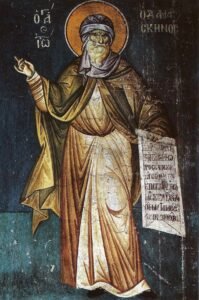
John of Damascus · A.D. 676–749 A.D. 743
“The bread and the wine are not merely figures of the body and blood of Christ (God forbid!) but the deified body of the Lord itself: for the Lord has said, "This is My body," not, this is a figure of My body: and "My blood," not, a figure of My blood.”
John of Damascus · A.D. 676–749 A.D. 749
“(De Fid. Orth. iii. 15.) For He was not only God, but man also, whence He wrought Divine wonders by touch and word; for as by an instrument so by His body the Divine acts were done.”
John of Damascus · A.D. 676–749 A.D. 749
“(de. Fid. Orth. iii. 24.) But seeing that prayer is the sending up the understanding to God, or the asking of God things fitting, how did the Lord pray? For His understanding needed not to be lifted up to God, having been once united hypostatically to God the Word. Neither could He need to ask of God things fitting, for the One Christ is both God and Man. But giving in Himself a pattern to us, He taught us to ask of God, and to lift up our minds to Him. As He took on Him our passions, that by triumphing over them Himself, He might give us also the victory over them, so now He prays to open to us the way to that lifting up to God, to fulfil for us all righteousness, to reconcile His Father to us, to pay honour to Him as the First Cause, and to shew that He is not against God.”
John of Damascus · A.D. 676–749 A.D. 749
“(Fid. Orth. iii. 23.) Or otherwise; All things which have not yet been brought into existence by their Maker have a natural desire of existence, and naturally shun non-existence. God the Word then, having been made Man, had this desire, through which He desired food, drink, and sleep, by which life is supported, and naturally used them, and contrariwise shunned the things that are destructive of life. Hence in the season of His Passion which He endured voluntarily, He had the natural fear and sorrow for death. For there is a natural fear wherewith the soul shrinks from separation from the body, by reason of that close sympathy implanted from the first by the Maker of all things.”
John of Damascus · A.D. 676–749 A.D. 749
“(Fid. Orth. iii. 20.) Wherefore the passions of our nature were in Christ both by nature and beyond nature. By nature, because He left His flesh to suffer the things incidental to it; beyond nature, because these natural emotions did not in Him precede the will. For in Christ nothing befel of compulsion, but all was voluntary; with His will He hungered, with His will He feared, or was sorrowful. Here His sorrow is declared, Then saith he unto them, My soul is sorrowful even unto death.”
John of Damascus · A.D. 676–749 A.D. 749
“(de Fid. Orth. iii. 27.) Although He died as man, and His holy soul was separated from His unstained body, yet His Godhead remained inseparate from either body or soul. Yet was not the one Person divided into two; for as both body and soul had from the beginning an existence in the Person of the Word, so also had they in death. For neither soul nor body had ever a Person of their own, besides the Person of the Word.”
John of Damascus · A.D. 676–749 A.D. 749
“(de fide Orthodox. ii. 3.) Angels, however, are revealed not as they really are, but transformed (as men are able to behold them) into whatever the Lord commands.”
John of Damascus · A.D. 676–749 A.D. 749
“(in lib. de Logic c. 49.) Those things which may be measured or numbered are used definitely, but that which from a certain excellence surpasses all measure and number we call great and much indefinitely; as when we say that great is the longsuffering of God.”
John of Damascus · A.D. 676–749 A.D. 749
“(Orat. de Trans fig. §. 8.) Matthew and Mark indeed say that the transfiguration took place on the sixth day after the promise made to the disciples, but Luke on the eighth. But there is no disagreement in these testimonies, but they who make the number six, taking off a day at each end, that is, the first and the last, the day on which He makes the promise, and that on which He fulfilled it, have reckoned only the intervening ones, but He who makes the number eight, has counted in each of the two days above mentioned. But why were not all called, but only some, to behold the sight? There was only one indeed who was unworthy to see the divinity, namely Judas, according to the word of Isaiah, Let the wicked be taken away, that he should not behold the glory of God. (Isai. 26:10 LXX.) If then he alone had been sent away, he might have, as it were from envy, been provoked to greater wickedness. Henceforward He takes away from the traitor every pretext for his treachery, seeing that He left below the rest of the company of the Apostles. But He took with Him three, that in the mouths of two or three witnesses every word should be established. He took Peter, indeed, because He wished to shew him that the witness he had borne to Him was confirmed by the witness of the Father, and that he was as it were to preside over the whole Church. He took with Him James, who was to be the first of all the disciples to die for Christ; but He took John as the clearest singer of the sacred doctrine, that having seen the glory of the Son, which submits not to time, he might sound forth, In the beginning was the Word. (John 1:1.)”
John of Damascus · A.D. 676–749 A.D. 749
“(ut sup. 10.) Servants however pray in one way; our Lord prayed in another. For the prayer of the servant is offered up by the lifting up of the mind to God, but the holy mind of Christ, (who was hypostatically [ὑπόστασιν] united to God,) prayed, that He might lead us by the hand to the ascent, whereby we mount up in prayer to God, and teach us that He is not opposed to God, but reverences the Father as His beginning; (ὡς ἀρχὴν ἑαυτὸν) nay, even tempting the tyrant, who sought from Him whether He were God, (which the power of His miracles declared,) He concealed as it were under the bait a hook; that he who had deceived man with the hope of divinity might fitly himself be caught with the clothing of humanity. Prayer is the revelation of Divine glory; as it follows, And as he prayed, the fashion of his countenance was altered.”
John of Damascus · A.D. 676–749 A.D. 749
“(ut sup. 13.) Now the devil, seeing His face shining in prayer, recollected Moses, whose face was glorified. But Moses indeed was arrayed with a glory, which came from without; our Lord, with that which proceeded from the inherent brightness of Divine glory. (Exod. 34:29.) For since in the hypostatical union there is one and the same glory of the Word and the flesh, He is transfigured not as receiving what He was not, but manifesting to His disciples, what He was. Hence, according to Matthew, it is said, that He was transfigured before them, and that His face shone as the sun; (Mat. 17:2.) for what the sun is in things of sense, God is in spiritual things. And as the sun, which is the fountain of light, cannot be easily seen, but its light is perceived from that which reaches the earth; so the countenance of Christ shines more intensely, like the sun, but His raiment is white as snow; as it follows, And his raiment was white and glistering; that is, lighted up by its participation of the divine light. And a little afterwards, But while these things were so, that it might be shewn there was but one Lord of the new and old covenant, and the mouths of heretics might be shut, and men might believe on the resurrection, and He also, who was transfigured, be believed to be the Lord of the living and the dead, Moses and Elias, as servants, stand by their Lord in His glory; hence it follows, And behold there talked with him two men. For it became men, seeing the glory and confidence of their fellow servants, to admire indeed the merciful condescension of the Lord, but to emulate those who had laboured before them, and looking to the pleasantness of future blessings, to be the more strengthened for conflicts. For he who has known the reward of his labours, will the more easily endure them.”
John of Damascus · A.D. 676–749 A.D. 749
“(Orat. de Trans. fig.) It were not good for thee, Peter, that Christ should abide there, for if He had remained, the promise made to thee would never receive its accomplishment. For neither wouldest thou have obtained the keys of the kingdom, nor the tyranny of death been abolished. Seek not bliss before its time, as Adam did to be made a God. The time shall come when thou shalt enjoy the sight without ceasing, and dwell together with Him who is light and life.”
John of Damascus · A.D. 676–749 A.D. 749
“(ubi sup.) But the Lord ordained thee not the builder of tabernacles, but of the universal Church. Thy words have been brought to pass by thy disciples, by thy sheep, in building a tabernacle, not only for Christ, but also for His servants. But Peter said not this deliberately, but through the inspiration of the Spirit revealing things to come, as it follows, not knowing what he said.”
John of Damascus · A.D. 676–749 A.D. 749
“(ubi sup.) It behoved Him also not to confine the fruit of His incarnation to the service of those only who were on the mount, but to extend it to all believers, which was to be accomplished by His cross and passion.”
John of Damascus · A.D. 676–749 A.D. 749
“(ubi sup.) This also our Lord commands, since He knew His disciples to be imperfect, seeing that they had not yet received the full measure of the Spirit, lest the hearts of others who had not seen should be prostrated by sorrow, and lest the traitor should be stirred up to a frantic hatred.”
John of Damascus · A.D. 676–749 A.D. 749
“(Hom. de Sabb. San.) Or to speak more expressly, In respect of His body, He was in the grave, in respect of His soul, He was in hell, and with the thief in Paradise; but as God, on the throne with His Father and the Holy Spirit.”
John of Damascus · A.D. 676–749 A.D. 749
“Now, the fact that Scripture speaks of one gathering does not mean that they were gathered together into one place, for notice that after this it says: "And the gathering together of the waters he called seas." Actually, the account meant that the waters were segregated by themselves apart from the earth. And so the waters were brought together into their gathering places and the dry land appeared.”
John of Damascus · A.D. 676–749 A.D. 749
“Fire is one of the four elements. It is light and more buoyant than the others, and it both burns and gives light. It was made by the Creator on the first day, for sacred Scripture says, "And God said: Be light made. And light was made." According to what some say, fire is the same thing as light.… And into the luminaries of the firmament the Creator put the primordial light, not that he was in want of any other light but that that particular light might not remain idle. For the luminary is not the light itself but its receptacle.”
John of Damascus · A.D. 676–749 A.D. 749
“Since this is so, God created man out of visible and invisible nature with his own hands according to the image and likeness, forming the body from the earth and through his own breathing upon it giving it a rational and intellectual soul, which we call the divine image. That which is "according to the image" is manifest in the intellect and free will. That which is "according to the likeness" is manifest in such likeness in virtue as is possible.”
John of Damascus · A.D. 676–749 A.D. 749
“After the transgression, … to prevent the wearing out and destruction of the race by death, marriage was devised that the race of men may be preserved through the procreation of children.But they will perhaps ask, What then is the meaning of "male and female" and "Be fruitful and multiply"? In answer we shall say that "Be fruitful and multiply" does not altogether refer to the multiplying by the marriage connection. For God had power to multiply the race also in different ways, if they kept the precept unbroken to the end. But God, who knows all things before they have existence, knowing in his foreknowledge that they would fall into transgression in the future and be condemned to death, anticipated this and made "male and female," and bade them "be fruitful and multiply."”
John of Damascus · A.D. 676–749 A.D. 749
“From the earth he formed his body and by his own inbreathing gave him a rational and understanding soul, which we say is the divine image.… The body and the soul were formed at the same time—not one before and the other afterward, as the ravings of Origen would have it.”
John of Damascus · A.D. 676–749 A.D. 749
“Then there is the ocean that encircles the entire earth like a sort of river and to which it seems to me that Scripture referred when it said that "a river flowed out of paradise." It has sweet potable water and supplies the seas, but because the water remains stagnant in the seas for a long time it becomes brackish. The sun and the waterspouts are constantly drawing up the less dense water, and from this the clouds are formed and the rain comes, the water becoming sweet by filtration. This ocean is divided into four heads, of four rivers. The name of the first is Pishon; this is the Ganges of India. The name of the second is Gehon; this is the Nile, which comes down from Ethiopia into Egypt. The name of the third is Tigris, and of the fourth, Euphrates.”
John of Damascus · A.D. 676–749 A.D. 749
“For God says, "Of every tree of paradise you shall eat," meaning, I think, by means of all created things you will be drawn up to me, their Creator, and from them reap the one fruit which is myself, who am the true life. Let all things be fruitful life to you, and make participation in me to be the substance of your own existence, for thus you shall be immortal.”
John of Damascus · A.D. 676–749 A.D. 749
“The tree of knowledge of good and evil is the power of discernment by multidimensional vision. This is the complete knowing of one's own nature. Of itself it manifests the magnificence of the Creator, and it is good for them that are fullgrown and have walked in the contemplation of God—for them that have no fear of changing, because in the course of time they have acquired a certain habit of such contemplation. It is not good, however, for such as are still young and are more greedy in their appetites, who, because of the uncertainty of their perseverance in the true good and because of their not yet being solidly established in their application to the only good, are naturally inclined to be drawn away and distracted by their solicitude for their own bodies.”
John of Damascus · A.D. 676–749 A.D. 749
“Some have imagined paradise to have been material, while others have imagined it to have been spiritual. However, it seems to me that just as man was created both sensitive and intellectual, so did this most sacred domain of his have the twofold aspect of being perceptible both to the senses and to the mind. For while in his body he dwelt in this most sacred and superbly beautiful place, as we have related, spiritually he resided in a loftier and far more beautiful place. There he had the indwelling God as a dwelling place and wore him as a glorious garment. He was wrapped about with his grace, and like some one of the angels he rejoiced in the enjoyment of that one most sweet fruit which is the contemplation of God, and by this he was nourished. Now this is indeed what is fittingly called the tree of life, for the sweetness of divine contemplation communicates a life uninterrupted by death to them that partake of it.”
John of Damascus · A.D. 676–749 A.D. 749
“Before the fall, all things were subject to the control of man, because God had made him ruler over all the things on the earth and in the water. And the serpent was on intimate terms with man, associating with him more than all the rest and conversing agreeably with him. For that reason it was through this relation that the devil, who is the source of evil, made that most evil suggestion to our first parents.”
John of Damascus · A.D. 676–749 A.D. 749
“Virginity was practiced in paradise. Indeed, sacred Scripture says that "they were naked, to wit, Adam and Eve, and were not ashamed." However, once they had fallen, they knew that they were naked, and being ashamed they sewed together aprons for themselves. After the fall, when Adam heard "Dust thou art, and unto dust you shall return," and death entered into the world through transgression, then Adam knew his wife, who conceived and brought forth. And so to keep the race from dwindling and being destroyed by death, marriage was devised, so that by the begetting of children the race of men might be preserved.”
John of Damascus · A.D. 676–749 A.D. 749
“From the beginning "the spirit of God moved over the waters," and over and again Scripture testifies to the fact that water is purifying. It was with water that God washed away the sin of the world in the time of Noah.”
John of Damascus · A.D. 676–749 A.D. 749
“When Noah was ordered to enter the ark and was entrusted with the safeguarding of the seed of the earth, he was given this command, which reads: "Come into the ark, you, your sons, your wife and your sons' wives." He separated them from their wives, so that with the help of chastity they might escape the ocean's depths and that worldwide destruction.”
John of Damascus · A.D. 676–749 A.D. 749
“When Noah was ordered to enter the ark and was entrusted with the safeguarding of the seed of the earth, he was given this command, which reads, "Go forth from the ark, you and your wife, and your sons and your sons' wives with you." He had separated them from their wives, so that with the help of chastity they might escape the deep and that worldwide destruction. However, after the cessation of the flood, the command was "Go forth from the ark, you and your wife, and your sons and your sons' wives with you." Here, see how marriage was again permitted for the sake of increase.”
John of Damascus · A.D. 676–749 A.D. 749
“Moreover, sacred Scripture, too, testifies to the fact that there will be a resurrection of the body. Indeed, God already had said to Noah after the flood, "Even as the green herbs have I delivered them all to you: saving that flesh with blood of its life you shall not eat. And I will require your blood of your lives, at the hand of every beast I will require it. And at the hand of every man I will require the life of his brother. Whosoever shall shed man's blood, for that blood his blood will be shed: for I made man to the image of God." How can he require the blood of men at the hand of every beast, unless he raises the bodies of those who die? For beasts will not die in the place of human beings.”
John of Damascus · A.D. 676–749 A.D. 749
“The burning bush was an image of God's mother, and when Moses was about to approach it, God said, "Do not come near; put off your shoes from your feet, for the place on which you are standing is holy ground." Now if the ground where Moses saw an image of the Theotokos is holy ground, how much more holy is the image itself? Not only is it holy, I daresay, but the holy of holies.”
John of Damascus · A.D. 676–749 A.D. 749
“I say that they are gods, lords and kings not by nature but because they have ruled over and dominated sufferings and because they have kept undebased the likeness of the divine image to which they were made—for the image of the king is also called a king. Finally … they have freely been united to God and [by] receiving him as a dweller within themselves have through association with him become by grace what he is by nature.”
John of Damascus · A.D. 676–749 A.D. 749
“This [cross] we have been given as a sign on our forehead, just as Israel was given the circumcision. For by it we faithful are set apart from the infidels and recognized. It is a shield and armor and a trophy against the devil. It is a seal that the destroyer may not strike us, as Scripture says.”
John of Damascus · A.D. 676–749 A.D. 749
“Behold, the glorification of matter, which you despise! What is more insignificant than colored goatskins? Are not blue and purple and scarlet merely colors? Behold the handiwork of men becoming the likeness of the cherubim! Was not the meeting tent an image in every way? "And see that you make them after the pattern for them, which is being shown you on the mountain." Yet all the people stood around it and worshiped! Were not the cherubim kept where all the people could see them? Did not the people gaze upon the ark, and the lampstand, and the table, the golden urn and Aaron's rod, and fall down in worship? I do not worship matter. I worship the Creator of matter, who became matter for me, taking up his abode in matter and accomplishing my salvation through matter.”
John of Damascus · A.D. 676–749 A.D. 749
“"You shall make for yourself no molten gods." You see that he forbids the making of images because of idolatry and that it is impossible to make an image of the bodiless, invisible and uncircumscribed God. "You saw no form on the day that the Lord spoke.…" And St. Paul, standing in the midst of the Areopagus, says, "Being therefore God's offspring, we ought not to think that the Deity is like gold, or silver or stone, a representation by the art and imagination of man."”
John of Damascus · A.D. 676–749 A.D. 749
“A first baptism was that of the flood [of Noah] that cut away of sin. A second was that by the [Red] Sea and the cloud, for the cloud is a symbol of the Spirit, while the sea is a symbol of the water. A third is that of the [Levitical] law, for every unclean person washed himself with water and also washed his garments and thus entered into the camp. A fourth is that of John, which was an introductory baptism leading those thus baptized to penance, so that they might believe in Christ.”
John of Damascus · A.D. 676–749 A.D. 749
“For from the beginning "the spirit of God moved over the waters," and over and again Scripture testifies to the fact that water is purifying. It was with water that God washed away the sin of the world in the time of Noah. It was with water that every one who was unclean was purified in accordance with the law, and even their garments were washed with water.”
John of Damascus · A.D. 676–749 A.D. 749
“And the Holy Spirit descended upon the holy apostles in the form of fire, because he is God, and "God is a consuming fire."”
John of Damascus · A.D. 676–749 A.D. 749
“God ordered twelve stones to be taken from the Jordan, and specified why, for he says, "When your children ask their fathers in time to come, what do these stones mean? Then you shall let your children know, Israel passed over this Jordan on dry ground, for the Lord your God dried up the waters of the Jordan for you until you passed over," and thus the ark was saved and all the people. Shall we not then record with images the saving passion and miracles of Christ our God, so that when my son asks me, "What is this?" I may say that God the Word became man, and that through him not only Israel passed through the Jordan, but the whole human race regained its original happiness? Through him, human nature rose from the lowest depths to the most exalted heights, and in him sat on the Father's throne.”
John of Damascus · A.D. 676–749 A.D. 749
“Images are of two kinds: either they are words written in a book … or else they are material images such as the twelve stones which he commanded to be taken from the Jordan for a second memorial (such a mystery, truly the greatest ever to befall the faithful people!) of the carrying of the ark and the parting of the waters. Therefore we now set up images in remembrance of valiant men, that we may zealously desire to follow their example. Either remove these images altogether, and reject the authority of him who commanded them to be made, or else accept them in the manner and with the esteem which they deserve.”
John of Damascus · A.D. 676–749 A.D. 749
“Now, this was a figure of baptism, for, just as circumcision cuts off from the body a part which is not useful but a useless superfluity, so by holy baptism are we circumcised of sin. It is obvious that sin is a superfluity of concupiscence and of no use. For it is impossible for anyone not to have any concupiscence at all or to be entirely without any taste for pleasure, but the useless part of pleasure, this is the sin which holy baptism circumcises.”
John of Damascus · A.D. 676–749 A.D. 749
“The circumcision was given to Abraham before the law, after the blessings and after the promise, as a sign to set him and those born of him and those of his household apart from the Gentiles in whose midst he was living. And this is obvious, because, when Israel spent forty years alone by themselves in the desert without mixing with any other nation, all those who were born in the desert were not circumcised. However, when Joshua brought them across the Jordan, they were circumcised and a second law of circumcision was made. For, under Abraham a law of circumcision was given, and then it was inoperative for forty years in the desert. Then, after the crossing of the Jordan, God again gave the law for a second time, as is written in the book of Joshua, son of Nave [Nun]: "At that time the Lord said to Joshua: make knives of stone from the sharpest rock, and sitting down circumcise the second time the children of Israel"; and a little further on: "for during forty-two years Israel dwelt in the wilderness of Midbar, and for this reason very many were uncircumcised of the sons of the fighting men who had come out of Egypt, who had disobeyed the commandments of God and to whom he declared that they should not see the good land which he had sworn to give to their fathers, the land flowing with milk and honey. The children of these he made to succeed in their place whom Joshua circumcised because of their not having been circumcised in the way." Hence, circumcision was a sign by which Israel was set apart from the Gentiles among whom they lived.”
John of Damascus · A.D. 676–749 A.D. 749
“Joshua, the son of Nun, and Daniel bowed in veneration before an angel of God, but they did not adore him. For adoration is one thing, and that which is offered in order to honor something of great excellence is another.”
John of Damascus · A.D. 676–749 A.D. 749
“Joshua the son of Nun did not see the angel as he is by nature, but an image, for an angel by nature is not visible to bodily eyes, yet he fell down and worshiped, and Daniel did likewise. Yet an angel is a creature, a servant and minister of God, but not God. And they fell down in worship before the angels, not as God, but as God's ministering spirits. Shall I not make images of friends? Shall I not honor them, not as gods but as the images of God's friends? Neither Joshua nor Daniel worshiped the angels they saw as gods. Neither do I worship an image as god, but through the images of Christ and of the holy Theotokos and of the saints, I bring worship and honor to God, because of the reverence with which I honor his friends. God did not unite himself with angelic nature but with human nature. God did not become an angel; he became a man by nature and in truth.”
John of Damascus · A.D. 676–749 A.D. 749
“In the relics of the saints the Lord Christ has provided us with saving fountains which in many ways pour out benefactions and gush with fragrant ointment. And let no one disbelieve. For, if by the will of God water poured out of the precipitous living rock in the desert, and for the thirsty Samson from the jawbone of an ass, is it unbelievable that fragrant ointment should flow from the relics of the martyrs? Certainly not, at least for such as know the power of God and the honor which the saints have from him.”
John of Damascus · A.D. 676–749 A.D. 749
“Political prosperity is the business of emperors; the condition of the church is the concern of shepherds and teachers. Any other method is piracy, brothers. Saul tore Samuel's cloak, and what was the consequence? God tore the kingdom away from him and gave it to David the meek.… We will obey you, O emperor, in those matters which pertain to our daily lives: payments, taxes, tributes; these are your due, and we will give them to you. But as far as the government of the church is concerned, we have our pastors, and they have preached the word to us; we have those who interpret the ordinances of the church.”
John of Damascus · A.D. 676–749 A.D. 749
“"Remember your leaders, those who spoke to you the Word of God; consider the outcome of their life and imitate their faith." Emperors have not preached the word to you, but apostles and prophets, shepherds and teachers. When God gave commands to David concerning the house David intended to build for him, he said to him, "You may not build a house for my name, for you are a warrior and have shed blood." "Pay all of them their dues," the apostle Paul says, "taxes to whom taxes are due, revenue to whom revenue is due, respect to whom respect is due, honor to whom honor is due." Political prosperity is the business of emperors; the condition of the church is the concern of shepherds and teachers. Any other method is piracy, brothers. Saul tore Samuel's cloak, and what was the consequence? God tore the kingdom away from him and gave it to David the meek.”
John of Damascus · A.D. 676–749 A.D. 749
“The soul watered by sacred Scripture grows fat and bears fruit in due season, which is the orthodox faith, and so is it adorned with its evergreen leaves, with actions pleasing to God, I mean. And thus we are disposed to virtuous action and untroubled contemplation by the sacred Scriptures.”
John of Damascus · A.D. 676–749 A.D. 749
“So from all these and many other examples beyond count we learn the virtue of tears and repentance. Only the manner thereof must be noted—it must arise from a heart that hates sin and weeps, as the prophet David says.… Again the cleansing of sins will be wrought by the blood of Christ, in the greatness of his compassion and the multitude of the mercies of that God who says, "Though your sins be as scarlet, I will make them white as snow."”
John of Damascus · A.D. 676–749 A.D. 749
“By saying "founded" he meant the stability and immutability of the order and succession given them by God.”
John of Damascus · A.D. 676–749 A.D. 749
“From there by his grace [the apostles] were scattered abroad among all nations and preached the orthodox faith, baptizing them in the name of the Father, and of the Son and of the Holy Spirit, and teaching them to observe all the commandments of the Savior. So they gave light to the people that wandered in darkness and abolished the superstitious error of idolatry. Though the enemy chafes under his defeat and even now stirs up war against us, the faithful, persuading the fools and unwise to cling to the worship of idols, yet is his power grown feeble, and his swords have at last failed him by the power of Christ.”
John of Damascus · A.D. 676–749 A.D. 749
“The fact that God exists is not doubted by those who accept the sacred Scriptures—both the Old and New Testaments, I mean—or by the majority of the Greeks, for, as we have said, the knowledge of God's existence has been revealed to us through nature. However, since the wickedness of the evil one has so prevailed over people's nature as even to drag some of them down to the most unspeakable and extremely wicked abyss of perdition and to make them say that there is no God, … then the Lord's disciples and apostles, made wise by the all-Holy Spirit, did by his power and grace show signs from God and draw up those people alive in the net of their miracles from the depths of the ignorance of God to the light of his knowledge.”
John of Damascus · A.D. 676–749 A.D. 749
“The word destruction (phthora) has two meanings. [First], it means human sufferings such as hunger, thirst, weariness, piercing with nails, death—that is separation of the soul from the body—and the like. In this sense, we say that the Lord's body was destructible, because he endured all these things freely. Destruction, however, also means the complete dissolution of the body and its reduction to the elements of which it was composed. By many this is more generally called corruption (diaphthora). This the Lord's body did not experience, as the prophet David says [in this psalm].… Therefore, it is impious to say with the insane Julian and Gaianus that before the resurrection the Lord's body was indestructible in the first sense. For, if it was thus incorruptible, then it was not consubstantial with us, and the things such as the hunger, the thirst, the nails, the piercing of the side and death that the gospel says happened did not really happen but only seemed to. But if they only seemed to happen, then the mystery of the incarnation is a hoax and a stage trick; it was in appearance and not in truth that he was made man and in appearance and not in truth that we have been saved. But far be it, and let those who say this have no part in salvation. We, however, have gained and shall obtain the true salvation. Moreover, in the second sense of the word destruction, we confess that the Lord's body was indestructible, that is to say, incorruptible, even as has been handed down to us by the inspired fathers.”
John of Damascus · A.D. 676–749 A.D. 749
“"The heavens show forth the glory of God" not by speaking in a voice audible to sensible ears but by manifesting to us through their own greatness the power of the Creator, and when we remark their beauty, we give glory to their Maker as the best of all artificers.”
John of Damascus · A.D. 676–749 A.D. 749
“Now a spirit that is sent, and acts, and strengthens and maintains is not breath that is dissipated any more than the mouth of God is a bodily member. Both in fact are to be understood as appropriately referring to God.”
John of Damascus · A.D. 676–749 A.D. 749
“Concerning you, the defenders of idolatry, were these words spoken by the prophet. For a very, very little while and your place shall not be found, but "just as the smoke vanishes, and just as wax melts near a fire, so you will fail." But, as touching the divine wisdom of the gospel, the Lord says, "Heaven and earth will pass away, but my words will not pass away." And again the psalmist says, "You, Lord, in the beginning laid the foundation of the earth; and the heavens are the work of your hands. They shall perish, but you endure; and they all will wax old as does a garment, and you will fold them up as a vestment, and they shall be changed, but you are the same, and your years will not fail!" And those divine preachers of the coming of Christ, those wise fishers of the world, whose nets drew all people from the depths of deceit, whom you, in your wickedness and bondage to sin, do vilify, did by signs and wonders and manifold powers shine as the sun in the world, giving sight to the blind, hearing to the deaf, motion to the lame and life to the dead. Their shadows alone healed all the ailments of humankind. The devils, whom you dread as gods, they not only cast forth from people's bodies but even drove out of the world itself by the sign of the cross, whereby they destroyed all sorcery and rendered witchcraft powerless. And these men, by curing every human disease by the power of Christ, and renewing all creation, are rightly admired as preachers of truth by all persons of sound mind.”
John of Damascus · A.D. 676–749 A.D. 749
“And so, since God is spiritual light and Christ in sacred Scripture is called "Sun of Justice" and "orient," the east should be dedicated to his worship. For everything beautiful should be dedicated to God from whom everything that is good receives its goodness. Also, the divine David says, "Sing to God, all you kingdoms of the earth: sing to the Lord; who mounts above the heaven of heavens, to the east." And still again, Scripture says, "And the Lord had planted a paradise in Eden to the east; wherein he placed man whom he had formed," and whom he cast out, when he had transgressed, "and made him to live over against the paradise of pleasure," or in the west. Thus it is that, when we worship God, we long for our ancient fatherland and gaze toward it. The tabernacle of Moses had the veil and the propitiatory to the east; and the tribe of Judah, as being the more honorable, pitched their tents on the east; and in the celebrated temple of Solomon the gate of the Lord was set to the east. As a matter of fact, when the Lord was crucified, he looked toward the west, and so we worship gazing toward him. And when he was taken up, he ascended to the east, and thus the apostles worshiped him, and thus he shall come in the same way as they had seen him going into heaven, as the Lord said: "As lightning comes out of the east and appears even into the west, so shall also the coming of the Son of man be." And so, while we are awaiting him, we worship toward the east. This is, moreover, the unwritten tradition of the apostles, for they have handed many things down to us unwritten.”
John of Damascus · A.D. 676–749 A.D. 749
“Moreover, one must know that the word gnōmē, or opinion, is used in many ways and with many meanings. Thus, it sometimes means "advice" as when the divine apostle says, "Now, concerning virgins, I have no commandment of the Lord; but I give counsel." Sometimes it implies "design," as when the prophet David says, "They have taken a malicious counsel against your people." Sometimes it means "judgment," as when Daniel says: "Why so cruel a sentence has gone forth." And sometimes it is used in the sense of "faith," or "notion," or of "intent"—to put it simply, the word has twenty-eight different meanings.”
John of Damascus · A.D. 676–749 A.D. 749
“Furthermore, let no one maintain that the heavens or the heavenly bodies are animate, for they are inanimate and without feeling. So, even though sacred Scripture says, "Let the heavens rejoice, and let the earth be glad," it is really calling on the angels in heaven and the people on earth to rejoice. Of course, Scripture can personify inanimate things and talk about them as if they were alive, as for example, "The sea saw and fled; Jordan was turned back," and, "What ailed you, O sea, that you did flee? and you, O Jordan, that you were turned back?" and again, "Mountains and hills are asked the reason for their skipping." In just the same way it is customary for us to say that "the city was gathered together," not intending to mean the houses but the occupants of the houses. Still again, "the heavens show forth the glory of God" not by speaking in voice audible to sensible ears but by manifesting to us through their own greatness the power of the Creator, and when we make comments about their beauty, we give glory to their Maker as the best of all artificers.”
John of Damascus · A.D. 676–749 A.D. 749
“Others [unspecified pagan philosophers], however, have imagined the heavens to have the form of a hemisphere, because the inspired David says, "Who stretches out the heaven like a pavilion" which means a tent; and the blessed Isaiah: "He that establishes the heavens like a vault"; and because the sun, the moon and the stars, when they set, go round the earth from west to north and return again to the east. However, whichever way it may be, all things have been made and established by the command of God and have their foundation in the divine will and desire. "For he spoke, and they were made; he commanded, and they were created. He has established them for ever, and for ages of ages; he has made a decree, and it shall not pass away."”
John of Damascus · A.D. 676–749 A.D. 749
“[God] is the maker and creator of the angels. He brought into being and made them after his own image into a bodiless nature, some sort of spirit, as it were, and immaterial fire—as the divine David says: "Who makes his angels spirits and his ministers a burning fire." And he determined their lightness, fieriness, heat, extreme acuity, their keenness in their desire for God and his service and their being raised up and removed from every material consideration.”
John of Damascus · A.D. 676–749 A.D. 749
“And again to Moses: "I am the God of Abraham and the God of Isaac and the God of Jacob." God "is not the God of the dead," of those who have died and will never be again. Rather, he is the God of the living, whose souls live in his hand and whose bodies will by the resurrection live again. And David, the ancestor of God, says to God, "You shall take away their breath, and they shall fail and shall return to their dust." See how it is a question of their bodies. Then he adds, "You shall send forth your spirit, and they shall be created; and you shall renew the face of the earth."”
John of Damascus · A.D. 676–749 A.D. 749
“Obtain the same thing for yourself and strive to advance toward it; for it is able to raise you from earth to heaven. You will not advance in it without preparation or [solely] by chance. First cleanse your soul of every passion and wipe it as clean of every evil as a newly cleansed mirror. Remove far from you every recollection of wrong and anger, which most of all prevents our daily prayers from reaching God. Also remove from your heart the offenses of everyone who has ever sinned against you. Giving wings to your prayer with mercy and compassion for the poor, approach God with fervent tears. Praying in this way you will be able to say with the blessed David, who, although he was king and burdened with countless cares, cleansed his soul of all passions: "I hated and abhorred iniquity, but I loved your law. Seven times a day I praised you because of the judgments of your righteousness." My soul kept your testimonies and I loved them very much. Let my prayer draw near to you, Lord; enable me to understand your word.”
John of Damascus · A.D. 676–749 A.D. 749
“Providence, then, is the solicitude that God has for existing things. And again, providence is that will of God by which all existing things receive suitable guidance through to their end. But, if providence is God's will, then, according to right reason, everything that has come about through providence has quite necessarily come about in the best manner and that most befitting God, so that it could not have happened in a better way. Now, the Maker of existing things must be the same as their Provider, for it is neither fitting nor logical that one should be their creator and another their provider, because in such a case they would both be definitely wanting—the one in the matter of creating and the other in that of providing. Hence, God is both Creator and Provider, and his power of creating, sustaining and providing is his good will. For "whatsoever the Lord pleased he has done, in heaven and in earth," and none resisted his will. He willed all things to be made, and they were made; he wills the world to endure, and it does endure; and all things whatsoever he wills are done.”
John of Damascus · A.D. 676–749 A.D. 749
“The more those greater sins grow on them, the more does the soul become accustomed to them and think light of them. For it is said, "When the wicked comes to the depth of evil things, he thinks light of them."”
John of Damascus · A.D. 676–749 A.D. 749
“He has revealed to us what it was expedient for us to know, whereas that which we were unable to bear he has withheld. With these things let us be content, and in them let us abide, and let us not step over the ancient bounds or pass beyond the divine tradition.”
John of Damascus · A.D. 676–749 A.D. 749
“So, following the teachings of these blessed saints, we utterly renounce these corruptible and perishable things of life, wherein may be found nothing stable or constant, or that continues in one stay. But all things are vanity and vexation of spirit, and many are the changes that they bring in a moment, for they are slighter than dreams and a shadow, or the breeze that blows the air. Small and short-lived is their charm, that is after all no charm, but illusion and deception of the wickedness of the world; which world we have been taught to love not at all but rather to hate with all our heart. Yes, and truly it is worthy of hatred and abhorrence; for whatsoever gifts it gives to its friends, these in turn in passion it takes away and shall hand over its victims, stripped of all good things, clad in the garment of shame, and bound under heavy burdens, to eternal tribulation. And those again whom it exalts, it quickly abases to the utmost wretchedness, making them a footstool and a laughing stock for their enemies. Such are its charms, such its bounties.”
John of Damascus · A.D. 676–749 A.D. 749
“But as long as we are among the living, while the foundation of our true faith continues unshattered, even if somewhat of the outer roofwork or inner building be disabled, it is allowed to renew by repentance the part rotted by sins.”
John of Damascus · A.D. 676–749 A.D. 749
“Such therefore being the promises made by God to them that turn to him, don't delay … but draw near to Christ, our loving God, and be enlightened, and your face shall not be ashamed. For as soon as you go down into the bath of holy baptism, all the defilement of the old nature and all the burden of your many sins are buried in the water and pass into nothingness. And you come up from there a new person, pure from all pollution, with no spot or wrinkle of sin upon you.”
John of Damascus · A.D. 676–749 A.D. 749
“With eyes, lips and faces turned toward it, let us receive the divine burning coal, so that the fire of the coal may be added to the desire within us to consume our sins and enlighten our hearts, and so that by this communion with the divine fire we may be set afire and deified. Isaiah saw a live coal, and this coal was not plain wood but wood joined with fire. Thus also, the bread of communion is not plain bread but bread joined with the Godhead. And the body joined with the Godhead is not one nature. On the contrary, that of the body is one, whereas that of the Godhead joined with it is another—so that both together are not one nature but two.”
John of Damascus · A.D. 676–749 A.D. 749
“Now, since the Lord was not a mere man but was also God and knew all things, he stood in no need of reflection, inquiry, counsel or judgment. He also had a natural affinity for good and antipathy for evil. Thus it is in this sense that the prophet Isaiah, too, says, "Before the child shall know to refuse the evil, he will choose the good. For before the child knows to refuse the evil and to choose the good, he will reject the evil by choosing the good." The "before" shows that he made no inquiry or investigation in a human manner but that since he was God and divinely subsisted in the flesh—that is to say, was personally united to the flesh—by the fact of his very being and his knowing all things he naturally possessed the good.”
John of Damascus · A.D. 676–749 A.D. 749
“Those who trust in idols are foolish. Idols are their own creations, things they made with their own hands, but they turn around and say, "These idols are our creators." How can these people say that something they made is their creator? Moreover, they guard their idols, so that they will not be stolen by thieves. What foolishness! If idols cannot guard and protect themselves, how can they guard and save others?”
John of Damascus · A.D. 676–749 A.D. 749
“Sacred Scripture … testifies to the fact that there will be a resurrection of the body.… Isaiah also [testifies that] "the dead shall rise and those in their graves be awakened." And it is obvious that it is not the souls that are put in the tombs but the bodies.”
John of Damascus · A.D. 676–749 A.D. 749
“The prescription of the law must be taken in the more spiritual sense. For there is a spiritual seed which through charity and the fear of God is conceived in the womb of the soul, which in turn travails and brings forth the spirit of salvation. It is in this sense that the passage is to be taken which reads, "Blessed is he who has seed in Zion and kindred in Jerusalem." What, indeed! Even though one is a fornicator, a drunkard or an idolater, will he be blessed, provided only that he has seed in Zion and kindred in Jerusalem? No one in his right mind would say that.”
John of Damascus · A.D. 676–749 A.D. 749
“You are about to journey a long road, and you need many supplies. You shall arrive at the place eternal that has two regions, wherein are many mansions; one of which places God has prepared for them that love him and keep his commandments, full of all manner of good things. And they that attain to it shall live for ever in incorruption, enjoying immortality without death, where pain and sorrow and sighing are fled away. But the other place is full of darkness and tribulation and pain, prepared for the devil and his angels. In it also they shall be cast who by evil deeds have deserved it, who have bartered the incorruptible and eternal for the present world and have made themselves fuel for eternal fire.”
John of Damascus · A.D. 676–749 A.D. 749
“It has been sufficiently demonstrated that God exists and that his essence is incomprehensible. Furthermore, those who believe in sacred Scripture have no doubt that he is one and not several. For the Lord says at the beginning of his lawgiving, "I am the Lord your God, who brought you out of the land of Egypt. You shall not have strange gods before me." And again: "Hear, O Israel: the Lord your God is one Lord." And through the mouth of the prophet Isaiah: "I am," he says, "the first God, and I am the last, and there is no God besides me. Before me there was no God, and after me there shall be none, and beside me there is none." And the Lord speaks thus to his Father in the holy Gospels: "This is eternal life: that they may know you, the only true God." With those who do not believe in sacred Scripture we shall reason as follows. The Divinity is perfect and without deficiency in goodness or wisdom or power. He is without beginning, without end, eternal, uncircumscribed; to put it simply, he is perfect in all things. Now, if we say that there are several gods, there must be some difference to be found among them. For if there is no difference at all among them, then there is one God rather than several. But if there is some difference, then where is the perfection? For if one should come short of perfection in goodness, or power, or wisdom, or time or place, then he would not be God. The identity of God in all things shows him to be one and not several.”
John of Damascus · A.D. 676–749 A.D. 749
“Shine, shine, O new Jerusalem, for the glory of the Lord has shone on you. Rejoice and be glad, O Zion! And you, O immaculate, O Mother of God, exult with Job in the resurrection of your Son. Christ is risen, and he has crushed death and raised the dead: rejoice, therefore, O nations of the earth! Shine, shine, O new Jerusalem, for the glory of the Lord has risen over you. Cry out now and rejoice, O Zion; and you, the pure one, the Mother of God, exult in the resurrection of the One to whom you gave birth. On this day, the whole creation rejoices and exults, for Christ is risen and hades despoiled.”
John of Damascus · A.D. 676–749 A.D. 749
“"For heaven is his resting place and the earth his footstool," because on the earth he conversed in the flesh with men and women. And the sacred flesh of God has been called his foot. The church, too, is called the place of God, because we have set it apart for the glorifying of God as a sort of consecrated place wherein we also hold conversation with him. Likewise also the places in which his energy becomes manifest to us, whether through the flesh or apart from the flesh, are spoken of as the places of God.”
John of Damascus · A.D. 676–749 A.D. 749
“Now when the fullness of time came, an angel of the Lord was sent to [Mary] with the good news of her conception of the Lord. And thus she conceived the Son of God, the subsistent power of the Father, "not of the will of the flesh or of the will of man"—that is to say, not of carnal conjunction and seed—but of the good pleasure of the Father and the cooperation of the Holy Spirit. To the Creator she gave that he might be created, to the Fashioner that he might be fashioned, and to the Son of God and God that he might from her innocent and undefiled flesh and blood put on flesh and become man. And thus she paid the debt for the first mother. For as Eve was formed from Adam without carnal conjunction, so did this one bring forth the new Adam in accordance with the law of gestation but surpassing the nature of generation. Thus, he who is without a mother begotten of a father was without a father born of a woman. And because it was of a woman it was in accordance with the law of gestation; while, because it was without father, it surpassed the nature of generation. And because it was at the normal time, for having completed the nine-month period he was born at the beginning of the tenth, it was in accordance with the law of gestation, while because it was without pain it surpassed the established order of birth—for where pleasure had not preceded, pain did not follow, as the prophet said, "Before she was in labor, she brought forth," and again, "before her time came to be delivered she brought forth a man child."And so the Son of God became incarnate and was born of her. It was not as God-bearing man that he was born of her but as God incarnate; not as a prophet anointed through the operation of the one anointing but as one anointed with the entire presence of the one anointing—so that the one anointing became man and the one anointed became God.”
John of Damascus · A.D. 676–749 A.D. 749
“God finds fault with the commandments of the Old Testament, for he says, "I gave them statutes that were not good and ordinances by which they could not have life," because of their hardness of heart.”
John of Damascus · A.D. 676–749 A.D. 749
“One of the angel powers, the marshal of one host, bore in himself no trace of natural evil from his Maker's hand but had been created for good, yet by his own free and deliberate choice he turned aside from good to evil and was stirred up by madness to the desire to take up arms against his Lord God.”
John of Damascus · A.D. 676–749 A.D. 749
“Although it is best for us to be ever aware of our unworthiness and to confess our sins before God, nevertheless it is good and necessary to speak when the times demand it, for I see the church that God founded on the apostles and prophets, its cornerstone being Christ his Son, tossed on an angry sea, beaten by rushing waves, shaken and troubled by the assaults of evil spirits. Impious people seek to rend asunder the seamless robe of Christ and to cut his body in pieces: his body, which is the Word of God and the ancient tradition of the church. Therefore I think it unreasonable to keep silence and hold my tongue.”
John of Damascus · A.D. 676–749 A.D. 749
“For the wickedness of the wicked shall not hurt him in the day that he turns from his wickedness. If he acts righteously and walks in the statutes of life, he shall surely live; he shall not die. None of his sins that he committed shall be remembered against him. Because he has made the decree of righteousness, he shall live by it.”
John of Damascus · A.D. 676–749 A.D. 749
“But just as He who was conceived kept her who conceived still virgin, in like manner also He who was born preserved her virginity intact, only passing through her and keeping her closed. [Ezekiel 44:2] The conception, indeed, was through the sense of hearing, but the birth through the usual path by which children come, although some tell tales of His birth through the side of the Mother of God. For it was not impossible for Him to have come by this gate, without injuring her seal in anyway.
The ever-virgin One thus remains even after the birth still virgin, having never at any time up till death consorted with a man.”
John of Damascus · A.D. 676–749 A.D. 749
“Without seed the Son of God was conceived of the Holy Spirit, and in the Virgin's womb he formed for himself a fleshly body, animate with a reasonable and intelligent soul. From it [he came] forth in one substance but in two natures, perfect God and perfect man. It preserved undefiled, even after birth, the virginity of her that bore him. Being made of like passions with ourselves in all things, yet without sin, he took our infirmities and bore our sicknesses. For, since by sin death entered into the world, he who was to redeem the world had to be without sin, and not by sin subject to death.”
John of Damascus · A.D. 676–749 A.D. 749
“Further, the divine nature has the property of penetrating all things without mixing with them and of being itself impenetrable by anything else. Moreover, there is the property of knowing all things with a simple knowledge and seeing all things simply with his divine, all-surveying, immaterial eye, the things of the present, and the things of the past and the things of the future before they come into being. The divine nature is also sinless, and can cast sin out and bring salvation. And all that it wills, it can accomplish, but it does not will all it could accomplish. For it could destroy the universe, but it does not will so to do.”
John of Damascus · A.D. 676–749 A.D. 749
“The third kind of relative worship we give to objects dedicated to God, such as the holy Gospel and other books, for they have been written for our instruction, on whom the end of the ages has come. Obviously, patens, chalices, censers, candlesticks and altars should all receive respect. Remember how Belshazzar made his people serve wine in sacred vessels and how God brought his kingdom to an end.”
John of Damascus · A.D. 676–749 A.D. 749
“Joshua, the son of Nun, and Daniel bowed in veneration before an angel of God, but they did not adore him. For adoration is one thing, and that which is offered in order to honor something of great excellence is another.”
John of Damascus · A.D. 676–749 A.D. 749
“"Many shall awake" means the resurrection of their bodies, for I do not suppose that anyone would speak of souls sleeping in the dust of the earth.… The Lord, too, has clearly shown in the holy Gospels that there is a resurrection of the body, for "they that are in the graves," he says, "shall hear the voice of the Son of God. And they that have done good things shall come forth to the resurrection of life; but they that have done evil, to the resurrection of judgment." Now, no person in his right mind would ever say that it was the souls that were in the graves.”
John of Damascus · A.D. 676–749 A.D. 749
“The dead shall rise again, and they that are in the graves shall awake. They that have kept the commandments of Christ and have departed this life in the true faith shall inherit eternal life; and they that have died in their sins and have turned aside from the right faith shall go away into eternal punishment. Do not believe that there is any true being or kingdom of evil or suppose that it is without beginning, or self-originated or born of God—forget such an absurdity! But believe rather that it is the work of us and the devil, come on us through our inattentiveness, because we were endowed with free will, and we made our choice, of deliberate purpose, whether it be good or evil.”
John of Damascus · A.D. 676–749 A.D. 749
“It is, then, customary for sacred Scripture to speak of his permission as an action and deed, but even when it goes so far as to say that God "creates evil" and that "there is not evil in a city which the Lord has not done," it still does not show God to be the author of evil. On the contrary, since the word evil is ambiguous it has two meanings, for it sometimes means what is by nature evil, being the opposite of virtue and against God's will, while at other times it means what is evil and painful in relation to our sensibility, which is to say, tribulation and distress. Now while these last seem to be evil, because they cause pain, actually they are good because to such as understand them they are a source of conversion and salvation. It is these last that Scripture says are permitted by God. Moreover, one must know that we too cause them because involuntary evils spring from voluntary ones.”
John of Damascus · A.D. 676–749 A.D. 749
“It was with bread and wine that Melchizedek, the priest of the most high God, received Abraham, when he was returning from the slaughter of the alien tribes. That altar prefigured this mystical altar, even as that priest was a type and a figure of the true archpriest, who is Christ. For "you," he says, "are a priest forever according to the order of Melchizedek." This bread was prefigured by the loaves of proposition. This is quite plainly the pure and unbloody sacrifice which the Lord, through the mouth of the prophet, said was to be offered to him from the rising of the sun even to its going down.”
John of Damascus · A.D. 676–749 A.D. 749
“It is not without any reason or by any chance that we worship toward the east. On the contrary, since we are composed of a visible and an invisible nature, of an intellectual nature and a sensitive one, that is, we also offer a twofold worship to the Creator. It is just as we also sing both with our mind and our bodily lips, and as we are baptized both in water and in the spirit, and as we are united to the Lord in two ways when we receive the sacrament and the grace of the spirit. And so, since God is spiritual light and Christ in sacred Scripture is called "Sun of justice" and "Orient," the east should be dedicated to his worship. For everything beautiful should be dedicated to God, from whom everything that is good receives its goodness. Also, the divine David says, "Sing to God, you kingdoms of the earth; sing you to the Lord, who mounts above the heaven of heavens, to the east." And still again, Scripture says, "And the Lord had planted a paradise in Eden to the east; wherein he placed man whom he had formed," and whom he cast out, when he had transgressed, "and made him to live over against the paradise of pleasure," or in the west. Thus when we worship God, we long for our ancient homeland and gaze toward it. The tabernacle of Moses had the veil and the propitiatory altar to the east; and the tribe of Judah, as being the more honorable, pitched their tents on the east; and in the celebrated temple of Solomon the gate of the Lord was set to the east. As a matter of fact, when the Lord was crucified, he looked toward the west, and so we worship gazing toward him. And when he was taken up, he ascended to the east, and thus the apostles worshiped him. And thus he shall come in the same way as they had seen him going into heaven, as the Lord himself said: "As lightning comes out of the east and appears even into the west, so shall also the coming of the Son of man be." And so, while we are awaiting him, we worship toward the east.”
John of Damascus · A.D. 676–749 A.D. 749
“The angels see God to such extent as is possible for them, and this is their food. Although, because they are incorporeal, they are superior to us and free of all bodily passion, they are certainly not passionless, because only the Divinity is passionless. They take whatever form the Lord may command, and thus they appear to people and reveal the divine mysteries to them. They live in heaven and have as their one work to sing the praises of God and minister to his sacred will.”
John of Damascus · A.D. 676–749 A.D. 749
“The Word of God, who out of mercy condescended to become her son, serves with his sovereign hands this most holy and most divine woman as is fitting toward a mother and receives her holy soul. What a good legislator! Not being subject to the law, he keeps the law that he decreed. It is he, in fact, who established the duty of children toward their parents. "Honor," he says, "your father and your mother." I believe this is a truth that is obvious to anyone who is at least a little familiar with the divine revelation of sacred Scripture. If, as sacred Scripture says, "the souls of the righteous are in the hands of the Lord," how much more should she not entrust her soul to her Son and her God?”
John of Damascus · A.D. 676–749 A.D. 749
“No one is entirely without the gifts of God, but one will be inclined to this virtue and another to that. One to more virtue, another to less. One to the more elevated and supereminent virtues, another to those that are humble and modest. God has distributed to each according to the measure of his faith. The powerful will therefore be examined severely, and "of the one to whom much has been entrusted, much will be required." Of each person will be demanded, in fact, according to the measure in which he has been entrusted by God's power. And the benefactor knows his recipient: "Everything is naked and exposed before his eyes."”
John of Damascus · A.D. 676–749 A.D. 749
“Everything that exists must give thanks to God, rendering him perpetual veneration, since all things have being from him and subsist in him. Without stint he gives a share of his gifts to all without being asked, and he wants everyone to be saved and to partake of his goodness. He is patient toward us sinners. He makes the sun rise on the righteous and the unrighteous and makes it rain on the bad and the good, also because for our sake the Son of God became like us, making us partakers of his divine nature, since we will be like him, as John the theologian says in the catholic epistle.”
John of Damascus · A.D. 676–749 A.D. 749
“No one has ever known God, except the one to whom God has revealed himself. This is true not only for human beings but also among the supracosmic powers and, I would say, even among the cherubim and seraphim. Nevertheless, God did not abandon us in total ignorance. In fact, knowledge of God exists and has been implanted naturally by him in everyone. The creation itself, its preservation and its regulation, proclaim the greatness of the divine nature. And he also revealed knowledge of himself, to the extent it can be attained, first through the Law and the prophets and then through his only-begotten Son, our Lord God and Savior Jesus Christ. For this reason we receive, acknowledge and reverence what has been passed down to us through the Law, the prophets, the apostles and the Evangelists, not seeking anything beyond these things. Indeed, God, being good, is the author of every good and is subject to neither envy or passion. "Envy is far from the divine nature, which is impassive and only good." Therefore, knowing all things and concerned for what is useful for each, he revealed what is good for us to know, passing over in silence what we could not bear.”
John of Damascus · A.D. 676–749 A.D. 749
“If the bones of the righteous are impure, how is it that the bones of Jacob and Joseph were carried out of Egypt with every honor? Or how is it that a dead man was raised after coming in contact with the bones of Elisha? If God works miracles through bones, it is clear that he can also do so through images, stones and many other things. This also happened with Elisha, who gave his staff to his servant and ordered him to go and raise the son of the Shunammite woman with it. Moses too, with a staff, not only punished Pharaoh but also divided the sea, sweetened waters and opened the rock and made water flow out. Solomon says, "Blessed is the wood from which salvation comes." Elisha made a piece of iron float after throwing a stick in the Jordan, and it is also written that "the tree of life" and "the plant of Sabek" lead to forgiveness. Moses lifted up the serpent on a stick, saving the lives of the people, and confirmed the priesthood in the tent with a blooming branch.”
John of Damascus · A.D. 676–749 A.D. 749
“Death, previously abhorred and hated, is now the object of praise and declared blessed. What at one time procured pain and sadness, tears and melancholy, now appears as a source of joy and feasting. All the servants of God enjoy a blessed death because the end of their lives bears the security of being welcomed by God. In fact, they become perfect, and this perfection renders them blessed, giving them the solidity of virtue, as the oracle affirms, "Do not judge a person blessed before his death."”
John of Damascus · A.D. 676–749 A.D. 749
“By his miracles and resurrection and by the descent of the Holy Spirit, it was made plain and certain to the world that Christ was the Son of God.”
John of Damascus · A.D. 676–749 A.D. 749
“The very creation, by its harmony and ordering, proclaims the majesty of the divine nature.”
John of Damascus · A.D. 676–749 A.D. 749
“Sun and moon are subject to change and variation, as is evident in an eclipse. This refutes the folly of those who worship the creature. Now, anything that is subject to change is not God, for by its very nature it is subject to corruption and change.”
John of Damascus · A.D. 676–749 A.D. 749
“Faith comes by hearing, because when we hear the holy Scriptures we believe in the teaching of the Holy Spirit. This faith is made perfect by all the things which Christ has ordained; it believes truly, it is devout and it keeps the commandments of him who has renewed us. For he who does not believe in accordance with the traditions of the catholic church or who through untoward works holds communion with the devil is without faith.”
John of Damascus · A.D. 676–749 A.D. 749
“This is not to be taken in the sense of God acting but in the sense of God permitting, because of free will and because virtue is not forced.”
John of Damascus · A.D. 676–749 A.D. 749
“"In him are all things" not only because he has brought them from nothing into being but because it is by his operation that all things he made are kept in existence and held together. Living things, however, participate more abundantly, because they participate in the good both by their being and by their living. But rational beings, while they participate in the good in the aforementioned ways, do so still more by their very rationality. For in a way they are more akin to him, although of course he is immeasurably superior to them.”
John of Damascus · A.D. 676–749 A.D. 749
“Those from among the Jews who had believed, being on the one hand possessed by the prejudice to Judaism and on the other hand, drunk with vainglory, wishing also to ascribe to themselves the authority of teachers, came to the nation of the Galatians and taught the necessity of being circumcised, of keeping Sabbaths and new moons and of being intolerant of Paul who abolishes these. They argued that those around Peter and James and John, who are the first of the Apostles, do not prohibit these things. Indeed Paul appeared yesterday and today, whereas those around Peter were first. He is the disciple of the Apostles, whereas they are disciples of Christ. He is alone, whereas they are many and pillars of the Church. Seeing, then, in front of him an entire nation and a fire to have been lit, starting from the Church of the Galatians, he writes this Letter to everybody offering a word of apology and right at the start he takes up what they were saying undermining his reputation — namely, that the others were disciples of Christ whereas he became the disciple of the Apostles.”
John of Damascus · A.D. 676–749 A.D. 749
“Why did he not start with what befits the Godhead of Christ, but with the very passion? He did so because they rebelled against him as those who would be punished if they deviated from the law; and so he mentions that thing through which every need of the law has been thrown out. I mean, of course, the cross and the resurrection, which provided the cause for the salvation of all.”
John of Damascus · A.D. 676–749 A.D. 749
“He indicates by this the necessity of the Letter; for it was not only one Church that prompted him to such a diligent action, but a multitude of Churches.”
John of Damascus · A.D. 676–749 A.D. 749
“Again he takes up the point they made, namely, that Paul is one, and the Apostles, many. Thus he brought in with him a whole multitude, and not as in other Letters, only Paul, or Paul and Timothy, or Silvanus as well.”
John of Damascus · A.D. 676–749 A.D. 749
“He lays this down everywhere, and especially now he writes to the Galatians, because they were running the risk of falling away from grace, and returning to circumcision.”
John of Damascus · A.D. 676–749 A.D. 749
“He did not speak about the time, but pronounced the present life to be evil.”
John of Damascus · A.D. 676–749 A.D. 749
“We have incurred innumerable evils, and have become responsible for the last punishment; for the law not only has not led anyone to reconciliation, but, to condemnation, and besides, it is incapable of emancipating anyone, or putting an end to God's wrath, when it reveals sin; whereas the Son of God, not only has made possible what was impossible, but also has remitted sins and has placed enemies to the position of friends.”
John of Damascus · A.D. 676–749 A.D. 749
“He refers to the evil deeds, to the distorted free choice.”
John of Damascus · A.D. 676–749 A.D. 749
“This, he says, has raised within me much surprise, because those who were taught the mystery of grace in such a way that they could become teachers of others, were so easily persuaded by deceivers.”
John of Damascus · A.D. 676–749 A.D. 749
“Just as Peter says, that "there is no other name under heaven given to men, whereby we must be saved" (Acts 4:12).”
John of Damascus · A.D. 676–749 A.D. 749
“He rightly said, "those who disturb," and not "those who teach," or "those who persuade," so as to show that the whole case was entirely one of deceit."”
John of Damascus · A.D. 676–749 A.D. 749
“See the apostolic prudence! He includes himself in the anathema, so that no one might say that he constructs his own dogmas on account of vainglory; and he mentioned the angels because they took refuge in authorities, i.e. James and John. Do not tell me, he says, about James and John, for even one of the angels, who are first, should be anathema in corrupting the Gospel.”
John of Damascus · A.D. 676–749 A.D. 749
“If, he says, I was trying to deceive you in saying these things, am I perhaps able to distort God's thought, who knows the secrets of one's mind, and whom I take every care to please in all things?”
John of Damascus · A.D. 676–749 A.D. 749
“If I wanted to please men, he says, I would still be with the Jews and would contest against the Church. If, however, I have treated with contempt an entire nation and relatives and glory, and have exchanged these with persecutions, and fights, and daily deaths, it should be obvious that even in saying these things I am not relying on the glory, which is from men. In fact he has said this because he is about to speak of his previous life. However, to prevent them from being elated in thinking that he does this as one who is apologizing to them, he says: "For am I still seeking to persuade men?"”
John of Damascus · A.D. 676–749 A.D. 749
“Do you see how he constantly affirms that he became God's disciple, in contrast to the claim of those who imposed the circumcision upon the Galatians, arguing that those who become disciples of Christ, i.e. Peter and James and John, permit the circumcision, whereas he is a disciple of the disciples and, therefore, they should not pay attention to them rather than to him?”
John of Damascus · A.D. 676–749 A.D. 749
“The whole construction is a demonstration that he did not receive the mystery from a man; for such an abrupt conversion could not possibly have taken place through a man. The teaching of men makes progress little by little. But there is also another underlying construction, in that he gently teaches them not to do the things of law; for he says, if he who showed such a great diligence in connection with the law, abandoned the things of law and turned to the salvation which is from faith, it is obvious that he abandoned the law as being unable to lead to perfection. How much more fitting, then, should it be for those who have turned to the faith not to seek to follow what is unable to lead to perfection!”
John of Damascus · A.D. 676–749 A.D. 749
“If he were indeed called to the mission from the mother's belly, how did he become a persecutor? He has indeed solved this inextricable difficulty in another place, in saying: "So that Christ might first demonstrate in me his entire long-suffering, providing a type for those who were to believe in him unto eternal life" (I Tim. 1:16).”
John of Damascus · A.D. 676–749 A.D. 749
“Another construction, demonstrating that he did not receive the teaching of Christ from men. Indeed, how could one, who was worthy of a teaching from above, confer with men?”
John of Damascus · A.D. 676–749 A.D. 749
“I did not come, he says, to be taught, but to inform; which brings only honor to him.”
John of Damascus · A.D. 676–749 A.D. 749
“At the beginning, when he received the Gospel, he did not go up, nor did he put this to the Apostles. For, having learned from Christ, he did not need their teaching. As the time went by, however, and while he was teaching the nations the Gospel without circumcision, some became scandalized, since those around Peter did not dismiss circumcision, whereas he was alone in dismissing it. Thus, because the Holy Spirit wished to cut out this scandal of the others, ordered him to come up with witnesses and to put it to the Apostles that he preaches without circumcision, so that they too may join him and this scandal for human beings might be dissolved.”
John of Damascus · A.D. 676–749 A.D. 749
“That is, by the Apostles; which is, of course, a highest proof that they should not pass sentence against the Apostle, who did not circumcise the nations.”
John of Damascus · A.D. 676–749 A.D. 749
“The preposition 'because of' (dia) was put here instead of 'according to' (kata). But the sense is this. The Apostles, he says, did not force Titus, who was uncircumcised, to be circumcised, although this was pointed out by the brethren who were brought in secretly and pressed for circumcision. Indeed he put them in the place of spies because of what is foreign to the truth.”
John of Damascus · A.D. 676–749 A.D. 749
“That they might introduce us again, he says, into the slavery of the law. This is why elsewhere he says, Christ purchased us from the curse of the law (Gal. 3:13).”
John of Damascus · A.D. 676–749 A.D. 749
“Not even for a short while, he says, did we submit to them, i.e. to those who slipped in, so that we might not be found saying one thing about the Gospel and doing another. What, then, did he say about the Gospel? So that if one is in Christ he is a new creation (II Cor. 5:17); And, the old things passed away, behold all things has become new (ibid.); and In freedom Christ has made us free (Gal. 5:1).”
John of Damascus · A.D. 676–749 A.D. 749
“He says 'those who thought of themselves to be' instead of 'those who were.' As he said about himself, I think that I too have the Spirit of God. The sense is this: I do not know, he says, nor do I contest about, the reason, which made those around Peter condescend to circumcision; they know, for they shall have to give an account to God. As for me I know one thing, that when I came, they no longer said anything about the preaching. He was right in saying, "whatever they might be," for they were not anything, so that he might offer the condescension to the beginning of his preaching and to them.”
John of Damascus · A.D. 676–749 A.D. 749
“The sentence beginning with "But on the contrary, seeing ... etc.," is summed up by the sentence "They extended to me and Barnabas the right hand of fellowship." Actually he says what he says in between in order to indicate once again that he was not ordained by men to preach to the nations, as his enemies said concerning him”
John of Damascus · A.D. 676–749 A.D. 749
“The circumstances, he says, were such, that they were to preach to the Jews and we, to the nations. But the care for the poor became a matter common to both of them. These poor were those from the Jews who believed in Christ and who had been deprived of their own homes by the Jews; They were those to whom he wrote, For you accepted joyfully the seizure of your property (Hebr. 10:34).”
John of Damascus · A.D. 676–749 A.D. 749
“When he was resident in Jerusalem, Peter condescended to Judaism, not prohibiting circumcision, nor the Sabbaths. When he came down to Antioch, however, he ate with those from the nations who had believed in the Lord without - any discrimination. Then, when certain people came down from Jerusalem, he was afraid in case he scandalized them and separated himself from those with whom he previously used to eat. But Paul made some sort of economy with him, when he rebuked him in front of everyone for demanding from the nations to Judaize; inasmuch as he intended that by seeing the teacher hearing this rebuke and remaining silent, they might learn that they should not keep the Jewish customs. The whole case was one of economy, based on the prudence of both and intended for the benefit of the disciples, so that even if Peter is said to have behaved as a hypocrite, and not to have been upright, this is understood to have been said for the benefit of the disciples, and on account of the economy.”
John of Damascus · A.D. 676–749 A.D. 749
“From those who came down from Jerusalem. "Because he was afraid of those from the circumcision." In other words, that he might not scandalize them, and might not suffer anything terrible on their account.”
John of Damascus · A.D. 676–749 A.D. 749
“By hypocrisy he means the observation of the Law, and he teaches that they should be separated from it.”
John of Damascus · A.D. 676–749 A.D. 749
“Namely that they did not cease altogether from [observing] the tradition of the Law. As we already said, he spoke in this way on account of the economy; for the whole event was an economy, including the rebuke made by Paul, and the silence and condescension of Peter. For both of them sought one thing, namely, that those who believed in Christ should cease to observe the Law. "If you are a Jew and live as a pagan, and not as a Jew." Namely, you do not keep the observance of the Law, but like those believers from the nations, you no longer keep the new months and the sabbaths. "How then do you force the nations to do this?" This too indicates the economy of this affair. Although he does not force you, nor does he attempt to persuade the nations to Judaize, Paul says that he does so that the rebuke addressed to Peter might be found to be a useful occasion to him with respect to his own disciples. By saying all this he educates the Galatians to easily cope with the weight of the rebuke for if Peter, being from the Jews, and persuading others to Judaize, was rebuked, and accepted the rebuke, as having been properly addressed to him, how much more should the Galatians, who are from the nations, and believed in Christ, and subjected themselves again to the slavery of the Law should accept the rebuke when it is addressed to them.”
John of Damascus · A.D. 676–749 A.D. 749
“Having worked out from the case of those around Peter that circumcision should not be applied, he now works this out in a more complete way. For if those who were Jews from childhood, and not prostylites, but having been brought up in the Law, having seen the weakness of the Law in justifying man, transpose themselves to the grace through faith, how much more those who were not from the beginning from the Law, but from the nations, and having later come to believe in Christ, are not obliged to incline themselves to the Law which is impotent in making one upright.”
John of Damascus · A.D. 676–749 A.D. 749
“Look at the absurd direction into which he leads those who are attached to the Law. If the faith in Christ, he says, is not sufficient to justify, but, once again there is a need to uphold the Law, and if those, having left the Law for Christ, are not justified in doing so, but rather are condemned, then Christ will be found to be the cause of our condemnation, since we left the law on his account in order to run towards the faith. "God forbid," he says. Seeing the absurdity, which this doctrine leads to, he immediately turns away from it by using this aphorism.”
John of Damascus · A.D. 676–749 A.D. 749
“When they say that he who does not keep the law is a transgressor, he says the exact opposite, calling a transgressor the person who keeps the law. It is like saying: The law has ceased, as we confessed, and so, having abandoned it, we have taken refuge with the salvation which is from faith. If, then, we contest about the application of the law, we become transgressor of the same, inasmuch as we contest about keeping what has been dissolved by God.”
John of Damascus · A.D. 676–749 A.D. 749
“This has a double meaning. For he speaks either of the law of grace, or only the old law, indicating that it is through this law that he died to the law. Actually what he says is this: The law itself led me to pay attention to him. If then in my attempt to pay attention to him I transgress it how and it what manner did Moses say the following, applying it to Christ, namely, That the Lord will raise a prophet from you from your brethren like me, and you shall listen to Him? So those who do not believe in Him, they transgress the Law. But what is the meaning of the statement, "I die to the Law?" Just as the dead are not subject to the commandments of the Law, likewise neither am I who, as one who has died to the curse of that Law. For the Law made all accursed those who did not fulfill the things of the Law. Indeed, no one was able to fulfill it completely.”
John of Damascus · A.D. 676–749 A.D. 749
“To the Law he says or inasmuch as it pertains to the Law.”
John of Damascus · A.D. 676–749 A.D. 749
“I have been freed through the grace, he says. Therefore, I do not turn back to the Law, nor do I revile the grace as being impotent to vivify. "For if righteousness is through the Law, the Christ has died in vain." Christ died for us, he says, that he might raise us up, justifying us and removing sin from our midst. But if those who attempt to persuade others to be circumcised say that man is justified in the law, then the death of Christ is made redundant.”
John of Damascus · A.D. 676–749 A.D. 749
“For in regards to the works of God, meaning he and his apostolic commission from God, he surely declared, I work only but through Christ, being empowered by God. The introduction of the epistle, is to teach them in regards to the grace of Christ. Now this grace, we received from Him, and our sanctification, inasmuch as we have become partakers of His body, and have taken on His understanding. And the cause of this grace, is the goodness of God, Who is praised forever. Now the path to her (i.e. Grace), is through the blood of Christ that redeems.”
John of Damascus · A.D. 676–749 A.D. 749
“He has thus, it is declared, blessed us; it is a gift from God, it is our holy and spiritual redemption. And this redemption is not of this earth; nor is it of the flesh, but eternal from the heavenly place of our Lord. "...”
John of Damascus · A.D. 676–749 A.D. 749
“The grace of the Spirit is now indeed made manifest, whereas before hand and from the very beginning God has chosen His elect, whom He knew and that God foreordained to be, and to be given over to holiness.”
John of Damascus · A.D. 676–749 A.D. 749
“He willingly gave us His grace, it was not given do to any work on our part, for we have been appointed as His sons.”
John of Damascus · A.D. 676–749 A.D. 749
“For as it is above so it is below, says the Scriptures, that we may become obedient unto the Father even unto death, and because, as Christ said, "O God, My God, why have you forsaken Me?" That He did not rescue Him, but truly abandoned Him on the cross; If and in favor of us this was done, then before His face, as such, the voice of God said loudly, This One's grace is everywhere. He who is loved and His beloved is proclaimed by the Holy Scriptures.”
John of Damascus · A.D. 676–749 A.D. 749
“Thus for us alone the grace of Christ has been set aside for knowledge; and that for the unenlightened it cannot be comprehended.”
John of Damascus · A.D. 676–749 A.D. 749
“For His favor was upon her good works before the ages, as well as on her and for a long time, for that which was foreordained has come, and has been greatly accepted.”
John of Damascus · A.D. 676–749 A.D. 749
“As much as Adam's sin had never tainted Him, we are then truly renewed in Christ. We therefore are cleansed through Christ; His very being is incorruptible, even though He came into corruption, His is eternal, even though He died, and from paradise He came, and left paradise for us. These things proceed from God, therefore to summarize and repeat, and truly on behalf of the Only-Begotten Son of Man, if He has destroyed death, and destroyed corruption, and sin He has cast out, we can truly be born again in Christ. This One, therefore, is in the heavens; This One had the means; for the world's sorrow was great and unceasing, and His message of redemption was for sinners, and by Him being cursed. And I declare it was truly said of the Lord "Grace is born of heaven and comes upon the repentant sinner." It is said, therefore, that when the Lord came, that the whole earth came to life, and the very heavens themselves, that the sorrow of the angels came to and end, and the anguish of mankind went away. It was upon them that God's grace first touched, and healed!”
John of Damascus · A.D. 676–749 A.D. 749
“The soul when it was deified descended into Hades, in order that, just as the Sun of Righteousness [Malachi 4:2] rose for those upon the earth, so likewise He might bring light to those who sit under the earth in darkness and shadow of death [Isaiah 9:2]: in order that just as He brought the message of peace to those upon the earth, and of release to the prisoners, and of sight to the blind , and became to those who believed the Author of everlasting salvation and to those who did not believe a reproach of their unbelief [1 Peter 3:19], so He might become the same to those in Hades: That every knee should bow to Him, of things in heaven, and things in earth and things under the earth. [Philippians 2:10] And thus after He had freed those who had been bound for ages, straightway He rose again from the dead, showing us the way of resurrection.”
John of Damascus · A.D. 676–749 A.D. 749
“He who is first begotten is called first-born, whether he is only-begotten or the first of a number of brothers. If then the Son of God was called first-born, but was not called Only-begotten, we could imagine that He was the first-born of creatures, as being a creature. But since He is called both first-born and Only-begotten, both senses must be preserved in His case. We say that He is first-born of all creation since both He Himself is of God and creation is of God, but as He Himself is born alone and timelessly of the essence of God the Father, He may with reason be called Only-begotten Son, first-born and not first-created. For the creation was not brought into being out of the essence of the Father, but by His will out of nothing. And He is called First-born among many brethren, for although being Only-begotten, He was also born of a mother. Since, indeed, He participated just as we ourselves do in blood and flesh and became man, while we too through Him became sons of God, being adopted through the baptism, He Who is by nature Son of God became first-born amongst us who were made by adoption and grace sons of God, and stand to Him in the relation of brothers.”
John of Damascus · A.D. 676–749 A.D. 749
“The word servant, then, is used merely as a title, though not in the strict meaning: but for our sakes He assumed the form of a servant and is called a servant among us. For although He is without passion, yet for our sake He was the servant of passion and became the minister of our salvation. Those, then, who say that He is a servant divide the one Christ into two, just as Nestorius did. But we declare Him to be Master and Lord of all creation, the one Christ, at once God and man, and all-knowing. For in Him are all the treasures of wisdom and knowledge, the hidden treasures.”
John of Damascus · A.D. 676–749 A.D. 749
“Then after long seasons, Christ our God shall come to judge the world in awful glory, beyond words to tell. For fear of him the powers of heaven shall be shaken, and all the angel hosts shall stand beside him in dread. Then at the voice of the archangel, and at the trump of God, shall the dead arise and stand before his awful throne. Now the resurrection is the reuniting of soul and body. So that very body, which decays and perishes, shall arise incorruptible. And concerning this, take care not to be overwhelmed by unbelief, for it is not impossible for him, who at the beginning formed the body out of earth, when according to its maker's judgment it had returned to earth whence it was taken, to raise the same again.”
John of Damascus · A.D. 676–749 A.D. 749
“And the apostle says: Let no man deceive you by any means: for that day shall not come except there come a falling away first, and that man of sin be revealed, the son of perdition: who opposeth and exalteth himself above all that is called God or that is worshipped, so that he sitteth in the temple of God, shewing himself that he is God; in the temple of God he said; not our temple, but the old Jewish temple. For he will come not to us but to the Jews: not for Christ or the things of Christ: wherefore he is called Antichrist.”
John of Damascus · A.D. 676–749 A.D. 749
“One should know that the Antichrist must come. Antichrist, to be sure, is everyone who does not confess that the Son of God came in the flesh, is perfect God and became perfect man while at the same time he was God. In a peculiar and special sense, however, he who is to come at the consummation of the world is called Antichrist. So, it is first necessary for the gospel to have been preached to all the Gentiles, as the Lord said, and then God shall proceed to the conviction of the impious Jews.… "Because they refused to love the truth and so be saved. Therefore God sends upon them a strong delusion, to let them believe what is false, so that all may be condemned who did not believe the truth but had pleasure in unrighteousness."”
John of Damascus · A.D. 676–749 A.D. 749
“From the time when we were born again of water and the Spirit, we have become sons of God and members of his household. For this reason St. Paul calls the faithful "saints." Therefore we do not grieve but rejoice over the death of the saints. We are not under the law but under grace, having been justified by faith and having seen the one true God. For the law is not laid down for the just, nor do we serve as children, held under the law, but we have reached the estate of mature manhood and are fed on solid food, not on that which leads to idolatry. The law was good, as a lamp shining in a dark place until the day dawns, and the morning star rose in our hearts. The living water of divine knowledge has driven away pagan seas, and now all may know God. The old creation has passed away, and all things are made new.”
John of Damascus · A.D. 676–749 A.D. 749
“The third kind of absolute worship is thanksgiving for all the good things he has created for us. All things owe a debt of thanks to God and must offer him ceaseless worship, because all things have their existence from him, and in him all things hold together. He gives lavishly of his gifts to all, without being asked. He desires all men to be saved and to partake of his goodness. He is long-suffering with us sinners, for he makes his sun rise on the evil and on the good, and sends rain on the just and the unjust. He is the Son of God, yet he became one of us for our sake and made us participants of his divine nature, so that "we shall be like him," as John the Theologian says in his catholic epistle.”
John of Damascus · A.D. 676–749 A.D. 749
“He, the framer of all creation and maker of our race, became man for our sake, and coming from a holy Virgin's womb, on earth conversed with men. For us ungrateful servants the master endured death, even the death of the cross, that the tyranny of sin might be destroyed, that the former condemnation might be abolished, that the gates of heaven might be open to us again. In this way he has exalted our nature, and set it on the throne of glory, and granted to them that love him an everlasting kingdom and joys beyond all that tongue can tell or ear can hear. He is the mighty and the only potentate, King of kings and Lord of lords, whose might is invincible and whose lordship is beyond comparison. He alone is holy and dwells in holiness, who with the Father and the Holy Spirit is glorified. Into this faith I have been baptized.”
John of Damascus · A.D. 676–749 A.D. 749
“He wrote to him while he was hindered and bound in Rome. And therefore he urged him for a second letter. He begins by praising the student, that he is a slave to Christ who dwells above.”
John of Damascus · A.D. 676–749 A.D. 749
“He said that if he suffers that he must not be ashamed.”
John of Damascus · A.D. 676–749 A.D. 749
“Before all things, keep that truth which is committed to your trust, the holy Word of faith by which you have been taught and instructed. And let no weeds of heresy grow up among you, but preserve the heavenly seed pure and sincere, that it may yield a great harvest to the master, when he comes to demand account of our lives. He shall reward us according to our deeds, when the righteous shall shine forth as the sun, but darkness and everlasting shame shall cover the sinners.”
John of Damascus · A.D. 676–749 A.D. 749
“It is clear that this cleansing is done freely, for he says, "if any man shall cleanse himself," the converse of which rejoins that, if he does not cleanse himself, he will be a vessel unto dishonor, of no use to the Lord and only fit to be broken.”
John of Damascus · A.D. 676–749 A.D. 749
“He refers to the things which he suffered at Thecla.”
John of Damascus · A.D. 676–749 A.D. 749
“As he remembered these things when he was younger, yet he was still well aware of it.”
John of Damascus · A.D. 676–749 A.D. 749
“To search the sacred Scripture is very good and most profitable for the soul. For, "like a tree which is planted near the running waters," so does the soul watered by sacred Scripture also grow hearty and bear fruit in due season. This is the orthodox faith. It is adorned with its evergreen leaves, with actions pleasing to God.”
John of Damascus · A.D. 676–749 A.D. 749
“After giving comfort and encouragement for everyone, he brings up great things at the close of his writing. Now reasonably he brings up such great things, because he was destressed about what he was going to say to the disciple about his own death. So the Scriptures say, from which he said, that "From childhood you have known the Scriptures. (2 Tim 3:15)"”
John of Damascus · A.D. 676–749 A.D. 749
“That is to say, do not think its not time to preach, always let it be that time for you, not just in peace or in gladness, nor should you teach only in Church while you are being censored, but even if you are in prison laying in chains, do not cease preaching.”
John of Damascus · A.D. 676–749 A.D. 749
“That is to say, they delight in their ears.”
John of Damascus · A.D. 676–749 A.D. 749
“One must give gentle council to the depressed student, urging him to be courageous, as if he was far from his crown, fulfilling everything, you must rejoice, he says, not agonize.”
John of Damascus · A.D. 676–749 A.D. 749
“That is, for relaxation and luxery.”
John of Damascus · A.D. 676–749 A.D. 749
“He does not find fault with them; for they were sent for preaching.”
John of Damascus · A.D. 676–749 A.D. 749
“The money-bag had the books and the paper. He teaches us as if its our last breath, that if we are in prison, the divine oracles not must not be neglected. He speaks of the Jewish propitiation of the law.”
John of Damascus · A.D. 676–749 A.D. 749
“For he once stood before Nero, and he escaped.”
John of Damascus · A.D. 676–749 A.D. 749
“So that everything may be revealed through preaching. Not by force, but as he said, through preaching, as if he was bearing a purple garment and a crown (see John 19:2), and because of them he was dilivered up. By "lion" he means Nero.”
John of Damascus · A.D. 676–749 A.D. 749
“For then, he says, the threat had vanished. But because the Gospel became sufficient, he will rescue me from all: that is to say, he will not leave me and the threat will disappear.”
John of Damascus · A.D. 676–749 A.D. 749
“As if to say: Do not grieve which removes oneself from a settled position. The Lord is with you: And he did not say, with you, but, with your spirit, so there's a double of assistance with the grace of the Spirit, also to assist him. It was written to Timothy from Rome. He wrote the letter while he was in prison in Rome, together with the first letter that he wrote to him, and from the feet of perfection. For I am already being poured out as a drink offering, and the time of my departure has come (2 Tim 4:6).”
John of Damascus · A.D. 676–749 A.D. 749
“Not by the domestic nature, but by the will of the one receiving.”
John of Damascus · A.D. 676–749 A.D. 749
“If a believing woman living with an unbeliever is not actually virtuous, the sacrilege ordinarily becomes an offense against God.”
John of Damascus · A.D. 676–749 A.D. 749
“If men honor emperors, who are often corrupt and impious sinners, as well as those appointed by them to rule over provinces, who often are greedy and violent, in obedience to the words of the divine apostle, "Be submissive to rulers and authorities" and "Pay all of them their dues, honor to whom honor is due; respect to whom respect is due" and "Render therefore to Caesar the things that are Caesar's and to God the things that are God's"9—if we do all this, how much more ought we to worship the King of kings?”
John of Damascus · A.D. 676–749 A.D. 749
“He did not start off immediately by asking for grace, but he started off by admiring and applauding the man for his excellent love, and to praise him for his faith in the Lord, and also the other generous saints.”
John of Damascus · A.D. 676–749 A.D. 749
“Indeed the epistle was written in behalf of the slave, and having returned him, though he had done wrong, he was improving through the Apostle's teaching. Now many have benefitted from it, indeed, first and foremost those who are zealous. For if Paul makes such great haste for the fugitive and repentant thief, how much more shall we not be lazy for the brethren. Secondly, one must not give up on the servile class, even if it strains the uttermost limits of wickedness. Oh how the thief and fugitive became so virtuous! Thirdly, its not appropriate for slaves to run away from their masters. For if Paul now insures Philemon that Onesimus was now thankful to serve him and not wishing to defy his superior, how much more should we ought not to do it. For if the wonderful servant is still fit to remain in his job, and their masters realize it, then he may be useful in everything else in the household.”
John of Damascus · A.D. 676–749 A.D. 749
“This is, the Lord who grants the grace, not me. It was written to Philemon from Rome.”
John of Damascus · A.D. 676–749 A.D. 749
“The God proclaimed by the Old Testament and the New is the one who is celebrated and glorified in Trinity, for the Lord said, "I have come not to abolish the law, but to fulfill." For he worked our salvation, for the sake of which all Scripture and every mystery has been revealed. Again, "Search the Scriptures, for it is they that bear witness to me." And the apostle too says, "In many and various ways God spoke of old to our fathers by the prophets, but in these last days he has spoken to us by a Son." Through the Holy Spirit, then, both the law and the prophets, evangelists, apostles, pastors and teachers spoke. Therefore, "all Scripture is inspired by God and profitable," so that to search the sacred Scripture is very good and most profitable for the soul.”
John of Damascus · A.D. 676–749 A.D. 749
“He made the ages who exists before the ages, of whom the divine David says, "From everlasting to everlasting you are" and the divine apostle, "By whom he made the ages."38Now one should note that the term age has several meanings, because it signifies a great many things. The span of life of every person is called an age, and a period of one thousand years is called an age. Moreover, this whole present life is called an age, and so is the age without end to come after the resurrection. Again, that is called an age which is neither time nor any division of time measured by the course and motion of the sun, that is, made up of days and nights; but it is coextensive with eternal things after the fashion of some sort of temporal period and interval. This kind of age is to eternal things exactly what time is to temporal things.”
John of Damascus · A.D. 676–749 A.D. 749
“It is when the Word was made flesh that we say he received the name of Christ Jesus. Since he was anointed with the oil of gladness—that is to say, anointed with the Spirit by God the Father—he is called Christ, or Anointed. That the anointing was of the humanity no right-minded person would doubt. And the renowned Athanasius says to this effect, somewhere in his discourse, on the saving coming of Christ, "God (the Word), as existing before coming to dwell in the flesh, was not man but God with God, being invisible and impassible. But when he became man, he took the name Christ, because the passion and death are consequent upon this name."38Now, even though sacred Scripture does say, "Therefore God, your God, has anointed you with the oil of gladness," one must know that sacred Scripture frequently uses the past tense for the future. [It says,] for example, "Afterwards, he appeared upon earth and lived among men," for God had not yet been seen by humanity nor had conversed with them when this was said. And again, "By the waters of Babylon, there we sat down and wept," for these things had not yet taken place.”
John of Damascus · A.D. 676–749 A.D. 749
“The tree of life that was planted by God in paradise prefigured this honorable cross, for, since death came by a tree, it was necessary for life and the resurrection to be bestowed by a tree. It was Jacob who first prefigured the cross, when he adored the top of the rod of Joseph. And when he blessed Joseph's sons with his hands crossed, he most clearly described the sign of the cross. Then there was the rod of Moses which struck the sea with the form of a cross and saved Israel while causing Pharaoh to be swallowed up; his hands stretched out in the form of a cross and put Amalek to flight;78 the bitter water being made sweet by a tree, and the rock being struck and gushing forth streams of water. Further, the rod of Aaron miraculously confirmed the dignity of the priesthood, a serpent was raised in triumph upon a tree, as if dead, with the tree preserving those who with faith beheld the dead enemy, even as Christ was nailed up in flesh of sin but which had not known sin. … May we who adore this attain to the portion of Christ the crucified. Amen.”
John of Damascus · A.D. 676–749 A.D. 749
“The soul when it was deified descended into Hades, in order that, just as the Sun of Righteousness [Malachi 4:2] rose for those upon the earth, so likewise He might bring light to those who sit under the earth in darkness and shadow of death [Isaiah 9:2]: in order that just as He brought the message of peace to those upon the earth, and of release to the prisoners, and of sight to the blind , and became to those who believed the Author of everlasting salvation and to those who did not believe a reproach of their unbelief [1 Peter 3:19], so He might become the same to those in Hades: That every knee should bow to Him, of things in heaven, and things in earth and things under the earth. [Philippians 2:10] And thus after He had freed those who had been bound for ages, straightway He rose again from the dead, showing us the way of resurrection.”
John of Damascus · A.D. 676–749 A.D. 749
“The soul when it was deified descended into Hades, in order that, just as the Sun of Righteousness [Malachi 4:2] rose for those upon the earth, so likewise He might bring light to those who sit under the earth in darkness and shadow of death [Isaiah 9:2]: in order that just as He brought the message of peace to those upon the earth, and of release to the prisoners, and of sight to the blind , and became to those who believed the Author of everlasting salvation and to those who did not believe a reproach of their unbelief [1 Peter 3:19], so He might become the same to those in Hades: That every knee should bow to Him, of things in heaven, and things in earth and things under the earth. [Philippians 2:10] And thus after He had freed those who had been bound for ages, straightway He rose again from the dead, showing us the way of resurrection.”
John of Damascus · A.D. 676–749 A.D. 749
“The enemy of our souls has made some people turn away from the straight road and divided them by strange teachings and taught them to interpret certain sayings of the Scriptures falsely. But the truth is one, and it is that which was preached by the glorious apostles and inspired Fathers and which shines in the universal church.”