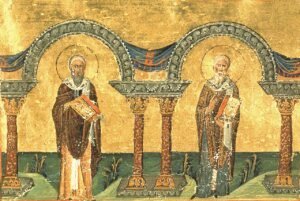
Cyril of Alexandria · A.D. 376–444 A.D. 430
“Having sufficiently taught the people, He returns again to His mighty works, and by the employment of fishing fishes for His disciples.”
Cyril of Alexandria · A.D. 376–444 A.D. 444
“(Ep. i. ad Monachos Egypti.) Saith the Apostle of the Only-begotten, Who being in the form of God, thought it no robbery to be equal with God (Phil. 2:6). Who then is this who is in the form of God? or how emptied He Himself, and humbled Himself to the likeness of man? If the above-mentioned heretics dividing Christ into two parts, i. e. the Man and the Word, affirm that it was the Man that was emptied of glory, they must first shew what form and equality with the Father are understood to be, and did exist, which might suffer any manner of emptying. But there is no creature, in its own proper nature, equal with the Father; how then can any creature be said to be emptied? or from what eminence to descend to become man? Or how can he be understood to have taken upon Him, as though He had not at first, the form of a servant? But, they say, the Word being equal with the Father dwelt in Man born of a woman, and this is the emptying. I hear the Son truly saying to the Holy Apostles, If any man love Me, he will keep My saying; and My Father will lore him, and We will come unto him, and make Our abode with him. (John 14:23.) Hear how He saith that He and the Father will dwell in them that love Him. Do you then suppose that we shall grant that He is there emptied of His glory, and has taken upon Him the form of a servant, when He makes His abode in the hearts of them that love Him? Or the Holy Spirit, does He fulfil an assumption of human flesh, when He dwells in our hearts?”
Cyril of Alexandria · A.D. 376–444 A.D. 444
“(Ep. ad Joan. Antioch. tom. 6. Ep. 107.) We account those persons mad who have suspected that so much as the shadow of change could take place in the nature of the Divine Word; it abides what it ever was, neither is nor can be changed.”
Cyril of Alexandria · A.D. 376–444 A.D. 444
“(Epist. ad Monach. Egypt. [Ep. p. 7.]) What will any one see in the Blessed Virgin more than in other mothers, if she be not the mother of God, but of Christ, or the Lord, as Nestorius says? For it would not be absurd should any one please to name the mother of any anointed person, the mother of Christ. Yet she alone and more than they is called the Holy Virgin, and the mother of Christ. For she bare not a simple man as ye say, but rather the Word incarnate, and made man of God the Father. But perhaps you say, Tell me, do you think the Virgin was made the mother of His divinity? To this also we say, that the Word was born of the very substance of God Himself, and without beginning of time always coexisted with the Father. But in these last times when He was made flesh, that is united to flesh, having a rational soul, He is said to be born of a woman after the flesh. Yet is this sacrament in a manner brought out like to birth among us; for the mothers of earthly children impart to their nature that flesh that is to be perfected by degrees in the human form; but God sends the life into the animal. But though these are mothers only of the earthly bodies, yet when they bear children, they are said to bear the whole animal, and not a part of it only. Such do we see to have been done in the birth of Emmanuel; the Word of God was born of the substance of His Father; but because He took on Him flesh, making it His own, it is necessary to confess that He was born of a woman according to the flesh. Where seeing He is truly God, how shall any one doubt to call the Holy Virgin the Mother of God?”
Cyril of Alexandria · A.D. 376–444 A.D. 444
“(Epist. ad Joan Antioch [Ep. p. 107.]) But if we were to say that the holy Body of Christ came down from heaven, and was not made of His mother, as Valentinus does, in what sense could Mary be the Mother of God?”
Cyril of Alexandria · A.D. 376–444 A.D. 444
“s; According to this promise of the Lord, the Apostolic Church of Peter remains pure and spotless from all leading into error, or heretical fraud, above all Heads and Bishops, and Primates of Churches and people, with its own Pontiffs, with most abundant faith, and the authority of Peter. And while other Churches have to blush for the error of some of their members, this reigns alone immoveably established, enforcing silence, and stopping the mouths of all heretics; and wet, not drunken with the wine of pride, confess together with it the type of truth, and of the holy apostolic tradition.”
Cyril of Alexandria · A.D. 376–444 A.D. 444
“a; Now they accuse Him of blasphemy, anticipating the sentence of His death: for there was a command in the Law, that whosoever blasphemed should be put to death. And this charge they laid upon Him, because He claimed for Himself the divine power of remitting sins: wherefore it is added, Who can forgive sin, save God only? For the Judge of all alone has power to forgive sin.”
Cyril of Alexandria · A.D. 376–444 A.D. 444
“(non occ.) See how the devil is divided between two passions, fear and audacity; he hangs back and prays, as if meditating a question; he wishes to know what he had to do with Jesus, as though he would say, Do you cast me out from men, who are mine?”
Cyril of Alexandria · A.D. 376–444 A.D. 444
“(non occ.) Consider the unconquerable power of Christ; He makes Satan shake, for to him the words of Christ are fire and flame; as the Psalmist says, The mountains melted at the presence of the Lord, (Ps. 97:5) that is, great and proud powers. There follows, And he asked him, What is thy name?”
Cyril of Alexandria · A.D. 376–444 A.D. 444
“(non occ.) In what he says of the Apostles having been eyewitnesses of the word, he agrees with John, who says, The Word was made flesh, and dwelt among us, and we saw His glory. For the Word by means of the flesh was made visible.”
Cyril of Alexandria · A.D. 376–444 A.D. 444
“(de fide ad Theod.) But this name was given anew to the Word in adaptation to His nativity in the flesh; as that prophecy saith, Thou shalt be called by a new name which the mouth of the Lord hath named. (Is. 62:2.)”
Cyril of Alexandria · A.D. 376–444 A.D. 444
“(contra Julian lib. viii.) Not however from Joseph proceeded the most pure descent of Christ. For from one and the same line of connexion had sprung both Joseph and the Virgin, and from this the only-begotten had taken the form of man.”
Cyril of Alexandria · A.D. 376–444 A.D. 444
“The mighty in knowledge were the evil spirits, the Devil, the wise ones of the Gentiles, the Scribes and Pharisees; yet these He hath put down, and raised up those who humbled themselves under the mighty hand of God (1 Pet. 5:6); giving them the power of treading upon serpents and scorpions and every power of the enemy. (Luke 10:19.) The Jews were also at one time puffed up with power, but unbelief slew them, and the mean and lowly of the Gentiles have through faith climbed up to the highest summit.”
Cyril of Alexandria · A.D. 376–444 A.D. 444
“(non occ.) It is said that she was espoused, to imply that nothing more than espousals preceded the conception; for it was not by man’s seed that the Holy Virgin conceived.”
Cyril of Alexandria · A.D. 376–444 A.D. 444
“He finds man in his corrupt affections become like the beasts that perish, and therefore He is laid in the manger, in the place of food, that we changing the life of beasts, might be brought to the knowledge that befits man, partaking not of hay, but of the heavenly bread, the lifegiving body.”
Cyril of Alexandria · A.D. 376–444 A.D. 444
“But that which is in the middle, namely, Christ, has reference to the adoration, and signifies not the nature, but the compound substance of two natures. For on Christ our Saviour we confess the anointing to have been performed, not however figuratively, (as formerly on kings by the oil,) and as if by prophetic grace, nor for the accomplishment of any work, as it is said in Isaiah, Thus saith the Lord to his anointed, to Cyrus; (Isa. 45.) who although he was an idolater was said to be anointed, that he might by the decree of Heaven take possession of the whole province of Babylon; but the Saviour as man in the form of a servant, was anointed by the Holy Spirit, as God He Himself by His Holy Spirit anoints those that believe on Him.”
Cyril of Alexandria · A.D. 376–444 A.D. 444
“This peace has been made through Christ, for He has reconciled us by Himself to God and our Father, (2 Cor. 5:18, 19, Eph. 2:16, Col. 1:20.) having taken away our guilt, which was the ground of offence also. He has united two nations in one man, and has joined the heavenly and the earthly in one flock.”
Cyril of Alexandria · A.D. 376–444 A.D. 444
“It was the custom on the eighth day to perform the circumcision of the flesh. For on the eighth day Christ rose from the dead, and conveyed to us a spiritual circumcision, saying, Go and teach all nations, baptizing them. (Matt. 28:19.)”
Cyril of Alexandria · A.D. 376–444 A.D. 444
“But according to the command of the law, on the same day He received the imposition of a name, as it follows, His name was called Jesus, which is interpreted Saviour. For He was brought forth for the salvation of the whole world, which by His circumcision He prefigured, as the Apostle says to the Colossians, “Ye are circumcised with a circumcision made without hands, in the stripping off of the body of the flesh, to wit, the circumcision of Christ.” (Col. 2:11.)”
Cyril of Alexandria · A.D. 376–444 A.D. 444
“Next after the circumcision they wait for the time of purification, as it is said, And when the days of her purification according to the law of Moses were come.”
Cyril of Alexandria · A.D. 376–444 A.D. 444
“(Hom. xi.) Oh the depth of the riches of the wisdom and knowledge of God! (Rom. 11:33.) He offers victims, Who in each victim is honoured equally with the Father. The Truth preserves the figures of the law. He who as God is the Maker of the law, as man has kept the law. Hence it follows, And that they should give a victim as it was ordered in the law of the Lord, a pair of turtle doves or two young pigeons. (Lev. 12:8.)”
Cyril of Alexandria · A.D. 376–444 A.D. 444
“(ubi sup.) But let us see what these offerings mean. The turtle dove is the most vocal of birds, and the pigeon the gentlest. And such was the Saviour made unto us; He was endowed with perfect meekness, and like the turtle dove entranced the world, fillinga His garden with His own melodies. There was killed then either a turtle dove or a pigeon, that by a figure He might be shewn forth unto us as about to suffer in the flesh for the life of the world.”
Cyril of Alexandria · A.D. 376–444 A.D. 444
“(ubi sup.) But Christ was the mystery which has been revealed in the last times of the world, having been prepared before the foundation of the world. Hence it follows, which thou hast prepared before the face of all men.”
Cyril of Alexandria · A.D. 376–444 A.D. 444
“(ubi sup.) But Christ coming was made a light to them that sat in darkness, being sore oppressed by the power of the devil, but they were called by God the Father to the knowledge of His Son, Who is the true light.”
Cyril of Alexandria · A.D. 376–444 A.D. 444
“Rightly with the growth in age, St. Luke has united increase in wisdom, as he says, And he was strengthened, (i. e. in spirit.) For in proportion to the measure of bodily growth, the Divine nature developed its own wisdom.”
Cyril of Alexandria · A.D. 376–444 A.D. 444
“The Evangelist having said before that the Child grew and waxed strong, verifies his own words when he relates, that Jesus with the holy Virgin went up to Jerusalem; as it is said, And when he was twelve years old, &c.”
Cyril of Alexandria · A.D. 376–444 A.D. 444
“He says this then by way of shewing that He surpasses all human standards, and hinting that the Holy Virgin was made the handmaid of the work in bringing His flesh unto the world, but that He Himself was by nature and in truth God, and the Son of the Father most high. Now from this let the followers of Valentinus, hearing that the temple was of God, be ashamed to say that the Creator, and the God of the law and of the temple, is not also the Father of Christ.”
Cyril of Alexandria · A.D. 376–444 A.D. 444
“(Thes. l. x. c. 7.) But the Eunomian Hereticsb say, “How can He be equal to the Father in substance, who is said to increase, as if before imperfect.” But not because He is the Word, but because He is made man, He is said to receive increase. For if He really increased after that He was made flesh, as having before existed imperfect, why then do we give Him thanks as having thence become incarnate for us? But how if He is the true wisdom can He be increased, or how can He who gives grace to others be Himself advanced in grace. Again, if hearing that the Word humbled Himself, no one is offended (thinking slightingly of the true God,) but rather marvels at His compassion, how is it not absurd to be offended at hearing that He increases? For as He was humbled for us, so for us He increased, that we who have fallen through sin might increase in Him. For whatever concerns us, Christ Himself has truly undertaken for us, that He might restore us to a better state. And mark what He says, not that the Word, but Jesus, increases, that you should not suppose that the pure Word increases, but the Word made flesh; and as we confess that the Word suffered in the flesh, although the flesh only suffered, because of the Word the flesh was which suffered, so He is said to increase, because the human nature of the Word increased in Him. But He is said to increase in His human nature, not as if that nature which was perfect from the beginning received increase, but that by degrees it was manifested. For the law of nature brooks not that man should have higher faculties than the age of his body permits. The Word then (made man) was perfect, as being the power and wisdom of the Father, but because something was to be yielded to the habits of our nature, lest He should be counted strange by those who saw Him, He manifested Himself as man with a body, gradually advancing in growth, and was daily thought wiser by those who saw and heard Him.”
Cyril of Alexandria · A.D. 376–444 A.D. 444
“(in Esai. 40. lib. 3.) But suppose some one should answer, saying, How shall we prepare the way of the Lord, or how shall we make His paths straight? since so many are the hindrances to those who wish to lead an honest life. To this the word of prophecy replies, There are some ways and paths by no means easy to travel, being in some places hilly and rugged, in others steep and precipitous; to remove which it says, Every valley shall be filled, every mountain and hill shall he brought low. Some roads are most unequally constructed, and while in one part rising, in another sloping downwards, are very difficult to pass. And here he adds, And the crooked ways shall be made straight, and the rough ways shall be made smooth. But this was in a spiritual manner brought to pass by the power of our Saviour. For formerly to pursue an Evangelical course of life was a difficult task, for men’s minds were so immersed in worldly pleasures. But now that God being made Man, has condemned sin in the flesh, all things are made plain, and the way of going has become easy, and neither hill nor valley is an obstacle to those who wish to advance.”
Cyril of Alexandria · A.D. 376–444 A.D. 444
“(ubi sup.) That is, of the Father, who sent His Son as our Saviour. But the flesh is here taken for the whole man.”
Cyril of Alexandria · A.D. 376–444 A.D. 444
“For what profits the nobleness we inherit through the flesh, unless it be supported by kindred feelings in us? It is folly then to boast of our worthy ancestors, and fall away from their virtues.”
Cyril of Alexandria · A.D. 376–444 A.D. 444
“By the axe then he declares the deadly wrath of God, which fell upon the Jews on account of the impieties they practised against Christ; he does not pronounce the axe to be yet fixed to the root, (ad radicem) but that it was laid, i. e. near the root. For though the branches were cut down, the tree itself was not yet entirely destroyed. For a remnant of Israel shall be saved.”
Cyril of Alexandria · A.D. 376–444 A.D. 444
“(Chrys. in Thes. lib. ii. c. 4.) By the following words, And he shall thoroughly purge his floor, the Baptist signifies that the Church belongs to Christ as her Lord.”
Cyril of Alexandria · A.D. 376–444 A.D. 444
“But the chaff signifies the trifling and empty, blown about and liable to be carried away by every blast of sin.”
Cyril of Alexandria · A.D. 376–444 A.D. 444
“(Glaph. in Exod. lib. 1.) Although in truth Christ had no father according to the flesh, yet some fancied he had a father. Hence it follows, As was supposed the son of Joseph.”
Cyril of Alexandria · A.D. 376–444 A.D. 444
“God said in times past, My Spirit shall not always abide in men, for that they are flesh. (Gen. 6:3. Vulg.) But now that we have been enriched with the gift of regeneration by water and the Spirit, we are become partakers of the Divine nature by participation of the Holy Spirit. But the first-born among many brethren first received the Spirit, who Himself also is the giver of the Spirit, that we through Him might also receive the grace of the Holy Spirit.”
Cyril of Alexandria · A.D. 376–444 A.D. 444
“Behold, He is among the wrestlers, who as God awards the prizes. He is among the crowned, who crowns the heads of the saints.”
Cyril of Alexandria · A.D. 376–444 A.D. 444
“Or, our earthly body is nourished by earthly food, but the reasonable soul is strengthened by the Divine Word, to the right ordering of the spirit.”
Cyril of Alexandria · A.D. 376–444 A.D. 444
“And dost thou, whose lot is the unquenchable fire, promise to the Lord of all that which is His own? Didst thou think to have Him for thy worshipper, from dread of whom the whole creation trembles?”
Cyril of Alexandria · A.D. 376–444 A.D. 444
“(in Thes. 32.) But how comes it that the Son (if as the heretics say a created being) is worshipped? What charge can be brought against those who served the creature and not the Creator, if the Son (according to them a created being) we are to worship as God?”
Cyril of Alexandria · A.D. 376–444 A.D. 444
“This command touched him to the quick; for before Christ’s coming he was every where worshipped. But the law of God casting him down from his usurped dominion, establishes the worship of Him alone who is really God.”
Cyril of Alexandria · A.D. 376–444 A.D. 444
“God gives not help to those who tempt Him, but to those who believe on Him. Christ therefore did not shew His miracles to them that tempted Him, but said to them, An evil generation seeketh a sign, and no sign shall be given to them. (Mat. 12:39.)”
Cyril of Alexandria · A.D. 376–444 A.D. 444
“Now He performed miracles not from any external power, and from having as it were the acquired grace of the Holy Spirit, as other saints, but rather as being by nature the Son of God, and partaking of all things which are the Father’s, He exercises as by His own power and operation that grace which is of the Holy Spirit. But it was right that from that time He should become known, and that the mystery of His humanity should shine forth among those who were of the seed of Israel. It therefore follows, And his fame went out.”
Cyril of Alexandria · A.D. 376–444 A.D. 444
“He communicates the knowledge of Himself to those among whom He was brought up according to the flesh. As it follows, And he came to Nazareth.”
Cyril of Alexandria · A.D. 376–444 A.D. 444
“In like manner we confess Him to have been anointed, inasmuch as He took upon Him our flesh, as it follows, Because he hath anointed me. For the Divine nature is not anointed, but that which is cognate to us. So also when He says that He was sent, we must suppose Him speaking of His human nature. For it follows, He hath sent me to preach the gospel to the poor.”
Cyril of Alexandria · A.D. 376–444 A.D. 444
“For perhaps to the poor in spirit He declares in these words, that among all the gifts which are obtained through Christ, upon them was bestowed a free gift. It follows, To heal the broken hearted. He calls those broken hearted, who are weak, of an infirm mind, and unable to resist the assaults of the passions, and to them He promises a healing remedy.”
Cyril of Alexandria · A.D. 376–444 A.D. 444
“For the darkness which the Devil has spread over the human heart, Christ the Sun of Righteousness has removed, making men, as the Apostle says, children not of night and darkness, but of light and the day. (1 Thess. 5:5.) For they who one time wandered have discovered the path of the righteous. It follows, To set at liberty them that are bruised.”
Cyril of Alexandria · A.D. 376–444 A.D. 444
“But then He turned the eyes of all men upon Him, wondering how He knew the writing which He had never learnt. But since it was the custom of the Jews to say that the prophecies spoken of Christ are completed either in certain of their chiefs, i. e. their kings, or in some of their holy prophets, the Lord made this announcement; as it follows, But he began to say unto them that this Scripture is fulfilled.”
Cyril of Alexandria · A.D. 376–444 A.D. 444
“But what prevents Him from filling men with awe, though He were the Son as was supposed of Joseph? Do you not see the divine miracles, Satan already prostrate, men released from their sickness?”
Cyril of Alexandria · A.D. 376–444 A.D. 444
“It was a common proverb among the Hebrews, invented as a reproach, for men used to cry out against infirm physicians, Physician, heal thyself.”
Cyril of Alexandria · A.D. 376–444 A.D. 444
“As if He says, You wish me to work many miracles among you, in whose country I have been brought up, but I am aware of a very common failing in the minds of many. To a certain extent it always happens, that even the very best things are despised when they fall to a man’s lot, not scantily, but ever at his will. So it happens also with respect to men. For a friend who is ever at hand, does not meet with the respect due to him.”
Cyril of Alexandria · A.D. 376–444 A.D. 444
“He convicted them of their evil intentions, and therefore they are enraged, and hence what follows, And all they in the synagogue when they heard these things were filled with wrath. Because He had said, This day is this prophecy fulfilled, they thought that He compared Himself to the prophets, and are therefore enraged, and expel Him out of their city, as it follows, And they rose up, and cast him out.”
Cyril of Alexandria · A.D. 376–444 A.D. 444
“For although He knew that they were disobedient and hard of heart, He nevertheless visits them, as a good Physician tries to heal those who are suffering from a mortal disease. But He taught them boldly in the synagogues, as Esaias saith, I have not spoken in secret, in a dark place of the earth. (Isa. 45:19.) On the sabbath day also He disputed with them, because they were at leisure. They wondered therefore at the mightiness of His teaching, His virtue, and His power, as it follows, And they were astonished at his doctrine, for his word was with power. That is, not soothing, but urging and exciting them to seek salvation. Now the Jews supposed Christ to be one of the saints or prophets. But in order that they might esteem Him higher, He passes beyond the prophetic limits. For he said not, “Thus saith the Lord,” but being the Master of the Law, He uttered things which were above the Law, changing the letter to the truth, and the figures to the spiritual meaning.”
Cyril of Alexandria · A.D. 376–444 A.D. 444
“But He generally intermingles with His teaching the performance of mighty works. For those whose reason does not incline to knowledge, are roused by the manifestation of miracles. Hence it follows, And there was in the synagogue a man which had a devil.”
Cyril of Alexandria · A.D. 376–444 A.D. 444
“But the Jews spoke falsely of the glory of Christ, saying, He casteth out devils by Beelzebub the prince of the devils. To remove this charge, when the devils came beneath His invincible power, and endured not the Divine Presence, they sent forth a savage cry, as it follows: And he cried with a loud voice, saying, Let us alone; what have we to do with thee, &c.”
Cyril of Alexandria · A.D. 376–444 A.D. 444
“(et Tit. Bost.) For the devils thought by praises of this sort to make Him a lover of vainglory, that He might be induced to abstain from opposing or destroying them by way of grateful return.”
Cyril of Alexandria · A.D. 376–444 A.D. 444
“Now see how Christ abides in the house of a poor man, suffering poverty of His own will for our sakes, that we might learn to visit the poor, and despise not the destitute and needy. It follows: And Simon’s wife’s mother was taken with a great fever: and they besought him for her.”
Cyril of Alexandria · A.D. 376–444 A.D. 444
“Let us therefore receive Jesus. For when He has visited us, we carry Him in our heart and mind; He will then extinguish the flames of our unlicensed pleasures, and will make us whole, so that we minister unto Him, that is, do things well-pleasing to Him.”
Cyril of Alexandria · A.D. 376–444 A.D. 444
“But although as God He was able to drive away diseases by His word, He nevertheless touches them, shewing that His flesh was powerful to apply remedies, since it was the flesh of God; for as fire, when applied to a brazen vessel, imprints on it the effect of its own heat, so the omnipotent Word of God, when He united to Himself in real assumption a living virgin temple, endued with understanding, implanted in it a participation of His own power. May He also touch us, nay rather may we touch Him, that He may deliver us from the infirmities of our souls as well as the assaults of the evil spirit and pride! For it follows, And devils also came out.”
Cyril of Alexandria · A.D. 376–444 A.D. 444
“Now this was a figure of the future. For they will not labour in vain who let down the net of evangelical doctrine, but will gather together the shoals of the Gentiles.”
Cyril of Alexandria · A.D. 376–444 A.D. 444
“But Peter beckons to his companions to help them. For many follow the labours of the Apostles, and first those who brought out the writings of the Gospels, next to whom are the other heads and shepherds of the Gospel, and those skilled in the teaching of the truth.”
Cyril of Alexandria · A.D. 376–444 A.D. 444
“For calling back to his consciousness the crimes he had committed, he is alarmed and trembles, and as being unclean, he believes it impossible he can receive Him who is clean, for he had learnt from the law to distinguish between what is defiled and holy.”
Cyril of Alexandria · A.D. 376–444 A.D. 444
“For he knew that leprosy yields not to the skill of physicians, but he saw the devils cast out by the Divine authority, and multitudes cured of divers diseases, all which he conceived was the work of the Divine arm.”
Cyril of Alexandria · A.D. 376–444 A.D. 444
“(Thes. 12. c. 14.) From majesty alone proceeds the royal command, how then is the Only-begotten counted among the servants, who by His mere will can do all things? We read of God the Father, that He hath done all things whatsoever He pleased. (Ps. 115:3; 135:6.) But He who exercises the power of His Father, how can He differ from Him in nature? Besides, whatsoever things are of the same power, are wont to be of the same substance. Again; let us then admire in these things Christ working both divinely and bodily. For it is of God so to will that all things are done accordingly, but of man to stretch forth the hand. From two natures therefore is perfected one Christ, for that the Word was made flesh.”
Cyril of Alexandria · A.D. 376–444 A.D. 444
“Though the leper was silent, the voice of the transaction itself was sufficient to publish it to all who acknowledged through him the power of the Curer.”
Cyril of Alexandria · A.D. 376–444 A.D. 444
“He says then, for a testimony unto them, because this deed makes manifest that Christ in His incomparable excellence is far above Moses. For when Moses could not rid his sister of the leprosy, he prayed the Lord to deliver her. But the Saviour, in His divine power, declared, I will, be thou clean. (Numb. 12:13.)”
Cyril of Alexandria · A.D. 376–444 A.D. 444
“The Scribes and Pharisees who had become spectators of Christ’s miracles, heard Him also teaching. Hence it is said, And it came to pass on a certain day, as he was teaching, that there were Pharisees sitting by, &c. And the power of the Lord was present to heal them. Not as though He borrowed the power of another, but as God and the Lord He healed by His own inherent power. Now men often become worthy of spiritual gifts, but generally depart from the rule which the giver of the gifts knew. It was not so with Christ, for the divine power went on abounding in giving remedies. But because it was necessary where so great a number of Scribes and Pharisees had come together, that something should be done to attest His power before those men who slighted Him, He performed the miracle on the man with the palsy, who since medical art seemed to fail, was carried by his kinsfolk to a higher and heavenly Physician. As it follows, And behold men brought him.”
Cyril of Alexandria · A.D. 376–444 A.D. 444
“By this they hasten the sentence of death, for it was commanded in the law, that whoever blasphemed God should be punished with death. (Lev. 24:16.)”
Cyril of Alexandria · A.D. 376–444 A.D. 444
“As if to say, O Pharisees, since ye say, Who can forgive sins, but God alone? I answer you, Who can search the secrets of the heart, but God alone, Who says by His prophet, I am the Lord, that searcheth the hearts, and trieth the reins. (Jer. 17:10.)”
Cyril of Alexandria · A.D. 376–444 A.D. 444
“For Levi had been a publican, a rapacious man, of unbridled desires after vain things, a lover of other men’s goods, for this is the character of the publican, but snatched from the very worship of malice by Christ’s call. Hence it follows, And he said unto him, Follow me. He bids him follow Him, not with bodily step, but with the soul’s affections. Matthew therefore, being called by the Word, left his own, who was wont to seize the things of others, as it follows, And having left all, he rose, and followed him.”
Cyril of Alexandria · A.D. 376–444 A.D. 444
“As soon as they have received the first answer from Christ, they proceed from one thing to another, with the intent to shew that the holy disciples, and Jesus Himself with them, cared very little for the law. Hence it follows, Why do the disciples of John fast, but thine eat, &c. (Lev. 15, prævaricationis.) As if they said, Ye eat with publicans and sinners, whereas the law forbids to have any fellowship with the unclean, but compassion comes in as an excuse for your transgression; why then do ye not fast, as they are wont to do who wish to live according to the law? But holy men indeed fast, that by the mortification of their body they may quell its passions. Christ needed not fasting for the perfecting of virtue, since as God He was free from every yoke of passion. Nor again did His companions need fasting, but being made partakers of His grace without fasting they were strengthened in all holy and godly living. For when Christ fasted for forty days, it was not to mortify His passions, but to manifest to carnal men the rule of abstinence.”
Cyril of Alexandria · A.D. 376–444 A.D. 444
“For the shewing forth of our Saviour in this world was nothing else but a great festival, (πανήγυρις) spiritually uniting our nature to Him as His bride, that she who was formerly barren might become fruitful. The children of the Bridegroom then are found to be those who have been called by Him through a new and evangelical discipline, but not the Scribes and Pharisees, who observe only the shadow of the law.”
Cyril of Alexandria · A.D. 376–444 A.D. 444
“Having granted to the children of the Bridegroom that it was not fitting that they should be troubled, as they were keeping a spiritual feast, but that fasting should be abolished among them, He adds as a direction, But the days shall come when the Bridegroom shall be taken from them, and then shall they fast in those days.”
Cyril of Alexandria · A.D. 376–444 A.D. 444
“But the Pharisees and Scribes not knowing the Holy Scriptures agreed together to find fault with Christ’s disciples, as it follows, And certain of the Pharisees said unto them, Why do ye, &c. Tell me now, when a table is set before you on the sabbath day; do you not break bread? Why then do you blame others?”
Cyril of Alexandria · A.D. 376–444 A.D. 444
“As if He said, Whereas the law of Moses expressly says, Give a righteous judgment, and ye shall not respect persons in judgment, (Deut. 1:16, 17.) how now do ye blame My disciples, who even to this day extol David as a saint and prophet, though he kept not the commandment of Moses?”
Cyril of Alexandria · A.D. 376–444 A.D. 444
“But He taught things far beyond their comprehension, and opened to his hearers the way to future salvation by Him; and then after having first taught them, He suddenly shewed His divine power, as it follows, and there was a man there whose right hand was withered.”
Cyril of Alexandria · A.D. 376–444 A.D. 444
“For this is the way of the envious man, he feeds in himself his pang of grief with the praises of others. But the Lord knew all things, and searches the hearts; as it follows, But he knew their thoughts, and said to the man who had the withered hand, Rise up, and stand. And he arose, and stood forth, that perchance he might stir up the cruel Pharisees to pity, and allay the flames of their passion.”
Cyril of Alexandria · A.D. 376–444 A.D. 444
“This is a very useful question, for if it is lawful to do good on the sabbath, and there is no reason why those who work should not obtain mercy from God, cease to gather up accusation against Christ. But if it be not lawful to do good on the sabbath, and the law prohibits the safety of life, thou art become the accuser of the law. For if we examine the very institution of the sabbath, we shall find it was introduced for an object of mercy, for God commanded to keep holy the sabbath, that may rest thy man servant and thy maid servant, and all thy cattle. (Exod. 20:23.) But he who has mercy on his ox, and the rest of his cattle, how much rather will he not have mercy on man troubled with a severe disease?”
Cyril of Alexandria · A.D. 376–444 A.D. 444
“Thou perceivest, O Pharisee, a divine Worker, and Him Who delivers the sick by His heavenly power, and out of envy thou breathest forth death.”
Cyril of Alexandria · A.D. 376–444 A.D. 444
“Let us examine then in the actions which Jesus did, how He teaches us to be instant in prayer to God, going apart by ourselves, and in secret, no one seeing us; putting aside also our worldly cares, that the mind may be raised up to the height of divine contemplation; and this we have marked in the fact, that Jesus went in to a mountain apart to pray.”
Cyril of Alexandria · A.D. 376–444 A.D. 444
“(ut sup.) But mark the great carefulness of the Evangelist. He not only says that the holy Apostles were chosen, but he enumerates them by name, that no one should dare to insert any others in the catalogue; Simon, whom he also called Peter, and Andrew his brother.”
Cyril of Alexandria · A.D. 376–444 A.D. 444
“But if we may learn the interpretation of the Apostles’ names, know that Peter means, “loosening or knowing;” Andrew, “glorious power,” or “answering;” but James, “apostle of grief;” John, “the grace of the Lord;” Matthew, “given;” Philip, “large mouth,” or the “orifice of a torch;” Bartholomew, “the son of him who lets down water;” Thomas, “deep or twin;” James the son of Alphæus, “supplanter of the step of life;” Judas, “confession;” Simon, “obedience.””
Cyril of Alexandria · A.D. 376–444 A.D. 444
“When the ordination of the Apostles was accomplished, and great numbers were collected together from the country of Judæa, and from the sea coast of Tyre and Sidon, (who were idolaters,) he gave the Apostles their commission to be the teachers of the whole world, that they might recal the Jews from the bondage of the law, but the worshippers of devils from their Gentile errors to the knowledge of the truth. Hence it is said, And he came down with them, and stood in the plain, and a great multitude from Judæa, and the sea coast, &c.”
Cyril of Alexandria · A.D. 376–444 A.D. 444
“But after that the High Priest had made publicly known His choice of Apostles, He did many and great miracles, that the Jews and Gentiles who had assembled might know that these were invested by Christ with the dignity of the Apostleship, and that He Himself was not as another man, but rather was God, as being the Incarnate Word. Hence it follows, And the whole multitude sought to touch him, for there went virtue out of him. For Christ did not receive virtue from others, but since he was by nature God, sending out His own virtue upon the sick, He healed them all.”
Cyril of Alexandria · A.D. 376–444 A.D. 444
“After the ordination of the Apostles, the Saviour directed His disciples to the newness of the evangelical life.”
Cyril of Alexandria · A.D. 376–444 A.D. 444
“In the Gospel according to St. Matthew it is said, Blessed are the poor in spirit, that we should understand the poor in spirit to be one of a modest and somewhat depressed mind. Hence our Saviour says, Learn from me, for I am meek and lowly of heart. But Luke says, Blessed are the poor, without the addition of spirit, calling those poor who despise riches. For it became those who were to preach the doctrines of the saving Gospel to have no covetousness, but their affections set upon higher things.”
Cyril of Alexandria · A.D. 376–444 A.D. 444
“After having commanded them to embrace poverty, He then crowns with honour those things which follow from poverty. It is the lot of those who embrace poverty to be in want of the necessaries of life, and scarcely to be able to get food. He does not then permit His disciples to be fainthearted on this account, but says, Blessed are ye who hunger now.”
Cyril of Alexandria · A.D. 376–444 A.D. 444
“But poverty is followed not only by a want of those things which bring delight, but also by a dejected look, because of sorrow. Hence it follows, Blessed are ye that weep. He blesses those who weep, not those who merely drop tears from their eyes, (for this is common to the believing and unbelieving, when sorrow befals them,) but rather He calls those blessed, who shun a careless life, mixed up with sin, and devoted to carnal pleasures, and refuse enjoyments almost weeping from their hatred of all worldly things.”
Cyril of Alexandria · A.D. 376–444 A.D. 444
“Having said before that poverty for God’s sake is the cause of every good thing, and that hunger and weeping will not be without the reward of the saints, he goes on to denounce the opposite to these as the source of condemnation and punishment. But woe unto you rich, for ye have your consolation.”
Cyril of Alexandria · A.D. 376–444 A.D. 444
“But this way of life was well adapted to the holy teachers who were about to preach throughout the earth the word of salvation, and if it had been their will to take vengeance upon their persecutors, had failed to call them to the knowledge of salvation.”
Cyril of Alexandria · A.D. 376–444 A.D. 444
“Now the old law commanded us not to injure one another; or if we are first injured, not to extend our wrath beyond the measure of the injurer, but the fulfilling of the law is in Christ and in His commands. Hence it follows, And unto him that smiteth thee on the one cheek, offer also the other.”
Cyril of Alexandria · A.D. 376–444 A.D. 444
“But the Lord would moreover have us to be despisers of property. As it follows, And him that taketh away thy cloak, forbid not to take thy coat also. For this is the soul’s virtue, which is altogether alien from feeling the pleasure of wealth. For it becomes him who is merciful even to forget his misfortunes, that we may confer the same benefits upon our persecutors, whereby we assist our dear friends.”
Cyril of Alexandria · A.D. 376–444 A.D. 444
“Great then is the praise of mercy. For this virtue makes us like unto God, and imprints upon our souls certain signs as it were of a heavenly nature. Hence it follows, Be ye then merciful, as your heavenly Father also is merciful.”
Cyril of Alexandria · A.D. 376–444 A.D. 444
“He here expresses that worst inclination of our thoughts or hearts, which is the first beginning and origin of a proud disdain. For although it becomes men to look into themselves and walk after God, this they do not, but look into the things of others, and while they forget their own passions, behold the infirmities of some, and make them a subject of reproach.”
Cyril of Alexandria · A.D. 376–444 A.D. 444
“But that we shall receive more abundant recompense from God, who gives bountifully to those who love him, he explains as follows, Good measure, pressed down, and shaken together, and running over, shall they give into your bosom.”
Cyril of Alexandria · A.D. 376–444 A.D. 444
“But the Apostle explains this when he says, He who sows sparingly, (that is, scantily, and with a niggardly hand,) shall also reap sparingly, (2 Cor. 6:9.) (that is, not abundantly,) and he who sows blessings, shall reap also blessings, that is, bountifully. But if a man has not, and performs not, he is not guilty. For a man is accepted in that which he has, not in that which he has not.”
Cyril of Alexandria · A.D. 376–444 A.D. 444
“The Lord added to what had gone before a very necessary parable, as it is said, And he spake a parable to them, for His disciples were the future teachers of the world, and it therefore became them to know the way of a virtuous life, having their minds illuminated as it were by a divine brightness, that they should not be blind leaders of the blind. And then he adds, Can the blind lead the blind? But if any should chance to attain unto an equal degree of virtue with their teachers, let them stand in the measure of their teachers, and follow their footsteps. Hence it follows, The disciple is not above his master. Hence also Paul says, Be ye also followers of me, as I am of Christ (1 Cor. 1:11.). Since Christ therefore judged not, why judgest thou? for He came not to judge the world, but to shew mercy.”
Cyril of Alexandria · A.D. 376–444 A.D. 444
“As if He said, How can he who is guilty of grievous sins, (which He calls the beam,) condemn him who has sinned only slightly, or even in some cases not at all? For this the mote signifies.”
Cyril of Alexandria · A.D. 376–444 A.D. 444
“That is to say, first shew thyself clean from great sins, and then afterwards shalt thou give counsel to thy neighbour, who is guilty only of slight sins.”
Cyril of Alexandria · A.D. 376–444 A.D. 444
“Each man’s life also will be a criterion of his character. For not by extrinsic ornaments and pretended humility is the beauty of true happiness discovered, but by those things which a man does; of which he gives an illustration, adding, For of thorns men do not gather figs.”
Cyril of Alexandria · A.D. 376–444 A.D. 444
“But having shewn that the good and the bad man may be discerned by their works as a tree by its fruits, he now sets forth the same thing by another figure, saying, A good man out of the good treasure of his heart bringeth forth that which is good, and the evil man out of the evil treasure bringeth forth that which is evil.”
Cyril of Alexandria · A.D. 376–444 A.D. 444
“But Lordship both in name and reality belongs only to the Highest Nature.”
Cyril of Alexandria · A.D. 376–444 A.D. 444
“But the advantage which arises from the keeping of the commandments, or the loss from disobedience, he shews as follows; Whosoever cometh to me, and heareth my sayings, he is like to a man who built his house upon a rock, &c.”
Cyril of Alexandria · A.D. 376–444 A.D. 444
“Or they build upon the earth without foundation, who upon the quicksand of doubt, which relates to opinion, lay the foundation of their spiritual building, which a few drops of temptation wash away.”
Cyril of Alexandria · A.D. 376–444 A.D. 444
“The Lord joins one miracle upon another. In the Former instance He came indeed when called for, but in this He came self-invited; as it is said, And it came to pass the day after that he went into a city called Nain.”
Cyril of Alexandria · A.D. 376–444 A.D. 444
“These were sufferings to excite compassion, and which might well affect to mourning and tears, as it follows, And when the Lord saw her, he had compassion on her, saying, Weep not.”
Cyril of Alexandria · A.D. 376–444 A.D. 444
“He performs the miracle not only in word, but also touches the bier, to the end that you might know that the sacred body of Christ is powerful to the saving of man. For it is the body of Life and the flesh of the Omnipotent Word, whose power it possesses. For as iron applied to fire does the work of fire, so the flesh, when it is united to the Word, which quickens all things, becomes itself also quickening, and the banisher of death.”
Cyril of Alexandria · A.D. 376–444 A.D. 444
“This was a great thing in an insensible and ungrateful people. For in a short time afterward they would neither esteem Him as a prophet, nor allow that He did aught for the public good. But none of those that dwelt in Judæa were ignorant of this miracle, as it follows, And this rumour of him went forth throughout all Judæa.”
Cyril of Alexandria · A.D. 376–444 A.D. 444
“Certain of His disciples relate to the holy Baptist the miracle which was known to all the inhabitants of Judæa and Galilee, as it follows, And they told John, &c.”
Cyril of Alexandria · A.D. 376–444 A.D. 444
“But we must altogether disallow such an opinion. For no where do we find the Holy Scriptures stating that John the Baptist foretold to those souls in hell the coming of our Saviour. It is also true to say, that the Baptist was not ignorant of the wonderful mystery of the incarnation of the Only-Begotten, and so also along with the other things had known this, that our Lord was about to preach the Gospel to those who were in hell, after He had tasted death for all living as well as dead. But since the word of holy Scripture indeed declared that Christ would come as the Lord and Chief, but the others were sent as servants before Him, therefore was the Lord and Saviour of all called by the prophets, He who cometh, or Who is to come; according to that, Blessed is he who cometh in the name of the Lord; (Ps. 118:26.) and, A little while, and he who is to come shall come, and will not tarry. (Hab. 2:3.) The blessed Baptist therefore, receiving as it were this name from Holy Scripture, sent certain of his disciples to seek whether it was indeed He who cometh, or, Who is to come.”
Cyril of Alexandria · A.D. 376–444 A.D. 444
“(Thes. lib. 11. c. 4.) Or he asks the question by economy. For as the forerunner he knew the mystery of Christ’s passion, but that his disciples might be convinced how great was the excellence of the Saviour, he sent the more understanding of them, instructing them to enquire and learn from the very words of the Saviour, whether it was He who was expected; as it is added, But when the men were come unto him, they said, John the Baptist hath sent us unto thee, saying, Art thou He, &c. But He knowing as God with what intention John had sent them, and the cause of their coming, was at the time performing many miracles, as it follows, And in the same hour he healed many of their infirmities, &c. He said not positively to them I am he, but rather leads them to the certainty of the fact, in order that receiving their faith in Him, with their reason agreeing thereto, they might return to him who sent them. Hence He made not answer to the words, but to the intention of him who sent them; as it follows, And Jesus answering said unto them, Go your way, and tell John what things you have seen and heard: as if He said, Go and tell John the things which ye have heard indeed through the Prophets, but have seen accomplished by Me. For He was then performing those things which the Prophets prophesied He would do; that is of which it is added, For the blind see, the lame walk.”
Cyril of Alexandria · A.D. 376–444 A.D. 444
“Or else, He wished by this to shew that whatever was passing in their hearts, could not be hid from His sight. For they were those who were offended at Him.”
Cyril of Alexandria · A.D. 376–444 A.D. 444
“(ubi sup.) The Lord, knowing the secrets of men, foresaw that some would say, If until now John is ignorant of Jesus, how did lie shew Him to us, saying, Behold the Lamb of God, which taketh away the sins of the world? To quench therefore this feeling which had taken possession of them, He prevented the injury which might arise from the offence, as it follows, And when the messengers of John were departed, he began to speak unto the people concerning John, what went ye out for to see? A reed shaken in the wind? As if He said, Ye marvelled at John the Baptist, and oftentimes came to see him, passing over long journeys in the desert; surely in vain, if you think him so fickle as to be like a reed bending down whichever way the wind moves it. For such he appeal’s to be, who lightly avows his ignorance of the things which he knows.”
Cyril of Alexandria · A.D. 376–444 A.D. 444
“(ubi sup.) How then could a religious strictness, so great that it subdued to itself all fleshly lusts, sink down to such ignorance, except from a frivolity of mind, which is not fostered by austerities, but by worldly delights. If then ye imitate John, as one who cared not for pleasure, award him also the strength of mind, which befits his continence. But if strictness no more tends to this than a life of luxury, why do you, not respecting those who live delicately, admire the inhabitant of the desert, and his wretched garment of camel’s hair.”
Cyril of Alexandria · A.D. 376–444 A.D. 444
“(ubi sup.) But perhaps it does not concern us to excuse John upon this ground, for you confess that he is worthy of imitation, hence He adds, But what went ye out for to see? A prophet? Verily I say unto you, more than a prophet. For the prophets foretold that Christ would come, but John not only foretold that He would come, but also declared Him to be present, saying, Behold the Lamb of God.”
Cyril of Alexandria · A.D. 376–444 A.D. 444
“(ubi sup.) Having then described his character by the place where he dwelt, by his clothing, and from the crowds who went to see him, He introduces the testimony of the prophet, saying, This is he of whom it is written, Behold, I send my angel. (Mal. 3:1.)”
Cyril of Alexandria · A.D. 376–444 A.D. 444
“But in a mystery, when shewing the superiority of John among those that are born of women, he places in opposition something greater, namely, Himself who was born by the holy Spirit the Son of God. For the kingdom of the Lord is the Spirit of God. Although then as respects works and holiness, we may be inferior to those who attained unto the mystery of the law, whom John represents, yet through Christ we have greater things, being made partakers of the Divine nature.”
Cyril of Alexandria · A.D. 376–444 A.D. 444
“There was a certain play among the Jewish children of this kind. A company of boys were collected together, who, mocking the sudden changes in the affairs of this life, some of them sang, some mourned, but the mourners did not rejoice with those that rejoiced, nor did those who rejoiced fall in with those that wept. They then rebuked each other in turn with the charge of want of sympathy. That such were the feelings of the Jewish people and their rulers, Christ implied in the following words, spoken in the person of Christ; Whereunto then shall I liken the men of this generation, and to what are they like? They are like to children sitting in the market-place.”
Cyril of Alexandria · A.D. 376–444 A.D. 444
“They take upon themselves to slander a man worthy of all admiration. They say that he who mortifies the law of sin which is in his members hath a devil.”
Cyril of Alexandria · A.D. 376–444 A.D. 444
“But where could they point out the Lord as gluttonous? For Christ is found every where repressing excess, and leading men to temperance. But He associated with publicans and sinners. Hence they said against Him, He is a friend of Publicans and sinners, though He could in no wise fall into sin, but on the contrary was to them the cause of salvation. For the sun is not polluted though sending its rays over all the earth, and frequently falling upon unclean bodies. Neither will the Sun of righteousness be hurt by associating with the bad. But let no one attempt to place his own condition on a level with Christ’s greatness, but let each considering his own infirmity avoid having dealing with such men, for “evil communications corrupt good manners.” It follows, And wisdom is justified of all her children.”
Cyril of Alexandria · A.D. 376–444 A.D. 444
“A woman of corrupt life, but testifying her faithful affection, comes to Christ, as having power to release her from every fault, and to grant her pardon for the crimes she had committed. For it follows, And behold a woman in the city, which was a sinner, brought an alabaster box of ointment.”
Cyril of Alexandria · A.D. 376–444 A.D. 444
“For every way side is in some measure dry and uncultivated, because it is trodden down by all men, and no seed gains moisture on it. So the divine warning reaches not the unteachable heart, that it should bring forth the praise of virtue. These then are the ways frequented by unclean spirits. There are again some who bear faith about them, as if it consisted in the nakedness of words; their faith is without root, of whom it is added, And some fell upon a rock, and as soon as it sprung up, it withered away, because it lacked moisture.”
Cyril of Alexandria · A.D. 376–444 A.D. 444
“Now the rich and fruitful ground is the honest and good hearts which receive deeply the seeds of the word, and retain them and cherish them. And whatever is added to this, And some fell upon good ground, and springing up, brought forth fruit an hundredfold. For when the divine word is poured into a soul free from all anxieties, then it strikes root deep, and sends forth as it were the ear, and in its due season comes to perfection.”
Cyril of Alexandria · A.D. 376–444 A.D. 444
“But what the meaning of the parable is, let us hear from him who made it, as it follows, And when he had said these things, he cried, He that hath ears to hear, let him hear.”
Cyril of Alexandria · A.D. 376–444 A.D. 444
“For when they enter the Church they gladly wait on the divine mysteries, but with infirmity of purpose. But when they leave the Church they forget the sacred discipline, and as long as Christians are undisturbed, their faith is lasting; but when persecution harasses, their heart fails them, for their faith was without root.”
Cyril of Alexandria · A.D. 376–444 A.D. 444
“When the disciples saw that all men received help from Christ, it seemed fitting that they themselves also should in turn rejoice in the benefits of Christ. For no one regards that which happens in the person of another equally with that to himself. The Lord therefore exposed the disciples to the sea and the winds, as it follows, Now it came to pass on a certain day that he went into a ship with his disciples; and he said unto them, Let us go over unto the other side of the lake: and they launched forth.”
Cyril of Alexandria · A.D. 376–444 A.D. 444
“(ubi sup.) But it seems to have been especially and wonderfully ordained that they should not seek His assistance when first the storm began to affect the boat, but after the danger had increased, in order that the power of the Divine Majesty might be made more manifest. Hence it is said, And they were filled with water, and were in jeopardy. This indeed our Lord allowed for the sake of trial, that having confessed their danger they should acknowledge the greatness of the miracle. Hence when their great danger had driven them into intolerable fear, having no other hope of safety but the Lord of power Himself, they awoke Him. It follows, And they came to him, and awoke him, saying, Master, we perish.”
Cyril of Alexandria · A.D. 376–444 A.D. 444
“But it could not be that they should perish while the Almighty was with them. Christ then arose, Who has power over all things, and immediately quells the storm and the violence of the wind, and the tempest ceased, and there was a calm. Herein He shews Himself to be God, to Whom it is said, Thou rulest the raging of the sea: when the waves thereof arise, thou stillest them (Ps. 89:10.). So then as He sailed, our Lord manifested both natures in one and the same person, seeing that He who as man slept in the ship, as God by His word stilled the raging of the sea.”
Cyril of Alexandria · A.D. 376–444 A.D. 444
“But together with the raging of the waters, He quiets also the tumult of their souls, as it follows, And he said unto them, Where is your faith? By which word He shewed, that it is not so much the assault of temptation which causes fear, as faint-heartedness. For as gold is proved in the fire, so is faith in temptation.”
Cyril of Alexandria · A.D. 376–444 A.D. 444
“When the tempest was quelled at the command of Christ, the disciples in astonishment whispered one to the other, as it follows, And they being afraid wondered, &c. Now the disciples said not this as ignorant of Him, for they knew that He was God, and Jesus the Son of God. But they marvel at the exceeding vastness of His natural power, and the glory of His divinity, although He was like to us, and visible in the flesh. Hence they say, Who is this? that is, of what manner of man? how great, and with what great power and majesty? for it is a mighty work, a lordly command, no abject petition.”
Cyril of Alexandria · A.D. 376–444 A.D. 444
“The Saviour, as He sailed with His disciples, came to a port, as it is said, And they arrived at the country of the Gadarenes, which is over against Galilee.”
Cyril of Alexandria · A.D. 376–444 A.D. 444
“Now his going naked among the tombs of the dead was a mark of demoniacal wildness. But God permits some in His providence to become subject to evil spirits, that we may ascertain through them of what kind the evil spirits are towards us, in order that we may refuse to be made subject unto them, and so by the suffering of one many may be edified.”
Cyril of Alexandria · A.D. 376–444 A.D. 444
“Mark here the combination of fear with boldness and great desperation, for it is a sign of devilish despair to speak out boldly, What have I to do with thee, Jesus, thou Son of God most high? but of fear when they pray, I beseech thee not to cast me out. But if thou knowest Him to be the Son of God most high, thou confessest Him to be the God of heaven and earth, and of all things that are contained in them. How then dost thou make use not of thy own but His words, saying, What have I to do with thee? But what earthly prince will altogether endure to have his subjects tormented by barbarians? Hence it follows, For he had commanded the unclean spirit to come out of him. And He shews the necessity of the command, adding, For oftentimes it had caught him, &c.”
Cyril of Alexandria · A.D. 376–444 A.D. 444
“And hence it is plain that the rebel hosts against the Divine Majesty were thrust down to hell by the unspeakable power of the Saviour.”
Cyril of Alexandria · A.D. 376–444 A.D. 444
“The multitude of unclean spirits seek therefore to be sent into the herd of unclean swine, like to themselves, for it follows, And they besought him that he would suffer them to enter into them.”
Cyril of Alexandria · A.D. 376–444 A.D. 444
“But the Lord granted them permission, that this might be among other things to us an occasion of benefit, and the confidence of our safety. It follows, And he suffered them. We must therefore consider that the evil spirits are hostile to those which are subject to them, and this will be evident from their sending down the swine violently into the waters and choking them; as it follows, Then went the devils out of the man and entered into the swine, and the herd ran violently down a steep place into the lake, and were choked. And this Christ permitted to them which sought it, that it might appear from the event how cruel they are. It was also necessary to shew that the Son of God has no less power to foresee than the Father, that equal glory might be manifested in each.”
Cyril of Alexandria · A.D. 376–444 A.D. 444
“(v. Chrys. 31. in Matt.) This was the greatest sign that He had really put on our flesh, and trampled under foot all pride. For they followed Him not afar off, but thronged Him.”
Cyril of Alexandria · A.D. 376–444 A.D. 444
“For it was not lawful for the unclean either to touch any of the holy saints, or come near a holy man.”
Cyril of Alexandria · A.D. 376–444 A.D. 444
“For the miracle which was performed escaped not the Lord, but He who knew all things asks as if He were ignorant.”
Cyril of Alexandria · A.D. 376–444 A.D. 444
“Moreover, He persuaded the ruler of the synagogue to believe undoubtingly that He would rescue his daughter from the hands of death.”
Cyril of Alexandria · A.D. 376–444 A.D. 444
“It was fitting that those who were appointed the ministers of holy teaching should be able to work miracles, and by these very acts themselves be believed to be the ministers of God. Hence it is said, Then called he his twelve disciples together, and gave them power and authority over all devils. Herein He brings down the haughty pride of the devil, who once said, There is none who shall open his month against me. (Isai. 10:14.LXX.)”
Cyril of Alexandria · A.D. 376–444 A.D. 444
“(in Thesaur. l. 12. c. 14.) Mark here the divine power of the Son, which belongs not to a fleshly nature. For it was in the power of the saints to perform miracles not by nature, but by participation of the Holy Spirit; but it was altogether out of their power to grant this authority to others. For how could created natures possess dominion over the gifts of the Spirit? But our Lord Jesus Christ, as by nature God, imparts graces of this kind to whomsoever He will, not invoking upon them a power which is not His own, but infusing it into them from Himself.”
Cyril of Alexandria · A.D. 376–444 A.D. 444
“(ut sup.) But it may be said, How then shall necessary things be prepared for them. He therefore adds, And into whatsoever house ye enter, there abide, and thence depart. As if He said, Let the food of disciples suffice you, who receiving from you spiritual things, will minister unto you temporal. But He ordered them to abide in one house, so as neither to incommode the host, (that is, so as to send him away,) nor themselves to incur the suspicion of gluttony and wantonness.”
Cyril of Alexandria · A.D. 376–444 A.D. 444
“(ubi sup.) For it is very improbable that those who despise the saving Word, and the Master of the household, will shew themselves kind to His servants, and seek further blessings.”
Cyril of Alexandria · A.D. 376–444 A.D. 444
“Some indeed asking to be delivered from evil spirits, but others desiring of Him the removal of their diseases; those also who were delighted with His teaching attended Him diligently.”
Cyril of Alexandria · A.D. 376–444 A.D. 444
“For, as has been said, they sought to be healed of different diseases, and because the disciples saw that what they sought might be accomplished by His simple assent, they say, Send them away, that they be no more distressed. But mark the overflowing kindness of Him who is asked. He not only grants those things which the disciples seek, but to those who follow Him, He supplies the bounty of a munificent hand, commanding food to be set before them; as it follows, But he said unto them, Give ye them to eat.”
Cyril of Alexandria · A.D. 376–444 A.D. 444
“But this was a command which the disciples were unable to comply with, since they had with them but five loaves and two fishes. As it follows, And they said, We have no more but five loaves and two fishes; except we go and buy meat for all this people.”
Cyril of Alexandria · A.D. 376–444 A.D. 444
“But that the difficulty of the miracle may be still more enhanced, the number of men is stated to have been by no means small. As it follows, And there were about five thousand men, besides women and children, (Mat. 14:21.) as another Evangelist relates.”
Cyril of Alexandria · A.D. 376–444 A.D. 444
“This also He did purposely for our sakes, that we may learn that at the commencement of a feast when we are going to break bread, we ought to offer thanks for it to God, and to draw forth the heavenly blessing upon it. As it follows, And he blessed, and brake.”
Cyril of Alexandria · A.D. 376–444 A.D. 444
“Nor was this all that the miracle came to; but it follows, And there was taken up of the fragments that remained, twelve baskets, that this might be a manifest proof that a work of love to our neighbour will claim a rich reward from God.”
Cyril of Alexandria · A.D. 376–444 A.D. 444
“Our Lord having retired from the multitude, and being in a place apart, was engaged in prayer. As it is said, And it came to pass, as he was alone praying. For He ordained Himself as an example of this, instructing His disciples by an easy method of teaching. For I suppose the rulers of the people ought to be superior also in good deeds, to those that are under them, ever holding converse with them in all necessary things, and treating of those things in which God delights.”
Cyril of Alexandria · A.D. 376–444 A.D. 444
“Now His engaging in prayer might perplex His disciples. For they saw Him praying like a man, Whom before they had seen performing miracles with divine power. In order then to banish all perplexity of this kind, He asks them this question, not because He did not know the reports which they had gathered from without, but that He might rid them of the opinion of the many, and instil into them the true faith. Hence it follows, And he asked them, saying, Whom say the people that I am?”
Cyril of Alexandria · A.D. 376–444 A.D. 444
“But mark the subtle skill of the question. For he directs them first to the praises of strangers, that having overthrown these, He might beget in them the right opinion. So when the disciples had given the opinion of the people, He asks them their own opinion; as it is added, And He said unto them, Whom say ye that I am? How marked is ye! He excludes them from the other, that they may avoid their opinions; as if He said, Ye who by my decree are called to the Apostleship, the witnesses of my miracles, whom do ye say that I am? But Peter anticipated the rest, and becomes the mouthpiece of the whole company, and launching forth into the eloquence of divine love, utters the confession of faith, as it is added, Peter answering said, The Christ of God. He says not merely that He was Christ of God, but now He uses the article. Hence it is in the Greek, τὸν χριστόν. For many divinely accounted persons are in diverse ways called Christs, for some were anointed kings, some prophets. But we through Christ have been anointed by the holy Spirit, have obtained the name of Christ. But there is only one who is the Christ of God and the Father, He alone as it were having His own Father who is in heaven. And so Luke agrees indeed in the same opinion as Matthew, who relates Peter to have said, Thou art Christ, the Son of the living God, but speaking briefly Luke says that Peter answered, the Christ of God.”
Cyril of Alexandria · A.D. 376–444 A.D. 444
“But we must observe, that Peter most wisely confessed Christ to be one, against those who presumed to divide Immanuel into two Christs. For Christ did not enquire of them, saying, Whom do men say the divine Word is? but the Son of man, whom Peter confessed to be the Son of God. Herein then is Peter to be admired, and thought worthy of such chief honour, seeing that Him whom he marvelled at in our form, he believed to be the Christ of the Father, that is to say, that the Word which proceeded of the Father’s Substance was become man.”
Cyril of Alexandria · A.D. 376–444 A.D. 444
“It was the duty then of the disciples to preach Him throughout the world. For this was the work of those who were chosen by Him to the office of the Apostleship. But as holy Scripture bears witness, There is a time for every thing. For it was fitting that the cross and resurrection should be accomplished, and then should follow the preaching of the Apostles; as it is spoken, saying, The Son of man must needs suffer many things.”
Cyril of Alexandria · A.D. 376–444 A.D. 444
“(non occ.) Great and noble leaders provoke the mighty in arms to deeds of valour, not only by promising them the honours of victory, but by declaring that suffering is in itself glorious. Such we see is the teaching of the Lord Jesus Christ. For He had foretold to His disciples, that He must needs suffer the accusations of the Jews, be slain, and rise again on the third day. Lest then they should think that Christ indeed was to suffer persecution for the life of the world, but that they might lead a soft life, He shews them that they must needs pass through similar struggles, if they desired to obtain His glory. Hence it is said, And he said unto all.”
Cyril of Alexandria · A.D. 376–444 A.D. 444
“(non occ.) But that incomparable exercise of the passion of Christ, which surpasses the delights and precious things of the world, is alluded to when he adds, What is a man advantaged, if he gain the whole world and lose himself, or be a cast away? As if he says, When a man, through his looking after the present delights, gains pleasure, and refuses indeed to suffer, but chooses to live splendidly in his riches, what advantage will he get then, when he has lost his soul? For the fashion of this world passeth away, and pleasant things depart as a shadow. (1 Cor. 7:31. Sap. 5:9.) For the treasures of ungodliness shall not profit, but righteousness snatches a man from death. (Prov. 10:2.)”
Cyril of Alexandria · A.D. 376–444 A.D. 444
“Now he strikes fear into their hearts, when He says that He will descend from heaven, not in His former humility and condition proportioned to our capacities for receiving Him, but in the glory of the Father, with the Angels ministering unto Him. For it follows, When he shall come in his own glory, and his Father’s, and of the holy angels. Awful then and fatal will it be, to be branded as an enemy, and slothful in business, when so great a Judge shall descend with the armies of Angels standing round Him. But from this you may perceive, that though He has taken to Himself our flesh and blood, the Son is no less God, seeing that He promises to come in the glory of God the Father, and that Angels shall minister to Him as the Judge of all, Who was made man like unto us.”
Cyril of Alexandria · A.D. 376–444 A.D. 444
“Not as though His body changed its human form, but a certain glistening glory overspread it.”
Cyril of Alexandria · A.D. 376–444 A.D. 444
“The mystery, namely, of His incarnation, also the life-giving Passion accomplished on the sacred cross.”
Cyril of Alexandria · A.D. 376–444 A.D. 444
“For perhaps holy Peter imagined that the kingdom of heaven was at hand, and therefore it seemed good to him to abide on the mount.”
Cyril of Alexandria · A.D. 376–444 A.D. 444
“He knew not what he said, for neither was the time come for the end of the world, or for the Saints’ enjoyment of their promised hope. And when the dispensation was now commencing, how was it fitting that Christ should abandon His love of the world, Who was willing to suffer for it?”
Cyril of Alexandria · A.D. 376–444 A.D. 444
“(in Thes. lib. 12. c. 14.) How then should men suppose Him who is really the Son to be made or created, when God the Father thundered from above, This is my beloved Son! as if He said, Not one of My sons, but He who is truly and by nature My Son, according to whose example the others are adopted, He ordered them then to obey Him, when He added, Hear ye him. And to obey Him more than Moses and Elias, for Christ is the end of the Law and the Prophets. Hence the Evangelist adds significantly, And when the voice was past, Jesus was found alone.”
Cyril of Alexandria · A.D. 376–444 A.D. 444
“As if not knowing how to continue in the right beginnings. Now Christ disdains to dwell with those who are thus disposed. Hence He says, How long shall I be with you, and suffer you? Feeling troubled with their company, because of their evil deeds.”
Cyril of Alexandria · A.D. 376–444 A.D. 444
“Now before not his father but the devil possessed him, but now the Evangelist adds that the people were astonished at the greatness of God, saying, And all were amazed at the mighty power of God, which he says, because of the gift of Christ, who conferred on the holy Apostles also the power of working divine miracles, and having the mastery over evil spirits.”
Cyril of Alexandria · A.D. 376–444 A.D. 444
“(non occ.) Every thing that Jesus did claimed admiration from all men for a peculiar and divine light reflected upon each of His works, according to the Psalms, honour and majesty wilt thou lay upon him. (Ps. 21:5.) Although all indeed marvelled at those things which He did, He however addresses what follows, not to all, but to His disciples; as it is said, But while they wondered every one, &c. He had shewn His glory on the mount to His disciples, and after this delivered a man from an evil spirit, but it was necessary for Him to undergo His passion for our salvation. Now His disciples might have been perplexed, saying, “Have we then been deceived in that we thought him to be God?” That they might know then what was to happen to Him, He bids them lay up in their minds as a certain deposit the mystery of His passion, saying, Let these sayings sink down in your hearts. By the word your, He distinguishes them from others. For the multitude were not to know that He was about to suffer, but were rather to be assured that the dead would rise again, destroying death, lest they should be offended.”
Cyril of Alexandria · A.D. 376–444 A.D. 444
“Now some one perhaps will say, How were the disciples ignorant of the mystery of the cross, seeing that it was touched upon in several places by the shadows of the Law? But as Paul relates, Even unto this day, when Moses is read, the vail is upon their hearts. (2 Cor. 3:15.) It becomes then those who approach Christ, to say, Open thou my eyes, that I may behold the wonderful things out of thy law. (Ps. 119:18.)”
Cyril of Alexandria · A.D. 376–444 A.D. 444
“(non occ.) The devil lays plots of various kinds for them that love the best way of life. And if indeed by carnal allurements he can gain possession of a man’s heart, He sharpens his love of pleasure; but if a man has escaped these snares, he excites in him a desire of glory, and this passion for vain-glory had seized some one of His apostles. Hence it is said, Then there arose a reasoning among them, which of them should be the greatest. For to have such thoughts, belongs to him who desires to be superior to the rest; but I think it improbable that all the disciples gave way to this weakness; and therefore suppose that the Evangelist, not to seem to lay the charge to any individual, expresses himself indefinitely, saying, that there arose a reasoning among them.”
Cyril of Alexandria · A.D. 376–444 A.D. 444
“But our Lord, Who knew how to save, seeing in the hearts of the disciples the thought that had risen up thereupon as it were a certain root of bitterness, plucks it up by the roots before it received growth. For when passions first begin in us, they are easily subdued; but having gained strength, they are with difficulty eradicated. Hence it follows, And Jesus perceiving the thought of their heart, &c. Let him who thinks Jesus to be mere man, know that he has erred; for the Word, although made flesh, remained God. For it is God alone Who is able to search into the heart and reins. But in taking a child, and placing it beside Him, He did it for the Apostles’ sake and ours. For the disease of vain-glory feeds generally on those who have the preeminence among other men. But a child has a pure mind and unspotted heart, and abides in simplicity of thought; he courts not honours, nor knows the limits of each one’s power, nor shuns seeming to be inferior to others, bearing no moroseness in his mind or heart. Such the Lord embraces and loves, and thinks them worthy to be near Him, as those who had chosen to taste of the things which are His; for He says, Learn of me, for I am meek and lowly of heart. Hence it follows, And he says unto them, Whosoever shall receive a child in my name, receiveth me. As if He were to say, Seeing that there is one and the same reward to those that honour the saints, whether perchance such an one be the least, or one distinguished for honours and glory, for in him is Christ received, how vain is it to seek to have the preeminence?”
Cyril of Alexandria · A.D. 376–444 A.D. 444
“Now He still more plainly conveys the meaning of the preceding words, saying, For he that is least among you all, the same shall be great; in which He speaks of the modest man who from honesty thinks nothing high of himself.”
Cyril of Alexandria · A.D. 376–444 A.D. 444
“But we ought to consider not so much the worker of the miracles, as the grace which was in him, who, by the power of Christ, performed miracles. But what if there should be both those which be numbered together with the Apostles, and those who are crowned with the grace of Christ; there are many diversities in Christ’s gifts. But because the Saviour had given the Apostles power to cast out evil spirits, (Matt. 10:8.) they thought no one else but themselves alone was permitted to have this privilege granted to him, and therefore they come to enquire if it were lawful for others also to do this.”
Cyril of Alexandria · A.D. 376–444 A.D. 444
“As if He said, On the side of you who love Christ, are all they who wish to follow those things which conduce to His glory, being crowned with His grace.”
Cyril of Alexandria · A.D. 376–444 A.D. 444
“When the time was near at hand in which it behoved our Lord to accomplish His life-giving Passion, and ascend up to heaven, He determines to go up to Jerusalem, as it is said, And it came to pass, &c.”
Cyril of Alexandria · A.D. 376–444 A.D. 444
“And He sends messengers to make a place for Him and His companions, who when they came to the country of the Samaritans were not admitted, as it follows, And sent messengers before his face: and they went, and altered into a village of the Samaritans, to make ready for him. And they did not receive him.”
Cyril of Alexandria · A.D. 376–444 A.D. 444
“But our Lord, Who knew all things before they came to pass, knowing that His messengers would not be received by the Samaritans, nevertheless commanded them to go before Him, because it was His practice to make all things conduce to the good of His disciples. Now He went up to Jerusalem as the time of His suffering drew near. In order then that they might not be offended, when they saw Him suffer, bearing in mind that they must also endure patiently when men persecute them, He ordained beforehand as a kind of prelude this refusal of the Samaritans. It was good for them also in another way. For they were to be the teachers of the world, going through towns and villages, to preach the doctrine of the Gospel, meeting sometimes with men who would not receive the sacred doctrine, allowing not that Jesus sojourned on earth with them. He therefore taught them, that in announcing the divine doctrine, they ought to be filled with patience and meekness, without bitterness, and wrath, and fierce enmity against those who had done any wrong to them. But as yet they were not so, nay, being stirred up with fervid zeal, they wished to bring down fire from heaven upon them. It follows, And when his disciples James and John saw this, they said, Lord, will thou that we command fire to come down from heaven, &c.”
Cyril of Alexandria · A.D. 376–444 A.D. 444
“(non occ.) Although the Almighty Lord is bountiful, He does not grant to every one absolutely and indiscriminately heavenly and divine gifts, but to those only who are worthy to receive them, who free themselves and their souls from the stains of wickedness. And this we are taught by the force of the angelic words, And it came to pass, that, us they went in the way, a certain man said unto him, Lord, I will follow thee. First indeed there is much tardiness implied in the manner of his coming. It is next shewn that he is filled with too great presumption. For he sought not to follow Christ simply as several others of the people, but rather caught at the honour of the Apostleship. Whereas Paul says, No one taketh the honour to himself but he that is called of God. (Heb. 5:4.)”
Cyril of Alexandria · A.D. 376–444 A.D. 444
“In another respect also our Lord deservedly gives him a refusal, for He taught that to follow the Lord, a man must take up his cross, and renounce the affection of this present life. And our Lord finding this lacking in him does not blame him, but corrects him.
It follows, And Jesus says to him, The foxes have holes, &c.”
Cyril of Alexandria · A.D. 376–444 A.D. 444
“Now under a mystical signification He applies the name of foxes and birds of the air to the wicked and crafty powers of evil spirits. As if He said, Since foxes and birds of the air have their abode in thee, how shall Christ rest in thee? What fellowship has light with darkness? (2 Cor. 6:14.)”
Cyril of Alexandria · A.D. 376–444 A.D. 444
“Or else, his father was borne down with years, and he thought he was doing an honourable act in proposing to pay the kind offices which were due to him, according to Exodus, Honour thy father and thy mother. (Exod. 20:12.) Hence when calling him to the ministry of the Gospel, our Lord said, Follow me, he sought for a time of respite, which should suffice for the support of his decrepit father, saying, Permit me first to go and bury my father, not that he asked to bury his deceased father, for Christ would not have hindered the wish to do this, but he said, Bury, that is, support in old age even till death. But the Lord said to him, Let the dead bury their dead. For there were other attendants also bound by the same tie of relationship, but as I consider dead, because they had not yet believed Christ. Learn from this, that our duty to God is to be preferred to our love for our parents, to whom we shew reverence, because through them have we been born. But the God of all, when as yet we were not, brought us into being, our parents were made the ministers of our introduction.”
Cyril of Alexandria · A.D. 376–444 A.D. 444
“Now this promise is worthy of our admiration and full of all praise, but to bid farewell to those who are at home, to get leave from them, shews that he was still somehow divided from the Lord, in that he had not yet resolved, to make this venture with his whole heart. For to wish to consult relations who would not agree to his proposal betokens one somewhat wavering. Wherefore our Lord condemns this, saying, No man, having put his hand to the plough, and looking back, is fit for the kingdom of God. He puts his hand to the plough who is ambitious to follow, yet looks back again who seeks an excuse for delay in returning home, and consulting with his friends.”
Cyril of Alexandria · A.D. 376–444 A.D. 444
“God had made known by the Prophets that the preaching of the Gospel of salvation was to embrace not only Israel, but also the Gentile nations; and therefore after the twelve Apostles, there were other seventy-two (Vulg. septuaginta duos.) also appointed by Christ, as it is said, After these things the Lord appointed other seventy-two also.”
Cyril of Alexandria · A.D. 376–444 A.D. 444
“An outline of this ordinance also was set forth in the words of Moses, who at the command of God chose out seventy, upon whom God poured out His Spirit. In the book of Numbers also it was written of the children of Israel, that they came to Elim, which is by interpretation “ascent,” and there were there twelve fountains of water, and seventy palm trees. (Numb. 33:9.) For when we fly to spiritual refreshment, we shall find twelve fountains, namely, the holy Apostles, from whom we imbibe the knowledge of salvation as from the well-springs of the Saviour; (Isai. 12:3.) and seventy palms, that is, those who were now appointed by Christ. For the palm is a tree of sound core, striking deep root and fruitful, always growing by the water side, yet at the same time putting forth its leaves upwards.
It follows, And he sent them two and two.”
Cyril of Alexandria · A.D. 376–444 A.D. 444
“(non occ. v. Tit. Bost.) As the large fields require many reapers, so also do the multitude of believers in Christ. Hence He adds, Pray ye therefore the Lord of the harvest, that he would send forth labourers into his harvest. Now mark that when He said, Pray ye therefore the Lord of the harvest, that he would send forth labourers into the harvest, He afterwards Himself performed it. He then is the Lord of the harvest, and by Him, and together with Him, God the Father rules over all.”
Cyril of Alexandria · A.D. 376–444 A.D. 444
“Luke next relates, that the seventy disciples obtained for themselves from Christ apostolical learning, lowliness, innocency, justice, and to prefer no worldly things to holy preachings, but to aspire to such fortitude of mind as to be afraid of no terrors, not even death itself. He adds therefore, Go.”
Cyril of Alexandria · A.D. 376–444 A.D. 444
“Thus He had already commanded them to have no care for these persons, when He said, I send you as lambs among wolves. And He also forbade all care about what is external to the body, by saying, Take neither purse nor scrip. Nor did He allow men to take with them any of those things which were not attached to the body. Hence He adds, Nor shoes. He not only forbade them to take purse and scrip, but He did not allow them to receive any distraction in their work, such as interruption by greetings on their way. Hence He adds, Salute no one by the way. Which had long ago been said by Elisha. (2 Kings. 4:29.) As if He said, Proceed straight on to your work without exchanging blessings with others. For it is a loss to waste the time which is fitter for preaching, in unnecessary things.”
Cyril of Alexandria · A.D. 376–444 A.D. 444
“Whereby He teaches, that whatever is said by the holy Apostles must be received, since he who heareth them heareth Christ, and an inevitable punishment therefore hangs over heretics who neglect the words of the Apostles; for it follows, and he who despises you despises me.”
Cyril of Alexandria · A.D. 376–444 A.D. 444
“It was said above that our Lord sent forth His disciples sealed with the grace of the Holy Spirit, and that being made ministers of preaching, they received power over the unclean spirits. But now when they returned, they confess the power of Him who honoured them, as it is said, And the seventy returned again with joy, saying, Lord, even the devils are subject unto us, &c. They seemed indeed to rejoice rather that they were made workers of miracles, than that they had become ministers of preaching. But they had better have rejoiced in those whom they had taken, as St. Paul says to them that were called by him, My joy and my crown. (Phil. 4:1.)”
Cyril of Alexandria · A.D. 376–444 A.D. 444
“Or else, I saw Satan as lightning fall from heaven, that is, from the highest power to the lowest impotence. For before the coming of our Saviour, he had subdued the world to him, and was worshipped by all men. But when the only-begotten Word of God came down from heaven, he fell as lightning, seeing that he is trodden under foot by those who worship Christ. As it follows, And, behold, I give unto you power to tread upon serpents, &c.”
Cyril of Alexandria · A.D. 376–444 A.D. 444
“Why, O Lord, dost not Thou permit men to rejoice in the honours which are conferred by Thee, since it is written, In thy name shall they rejoice all the day? (Ps. 89:16.) But the Lord raises them up by greater joys. Hence He adds, But rejoice that your names are written in heaven.”
Cyril of Alexandria · A.D. 376–444 A.D. 444
“He saw in truth that through the operation of the Holy Spirit, which He gave to the holy Apostles, the acquisition of many would be made, (or that many would be brought to the faith.) He is said therefore to have rejoiced in the Holy Spirit, that is, in the results which came forth through the Holy Spirit. For as one who loved mankind He considered the conversion of sinners to be a subject for rejoicing, for which He gives thanks. As it follows, I give thanks unto thee, O Father.”
Cyril of Alexandria · A.D. 376–444 A.D. 444
“Now here, say they whose hearts are perverted, the Son gives thanks to the Father as being inferior. But what should prevent the Son of the same substance with the Father from praising His own Father, who saves the world by Him? But if you think that because of His giving thanks He shews Himself to be inferior, observe, that He calls Him His Father, and the Lord of heaven and earth.”
Cyril of Alexandria · A.D. 376–444 A.D. 444
“Now having said that all things were given Him by His Father, He rises to His own glory and excellence, shewing that in nothing He is surpassed by His Father. Hence He adds, And no one knoweth who the Son is but the Father, &c. For the mind of the creatures is not able to comprehend the manner of the Divine substance, which passes all understanding, and His glory transcends our highest contemplations. By Itself only is known what the Divine nature is. Therefore the Father, by that which He is, knoweth the Son; the Son, by that which He is, knoweth the Father, no difference intervening as regards the Divine nature. And in another place. For that God is, we believe, but what He is by nature, is incomprehensible. But if the Son was created, how could He alone know the Father, or how could He be known only by the Father. For to know the Divine nature is impossible to any creature, but to know each created thing what it is, does not surpass every understanding, though it is far beyond our senses.”
Cyril of Alexandria · A.D. 376–444 A.D. 444
“He turns to them indeed, since He rejected the Jews, who were deaf, with their understandings blinded, and not wishing to see, and gives Himself wholly to those who love Him; and He pronounces those eyes blessed which see the things no others had seen before. We must however know this, that seeing does not signify the action of the eyes, but the pleasure which the mind receives from benefits conferred. For instance, if any one should say, He hath seen good times, that is, he has rejoiced in good times, according to the Psalm, Thou shall see the good of Jerusalem. (Ps. 128:5.) For many Jews have seen Christ performing divine works, that is to say, with their bodily sight, yet all were not fitted to receive the blessing, for they believed not; but these saw not His glory with their mental sight. Blessed then are our eyes, since we see by faith the Word who is made man for us, shedding upon us the glory of His Godhead, that He may make us like unto Him by sanctification and righteousness.”
Cyril of Alexandria · A.D. 376–444 A.D. 444
“For there were in fact certain men who then went about the whole country of the Jews bringing charges against Christ, and saying that He spoke of the commands of Moses as useless, and Himself introduced certain strange doctrines. A lawyer then, wishing to entrap Christ into saying something against Moses, comes and tempts Him, calling Him Master, though not bearing to be His disciple. And because our Lord was wont to speak to those who came to Him concerning eternal life, the lawyer adopts this kind of language. And since he tempted Him subtly, he receives no other answer than the command given by Moses; for it follows, He said unto him, What is written in the law? how readest thou?”
Cyril of Alexandria · A.D. 376–444 A.D. 444
“When the lawyer had answered the things contained in the law, Christ, to whom all things were known, cuts to pieces his crafty nets. For it follows, And he said to him, Thou hast answered right: this do, and thou shalt live.”
Cyril of Alexandria · A.D. 376–444 A.D. 444
“The lawyer, when praised by our Saviour for having answered right, breaks forth into pride, thinking that he had no neighbour, as though there was no one to be compared to him in righteousness. Hence it is said, But he willing to justify himself said unto Jesus, And who is my neighbour? For somehow first one sin and then another takes him captive. From the cunning with which he sought to tempt Christ, ho falls into pride. But here when asking, who is my neighbour, he proves himself to be devoid of love for his neighbour, since he did not consider any one to be his neighbour, and consequently of the love of God; for he who loves not his brother whom he sees, cannot love God whom he does not see. (1 John 4:20.)”
Cyril of Alexandria · A.D. 376–444 A.D. 444
“After what has gone before, our Lord fitly questions the lawyer; Which of these three thinkest thou was neighbour to him who fell among thieves? But he said, He that shewed mercy on him. For neither Priest nor Levite became neighbour to the sufferer, but he only who had compassion on him. For vain is the dignity of the Priesthood, and the knowledge of the Law, unless they are confirmed by good works. Hence it follows, And Jesus saith unto him, Go and do thou likewise.”
Cyril of Alexandria · A.D. 376–444 A.D. 444
“By His own example then He teaches His disciples how they ought to behave in the houses of those who receive them, namely, when they come to a house, they should not remain idle, but rather fill the minds of those who receive them with sacred and divine teaching. But let those who make ready the house, go to meet their guests gladly and earnestly, for two reasons. First, indeed, they will be edified by the teaching of those whom they receive; next also they will receive the reward of charity. And hence it follows here, But Martha was cumbered about much serving, &c.”
Cyril of Alexandria · A.D. 376–444 A.D. 444
“Or else, when certain brethren have received God, they will not be anxious about much service, nor ask for those things which are not in their hands, and are beyond their needs. For every where and in every thing that which is superfluous is burdensome. For it begets weariness in those who are wishing to bestow it, while the guests feel that they are the cause of trouble.”
Cyril of Alexandria · A.D. 376–444 A.D. 444
“Now whereas He possesses every good in abundance, why does He pray, since He is full, and has altogether need of nothing? To this we answer, that it befits Him, according to the manner of His dispensation in the flesh, to follow human observances at the time convenient for them. For if He eats and drinks, He rightly was used to pray, that He might teach us not to be lukewarm in this duty, but to be the more diligent and earnest in our prayers.”
Cyril of Alexandria · A.D. 376–444 A.D. 444
“Since among those to whom the faith has not yet come, the name of God is still despised. But when the rays of truth shall have shined upon them, they will confess the Holy of Holies. (Dan. 9:24.)”
Cyril of Alexandria · A.D. 376–444 A.D. 444
“Or they who say this seem to wish to have the Saviour of all again illuminating the world. But He has commanded us to desire in prayer that truly awful time, in order that men might know that it behoves them to live not in sloth and backwardness, lest that time bring upon them the fiery punishment, but rather honestly and according to His will, that that time may weave crowns for them. Hence it follows, according to Matthew,a Thy will be done, as in heaven, so in earth.”
Cyril of Alexandria · A.D. 376–444 A.D. 444
“Now perhaps some think it unfit for saints to seek from God bodily goods, and for this reason assign to these words a spiritual sense. But granting that the chief concern of the saints should be to obtain spiritual gifts, still it becomes them to see that they seek without blame, according to our Lord’s command, their common bread. For from the fact that He bids them ask for bread, that is daily food, it seems that He implies that they should possess nothing, but rather practise an honourable poverty. For it is not the part of those who have bread to seek it, but rather of those who are oppressed with want.”
Cyril of Alexandria · A.D. 376–444 A.D. 444
“For He wishes, if I may so speak, to make God the imitator of the patience which men practise, that the kindness which they have shewn to their fellowservants, they should in like manner seek to receive in equal balance from God, who recompenses to each man justly, and knows how to have mercy upon all men.”
Cyril of Alexandria · A.D. 376–444 A.D. 444
“The Saviour had before taught, in answer to the request of His apostles, how men ought to pray. But it might happen that those who had received this wholesome teaching, poured forth their prayers indeed according to the form given to them, but carelessly and languidly, and then when they were not heard in the first or second prayer, left off praying. That this then might not be our case, He shews by means of a parable, that cowardice in our prayers is hurtful, but it is of great advantage to have patience in them. Hence it is said, And he says unto them, Which of you shall have a friend.”
Cyril of Alexandria · A.D. 376–444 A.D. 444
“The words, I say unto you, have the force of an oath. For God doth not lie, but whenever He makes known any thing to His hearers with an oath, he manifests the inexcusable littleness of our faith.”
Cyril of Alexandria · A.D. 376–444 A.D. 444
“In these words our Saviour gives us a very necessary piece of instruction. For often-times we rashly, from the impulse of pleasure, give way to hurtful desires. When we ask any such thing from God, we shall not obtain it. To shew this, He brings an obvious example from those things which are before our eyes, in our daily experience. For when thy son asks of thee bread, thou givest it him gladly, because he seeks a wholesome food. But when from want of understanding he asks for a stone to eat, thou givest it him not, but rather hinderest him from satisfying his hurtful desire. So that the sense may be, But which of you asking his father for bread, (which the father gives,) will he give him a stone? (that is, if he asked it.) There is the same argument also in the serpent and the fish; of which he adds, Or if he asks a fish, will he for a fish give him a serpent? And in like manner in the egg and scorpion, of which he adds, Or if he ask an egg, will he offer him a scorpion?”
Cyril of Alexandria · A.D. 376–444 A.D. 444
“Now from the example just given he concludes, If then ye being evil, (i. e. having a mind capable of wickedness, and not uniform and settled in good, as God,) know how to give good gifts; how much more shall your heavenly Father?”
Cyril of Alexandria · A.D. 376–444 A.D. 444
“Now when the miracle was performed, the multitude extolled Him with loud praises, and the glory which was due to God. As it follows, And the people wondered.”
Cyril of Alexandria · A.D. 376–444 A.D. 444
“But others by similar darts of envy sought of him a sign from heaven. As it follows, And others, tempting him, sought of him a sign from heaven. As if they said, “Although thou hast cast out a devil from the man, this is no proof however of Divine power. For we have not yet seen any thing like to the miracles of former times. Moses led the people through the midst of the sea, (Exod. 14) and Joshua his successor stayed the sun in Gibeon. (Josh. 10:13.) But thou hast shewn us none of these things.” For to seek signs from heaven shewed that the speaker was at that time influenced by some feeling of this kind towards Christ.”
Cyril of Alexandria · A.D. 376–444 A.D. 444
“For the disciples of Christ were Jews, and sprung from Jews according to the flesh, and they had obtained from Christ power over unclean spirits, and delivered those who were oppressed by them in Christ’s name. Seeing then that your sons subdue Satan in My name, is it not very madness to say that I have My power from Beelzebub? Ye are then condemned by the faith of your children. Hence He adds, Therefore shall they be your judges.”
Cyril of Alexandria · A.D. 376–444 A.D. 444
“Since then what you say bears upon it the mark of calumny, it is plain that by the Spirit of God I cast out devils. Hence He adds, But if I by the finger of God cast out devils, no doubt the kingdom of God is come upon you.”
Cyril of Alexandria · A.D. 376–444 A.D. 444
“Or the Holy Spirit is called the finger of God for this reason. The Son was said to be the hand and arm of the Father, (Ps. 98:1.) for the Father worketh all things by Him. As then the finger is not separate from the hand, but by nature a part of it; so the Holy Spirit is consubstantially united to the Son, and through Him the Son does all things.”
Cyril of Alexandria · A.D. 376–444 A.D. 444
“And therefore it is justly said, The kingdom of God is come upon you, that is, “If I as a man cast out devils by the Spirit of God, human nature is enriched through Me, and the kingdom of God is come.””
Cyril of Alexandria · A.D. 376–444 A.D. 444
“As it was necessary for many reasons to refute the cavils of His opponents, our Lord now makes use of a very plain example, by which He proves to those who will consider it that He overcomes the power of the world, by a power inherent in Himself, saying, When a strong man armed keepeth his palace.”
Cyril of Alexandria · A.D. 376–444 A.D. 444
“For he used before the coming of the Saviour to seize with great violence upon the flocks of another, that is, God, and carry them as it were to his own fold.”
Cyril of Alexandria · A.D. 376–444 A.D. 444
“For as soon as the Word of the Most High God, the Giver of all strength, and the Lord of Hosts, was made man, He attacked him, and took away his arms.”
Cyril of Alexandria · A.D. 376–444 A.D. 444
“For the Jews who had been a long time entrapped by him into ignorance of God and sin, have been called out by the holy Apostles to the knowledge of the truth, and presented to God the Father, through faith in the Son.”
Cyril of Alexandria · A.D. 376–444 A.D. 444
“As if He said, I came to gather together the sons of God whom he hath scattered. And Satan himself as he is not with Me, tries to scatter those which I have gathered and saved. How then does he whom I use all My efforts to resist, supply Me with power?”
Cyril of Alexandria · A.D. 376–444 A.D. 444
“After what had gone before, our Lord proceeds to shew how it was that the Jewish people had sunk to these opinions concerning Christ, saying, When the unclean spirit is gone out of a man, &c. For that this example relates to the Jews, Matthew has explained when he says, Even so shall it be also unto this wicked generation. (Matt. 12:45.) For all the time that they were living in Egypt in the practice of the Egyptians, there dwelt in them an evil spirit, which was drawn out of them when they sacrificed the lamb as a type of Christ, and were sprinkled with its blood, and so escaped the destroyer.”
Cyril of Alexandria · A.D. 376–444 A.D. 444
“The last state also is worse than the first, according to the words of the Apostle, It were better not to have known the way of truth, than after they have known it to turn back from it. (2 Pet. 2:21.)”
Cyril of Alexandria · A.D. 376–444 A.D. 444
“The Jews said, that our Lord performed His miracles not for faith, i. e. that they might believe on Him, but to gain the applause of the spectators, i. e. that He might have more followers. He refutes therefore this calumny, saying, No man, when he hath lighted a candle, putteth it in a secret place, neither under a bushel, but on a candlestick.”
Cyril of Alexandria · A.D. 376–444 A.D. 444
“The Pharisee, while our Lord still continued on speaking, invites Him to his own house. As it is said, And while he was speaking, a certain Pharisee besought him to dine with him.”
Cyril of Alexandria · A.D. 376–444 A.D. 444
“For Christ, knowing the wickedness of those Pharisees, Himself purposely condescends to be occupied in admonishing them, after the manner of the best physicians, who bring remedies of their own making to those who are dangerously ill. Hence it follows, And he went in and sat down to meat. But what gave occasion for the words of Christ was, that the ignorant Pharisees were offended, that while men thought Him to be a great man and a prophet, He conformed not to their unreasonable customs. Therefore it is added, But the Pharisee began to think and say within himself, Why had he not first washed before dinner?”
Cyril of Alexandria · A.D. 376–444 A.D. 444
“Now our Lord might also have used other words to admonish the foolish Pharisee, but he seizes the opportunity and framed his reproof from the things that were ready before him. At the hour, namely, of meals He takes for His example the cup and the platter, pointing out that it became the sincere servants of God to be washed and clean, not only from bodily impurity, but also from that which lies concealed within the power of the soul, just as any of the vessels which are used for the table ought to be free from all inward defilement.”
Cyril of Alexandria · A.D. 376–444 A.D. 444
“Or He says it by way of censure upon the Pharisees, who ordered those precepts only to be strictly observed by their people, which were the cause of fruitful returns to themselves. Hence they omitted not even the smallest herbs, but despised the work of inspiring love to God, and the just awarding of judgment.”
Cyril of Alexandria · A.D. 376–444 A.D. 444
“By means of those things for which He blames us He makes us better. For He would have us be free from ambition, and not desire after vain show rather than the reality, which the Pharisees were then doing. For the greetings of men, and the rule over them, do not move us to be really useful, for these things fall to men though they be not good men. Therefore he adds, Woe unto you, who are as graves which appear not. For in wishing to receive greetings from men and to exercise authority over them, that they might be accounted great, they differ not from hidden graves, which glitter indeed with outward ornaments, but within are full of all uncleanness.”
Cyril of Alexandria · A.D. 376–444 A.D. 444
“(con. Julian. lib. 10.) Now here the apostate Julian says, that we must avoid graves which Christ says are unclean; but he knew not the force of our Saviour’s words, for He did not command us to depart from the graves, but likened to them the hypocritical people of the Pharisees.”
Cyril of Alexandria · A.D. 376–444 A.D. 444
“A reproof which exalts the meek is generally hateful to the proud man. When therefore our Saviour was blaming the Pharisees for transgressing from the right path, the body of Lawyers were struck with consternation. Hence it is said, Then answered one of the Lawyers, and said unto him, Master, thus saying thou reproachest us also.”
Cyril of Alexandria · A.D. 376–444 A.D. 444
“But Christ brings a severe charge against the Lawyers, and subdues their foolish pride, as it follows, And he said, Woe unto you also, ye Lawyers, for ye lade men, &c. He brings forward an obvious example for their direction. The Law was burdensome to the Jews as the disciples of Christ confess, but these Lawyers binding together legal burdens which could not be borne, placed them upon those under them, taking care themselves to have no toil whatever.”
Cyril of Alexandria · A.D. 376–444 A.D. 444
“Having then condemned the burdensome dealing of the Lawyer, He brings a general charge against all the chief men of the Jews, saying, Woe to you who build the tombs of the prophets, and your fathers killed them.”
Cyril of Alexandria · A.D. 376–444 A.D. 444
“Although then He says pointedly of this generation, He expresses not merely those who were then standing by Him and listening, but every manslayer. For like is attributed to like.”
Cyril of Alexandria · A.D. 376–444 A.D. 444
“Now we say, the law itself is the key of knowledge. For it was both a shadow and a figure of the righteousness of Christ, therefore it became the Lawyers, as instructors of the Law of Moses and the words of the Prophets, to reveal in a certain measure to the Jewish people the knowledge of Christ. This they did not, but on the contrary detracted from the divine miracles, and spoke against His teaching, Why hear ye him? So then they took away the key of knowledge. Hence it follows, Ye entered not in yourselves, and them that were entered in ye hindered. But faith also is the key of knowledge. For by faith comes also the knowledge of truth, according to that of Isaiah, Unless ye have believed, ye will not understand. (Isa. 7:9. LXX.) The Lawyers then have taken away the key of knowledge, not permitting men to believe in Christ.”
Cyril of Alexandria · A.D. 376–444 A.D. 444
“Now this urging is taken to mean pressing upon Him, or threatening Him, or waxing furious against Him. But they began to interrupt His words in many ways, as it follows, And to force him to speak of many things.”
Cyril of Alexandria · A.D. 376–444 A.D. 444
“For they were false accusers; therefore Christ warned His disciples against them.”
Cyril of Alexandria · A.D. 376–444 A.D. 444
“For it is not absolutely to every one that this discourse seems to apply, but to those who love God with their whole heart to whom it belongs to say, Who shall separate us from the love of Christ? (Rom. 8:3.) But they who are not such, are tottering, and ready to fall down. Moreover our Lord says, Greater love hath no man than this, that a man lay down his life for his friends. (John 15:13.) How then is it not most ungrateful to Christ not to repay Him what we receive?”
Cyril of Alexandria · A.D. 376–444 A.D. 444
“We must then consider that crowns and honours are prepared for the labours of those upon whom men are continually venting forth their indignation, and to them the death of the body is the end of their persecutions. Whence He adds, And after this have nothing more that they can do.”
Cyril of Alexandria · A.D. 376–444 A.D. 444
“It is His care then diligently to know the life of the saints. Whence it follows, But the hairs of your heads are all numbered; by which He means, that of all things which relate to them He has most accurate knowledge, for the numbering manifests the minuteness of the care exercised.”
Cyril of Alexandria · A.D. 376–444 A.D. 444
“Now mystically, indeed, the head of a man is his understanding, but his hairs the thoughts, which are open to the eye of God.”
Cyril of Alexandria · A.D. 376–444 A.D. 444
“Now Paul says, If thou wilt confess with thy mouth the Lord Jesus, and believe in thy heart that God raised him from the dead, thou shalt be saved. (Rom. 10:9.) The whole mystery of Christ is conveyed in these words. For we must first confess that the Word born of God the Father, that is, the only-begotten Son of His substance, is Lord of all, not as one who had gained His Lordship from without and by stealth, but who is in truth by His nature Lord, as well as the Father. Next we must confess that God raised Him from the dead, who was Himself truly made man, and suffered in the flesh for us; for such He rose from the dead. Whoever then will so confess Christ before men, namely, as God and the Lord, Christ will confess him before the angels of God at that time when He shall descend with the holy angels in the glory of His Father at the end of the world.”
Cyril of Alexandria · A.D. 376–444 A.D. 444
“Now they who deny are first indeed those who in time of persecution renounce the faith. Besides these, there are heretical teachers also, and their disciples.”
Cyril of Alexandria · A.D. 376–444 A.D. 444
“But if our Saviour means to imply, that if any injurious word is spoken by us against a common man, we shall obtain pardon if we repent, there is no difficulty in the passage, for since God is by nature merciful, He restores those who are willing to repent. But if the words are referred to Christ how is he not to be condemned who speaks a word against Him?”
Cyril of Alexandria · A.D. 376–444 A.D. 444
“But if the Holy Spirit were a creature, and not of the divine substance of the Father and the Son, how does an injury committed against Him entail upon it so great a punishment as is denounced against those that blaspheme against God?”
Cyril of Alexandria · A.D. 376–444 A.D. 444
“But the Lord after having inspired such great fear, and prepared men to resist those who depart from a right confession, commanded them for the rest to take no care what they should answer, because for those who are faithfully disposed, the Holy Spirit frames fit words, as their teacher, and dwelling within them. Whence it follows, And when they shall bring you into synagogues, take no thought how or what ye shall answer.”
Cyril of Alexandria · A.D. 376–444 A.D. 444
“Now the Son of God, when He was made like unto us, was appointed by God the Father to be King and Prince upon his holy Mount of Sion, to make known the Divine command.”
Cyril of Alexandria · A.D. 376–444 A.D. 444
“Or he says, of all covetousness, that is, great and little. For covetousness is unprofitable, as the Lord says, Ye shall build houses of hewn stone, and shall not dwell in them. (Amos 5:11, Isa. 5:10.) And elsewhere, Yea ten acres of vineyards shall yield one bath, and the seed of an homer shall yield an ephah. But also in another way it is unprofitable, as he shews, adding, For a man’s life consisteth not in the abundance, &c.”
Cyril of Alexandria · A.D. 376–444 A.D. 444
“Observe also in another respect the folly of his words, when he says, I will gather all my fruits, as if he thought that he had not obtained them from God, but that they were the fruits of his own labours.”
Cyril of Alexandria · A.D. 376–444 A.D. 444
“The rich man then builds barns which last not, but decay, and what is still more foolish, reckons for himself upon a long life; for it follows, And I will say unto my soul, Soul, thou hast much goods laid up for many years. But, O rich man, thou hast indeed fruits in thy barns, but as for many years whence canst thou obtain them?”
Cyril of Alexandria · A.D. 376–444 A.D. 444
“Now the soul is more excellent than food, and the body than clothing. Therefore He adds, The life is more than meat, &c. As if He said, “God who has implanted that which is greater, how will He not give that which is less?” Let not our attention then be stayed upon trifling things, nor our understanding serve to seek for food and raiment, but rather think on whatever saves the soul, and raises it to the kingdom of heaven.”
Cyril of Alexandria · A.D. 376–444 A.D. 444
“As before in raising our minds to spiritual boldness, He assured us by the example of the birds, which are counted of little worth, saying, Ye are of more value than many sparrows; so now also from the instance of birds, He conveys to us a firm and undoubting trust, saying, Consider the ravens, for they neither sow nor reap, which neither have storehouse nor barn, and God feedeth them; how much more are ye better than fowls?”
Cyril of Alexandria · A.D. 376–444 A.D. 444
“Now whereas our Lord might have taken an example from the men who have cared least about earthly things, such as Elias, Moses, and John, and the like, He made mention of the birds, following the Old Testament, which sends us to the bee and the ant, and others of the same kind, in whom the Creator has implanted certain natural dispositions.”
Cyril of Alexandria · A.D. 376–444 A.D. 444
“For it is sufficient to the prudent for the sake of necessity only, to have a suitable garment, and moderate food, not exceeding what is enough. To the saints it is sufficient even to have those spiritual delights which are in Christ, and the glory that comes after.”
Cyril of Alexandria · A.D. 376–444 A.D. 444
“it were strange for the disciples, who ought to set before others the rule and pattern of life, to fall into those things, which it was their duty to advise men to renounce; and therefore our Lord adds, And seek not what, ye shall eat, &c. Herein also our Lord strongly recommends the study of holy preaching, bidding His disciples to cast away all human cares.”
Cyril of Alexandria · A.D. 376–444 A.D. 444
“But why they ought not to fear, He shews, adding, for it is your Father’s good pleasure; as if He says, How shall He who gives such precious things be wearied in shewing mercy towards you? For although His flock is little both in nature and number and renown, yet the goodness of the Father has granted even to this little flock the lot of heavenly spirits, that is, the kingdom of heaven. Therefore that you may possess the kingdom of heaven, despise this world’s wealth. Hence it is added, Sell that ye have, &c.”
Cyril of Alexandria · A.D. 376–444 A.D. 444
“Now perhaps this command is irksome to the rich, yet to those who are of a sound mind, it is not unprofitable, for their treasure is the kingdom of heaven. Hence it follows, Provide for yourselves bags which wax not old, &c.”
Cyril of Alexandria · A.D. 376–444 A.D. 444
“Or, to be girded, signifies activity and readiness to undergo evils from regard to Divine love. But the burning of the lamp signifies that we should not suffer any to live in the darkness of ignorance.”
Cyril of Alexandria · A.D. 376–444 A.D. 444
“Now consider that He comes from the wedding as from a festival, which God is ever keeping; for nothing can cause sadness to the Incorruptible Nature.”
Cyril of Alexandria · A.D. 376–444 A.D. 444
“When then our Lord coming shall find us awake and girded, having our hearts enlightened, He will then pronounce us blessed, for it follows, Verily I say unto you, that he shall gird himself; from which we perceive that He will recompense us in like manner, seeing that He will gird Himself with those that are girded. (Isa. 11:5.)”
Cyril of Alexandria · A.D. 376–444 A.D. 444
“He will then make them to sit down as a refreshment to the weary, setting before them spiritual enjoyments, and ordering a sumptuous table of His gifts.”
Cyril of Alexandria · A.D. 376–444 A.D. 444
“Our Lord knew the proneness of human infirmity to sin, but because He is merciful, He docs not allow us to despair, but rather has compassion, and gives us repentance as a saving remedy. And therefore He adds, And if he shall come in the second watch, &c. For they who keep watch on the walls of cities, or observe the attacks of the enemy, divide the night into three or four watches.”
Cyril of Alexandria · A.D. 376–444 A.D. 444
“Of the first watch, however, he makes no mention, for childhood is not punished by God, but obtains pardon; but the second and third age owe obedience to God, and the leading of an honest life according to His will.”
Cyril of Alexandria · A.D. 376–444 A.D. 444
“Now to the courageous rightly belong the great and difficult of God’s holy commandments, but to those who have not yet attained to such virtue, belong those things from which all difficulty is excluded. Our Lord therefore uses a very obvious example, to shew that the above-mentioned command is suited to those who have been admitted into the rank of disciples, for it follows, And the Lord said, Who then is that faithful steward?”
Cyril of Alexandria · A.D. 376–444 A.D. 444
“Thus the faithful and wise servant prudently giving out in due season the servants’ food, that is, their spiritual meat, will be blessed according to the Saviour’s word, in that he will obtain still greater things, and will be thought worthy of the rewards which are duo to friends. Hence it follows, Of a truth I say unto you, that he will make him ruler over all that he hath.”
Cyril of Alexandria · A.D. 376–444 A.D. 444
“For the man of understanding who has given up his will to baser things will shamelessly implore pardon, because he has committed an inexcusable sin, departing as it were maliciously from the will of God, but the rude or unlearned man will more reasonably ask for pardon of the avenger. Hence it is added, But he that knew not, and did commit things worthy of stripes, shall be beaten with few stripes.”
Cyril of Alexandria · A.D. 376–444 A.D. 444
“Now it is the way of holy Scripture to use sometimes the term fire, of holy and divine words. For as they who know how to purify gold and silver, destroy the dross by fire, so the Saviour by the teaching of the Gospel in the power of the Spirit cleanses the minds of those who believe in Him. This then is that wholesome and useful fire by which the inhabitants of earth, in a manner cold and dead through sin, revive to a life of piety.”
Cyril of Alexandria · A.D. 376–444 A.D. 444
“But our Lord was hastening the kindling of the fire, and hence it follows, And what will I, save that it be kindleda? (nisi ut accendatur) For already some of the Jews believed, of whom the first were the holy Apostles, but the fire once lighted in Judæa was about to take possession of the whole world, yet not till after the dispensation of His Passion had been accomplished. Hence it follows, But I have a baptism to be baptized with. For before the holy cross and His resurrection from the dead, in Judæa only was the news told of His preaching and miracles; but after that the Jews in their rage had slain the Prince of life, then commanded He His Apostles, saying, Go and teach all nations. (Matt. 28:19.)”
Cyril of Alexandria · A.D. 376–444 A.D. 444
“What sayest thou, O Lord? Didst thou not come to give peace, Who art made peace for us? (Eph. 2:14.) making peace by Thy cross with things in earth and things in heaven; (Col. 1:20.) Who saidst, My peace I give unto you. (John 14:27.) But it is plain that peace is indeed a good, but sometimes hurtful, and separating us from the love of God, that is, when by it we unite with those who keep away from God. And for this reason we teach the faithful to avoid earthly bonds. Hence it follows, For from henceforth there shall be five in one house divided, three against two, &c.”
Cyril of Alexandria · A.D. 376–444 A.D. 444
“For the prophets have in many ways foretold the mystery of Christ; it became them therefore, if they were wise, to stretch their prospect beyond to the future, nor will ignorance of the time to come avail them after the present life. For there will be wind and rain, and a future punishment by fire; and this is signified when it is said, A shower cometh. It became them also not to be ignorant of the time of salvation, that is, the coming of the Saviour, through whom perfect piety entered into the world. And this is meant when it is said, Ye say that there will be heat. Whence it follows in censure of them, Ye hypocrites, ye can discern the face of the sky and the earth, but how is it that ye do not discern this time?”
Cyril of Alexandria · A.D. 376–444 A.D. 444
“Where thou wilt suffer want until thou payest the last farthing; and this is what He adds, I say unto you, thou shalt not depart hence.”
Cyril of Alexandria · A.D. 376–444 A.D. 444
“For these were followers of the opinions of Judas of Galilee, of whom Luke makes mention in the Acts of the Apostles, (Acts 5:37.) who said, that we ought to call no man master. Great numbers of them refusing to acknowledge Cæsar as their master, were therefore punished by Pilate. They said also that men ought not to offer God any sacrifices that were not ordained in the law of Moses, and so forbade to offer the sacrifices appointed by the people for the safety of the Emperor and the Roman people. Pilate then, being enraged against the Galilæans, ordered them to be slain in the midst of the very victims which they thought they might offer according to the custom of their law; so that the blood of the offerers was mingled with that of the victims offered. Now it being generally believed that these Galilæans were most justly punished, as sowing offences among the people, the rulers, eager to excite against Him the hatred of the people, relate these things to the Saviour, wishing to discover what He thought about them. But He, admitting them to be sinners, does not however judge them to have suffered such things, as though they were worse than those who suffered not. Whence it follows, And he answered and said unto them, Suppose ye that these Galilæans were sinners above all the Galilæans, &c.”
Cyril of Alexandria · A.D. 376–444 A.D. 444
“To save therefore the multitudes, from the intestine seditions, which were excited for the sake of religion, He adds, but unless ye repent, and unless ye cease to conspire against your rulers, for which ye have no divine guidance, ye shall all likewise perish, and your blood shall be united to that of your sacrifices.”
Cyril of Alexandria · A.D. 376–444 A.D. 444
“Now that the Incarnation of the Word was manifested to destroy corruption and death, and the hatred of the devil against us, is plain from the actual events; for it follows, And behold there was a woman which had a spirit of infirmity, &c. He says spirit of infirmity, because the woman suffered from the cruelty of the devil, forsaken by God because of her own crimes or for the transgression of Adam, on account of which the bodies of men incur infirmity and death. But God gives this power to the Devil, to the end that men when pressed down by the weight of their adversity might betake them to better things. He points out the nature of her infirmity, saying, And was bowed together, and could in no wise lift up herself.”
Cyril of Alexandria · A.D. 376–444 A.D. 444
“But our Lord, to shew that His coming into this world was to be the loosing of human infirmities, healed this woman. Hence it follows, And when Jesus saw her, he called her to him, and said unto her, Woman, thou art loosed from thine infirmity. A word most suitable to God, full of heavenly majesty; for by His royal assent He dispels the disease. He also laid His hands upon her, for it follows, He laid his hands on her, and immediately she was made straight, and glorified God. We should here answer, that the Divine power had put on the sacred flesh. For it was the flesh of God Himself, and of no other, as if the Son of Man existed apart from the Son of God, as some have falsely thought. But the ungrateful ruler of the synagogue, when he saw the woman, who before was creeping on the ground, now by Christ’s single touch made upright, and relating the mighty works of God, sullies his zeal for the glory of the Lord with envy, and condemns the miracle, that he might appear to be jealous for the Sabbath. As it follows, And the ruler of the synagogue answered with indignation, because that Jesus had healed on the sabbath-day, and said unto the people, There are six days in which men ought to work, and not on the sabbath-day. He would have those who are dispersed about on the other days, and engaged in their own works, not come on the Sabbath to see and admire our Lord’s miracles, lest by chance they should believe. But the law has not forbidden all manual work on the Sabbath-day, and has it forbidden that which is done by a word or the mouth? Cease then both to eat and drink and speak and sing. And if thou readest not the law, how is it a Sabbath to thee? But supposing the law has forbidden manual works, how is it a manual work to raise a woman upright by a word?”
Cyril of Alexandria · A.D. 376–444 A.D. 444
“Now the ruler of the synagogue is convicted a hypocrite, in that he leads his cattle to watering on the Sabbath-day, but this woman, not more by birth than by faith the daughter of Abraham, he thought unworthy to be loosed from the chain of her infirmity. Therefore He adds, And ought not this woman, being a daughter of Abraham, whom Satan has bound, lo, these eighteen years, to be loosed from this bond on the sabbath-day? The ruler preferred that this woman should like the beasts rather look upon the earth than receive her natural stature, provided that Christ was not magnified. But they had nothing to answer; they themselves unanswerably condemned themselves. Hence it follows, And when he had said these things, all his adversaries were ashamed. But the people, reaping great good from His miracles, rejoiced at the signs which they saw, as it follows, And all the people rejoiced. For the glory of His works vanquished every scruple in them who sought Him not with corrupt hearts.”
Cyril of Alexandria · A.D. 376–444 A.D. 444
“Or else; The kingdom of God is the Gospel, through which we gain the power of reigning with Christ. As then the mustard seed is surpassed in size by the seeds of other herbs, yet so increases as to become the shelter of many birds; so also the life-giving doctrine was at first in the possession only of a few, but afterwards spread itself abroad.”
Cyril of Alexandria · A.D. 376–444 A.D. 444
“The narrow gate also represents the toils and sufferings of the saints. For as a victory in battle bears witness to the strength of the soldiers, so a courageous endurance of labours and temptations will make a man strong.”
Cyril of Alexandria · A.D. 376–444 A.D. 444
“Now our Lord does not seem to satisfy him who asked whether there are few that be saved, when He declares the way by which man may become righteous. But it must be observed, that it was our Saviour’s custom to answer those who asked Him, not according as they might judge right, as often as they put to Him useless questions, but with regard to what might be profitable to His hearers. And what advantage would it have been to His hearers to know whether there should be many or few who would be saved. But it was more necessary to know the way by which man may come to salvation. Purposely then He says nothing in answer to the idle question, but turns His discourse to a more important subject.”
Cyril of Alexandria · A.D. 376–444 A.D. 444
“But that they who cannot enter are regarded with wrath, He has shewn by an obvious example, as follows, When once the master of the house has risen up, &c. as if when the master of the house who has called many to the banquet has entered in with his guests, and shut to the door, then shall come afterwards men knocking.”
Cyril of Alexandria · A.D. 376–444 A.D. 444
“This refers to the Israelites, who, according to the practice of their law, when offering victims to God, eat and are merry. They heard also in the synagogues the books of Moses, who in his writings delivered not his own words, but the words of God.”
Cyril of Alexandria · A.D. 376–444 A.D. 444
“For to the Jews who held the first place have the Gentiles been preferred.”
Cyril of Alexandria · A.D. 376–444 A.D. 444
“The preceding words of our Lord roused the Pharisees to anger. For they perceived that the people were now smitten in their hearts, and eagerly receiving His faith. For fear then of losing their office as rulers of the people, and lacking their gains, with pretended love for Him, they persuade Him to depart from hence, as it is said, The same day there came certain of the Pharisees, saying unto him, Get thee out and depart hence, for Herod will kill thee: but Christ, who searcheth the heart and the reins, answers them meekly and under figure. Hence it follows, And he said unto them, Go ye and tell that fox.”
Cyril of Alexandria · A.D. 376–444 A.D. 444
“Or else the discourse seems to change here, and not to refer so much to the character of Herod as some think, as to the lies of the Pharisees. For He almost represents the Pharisees themselves to be standing near, when He said, Go tell this fox, as it is in the Greek. Therefore he commanded them to say that which might rouse the multitude of Pharisees. Behold, said He, I cast out devils, and I do cures to day and to morrow, and on the third day I shall be perfected. He promises to do what was displeasing to the Jews, namely, to command the evil spirits, and deliver the sick from disease, until in His own person He should undergo the suffering of the cross. But because the Pharisees thought that He who was the Lord of hosts, feared the hand of Herod. He refutes this, saying, Nevertheless I must walk to day and to morrow, and the day following. When He says must, He by no means implies a necessity imposed upon Him, but rather that He walked where He liked according to the inclination of His will, until He should come to the end of the dreadful cross, the time of which Christ shews to be now drawing near, when He says, To day and to morrow.”
Cyril of Alexandria · A.D. 376–444 A.D. 444
“Now that they were unmindful of the Divine blessings He proves as follows, How often would I have gathered thy children together as a hen doth gather her brood under her wings, and ye would not. He led them by the hand of Moses full of all wisdom. He warns them by His prophets, He wished to have them under His wings, (i. e. under the shelter of His power,) but they deprived themselves of these choice blessings, through their ingratitude.”
Cyril of Alexandria · A.D. 376–444 A.D. 444
“For our Lord had departed from Jerusalem, as it were abandoning those who were unworthy of His presence, and afterwards returned to Jerusalem, having performed many miracles, when that crowd meets Him, saying, Osanna to the Son of David, blessed is he that cometh in the name of the Lord.”
Cyril of Alexandria · A.D. 376–444 A.D. 444
“Although our Lord knew the malice of the Pharisees, yet He became their guest, that He might benefit by His words and miracles those who were present. Whence it follows, And it came to pass, as he went into the house of one of the chief Pharisees to eat bread on the sabbath day, that they watched him; to see whether He would despise the observance of the law, or do any thing that was forbidden on the sabbath day. When then the man with the dropsy came into the midst of them, He rebukes by a question the insolence of the Pharisees, who wished to detect Him; as it is said, And, behold, there was a certain man before him which had the dropsy. And Jesus answering, &c.”
Cyril of Alexandria · A.D. 376–444 A.D. 444
“Disregarding then the snares of the Jews, He cures the dropsical, who from fear of the Pharisees did not ask to be healed on account of the sabbath, but only stood up, that when Jesus beheld him, He might have compassion on him and heal him. And the Lord knowing this, asked not whether he wished to be made whole, but forthwith healed him. Whence it follows; And he took him, and healed him, and let him go. Wherein our Lord took no thought not to offend the Pharisees, but only that He might benefit him who needed healing. For it becomes us, when a great good is the result, not to care if fools take offence.”
Cyril of Alexandria · A.D. 376–444 A.D. 444
“But seeing the Pharisees awkwardly silent, Christ baffles their determined impudence by some important considerations. As it follows; And he answered and said unto them, Which of you shall have an ass or an ox fallen into a pit, and will not straightway pull him out on the sabbath day?”
Cyril of Alexandria · A.D. 376–444 A.D. 444
“For to rush forward hastily to honours which are not fitting for us, indicates rashness and casts a slur upon our actions. Hence it follows, lest a more honourable man than thou be invited, &c.”
Cyril of Alexandria · A.D. 376–444 A.D. 444
“For if a man wishes not to be set before others, he obtains this honour according to the divine word. As it follows; That when he that bade thee cometh, he may say unto thee, Friend, go up higher. In these words He does not harshly chide, but gently admonishes; for a word of advice is enough for the wise. And thus for their humility men are crowned with honours; as it follows, Then shall thou have worship.”
Cyril of Alexandria · A.D. 376–444 A.D. 444
“Having shewn therefore from so slight an example the degradation of the ambitious and the exaltation of the humbleminded, He adds a great thing to a little, pronouncing a general sentence, as it follows, For every one who exalts himself shall be abased, and he that humbleth himself shall be exalted. This is spoken according to the divine judgment, not after human experience, in which they who desire after glory obtain it, while others who humble themselves remain inglorious.”
Cyril of Alexandria · A.D. 376–444 A.D. 444
“That man was carnal, and a careless hearer of the things which Christ delivered, for he thought the reward of the saints was to be bodily.”
Cyril of Alexandria · A.D. 376–444 A.D. 444
“This man represents God the Father just as images are formed to give the resemblance of power. For as often as God wishes to declare His avenging power, He is called by the names of bear, leopard, lion, and others of the same kind; but when He wishes to express mercy, by the name of man. The Maker of all things, therefore, and Father of Glory, or the Lord, prepared the great supper which was finished in Christ.
For in these latter times, and as it were the setting of our world, the Son of God has shone upon us, and enduring death for our sakes, has given us His own body to eat. Hence also the lamb was sacrificed in the evening according to the Mosaic law. Rightly then was the banquet which was prepared in Christ called a supper.”
Cyril of Alexandria · A.D. 376–444 A.D. 444
“That servant who was sent is Christ Himself, who being by nature God and the true Son of God, emptied Himself, and took upon Him the form of a servant. But He was sent at supper time. For not in the beginning did the Word take upon Him our nature, but in the last time; and he adds, For all things are ready. For the Father prepared in Christ the good things bestowed upon the world through Him, the removal of sins, the participation of the Holy Spirit, the glory of adoption. To these Christ bade men by the teaching of the Gospel.”
Cyril of Alexandria · A.D. 376–444 A.D. 444
“But whom can we suppose these to be who refused to come for the reason just mentioned, but the rulers of the Jews, whom throughout the sacred history we find to have been often reproved for these things?”
Cyril of Alexandria · A.D. 376–444 A.D. 444
“But with the rulers of the Jews who refused their call, as they themselves confessed, Have any of the rulers believed on him? (John 7:48.) the Master of the household was wroth, as with them that deserved His indignation and anger; whence it follows, Then the master of the house being angry, &c.”
Cyril of Alexandria · A.D. 376–444 A.D. 444
“Thus it was that the master of the house is said to have been enraged with the chiefs of the Jews, and in their stead were called men taken from out of the Jewish multitude, and of weak and impotent minds. For at Peter’s preaching, first indeed three thousand, then five thousand believed, and afterwards much people; whence it follows, He said unto his servant, Go out straightway into the streets and lanes of the city, and bring in hither the poor, and the maimed, and the halt, and the blind. (Acts 2:41, 44.”
Cyril of Alexandria · A.D. 376–444 A.D. 444
“But life must not be renounced, which both in the body and the soul the blessed Paul also preserved, that yet living in the body he might preach Christ. But when it was necessary to despise life so that he might finish his course, he counts not his life dear unto him. (Acts 20:24.)”
Cyril of Alexandria · A.D. 376–444 A.D. 444
“For we fight against spiritual wickedness in high places; (Eph. 6:12.) but there presses upon us a multitude also of other enemies, fleshly lust, the law of sin raging in our members, and various passions, that is, a dreadful multitude of enemies.”
Cyril of Alexandria · A.D. 376–444 A.D. 444
“We may hence understand the extent of our Saviour’s kingdom. For He says there are a hundred sheep, bringing to a perfect sum the number of rational creatures subject to Him. For the number hundred is perfect, being composed of ten decades. But out of these one has wandered, namely, the race of man which inhabits earth.”
Cyril of Alexandria · A.D. 376–444 A.D. 444
“But was He then angry with the rest, and moved by kindness only to one? By no means. For they are in safety, the right hand of the Most Mighty being their defence. It behoved Him rather to pity the perishing, that the remaining number might not seem imperfect. For the one being brought back, the hundred regains its own proper form.”
Cyril of Alexandria · A.D. 376–444 A.D. 444
“But some say that by the elder son is signified Israel according to the flesh, but by the other who left his father, the multitude of the Gentiles.”
Cyril of Alexandria · A.D. 376–444 A.D. 444
“But since the Jews are frequently reproved in holy Scripture for their many crimes, how agree with this people the words of the elder son, saying, Lo, these many years do I serve thee, neither transgressed I at any time thy commandment. (Jer. 2:5, Isa. 29:13.) This then is the meaning of the parable. The Pharisees and Scribes reproved Him because He received sinners; He set forth the parable in which He calls God the man who is the father of the two sons, (that is, the righteous and the sinners,) of whom the first degree is of the righteous who follow righteousness from the beginning, the second is of those men who are brought back by repentance to righteousness.”
Cyril of Alexandria · A.D. 376–444 A.D. 444
“Which we also ourselves sometimes feel; for some live a most excellent and perfect life, another off time even in his old age is converted to God, or perhaps when just about to close his last day, through God’s mercy washes away his guilt. But this mercy some men reject from restless timidity of mind, not counting upon the will of our Saviour, who rejoices in the salvation of those who are perishing.”
Cyril of Alexandria · A.D. 376–444 A.D. 444
“Thus then Christ taught those who abound in riches, earnestly to love the friendship of the poor, and to have treasure in heaven. But He knew the sloth of the human mind, how that they who court riches bestow no work of charity upon the needy. That to such men there results no profit of spiritual gifts, He shews by obvious examples, adding, He that is faithful in that which is least is faithful also in much; and he that is unjust in the least is unjust also in much. Now our Lord opens to us the eye of the heart, explaining what He had said, adding, If therefore ye have not been faithful in the unrighteous mammon, who will commit to your trust the true riches? That which is least then is the mammon of unrighteousness, that is, earthly riches, which seem nothing to those that are heavenly wise. I think then that a man is faithful in a little, when he imparts aid to those who are bowed down with sorrow. If then we have been unfaithful in a little thing, how shall we obtain from hence the true riches, that is, the fruitful gift of Divine grace, impressing the image of God on the human soul? But that our Lord’s words incline to this meaning is plain from the following; for He says, And if ye have not been faithful in that which is another man’s, who shall give you that which is your own?”
Cyril of Alexandria · A.D. 376–444 A.D. 444
“But the conclusion of the whole discourse is what follows, Ye cannot serve God and mammon. Let us then transfer all our devotions to the one, forsaking riches.”
Cyril of Alexandria · A.D. 376–444 A.D. 444
“Or else; This discourse concerning the rich man and Lazarus was written after the manner of a comparison in a parable, to declare that they who abound in earthly riches, unless they will relieve the necessities of the poor, shall meet with a heavy condemnation. But the tradition of the Jews relates that there was at that time in Jerusalem a certain Lazarus who was afflicted with extreme poverty and sickness, whom our Lord remembering, introduces him into the example for the sake of adding greater point to His words.”
Cyril of Alexandria · A.D. 376–444 A.D. 444
“Now there are two kinds of offences, of which the one resist the glory of God, but the other serve only to cause a stumbling-block to the brethren. For the inventions of heresies, and every word that is spoken against the truth, are obstructions to the glory of God. Such offences however do not seem to be mentioned here, but rather those which occur between friends and brethren, as strifes, slanders, and the like. Therefore He adds afterwards, If thy brother trespass against thee, rebuke him.”
Cyril of Alexandria · A.D. 376–444 A.D. 444
“Our Lord teaches us that it is no more than the just and proper right of a master to require, as their bounden duty, subjection from servants, adding, Doth he thank that servant because he did the things that were commanded him? I trow not. Here then is the disease of pride cut away. Why boastest thou thyself? Dost thou know that if thou payest not thy debt, danger is at hand, but if thou payest, thou doest nothing thankworthy? As St. Paul says, For though I preach the Gospel I have nothing to glory of, for necessity is laid upon me, yea, woe is unto me if I preach not the Gospel. (1 Cor. 9:16.)
Observe then that they who have rule among us, do not thank their subjects, when they perform their appointed service, but by kindness gaining the affections of their people, breed in them a greater eagerness to serve them. So likewise God requires from us that we should wait upon Him as His servants, but because He is merciful, and of great goodness, He promises reward to them that work, and the greatness of His loving-kindness far exceeds the labours of His servants.”
Cyril of Alexandria · A.D. 376–444 A.D. 444
“The Saviour next manifests His glory by drawing over Israel to the faith. As it follows, And as he entered into a certain village, there met him ten men that were lepers, men who were banished from the towns and cities, and counted unclean, according to the rites of the Mosaic law.”
Cyril of Alexandria · A.D. 376–444 A.D. 444
“The law also ordered, that those who were cleansed from leprosy should offer sacrifice for the sake of their purification.”
Cyril of Alexandria · A.D. 376–444 A.D. 444
“Whereby the Jewish priests who were jealous of His glory might know that it was by Christ granting them health that they were suddenly and miraculously healed.”
Cyril of Alexandria · A.D. 376–444 A.D. 444
“Because our Saviour, in His discourses which He addressed to others, spake often of the kingdom of God, the Pharisees derided Him; hence it is said, And when he was asked by the Pharisees when the kingdom of God should come. As though they said tauntingly, “Before the kingdom of God come, which Thou speakest of, the death of the cross will be Thy lot.” But our Lord testifying His patience, when reviled reviles not again, but the rather because they were evil, returns not a scornful answer; for it follows, He answered and said, The kingdom cometh not with observation; as if he says, “Seek not to know the time when the kingdom of heaven shall again be at hand. For that time can be observed neither by men nor angels, not as the time of the Incarnation which was proclaimed by the foretelling of Prophets and the heraldings of Angels.” Wherefore He adds, Neither shall they say, Lo here! or, Lo there! Or else, They ask about the kingdom of God, because, as is said below, they thought that on our Lord’s coming into Jerusalem, the kingdom of God would be immediately manifested. Therefore our Lord answers, that the kingdom of God will not come with observation.”
Cyril of Alexandria · A.D. 376–444 A.D. 444
“Now it is only for the benefit of each individual that He says that which follows, For behold the kingdom of God is within you; that is, it rests with you and your own hearts to receive it. For every man who is justified by faith and the grace of God, and adorned with virtues, may obtain the kingdom of heaven.”
Cyril of Alexandria · A.D. 376–444 A.D. 444
“When our Lord said, The kingdom of God is within you, He would fain prepare His disciples for suffering, that being made strong they might be able to enter the kingdom of God; He therefore foretells to them, that before His coming from heaven at the end of the world, persecution will break out upon them. Hence it follows, And he said unto the disciples, The days will come, &c. meaning that so terrible will be the persecution, that they would desire to see one of His days, that is, of that time when they yet walked with Christ. Truly the Jews ofttimes beset Christ with reproaches and insults, and sought to stone Him, and ofttimes would have hurled Him down from the mountain; but even these seem to be looked upon as slight in comparison of greater evils that are to come.”
Cyril of Alexandria · A.D. 376–444 A.D. 444
“Now His disciples supposed that He would go to Jerusalem, and would at once make a manifestation of the kingdom of God. To rid them therefore of this belief, He informs them that it became Him first to suffer the Life-giving Passion, then to ascend to the Father and shine forth from above, that He might judge the world in righteousness. Hence He adds, But first must he suffer many things, and be rejected of this generation.”
Cyril of Alexandria · A.D. 376–444 A.D. 444
“How a man may lose his own life to save it, St. Paul explains when he speaks of some who crucified their flesh with the affections and lusts, (Gal. 5:24.) that is, with perseverance and devotion engaging in the conflict.”
Cyril of Alexandria · A.D. 376–444 A.D. 444
“For by the two men in one bed, He seems to denote the rich who repose themselves in worldly pleasures, for a bed is a sign of rest. But not all who abound in riches are wicked, but if one is good and elect in the faith, he will be taken, but another who is not so will be left. For when our Lord descends to judgment, He will send His Angels, who while they leave behind on the earth the rest to suffer punishment, will bring the holy and righteous men to Him; according to the Apostle’s words, We shall be caught up together in the clouds to meet Christ in the air. (1 Thess 4:17.)”
Cyril of Alexandria · A.D. 376–444 A.D. 444
“When He said that some should be taken up, the disciples not unprofitably inquire, ‘Where, Lord?’”
Cyril of Alexandria · A.D. 376–444 A.D. 444
“As if He said, As when a dead body is thrown away, all the birds which feed on human flesh flock to it, so when the Son of man shall come, all the eagles, that is, the saints, shall haste to meet Him.”
Cyril of Alexandria · A.D. 376–444 A.D. 444
“Or else; Whenever men inflict injury upon us, we must then think it a noble thing to be forgetful of the evil; but when they offend against the glory of God by taking up arms against the ministers of God’s ordinance, we then approach God imploring His help, and loudly rebuking them who impugn His glory.”
Cyril of Alexandria · A.D. 376–444 A.D. 444
“Now he thought to detect Christ in blaming the law of Moses, while He introduced His own commands. He went then to the Master, and calling Him good, says that he wishes to be taught by Him, for he sought to tempt Him. But He who takes the wise in their craftiness answers him fitly as follows, Why callest thou me good? there is none good, save God alone.”
Cyril of Alexandria · A.D. 376–444 A.D. 444
“But the ruler expected to hear Christ say, Forsake the commandments of Moses, and listen to Mine. Whereas He sends him to the former; as it follows, Thou shalt not kill, Thou shalt not commit adultery.”
Cyril of Alexandria · A.D. 376–444 A.D. 444
“The ruler was not able to contain the new word, but being like an old bottle, burst with sorrow.”
Cyril of Alexandria · A.D. 376–444 A.D. 444
“The rich man who has despised many things will naturally expect a reward, but he who possessing little resigns what he has, may fairly ask what there is in store for him; as it follows, Then Peter said, Lo, we have left all. Matthew adds, What shall we have therefore? (Matt. 19:27.)”
Cyril of Alexandria · A.D. 376–444 A.D. 444
“It was necessary to say this, because those who forsake a few things, as far as regards their motives and obedience, are weighed in the same balance with the rich, who have forsaken all, inasmuch as they act from the like affections, in voluntarily making a surrender of all that they possess. And therefore it follows, Verily I say unto you, there is no man that hath left house, &c. who shall not receive manifold more, &c. He inspires all who hear Him with the most joyful hopes, confirming His promises to them with an oath, beginning His declaration with Verily. For when the divine teaching invites the world to the faith of Christ, some perhaps regarding their unbelieving parents are unwilling to distress them by coming to the faith, and have the like respect of others of their relations; while some again forsake their father and mother, and hold lightly the love of their whole kindred in comparison of the love of Christ.”
Cyril of Alexandria · A.D. 376–444 A.D. 444
“This then we say, that he who gives up all worldly and carnal things will gain for himself far greater, inasmuch as the Apostles, after leaving a few things, obtained the manifold gifts of grace, and were accounted great every where. We then shall be like to them. If a man has left his home, he shall receive an abiding place above. If his father, he shall have a Father in heaven. If he has forsaken his kindred, Christ shall take him for a brother. If he has given up a wife, he shall find divine wisdom, from which he shall beget spiritual offspring. If a mother, he shall find the heavenly Jerusalem, who is our mother. From brethren and sisters also united together with him by the spiritual bond of his will, he shall receive in this life far more kindly affections.”
Cyril of Alexandria · A.D. 376–444 A.D. 444
“And to convince them that He foreknew His Passion, and of His own accord came to it, that they might not say, “How has He fallen into the hands of the enemy, who promised us salvation?” He relates in order the successive events of the Passion; He shall be delivered unto the Gentiles, and shall be mocked, and scourged, and spitted on.”
Cyril of Alexandria · A.D. 376–444 A.D. 444
“The disciples did not as yet know exactly what the Prophets had foretold, but after He rose again, He opened their understanding that they should understand the Scriptures. (Luke 24:25.)”
Cyril of Alexandria · A.D. 376–444 A.D. 444
“Having been brought up a Jew, he was not ignorant that of the seed of David should God be born according to the flesh, and therefore he addresses Him as God, saying, Have mercy upon me. Would that those might imitate him who divide Christ into two. For he speaks of Christ as God, yet calls Him Son of David. But they marvel at the justice of his confession, and some even wished to prevent him from confessing his faith. But by checks of this kind his ardour was not damped. For faith is able to resist all, and to triumph over all. It is a good thing to lay aside shame in behalf of divine worship. For if for money’s sake some are bold, is it not fitting when the soul is at stake, to put on a righteous boldness? As it follows, But he cried out the more, Son of David, & c. The voice of one invoking in faith stops Christ, for He looks back upon them who call upon Him in faith. And accordingly He calls the blind man to Him, and bids him draw nigh, that he in truth who had first laid hold on Him in faith, might approach Him also in the body. The Lord asks this blind man as he drew near, What will thou that I shall do? He asks the question purposely, not as ignorant, but that those who stood by might know that he sought not money, but divine power from God. And thus it follows, But he said, Lord, that I may receive my sight.”
Cyril of Alexandria · A.D. 376–444 A.D. 444
“From which it is clear, that he was released from a double blindness, both bodily and intellectual. For he would not have glorified Him as God, had he not truly seen Him as He is. But he also gave occasion to others to glorify God; as it follows, And all the people, when they saw it, gave praise unto God.”
Cyril of Alexandria · A.D. 376–444 A.D. 444
“But Zacchæus made no delay in what he did, and so was accounted worthy of the favour of God, which gives sight to the blind, and calls them who are afar off.”
Cyril of Alexandria · A.D. 376–444 A.D. 444
“The crowd is the tumultuous state of an ignorant multitude, which cannot see the lofty top of wisdom. Zacchæus therefore, while he was in the crowd, saw not Christ, but having advanced beyond the vulgar ignorance, was thought worthy to entertain Him, whom he desired to look upon.”
Cyril of Alexandria · A.D. 376–444 A.D. 444
“This parable is intended to set before us the mysteries of Christ from the first to the last. For God was made man, who was the Word from the beginning; and though He became a servant, yet was He noble because of His unspeakable birth from the Father.”
Cyril of Alexandria · A.D. 376–444 A.D. 444
“For ascending up to heaven, He sits on the right hand of the Majesty on high. (Heb. 1:3.) But being ascended, He hath dispensed to those that believe on Him different divine graces, as unto the servants were committed their Lord’s goods, that gaining something they might bring him token of their service. As it follows, And he called his ten servants, and delivered them ten pounds.”
Cyril of Alexandria · A.D. 376–444 A.D. 444
“But greatly indeed do these differ from those who denied the kingdom of God, of whom it is added, But his citizens hated him. And this it is for which Christ upbraided the Jews, when He said, But now have they both seen and hated me and my Father. (John 15:24.) But they rejected His kingdom, saying to Pilate, We have no king but Cæsar. (John 19:15.)”
Cyril of Alexandria · A.D. 376–444 A.D. 444
“But when Christ returns, having taken unto Himself His kingdom, the ministers of the word will receive their deserved praises and delight in heavenly rewards, because they multiplied their talent by acquiring more talents, as it is added, Then came the first, saying, Lord, thy pound has gained ten pounds.”
Cyril of Alexandria · A.D. 376–444 A.D. 444
“It is the work of teachers to engraft in their hearers’ minds wholesome and profitable words, but of divine power to win the hearers to obedience, and render their understanding fruitful. Now this servant, so far from being commended or thought worthy of honour, was condemned as slothful, as it follows, And he said unto them that stood by, Take from him the pound, and give to him that hath ten pounds.”
Cyril of Alexandria · A.D. 376–444 A.D. 444
“Those men who were directed, when they were loosing the colt, did not use their own words, but spoke as Jesus had told them, that you may know that not by their own words, but the word of God, not in their own name but in Christ’s, they implanted the faith among the Gentile nations; and by the command of God the hostile powers ceased, which claimed to themselves the obedience of the Gentiles.”
Cyril of Alexandria · A.D. 376–444 A.D. 444
“But the Lord forbade not them that glorified Him as God, but rather forbade those that blamed them, so bearing witness to Himself concerning the glory of the Godhead. Hence it follows, He answered and said unto them, I tell you, if these should hold their peace, the stones would immediately cry out.”
Cyril of Alexandria · A.D. 376–444 A.D. 444
“For Christ had compassion upon the Jews, who wills that all men should be saved. Which had not been plain to us, were it not revealed by a certain mark of His humanity. For tears poured forth are the tokens of sorrow.”
Cyril of Alexandria · A.D. 376–444 A.D. 444
“If thou hadst known, even thou. The Jews were not worthy to receive the divinely inspired Scriptures, which relate the mystery of Christ. For as often as Moses is read, a veil overshadows their heart that they should not see what has been accomplished in Christ, who being the truth puts to flight the shadow. And because they regarded not the truth, they rendered themselves unworthy of the salvation which flows from Christ.”
Cyril of Alexandria · A.D. 376–444 A.D. 444
“Now there were in the temple a number of sellers who sold animals, by the custom of the law, for the sacrificial victims, but the time was now come for the shadows to pass away, and the truth of Christ to shine forth. Therefore Christ, who together with the Father was worshipped in the temple, commanded the customs of the law to be reformed, but the temple to become a house of prayer; as it is added, My house, &c.”
Cyril of Alexandria · A.D. 376–444 A.D. 444
“Now from what Christ had said and done it was meet that men should worship Him as God, but far from doing this, they sought to slay Him; as it follows, But the chief priests and scribes and the chief of the people sought to destroy him.”
Cyril of Alexandria · A.D. 376–444 A.D. 444
“But the people held Christ in far higher estimation than the Scribes and Pharisees, and chiefs of the Jews, who not receiving the faith of Christ themselves, rebuked others. Hence it follows, And they could not find what they might do: for all the people were very attentire to hear him.”
Cyril of Alexandria · A.D. 376–444 A.D. 444
“Or God took Himself away from the vineyard for the course of many years, for since the time that He was seen to descend in the likeness of fire upon Mount Sinai, He no longer vouchsafed to them His visible presence; though no change took place, in which He sent not His prophets and righteous men to give warning thereof; as it follows, And at the time of the vintage he sent a servant to the husbandmen, that they should give him of the fruit of the vineyard. (Exod. 19.)”
Cyril of Alexandria · A.D. 376–444 A.D. 444
“The Lord of the vineyard also ponders what He should do, not that He is in need of ministers, but that having thoroughly tried every device of human aid, yet His people being in no wise healed, He may add something greater; as He goes on to say, I will send my beloved son: it may be they will reverence him when they see him.”
Cyril of Alexandria · A.D. 376–444 A.D. 444
“The Jewish rulers were shut out then, because they resisted their Lord’s will, and made the vineyard barren which was entrusted to them. But the cultivation of the vineyard was given to the Priests of the New Testament, upon which the Scribes and Pharisees, as soon as they perceived the force of the parable, refuse to permit it, saying as follows, God forbid. They did not however escape any whit the more, because of their obstinacy and disobedience to the faith of Christ.”
Cyril of Alexandria · A.D. 376–444 A.D. 444
“But holy Scripture compares to a corner the meeting together of the two nations, the Jew and the Gentile, into one faith. (1 Pet. 2:7. Eph. 2:20.) For the Saviour has compacted both peoples into one new man, reconciling them in one body to the Father. Of saving help then is that stone to the corner made by it, but to the Jews who resist this spiritual union, it bringeth destruction.”
Cyril of Alexandria · A.D. 376–444 A.D. 444
“It became indeed the rulers of the Jews, perceiving that the parable was spoken of them, to depart from evil, having been thus as it were warned concerning the future. But little mindful of this, they rather gather a fresh occasion for their crimes. The commandment of the Law restrained them not, which says, The innocent and righteous men thou shalt not slay, (Exod. 23:7.) but the fear of the people checked their wicked purpose. For they set the fear of man before the reverence of God. The reason of this purpose is given, for they perceived that he spoke this parable against them.”
Cyril of Alexandria · A.D. 376–444 A.D. 444
“For they seemed to be trifling, yet were in earnest, forgetful of God, who says, Who is this that hideth his counsel from me? (Job 42:3.) For they come to Christ the Saviour of all, as though He were a common man, as it follows, that they might take him in his speech.”
Cyril of Alexandria · A.D. 376–444 A.D. 444
“For as the multitude of the angels is indeed very great, yet they are not propagated by generation, but have their being from creation, so also to those who rise again, there is no more necessity for marriage; as it follows, And are the children of God.”
Cyril of Alexandria · A.D. 376–444 A.D. 444
“Or, that He sits on the Father’s right hand proves His heavenly glory. For whose throne is equal, their Majesty is equal. But sitting when it is said of God signifies a universal kingdom and power. Therefore He sitteth at the right hand of the Father, because the Word proceeding from the substance of the Father, being made flesh, putteth not off His divine glory.”
Cyril of Alexandria · A.D. 376–444 A.D. 444
“We then likewise in answer to the new Pharisees, who neither confess the Son of the holy Virgin to be the true Son of God, nor to be God, but divide one son into two, put the like objections: How then is the Son of David David’s Lord, and that not by human lordship, but divine?”
Cyril of Alexandria · A.D. 376–444 A.D. 444
“The passions of the Scribes were the love of vainglory and the love of gain. That the disciples should avoid these hateful crimes, He gives them this warning, and adds, And love greetings in the markets.”
Cyril of Alexandria · A.D. 376–444 A.D. 444
“She offered two oboli, which with the sweat of her brow she had earned for her daily living, or what she daily begs for at the hands of others she gives to God, shewing that her poverty is fruitful to her. Therefore does she surpass the others, and by a just award receives a crown from God; as it follows, Of a truth I say unto you, that this poor widow hath cast in more, &c.”
Cyril of Alexandria · A.D. 376–444 A.D. 444
“Now His disciples did not at all perceive the force of His words, but supposed they were spoken of the end of the world. Therefore asked they Him, saying, Master, but when shall these things be? and what sign, &c.”
Cyril of Alexandria · A.D. 376–444 A.D. 444
“For before His descent from heaven, there shall come some to whom we must not give place. For the Only-begotten Son of God, when He came to save the world, wished to be in secret, that He might bear the cross for us. But His second coming shall not be in secret, but terrible and open. For He shall descend in the glory of God the Father, with the Angels attending Him, to judge the world in righteousness. Therefore He concludes, Go ye not therefore after them.”
Cyril of Alexandria · A.D. 376–444 A.D. 444
“Or He says this, because before that Jerusalem should be taken by the Romans, the disciples, having suffered persecution from the Jews, were imprisoned and brought before rulers; Paul was sent to Rome to Cæsar, and stood before Festus and Agrippa.
It follows, And it shall turn to you for a testimony. In the Greek it is εἰς μαρτύριον, that is, for the glory of martyrdom.”
Cyril of Alexandria · A.D. 376–444 A.D. 444
“Great must be understood in like manner. For His first appearance He made in our weakness and lowliness, the second He shall celebrate in all His own power.”
Cyril of Alexandria · A.D. 376–444 A.D. 444
“But what were the things He taught, unless such as transcended the worship of the law?”
Cyril of Alexandria · A.D. 376–444 A.D. 444
“But because His speech was with power, and with authority He applied to spiritual worship the things which had been delivered in figures by Moses and the Prophets, the people heard Him gladly. As it follows, And the whole people made haste to come early to hear him in the temple. But the people who came to Him before light might with fitness say, O God my God, early do I wait upon thee.”
Cyril of Alexandria · A.D. 376–444 A.D. 444
“As soon as the disciples had prepared the Passover, they proceed to eat it; as it is said, And when the hour was come, &c.”
Cyril of Alexandria · A.D. 376–444 A.D. 444
“He says this, because the covetous disciple was looking out for the time for betraying Him; but that he might not betray Him before the feast of the Passover, our Lord had not divulged either the house, or the man with whom He should keep the Passover. That this was the cause is very evident from these words.”
Cyril of Alexandria · A.D. 376–444 A.D. 444
“(in Luc.) Nor doubt that this is true; for He plainly says, This is my body; but rather receive the words of thy Saviour in faith. For since He is the Truth, He lies not. (Ep. ad Calosyr.). a They rave foolishly then who say that the mystical blessing loses its power of sanctifying, if any remains are left till the following day. For the most holy Body of Christ will not be changed, but the power of blessing and the life-giving grace is ever abiding in it. (in Luc. ut sup.). For the life-giving power of God the Father is the only-begotten Word, which was made flesh not ceasing to be the Word, but making the flesh life-giving. What then? since we have in us the life of God, the Word of God dwelling in us, will our body be life-giving? But it is one thing for us by the habit of participation to have in ourselves the Son of God, another for Himself to have been made flesh, that is, to have made the body which He took from the pure Virgin His own Body. He must needs then be in a certain manner united to our bodies by His holy Body and precious Blood, which we have received for a life-giving blessing in the bread and wine. For lest we should be shocked, seeing the Flesh and Blood placed on the holy altars, God, in compassion to our infirmities, pours into the offerings the power of life, changing them into the reality of His own flesh, that the body of life may be found in us, as it were a certain life-giving seed. He adds. Do this in commemoration of me.”
Cyril of Alexandria · A.D. 376–444 A.D. 444
“Soft words are also given them by their subjects, as it follows, And they that exercise authority upon them are called benefactors. Now they truly as alien from the sacred law are subject to these evils, but your preeminence is in humility, as it follows, But ye shall not be so.”
Cyril of Alexandria · A.D. 376–444 A.D. 444
“By means of the things of our present life He describes spiritual things. For they exercise a high privilege with earthly kings, who sit at their table as guests. So then by man’s estimation He shews who shall be rewarded by Him with the greatest honours.”
Cyril of Alexandria · A.D. 376–444 A.D. 444
“Or to shew that men being as nought, (as regards human nature, and the proneness of our minds to fall,) it is not meet that they should wish to be above their brethren. Therefore passing by all the others, He comes to Peter, who was the chief of them, saying, But I have prayed for thee, that thy faith fail not.”
Cyril of Alexandria · A.D. 376–444 A.D. 444
“Marvel then at the superabundance of the Divine forbearance: lest He should cause a disciple to despair, before the crime was committed, He granted pardon, and again restored him to his Apostolic rank, saying, Strengthen thy brethren.”
Cyril of Alexandria · A.D. 376–444 A.D. 444
“Our Lord had foretold to Peter that he should deny Him; namely, at the time of His being taken. But having once made mention of His being taken captive, He next announces the struggle that would ensue against the Jews. Hence it is said, And he said unto them, When I sent you without purse, &c.For the Saviour had sent the holy Apostles to preach in the cities and towns the kingdom of heaven, bidding them to take no thought of the things of the body, but to place their whole hope of salvation in Him.”
Cyril of Alexandria · A.D. 376–444 A.D. 444
“Or else; When our Lord says, He who hath a purse, let him take it, likewise a scrip, His discourse He addressed to His disciples, but in reality He regards every individual Jew; as if He says, If any Jew is rich in resources, let him collect them together and fly. But if any one oppressed with extreme poverty applies himself to religion, let him also sell his cloak and buy a sword. For the terrible attack of battle shall overtake them, so that nothing shall suffice to resist it. He next lays open the cause of these evils, namely, that He suffered the penalty due to the wicked, being crucified with thieves. And when it shall have come at last to this, the word of dispensation will receive its end. But to the persecutors shall happen all that has been foretold by the Prophets. These things then God prophesied concerning what should befall the country of the Jews, but the disciples understood not the depth of His words, thinking they had need of swords against the coming attack of the traitor. Whence it follows; But they said, Lord, behold, here are two swords.”
Cyril of Alexandria · A.D. 376–444 A.D. 444
“By day He was in Jerusalem, but when the darkness of night came on He held converse with His disciples on the mount of Olives; as it is added, And his disciples followed.”
Cyril of Alexandria · A.D. 376–444 A.D. 444
“But not to do good by words only, He went forward a little and prayed; as it follows, And he was withdrawn from them about a stone’s cast. You will every where find Him praying apart, to teach you that with a devout mind and quiet heart we should speak with the most high God. He did not betake Himself to prayer, as if He was in want of another’s help, who is the Almighty power of the Father, but that we may learn not to slumber in temptation, but rather to be instant in prayer.”
Cyril of Alexandria · A.D. 376–444 A.D. 444
“He says, he that was called Judas, holding his name as it were in abhorrence; but adds, one of the twelve, to signify the enormity of the traitor. For he who had been honoured as an apostle became the cause of the murder of Christ.”
Cyril of Alexandria · A.D. 376–444 A.D. 444
“Unmindful of the glory of Christ, he thought to be able to act secretly, daring to make an especial token of love the instrument of his treachery.”
Cyril of Alexandria · A.D. 376–444 A.D. 444
“Whereby He does not blame the chiefs of the Jews that they had not sooner prepared their murderous designs against Him, but convicts them of having presumptuously supposed they had attacked Him against His will; as if He says, “Ye did not take Me then, because I willed it not, but neither could ye now, did I not of My own accord surrender Myself into your hands.” Hence it follows, But this is your hour, that is, a short time is permitted you to exercise your vengeance against Me, but the Father’s will agrees with Mine. He also says, that this power is given to darkness, i. e. the Devil and the Jews, of rising in rebellion against Christ. And then is added, And the power of darkness.”
Cyril of Alexandria · A.D. 376–444 A.D. 444
“Now Peter did not dare to weep openly, lest he should be detected by his tears, but he went out and wept. Ho wept not because of punishment, but because he denied his beloved Lord, which was more galling than any punishment.”
Cyril of Alexandria · A.D. 376–444 A.D. 444
“Whenever sitting and a throne are spoken of God, His kingly and supreme majesty is signified. For we do not imagine any judgment-seat to be placed, on which we believe the Lord of all takes His seat; nor again, that in any wise right hand or left hand appertain to the Divine nature; for figure, and place, and sitting, are the properties of bodies. But how shall the Son be seen to be of equal honour and to sit together on the same throne, if He is not the Son according to nature, having in Himself the natural property of the Father?”
Cyril of Alexandria · A.D. 376–444 A.D. 444
“When Christ spoke this, the company of the Pharisees were very wroth, uttering shameful words; as it follows, Then said they, What need we any further witness? &c.”
Cyril of Alexandria · A.D. 376–444 A.D. 444
“Women also are ever prone to tears, and have hearts easily disposed to pity.”
Cyril of Alexandria · A.D. 376–444 A.D. 444
“Signifying that in the time to come women would be bereft of their children. For when war breaks out upon the land of the Jews, all shall perish, both small and great. Hence it follows, For, behold, the days are coming, in the which they shall say, Blessed are the barren, &c.”
Cyril of Alexandria · A.D. 376–444 A.D. 444
“The only-begotten Son of God did not Himself in His own nature in which He is God suffer the things which belong to the body, but rather in His earthly nature. For of one and the same Son both may be affirmed, namely, that He doth not suffer in His divine nature, and that He suffered in His human.”
Cyril of Alexandria · A.D. 376–444 A.D. 444
“Now one of the thieves uttered the same revilings as the Jews, but the other tried to check his words, while he confessed his own guilt, adding, We indeed justly, for we receive the due reward of our deeds.”
Cyril of Alexandria · A.D. 376–444 A.D. 444
“As soon as the Lord of all had been given up to be crucified, the whole framework of the world bewailed its rightful Master, and the light was darkened at mid-day, (Amos 8:9.) which was a manifest token that the souls of those who crucified Him would suffer darkness.”
Cyril of Alexandria · A.D. 376–444 A.D. 444
“When then they found not the body of Christ which was risen, they were distracted by various thoughts, and for their love of Christ and the tender care they had shewn Him, were thought worthy of the vision of angels. For it follows, And it came to pass as they were much perplexed thereabout, behold, two men stood by them in shining garments.”
Cyril of Alexandria · A.D. 376–444 A.D. 444
“Now the women, when they had received the sayings of the Angels, hastened to tell them to the disciples; as it follows, And they remembered his words, and returned from the sepulchre, and told all these things to the eleven, and to all the rest. For woman who was once the minister of death, is now the first to receive and tell the awful mystery of the resurrection. The female race has obtained therefore both deliverance from reproach, and the withdrawal of the curse.”
Cyril of Alexandria · A.D. 376–444 A.D. 444
“Here then was a most evident sign that He whom they now see was none other but the same whom they had seen dead on the cross, and lain in the sepulchre, who knew every thing that was in man.”
Cyril of Alexandria · A.D. 376–444 A.D. 444
“Now our Lord testifying that death was overcome, and human nature had now in Christ put on incorruption, first shews them His hands and His feet, and the print of the nails; as it follows, Behold my hands and my feet, that it is I myself.”
Cyril of Alexandria · A.D. 376–444 A.D. 444
“The Lord had shewn His disciples His hands and His feet, that He might certify to them that the same body which had suffered rose again. But to confirm them still more, He asked for something to eat.”
Cyril of Alexandria · A.D. 376–444 A.D. 444
“(ad Nes. Ep. 8) The Word uniting to Himself a body of flesh animated with a rational soul, substantially, was ineffably and incomprehensibly made Man, and called the Son of man, and that not according to the will only, or good-pleasure, nor again by the assumption of the Person alone. The natures are different indeed which are brought into true union, but He Who is of both, Christ the Son, is One; the difference of the natures, on the other hand, not being destroyed in consequence of this coalition.”