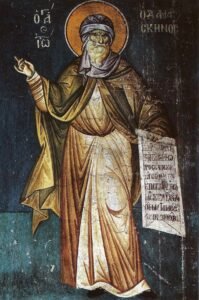
John of Damascus
Patristic

Saint John of Damascus

Monk of Mar Saba · Doctor of the Church
A.D. 676–749

Monk of Mar Saba near Jerusalem and the last of the Greek Fathers; his Exact Exposition of the Orthodox Faith summarizes the Eastern patristic inheritance.

John of Damascus · A.D. 676–749 A.D. 743
“The bread and the wine are not merely figures of the body and blood of Christ (God forbid!) but the deified body of the Lord itself: for the Lord has said, "This is My body," not, this is a figure of My body: and "My blood," not, a figure of My blood.”
An Exact Exposition of the Orthodox Faith, An Exact Exposition of the Orthodox Faith, Book IV, ch. 13 PD · NPNF2 Vol. 9 (Salmond) ↗
John of Damascus · A.D. 676–749 A.D. 749
“(de. Fid. Orth. iii. 24.) But seeing that prayer is the sending up the understanding to God, or the asking of God things fitting, how did the Lord pray? For His understanding needed not to be lifted up to God, having been once united hypostatically to God the Word. Neither could He need to ask of God things fitting, for the One Christ is both God and Man. But giving in Himself a pattern to us, He taught us to ask of God, and to lift up our minds to Him. As He took on Him our passions, that by triumphing over them Himself, He might give us also the victory over them, so now He prays to open to us the way to that lifting up to God, to fulfil for us all righteousness, to reconcile His Father to us, to pay honour to Him as the First Cause, and to shew that He is not against God.”
Catena Aurea: Gospel of Matthew, as excerpted in the Catena Aurea on Matthew 26:36-38 PD · J. H. Newman (Oxford, 1841) ↗
John of Damascus · A.D. 676–749 A.D. 749
“(Fid. Orth. iii. 23.) Or otherwise; All things which have not yet been brought into existence by their Maker have a natural desire of existence, and naturally shun non-existence. God the Word then, having been made Man, had this desire, through which He desired food, drink, and sleep, by which life is supported, and naturally used them, and contrariwise shunned the things that are destructive of life. Hence in the season of His Passion which He endured voluntarily, He had the natural fear and sorrow for death. For there is a natural fear wherewith the soul shrinks from separation from the body, by reason of that close sympathy implanted from the first by the Maker of all things.”
Catena Aurea: Gospel of Matthew, as excerpted in the Catena Aurea on Matthew 26:36-38 PD · J. H. Newman (Oxford, 1841) ↗
John of Damascus · A.D. 676–749 A.D. 749
“(Fid. Orth. iii. 20.) Wherefore the passions of our nature were in Christ both by nature and beyond nature. By nature, because He left His flesh to suffer the things incidental to it; beyond nature, because these natural emotions did not in Him precede the will. For in Christ nothing befel of compulsion, but all was voluntary; with His will He hungered, with His will He feared, or was sorrowful. Here His sorrow is declared, Then saith he unto them, My soul is sorrowful even unto death.”
Catena Aurea: Gospel of Matthew, as excerpted in the Catena Aurea on Matthew 26:36-38 PD · J. H. Newman (Oxford, 1841) ↗
John of Damascus · A.D. 676–749 A.D. 749
“(de Fid. Orth. iii. 27.) Although He died as man, and His holy soul was separated from His unstained body, yet His Godhead remained inseparate from either body or soul. Yet was not the one Person divided into two; for as both body and soul had from the beginning an existence in the Person of the Word, so also had they in death. For neither soul nor body had ever a Person of their own, besides the Person of the Word.”
Catena Aurea: Gospel of Matthew, as excerpted in the Catena Aurea on Matthew 27:45-50 PD · J. H. Newman (Oxford, 1841) ↗
John of Damascus · A.D. 676–749 A.D. 749
“(in lib. de Logic c. 49.) Those things which may be measured or numbered are used definitely, but that which from a certain excellence surpasses all measure and number we call great and much indefinitely; as when we say that great is the longsuffering of God.”
Catena Aurea: Gospel of Luke, as excerpted in the Catena Aurea on Luke 6:20-23 PD · J. H. Newman (Oxford, 1843) ↗
John of Damascus · A.D. 676–749 A.D. 749
“(Orat. de Trans fig. §. 8.) Matthew and Mark indeed say that the transfiguration took place on the sixth day after the promise made to the disciples, but Luke on the eighth. But there is no disagreement in these testimonies, but they who make the number six, taking off a day at each end, that is, the first and the last, the day on which He makes the promise, and that on which He fulfilled it, have reckoned only the intervening ones, but He who makes the number eight, has counted in each of the two days above mentioned. But why were not all called, but only some, to behold the sight? There was only one indeed who was unworthy to see the divinity, namely Judas, according to the word of Isaiah, Let the wicked be taken away, that he should not behold the glory of God. (Isai. 26:10 LXX.) If then he alone had been sent away, he might have, as it were from envy, been provoked to greater wickedness. Henceforward He takes away from the traitor every pretext for his treachery, seeing that He left below the rest of the company of the Apostles. But He took with Him three, that in the mouths of two or three witnesses every word should be established. He took Peter, indeed, because He wished to shew him that the witness he had borne to Him was confirmed by the witness of the Father, and that he was as it were to preside over the whole Church. He took with Him James, who was to be the first of all the disciples to die for Christ; but He took John as the clearest singer of the sacred doctrine, that having seen the glory of the Son, which submits not to time, he might sound forth, In the beginning was the Word. (John 1:1.)”
Catena Aurea: Gospel of Luke, as excerpted in the Catena Aurea on Luke 9:28-31 PD · J. H. Newman (Oxford, 1843) ↗
John of Damascus · A.D. 676–749 A.D. 749
“(ut sup. 10.) Servants however pray in one way; our Lord prayed in another. For the prayer of the servant is offered up by the lifting up of the mind to God, but the holy mind of Christ, (who was hypostatically [ὑπόστασιν] united to God,) prayed, that He might lead us by the hand to the ascent, whereby we mount up in prayer to God, and teach us that He is not opposed to God, but reverences the Father as His beginning; (ὡς ἀρχὴν ἑαυτὸν) nay, even tempting the tyrant, who sought from Him whether He were God, (which the power of His miracles declared,) He concealed as it were under the bait a hook; that he who had deceived man with the hope of divinity might fitly himself be caught with the clothing of humanity. Prayer is the revelation of Divine glory; as it follows, And as he prayed, the fashion of his countenance was altered.”
Catena Aurea: Gospel of Luke, as excerpted in the Catena Aurea on Luke 9:28-31 PD · J. H. Newman (Oxford, 1843) ↗
John of Damascus · A.D. 676–749 A.D. 749
“(ut sup. 13.) Now the devil, seeing His face shining in prayer, recollected Moses, whose face was glorified. But Moses indeed was arrayed with a glory, which came from without; our Lord, with that which proceeded from the inherent brightness of Divine glory. (Exod. 34:29.) For since in the hypostatical union there is one and the same glory of the Word and the flesh, He is transfigured not as receiving what He was not, but manifesting to His disciples, what He was. Hence, according to Matthew, it is said, that He was transfigured before them, and that His face shone as the sun; (Mat. 17:2.) for what the sun is in things of sense, God is in spiritual things. And as the sun, which is the fountain of light, cannot be easily seen, but its light is perceived from that which reaches the earth; so the countenance of Christ shines more intensely, like the sun, but His raiment is white as snow; as it follows, And his raiment was white and glistering; that is, lighted up by its participation of the divine light. And a little afterwards, But while these things were so, that it might be shewn there was but one Lord of the new and old covenant, and the mouths of heretics might be shut, and men might believe on the resurrection, and He also, who was transfigured, be believed to be the Lord of the living and the dead, Moses and Elias, as servants, stand by their Lord in His glory; hence it follows, And behold there talked with him two men. For it became men, seeing the glory and confidence of their fellow servants, to admire indeed the merciful condescension of the Lord, but to emulate those who had laboured before them, and looking to the pleasantness of future blessings, to be the more strengthened for conflicts. For he who has known the reward of his labours, will the more easily endure them.”
Catena Aurea: Gospel of Luke, as excerpted in the Catena Aurea on Luke 9:28-31 PD · J. H. Newman (Oxford, 1843) ↗
John of Damascus · A.D. 676–749 A.D. 749
“(Orat. de Trans. fig.) It were not good for thee, Peter, that Christ should abide there, for if He had remained, the promise made to thee would never receive its accomplishment. For neither wouldest thou have obtained the keys of the kingdom, nor the tyranny of death been abolished. Seek not bliss before its time, as Adam did to be made a God. The time shall come when thou shalt enjoy the sight without ceasing, and dwell together with Him who is light and life.”
Catena Aurea: Gospel of Luke, as excerpted in the Catena Aurea on Luke 9:32-36 PD · J. H. Newman (Oxford, 1843) ↗
John of Damascus · A.D. 676–749 A.D. 749
“(ubi sup.) But the Lord ordained thee not the builder of tabernacles, but of the universal Church. Thy words have been brought to pass by thy disciples, by thy sheep, in building a tabernacle, not only for Christ, but also for His servants. But Peter said not this deliberately, but through the inspiration of the Spirit revealing things to come, as it follows, not knowing what he said.”
Catena Aurea: Gospel of Luke, as excerpted in the Catena Aurea on Luke 9:32-36 PD · J. H. Newman (Oxford, 1843) ↗
John of Damascus · A.D. 676–749 A.D. 749
“(ubi sup.) This also our Lord commands, since He knew His disciples to be imperfect, seeing that they had not yet received the full measure of the Spirit, lest the hearts of others who had not seen should be prostrated by sorrow, and lest the traitor should be stirred up to a frantic hatred.”
Catena Aurea: Gospel of Luke, as excerpted in the Catena Aurea on Luke 9:32-36 PD · J. H. Newman (Oxford, 1843) ↗
An Exact Exposition of the Orthodox Faith
1899 · PD · NPNF2 Vol. 9 (Salmond)
open in the reader →

A richly-documented figure overflows with verbatim words and works; a sparsely-sourced one is handled honestly — what survives in the public domain, plainly shown, nothing padded.